International Labour Organisation
 Established in 1919 as a part of league of nations.
Only international body that survived even after 2nd world war.
 Becomes specialized agency of U.N.’s in 1946.
Aims at world peace through social justice.
India became original signatory member in 1919.
 Draws attention on various problems like: working conditions,
unemployment, industrial accidents, diseases, problem of women &
young persons, children etc.
International Labour Organisation
•

It is tripartite body: representative of employer, labour &
govt.
•
Till now 183 nations are member of ILO
Fundamental principles:
1. Labour is not a commodity
2. Freedom of expression & association is essential
3. Poverty act as a danger for prosperity
4. War against want requires to be carried on. Workers &
employers should enjoy equal status in free discussion
ROLE of ILO
• Full employment & raising standard of living
• Ensure employment, in which workers are in should
get satisfaction
• Facilities for training & transfer of labour-migration
for employment & settlement
• Policies with wages, hours & condition of work
• Effective recognition of the right of collective
bargaining
• Protection of life & health of workers
• Provision for child welfare & maternity protection
• Provision for adequate nutrition, housing
• Assurance of equality of education & vocational
opportunity.
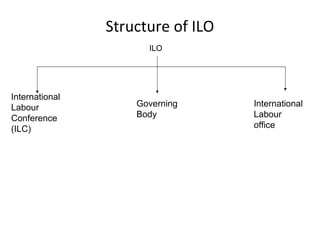
Structure of ILO
ILO

International
Labour
Conference
(ILC)

Governing
Body

International
Labour
office
International Labour Conference
(ILC)
•
•
•
•

Policy making/ legislative wing of ILO
Holds session once in a year
ILC elect governing body
Meetings/sessions are attended by 4 delegates
- 2 from govt. (Generally Cabinet Ministers)
- 1 representative of employee
- 1 representative of employer
• Each delegate is accompanied by advisor not
exceeding 2 in number
• Non- govt. delegates are chosen by govt.
International Labour Conference
(ILC)
Functions of ILC:
1. Formulate international standards (Conventions &
recommendations)
2. Decide expenditure budget
3. To make amendments
4. Consider labour problems & assist solution
5. Select once in 3 years members of governing body
6. Elect president
Governing Body
• It is executive wing of ILO
• It is a political body
• Implements decisions of ILC with the help of International
labour office
• It consist of 56 titular members
- 28 govt.
-14 employer
-14 employee
• Further, it consist of 66 deputy members
-28 govt.
-19 employer
-19 employee
Governing Body
• 10 of the titular govt. seats are permanently held by states of
chief industrial importance (Brazil, China, France, Germany,
India, Italy, Japan, U.K.,U.S., The Russian Federation)
• Generally it meets thrice in a year (March, June, November)
• Members are elected by ILC every 3 years
Governing Body
•
•
•
•

Elects director-general after every 5 year
Decides agendas for ILC
Scrutinize the budget
Follow up recommendations & conventions of ILC
International Labour Office
• It is a focal point for activities of International Labour
Organization under the supervision of Governing Body
• It is headed by Director-General
• Its headquarter is at Geneva
• Office employs 2700 officials from over 150 nations
• Office also contains a research & documentation centre
• It is responsible to collect & distribute information of labour &
social problems
Functions of ILO
•
•
•
•
•
•
•
•

Manpower organisation & Vocational training
Migrant workers
Women workers
Child workers
Social security
Conditions of work
Health, safety & welfare
Other activities- Promotion of handicraft & small industries,
worker’s education programes.
international labour organisation

international labour organisation

  • 1.
    International Labour Organisation Established in 1919 as a part of league of nations. Only international body that survived even after 2nd world war.  Becomes specialized agency of U.N.’s in 1946. Aims at world peace through social justice. India became original signatory member in 1919.  Draws attention on various problems like: working conditions, unemployment, industrial accidents, diseases, problem of women & young persons, children etc.
  • 2.
    International Labour Organisation • Itis tripartite body: representative of employer, labour & govt. • Till now 183 nations are member of ILO Fundamental principles: 1. Labour is not a commodity 2. Freedom of expression & association is essential 3. Poverty act as a danger for prosperity 4. War against want requires to be carried on. Workers & employers should enjoy equal status in free discussion
  • 3.
    ROLE of ILO •Full employment & raising standard of living • Ensure employment, in which workers are in should get satisfaction • Facilities for training & transfer of labour-migration for employment & settlement • Policies with wages, hours & condition of work • Effective recognition of the right of collective bargaining • Protection of life & health of workers • Provision for child welfare & maternity protection • Provision for adequate nutrition, housing • Assurance of equality of education & vocational opportunity.
  • 4.
  • 5.
    International Labour Conference (ILC) • • • • Policymaking/ legislative wing of ILO Holds session once in a year ILC elect governing body Meetings/sessions are attended by 4 delegates - 2 from govt. (Generally Cabinet Ministers) - 1 representative of employee - 1 representative of employer • Each delegate is accompanied by advisor not exceeding 2 in number • Non- govt. delegates are chosen by govt.
  • 6.
    International Labour Conference (ILC) Functionsof ILC: 1. Formulate international standards (Conventions & recommendations) 2. Decide expenditure budget 3. To make amendments 4. Consider labour problems & assist solution 5. Select once in 3 years members of governing body 6. Elect president
  • 7.
    Governing Body • Itis executive wing of ILO • It is a political body • Implements decisions of ILC with the help of International labour office • It consist of 56 titular members - 28 govt. -14 employer -14 employee • Further, it consist of 66 deputy members -28 govt. -19 employer -19 employee
  • 8.
    Governing Body • 10of the titular govt. seats are permanently held by states of chief industrial importance (Brazil, China, France, Germany, India, Italy, Japan, U.K.,U.S., The Russian Federation) • Generally it meets thrice in a year (March, June, November) • Members are elected by ILC every 3 years
  • 9.
    Governing Body • • • • Elects director-generalafter every 5 year Decides agendas for ILC Scrutinize the budget Follow up recommendations & conventions of ILC
  • 10.
    International Labour Office •It is a focal point for activities of International Labour Organization under the supervision of Governing Body • It is headed by Director-General • Its headquarter is at Geneva • Office employs 2700 officials from over 150 nations • Office also contains a research & documentation centre • It is responsible to collect & distribute information of labour & social problems
  • 11.
    Functions of ILO • • • • • • • • Manpowerorganisation & Vocational training Migrant workers Women workers Child workers Social security Conditions of work Health, safety & welfare Other activities- Promotion of handicraft & small industries, worker’s education programes.