The social web for grannies
Martin Hatchuel, Silver surfer
Douglas Adams, The Hitchhiker's Guide to the Galaxy
Don’t Panic
YYYYYEEEEEEAAAAAARRRRRGH!
Social media
Bad name.
It’s social.
But it’s not media.
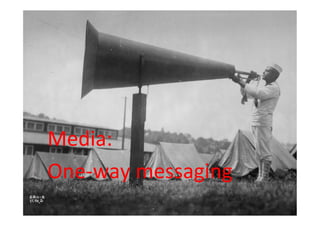
Media:
One-way messaging
Twitter is not a new media.
It's the global conversation we've
always thirsted for
Jack Dorsey
Executive chairman of Twitter, CEO of Square, and a founder of both
So let’s call it
The social web
But it’s
for the kidsEvery granny you ever meet
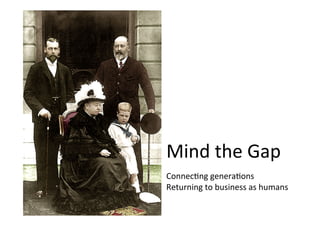
Mind the Gap
Connecting generations
Returning to business as humans
I’ve come up with a set of rules that describe our
reactions to technologies:
1. Anything that is in the world when you’re born is
normal and ordinary and is just a natural part of the
way the world works.
2. Anything that’s invented between when you’re
fifteen and thirty-five is new and exciting and
revolutionary and you can probably get a career in it.
3. Anything invented after you’re thirty-five is against
the natural order of things.
Douglas Adams, The Salmon of Doubt
It’s a
State of mind
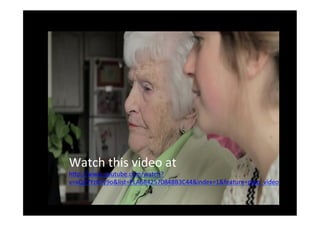
Video: bit.ly/SocWebForGrans
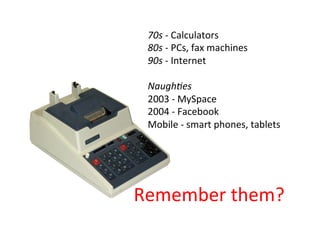
70s - Calculators
80s - PCs, fax machines
90s - Internet
Naughties
2003 - MySpace
2004 - Facebook
Mobile - smart phones, tablets
Remember them?
Expensive technology & connectivity
Only available to the wealthy few
35 in 1990
57 in 2012
How’re the grandkids?
When I took office only high energy
physicists had heard of the world
wide web.
Now even my cat has a home page
Bill Clinton
RevolutionsPew Research Center
3
Internet & Broadband
Individuals became broadcasters
1.
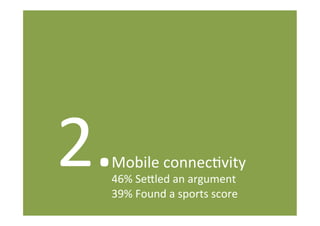
Mobile connectivity
46% Settled an argument
39% Found a sports score
2.
Social networking
Blimmin no good kids
3.
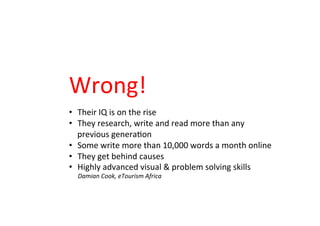
Wrong!
• Their IQ is on the rise
• They research, write and read more than any
previous generation
• Some write more than 10,000 words a month online
• They get behind causes
• Highly advanced visual & problem solving skills
Damian Cook, eTourism Africa
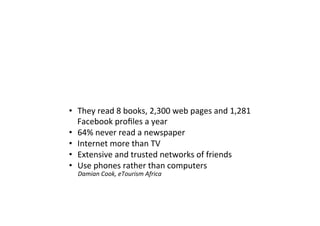
• They read 8 books, 2,300 web pages and 1,281
Facebook profiles a year
• 64% never read a newspaper
• Internet more than TV
• Extensive and trusted networks of friends
• Use phones rather than computers
Damian Cook, eTourism Africa
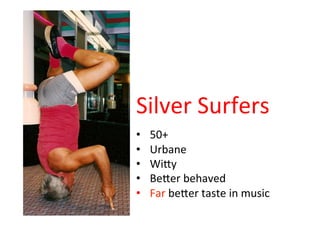
Silver Surfers
• 50+
• Urbane
• Witty
• Better behaved
• Far better taste in music
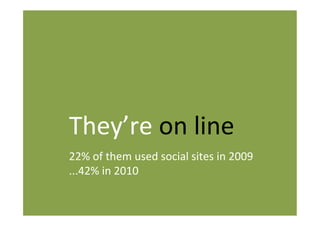
They’re on line
22% of them used social sites in 2009
... More than 51% in 2016
They’re curious
Anyone who stops learning is old, whether
at twenty or eighty. Anyone who keeps
learning stays young. The greatest thing in
life is to keep your mind young.
Henry Ford
They’re engaged
Silver surfers are 30% less likely to suffer
depression than non-surfers
So what IS
the social web?
Any on-line platform
that lets us do a
profoundly human
thing: connect with
one another
Kids?
They’re not looking at their gadgets. They’re
looking at each other
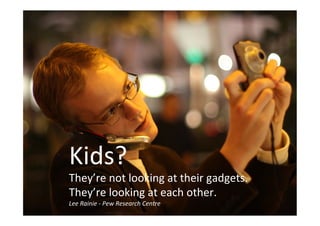
Kids?
They’re not looking at their gadgets.
They’re looking at each other.
Lee Rainie - Pew Research Centre
Yes, but how
are they
using the tools?
Following
Liking
Sharing
Talking
Telling
Stories
Here be dragons
Security
Silos
Youworkfor
Zuck
“Facebook, in fact, is the biggest surveillance-based
enterprise in the history of mankind. It knows far, far
more about you than the most intrusive government has
ever known about its citizens.
“… What Facebook does is watch you, and then use what
it knows about you and your behaviour to sell ads. I’m
not sure there has ever been a more complete disconnect
‘between what a company says it does – ‘connect’, ‘build
communities’ – and the commercial reality.”
John Lanchester, You Are the Product
London Review of Books, Vol. 39 No. 16: 17 August 2017 www.lrb.co.uk
Echo
Echo
Echo
Echo
Echo
Echo
Echo
Echo
Echo
Echo
ID numbers
Bank accounts
Credit cards
Secret stuff
Family stuff
Where do I start?
Stay in touch
Get curious
- talk to strangers
Curate
Create
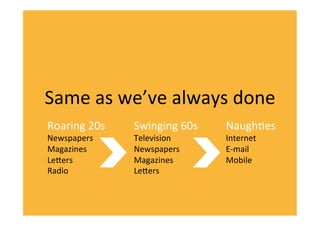
Same as we’ve always done
Roaring 20s
Newspapers
Magazines
Letters
Radio
Swinging 60s
Television
Newspapers
Magazines
Letters
Naughties
Internet
E-mail
Mobile
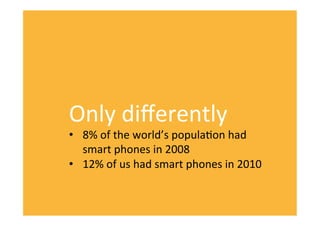
Only differently
• 8% of the world’s population had
smart phones in 2008
• 12% of us had smart phones in 2010
https://www.statista.com/statistics/274774/forecast-of-mobile-phone-users-worldwide/
Use the social web
to build relationships
Be personal
Be authentic
Be transparent
AmplifyThe love
Build a community
Connect
Reciprocate
Follow
Link
The value of the
social web
becomes clear
through
repetition and
redundancy
Ron Mader
1. Think globally: Deal locally
2. Tiny cells make giant trees
All media is now social media.
Yet the basic rules remain the same.
brandinfiltration.com/wtf
Rule #1:
Listen
brandinfiltration.com/wtf
Rule #2:
Engage
brandinfiltration.com/wtf
Rule #3:
Be real
brandinfiltration.com/wtf
Rule #4:
Be respectful
brandinfiltration.com/wtf
Rule #5:
Have fun
brandinfiltration.com/wtf
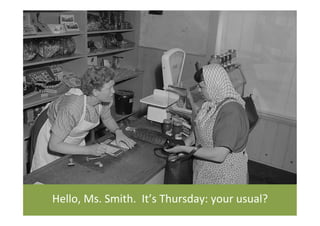
Hello, Ms. Smith. It’s Thursday: your usual?
Martin Hatchuel
martinhatchuel@gmail.com 0027(0)84 951 0574
www.thistourismweek.co.za www.capecoastalroute.com
Thank you
• Panic button - Microchip08
• Four generations of Victoria's family - Peter Symons
• Fitness – Shustov
• Dinosaur Footprints – Petropoxy
• Multitasking – Zil
• Little Spielberg - Me
• Grocery - Deutsche Fotothek
• The Pine, Saint Tropez, 1892-1893 - Paul Signac (Hermitage, St. Petersburg)
Advice and inspiration: Ron Mader http://planeta.com/
Planet of the phones - The Economist (editorial, 28 February, 2015)
“Smartphones matter partly because of their ubiquity. They have become the fastest-selling gadgets in history, outstripping the
growth of the simple mobile phones that preceded them. They outsell personal computers four to one. Today about half the
adult population owns a smartphone; by 2020, 80% will. Smartphones have also penetrated every aspect of daily life. The
average American is buried in one for over two hours every day. Asked which media they would miss most, British teenagers
pick mobile devices over TV sets, PCs and games consoles. Nearly 80% of smartphone-owners check messages, news or other
services within 15 minutes of getting up. About 10% admit to having used the gadget during sex.”
https://www.economist.com/news/leaders/21645180-smartphone-ubiquitous-addictive-and-transformative-planet-phones
You Are the Product - John Lanchester
“So Facebook knows your phone ID and can add it to your Facebook ID. It puts that together with the rest of your online
activity: not just every site you’ve ever visited, but every click you’ve ever made – the Facebook button tracks every Facebook
user, whether they click on it or not. Since the Facebook button is pretty much ubiquitous on the net, this means that
Facebook sees you, everywhere. Now, thanks to its partnerships with the old-school credit firms, Facebook knew who
everybody was, where they lived, and everything they’d ever bought with plastic in a real-world offline shop.​ All this

information is used for a purpose which is, in the final analysis, profoundly bathetic. It is to sell you things via online ads.”
https://www.lrb.co.uk/v39/n16/john-lanchester/you-are-the-product
I used to think social media was a force for good. Now the evidence says I was wrong - Matt Haig
“More and more, it’s clear these platforms create divisions, exploit our insecurities and risk our health. They’re as bad as the
tobacco industry.” https://www.theguardian.com/commentisfree/2017/sep/06/social-media-good-evidence-platforms-
insecurities-health
Security in-a-box - digital security tools and tactics web site
“Remember that social networking sites are owned by private businesses, and that they make their money by collecting data
about individuals and selling that data on, particularly to third party advertisers. When you enter a social networking site, you
are leaving the freedoms of the internet behind and are entering a network that is governed and ruled by the owners of the
site. Privacy settings are only meant to protect you from other members of the social network, but they do not shield your
data from the owners of the service. Essentially you are giving all your data over to the owners and trusting them with it.”
https://securityinabox.org/en/guide/social-networking/

Social web for grannies

  • 1.
    The social webfor grannies Martin Hatchuel, Silver surfer Douglas Adams, The Hitchhiker's Guide to the Galaxy Don’t Panic
  • 2.
  • 3.
  • 4.
  • 5.
    Twitter is nota new media. It's the global conversation we've always thirsted for Jack Dorsey Executive chairman of Twitter, CEO of Square, and a founder of both
  • 6.
    So let’s callit The social web
  • 7.
    But it’s for thekidsEvery granny you ever meet
  • 8.
    Mind the Gap Connectinggenerations Returning to business as humans
  • 9.
    I’ve come upwith a set of rules that describe our reactions to technologies: 1. Anything that is in the world when you’re born is normal and ordinary and is just a natural part of the way the world works. 2. Anything that’s invented between when you’re fifteen and thirty-five is new and exciting and revolutionary and you can probably get a career in it. 3. Anything invented after you’re thirty-five is against the natural order of things. Douglas Adams, The Salmon of Doubt
  • 10.
  • 11.
  • 12.
    70s - Calculators 80s- PCs, fax machines 90s - Internet Naughties 2003 - MySpace 2004 - Facebook Mobile - smart phones, tablets Remember them?
  • 13.
    Expensive technology &connectivity Only available to the wealthy few
  • 14.
    35 in 1990 57in 2012 How’re the grandkids?
  • 15.
    When I tookoffice only high energy physicists had heard of the world wide web. Now even my cat has a home page Bill Clinton
  • 16.
  • 17.
    Internet & Broadband Individualsbecame broadcasters 1.
  • 18.
    Mobile connectivity 46% Settledan argument 39% Found a sports score 2.
  • 19.
  • 20.
    Wrong! • Their IQis on the rise • They research, write and read more than any previous generation • Some write more than 10,000 words a month online • They get behind causes • Highly advanced visual & problem solving skills Damian Cook, eTourism Africa
  • 21.
    • They read8 books, 2,300 web pages and 1,281 Facebook profiles a year • 64% never read a newspaper • Internet more than TV • Extensive and trusted networks of friends • Use phones rather than computers Damian Cook, eTourism Africa
  • 22.
    Silver Surfers • 50+ •Urbane • Witty • Better behaved • Far better taste in music
  • 23.
    They’re on line 22%of them used social sites in 2009 ... More than 51% in 2016
  • 24.
    They’re curious Anyone whostops learning is old, whether at twenty or eighty. Anyone who keeps learning stays young. The greatest thing in life is to keep your mind young. Henry Ford
  • 25.
    They’re engaged Silver surfersare 30% less likely to suffer depression than non-surfers
  • 26.
    So what IS thesocial web?
  • 27.
    Any on-line platform thatlets us do a profoundly human thing: connect with one another
  • 28.
    Kids? They’re not lookingat their gadgets. They’re looking at each other Kids? They’re not looking at their gadgets. They’re looking at each other. Lee Rainie - Pew Research Centre
  • 29.
    Yes, but how arethey using the tools?
  • 30.
  • 31.
  • 32.
  • 33.
  • 34.
  • 35.
  • 36.
  • 37.
  • 38.
    “Facebook, in fact,is the biggest surveillance-based enterprise in the history of mankind. It knows far, far more about you than the most intrusive government has ever known about its citizens. “… What Facebook does is watch you, and then use what it knows about you and your behaviour to sell ads. I’m not sure there has ever been a more complete disconnect ‘between what a company says it does – ‘connect’, ‘build communities’ – and the commercial reality.” John Lanchester, You Are the Product London Review of Books, Vol. 39 No. 16: 17 August 2017 www.lrb.co.uk
  • 39.
  • 40.
    ID numbers Bank accounts Creditcards Secret stuff Family stuff
  • 41.
    Where do Istart?
  • 42.
  • 43.
    Get curious - talkto strangers
  • 44.
  • 45.
  • 46.
    Same as we’vealways done Roaring 20s Newspapers Magazines Letters Radio Swinging 60s Television Newspapers Magazines Letters Naughties Internet E-mail Mobile
  • 47.
    Only differently • 8%of the world’s population had smart phones in 2008 • 12% of us had smart phones in 2010
  • 48.
  • 49.
    Use the socialweb to build relationships
  • 50.
  • 51.
  • 52.
  • 53.
    The value ofthe social web becomes clear through repetition and redundancy Ron Mader
  • 54.
    1. Think globally:Deal locally 2. Tiny cells make giant trees
  • 55.
    All media isnow social media. Yet the basic rules remain the same. brandinfiltration.com/wtf
  • 56.
  • 57.
  • 58.
  • 59.
  • 60.
  • 61.
    Hello, Ms. Smith.It’s Thursday: your usual?
  • 62.
    Martin Hatchuel martinhatchuel@gmail.com 0027(0)84951 0574 www.thistourismweek.co.za www.capecoastalroute.com Thank you • Panic button - Microchip08 • Four generations of Victoria's family - Peter Symons • Fitness – Shustov • Dinosaur Footprints – Petropoxy • Multitasking – Zil • Little Spielberg - Me • Grocery - Deutsche Fotothek • The Pine, Saint Tropez, 1892-1893 - Paul Signac (Hermitage, St. Petersburg) Advice and inspiration: Ron Mader http://planeta.com/
  • 63.
    Planet of thephones - The Economist (editorial, 28 February, 2015) “Smartphones matter partly because of their ubiquity. They have become the fastest-selling gadgets in history, outstripping the growth of the simple mobile phones that preceded them. They outsell personal computers four to one. Today about half the adult population owns a smartphone; by 2020, 80% will. Smartphones have also penetrated every aspect of daily life. The average American is buried in one for over two hours every day. Asked which media they would miss most, British teenagers pick mobile devices over TV sets, PCs and games consoles. Nearly 80% of smartphone-owners check messages, news or other services within 15 minutes of getting up. About 10% admit to having used the gadget during sex.” https://www.economist.com/news/leaders/21645180-smartphone-ubiquitous-addictive-and-transformative-planet-phones You Are the Product - John Lanchester “So Facebook knows your phone ID and can add it to your Facebook ID. It puts that together with the rest of your online activity: not just every site you’ve ever visited, but every click you’ve ever made – the Facebook button tracks every Facebook user, whether they click on it or not. Since the Facebook button is pretty much ubiquitous on the net, this means that Facebook sees you, everywhere. Now, thanks to its partnerships with the old-school credit firms, Facebook knew who everybody was, where they lived, and everything they’d ever bought with plastic in a real-world offline shop.​ All this information is used for a purpose which is, in the final analysis, profoundly bathetic. It is to sell you things via online ads.” https://www.lrb.co.uk/v39/n16/john-lanchester/you-are-the-product I used to think social media was a force for good. Now the evidence says I was wrong - Matt Haig “More and more, it’s clear these platforms create divisions, exploit our insecurities and risk our health. They’re as bad as the tobacco industry.” https://www.theguardian.com/commentisfree/2017/sep/06/social-media-good-evidence-platforms- insecurities-health Security in-a-box - digital security tools and tactics web site “Remember that social networking sites are owned by private businesses, and that they make their money by collecting data about individuals and selling that data on, particularly to third party advertisers. When you enter a social networking site, you are leaving the freedoms of the internet behind and are entering a network that is governed and ruled by the owners of the site. Privacy settings are only meant to protect you from other members of the social network, but they do not shield your data from the owners of the service. Essentially you are giving all your data over to the owners and trusting them with it.” https://securityinabox.org/en/guide/social-networking/