When You Are Telling,
You Ain’t Selling


Intelligence Gathering to Increase
Sales Through the DISC Tool


2012© All Rights Reserved, Leanne Hoagland-Smith
Agenda 60 Minutes of Good Content into
30 Minutes of Great Content™

   History of DISC
   How DISC is a communication tool
   Real examples how DISC increases sales
   The DISC behaviors and tips
   NLP – A Partner to DISC
   Special Offer
   Upcoming Webinars
   Contact information for Leanne Hoagland-
    Smith
Brief History of DISC
   1928 William Mouton Marston
   In his 1928, Emotions of Normal People, William Mouton
    Marston explained his theory on how human emotions lead to
    observable and measureable behavioral differences and how
    these behaviors may change over time.
   Marston categorized four (4) primary types from these
    perceptions of self in relationship to one’s environment.
    D=Dominance; I=Inducement; S=Submission and C-
    Compliance
   1948 – Walter V. Clarke
   In 1948, Walter V. Clarke an industrial psychologist was the
    first person to build an assessment tool using Marston’s
    theories for personnel selection by businesses. He based his
    four categories aggressive, social, stable and avoidant on
    Marston’s model.
The DISC Assessment Classifies 4
Aspects of Behavior


•Dominance or Decisiveness - relating to control,
power and assertiveness
•Influence or Interactive - relating to social situations
and communication
•Steadiness or Stabilizing- relating to patience,
persistence, and thoughtfulness
•Conscientiousness or Cautious- relating to
structure, data and organization
WHAT DISC MEASURES - HIGH AND LOWS
        D                      I                       S                    C
     Will more        Will actively seek out   Will initially resist   Will follow rules
    assertively        people to interact            change                  set by
  accept problems      with or influence        Steady pace                  others

   How a Person          How a Person            How a Person          How a Person
  Solves Problems      Influences People         Sets the Pace         Responds to
         Or                     Or                     Or                  Rules
      Accepts             Interacts with           Reacts to            Procedures or
    Challenges                Others                Change               Constraints


    Will accept         Will use more            Will actively          Will actively
    challenge in       skeptical logical             seek               attempt to
conservative manner      approach to               change                 set their
   Avoids conflict        influence               Fast pace              own rules
What DISC Also Measures
   Natural behaviors
   Instinctive, gut reactions
   Natural means less stress; more authentic
   Adaptive behaviors
   Learned behaviors to “rise to the occasion”
   Adaptive equals more stress; less
    authentic
   These are the behaviors others see more
    often
No one is purely a "D," "I," "S," or "C." Rather, each
        of us is a blend of these four traits
   "D" is fast-paced and task-oriented.


   "I" is fast-paced and people-oriented.

   "S" is slow-paced and people-oriented.


   "C“ is slow-paced and task-oriented.
Better Communication =
Increase Sales
                   Imagine if you could
                   Gather intelligence?
                   Be more observant?
                   Quickly apply buyer’s
                    buying behaviors?
                   Shorten the sales cycle
                    time?
                   Increase sales?
                   What would that mean
                    for your small
                    business?
Communication and Behaviors
   Mind reading is still
    not a sense shared by
    all
   Human beings
    communicate through
    their behaviors
   Observation
   Interaction
   DISC tools enhances
    those observations
    and interactions
Real World Scenario
   Auto story from DISC
   Buick or a Ford?
   An older couple visit a Ford
    dealership; want a Buick
   Salesperson is DISC
    knowledgeable
   Sends them to the Buick
    salesperson with a High D
    and did not know DISC
    language
   Couple returns and buys the
    Ford
   Morale – People buy from
    people they know and trust
Real World Scenario
   New client CEO was Fast
    Paced and People
    Oriented – High I
   I focused sales solutions
    on the people side first
   The Dir. Of HR was Fast
    Paced and Task Oriented
    – High D
   I focused my responses
    on the tasks
   Reduced sales leads time
    from 6 months to 2
    months
   Earned sale; earned
    repeat business
Communication Intelligence
                  Communicate
                  55% non-verbal
                  38% para-verbal
                  7% verbal
                  Use eyes more
                  Use ears more
                  Adjust your sales
                   style to her or his
                   communication
Communication Intelligence
   “If the good Lord
    wanted us to talk
    more than to
    listen, he would
    have given us two
    mouths instead of
    two ears.”
   In sales this is
    critical
3 Simple Steps for Sales People


Step #1       Step #2         Step #3


 Know your    Recognize    Adapt your
              your         behavioral style
 own
              potential    to reduce
 behavioral   customer’s   communication
 style        behavioral   gaps in the
              style        sales process
“D” Behaviors
   Decisive
   Extroverted
   Task driven
   Direct
   Impatient
   Results focused
   ↑ Emotion = Short
    Fuse, Quick to Anger
   ↓ Emotion =
    LongerFuse
How to spot Decisive Behaviors
   Drive fast
   Walk fast
   Lots of hand movement when
    talking
   Communicate numbers e.g. first
   Office décor inclined to status,
    large desk
What “D” Behaviors Want
                  Results
                  Be direct
                  Provide alternatives
                  Let them be in the
                   driver’s seat
                  Allow them to build
                   the relationship
                  Enjoy the tension
“I” Behaviors
   Interactive
   Indirect
   People driven
   Disorganized
   Fun focused
   ↑ Emotion =
    Optimism
   ↓ Emotion =
    Pessimism
How to spot Interactive Behaviors
   Drive with radio on
   Weave when walking
   Big hand gestures when talking
   Very verbal; poor listener
   Office décor inclined to being
    contemporary with memorabilia
What “I” Behaviors Want
                  Experience
                  Be friendly
                  Take your time
                  Have fun; joke
                   appropriately
                  Talk about people
                  Follow up often
“S” Behaviors
                   Stabilizing
                   Indirect
                   People driven
                   Passiveness
                   Stability
                   ↑ Emotion = Non
                    emotional
                   ↓ Emotion =
                    Emotional
How to spot Stablizing Behaviors
   Drive speed limit, relaxed
   Steady, easy pace when walking
   Smaller hand gestures when
    talking
   Warm, will listen before talking
   Office décor inclined to “homey”
    with family photos
What “S” Behaviors Want
   Security
   Slow down
   Build trust
   Provide logical
    presentation
   Achieve “mini”
    agreements
   Listen well
   Show sincerity
“C” Behaviors
                   Cautious
                   Direct
                   Task driven
                   Critical
                   Procedures
                   ↑ Emotion = Fear
                   ↓ Emotion = No fear
How to spot Cautious Behaviors
   Careful, best drivers
   Walks in straight line
   Limited to no hand gestures
   Direct with questions for clarity
   Office décor inclined to be
    functional with charts
What “C” Behaviors Want
                  Information
                  Give data
                  Not to be touched
                  Patient and slow
                   presentations
                  Provide printed
                   brochures, flyers
                  Stay in control
                  Keep it impersonal
INTROVERTED                          EXTROVERTED
                                                                      T
TASK                                                                  H
              C                                           D           I
                      INT                    EST
                                                                      N
                              IMPLEMENTOR                             K
                   ANALYZER             CONDUCTOR                     I
       IST                                                     ENT
                                                                      N
                                                                      G


             COORDINATOR                    PERSUADER


  ISF                                                           ENF
                  SUPPORTER             PROMOTER
                                                                      F
                              RELATER
                                                                      E
PEOPLE                                                                E
                     INF                    ESF                       L
              S                                            I          I
                                                                      N
              SENSING                                                 G
                                                   INTUITION
             (EVALUATE)
NLP – A Partner to DISC
   NLP = Neuro Linguistic Programming
   Provides opportunities to further
    adapt your sales communication
    behaviors to your potential
    customers’ behaviors
   Four Styles
   Listening again the key
4 Types of Communication Styles
   Visual
   Auditory
   Kinesthetic
   Auditory-
    Digital
Visual –
See pictures, mind tends to wander
   Commonly used      Questions to Engage
    words              Do you see what I
   See                 mean?
   Look               Are you getting the
   Appear              picture?
   View               Wrapping up a sales
                        discussion
   Show
                       What did you see that
   Imagine
                        looks the best for you?
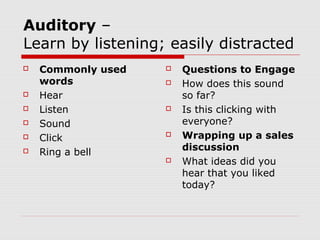
Auditory –
Learn by listening; easily distracted
   Commonly used      Questions to Engage
    words              How does this sound
   Hear                so far?
   Listen             Is this clicking with
   Sound               everyone?
   Click              Wrapping up a sales
                        discussion
   Ring a bell
                       What ideas did you
                        hear that you liked
                        today?
Kinesthetic –
Talk slowly, respond to physical gestures
   Commonly used        Questions to Engage
    words                Does this feel OK?
   Feel                 Is this comfortable?
   Touch                Wrapping up a Sales
   Get hold of           discussion
   Comfortable          What felt best of the
   Catch on              options you were most
                          comfortable with?
   Play
   Together
Auditory Digital –
Talk to himself/herself; sequence
   Commonly used      Questions to Engage
    words              Is this making sense?
   Sense              Do you understand?
   Experience         Wrapping up a sales
   Understand          discussion
   Think              What do you think
   Process             about the options we
                        just discussed?
   I know
3 Simple Steps for Sales People


Step #1       Step #2         Step #3


 Know your    Recognize    Adapt your
              your         behavioral style
 own
              potential    to reduce
 behavioral   customer’s   communication
 style        behavioral   gaps in the
              style        sales process
Thank You
   Within 24 to 48 hours you will be sent
    a link to listen to the recording of this
    webinar.
   The PowerPoint Presentation will also
    be available.
   You will be receiving notification of
    the next 3 webinars as well as
    December’s webinars
Special Offer
   Take the DISC Index assessment tool
   Receive a personal 30 minute debriefing
   Receive a 21 page PDF file of your DISC
   Receive a 30 minute follow-up at 30 days
   Standard investment = $147
   Special offer to webinar attendees = $77
   Visit www.processspecialist.com/special-
    offer.htm
   This offer valid until November 30, 2012
November’s 2012 Webinars
   All webinars are on Thursday from
    12-12:30pm Chicago CST
   Nov.8 - Strongly Silent to Emotionally
    Engaging: The D & I Behaviors
   Nov. 15 - Strongly Stabilizing to
    Consciously Consistent: The S&C
    Behaviors
   Nov. 29 - NLP Another Silent Partner
60 Minutes of Good Content in
30 Minutes of Great Content™
   Weekly 30 Minute Webinars
   Content relevant and rich
   No wasted time:
   No Biographies of presenter or
    presenters
   No Questions and answers
   No recycled content with a new title
November’s 2012 Webinars
   Nov.8 - Strongly Silent to Emotionally
    Engaging: The D & I Behaviors
   In this session there will be:
   More specific “D” Behaviors
   More specific “I” Behaviors
   How to adapt to each
   Early Bird Special ends
   Register for this webinar
November’s 2012 Webinars
   Nov. 15 - Strongly Stabilizing to
    Consciously Consistent: The S&C
    Behaviors
   In this session there will be:
   More specific “S” Behaviors
   More specific “C” Behaviors
   How to adapt to each
   Early Bird Special ends
   Register for this webinar
November’s 2012 Webinars
   Nov. 29 - NLP Another Silent Partner
   In this session there will be:
   More specific NLP Behaviors
   Questions to engage decision maker
   How to wrap up discussion for each style
   Early Bird Special ends
   Register for this webinar
December’s 2012 Webinars
   All webinars are on Thursday from
    12-12:30pm Chicago CST
   Dec. 6 - The 3 Dirty Words in
    Business (FREE)
   Dec. 13 – Goal*
   Dec. 20 – Plan*
   Dec. 27 - Do It*
   *Early registration opens Nov. 5, 2012
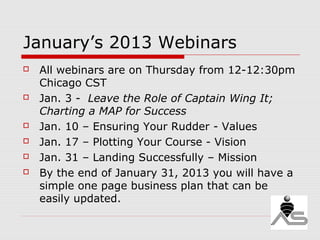
January’s 2013 Webinars
   All webinars are on Thursday from 12-12:30pm
    Chicago CST
   Jan. 3 - Leave the Role of Captain Wing It;
    Charting a MAP for Success
   Jan. 10 – Ensuring Your Rudder - Values
   Jan. 17 – Plotting Your Course - Vision
   Jan. 31 – Landing Successfully – Mission
   By the end of January 31, 2013 you will have a
    simple one page business plan that can be
    easily updated.
60 Minutes of Good Content in
30 Minutes of Great Content™
   First Thursday of each month FREE Webinar overview of
    the content for the following weekly Webinars
   Weeks 2 through 4 or 2 through 5 are paid Webinars
   $16 Early Bird Special
   $20 Standard Investment
   3 Week Webinar package =$45
   4 Week Webinar package = $60
   All Webinars recorded are available within 48-72 hours
   Webinar package pricing begins in December of 2012
   Corporate or association pricing is available for 40
    attendees or more
Thank You

                                  Leanne Hoagland Smith, CRO &
                                   Founder
                                  ADVANCED SYSTEMS
                                  Unlocking Sustainable Results in
                                   People, Processes and Strategies
                                  219.759.5601 Main Chicago CST
                                  219.508.2859 Mobile Chicago CST
                                  www.processspecialist.com
                                  coach@processspecialist.com
                                  www.increase-sales-coach.com
                                  @CoachLee - Twitter ID

                  What Makes Us Unique?
Strategic Thinking + Processes with Proven Tools + Connectivity =
                       “Just Be Valuable”

Telling Ain't Selling Webinar

  • 1.
    When You AreTelling, You Ain’t Selling Intelligence Gathering to Increase Sales Through the DISC Tool 2012© All Rights Reserved, Leanne Hoagland-Smith
  • 2.
    Agenda 60 Minutesof Good Content into 30 Minutes of Great Content™  History of DISC  How DISC is a communication tool  Real examples how DISC increases sales  The DISC behaviors and tips  NLP – A Partner to DISC  Special Offer  Upcoming Webinars  Contact information for Leanne Hoagland- Smith
  • 3.
    Brief History ofDISC  1928 William Mouton Marston  In his 1928, Emotions of Normal People, William Mouton Marston explained his theory on how human emotions lead to observable and measureable behavioral differences and how these behaviors may change over time.  Marston categorized four (4) primary types from these perceptions of self in relationship to one’s environment. D=Dominance; I=Inducement; S=Submission and C- Compliance  1948 – Walter V. Clarke  In 1948, Walter V. Clarke an industrial psychologist was the first person to build an assessment tool using Marston’s theories for personnel selection by businesses. He based his four categories aggressive, social, stable and avoidant on Marston’s model.
  • 4.
    The DISC AssessmentClassifies 4 Aspects of Behavior •Dominance or Decisiveness - relating to control, power and assertiveness •Influence or Interactive - relating to social situations and communication •Steadiness or Stabilizing- relating to patience, persistence, and thoughtfulness •Conscientiousness or Cautious- relating to structure, data and organization
  • 5.
    WHAT DISC MEASURES- HIGH AND LOWS D I S C Will more Will actively seek out Will initially resist Will follow rules assertively people to interact change set by accept problems with or influence Steady pace others How a Person How a Person How a Person How a Person Solves Problems Influences People Sets the Pace Responds to Or Or Or Rules Accepts Interacts with Reacts to Procedures or Challenges Others Change Constraints Will accept Will use more Will actively Will actively challenge in skeptical logical seek attempt to conservative manner approach to change set their Avoids conflict influence Fast pace own rules
  • 6.
    What DISC AlsoMeasures  Natural behaviors  Instinctive, gut reactions  Natural means less stress; more authentic  Adaptive behaviors  Learned behaviors to “rise to the occasion”  Adaptive equals more stress; less authentic  These are the behaviors others see more often
  • 7.
    No one ispurely a "D," "I," "S," or "C." Rather, each of us is a blend of these four traits "D" is fast-paced and task-oriented. "I" is fast-paced and people-oriented. "S" is slow-paced and people-oriented. "C“ is slow-paced and task-oriented.
  • 8.
    Better Communication = IncreaseSales  Imagine if you could  Gather intelligence?  Be more observant?  Quickly apply buyer’s buying behaviors?  Shorten the sales cycle time?  Increase sales?  What would that mean for your small business?
  • 9.
    Communication and Behaviors  Mind reading is still not a sense shared by all  Human beings communicate through their behaviors  Observation  Interaction  DISC tools enhances those observations and interactions
  • 10.
    Real World Scenario  Auto story from DISC  Buick or a Ford?  An older couple visit a Ford dealership; want a Buick  Salesperson is DISC knowledgeable  Sends them to the Buick salesperson with a High D and did not know DISC language  Couple returns and buys the Ford  Morale – People buy from people they know and trust
  • 11.
    Real World Scenario  New client CEO was Fast Paced and People Oriented – High I  I focused sales solutions on the people side first  The Dir. Of HR was Fast Paced and Task Oriented – High D  I focused my responses on the tasks  Reduced sales leads time from 6 months to 2 months  Earned sale; earned repeat business
  • 12.
    Communication Intelligence  Communicate  55% non-verbal  38% para-verbal  7% verbal  Use eyes more  Use ears more  Adjust your sales style to her or his communication
  • 13.
    Communication Intelligence  “If the good Lord wanted us to talk more than to listen, he would have given us two mouths instead of two ears.”  In sales this is critical
  • 14.
    3 Simple Stepsfor Sales People Step #1 Step #2 Step #3 Know your Recognize Adapt your your behavioral style own potential to reduce behavioral customer’s communication style behavioral gaps in the style sales process
  • 15.
    “D” Behaviors  Decisive  Extroverted  Task driven  Direct  Impatient  Results focused  ↑ Emotion = Short Fuse, Quick to Anger  ↓ Emotion = LongerFuse
  • 16.
    How to spotDecisive Behaviors  Drive fast  Walk fast  Lots of hand movement when talking  Communicate numbers e.g. first  Office décor inclined to status, large desk
  • 17.
    What “D” BehaviorsWant  Results  Be direct  Provide alternatives  Let them be in the driver’s seat  Allow them to build the relationship  Enjoy the tension
  • 18.
    “I” Behaviors  Interactive  Indirect  People driven  Disorganized  Fun focused  ↑ Emotion = Optimism  ↓ Emotion = Pessimism
  • 19.
    How to spotInteractive Behaviors  Drive with radio on  Weave when walking  Big hand gestures when talking  Very verbal; poor listener  Office décor inclined to being contemporary with memorabilia
  • 20.
    What “I” BehaviorsWant  Experience  Be friendly  Take your time  Have fun; joke appropriately  Talk about people  Follow up often
  • 21.
    “S” Behaviors  Stabilizing  Indirect  People driven  Passiveness  Stability  ↑ Emotion = Non emotional  ↓ Emotion = Emotional
  • 22.
    How to spotStablizing Behaviors  Drive speed limit, relaxed  Steady, easy pace when walking  Smaller hand gestures when talking  Warm, will listen before talking  Office décor inclined to “homey” with family photos
  • 23.
    What “S” BehaviorsWant  Security  Slow down  Build trust  Provide logical presentation  Achieve “mini” agreements  Listen well  Show sincerity
  • 24.
    “C” Behaviors  Cautious  Direct  Task driven  Critical  Procedures  ↑ Emotion = Fear  ↓ Emotion = No fear
  • 25.
    How to spotCautious Behaviors  Careful, best drivers  Walks in straight line  Limited to no hand gestures  Direct with questions for clarity  Office décor inclined to be functional with charts
  • 26.
    What “C” BehaviorsWant  Information  Give data  Not to be touched  Patient and slow presentations  Provide printed brochures, flyers  Stay in control  Keep it impersonal
  • 27.
    INTROVERTED EXTROVERTED T TASK H C D I INT EST N IMPLEMENTOR K ANALYZER CONDUCTOR I IST ENT N G COORDINATOR PERSUADER ISF ENF SUPPORTER PROMOTER F RELATER E PEOPLE E INF ESF L S I I N SENSING G INTUITION (EVALUATE)
  • 28.
    NLP – APartner to DISC  NLP = Neuro Linguistic Programming  Provides opportunities to further adapt your sales communication behaviors to your potential customers’ behaviors  Four Styles  Listening again the key
  • 29.
    4 Types ofCommunication Styles  Visual  Auditory  Kinesthetic  Auditory- Digital
  • 30.
    Visual – See pictures,mind tends to wander  Commonly used  Questions to Engage words  Do you see what I  See mean?  Look  Are you getting the  Appear picture?  View  Wrapping up a sales discussion  Show  What did you see that  Imagine looks the best for you?
  • 31.
    Auditory – Learn bylistening; easily distracted  Commonly used  Questions to Engage words  How does this sound  Hear so far?  Listen  Is this clicking with  Sound everyone?  Click  Wrapping up a sales discussion  Ring a bell  What ideas did you hear that you liked today?
  • 32.
    Kinesthetic – Talk slowly,respond to physical gestures  Commonly used  Questions to Engage words  Does this feel OK?  Feel  Is this comfortable?  Touch  Wrapping up a Sales  Get hold of discussion  Comfortable  What felt best of the  Catch on options you were most comfortable with?  Play  Together
  • 33.
    Auditory Digital – Talkto himself/herself; sequence  Commonly used  Questions to Engage words  Is this making sense?  Sense  Do you understand?  Experience  Wrapping up a sales  Understand discussion  Think  What do you think  Process about the options we just discussed?  I know
  • 34.
    3 Simple Stepsfor Sales People Step #1 Step #2 Step #3 Know your Recognize Adapt your your behavioral style own potential to reduce behavioral customer’s communication style behavioral gaps in the style sales process
  • 35.
    Thank You  Within 24 to 48 hours you will be sent a link to listen to the recording of this webinar.  The PowerPoint Presentation will also be available.  You will be receiving notification of the next 3 webinars as well as December’s webinars
  • 36.
    Special Offer  Take the DISC Index assessment tool  Receive a personal 30 minute debriefing  Receive a 21 page PDF file of your DISC  Receive a 30 minute follow-up at 30 days  Standard investment = $147  Special offer to webinar attendees = $77  Visit www.processspecialist.com/special- offer.htm  This offer valid until November 30, 2012
  • 37.
    November’s 2012 Webinars  All webinars are on Thursday from 12-12:30pm Chicago CST  Nov.8 - Strongly Silent to Emotionally Engaging: The D & I Behaviors  Nov. 15 - Strongly Stabilizing to Consciously Consistent: The S&C Behaviors  Nov. 29 - NLP Another Silent Partner
  • 38.
    60 Minutes ofGood Content in 30 Minutes of Great Content™  Weekly 30 Minute Webinars  Content relevant and rich  No wasted time:  No Biographies of presenter or presenters  No Questions and answers  No recycled content with a new title
  • 39.
    November’s 2012 Webinars  Nov.8 - Strongly Silent to Emotionally Engaging: The D & I Behaviors  In this session there will be:  More specific “D” Behaviors  More specific “I” Behaviors  How to adapt to each  Early Bird Special ends  Register for this webinar
  • 40.
    November’s 2012 Webinars  Nov. 15 - Strongly Stabilizing to Consciously Consistent: The S&C Behaviors  In this session there will be:  More specific “S” Behaviors  More specific “C” Behaviors  How to adapt to each  Early Bird Special ends  Register for this webinar
  • 41.
    November’s 2012 Webinars  Nov. 29 - NLP Another Silent Partner  In this session there will be:  More specific NLP Behaviors  Questions to engage decision maker  How to wrap up discussion for each style  Early Bird Special ends  Register for this webinar
  • 42.
    December’s 2012 Webinars  All webinars are on Thursday from 12-12:30pm Chicago CST  Dec. 6 - The 3 Dirty Words in Business (FREE)  Dec. 13 – Goal*  Dec. 20 – Plan*  Dec. 27 - Do It*  *Early registration opens Nov. 5, 2012
  • 43.
    January’s 2013 Webinars  All webinars are on Thursday from 12-12:30pm Chicago CST  Jan. 3 - Leave the Role of Captain Wing It; Charting a MAP for Success  Jan. 10 – Ensuring Your Rudder - Values  Jan. 17 – Plotting Your Course - Vision  Jan. 31 – Landing Successfully – Mission  By the end of January 31, 2013 you will have a simple one page business plan that can be easily updated.
  • 44.
    60 Minutes ofGood Content in 30 Minutes of Great Content™  First Thursday of each month FREE Webinar overview of the content for the following weekly Webinars  Weeks 2 through 4 or 2 through 5 are paid Webinars  $16 Early Bird Special  $20 Standard Investment  3 Week Webinar package =$45  4 Week Webinar package = $60  All Webinars recorded are available within 48-72 hours  Webinar package pricing begins in December of 2012  Corporate or association pricing is available for 40 attendees or more
  • 45.
    Thank You  Leanne Hoagland Smith, CRO & Founder  ADVANCED SYSTEMS  Unlocking Sustainable Results in People, Processes and Strategies  219.759.5601 Main Chicago CST  219.508.2859 Mobile Chicago CST  www.processspecialist.com  coach@processspecialist.com  www.increase-sales-coach.com  @CoachLee - Twitter ID What Makes Us Unique? Strategic Thinking + Processes with Proven Tools + Connectivity = “Just Be Valuable”

Editor's Notes

  • #8 No one is purely a "D," "I," "S," or "C." Rather, each of us is a blend of these four traits, to a greater or lesser degree. Your primary trait is the one we identify with one of these four letters, but you may have above average amounts of some of the others, as well. There is an entire chapter on blends in our latest book
  • #28 UNDERSTAND YOUSELF RECOGNIZE, UNDERSTAND AND APPRECIATE OTHERS ADAPT YOUR COMMUNICATIONS STYLE