Autism Spectrum
Disorder
Imrana Shakoor
Speech-Language Pathologist
What is Autism.??
Autism spectrum disorder (ASD) is a neurodevelopmental disorder
characterized by deficits in social communication and social
interaction and the presence of restricted, repetitive behaviors.
• Social communication deficits include impairments in aspects of joint
attention and social reciprocity, as well as challenges in the use of
verbal and nonverbal communicative behaviors for social interaction.
• Restricted, repetitive behaviors, interests, or activities are manifested by
stereotyped, repetitive speech, motor movement, or use of objects;
inflexible adherence to routines; restricted interests; and hyper- and/or
hypo-sensitivity to sensory input.
This definition is consistent with the diagnostic criteria for ASD detailed in the Diagnostic and Statistical Manual of Mental Disorders, 5th edition
(DSM-5; American Psychiatric Association, 2013)
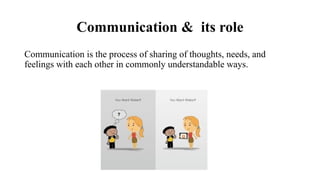
Communication & its role
Communication is the process of sharing of thoughts, needs, and
feelings with each other in commonly understandable ways.
Means of Communicate
1. Non Verbal Communication:
• Eye contact
• Facial expressions
• Gestures
• Pointing
• Using hands signs
• Sign language & conventional signs
2. Verbal Communication:
• Speech ,language social reciprocation.
3. Written/Visual Communication:
• Writing
• Drawing
• Using equipment e.g. Text message, tablet or computer
NONVERBAL
INTERVENTION
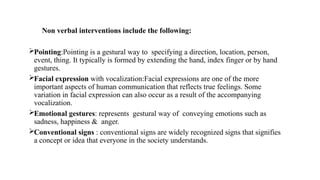
Non verbal interventions include the following:
Pointing:Pointing is a gestural way to specifying a direction, location, person,
event, thing. It typically is formed by extending the hand, index finger or by hand
gestures.
Facial expression with vocalization:Facial expressions are one of the more
important aspects of human communication that reflects true feelings. Some
variation in facial expression can also occur as a result of the accompanying
vocalization.
Emotional gestures: represents gestural way of conveying emotions such as
sadness, happiness & anger.
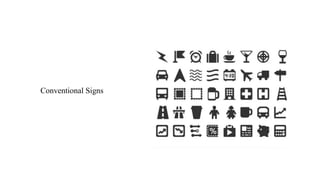
Conventional signs : conventional signs are widely recognized signs that signifies
a concept or idea that everyone in the society understands.
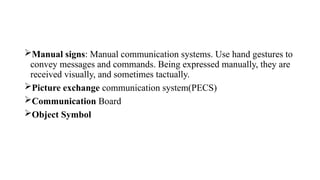
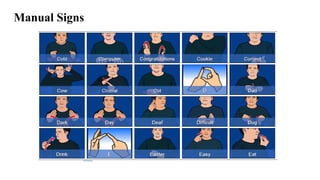
Manual signs: Manual communication systems. Use hand gestures to
convey messages and commands. Being expressed manually, they are
received visually, and sometimes tactually.
Picture exchange communication system(PECS)
Communication Board
Object Symbol
Manual Signs
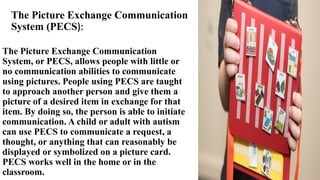
The Picture Exchange Communication
System (PECS):
The Picture Exchange Communication
System, or PECS, allows people with little or
no communication abilities to communicate
using pictures. People using PECS are taught
to approach another person and give them a
picture of a desired item in exchange for that
item. By doing so, the person is able to initiate
communication. A child or adult with autism
can use PECS to communicate a request, a
thought, or anything that can reasonably be
displayed or symbolized on a picture card.
PECS works well in the home or in the
classroom.
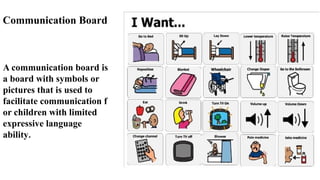
Communication Board
A communication board is
a board with symbols or
pictures that is used to
facilitate communication f
or children with limited
expressive language
ability.
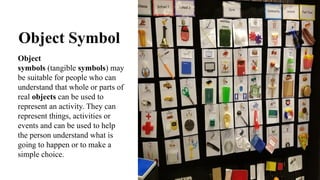
Object Symbol
Object
symbols (tangible symbols) may
be suitable for people who can
understand that whole or parts of
real objects can be used to
represent an activity. They can
represent things, activities or
events and can be used to help
the person understand what is
going to happen or to make a
simple choice.
Conventional Signs
VERBAL INTERVENTIONS
• Expressive Measures
• Development of appropriate speech sounds
• Vocabulary building
• Word Imitation
• Labelling
• Modeling
• Multi-disciplinary approach
• Group/Social Skills
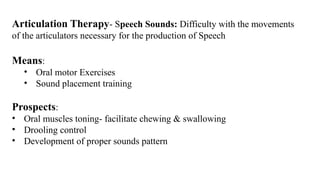
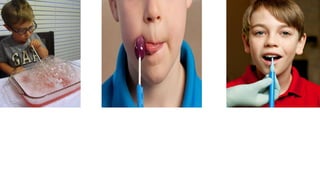
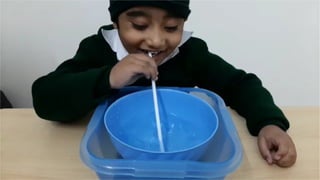
Articulation Therapy- Speech Sounds: Difficulty with the movements
of the articulators necessary for the production of Speech
Means:
• Oral motor Exercises
• Sound placement training
Prospects:
• Oral muscles toning- facilitate chewing & swallowing
• Drooling control
• Development of proper sounds pattern
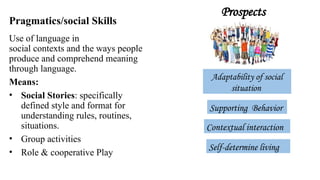
Pragmatics/social Skills
Use of language in
social contexts and the ways people
produce and comprehend meaning
through language.
Means:
• Social Stories: specifically
defined style and format for
understanding rules, routines,
situations.
• Group activities
• Role & cooperative Play
Adaptability of social
situation
Supporting Behavior
Prospects
Self-determine living
Contextual interaction
PLAN OF CARE
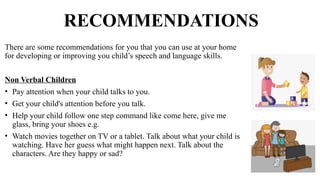
RECOMMENDATIONS
There are some recommendations for you that you can use at your home
for developing or improving you child’s speech and language skills.
Non Verbal Children
• Pay attention when your child talks to you.
• Get your child's attention before you talk.
• Help your child follow one step command like come here, give me
glass, bring your shoes e.g.
• Watch movies together on TV or a tablet. Talk about what your child is
watching. Have her guess what might happen next. Talk about the
characters. Are they happy or sad?
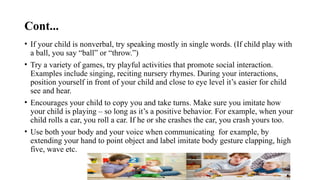
Cont...
• If your child is nonverbal, try speaking mostly in single words. (If child play with
a ball, you say “ball” or “throw.”)
• Try a variety of games, try playful activities that promote social interaction.
Examples include singing, reciting nursery rhymes. During your interactions,
position yourself in front of your child and close to eye level it’s easier for child
see and hear.
• Encourages your child to copy you and take turns. Make sure you imitate how
your child is playing – so long as it’s a positive behavior. For example, when your
child rolls a car, you roll a car. If he or she crashes the car, you crash yours too.
• Use both your body and your voice when communicating for example, by
extending your hand to point object and label imitate body gesture clapping, high
five, wave etc.
• Keep communicating with your child in every environment if you are in kitchen,
living room, bedroom, bathroom label things that available in environment
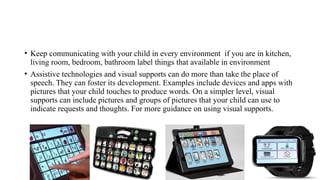
• Assistive technologies and visual supports can do more than take the place of
speech. They can foster its development. Examples include devices and apps with
pictures that your child touches to produce words. On a simpler level, visual
supports can include pictures and groups of pictures that your child can use to
indicate requests and thoughts. For more guidance on using visual supports.
Verbal Children
• Praise your child when tells you something. Show that you understand the words.
• Keep helping your child learn new words. Say a new word, and tell color,
function, shape For example, you can use the word “glass" You can say, it’s
yellow color glass, drink water from glass, it’s big glass etc.
• Stays on topic, takes turns, and uses eye contact during conversation.
• Clarifies and explains words and ideas when conversation breaks down, uses
language to inform, persuade, and entertain.
• Uses phonics strategies when reading. (sounds, syllables, words, phrases)
Cont…
• Go grocery shopping together. Talk about what you will buy, how many things you
need, and what you will make.
• Repeat what your child says to show that you understand. Add on to what he/she says.
Use words like, "Want juice? I have juice. I have apple juice. Do you want apple juice?
• Ask questions that include a choice. "Do you want an apple or an orange?" "Do you
want to wear your blue shirt or red shirt?
• Reads a story and retells story sequences.
• Help your child learn new words. Name body parts, and talk about what you do with
them. "This is my nose. I can smell flowers, brownies, and soap."
THANK YOU!!!!

Speech presentation on autism spectrum disorder

  • 1.
  • 2.
    What is Autism.?? Autismspectrum disorder (ASD) is a neurodevelopmental disorder characterized by deficits in social communication and social interaction and the presence of restricted, repetitive behaviors. • Social communication deficits include impairments in aspects of joint attention and social reciprocity, as well as challenges in the use of verbal and nonverbal communicative behaviors for social interaction. • Restricted, repetitive behaviors, interests, or activities are manifested by stereotyped, repetitive speech, motor movement, or use of objects; inflexible adherence to routines; restricted interests; and hyper- and/or hypo-sensitivity to sensory input. This definition is consistent with the diagnostic criteria for ASD detailed in the Diagnostic and Statistical Manual of Mental Disorders, 5th edition (DSM-5; American Psychiatric Association, 2013)
  • 3.
    Communication & itsrole Communication is the process of sharing of thoughts, needs, and feelings with each other in commonly understandable ways.
  • 4.
    Means of Communicate 1.Non Verbal Communication: • Eye contact • Facial expressions • Gestures • Pointing • Using hands signs • Sign language & conventional signs 2. Verbal Communication: • Speech ,language social reciprocation. 3. Written/Visual Communication: • Writing • Drawing • Using equipment e.g. Text message, tablet or computer
  • 5.
  • 6.
    Non verbal interventionsinclude the following: Pointing:Pointing is a gestural way to specifying a direction, location, person, event, thing. It typically is formed by extending the hand, index finger or by hand gestures. Facial expression with vocalization:Facial expressions are one of the more important aspects of human communication that reflects true feelings. Some variation in facial expression can also occur as a result of the accompanying vocalization. Emotional gestures: represents gestural way of conveying emotions such as sadness, happiness & anger. Conventional signs : conventional signs are widely recognized signs that signifies a concept or idea that everyone in the society understands.
  • 7.
    Manual signs: Manualcommunication systems. Use hand gestures to convey messages and commands. Being expressed manually, they are received visually, and sometimes tactually. Picture exchange communication system(PECS) Communication Board Object Symbol
  • 8.
  • 9.
    The Picture ExchangeCommunication System (PECS): The Picture Exchange Communication System, or PECS, allows people with little or no communication abilities to communicate using pictures. People using PECS are taught to approach another person and give them a picture of a desired item in exchange for that item. By doing so, the person is able to initiate communication. A child or adult with autism can use PECS to communicate a request, a thought, or anything that can reasonably be displayed or symbolized on a picture card. PECS works well in the home or in the classroom.
  • 10.
    Communication Board A communicationboard is a board with symbols or pictures that is used to facilitate communication f or children with limited expressive language ability.
  • 11.
    Object Symbol Object symbols (tangiblesymbols) may be suitable for people who can understand that whole or parts of real objects can be used to represent an activity. They can represent things, activities or events and can be used to help the person understand what is going to happen or to make a simple choice.
  • 12.
  • 13.
    VERBAL INTERVENTIONS • ExpressiveMeasures • Development of appropriate speech sounds • Vocabulary building • Word Imitation • Labelling • Modeling • Multi-disciplinary approach • Group/Social Skills
  • 14.
    Articulation Therapy- SpeechSounds: Difficulty with the movements of the articulators necessary for the production of Speech Means: • Oral motor Exercises • Sound placement training Prospects: • Oral muscles toning- facilitate chewing & swallowing • Drooling control • Development of proper sounds pattern
  • 17.
    Pragmatics/social Skills Use oflanguage in social contexts and the ways people produce and comprehend meaning through language. Means: • Social Stories: specifically defined style and format for understanding rules, routines, situations. • Group activities • Role & cooperative Play Adaptability of social situation Supporting Behavior Prospects Self-determine living Contextual interaction
  • 18.
  • 19.
    RECOMMENDATIONS There are somerecommendations for you that you can use at your home for developing or improving you child’s speech and language skills. Non Verbal Children • Pay attention when your child talks to you. • Get your child's attention before you talk. • Help your child follow one step command like come here, give me glass, bring your shoes e.g. • Watch movies together on TV or a tablet. Talk about what your child is watching. Have her guess what might happen next. Talk about the characters. Are they happy or sad?
  • 20.
    Cont... • If yourchild is nonverbal, try speaking mostly in single words. (If child play with a ball, you say “ball” or “throw.”) • Try a variety of games, try playful activities that promote social interaction. Examples include singing, reciting nursery rhymes. During your interactions, position yourself in front of your child and close to eye level it’s easier for child see and hear. • Encourages your child to copy you and take turns. Make sure you imitate how your child is playing – so long as it’s a positive behavior. For example, when your child rolls a car, you roll a car. If he or she crashes the car, you crash yours too. • Use both your body and your voice when communicating for example, by extending your hand to point object and label imitate body gesture clapping, high five, wave etc.
  • 21.
    • Keep communicatingwith your child in every environment if you are in kitchen, living room, bedroom, bathroom label things that available in environment • Assistive technologies and visual supports can do more than take the place of speech. They can foster its development. Examples include devices and apps with pictures that your child touches to produce words. On a simpler level, visual supports can include pictures and groups of pictures that your child can use to indicate requests and thoughts. For more guidance on using visual supports.
  • 22.
    Verbal Children • Praiseyour child when tells you something. Show that you understand the words. • Keep helping your child learn new words. Say a new word, and tell color, function, shape For example, you can use the word “glass" You can say, it’s yellow color glass, drink water from glass, it’s big glass etc. • Stays on topic, takes turns, and uses eye contact during conversation. • Clarifies and explains words and ideas when conversation breaks down, uses language to inform, persuade, and entertain. • Uses phonics strategies when reading. (sounds, syllables, words, phrases)
  • 23.
    Cont… • Go groceryshopping together. Talk about what you will buy, how many things you need, and what you will make. • Repeat what your child says to show that you understand. Add on to what he/she says. Use words like, "Want juice? I have juice. I have apple juice. Do you want apple juice? • Ask questions that include a choice. "Do you want an apple or an orange?" "Do you want to wear your blue shirt or red shirt? • Reads a story and retells story sequences. • Help your child learn new words. Name body parts, and talk about what you do with them. "This is my nose. I can smell flowers, brownies, and soap."
  • 24.