Web Analytics
Social Network Analysis
Dr.T.Abirami
Associate Professor
Department of Information Technology
Kongu Engineering College
Perundurai
Chapter 3
Social Network Analysis
Introduction
• People connect through social networks
formed by kinship, language, trade, exchange,
conflict, citation, and collaboration.
• Kinship can refer both to the patterns of
social relationships themselves, or it can refer
to the study of the patterns of social
relationships in one or more human cultures
(i.e. kinship studies).
• network is a collection of things and their
relationships to one another.
• The “things” that are connected are called
nodes, vertices, entities, and in some
contexts people.
• The connections between the vertices are
called edges, ties, and links.
• Many natural and artificial systems form
networks
Introduction
Social networks
• It created whenever people interact, directly or indirectly,
with other people, institutions, and artifacts.
• Social network theory and analysis is a relatively recent set
of ideas and methods largely developed over the past 80
years.
• It builds on and uses concepts from the mathematics of
graph theory, which has a longer history.
• Using network analysis, you can visualize complex sets of
relationships as maps (i.e., graphs or sociograms) of
connected symbols and calculate precise measures of the
size, shape, and density of the network as a whole and the
positions of each element within it.
Social network analysis
• the treelike “org-chart” that commonly
represents the hierarchical structure of an
organization or enterprise is too simple and
lacks important information about the cross
connections that exist between and across
departments and divisions.
• To the creation of visualizations that resemble
maps of highway systems, airline routes, or
rail networks
Social network analysis
The Network Perspective
• It is a collection of interconnected pieces
• relationships as the building blocks of the
social world, each set of relationships
combining to create emergent patterns of
connections among people, groups, and
things.
Social network analysis
• It is between, not within people. Whereas
traditional social science research methods
such as surveys focus on individuals and their
attributes (e.g., gender, age, income), network
scientists focus on the connections that bind
individuals together
• To affects how data are collected,
represented, and analyzed.
Network perspective
• It is a collection of ties among a population
and creates measurements that describe the
location of each person or entity within the
structure of all relationships in the network.
• network analysis approach makes the web of
interconnections that bind people to one
another visible, creating a mathematical and
graphical language that can highlight
important people, events, and subgroups.
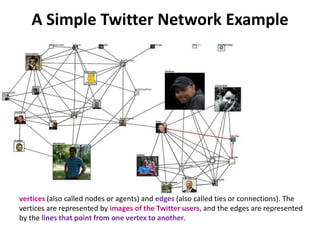
A Simple Twitter Network Example
vertices (also called nodes or agents) and edges (also called ties or connections). The
vertices are represented by images of the Twitter users, and the edges are represented
by the lines that point from one vertex to another.
Assignment 1 :
Case study 1 : NodeXL social media
network
https://www.smrfoundation.org/nodexl/
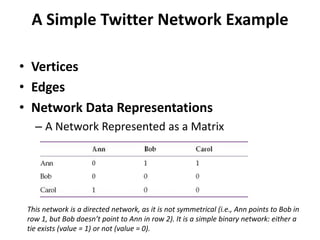
• Vertices
• Edges
• Network Data Representations
– A Network Represented as a Matrix
A Simple Twitter Network Example
This network is a directed network, as it is not symmetrical (i.e., Ann points to Bob in
row 1, but Bob doesn’t point to Ann in row 2). It is a simple binary network: either a
tie exists (value = 1) or not (value = 0).
Types of Networks
• Full, Partial, and Egocentric Networks
• Unimodal, Multimodal, and Affiliation
Networks
• Multiplex Networks
Full, Partial, and Egocentric Networks
• It is useful to consider social networks from an
individual member’s point of view.
• Network analysts call the individual that is the
focus of attention “ego” and the people he or
she is connected to “alters.”
• egocentric networks, only include individuals
who are connected to a specified ego.
• Facebook friends would be an egocentric
network because you are, by definition,
connected to all other vertices.
• A full or complete network contains all the people or
entities of interest and the connections among them.
All egos are treated equally.
• A full network is often created and available when a
single system, such as a social media platform, acts as a
hub among a group of connected people or groups.
• For example, the Twitter network includes all users of
the service and the connections between them.
• In practice, it is not always feasible (or particularly
insightful) to analyze a full network.
Full, Partial, and Egocentric Networks
Unimodal, Multimodal, and
Affiliation Networks
• They connect users to users or they connect
documents to documents, but they don’t
include both users and documents.
• However, networks can include different types
of vertices creating multimodal networks.
• a network may connect users to discussion
forums and blog posts they have commended
on.
multimodal network
• It is a bimodal network with exactly two types
of vertices.
• Data for these networks often include
individuals and some event, activity, or
content with which they are affiliated,
creating an affiliation network.
• For example, an affiliation network may
connect users with wiki pages they edit.
• In this network, no two users would directly
connect to each other. Likewise, no two wiki
pages would directly connect to each other in
this type of network.
Affiliation network
Bimodal affiliation networks
• It can be transformed into two separate unimodal
networks:
1. a user-to-user network and
2. an affiliation-to-affiliation network (e.g., article–
to–article network in a wiki)
Affiliation networks are the raw material of many
recommender systems that recommend items of
interest,
such as Amazon’s “Customers Who Bought This
Item Also Bought” feature.
Multiplex Networks
• It is consider networks with multiple types of
connections, called multiplex networks.
• Twitter network includes three types of
directed edges: following relationships, “reply
to” relationships, and “mention” relationships.
The graph could have uniquely represented
each type of edge by using color, different
edge types (e.g., dotted lines, solid lines), or
edge labels
Case study 2 : The Network Analysis
Research and Practitioner Landscape
Network Analysis Metrics
• It allow analysts to systematically dissect the social
world, creating a basis on which to compare
networks, track changes in a network over time, and
determine the relative position of individuals and
clusters within a network.
• Social scientists, physicists, computer scientists, and
mathematicians have collaborated to create theories
and algorithms for calculating novel measurements
of social networks and the people and things that
populate them.
• Social network measures focused on simple
counts of connections and became more
sophisticated as concepts of density,
centrality, structural holes, balance, and
transitivity developed.
Network Analysis Metrics
• Aggregate Networks Metrics
• Vertex-Specific Networks Metrics
• Clustering and Community Detection
Algorithms
• Structures, Network Motifs, and Social Roles
Network Analysis Metrics
Aggregate Networks Metrics
• A number of metrics describe entire networks.
• a single network is broken into several
disconnected pieces, called components.
• Some aggregate network metrics only work on
networks where all of the vertices are
connected in a single component, whereas
others can be applied to entire networks even
if they are split up.
Density
• It is an aggregate network metric used to
describe the level of interconnectedness of the
vertices.
• It is a count of the number of relationships
observed to be present in a network divided by
the total number of possible relationships that
could be present.
• It is a quantitative way to capture important
sociological ideas like cohesion, solidarity, and
membership.
Centralization
• It is an aggregate metric that characterizes the
amount to which the network is centered on
one or a few important nodes.
• Centralized networks have many edges that
emanate from a few important vertices,
whereas decentralized networks have little
variation between the numbers of edges each
vertex possesses.
Vertex-Specific Networks Metrics
• set of metrics identifies individuals’ positions
within a network.
• Paramount among these is the set of
centrality measures, which describe how a
particular vertex can be said to be in the
“middle” of a network.
• Network theorists noted that simply having
many connections, called “degree centrality,”
Degree centrality
• It is a simple count of the total number of connections
linked to a vertex.
• It can be thought of as a kind of popularity measure, but a
crude one that does not recognize a difference between
quantity and quality.
• Degree is the measure of the total number of edges
connected to a particular vertex.
• For directed networks, there are two measures of degree.
• In-degree is the number of connections that point inward
at a vertex.
• Out-degree is the number of connections that originate at a
vertex and point outward to other vertices.
Betweenness Centralities: Bridge
Scores for Boundary Spanners
• the distance between people who are not
neighbors is measured by the smallest
number of neighbor-to-neighbor hops from
one to the other.
• The shortest path between two people is
called the “geodesic distance” and is used in
many centrality metrics.
• A structural hole is a missing bridge. Wherever
two or more groups fail to connect, one can
argue that there is a structural hole, a missing gap
waiting to be filled.
• Burt provides compelling evidence that
individuals who bridge structural holes are
promoted faster than others
• Managers and leaders can recognize gaps or
disconnections within organizations and devote
resources to traversing the divide.
Betweenness Centralities: Bridge
Scores for Boundary Spanners
Closeness Centrality: Distance Scores
for Broadly Connected People
• capturing the average distance between a
vertex and every other vertex in the network.
• Assuming that vertices can only pass
messages to or influence their existing
connections, a low closeness centrality means
that a person is directly connected or “just a
hop away” from most others in the network.
Eigenvector Centrality: Influence Scores for
Strategically Connected People
• a person with few connections could have a very
high eigenvector centrality if those few
connections were themselves very well
connected.
• Eigenvector centrality allows for connections to
have a variable value, so that connecting to some
vertices has more benefit than connecting to
others.
• The PageRank algorithm used by Google’s search
engine is a variant of Eigenvector Centrality.
Clustering Coefficient: How
Connected are My Friends?
• focused on egocentric networks. Specifically, the
clustering coefficient is a measure of the density
of a 1.5-degree egocentric network.
• When these connections are dense, the
clustering coefficient is high.
• If your “friends” (alters) all know each other, you
have a high clustering coefficient.
• If your “friends” (alters) don’t know each other,
then you have a low clustering coefficient.
Clustering and Community Detection
Algorithms
• people occupy many relationships and are
potentially members in many groups and less
defined clusters.
• Defining exact boundaries in networks may be
difficult, reflecting the reality of multiple and
shifting memberships.
Structures, Network Motifs, and
Social Roles
• Two people within a network may sometimes
share a pattern of connection to other people,
even if they do not connect to the same people.
• Certain professions have distinct patterns of
connections, either linking with many others (real
estate agents, and other retail professionals) or
few (reclusive authors and artists, peripheral
workers, and other people focused on things
rather than people).
Social Networks in the Era of
Abundant Computation
• networks of connections of people spanning
societies and nations was once esoteric, today
many people actively manage an explicit social
network of Internet friends, contacts, buddies,
associates, and addresses that compose their
family, social, professional, and civic lives.
• Email messages forwarded from person to person
have become a common and visible example of
the ways information passes through networks of
connected people.
The Era of Abundant Social Networks:
From the Desktop to Your Pocket
• interactions between people increasingly take
place through computing systems.
• Users create many types of networks in a
machine-readable form each day as our
interactions are documented in a computer.
• When we use these communication tools,
databases are created and maintained with
records and log files that document the details of
the time, place, and participants of each
interaction,
Tools for Network Analysis
• Social media network data collection, scrubbing,
analysis, and display tasks have historically required a
remarkable collection of tools and skills.
• Drew Conway’s blog - python or other programming
languages and the application programmer interfaces
(API) that give sophisticated users special access to
resources.
• single tool designed for nonprogrammers, NodeXL-
support for rich visuals and analytics, and integration
with the ubiquitous Excel spreadsheet software.
Search engine optimization (SEO)
• It is the process of improving the quality and
quantity of website traffic to a website or a web
page from search engines.
Node-link Diagrams: Visually Mapping
Social Networks
• network graph can provide an overview of the
structure of the network, calling out cliques,
clusters, communities, and key participants
• goal of “netviz nirvana” in which the following
goals are proposed:
– Every vertex is visible.
– Every vertex’s degree is countable (i.e., the number of
connections that start or end at that vertex).
– Every edge can be followed from source to
destination.
– Clusters and outliers are identifiable.

Chapter 3.pdf

  • 1.
    Web Analytics Social NetworkAnalysis Dr.T.Abirami Associate Professor Department of Information Technology Kongu Engineering College Perundurai
  • 2.
  • 3.
    Introduction • People connectthrough social networks formed by kinship, language, trade, exchange, conflict, citation, and collaboration. • Kinship can refer both to the patterns of social relationships themselves, or it can refer to the study of the patterns of social relationships in one or more human cultures (i.e. kinship studies).
  • 4.
    • network isa collection of things and their relationships to one another. • The “things” that are connected are called nodes, vertices, entities, and in some contexts people. • The connections between the vertices are called edges, ties, and links. • Many natural and artificial systems form networks Introduction
  • 5.
    Social networks • Itcreated whenever people interact, directly or indirectly, with other people, institutions, and artifacts. • Social network theory and analysis is a relatively recent set of ideas and methods largely developed over the past 80 years. • It builds on and uses concepts from the mathematics of graph theory, which has a longer history. • Using network analysis, you can visualize complex sets of relationships as maps (i.e., graphs or sociograms) of connected symbols and calculate precise measures of the size, shape, and density of the network as a whole and the positions of each element within it.
  • 6.
    Social network analysis •the treelike “org-chart” that commonly represents the hierarchical structure of an organization or enterprise is too simple and lacks important information about the cross connections that exist between and across departments and divisions.
  • 7.
    • To thecreation of visualizations that resemble maps of highway systems, airline routes, or rail networks Social network analysis
  • 8.
    The Network Perspective •It is a collection of interconnected pieces • relationships as the building blocks of the social world, each set of relationships combining to create emergent patterns of connections among people, groups, and things.
  • 9.
    Social network analysis •It is between, not within people. Whereas traditional social science research methods such as surveys focus on individuals and their attributes (e.g., gender, age, income), network scientists focus on the connections that bind individuals together • To affects how data are collected, represented, and analyzed.
  • 10.
    Network perspective • Itis a collection of ties among a population and creates measurements that describe the location of each person or entity within the structure of all relationships in the network. • network analysis approach makes the web of interconnections that bind people to one another visible, creating a mathematical and graphical language that can highlight important people, events, and subgroups.
  • 11.
    A Simple TwitterNetwork Example vertices (also called nodes or agents) and edges (also called ties or connections). The vertices are represented by images of the Twitter users, and the edges are represented by the lines that point from one vertex to another.
  • 12.
    Assignment 1 : Casestudy 1 : NodeXL social media network https://www.smrfoundation.org/nodexl/
  • 13.
    • Vertices • Edges •Network Data Representations – A Network Represented as a Matrix A Simple Twitter Network Example This network is a directed network, as it is not symmetrical (i.e., Ann points to Bob in row 1, but Bob doesn’t point to Ann in row 2). It is a simple binary network: either a tie exists (value = 1) or not (value = 0).
  • 14.
    Types of Networks •Full, Partial, and Egocentric Networks • Unimodal, Multimodal, and Affiliation Networks • Multiplex Networks
  • 15.
    Full, Partial, andEgocentric Networks • It is useful to consider social networks from an individual member’s point of view. • Network analysts call the individual that is the focus of attention “ego” and the people he or she is connected to “alters.” • egocentric networks, only include individuals who are connected to a specified ego. • Facebook friends would be an egocentric network because you are, by definition, connected to all other vertices.
  • 16.
    • A fullor complete network contains all the people or entities of interest and the connections among them. All egos are treated equally. • A full network is often created and available when a single system, such as a social media platform, acts as a hub among a group of connected people or groups. • For example, the Twitter network includes all users of the service and the connections between them. • In practice, it is not always feasible (or particularly insightful) to analyze a full network. Full, Partial, and Egocentric Networks
  • 17.
    Unimodal, Multimodal, and AffiliationNetworks • They connect users to users or they connect documents to documents, but they don’t include both users and documents. • However, networks can include different types of vertices creating multimodal networks. • a network may connect users to discussion forums and blog posts they have commended on.
  • 18.
    multimodal network • Itis a bimodal network with exactly two types of vertices. • Data for these networks often include individuals and some event, activity, or content with which they are affiliated, creating an affiliation network. • For example, an affiliation network may connect users with wiki pages they edit.
  • 19.
    • In thisnetwork, no two users would directly connect to each other. Likewise, no two wiki pages would directly connect to each other in this type of network. Affiliation network
  • 20.
    Bimodal affiliation networks •It can be transformed into two separate unimodal networks: 1. a user-to-user network and 2. an affiliation-to-affiliation network (e.g., article– to–article network in a wiki) Affiliation networks are the raw material of many recommender systems that recommend items of interest, such as Amazon’s “Customers Who Bought This Item Also Bought” feature.
  • 21.
    Multiplex Networks • Itis consider networks with multiple types of connections, called multiplex networks. • Twitter network includes three types of directed edges: following relationships, “reply to” relationships, and “mention” relationships. The graph could have uniquely represented each type of edge by using color, different edge types (e.g., dotted lines, solid lines), or edge labels
  • 22.
    Case study 2: The Network Analysis Research and Practitioner Landscape
  • 23.
    Network Analysis Metrics •It allow analysts to systematically dissect the social world, creating a basis on which to compare networks, track changes in a network over time, and determine the relative position of individuals and clusters within a network. • Social scientists, physicists, computer scientists, and mathematicians have collaborated to create theories and algorithms for calculating novel measurements of social networks and the people and things that populate them.
  • 24.
    • Social networkmeasures focused on simple counts of connections and became more sophisticated as concepts of density, centrality, structural holes, balance, and transitivity developed. Network Analysis Metrics
  • 25.
    • Aggregate NetworksMetrics • Vertex-Specific Networks Metrics • Clustering and Community Detection Algorithms • Structures, Network Motifs, and Social Roles Network Analysis Metrics
  • 26.
    Aggregate Networks Metrics •A number of metrics describe entire networks. • a single network is broken into several disconnected pieces, called components. • Some aggregate network metrics only work on networks where all of the vertices are connected in a single component, whereas others can be applied to entire networks even if they are split up.
  • 27.
    Density • It isan aggregate network metric used to describe the level of interconnectedness of the vertices. • It is a count of the number of relationships observed to be present in a network divided by the total number of possible relationships that could be present. • It is a quantitative way to capture important sociological ideas like cohesion, solidarity, and membership.
  • 28.
    Centralization • It isan aggregate metric that characterizes the amount to which the network is centered on one or a few important nodes. • Centralized networks have many edges that emanate from a few important vertices, whereas decentralized networks have little variation between the numbers of edges each vertex possesses.
  • 29.
    Vertex-Specific Networks Metrics •set of metrics identifies individuals’ positions within a network. • Paramount among these is the set of centrality measures, which describe how a particular vertex can be said to be in the “middle” of a network. • Network theorists noted that simply having many connections, called “degree centrality,”
  • 30.
    Degree centrality • Itis a simple count of the total number of connections linked to a vertex. • It can be thought of as a kind of popularity measure, but a crude one that does not recognize a difference between quantity and quality. • Degree is the measure of the total number of edges connected to a particular vertex. • For directed networks, there are two measures of degree. • In-degree is the number of connections that point inward at a vertex. • Out-degree is the number of connections that originate at a vertex and point outward to other vertices.
  • 31.
    Betweenness Centralities: Bridge Scoresfor Boundary Spanners • the distance between people who are not neighbors is measured by the smallest number of neighbor-to-neighbor hops from one to the other. • The shortest path between two people is called the “geodesic distance” and is used in many centrality metrics.
  • 32.
    • A structuralhole is a missing bridge. Wherever two or more groups fail to connect, one can argue that there is a structural hole, a missing gap waiting to be filled. • Burt provides compelling evidence that individuals who bridge structural holes are promoted faster than others • Managers and leaders can recognize gaps or disconnections within organizations and devote resources to traversing the divide. Betweenness Centralities: Bridge Scores for Boundary Spanners
  • 33.
    Closeness Centrality: DistanceScores for Broadly Connected People • capturing the average distance between a vertex and every other vertex in the network. • Assuming that vertices can only pass messages to or influence their existing connections, a low closeness centrality means that a person is directly connected or “just a hop away” from most others in the network.
  • 34.
    Eigenvector Centrality: InfluenceScores for Strategically Connected People • a person with few connections could have a very high eigenvector centrality if those few connections were themselves very well connected. • Eigenvector centrality allows for connections to have a variable value, so that connecting to some vertices has more benefit than connecting to others. • The PageRank algorithm used by Google’s search engine is a variant of Eigenvector Centrality.
  • 35.
    Clustering Coefficient: How Connectedare My Friends? • focused on egocentric networks. Specifically, the clustering coefficient is a measure of the density of a 1.5-degree egocentric network. • When these connections are dense, the clustering coefficient is high. • If your “friends” (alters) all know each other, you have a high clustering coefficient. • If your “friends” (alters) don’t know each other, then you have a low clustering coefficient.
  • 36.
    Clustering and CommunityDetection Algorithms • people occupy many relationships and are potentially members in many groups and less defined clusters. • Defining exact boundaries in networks may be difficult, reflecting the reality of multiple and shifting memberships.
  • 37.
    Structures, Network Motifs,and Social Roles • Two people within a network may sometimes share a pattern of connection to other people, even if they do not connect to the same people. • Certain professions have distinct patterns of connections, either linking with many others (real estate agents, and other retail professionals) or few (reclusive authors and artists, peripheral workers, and other people focused on things rather than people).
  • 38.
    Social Networks inthe Era of Abundant Computation • networks of connections of people spanning societies and nations was once esoteric, today many people actively manage an explicit social network of Internet friends, contacts, buddies, associates, and addresses that compose their family, social, professional, and civic lives. • Email messages forwarded from person to person have become a common and visible example of the ways information passes through networks of connected people.
  • 39.
    The Era ofAbundant Social Networks: From the Desktop to Your Pocket • interactions between people increasingly take place through computing systems. • Users create many types of networks in a machine-readable form each day as our interactions are documented in a computer. • When we use these communication tools, databases are created and maintained with records and log files that document the details of the time, place, and participants of each interaction,
  • 40.
    Tools for NetworkAnalysis • Social media network data collection, scrubbing, analysis, and display tasks have historically required a remarkable collection of tools and skills. • Drew Conway’s blog - python or other programming languages and the application programmer interfaces (API) that give sophisticated users special access to resources. • single tool designed for nonprogrammers, NodeXL- support for rich visuals and analytics, and integration with the ubiquitous Excel spreadsheet software.
  • 41.
    Search engine optimization(SEO) • It is the process of improving the quality and quantity of website traffic to a website or a web page from search engines.
  • 42.
    Node-link Diagrams: VisuallyMapping Social Networks • network graph can provide an overview of the structure of the network, calling out cliques, clusters, communities, and key participants • goal of “netviz nirvana” in which the following goals are proposed: – Every vertex is visible. – Every vertex’s degree is countable (i.e., the number of connections that start or end at that vertex). – Every edge can be followed from source to destination. – Clusters and outliers are identifiable.