
ep.jhu.edu
11100 Johns Hopkins Road
Laurel, MD 20723-6099
Social Network Analysis (SNA)
15 May 2018
Ian McCulloh, Ph.D.
Parson Fellow, Bloomberg School of Public Health
Senior Lecturer, Whiting School of Engineering
Senior Scientist, Applied Physics Laboratory
imccull4@jhu.edu
1
ep.jhu.eduep.jhu.edu
1. PhD Computer Science/Social Networks, Carnegie Mellon University.
2. 50+ peer reviewed papers.
3. Author of Wiley’s textbook on Social Network Analysis.
4. Current research: social media and the neuroscience of persuasion.
5. 20 years in the US Army – Network targeting.
6. Organizing the North American Social Network (NASN) Conference
in DC 27-30 NOV 2018
Background
ep.jhu.eduep.jhu.edu
Getting Started
https://www.rstudio.com
https://ep.jhu.edu/programs-and-courses
•605.633—Social Media Analytics
•605.634—Crowdsourcing and
Human Computation
•605.632—Graph Analytics
ep.jhu.eduep.jhu.edu
• Study of sociology
• Organizational behavior (leadership, management)
• Influencing groups (public health, propaganda, marketing)
• Increasing engagement with social media (computer science)
• Cool algorithms/heuristics (math, computer science)
Why Social Networks?
ep.jhu.eduep.jhu.edu
• Study of sociology
• Organizational behavior (leadership, management)
• Influencing groups (public health, propaganda, marketing)
• Increasing engagement with social media (computer science)
• Cool algorithms/heuristics (math, computer science)
Why Social Networks?
ep.jhu.eduep.jhu.edu
Study of Sociology
Moreno (1934) Sociometry
• 2nd grade classroom in the US
• Social physics
• The birth of social networks
Network Science
• 1999 Albert-Barabasi Scale-free networks
• 2004 NRC Report, Army interest
• Often lacks empirically grounded social theory that has been
developed over 65years – communities are merging
ep.jhu.eduep.jhu.edu
• Study of sociology
• Organizational behavior (leadership, management)
• Influencing groups (public health, propaganda, marketing)
• Increasing engagement with social media (computer science)
• Cool algorithms/heuristics (math, computer science)
Why Social Networks?
ep.jhu.eduep.jhu.edu
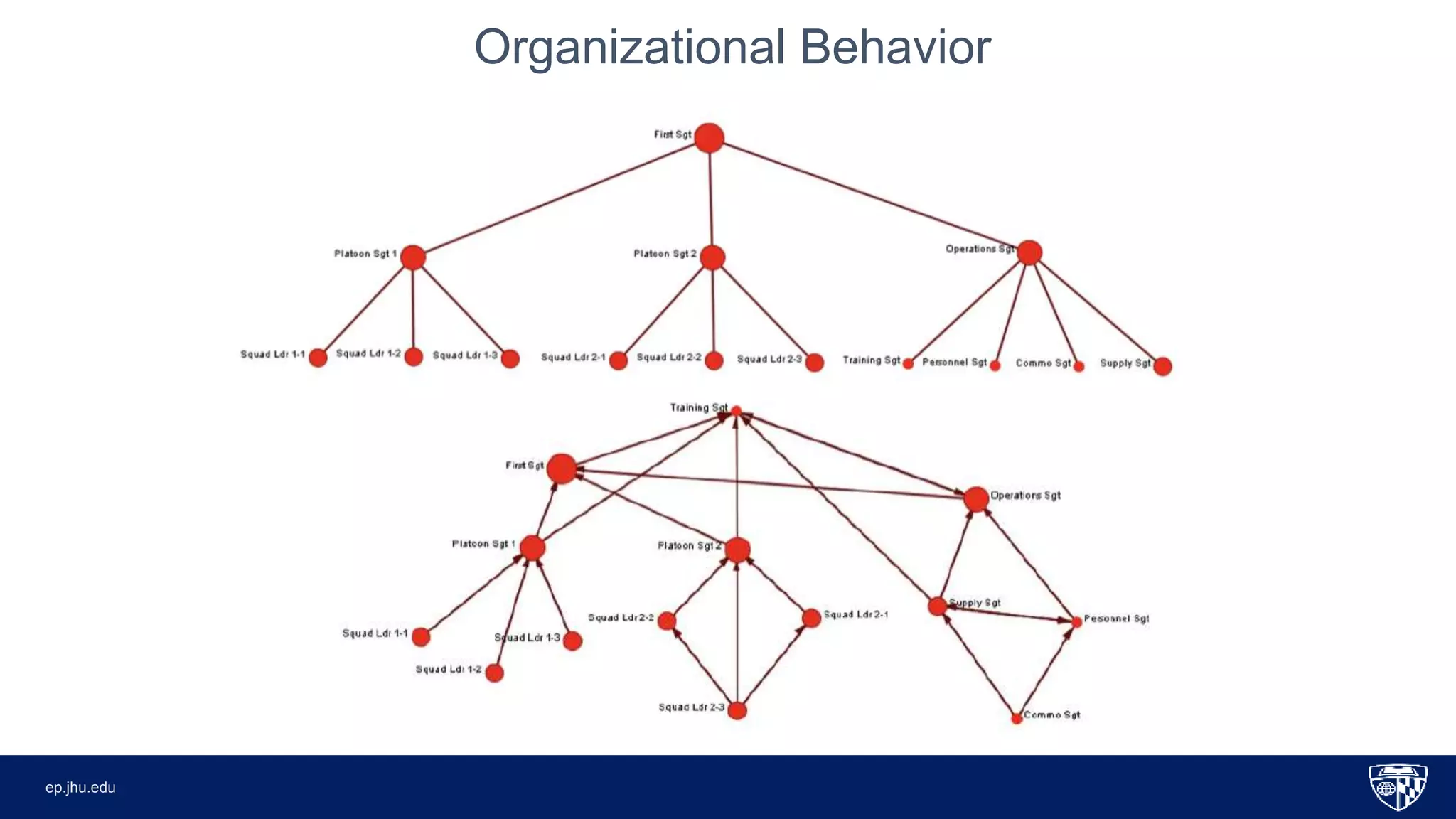
Organizational Behavior
• Who is the most powerful person in this network?
ep.jhu.eduep.jhu.edu
Organizational Behavior
ep.jhu.edu
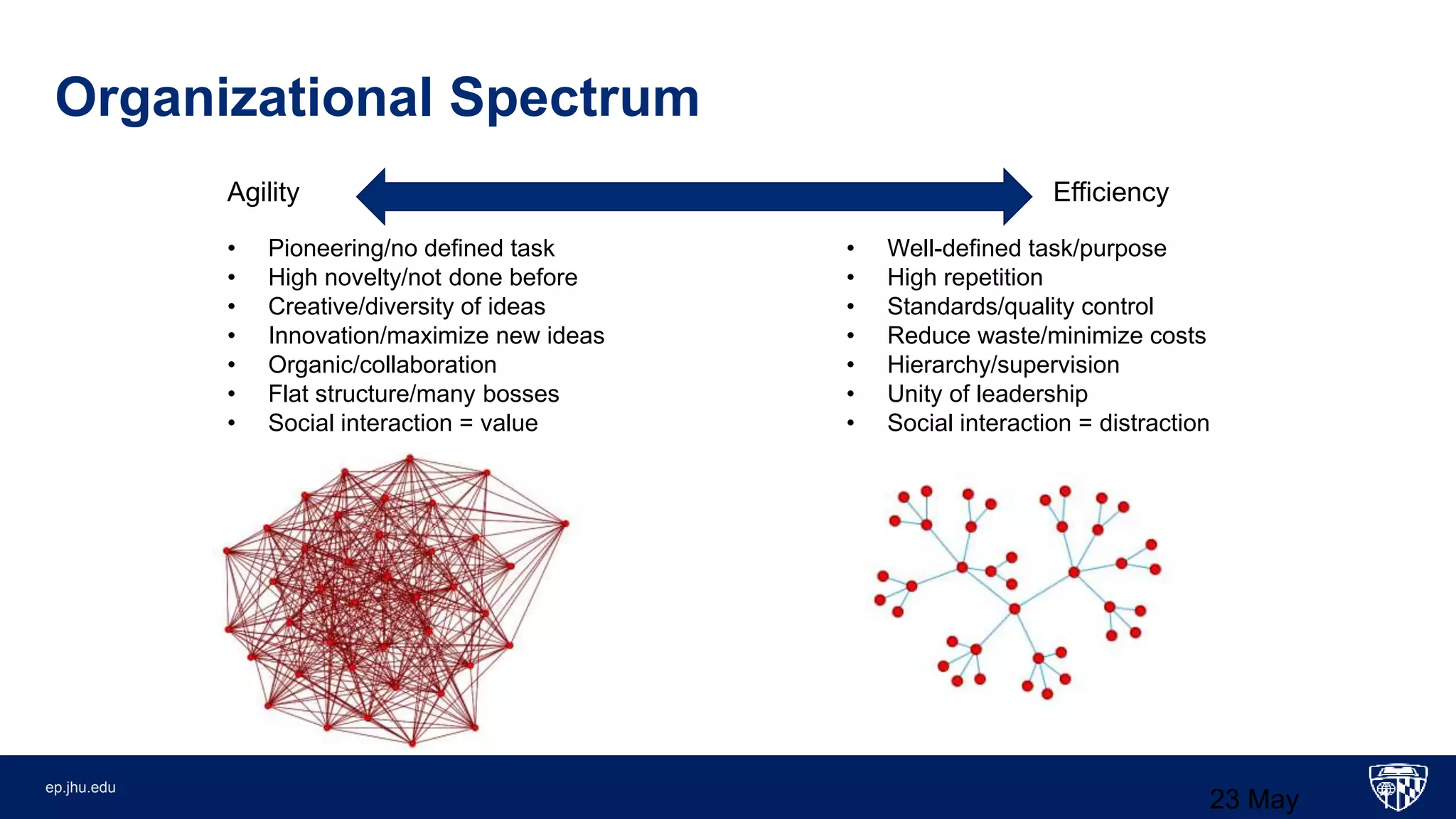
Organizational Spectrum
23 May 1
Agility Efficiency
• Well-defined task/purpose
• High repetition
• Standards/quality control
• Reduce waste/minimize costs
• Hierarchy/supervision
• Unity of leadership
• Social interaction = distraction
• Pioneering/no defined task
• High novelty/not done before
• Creative/diversity of ideas
• Innovation/maximize new ideas
• Organic/collaboration
• Flat structure/many bosses
• Social interaction = value
ep.jhu.edu
Measuring Organizational Efficiency
1
Four Properties:
1. Connected
2. Hierarchic (no reciprocity)
3. Efficient (no cross-talk)
4. Least Upper Bound
1 −
𝑉
𝑛 𝑛 − 1 /2
1 −
𝑉
max 𝑉
1 −
𝐿
max 𝐿
1 −
𝑈
max 𝑈
V = reciprocal link
L = #links above nk-1
U = #pairs without LUB
ep.jhu.edu
What do we seek in an agile network
1
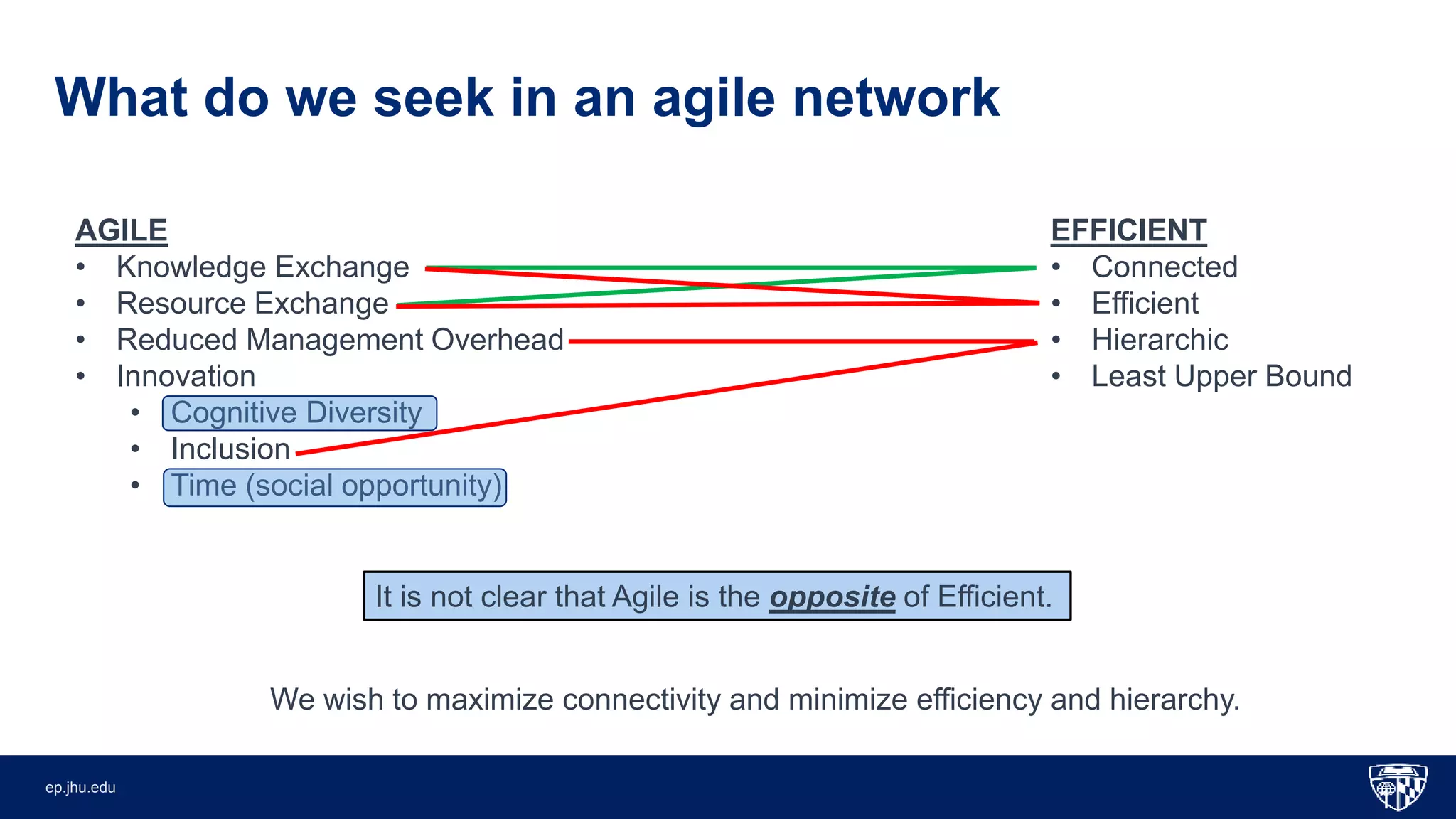
AGILE
• Knowledge Exchange
• Resource Exchange
• Reduced Management Overhead
• Innovation
• Cognitive Diversity
• Inclusion
• Time (social opportunity)
EFFICIENT
• Connected
• Efficient
• Hierarchic
• Least Upper Bound
It is not clear that Agile is the opposite of Efficient.
We wish to maximize connectivity and minimize efficiency and hierarchy.
ep.jhu.edu
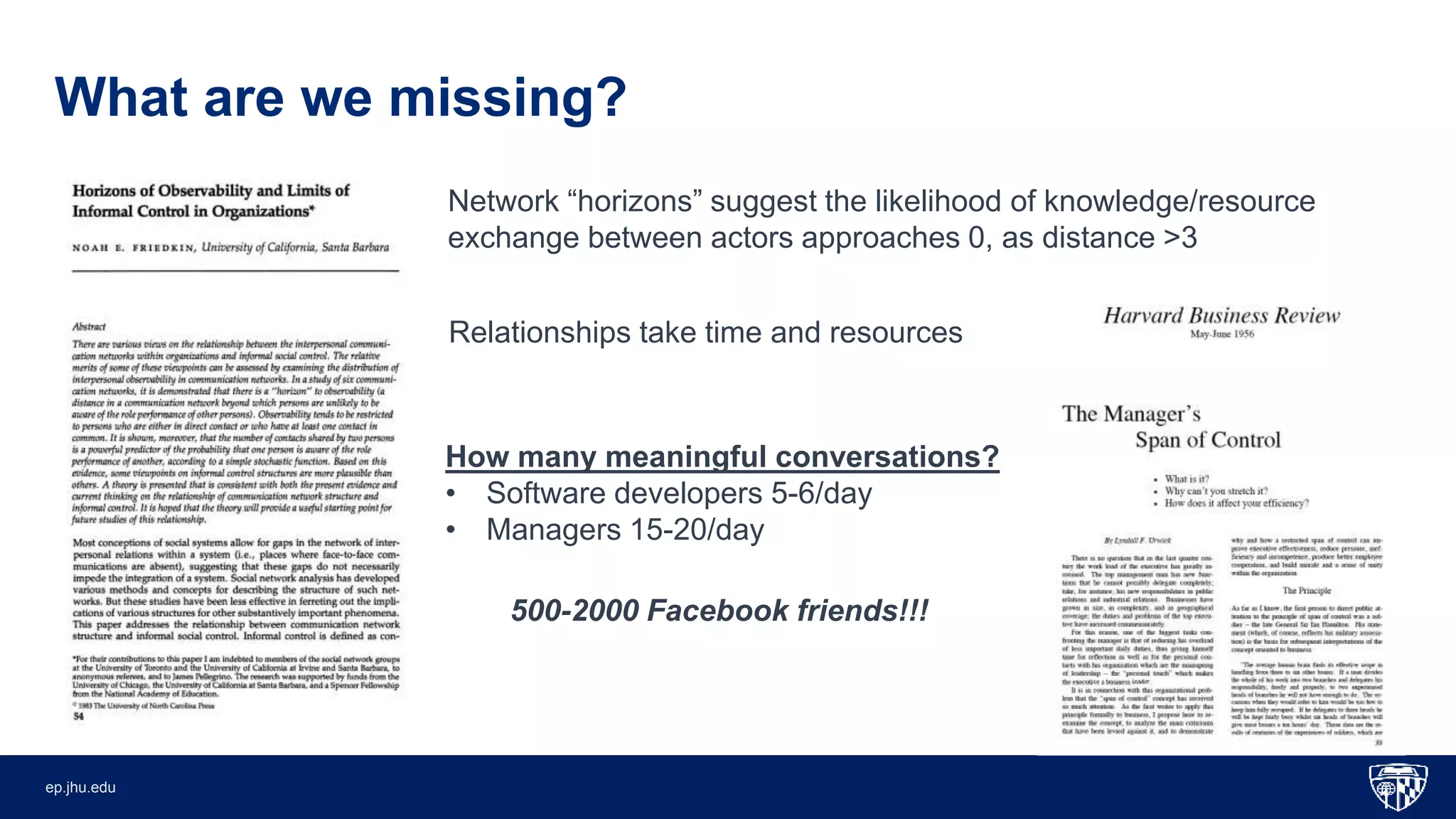
What are we missing?
1
Network “horizons” suggest the likelihood of knowledge/resource
exchange between actors approaches 0, as distance >3
Relationships take time and resources
How many meaningful conversations?
• Software developers 5-6/day
• Managers 15-20/day
500-2000 Facebook friends!!!
ep.jhu.edu
How to Create Truly Agile Networks
• Minimize the diameter of the network
• Minimize the average degree of actors (a.k.a. density)
• Maximize cognitive diversity
Diameter = 2
Density = 0.4
Diameter = 1
Density = 1.0
Diameter = 2
Density = 0.5
Need to explore tradeoffs in diameter and density
ep.jhu.eduep.jhu.edu
• Study of sociology
• Organizational behavior (leadership, management)
• Influencing groups (public health, propaganda, marketing)
• Increasing engagement with social media (computer science)
• Cool algorithms/heuristics (math, computer science)
Why Social Networks?
ep.jhu.eduep.jhu.edu
Reasoned Action Theory
𝐵 = 𝑤1 𝐴 + 𝑤2 𝐼𝑁 + 𝑤3 𝐷𝑁 ∗ 𝑤4 𝑃𝐵𝐶
• B = Behavior
• A = Salient Attitudes
• IN = Injunctive Norms
• DN = Descriptive Norms
• PBC = Perceived Behavioral Control
• wi = Weight applied to factor
ep.jhu.eduep.jhu.edu
Where do you get the data?
𝐵 = 𝑤1 𝐴 + 𝑤2 𝐼𝑁 + 𝑤3 𝐷𝑁 ∗ 𝑤4 𝑃𝐵𝐶
Opinion Leader
Key Influencer
Key
Communic
ator
Alters
Informational
Conformity
Normative Conformity
Network Conformity
Social
Network
Analysis
ep.jhu.edu
ep.jhu.edu
ep.jhu.eduep.jhu.edu
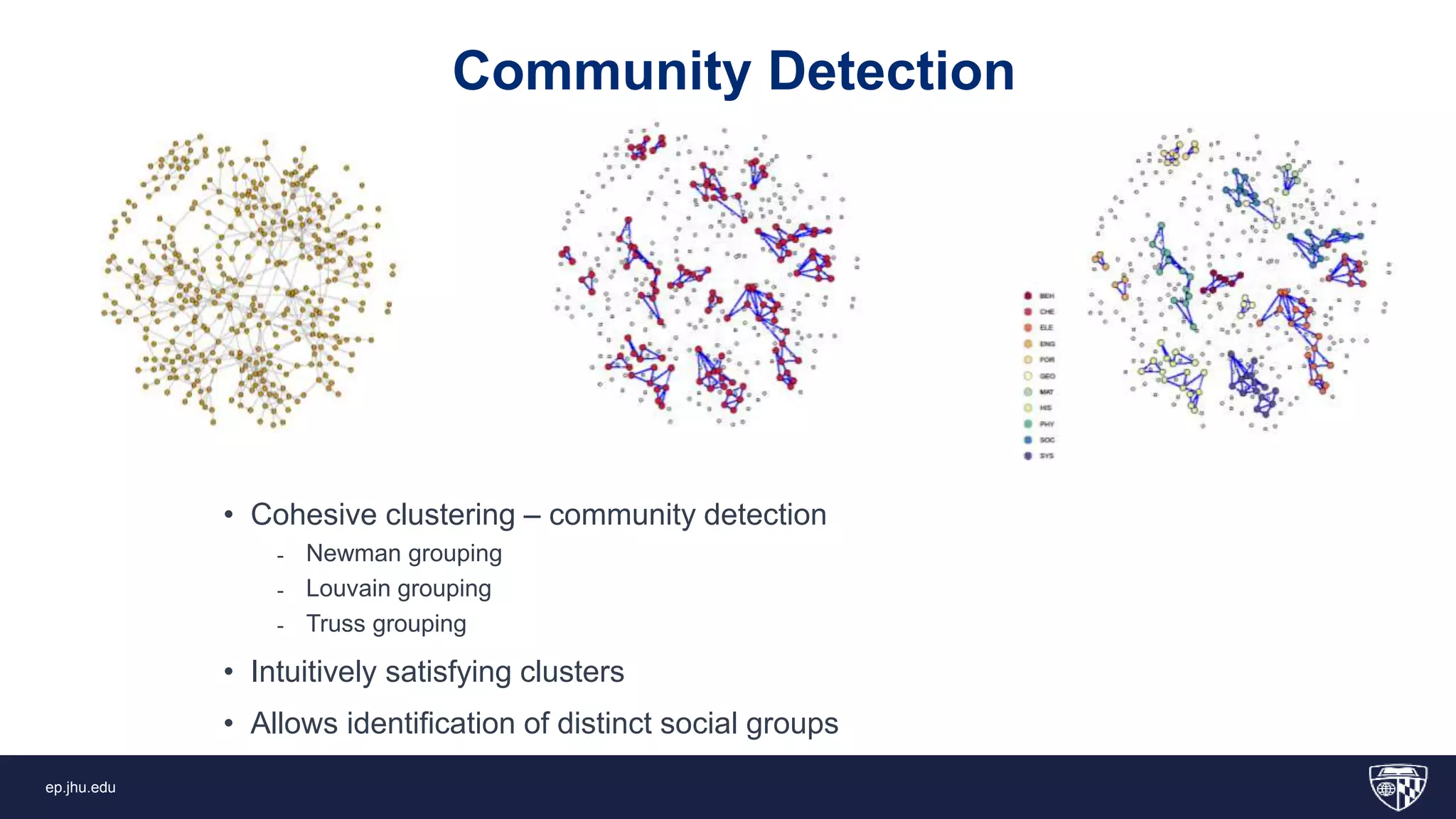
Community Detection
• Cohesive clustering – community detection
- Newman grouping
- Louvain grouping
- Truss grouping
• Intuitively satisfying clusters
• Allows identification of distinct social groups
ep.jhu.edu
ep.jhu.eduep.jhu.edu
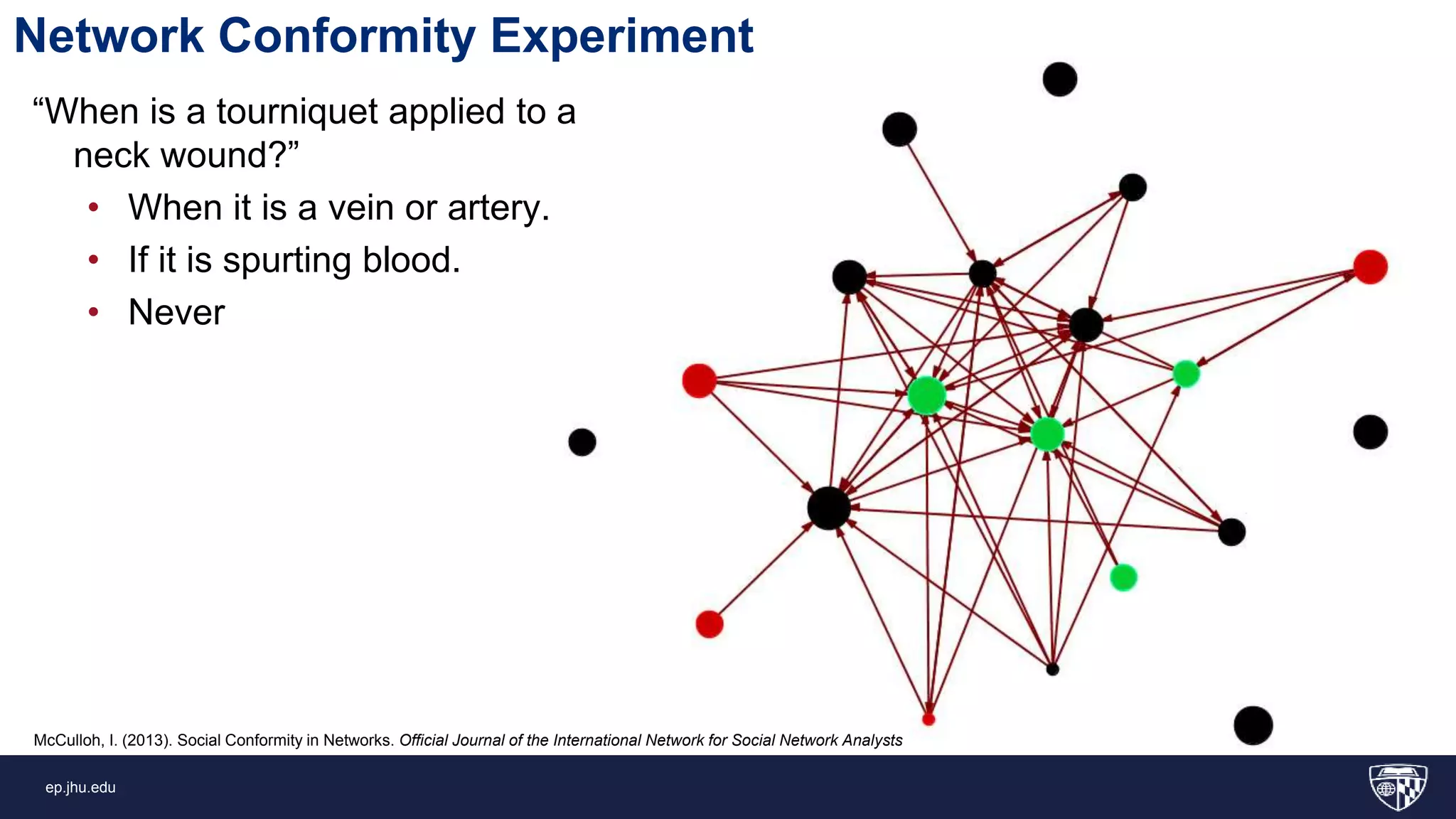
“When is a tourniquet applied to a
neck wound?”
• When it is a vein or artery.
• If it is spurting blood.
• Never
McCulloh, I. (2013). Social Conformity in Networks. Official Journal of the International Network for Social Network Analysts
Network Conformity Experiment
ep.jhu.eduep.jhu.edu
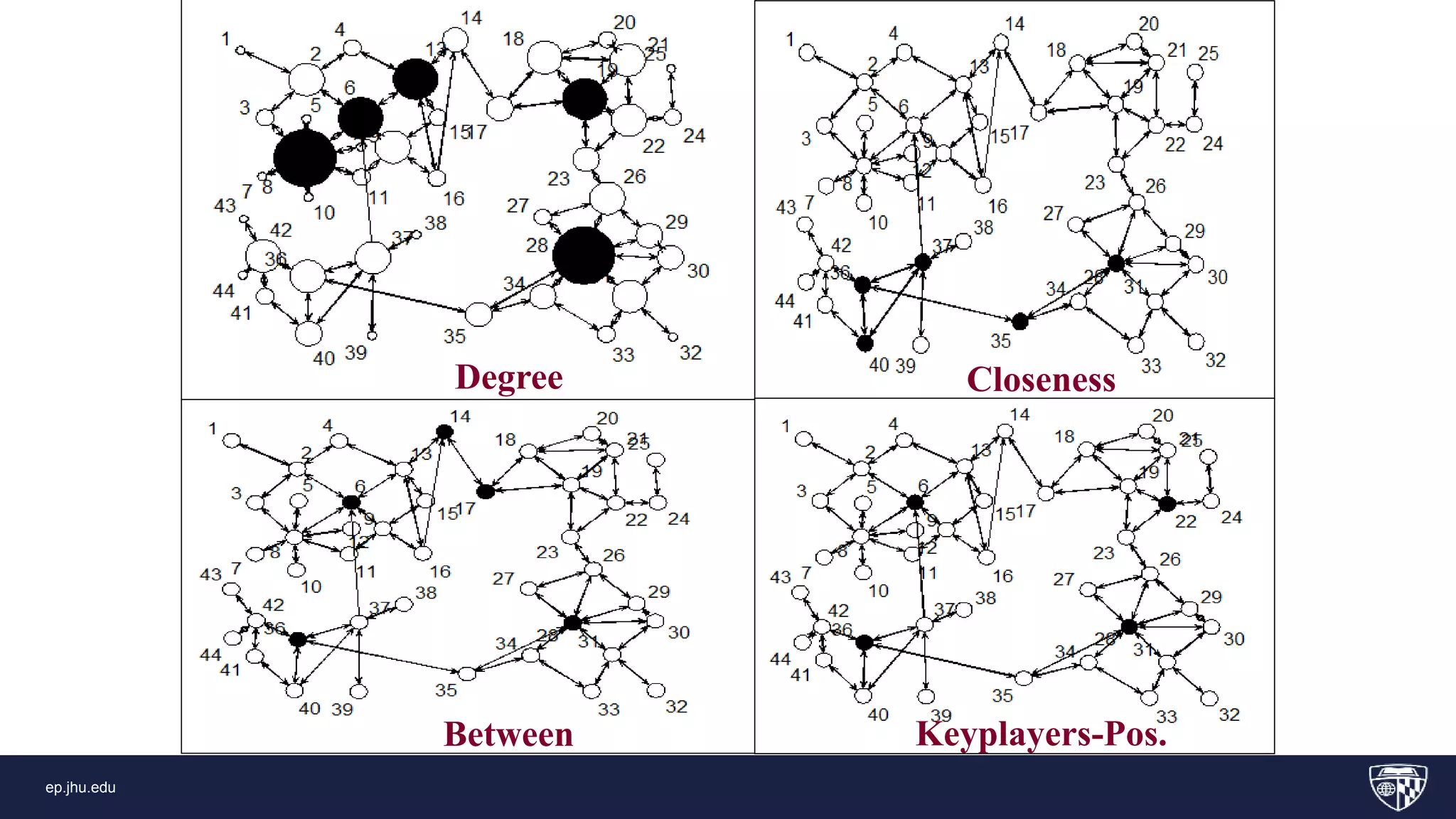
Centrality
ep.jhu.eduep.jhu.edu
Degree
Keyplayers-Pos.Between
Closeness
ep.jhu.eduep.jhu.edu
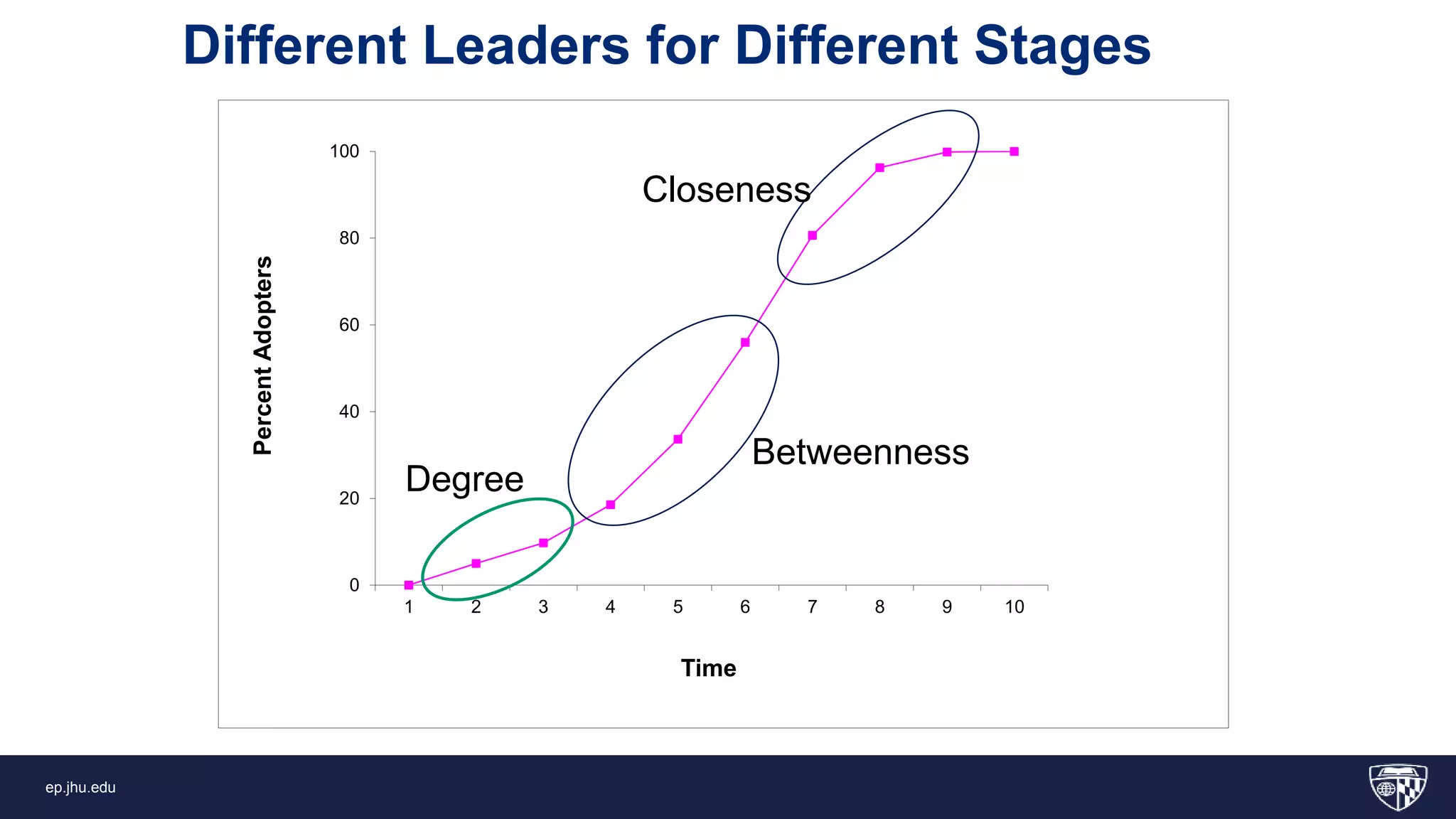
Different Leaders for Different Stages
0
20
40
60
80
100
1 2 3 4 5 6 7 8 9 10
PercentAdopters
Time
Degree
Betweenness
Closeness
ep.jhu.eduep.jhu.edu
• Study of sociology
• Organizational behavior (leadership, management)
• Influencing groups (public health, propaganda, marketing)
• Increasing engagement with social media (computer science)
• Cool algorithms/heuristics (math, computer science)
Why Social Networks?
ep.jhu.eduep.jhu.edu
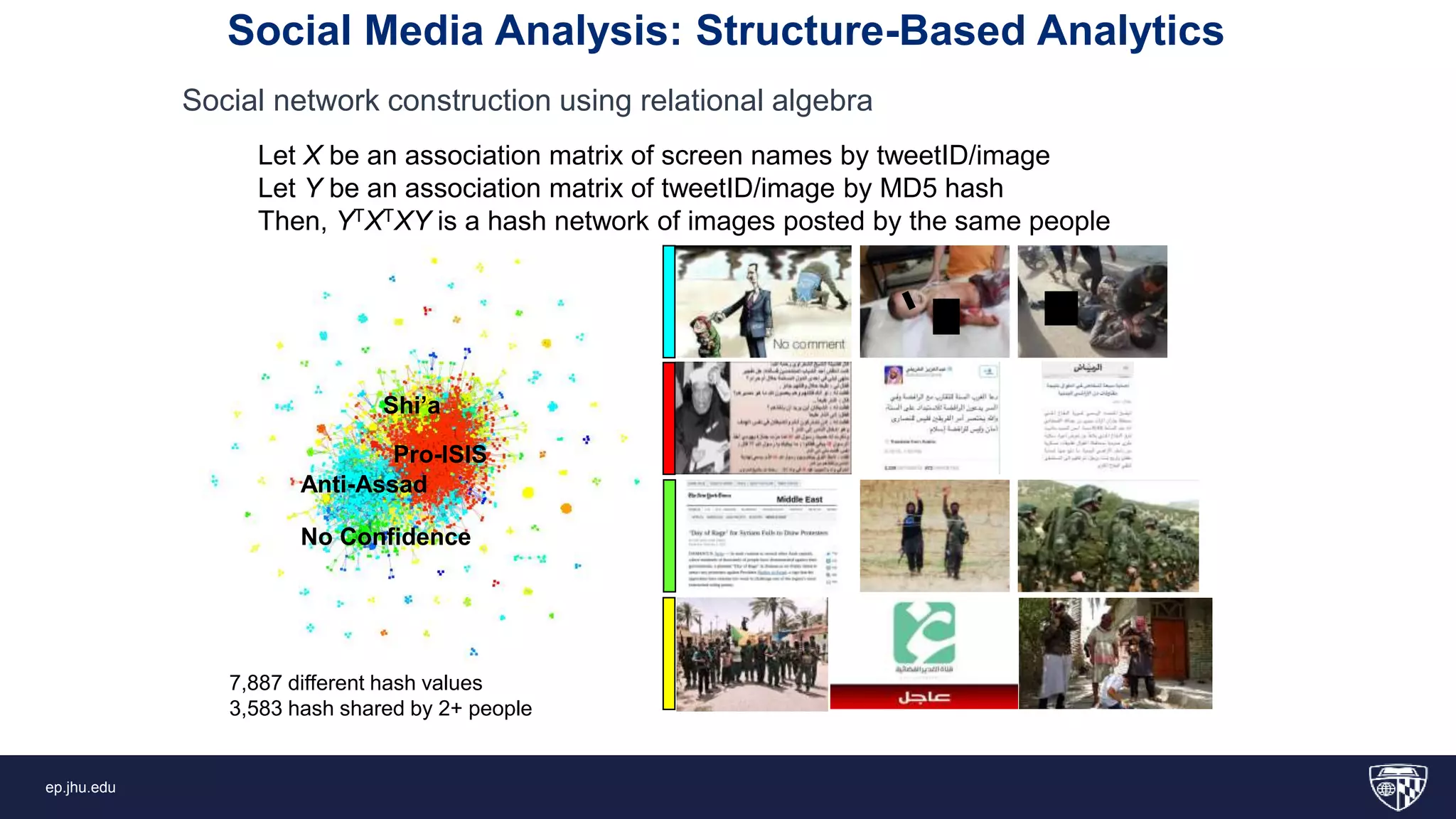
Social Media Analysis: Structure-Based Analytics
Social network construction using relational algebra
Let X be an association matrix of screen names by tweetID/image
Let Y be an association matrix of tweetID/image by MD5 hash
Then, YTXTXY is a hash network of images posted by the same people
Pro-ISIS
Anti-Assad
Shi’a
No Confidence
7,887 different hash values
3,583 hash shared by 2+ people
ep.jhu.edu
ep.jhu.eduep.jhu.edu
Time for the Workshop!
0
500
1000
1500
2013
2014
2015
2016
DailyDownloads
Package
igraph
sna
tnet
Daily Downloads (RStudio mirror) for
igraph, sna, and tnet
igraph (also in python)
• Social media, cluster, speed
statnet
• Statistics, longitudinal, egonet
Not compatible
ep.jhu.eduep.jhu.edu
• Centrality measures
• Diameter & density
• Clustering
• Social media context
• Network statistics (ERGM, SAOM)
What are the most common analytics?
It’s the social theory that gives life to analysis!
Let’s go to Rstudio!
We will use the igraph package
Python uses igraph
ep.jhu.edu © The Johns Hopkins University 2016, All Rights Reserved.

Social Network Analysis Workshop

  • 1.
    ep.jhu.edu 11100 Johns HopkinsRoad Laurel, MD 20723-6099 Social Network Analysis (SNA) 15 May 2018 Ian McCulloh, Ph.D. Parson Fellow, Bloomberg School of Public Health Senior Lecturer, Whiting School of Engineering Senior Scientist, Applied Physics Laboratory imccull4@jhu.edu 1
  • 2.
    ep.jhu.eduep.jhu.edu 1. PhD ComputerScience/Social Networks, Carnegie Mellon University. 2. 50+ peer reviewed papers. 3. Author of Wiley’s textbook on Social Network Analysis. 4. Current research: social media and the neuroscience of persuasion. 5. 20 years in the US Army – Network targeting. 6. Organizing the North American Social Network (NASN) Conference in DC 27-30 NOV 2018 Background
  • 3.
    ep.jhu.eduep.jhu.edu Getting Started https://www.rstudio.com https://ep.jhu.edu/programs-and-courses •605.633—Social MediaAnalytics •605.634—Crowdsourcing and Human Computation •605.632—Graph Analytics
  • 4.
    ep.jhu.eduep.jhu.edu • Study ofsociology • Organizational behavior (leadership, management) • Influencing groups (public health, propaganda, marketing) • Increasing engagement with social media (computer science) • Cool algorithms/heuristics (math, computer science) Why Social Networks?
  • 5.
    ep.jhu.eduep.jhu.edu • Study ofsociology • Organizational behavior (leadership, management) • Influencing groups (public health, propaganda, marketing) • Increasing engagement with social media (computer science) • Cool algorithms/heuristics (math, computer science) Why Social Networks?
  • 6.
    ep.jhu.eduep.jhu.edu Study of Sociology Moreno(1934) Sociometry • 2nd grade classroom in the US • Social physics • The birth of social networks Network Science • 1999 Albert-Barabasi Scale-free networks • 2004 NRC Report, Army interest • Often lacks empirically grounded social theory that has been developed over 65years – communities are merging
  • 7.
    ep.jhu.eduep.jhu.edu • Study ofsociology • Organizational behavior (leadership, management) • Influencing groups (public health, propaganda, marketing) • Increasing engagement with social media (computer science) • Cool algorithms/heuristics (math, computer science) Why Social Networks?
  • 8.
    ep.jhu.eduep.jhu.edu Organizational Behavior • Whois the most powerful person in this network?
  • 9.
  • 10.
    ep.jhu.edu Organizational Spectrum 23 May1 Agility Efficiency • Well-defined task/purpose • High repetition • Standards/quality control • Reduce waste/minimize costs • Hierarchy/supervision • Unity of leadership • Social interaction = distraction • Pioneering/no defined task • High novelty/not done before • Creative/diversity of ideas • Innovation/maximize new ideas • Organic/collaboration • Flat structure/many bosses • Social interaction = value
  • 11.
    ep.jhu.edu Measuring Organizational Efficiency 1 FourProperties: 1. Connected 2. Hierarchic (no reciprocity) 3. Efficient (no cross-talk) 4. Least Upper Bound 1 − 𝑉 𝑛 𝑛 − 1 /2 1 − 𝑉 max 𝑉 1 − 𝐿 max 𝐿 1 − 𝑈 max 𝑈 V = reciprocal link L = #links above nk-1 U = #pairs without LUB
  • 12.
    ep.jhu.edu What do weseek in an agile network 1 AGILE • Knowledge Exchange • Resource Exchange • Reduced Management Overhead • Innovation • Cognitive Diversity • Inclusion • Time (social opportunity) EFFICIENT • Connected • Efficient • Hierarchic • Least Upper Bound It is not clear that Agile is the opposite of Efficient. We wish to maximize connectivity and minimize efficiency and hierarchy.
  • 13.
    ep.jhu.edu What are wemissing? 1 Network “horizons” suggest the likelihood of knowledge/resource exchange between actors approaches 0, as distance >3 Relationships take time and resources How many meaningful conversations? • Software developers 5-6/day • Managers 15-20/day 500-2000 Facebook friends!!!
  • 14.
    ep.jhu.edu How to CreateTruly Agile Networks • Minimize the diameter of the network • Minimize the average degree of actors (a.k.a. density) • Maximize cognitive diversity Diameter = 2 Density = 0.4 Diameter = 1 Density = 1.0 Diameter = 2 Density = 0.5 Need to explore tradeoffs in diameter and density
  • 15.
    ep.jhu.eduep.jhu.edu • Study ofsociology • Organizational behavior (leadership, management) • Influencing groups (public health, propaganda, marketing) • Increasing engagement with social media (computer science) • Cool algorithms/heuristics (math, computer science) Why Social Networks?
  • 16.
    ep.jhu.eduep.jhu.edu Reasoned Action Theory 𝐵= 𝑤1 𝐴 + 𝑤2 𝐼𝑁 + 𝑤3 𝐷𝑁 ∗ 𝑤4 𝑃𝐵𝐶 • B = Behavior • A = Salient Attitudes • IN = Injunctive Norms • DN = Descriptive Norms • PBC = Perceived Behavioral Control • wi = Weight applied to factor
  • 17.
    ep.jhu.eduep.jhu.edu Where do youget the data? 𝐵 = 𝑤1 𝐴 + 𝑤2 𝐼𝑁 + 𝑤3 𝐷𝑁 ∗ 𝑤4 𝑃𝐵𝐶 Opinion Leader Key Influencer Key Communic ator Alters Informational Conformity Normative Conformity Network Conformity Social Network Analysis
  • 18.
  • 19.
  • 20.
    ep.jhu.eduep.jhu.edu Community Detection • Cohesiveclustering – community detection - Newman grouping - Louvain grouping - Truss grouping • Intuitively satisfying clusters • Allows identification of distinct social groups
  • 21.
  • 22.
    ep.jhu.eduep.jhu.edu “When is atourniquet applied to a neck wound?” • When it is a vein or artery. • If it is spurting blood. • Never McCulloh, I. (2013). Social Conformity in Networks. Official Journal of the International Network for Social Network Analysts Network Conformity Experiment
  • 23.
  • 24.
  • 25.
    ep.jhu.eduep.jhu.edu Different Leaders forDifferent Stages 0 20 40 60 80 100 1 2 3 4 5 6 7 8 9 10 PercentAdopters Time Degree Betweenness Closeness
  • 26.
    ep.jhu.eduep.jhu.edu • Study ofsociology • Organizational behavior (leadership, management) • Influencing groups (public health, propaganda, marketing) • Increasing engagement with social media (computer science) • Cool algorithms/heuristics (math, computer science) Why Social Networks?
  • 27.
    ep.jhu.eduep.jhu.edu Social Media Analysis:Structure-Based Analytics Social network construction using relational algebra Let X be an association matrix of screen names by tweetID/image Let Y be an association matrix of tweetID/image by MD5 hash Then, YTXTXY is a hash network of images posted by the same people Pro-ISIS Anti-Assad Shi’a No Confidence 7,887 different hash values 3,583 hash shared by 2+ people
  • 28.
  • 29.
    ep.jhu.eduep.jhu.edu Time for theWorkshop! 0 500 1000 1500 2013 2014 2015 2016 DailyDownloads Package igraph sna tnet Daily Downloads (RStudio mirror) for igraph, sna, and tnet igraph (also in python) • Social media, cluster, speed statnet • Statistics, longitudinal, egonet Not compatible
  • 30.
    ep.jhu.eduep.jhu.edu • Centrality measures •Diameter & density • Clustering • Social media context • Network statistics (ERGM, SAOM) What are the most common analytics? It’s the social theory that gives life to analysis! Let’s go to Rstudio! We will use the igraph package Python uses igraph
  • 31.
    ep.jhu.edu © TheJohns Hopkins University 2016, All Rights Reserved.