Social Web

2016
Lecture 6: How can we STUDY the Social Web?
(based on slides from Les Carr, Nigel Shadbolt, Harith Alani)
Davide Ceolin (credits to: Lora Aroyo)
The Network Institute
VU University Amsterdam
The Web
the most used and one of the most transformative applications
in the history of computing, e.g. how the Social Web has
transformed the world's communication
approximately 1010 people
more than 1011 web documents
Social Web 2016, Davide Ceolin
The Web
Great success as a technology,
it’s built on significant computing infrastructure,
but
as an entity surprisingly unstudied
Social Web 2016, Davide Ceolin
• physical science: analytic discipline to find laws that
generate or explain observed phenomena
• CS is mainly synthetic: formalisms & algorithms are
created to support specific desired behaviors
• Web Science: web needs to be studied & understood
as a phenomenon but also to be engineered for future
growth and capabilities
Science & Engineering
Social Web 2016, Davide Ceolin
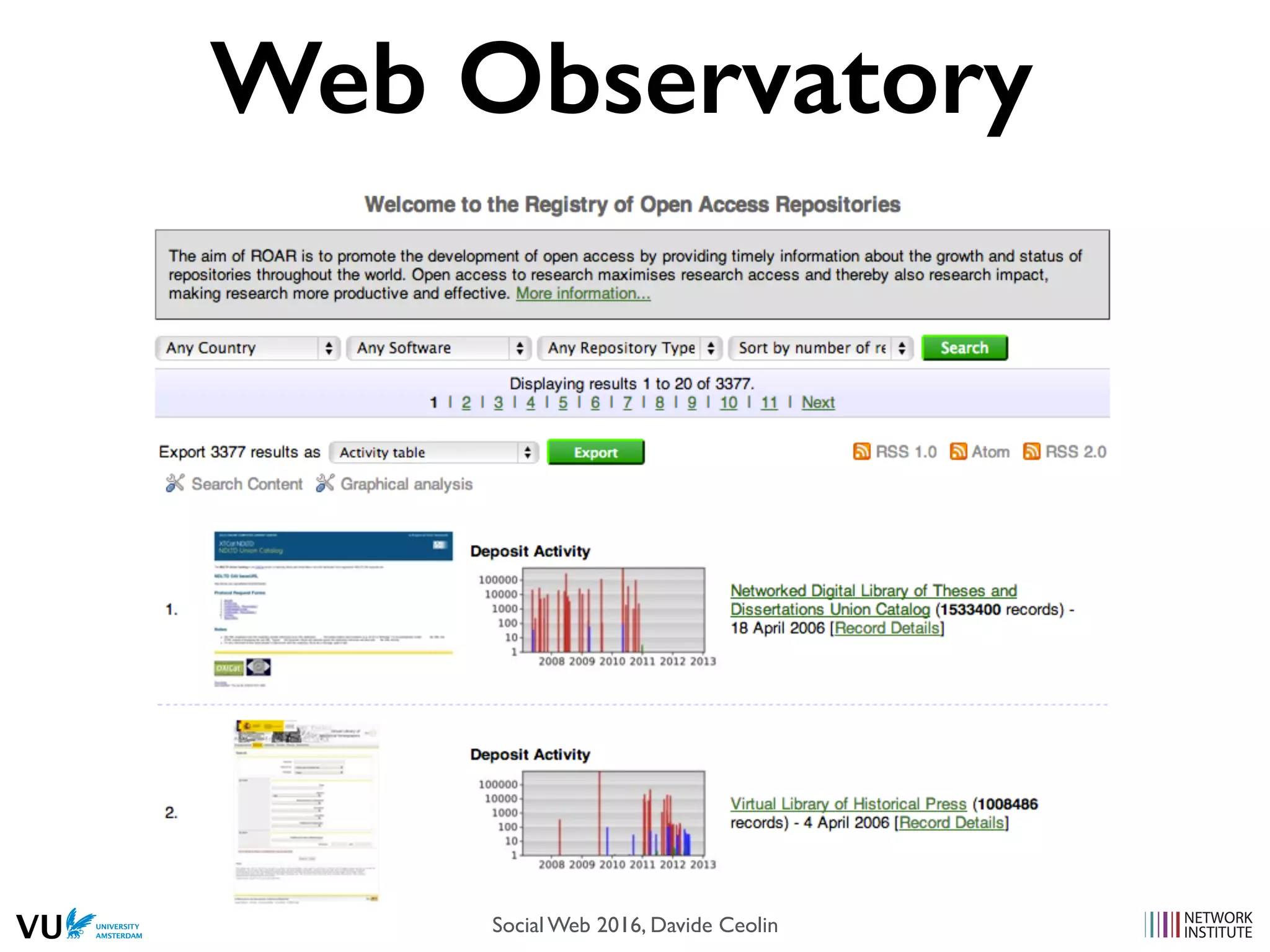
Web Observatory
Social Web 2016, Davide Ceolin
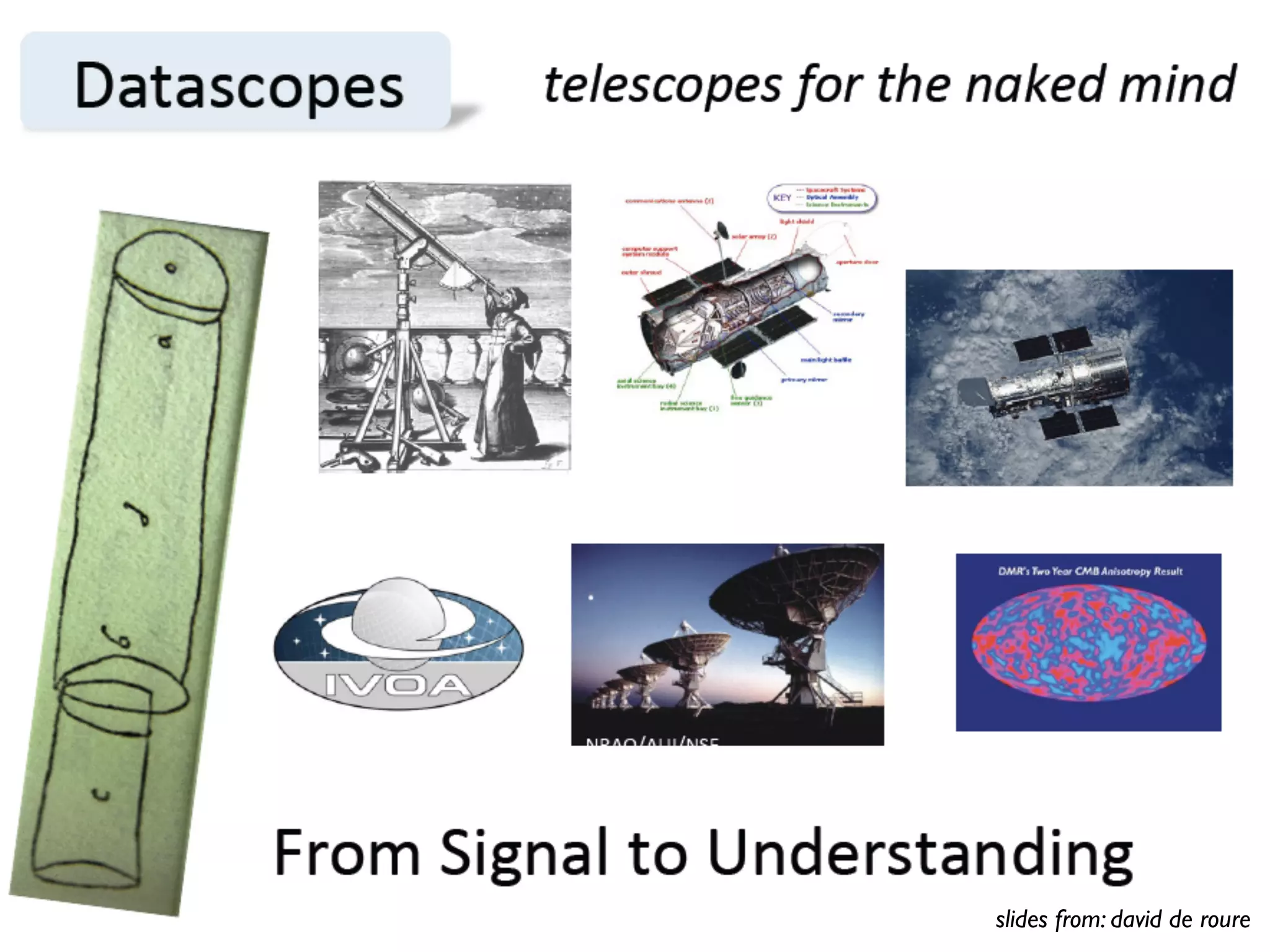
slides from: david de roure
http://websci15.org/accepted-submissions
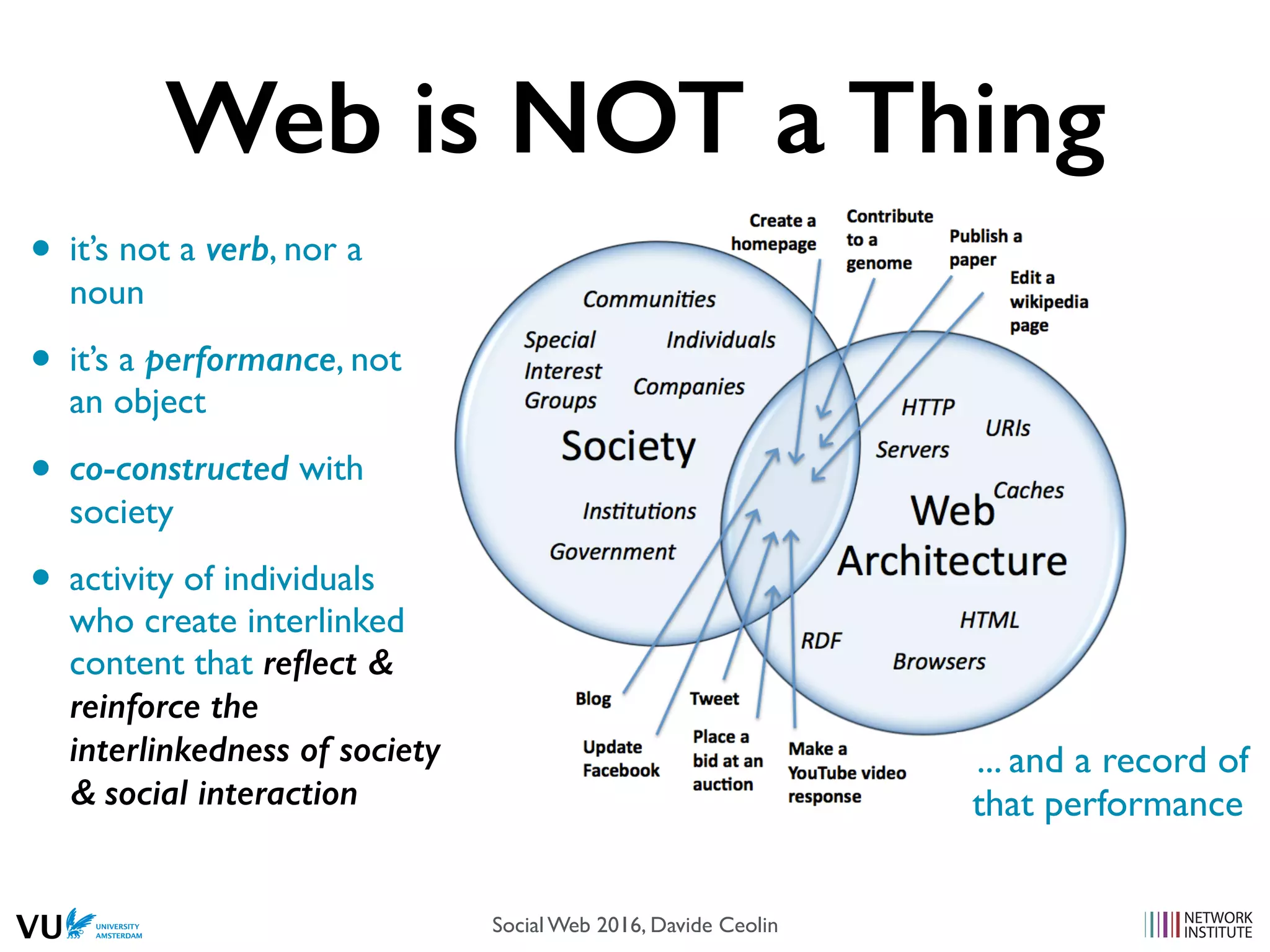
Web is NOT a Thing
• it’s not a verb, nor a
noun
• it’s a performance, not
an object
• co-constructed with
society
• activity of individuals
who create interlinked
content that reflect &
reinforce the
interlinkedness of society
& social interaction
... and a record of
that performance
Social Web 2016, Davide Ceolin
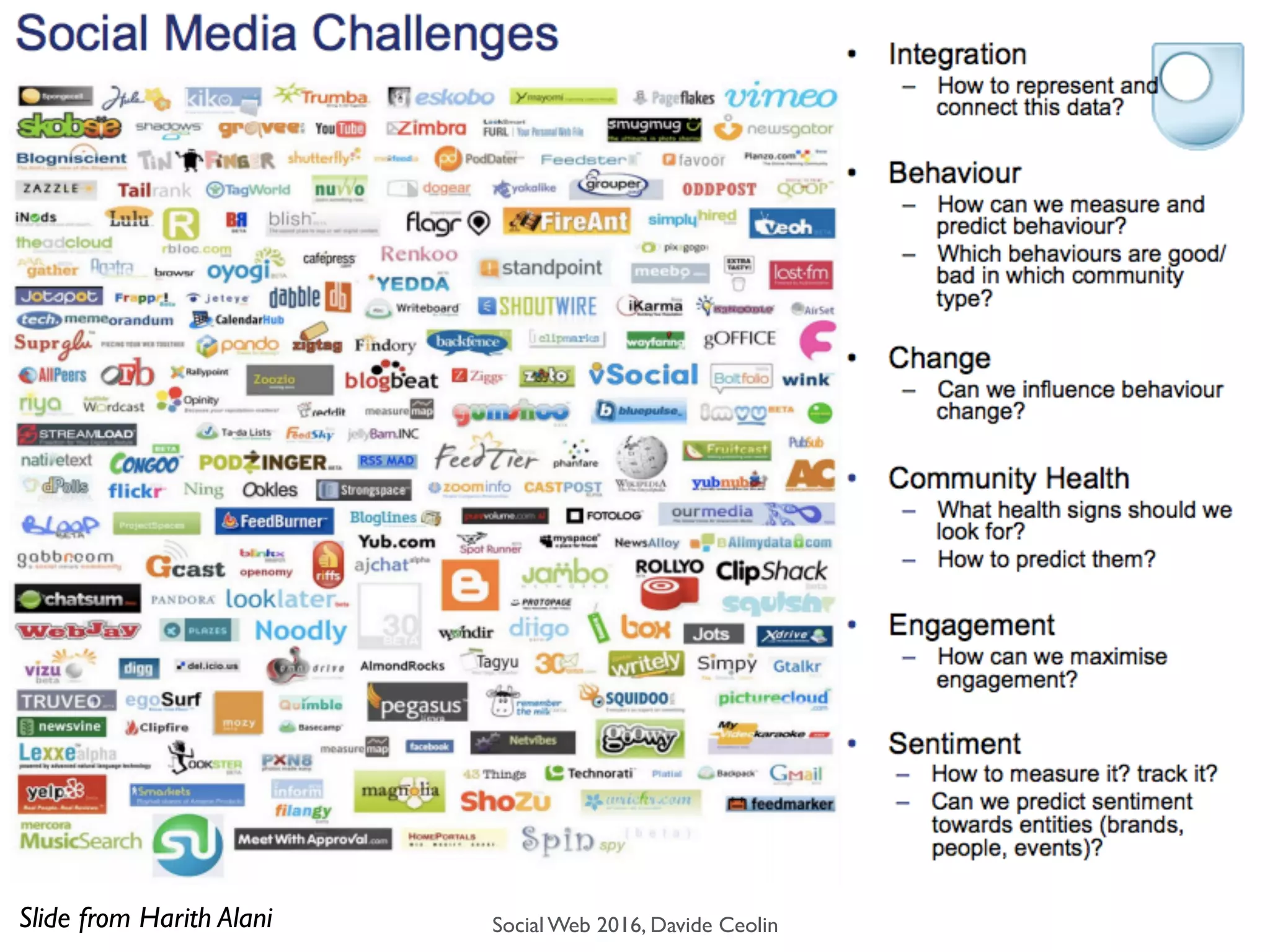
Slide from Harith Alani Social Web 2016, Davide Ceolin
eScience: Analysis of Data
• the automated or semi-automated extraction of
knowledge from massive volumes of data — it is a
lot, but it is not just a matter of volume
• 3 Vs of Big Data
• Volume: # rows / object / bytes
• Variety: # columns / dimensions / sources
• Velocity: # columns / bytes per unit time
• more Vs — Veracity: Can we trust this data?
Social Web 2016, Davide Ceolin
Simple micro rules give rise to
complex macro phenomena
• at microscale an infrastructure of artificial languages and protocols:
a piece of engineering
• however, interaction of people creating, linking and consuming
information generates web's behavior as emergent properties at
macroscale
• properties require new analytic methods to be understood
• some properties are desirable and are to be engineered in, others
are undesirable and if possible engineered out
Social Web 2016, Davide Ceolin
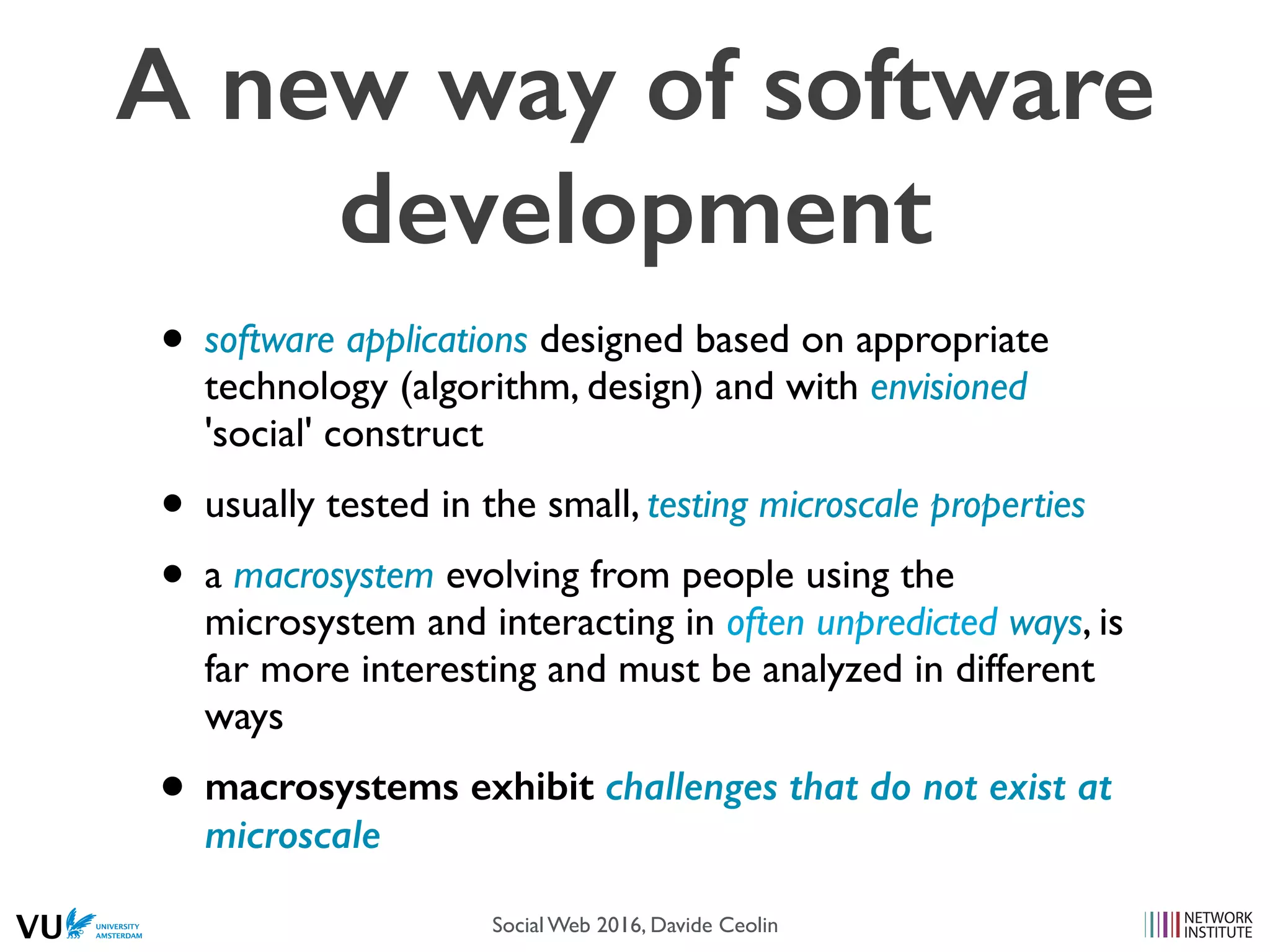
• software applications designed based on appropriate
technology (algorithm, design) and with envisioned
'social' construct
• usually tested in the small, testing microscale properties
• a macrosystem evolving from people using the
microsystem and interacting in often unpredicted ways, is
far more interesting and must be analyzed in different
ways
• macrosystems exhibit challenges that do not exist at
microscale
A new way of software
development
Social Web 2016, Davide Ceolin
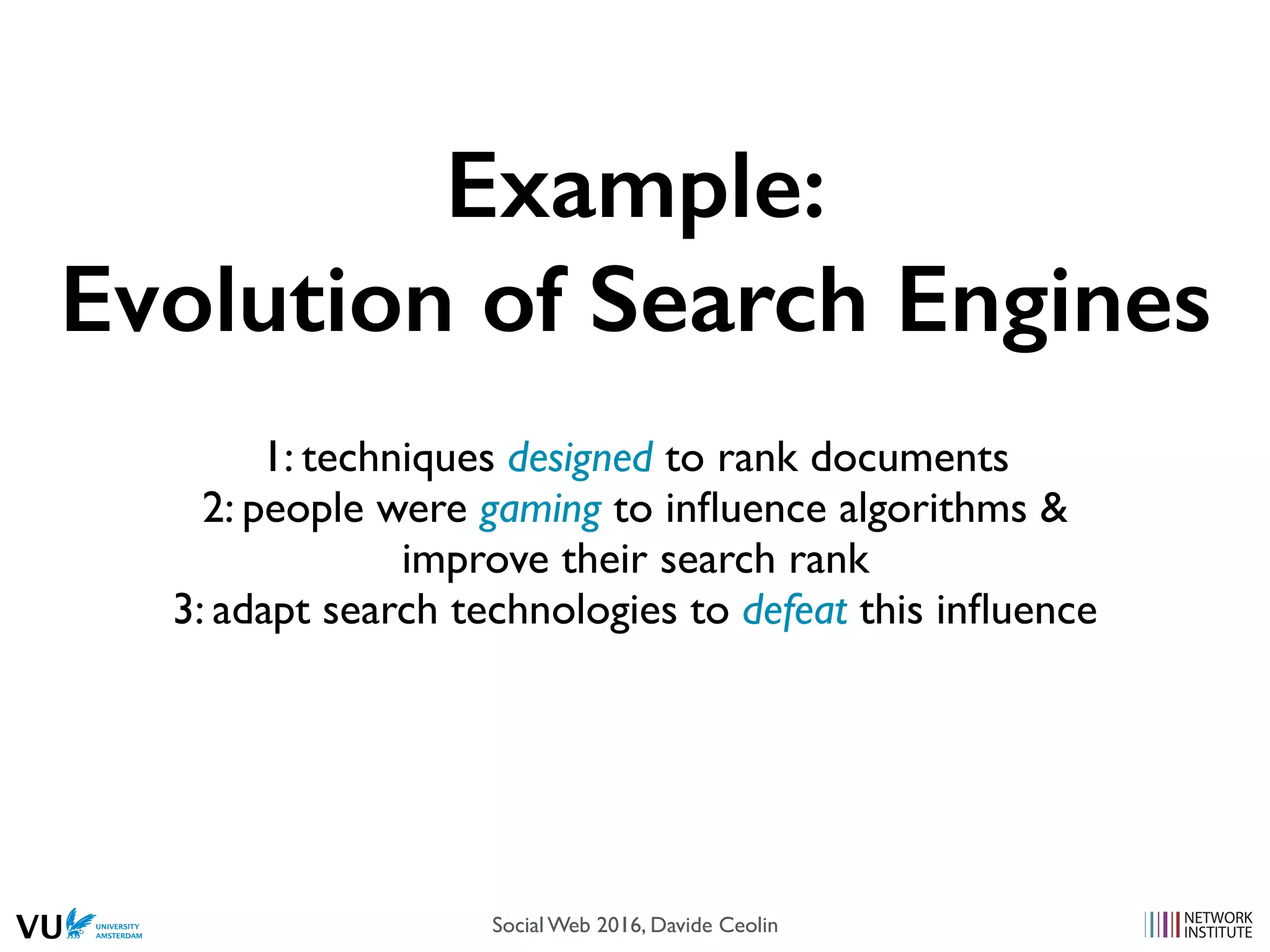
Example:
Evolution of Search Engines
1: techniques designed to rank documents
2: people were gaming to influence algorithms &
improve their search rank
3: adapt search technologies to defeat this influence
Social Web 2016, Davide Ceolin
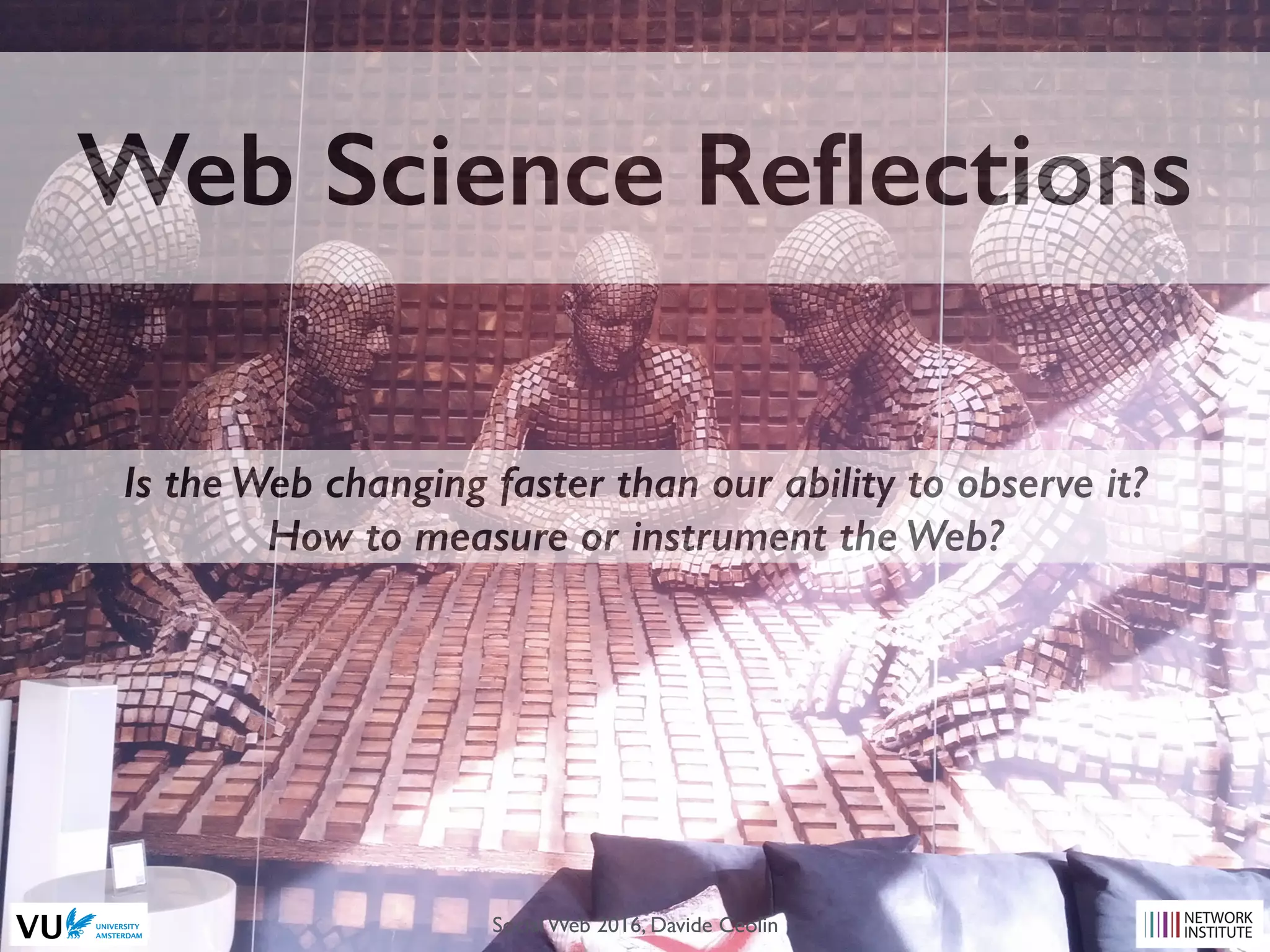
Web Science Reflections
Is the Web changing faster than our ability to observe it?
How to measure or instrument the Web?
Social Web 2016, Davide Ceolin
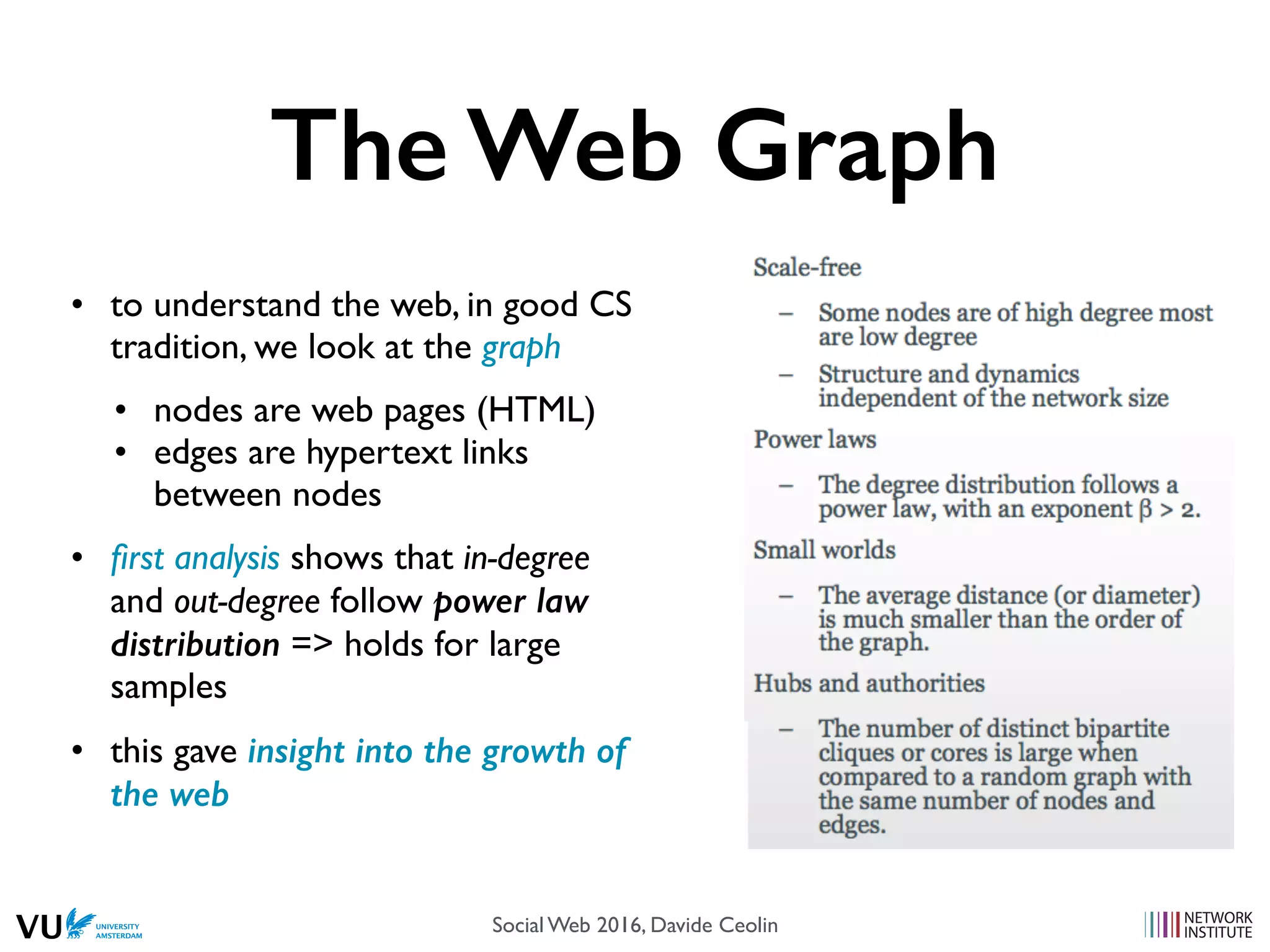
The Web Graph
• to understand the web, in good CS
tradition, we look at the graph
• nodes are web pages (HTML)
• edges are hypertext links
between nodes
• first analysis shows that in-degree
and out-degree follow power law
distribution => holds for large
samples
• this gave insight into the growth of
the web
Social Web 2016, Davide Ceolin
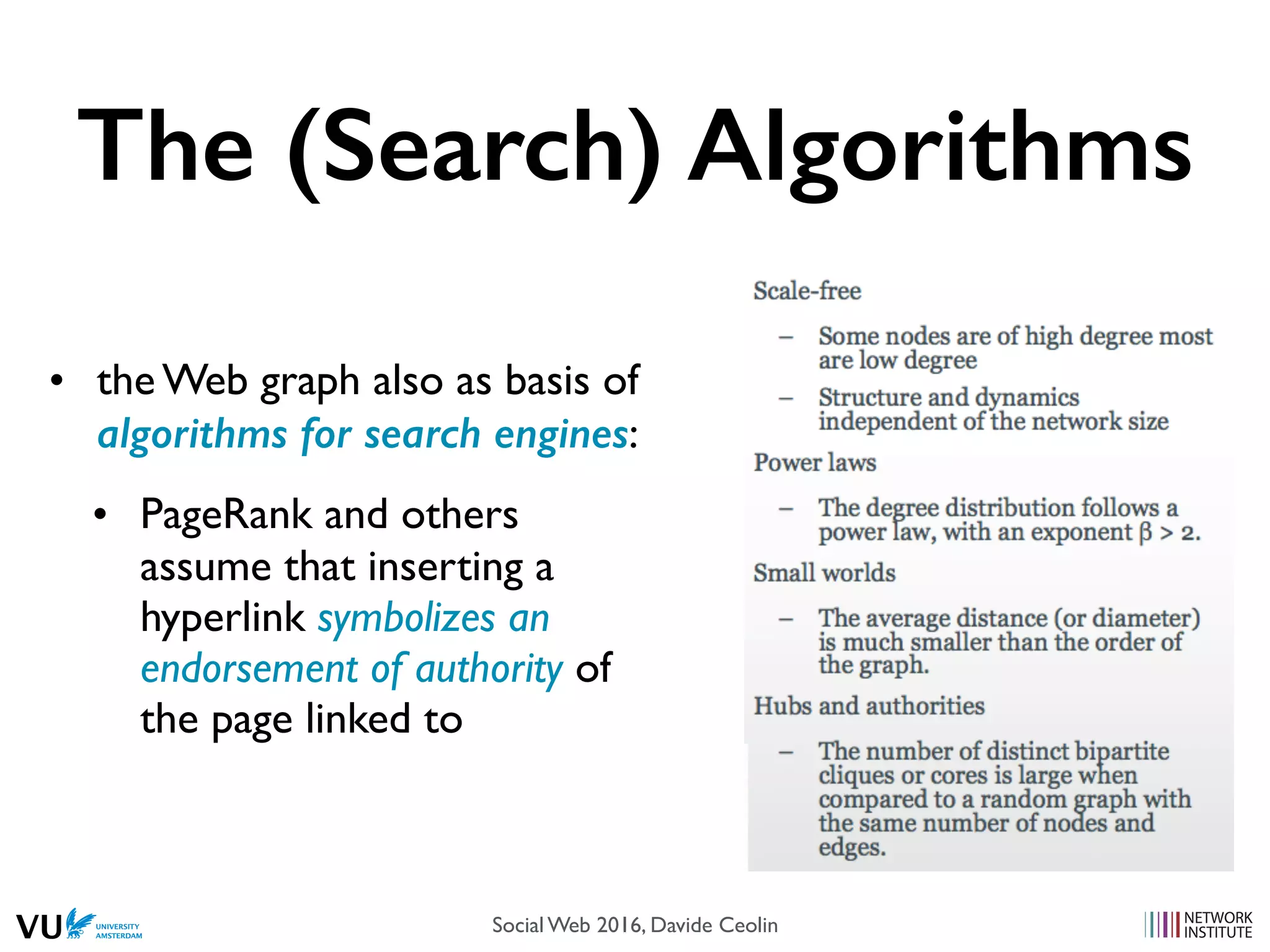
The (Search) Algorithms
• the Web graph also as basis of
algorithms for search engines:
• PageRank and others
assume that inserting a
hyperlink symbolizes an
endorsement of authority of
the page linked to
Social Web 2016, Davide Ceolin
User State is Important
• the original Web graph is too simple, starts from quasi static HTML
• for personalization or customization different representations (of
sources) may be served to different requesters, e.g. cookies
• graph-based models often do not account for this sort of user-
dependent state, and not fit for all the information behind the
servers, in DeepWeb
• it’s not a simple HTTP-GET anymore (but HTTP-POST or HTTP-
GET with complex URI) that is the basis for defining nodes in the
graph
• URis that carry user state are heavily used in Web applications, but
are not in the model and largely unanalyzed
Social Web 2016, Davide Ceolin
According to Google
each day 20-25% of searches have not been seen before, i.e.
generate a new identifier
thus a new node in the graph
more than 20 million new links per day, 200 per second
do they follow the same power laws & growth models?
validating such models is hard
exponential growth of content
changes in number & power of servers
increasing diversity in users
Social Web 2016, Davide Ceolin
Wikipedia
• purely mathematical (technology-based) models do not capture the
whole story
• the Wikipedia structure (link labels) shows a Zipf-like distribution
just like other tag-based systems
• Wikipedia is built on MediaWiki software
• but other MediaWiki-based applications did not generate such
significant use
• the pure 'technological' explanation cannot explain it
• must be related to the 'social model' of how Wikipedia is
organized
this is referred to as the dynamics of a 'social machine' (already inTBL’s original vision ofWWW)
Social Web 2014, Lora Aroyo!
Collective Intelligence
• why do people contribute?
• how to maintain the connected content?
• how are trust & provenance represented, maintained
and repaired on the Web?
Social Web 2014, Lora Aroyo!Social Web 2016, Davide Ceolin
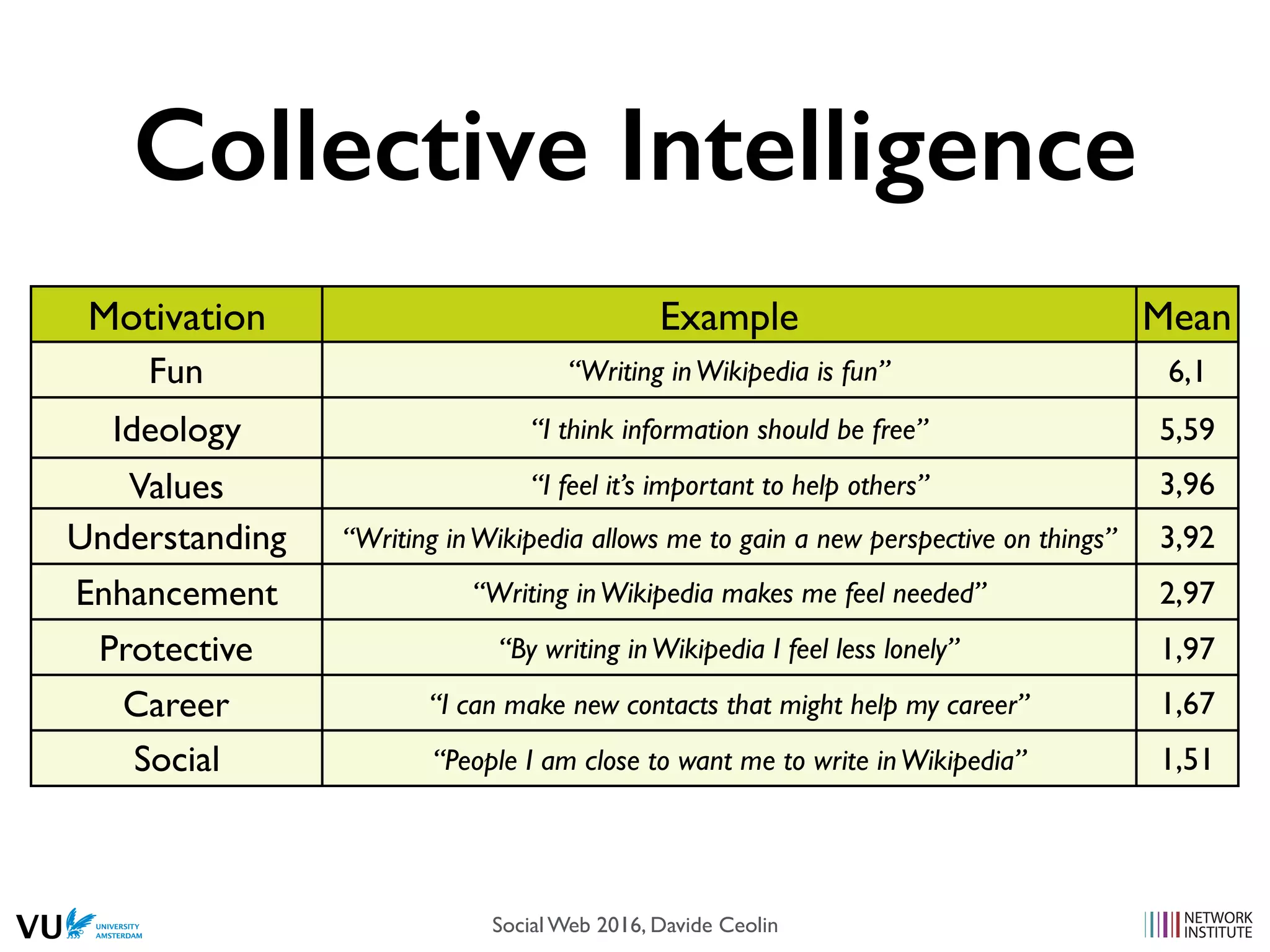
Collective Intelligence
Motivation Example Mean
Fun “Writing inWikipedia is fun” 6,1
Ideology “I think information should be free” 5,59
Values “I feel it’s important to help others” 3,96
Understanding “Writing inWikipedia allows me to gain a new perspective on things” 3,92
Enhancement “Writing inWikipedia makes me feel needed” 2,97
Protective “By writing inWikipedia I feel less lonely” 1,97
Career “I can make new contacts that might help my career” 1,67
Social “People I am close to want me to write inWikipedia” 1,51
Social Web 2016, Davide Ceolin
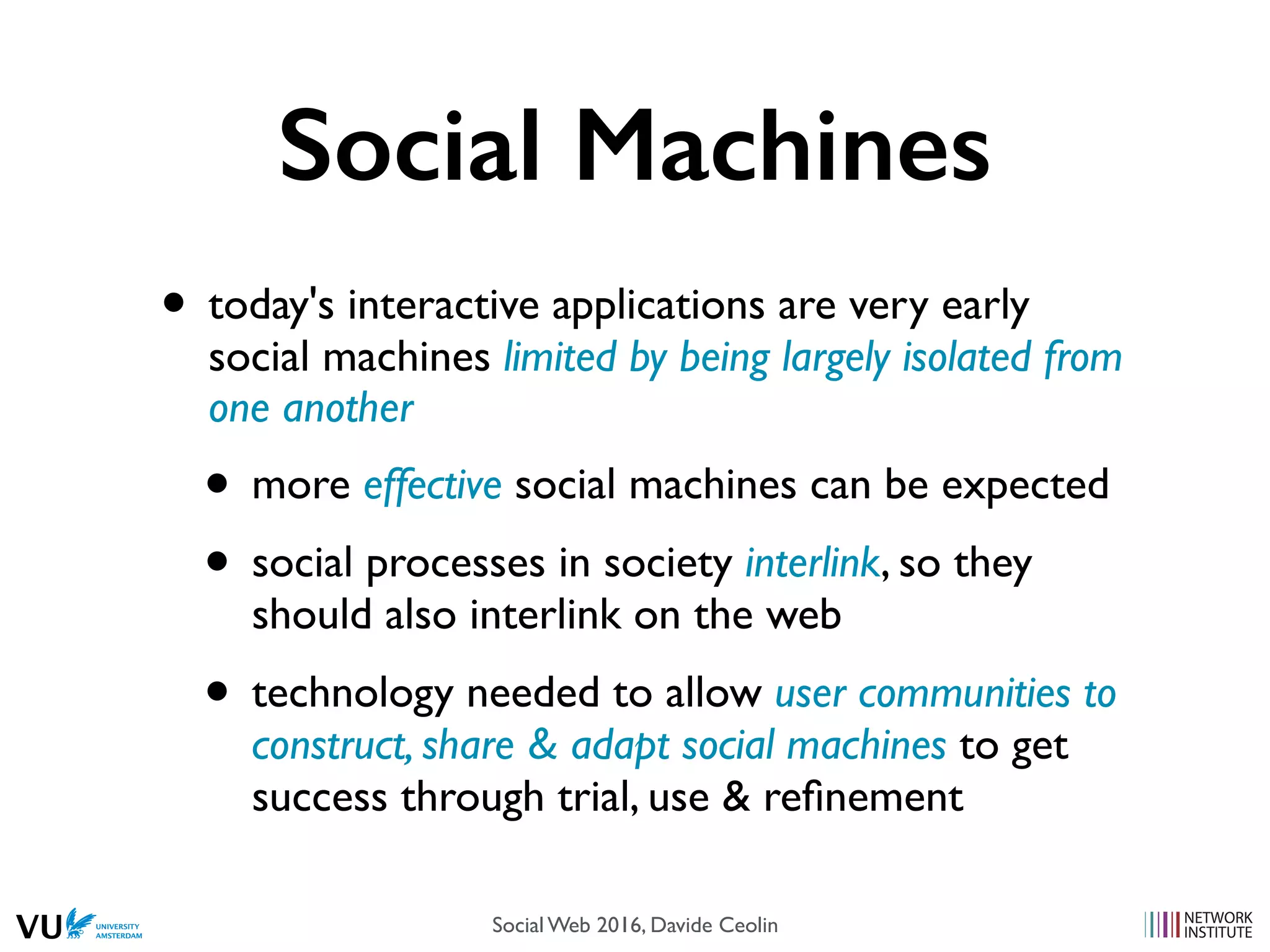
Social Machines
• today's interactive applications are very early
social machines limited by being largely isolated from
one another
• more effective social machines can be expected
• social processes in society interlink, so they
should also interlink on the web
• technology needed to allow user communities to
construct, share & adapt social machines to get
success through trial, use & refinement
Social Web 2014, Lora Aroyo!Social Web 2016, Davide Ceolin
Social Web 2016, Davide Ceolin
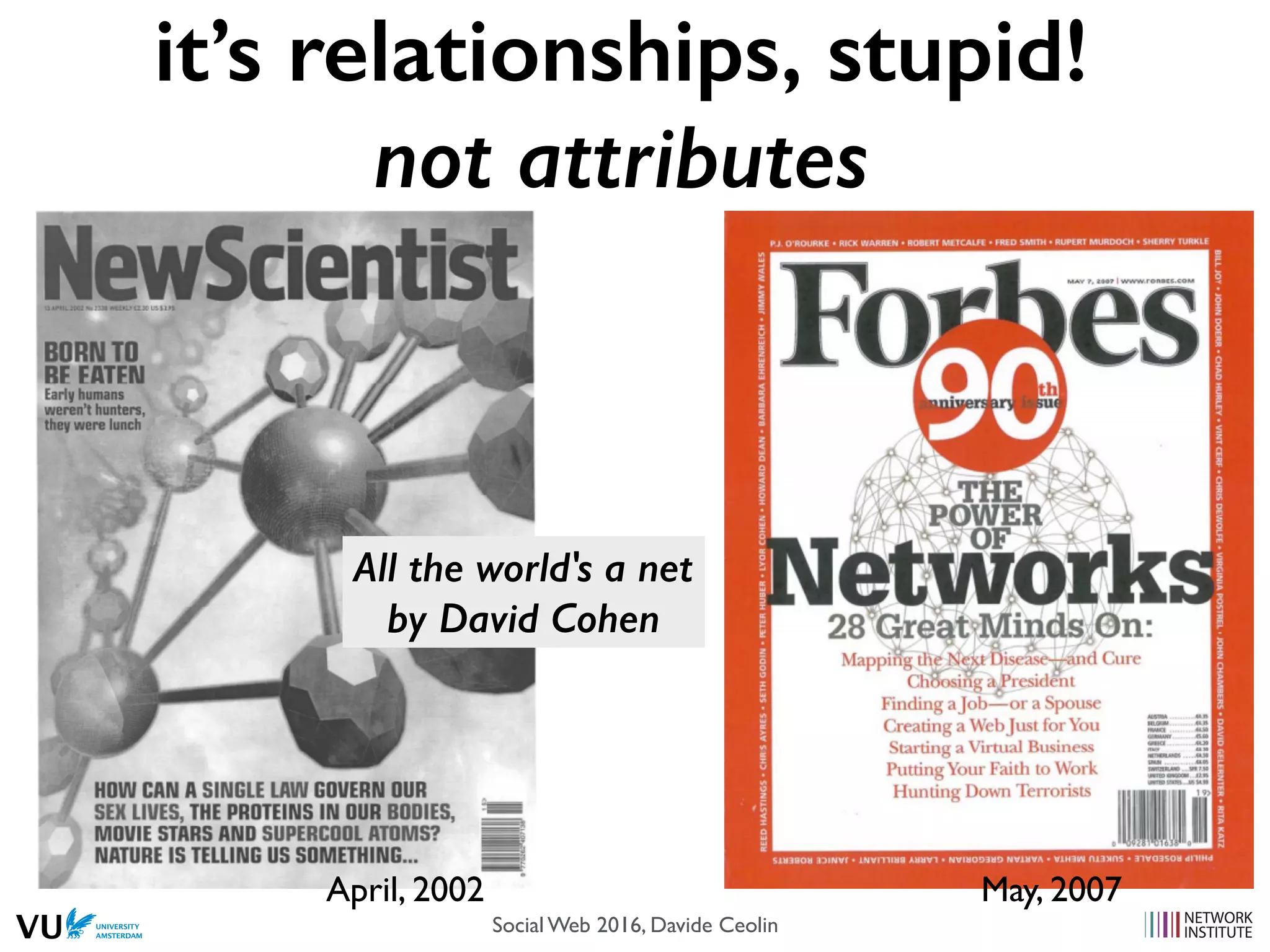
it’s relationships, stupid!
not attributes
May, 2007April, 2002
All the world's a net
by David Cohen
Social Web 2016, Davide Ceolin
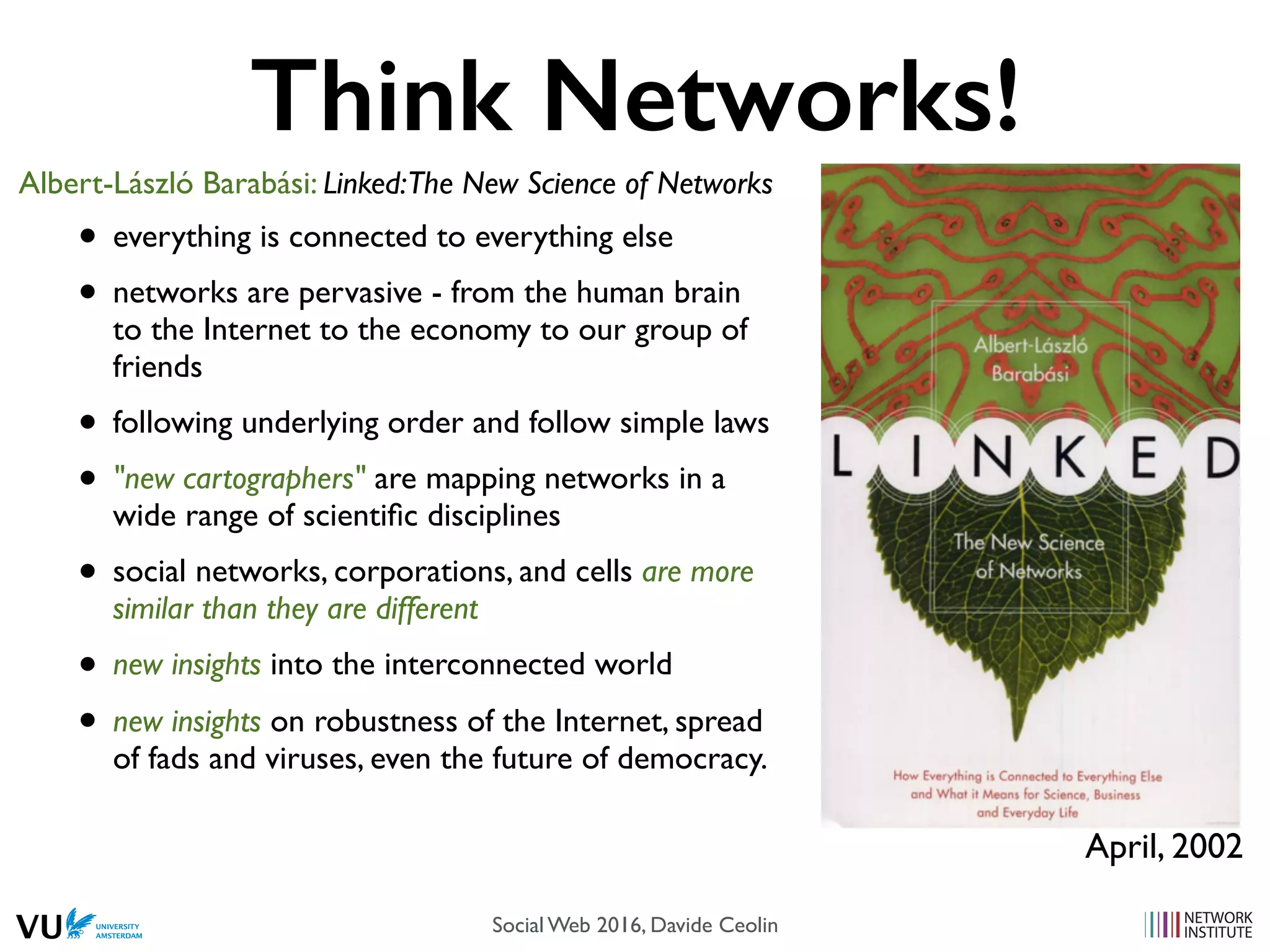
Think Networks!
• everything is connected to everything else
• networks are pervasive - from the human brain
to the Internet to the economy to our group of
friends
• following underlying order and follow simple laws
• "new cartographers" are mapping networks in a
wide range of scientific disciplines
• social networks, corporations, and cells are more
similar than they are different
• new insights into the interconnected world
• new insights on robustness of the Internet, spread
of fads and viruses, even the future of democracy.
Albert-László Barabási: Linked:The New Science of Networks
April, 2002
Social Web 2016, Davide Ceolin
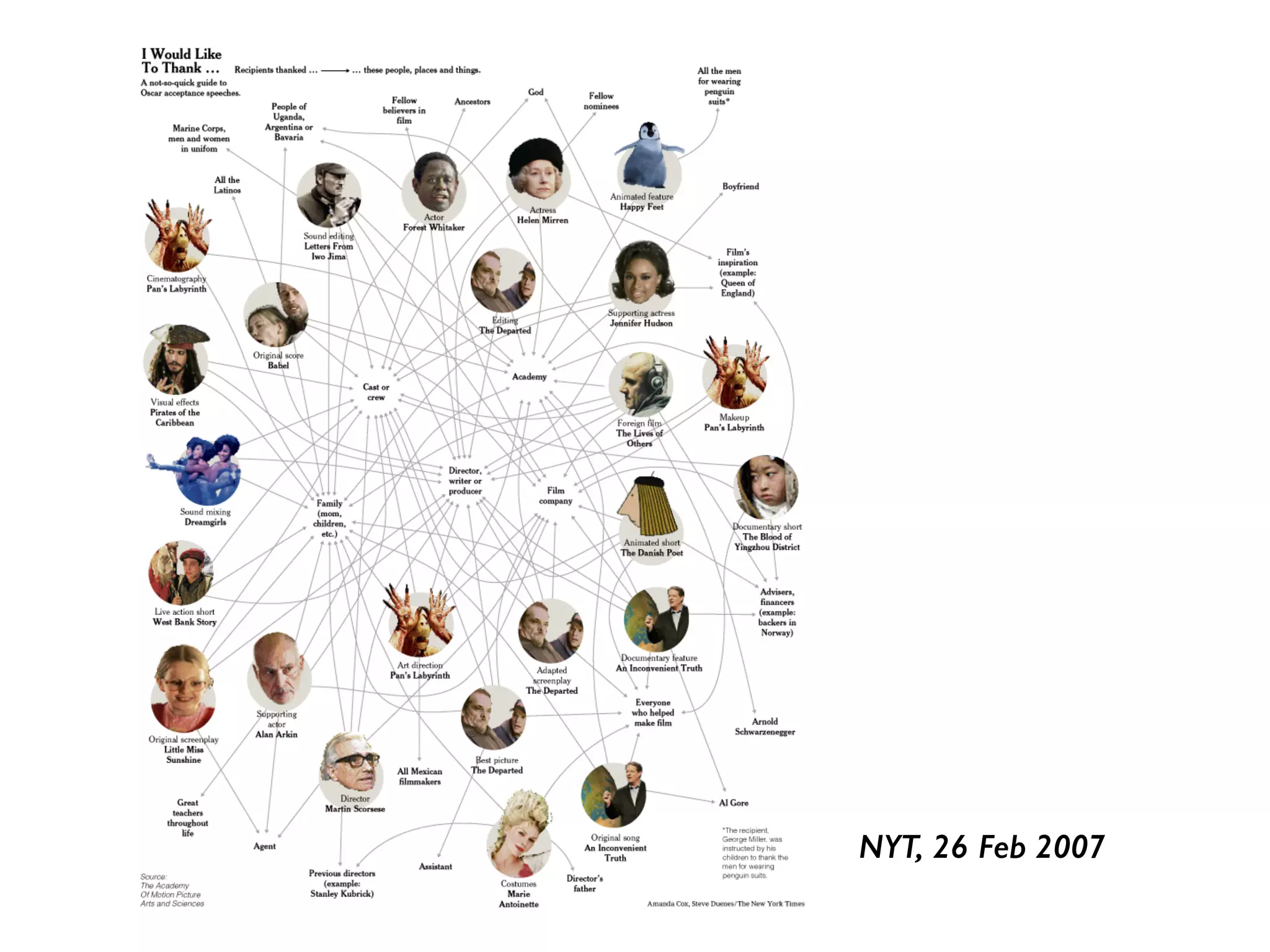
NYT, 26 Feb 2007
Networks:
another perspective
• Social Networks: It’s not what you know,
it’s who you know
• Cognitive Social Networks: It’s not who
you know, it’s who they think you know.
• Knowledge Networks: It’s not what you
know, it’s what they think you know
Social Web 2016, Davide Ceolin
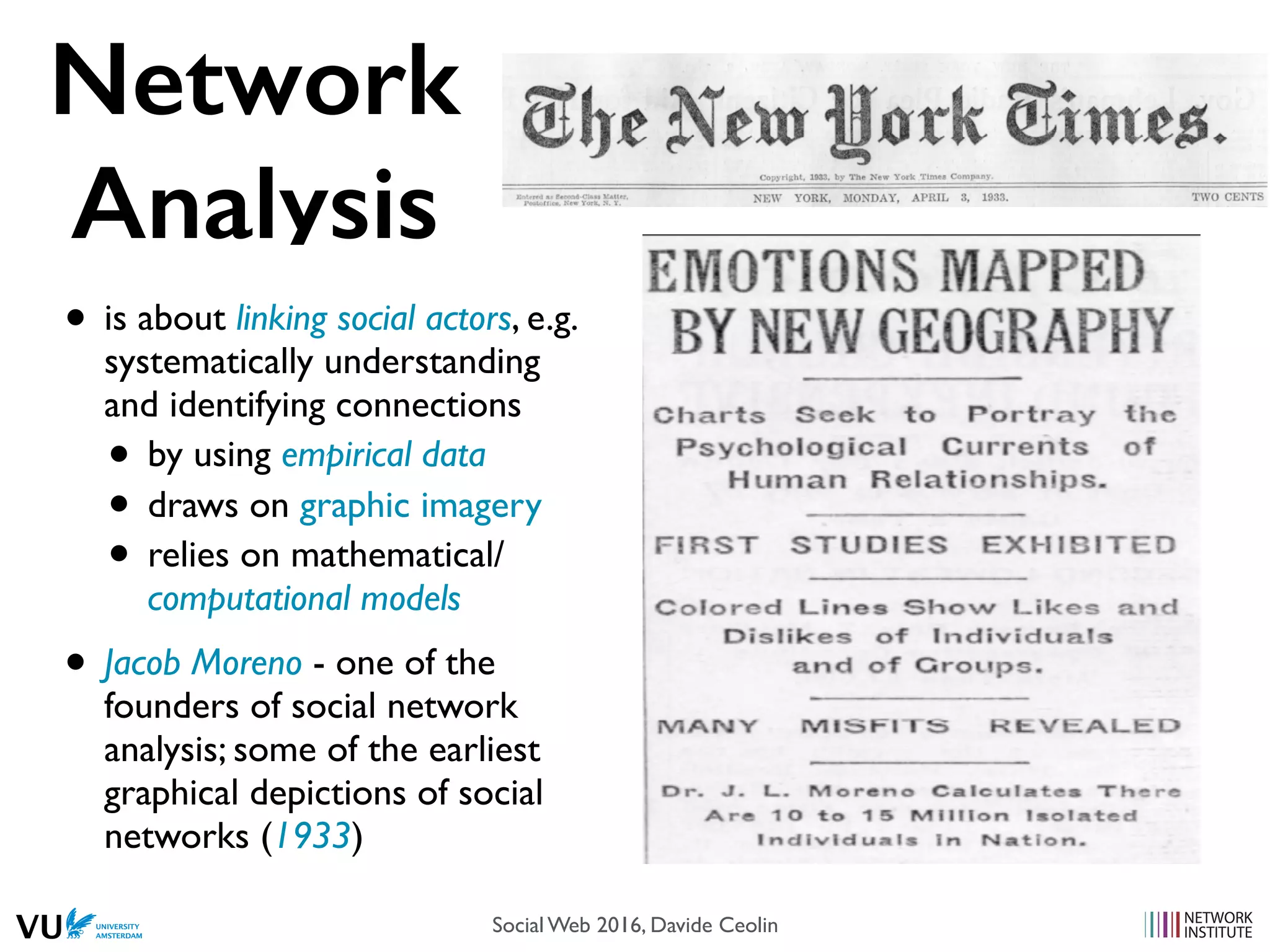
Network
Analysis
• is about linking social actors, e.g.
systematically understanding
and identifying connections
• by using empirical data
• draws on graphic imagery
• relies on mathematical/
computational models
• Jacob Moreno - one of the
founders of social network
analysis; some of the earliest
graphical depictions of social
networks (1933)
Social Web 2016, Davide Ceolin
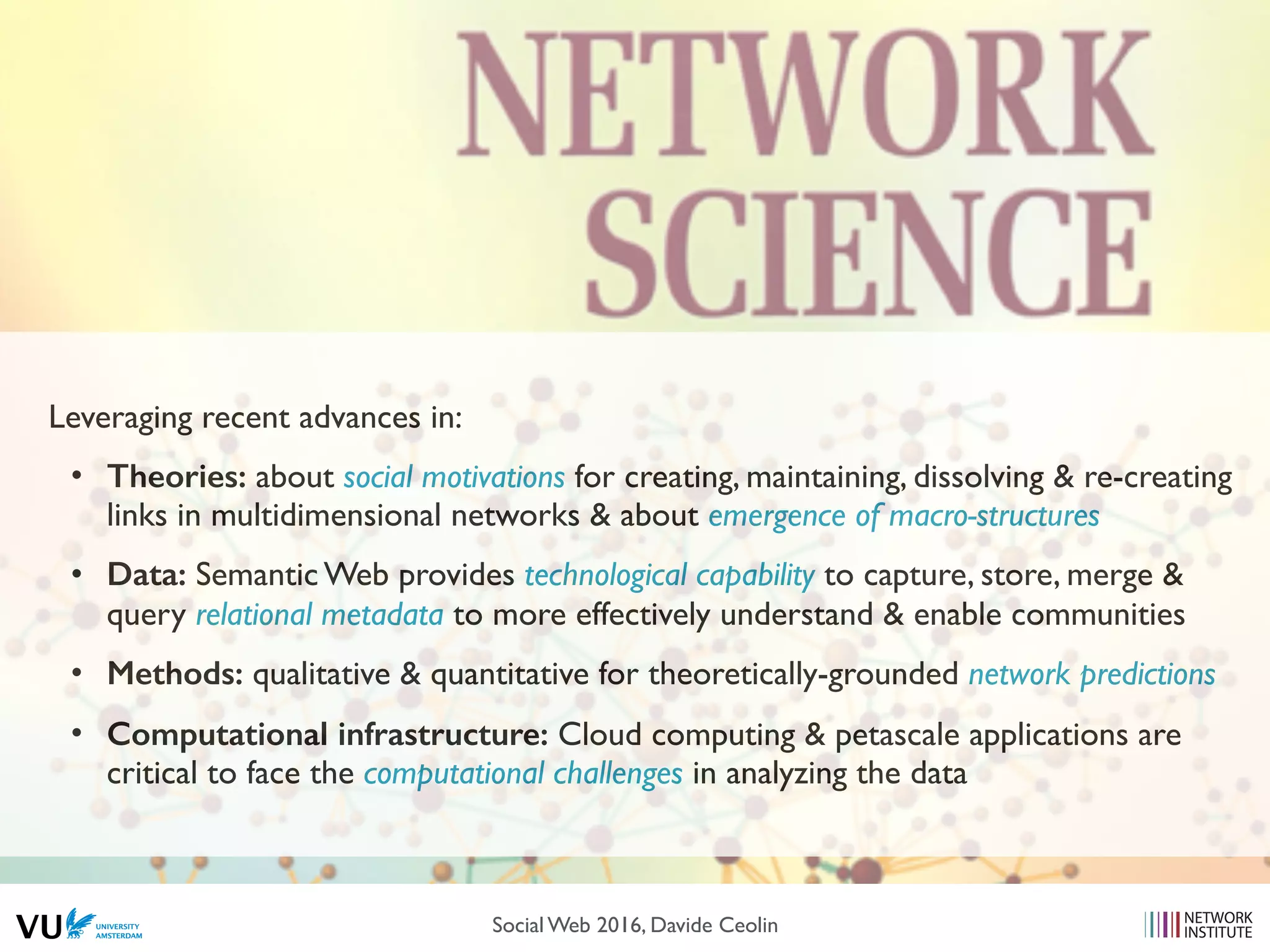
Leveraging recent advances in:
• Theories: about social motivations for creating, maintaining, dissolving & re-creating
links in multidimensional networks & about emergence of macro-structures
• Data: Semantic Web provides technological capability to capture, store, merge &
query relational metadata to more effectively understand & enable communities
• Methods: qualitative & quantitative for theoretically-grounded network predictions
• Computational infrastructure: Cloud computing & petascale applications are
critical to face the computational challenges in analyzing the data
Social Web 2016, Davide Ceolin
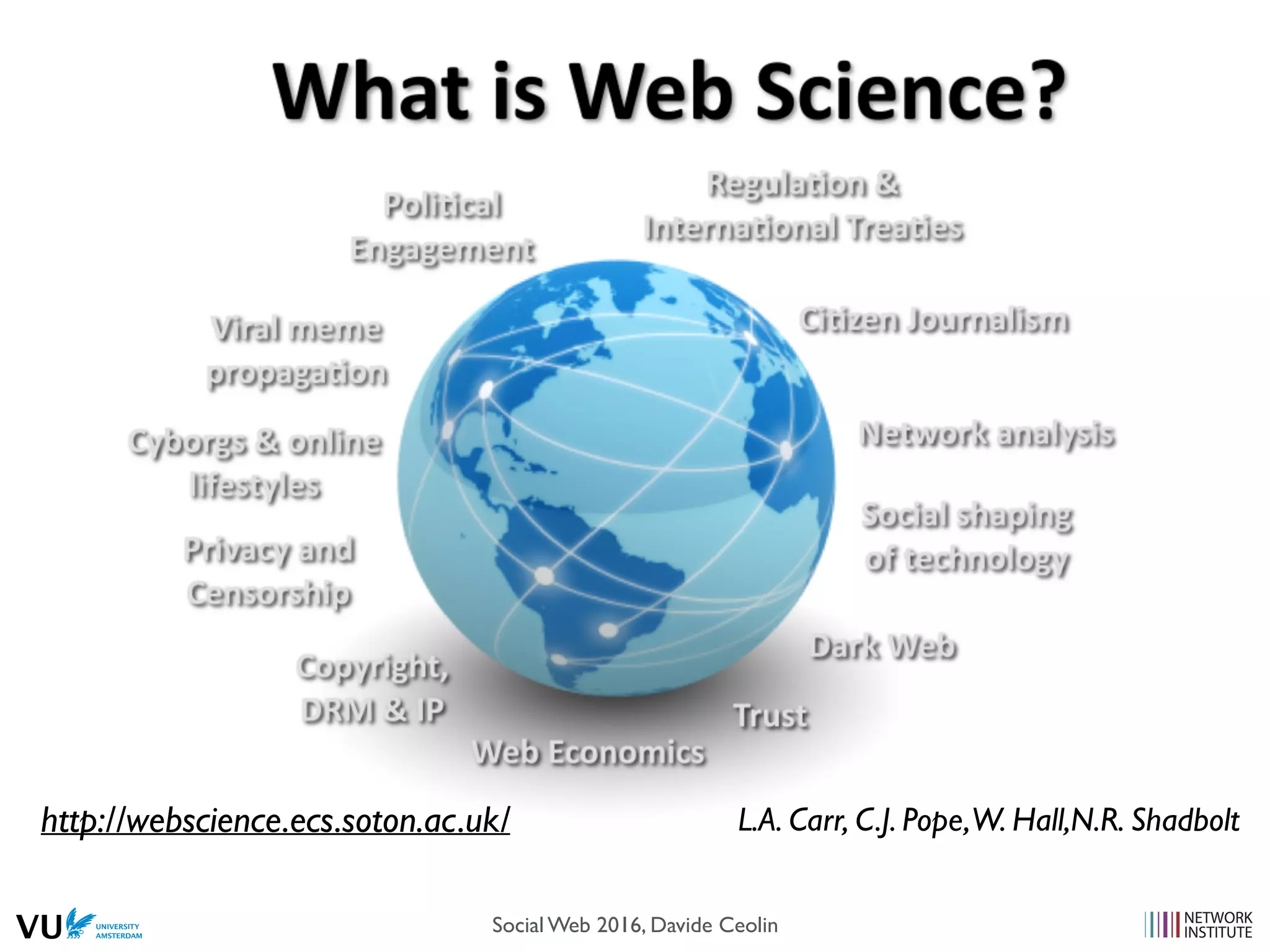
http://webscience.ecs.soton.ac.uk/ L.A. Carr, C.J. Pope,W. Hall,N.R. Shadbolt
Social Web 2016, Davide Ceolin
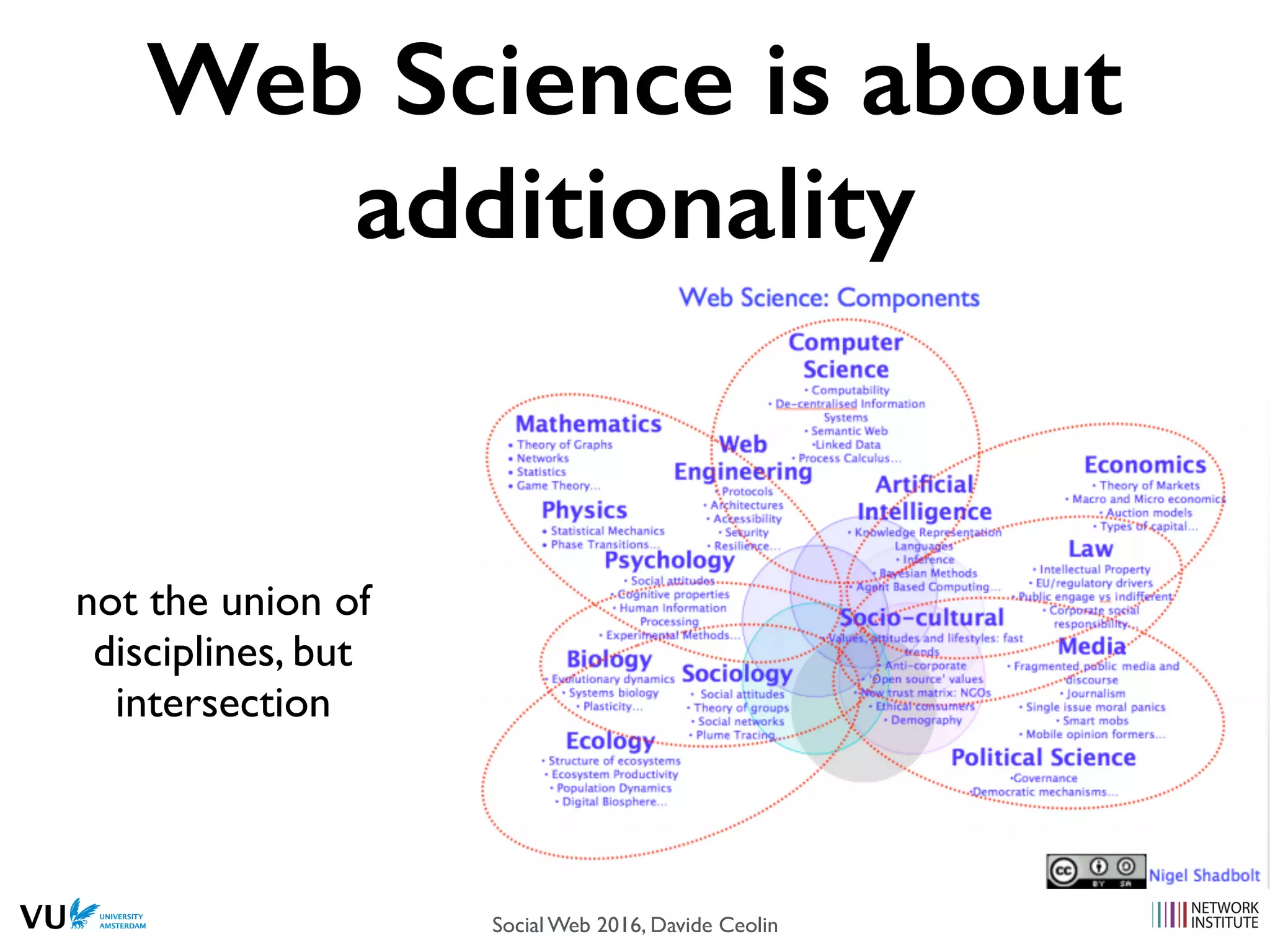
Web Science is about
additionality
not the union of
disciplines, but
intersection
Social Web 2016, Davide Ceolin
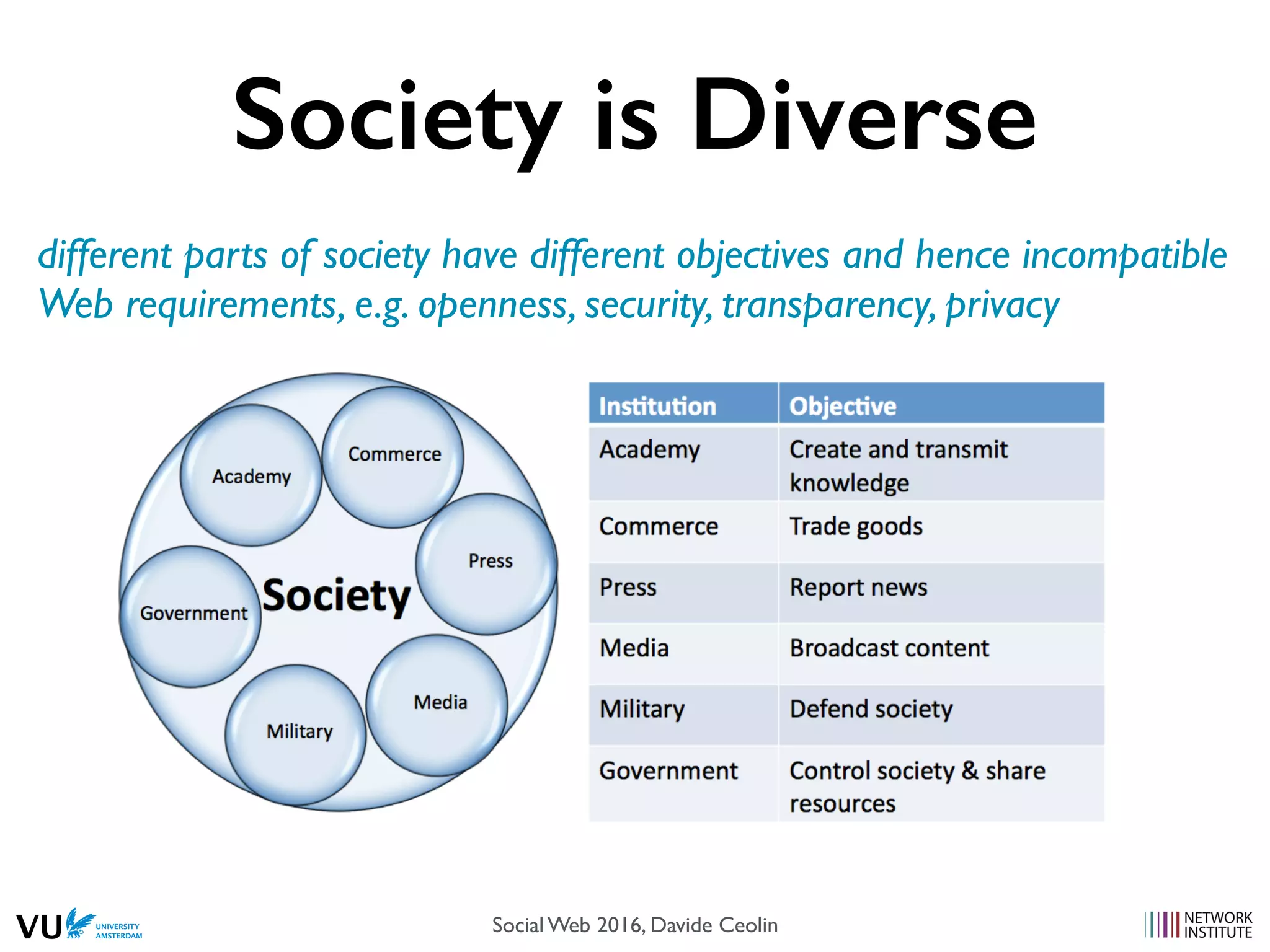
Society is Diverse
different parts of society have different objectives and hence incompatible
Web requirements, e.g. openness, security, transparency, privacy
Social Web 2016, Davide Ceolin
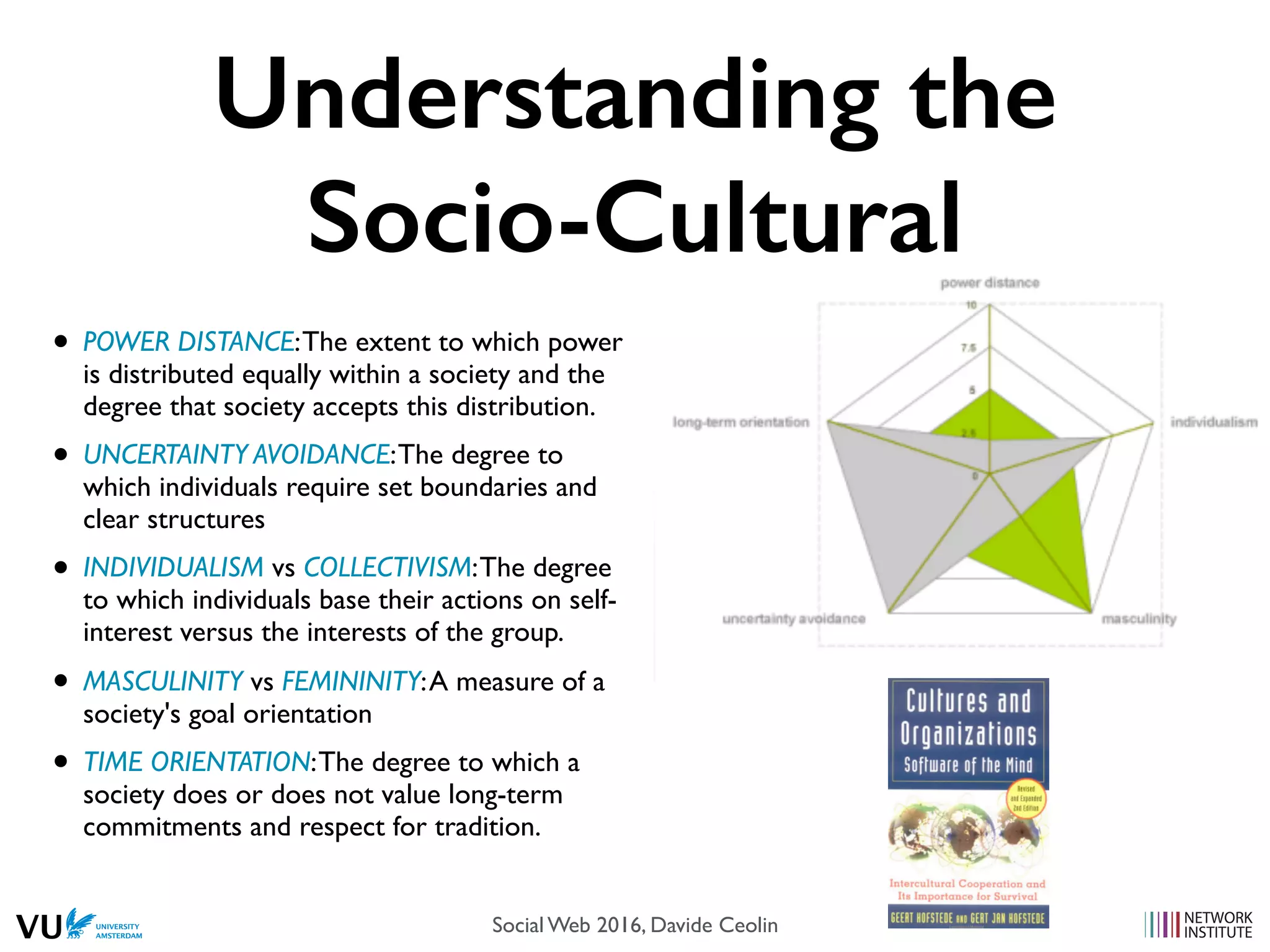
• POWER DISTANCE:The extent to which power
is distributed equally within a society and the
degree that society accepts this distribution.
• UNCERTAINTY AVOIDANCE:The degree to
which individuals require set boundaries and
clear structures
• INDIVIDUALISM vs COLLECTIVISM:The degree
to which individuals base their actions on self-
interest versus the interests of the group.
• MASCULINITY vs FEMININITY:A measure of a
society's goal orientation
• TIME ORIENTATION:The degree to which a
society does or does not value long-term
commitments and respect for tradition.
Understanding the
Socio-Cultural
Social Web 2016, Davide Ceolin
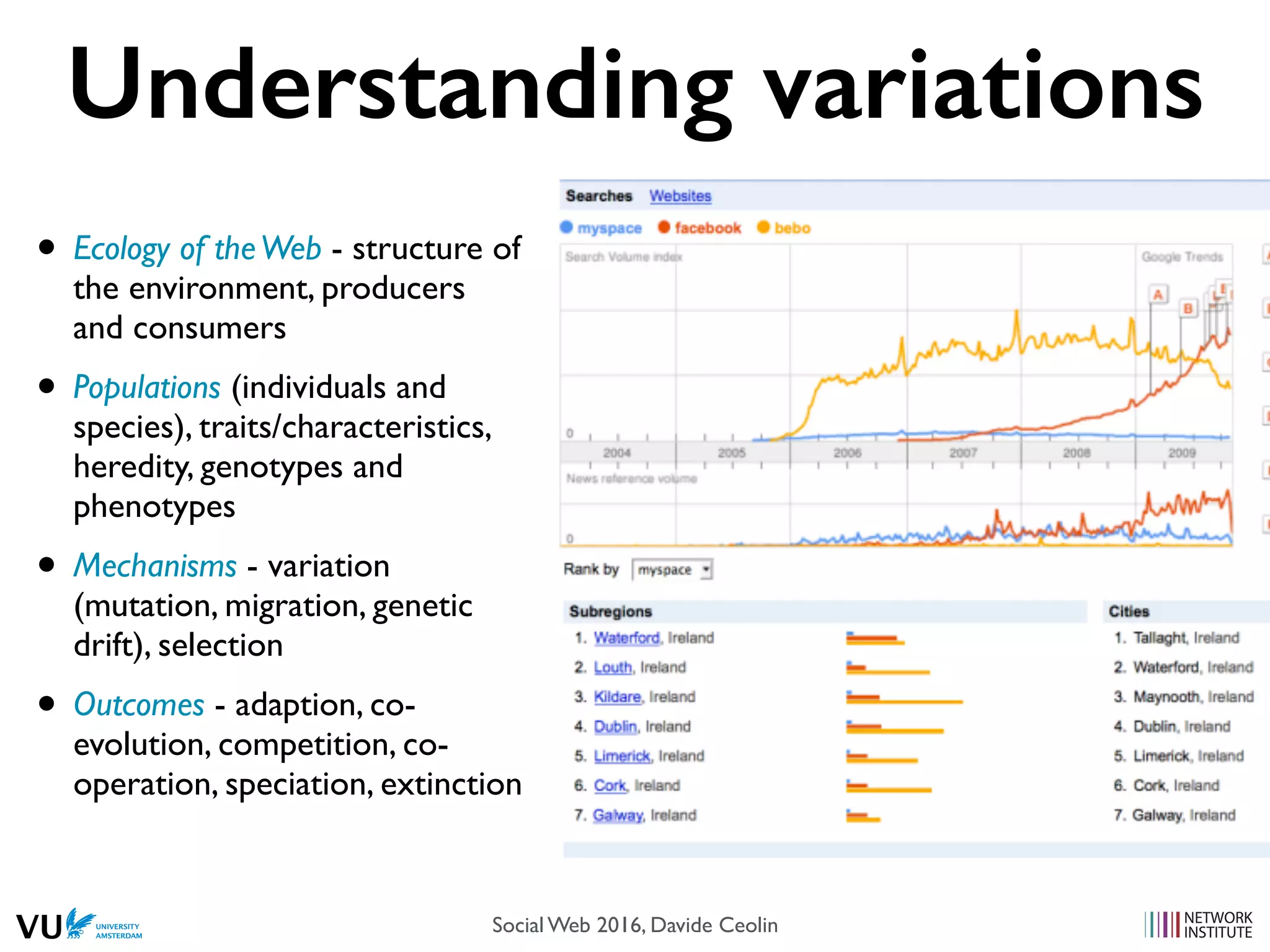
Understanding variations
• Ecology of theWeb - structure of
the environment, producers
and consumers
• Populations (individuals and
species), traits/characteristics,
heredity, genotypes and
phenotypes
• Mechanisms - variation
(mutation, migration, genetic
drift), selection
• Outcomes - adaption, co-
evolution, competition, co-
operation, speciation, extinction
Social Web 2016, Davide Ceolin
but
How to do the Science?
Social Web 2016, Davide Ceolin
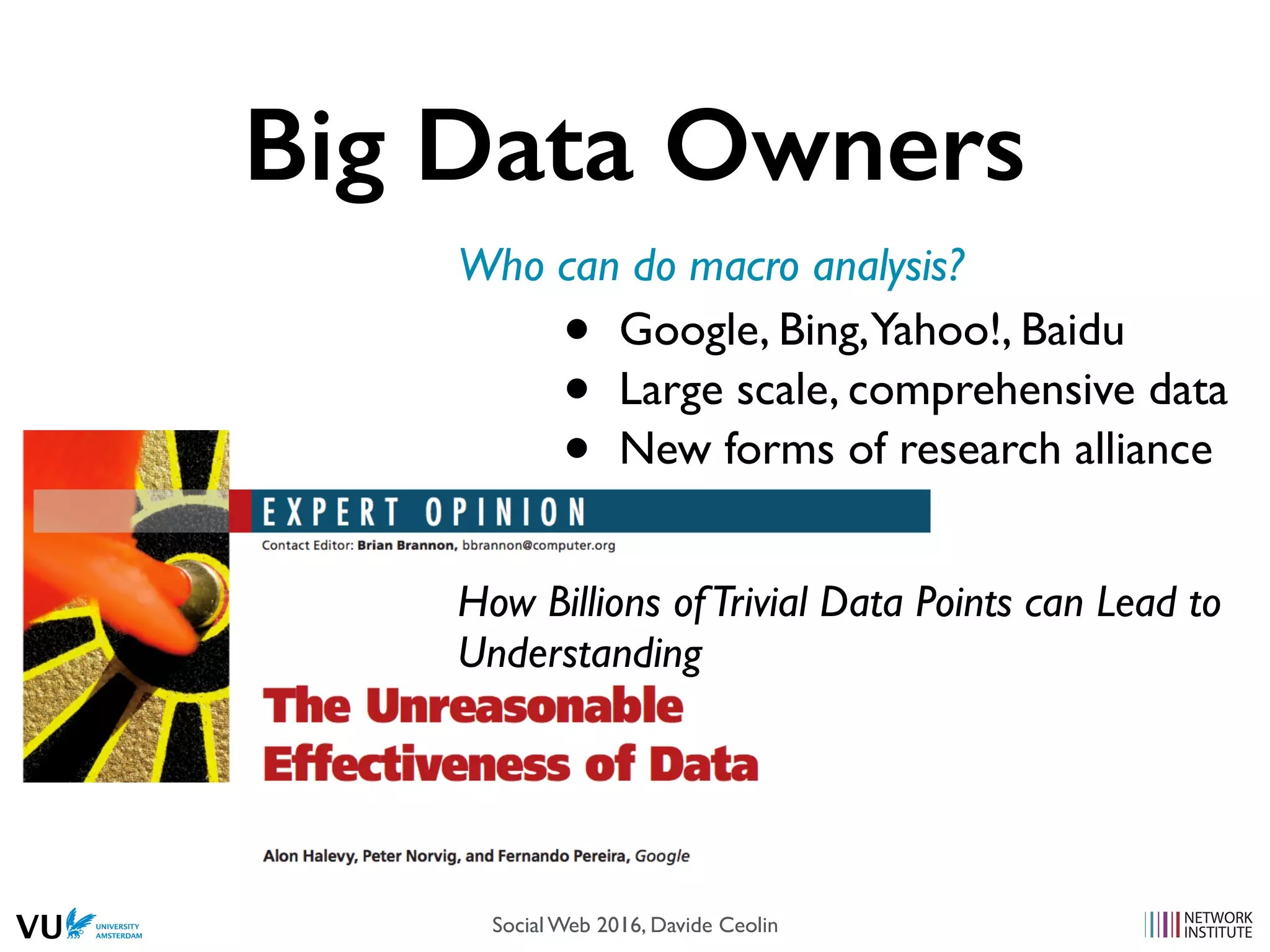
Big Data Owners
Who can do macro analysis?
• Google, Bing,Yahoo!, Baidu
• Large scale, comprehensive data
• New forms of research alliance
How Billions ofTrivial Data Points can Lead to
Understanding
Social Web 2016, Davide Ceolin
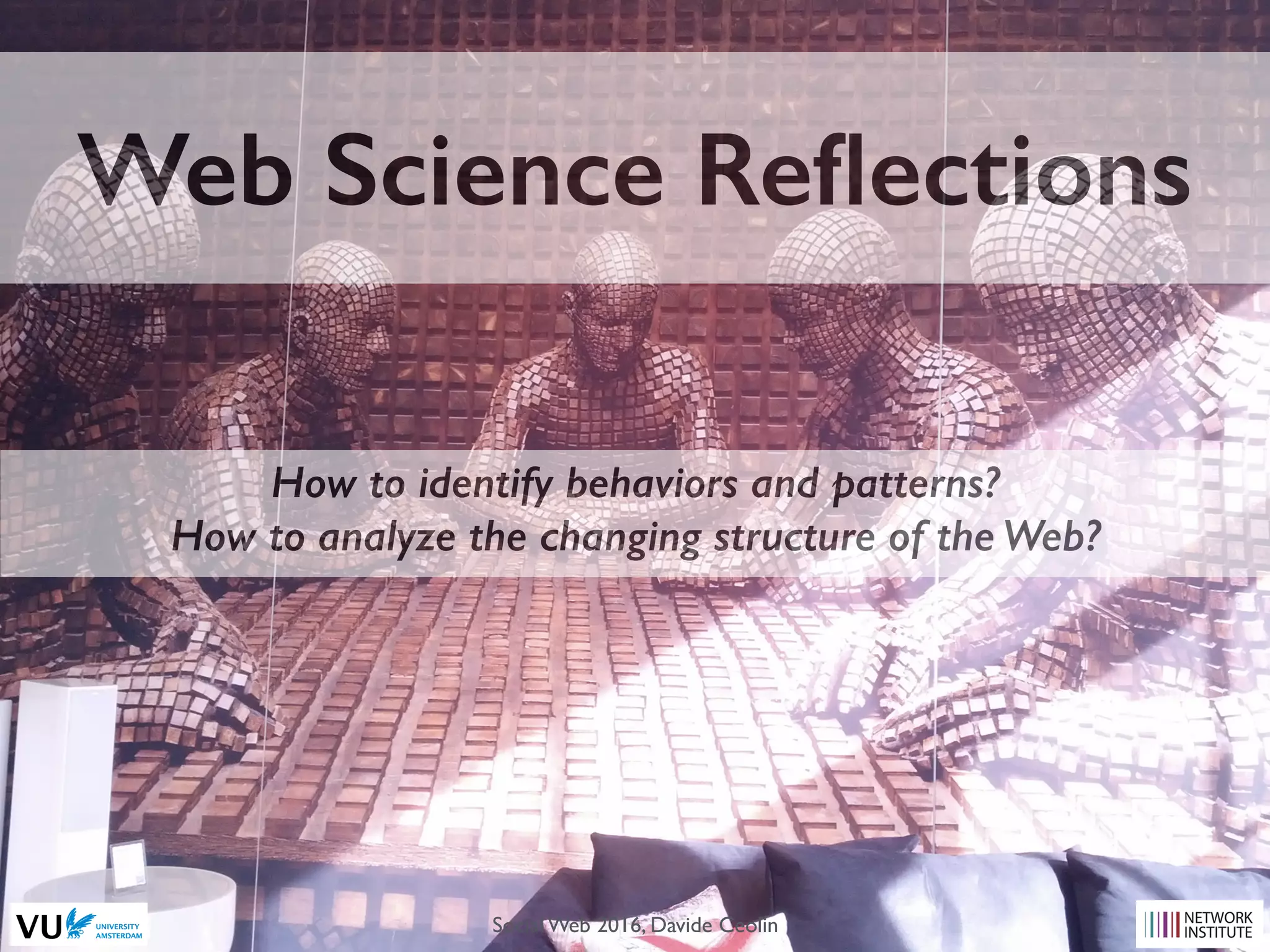
Web Science Reflections
How to identify behaviors and patterns?
How to analyze the changing structure of the Web?
Social Web 2016, Davide Ceolin
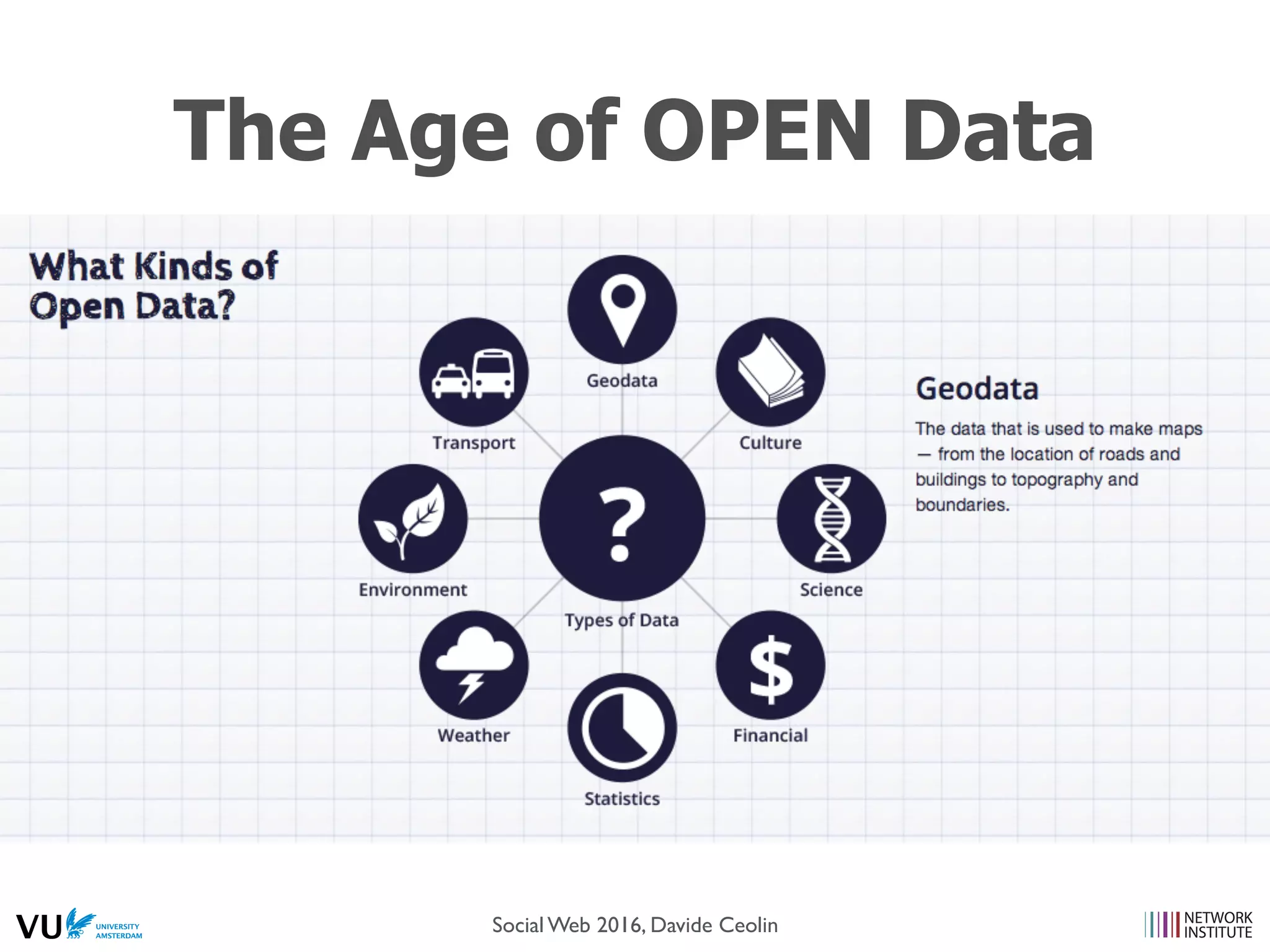
The Age of OPEN Data
Social Web 2016, Davide Ceolin
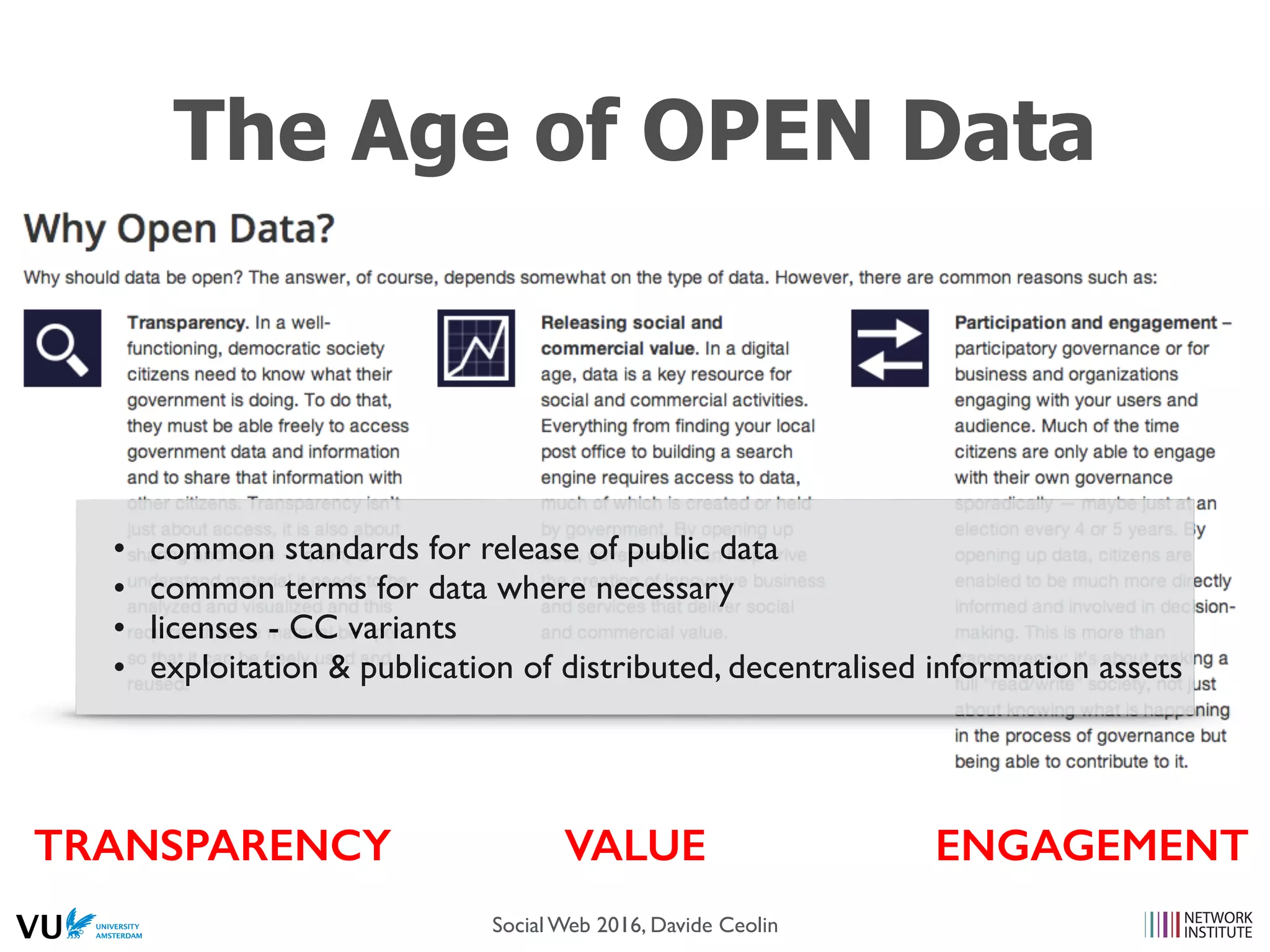
The Age of OPEN Data
TRANSPARENCY VALUE ENGAGEMENT
• common standards for release of public data
• common terms for data where necessary
• licenses - CC variants
• exploitation & publication of distributed, decentralised information assets
Social Web 2016, Davide Ceolin
Big Bang:
Web Information
• the assumption of open exchange of information is
being imposed on the society
• is the Web, and its open access, open data, scientific &
creative commons offer a beneficial opportunity or
dangerous cul-de-sac?
Social Web 2016, Davide Ceolin
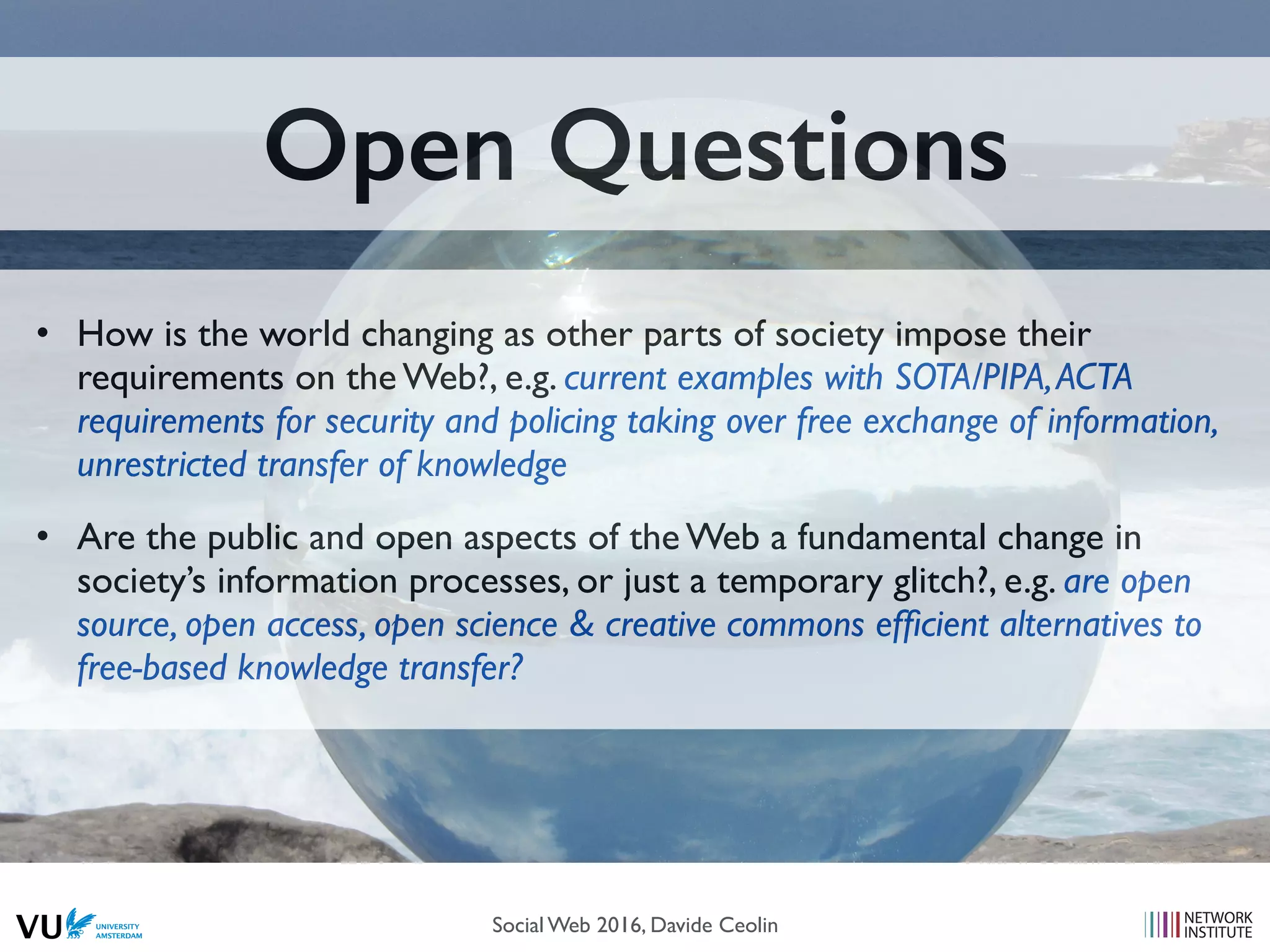
Open Questions
• How is the world changing as other parts of society impose their
requirements on the Web?, e.g. current examples with SOTA/PIPA,ACTA
requirements for security and policing taking over free exchange of information,
unrestricted transfer of knowledge
• Are the public and open aspects of the Web a fundamental change in
society’s information processes, or just a temporary glitch?, e.g. are open
source, open access, open science & creative commons efficient alternatives to
free-based knowledge transfer?
Social Web 2016, Davide Ceolin
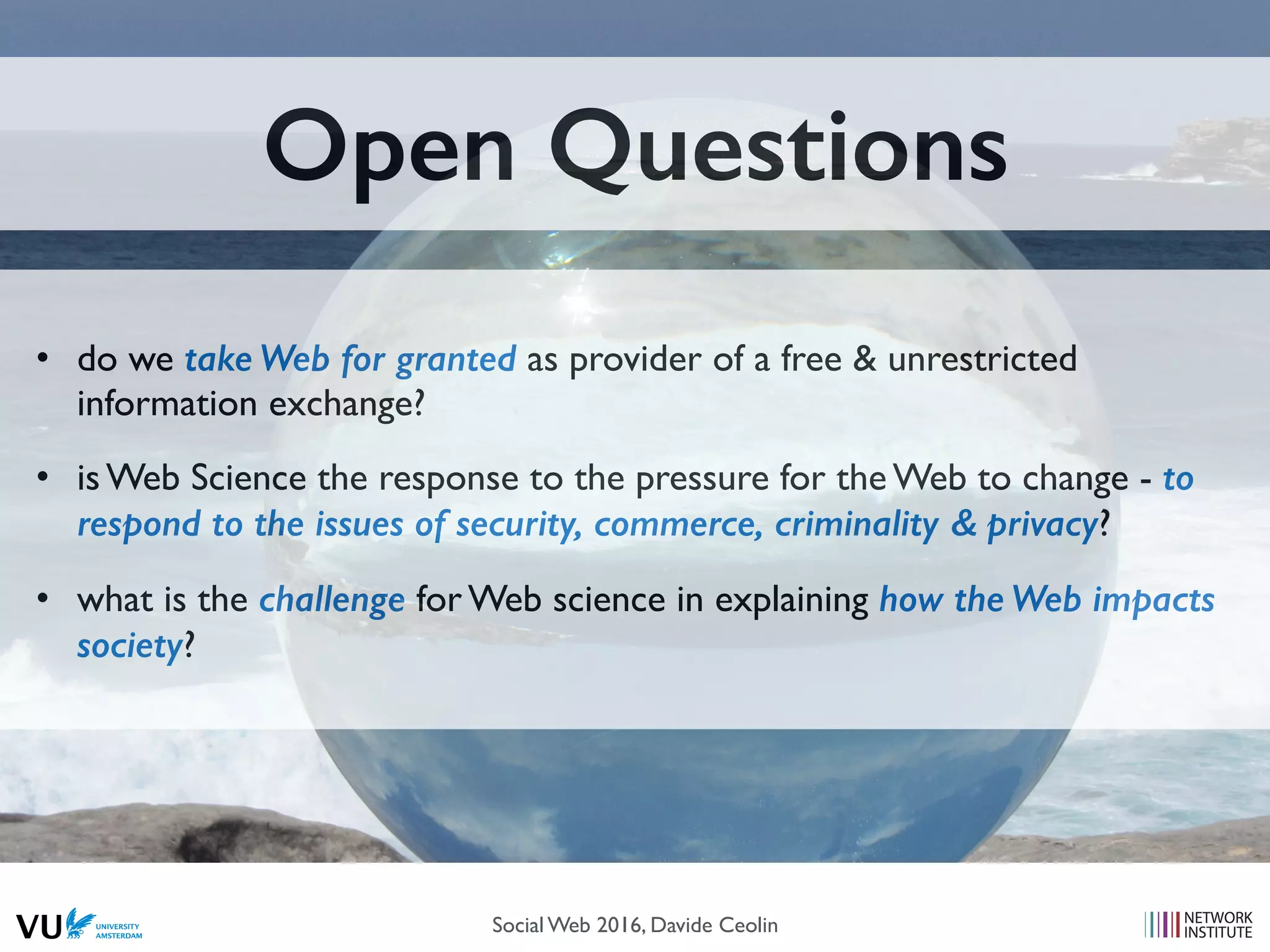
Open Questions
• do we take Web for granted as provider of a free & unrestricted
information exchange?
• is Web Science the response to the pressure for the Web to change - to
respond to the issues of security, commerce, criminality & privacy?
• what is the challenge for Web science in explaining how the Web impacts
society?
Social Web 2016, Davide Ceolin
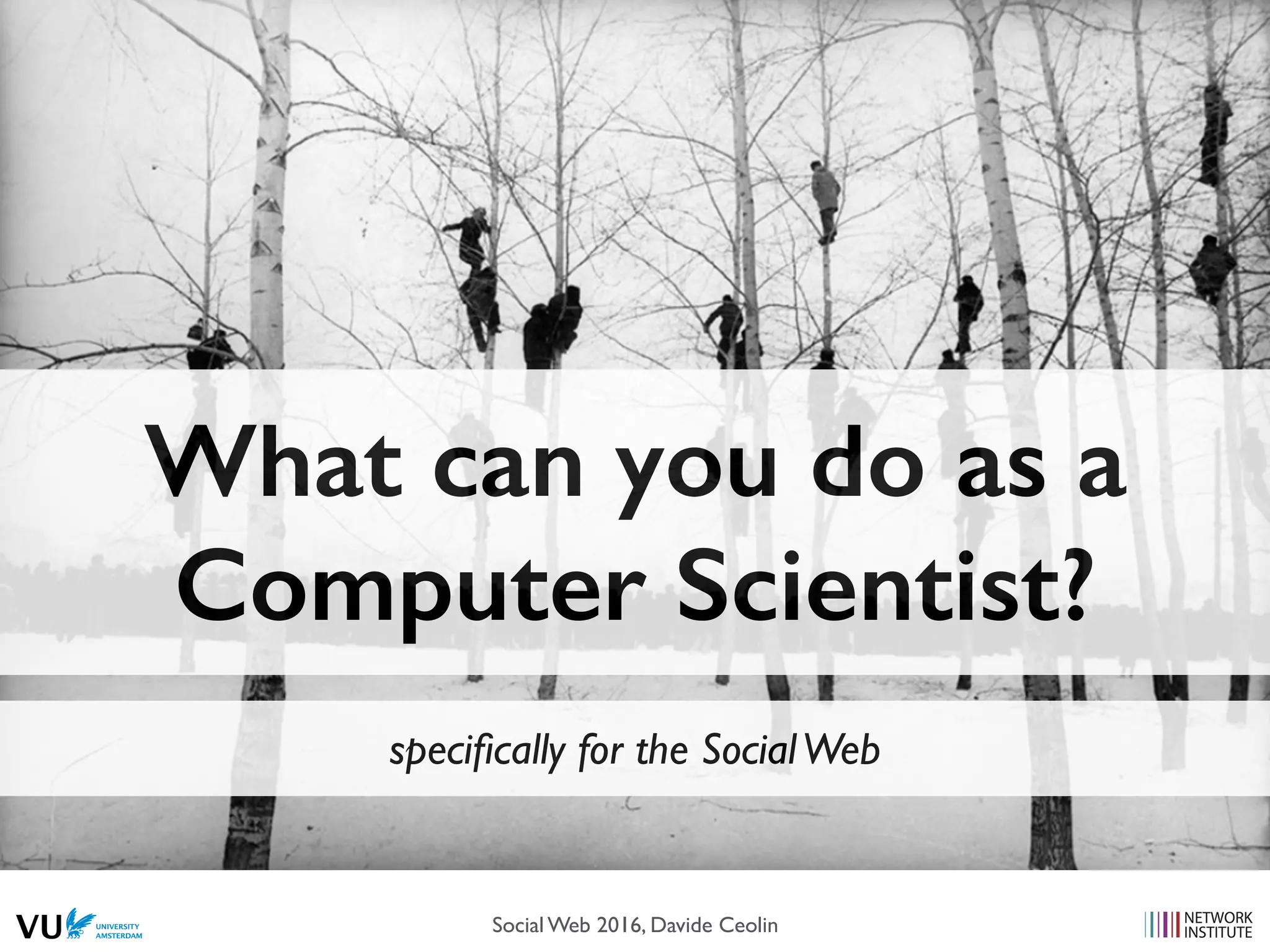
What can you do as a
Computer Scientist?
specifically for the SocialWeb
Social Web 2016, Davide Ceolin
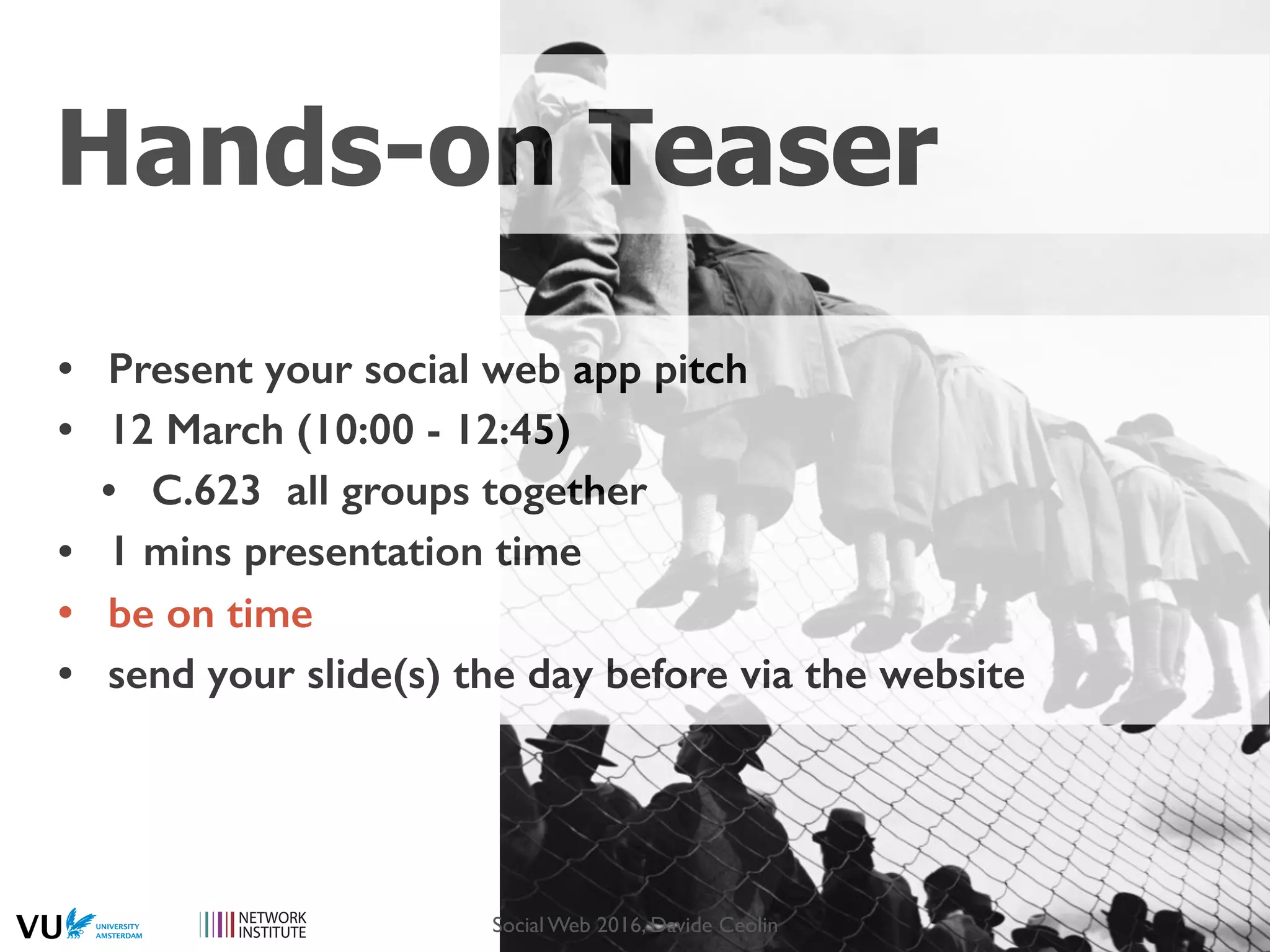
Hands-on Teaser
• Present your social web app pitch
• 12 March (10:00 - 12:45)
• C.623 all groups together
• 1 mins presentation time
• be on time
• send your slide(s) the day before via the website
Social Web 2016, Davide Ceolin

VU University Amsterdam - The Social Web 2016 - Lecture 6

  • 1.
    Social Web
 2016 Lecture 6:How can we STUDY the Social Web? (based on slides from Les Carr, Nigel Shadbolt, Harith Alani) Davide Ceolin (credits to: Lora Aroyo) The Network Institute VU University Amsterdam
  • 2.
    The Web the mostused and one of the most transformative applications in the history of computing, e.g. how the Social Web has transformed the world's communication approximately 1010 people more than 1011 web documents Social Web 2016, Davide Ceolin
  • 3.
    The Web Great successas a technology, it’s built on significant computing infrastructure, but as an entity surprisingly unstudied Social Web 2016, Davide Ceolin
  • 4.
    • physical science:analytic discipline to find laws that generate or explain observed phenomena • CS is mainly synthetic: formalisms & algorithms are created to support specific desired behaviors • Web Science: web needs to be studied & understood as a phenomenon but also to be engineered for future growth and capabilities Science & Engineering Social Web 2016, Davide Ceolin
  • 5.
    Web Observatory Social Web2016, Davide Ceolin
  • 6.
  • 7.
  • 8.
    Web is NOTa Thing • it’s not a verb, nor a noun • it’s a performance, not an object • co-constructed with society • activity of individuals who create interlinked content that reflect & reinforce the interlinkedness of society & social interaction ... and a record of that performance Social Web 2016, Davide Ceolin
  • 9.
    Slide from HarithAlani Social Web 2016, Davide Ceolin
  • 10.
    eScience: Analysis ofData • the automated or semi-automated extraction of knowledge from massive volumes of data — it is a lot, but it is not just a matter of volume • 3 Vs of Big Data • Volume: # rows / object / bytes • Variety: # columns / dimensions / sources • Velocity: # columns / bytes per unit time • more Vs — Veracity: Can we trust this data? Social Web 2016, Davide Ceolin
  • 11.
    Simple micro rulesgive rise to complex macro phenomena • at microscale an infrastructure of artificial languages and protocols: a piece of engineering • however, interaction of people creating, linking and consuming information generates web's behavior as emergent properties at macroscale • properties require new analytic methods to be understood • some properties are desirable and are to be engineered in, others are undesirable and if possible engineered out Social Web 2016, Davide Ceolin
  • 13.
    • software applicationsdesigned based on appropriate technology (algorithm, design) and with envisioned 'social' construct • usually tested in the small, testing microscale properties • a macrosystem evolving from people using the microsystem and interacting in often unpredicted ways, is far more interesting and must be analyzed in different ways • macrosystems exhibit challenges that do not exist at microscale A new way of software development Social Web 2016, Davide Ceolin
  • 14.
    Example: Evolution of SearchEngines 1: techniques designed to rank documents 2: people were gaming to influence algorithms & improve their search rank 3: adapt search technologies to defeat this influence Social Web 2016, Davide Ceolin
  • 15.
    Web Science Reflections Isthe Web changing faster than our ability to observe it? How to measure or instrument the Web? Social Web 2016, Davide Ceolin
  • 16.
    The Web Graph •to understand the web, in good CS tradition, we look at the graph • nodes are web pages (HTML) • edges are hypertext links between nodes • first analysis shows that in-degree and out-degree follow power law distribution => holds for large samples • this gave insight into the growth of the web Social Web 2016, Davide Ceolin
  • 17.
    The (Search) Algorithms •the Web graph also as basis of algorithms for search engines: • PageRank and others assume that inserting a hyperlink symbolizes an endorsement of authority of the page linked to Social Web 2016, Davide Ceolin
  • 18.
    User State isImportant • the original Web graph is too simple, starts from quasi static HTML • for personalization or customization different representations (of sources) may be served to different requesters, e.g. cookies • graph-based models often do not account for this sort of user- dependent state, and not fit for all the information behind the servers, in DeepWeb • it’s not a simple HTTP-GET anymore (but HTTP-POST or HTTP- GET with complex URI) that is the basis for defining nodes in the graph • URis that carry user state are heavily used in Web applications, but are not in the model and largely unanalyzed Social Web 2016, Davide Ceolin
  • 19.
    According to Google eachday 20-25% of searches have not been seen before, i.e. generate a new identifier thus a new node in the graph more than 20 million new links per day, 200 per second do they follow the same power laws & growth models? validating such models is hard exponential growth of content changes in number & power of servers increasing diversity in users Social Web 2016, Davide Ceolin
  • 20.
    Wikipedia • purely mathematical(technology-based) models do not capture the whole story • the Wikipedia structure (link labels) shows a Zipf-like distribution just like other tag-based systems • Wikipedia is built on MediaWiki software • but other MediaWiki-based applications did not generate such significant use • the pure 'technological' explanation cannot explain it • must be related to the 'social model' of how Wikipedia is organized this is referred to as the dynamics of a 'social machine' (already inTBL’s original vision ofWWW) Social Web 2014, Lora Aroyo!
  • 21.
    Collective Intelligence • whydo people contribute? • how to maintain the connected content? • how are trust & provenance represented, maintained and repaired on the Web? Social Web 2014, Lora Aroyo!Social Web 2016, Davide Ceolin
  • 22.
    Collective Intelligence Motivation ExampleMean Fun “Writing inWikipedia is fun” 6,1 Ideology “I think information should be free” 5,59 Values “I feel it’s important to help others” 3,96 Understanding “Writing inWikipedia allows me to gain a new perspective on things” 3,92 Enhancement “Writing inWikipedia makes me feel needed” 2,97 Protective “By writing inWikipedia I feel less lonely” 1,97 Career “I can make new contacts that might help my career” 1,67 Social “People I am close to want me to write inWikipedia” 1,51 Social Web 2016, Davide Ceolin
  • 23.
    Social Machines • today'sinteractive applications are very early social machines limited by being largely isolated from one another • more effective social machines can be expected • social processes in society interlink, so they should also interlink on the web • technology needed to allow user communities to construct, share & adapt social machines to get success through trial, use & refinement Social Web 2014, Lora Aroyo!Social Web 2016, Davide Ceolin
  • 24.
    Social Web 2016,Davide Ceolin
  • 25.
    it’s relationships, stupid! notattributes May, 2007April, 2002 All the world's a net by David Cohen Social Web 2016, Davide Ceolin
  • 26.
    Think Networks! • everythingis connected to everything else • networks are pervasive - from the human brain to the Internet to the economy to our group of friends • following underlying order and follow simple laws • "new cartographers" are mapping networks in a wide range of scientific disciplines • social networks, corporations, and cells are more similar than they are different • new insights into the interconnected world • new insights on robustness of the Internet, spread of fads and viruses, even the future of democracy. Albert-László Barabási: Linked:The New Science of Networks April, 2002 Social Web 2016, Davide Ceolin
  • 27.
  • 28.
    Networks: another perspective • SocialNetworks: It’s not what you know, it’s who you know • Cognitive Social Networks: It’s not who you know, it’s who they think you know. • Knowledge Networks: It’s not what you know, it’s what they think you know Social Web 2016, Davide Ceolin
  • 29.
    Network Analysis • is aboutlinking social actors, e.g. systematically understanding and identifying connections • by using empirical data • draws on graphic imagery • relies on mathematical/ computational models • Jacob Moreno - one of the founders of social network analysis; some of the earliest graphical depictions of social networks (1933) Social Web 2016, Davide Ceolin
  • 30.
    Leveraging recent advancesin: • Theories: about social motivations for creating, maintaining, dissolving & re-creating links in multidimensional networks & about emergence of macro-structures • Data: Semantic Web provides technological capability to capture, store, merge & query relational metadata to more effectively understand & enable communities • Methods: qualitative & quantitative for theoretically-grounded network predictions • Computational infrastructure: Cloud computing & petascale applications are critical to face the computational challenges in analyzing the data Social Web 2016, Davide Ceolin
  • 31.
    http://webscience.ecs.soton.ac.uk/ L.A. Carr,C.J. Pope,W. Hall,N.R. Shadbolt Social Web 2016, Davide Ceolin
  • 32.
    Web Science isabout additionality not the union of disciplines, but intersection Social Web 2016, Davide Ceolin
  • 33.
    Society is Diverse differentparts of society have different objectives and hence incompatible Web requirements, e.g. openness, security, transparency, privacy Social Web 2016, Davide Ceolin
  • 34.
    • POWER DISTANCE:Theextent to which power is distributed equally within a society and the degree that society accepts this distribution. • UNCERTAINTY AVOIDANCE:The degree to which individuals require set boundaries and clear structures • INDIVIDUALISM vs COLLECTIVISM:The degree to which individuals base their actions on self- interest versus the interests of the group. • MASCULINITY vs FEMININITY:A measure of a society's goal orientation • TIME ORIENTATION:The degree to which a society does or does not value long-term commitments and respect for tradition. Understanding the Socio-Cultural Social Web 2016, Davide Ceolin
  • 35.
    Understanding variations • Ecologyof theWeb - structure of the environment, producers and consumers • Populations (individuals and species), traits/characteristics, heredity, genotypes and phenotypes • Mechanisms - variation (mutation, migration, genetic drift), selection • Outcomes - adaption, co- evolution, competition, co- operation, speciation, extinction Social Web 2016, Davide Ceolin
  • 36.
    but How to dothe Science? Social Web 2016, Davide Ceolin
  • 37.
    Big Data Owners Whocan do macro analysis? • Google, Bing,Yahoo!, Baidu • Large scale, comprehensive data • New forms of research alliance How Billions ofTrivial Data Points can Lead to Understanding Social Web 2016, Davide Ceolin
  • 38.
    Social Web 2016,Davide Ceolin
  • 39.
    Social Web 2016,Davide Ceolin
  • 40.
    Web Science Reflections Howto identify behaviors and patterns? How to analyze the changing structure of the Web? Social Web 2016, Davide Ceolin
  • 41.
    The Age ofOPEN Data Social Web 2016, Davide Ceolin
  • 42.
    The Age ofOPEN Data TRANSPARENCY VALUE ENGAGEMENT • common standards for release of public data • common terms for data where necessary • licenses - CC variants • exploitation & publication of distributed, decentralised information assets Social Web 2016, Davide Ceolin
  • 43.
    Social Web 2016,Davide Ceolin
  • 44.
    Big Bang: Web Information •the assumption of open exchange of information is being imposed on the society • is the Web, and its open access, open data, scientific & creative commons offer a beneficial opportunity or dangerous cul-de-sac? Social Web 2016, Davide Ceolin
  • 45.
    Open Questions • Howis the world changing as other parts of society impose their requirements on the Web?, e.g. current examples with SOTA/PIPA,ACTA requirements for security and policing taking over free exchange of information, unrestricted transfer of knowledge • Are the public and open aspects of the Web a fundamental change in society’s information processes, or just a temporary glitch?, e.g. are open source, open access, open science & creative commons efficient alternatives to free-based knowledge transfer? Social Web 2016, Davide Ceolin
  • 46.
    Open Questions • dowe take Web for granted as provider of a free & unrestricted information exchange? • is Web Science the response to the pressure for the Web to change - to respond to the issues of security, commerce, criminality & privacy? • what is the challenge for Web science in explaining how the Web impacts society? Social Web 2016, Davide Ceolin
  • 47.
    What can youdo as a Computer Scientist? specifically for the SocialWeb Social Web 2016, Davide Ceolin
  • 48.
    Hands-on Teaser • Presentyour social web app pitch • 12 March (10:00 - 12:45) • C.623 all groups together • 1 mins presentation time • be on time • send your slide(s) the day before via the website Social Web 2016, Davide Ceolin