Building Social Applications Stowe Boyd [email_address] +1 703 966 9854 625 2nd St, San Francisco CA 94107
Re: Me /Messenger of  /Message Social tools and their impact on business, media, and society
Some Questions What makes social applications social (or anti-social)? How can we make applications more social? What are the common factors in successful social applications? What is worth building?
Participants Goals Why are you here?
Apologies and Explanations It was blogging what done this to me Fragments, conjectures, cheap shots, biases No pretty box with a bow
We’re gonna party like it’s 1999 “ A new category of software is emerging, software intended to augment social systems . Not to change the company inadvertently, like email did, when the electronic analog of interoffice mail became something else, grew into something else by changing the way people communicated, and led a change in the structure of the company. No, this generation of software is intentional, designed from the start to guide human behavior into new paths and patterns, to counter prevailing ways of interaction.  I call these  social tools : software intended to shape culture. "    - Stowe Boyd [ Message , August 1999]
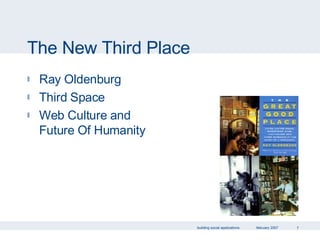
The New Third Place Ray Oldenburg Third Space Web Culture and  The Future Of Humanity
Social = Me First The individual is the new group Me first my passions my people my markets The edge dissolves the center Bottom-up belonging
Semi- and Asocial Applications iTunes Bestbuy.com Pandora (until recently) After the fact: eBay Netflix Amazon Basecamp
The Buddylist Is  The Center Of The Universe I am made greater by the sum of my connections, and so are my  connections It’s mostly connections
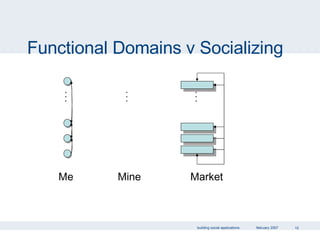
A Structural View: Social Architecture Me, Mine, and Market Functional Domains v Socializing
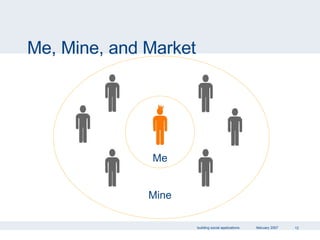
Me, Mine, and Market Me Mine
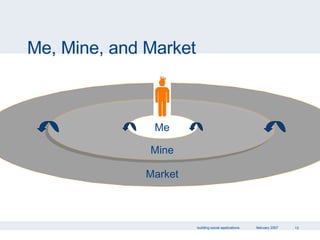
Me, Mine, and Market Mine Me Market
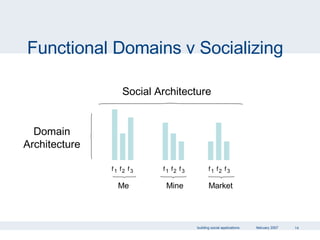
Functional Domains v Socializing Domain Architecture Social Architecture f 1 f 2 f 3 f 1 f 2 f 3 f 1 f 2 f 3 Me Mine Market
Functional Domains v Socializing Me Mine Market . . . . . . . . .
Functional Domains v Socializing I need a perfect black dress for that dinner party. Who knows where to shop for the most fashionable stuff? [Buying the perfect black dress, with commission to the recommender.] . . . . . . . . .
Functional Domains v Socializing I need to track time for this project. [Inviting project manager to review timesheet.] [Invoicing for the project based on the timesheet, and allowing the project manager to pay.] . . . . . . . . .
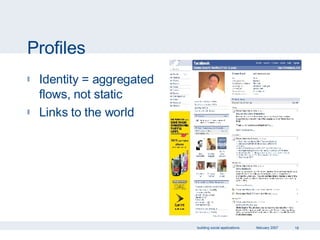
Profiles Identity = aggregated flows, not static Links to the world
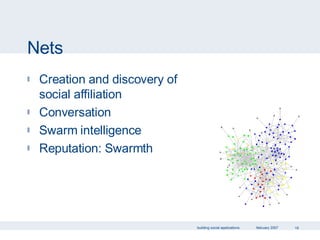
Nets Creation and discovery of social affiliation Conversation Swarm intelligence Reputation: Swarmth
Media and Traffic:  Different Registers Conversation flows through networks = Traffic Media hold the pieces, but not the sense of the conversation To understand the sense of what is being said, you have to be in the flow, not outside
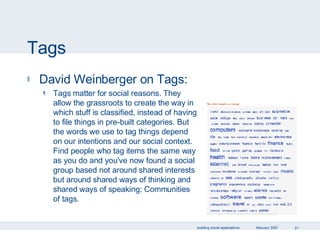
Tags David Weinberger on Tags: Tags matter for social reasons. They allow the grassroots to create the way in which stuff is classified, instead of having to file things in pre-built categories. But the words we use to tag things depend on our intentions and our social context. Find people who tag items the same way as you do and you've now found a social group based not around shared interests but around shared ways of thinking and shared ways of speaking: Communities of tags.
Discovery The primary abiding motivator: Discovery Discovery of Things (a red herring: the functional domain) Places (the Third Space) People (who fill the places) Self (at the still point of the turning world)
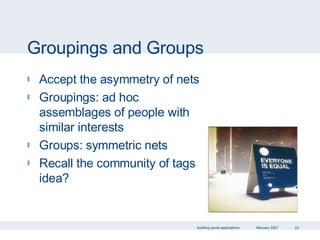
Groupings and Groups Accept the asymmetry of nets Groupings: ad hoc assemblages of people with similar interests Groups: symmetric nets Recall the community of tags idea?
The Inexorable Power Laws What’s wrong with power? Vox Populi, Vox Humana Gaming systems
Reputation and Swarmth How to measure, how to reward? Harnessing nets: swarm intelligence All nets are not the same: is swarmth fungible?
Group Exercise #1 Form groups What are the most important functions of the social applications you use most? What is the ‘market’ that they create, and what is made more ‘liquid’?
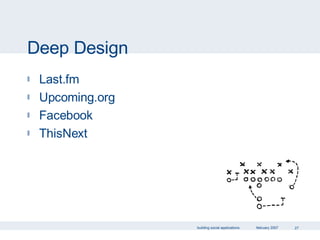
Deep Design Last.fm Upcoming.org Facebook ThisNext
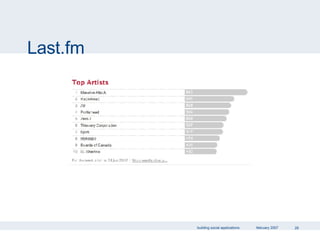
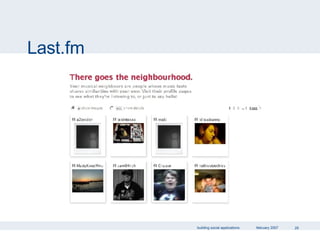
Last.fm
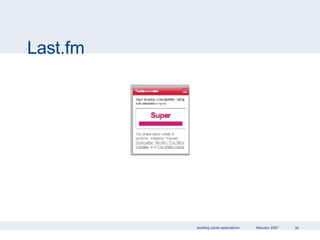
Last.fm
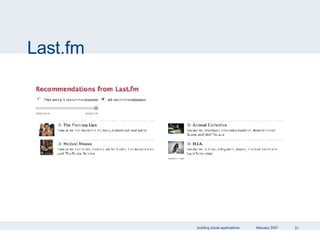
Last.fm
Last.fm
Last.fm
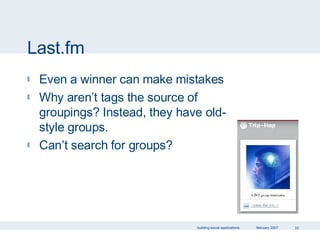
Last.fm Even a winner can make mistakes Why aren’t tags the source of groupings? Instead, they have old-style groups. Can’t search for groups?
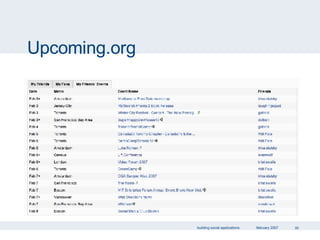
Upcoming.org
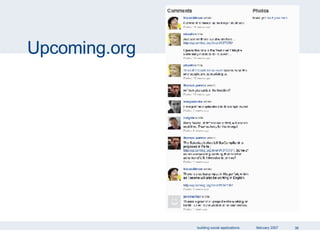
Upcoming.org
Upcoming.org
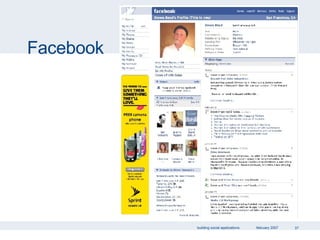
Facebook
Facebook
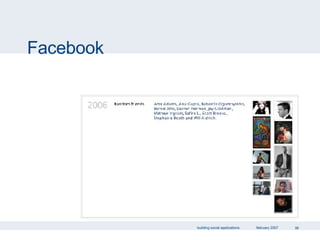
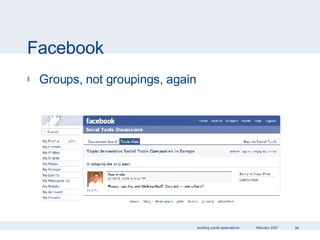
Facebook Groups, not groupings, again
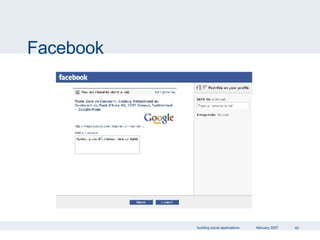
Facebook
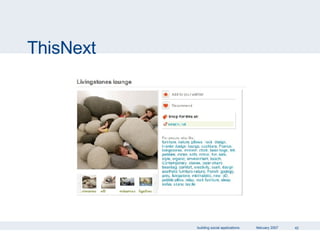
ThisNext
ThisNext
ThisNext
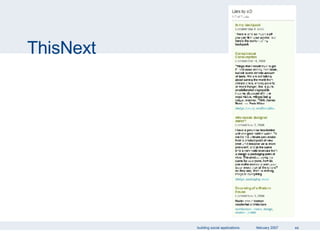
ThisNext
Cautionary Tales Basecamp and the Federation of Work Outside.in and The Social Tipping Point Blinksale and the Missing Market
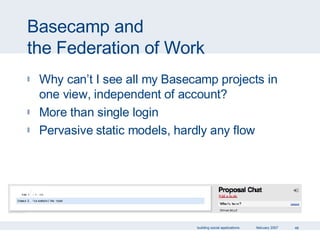
Basecamp and  the Federation of Work Why can’t I see all my Basecamp projects in one view, independent of account? More than single login Pervasive static models, hardly any flow
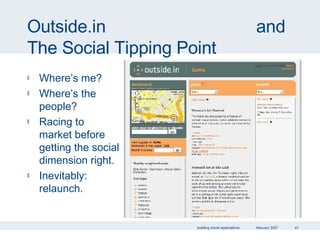
Outside.in  and The Social Tipping Point Where’s me? Where’s the people? Racing to market before getting the social dimension right.  Inevitably: relaunch.
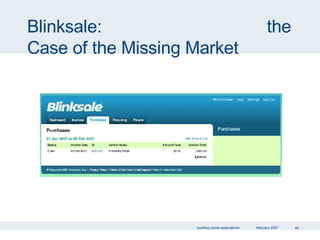
Blinksale:  the Case of the Missing Market
Group Exercise 2: Explorations Again, form groups A Social iTunes Why Are Calendars So Hard? Social Browsing
Building Social Applications Stowe Boyd [email_address] +1 703 966 9854 625 2nd St, San Francisco CA 94107

Building Social Applications

  • 1.
    Building Social ApplicationsStowe Boyd [email_address] +1 703 966 9854 625 2nd St, San Francisco CA 94107
  • 2.
    Re: Me /Messengerof /Message Social tools and their impact on business, media, and society
  • 3.
    Some Questions Whatmakes social applications social (or anti-social)? How can we make applications more social? What are the common factors in successful social applications? What is worth building?
  • 4.
  • 5.
    Apologies and ExplanationsIt was blogging what done this to me Fragments, conjectures, cheap shots, biases No pretty box with a bow
  • 6.
    We’re gonna partylike it’s 1999 “ A new category of software is emerging, software intended to augment social systems . Not to change the company inadvertently, like email did, when the electronic analog of interoffice mail became something else, grew into something else by changing the way people communicated, and led a change in the structure of the company. No, this generation of software is intentional, designed from the start to guide human behavior into new paths and patterns, to counter prevailing ways of interaction. I call these social tools : software intended to shape culture. " - Stowe Boyd [ Message , August 1999]
  • 7.
    The New ThirdPlace Ray Oldenburg Third Space Web Culture and The Future Of Humanity
  • 8.
    Social = MeFirst The individual is the new group Me first my passions my people my markets The edge dissolves the center Bottom-up belonging
  • 9.
    Semi- and AsocialApplications iTunes Bestbuy.com Pandora (until recently) After the fact: eBay Netflix Amazon Basecamp
  • 10.
    The Buddylist Is The Center Of The Universe I am made greater by the sum of my connections, and so are my connections It’s mostly connections
  • 11.
    A Structural View:Social Architecture Me, Mine, and Market Functional Domains v Socializing
  • 12.
    Me, Mine, andMarket Me Mine
  • 13.
    Me, Mine, andMarket Mine Me Market
  • 14.
    Functional Domains vSocializing Domain Architecture Social Architecture f 1 f 2 f 3 f 1 f 2 f 3 f 1 f 2 f 3 Me Mine Market
  • 15.
    Functional Domains vSocializing Me Mine Market . . . . . . . . .
  • 16.
    Functional Domains vSocializing I need a perfect black dress for that dinner party. Who knows where to shop for the most fashionable stuff? [Buying the perfect black dress, with commission to the recommender.] . . . . . . . . .
  • 17.
    Functional Domains vSocializing I need to track time for this project. [Inviting project manager to review timesheet.] [Invoicing for the project based on the timesheet, and allowing the project manager to pay.] . . . . . . . . .
  • 18.
    Profiles Identity =aggregated flows, not static Links to the world
  • 19.
    Nets Creation anddiscovery of social affiliation Conversation Swarm intelligence Reputation: Swarmth
  • 20.
    Media and Traffic: Different Registers Conversation flows through networks = Traffic Media hold the pieces, but not the sense of the conversation To understand the sense of what is being said, you have to be in the flow, not outside
  • 21.
    Tags David Weinbergeron Tags: Tags matter for social reasons. They allow the grassroots to create the way in which stuff is classified, instead of having to file things in pre-built categories. But the words we use to tag things depend on our intentions and our social context. Find people who tag items the same way as you do and you've now found a social group based not around shared interests but around shared ways of thinking and shared ways of speaking: Communities of tags.
  • 22.
    Discovery The primaryabiding motivator: Discovery Discovery of Things (a red herring: the functional domain) Places (the Third Space) People (who fill the places) Self (at the still point of the turning world)
  • 23.
    Groupings and GroupsAccept the asymmetry of nets Groupings: ad hoc assemblages of people with similar interests Groups: symmetric nets Recall the community of tags idea?
  • 24.
    The Inexorable PowerLaws What’s wrong with power? Vox Populi, Vox Humana Gaming systems
  • 25.
    Reputation and SwarmthHow to measure, how to reward? Harnessing nets: swarm intelligence All nets are not the same: is swarmth fungible?
  • 26.
    Group Exercise #1Form groups What are the most important functions of the social applications you use most? What is the ‘market’ that they create, and what is made more ‘liquid’?
  • 27.
    Deep Design Last.fmUpcoming.org Facebook ThisNext
  • 28.
  • 29.
  • 30.
  • 31.
  • 32.
  • 33.
    Last.fm Even awinner can make mistakes Why aren’t tags the source of groupings? Instead, they have old-style groups. Can’t search for groups?
  • 34.
  • 35.
  • 36.
  • 37.
  • 38.
  • 39.
    Facebook Groups, notgroupings, again
  • 40.
  • 41.
  • 42.
  • 43.
  • 44.
  • 45.
    Cautionary Tales Basecampand the Federation of Work Outside.in and The Social Tipping Point Blinksale and the Missing Market
  • 46.
    Basecamp and the Federation of Work Why can’t I see all my Basecamp projects in one view, independent of account? More than single login Pervasive static models, hardly any flow
  • 47.
    Outside.in andThe Social Tipping Point Where’s me? Where’s the people? Racing to market before getting the social dimension right. Inevitably: relaunch.
  • 48.
    Blinksale: theCase of the Missing Market
  • 49.
    Group Exercise 2:Explorations Again, form groups A Social iTunes Why Are Calendars So Hard? Social Browsing
  • 50.
    Building Social ApplicationsStowe Boyd [email_address] +1 703 966 9854 625 2nd St, San Francisco CA 94107