Lessons from Social Software:
From Facebook to a Face to Face Design Guild
            Xianhang Zhang - BayCHI
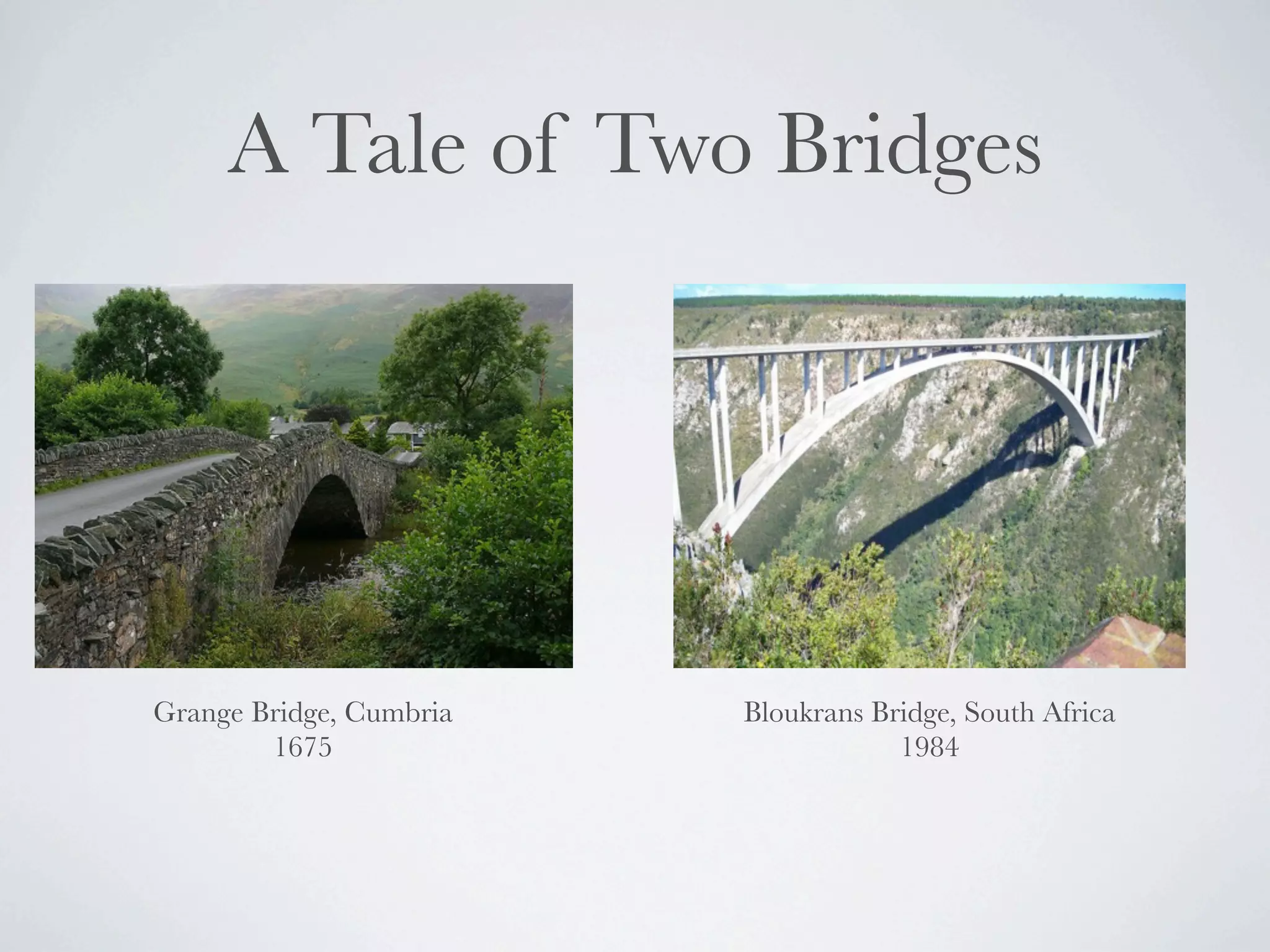
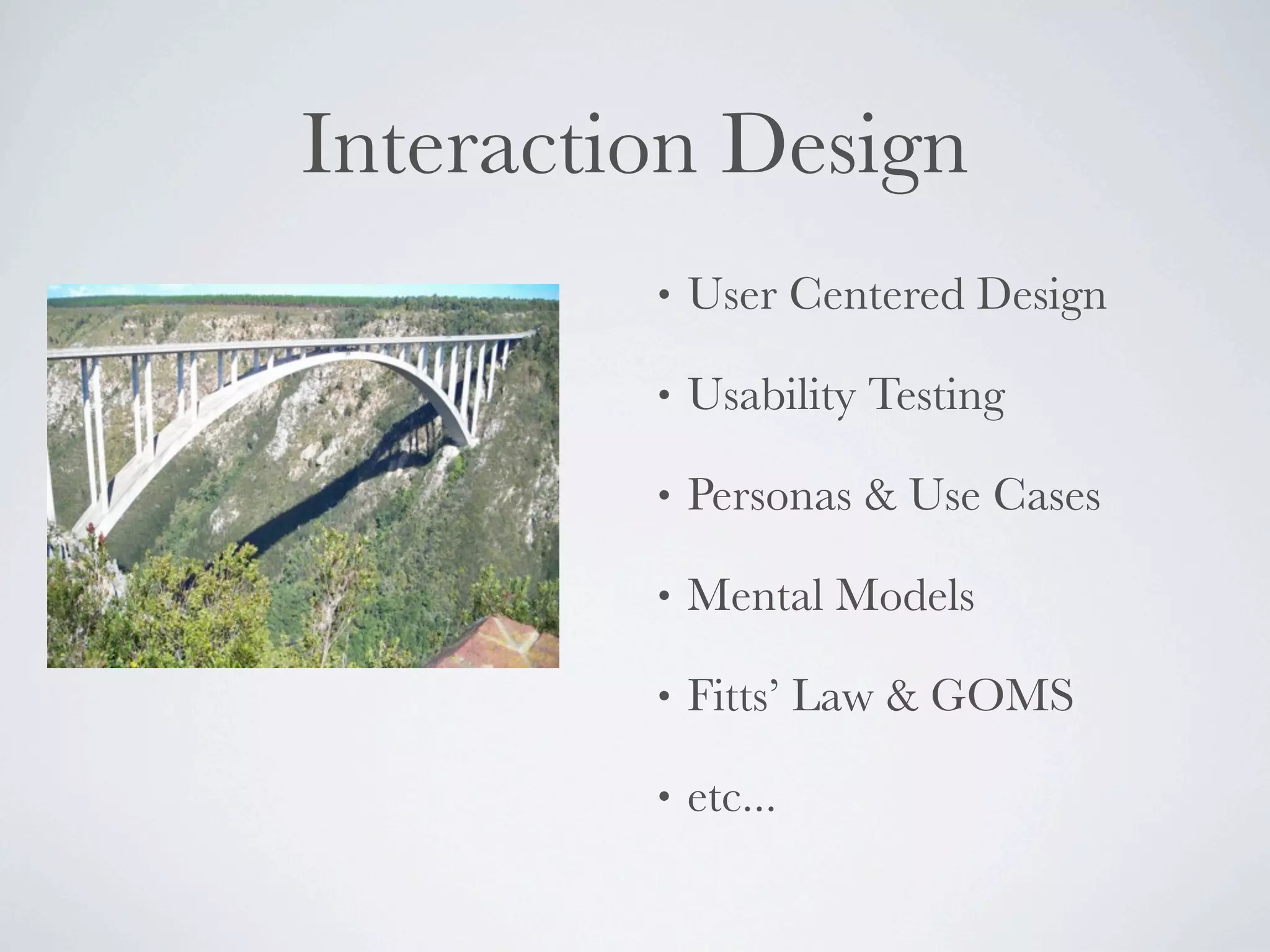
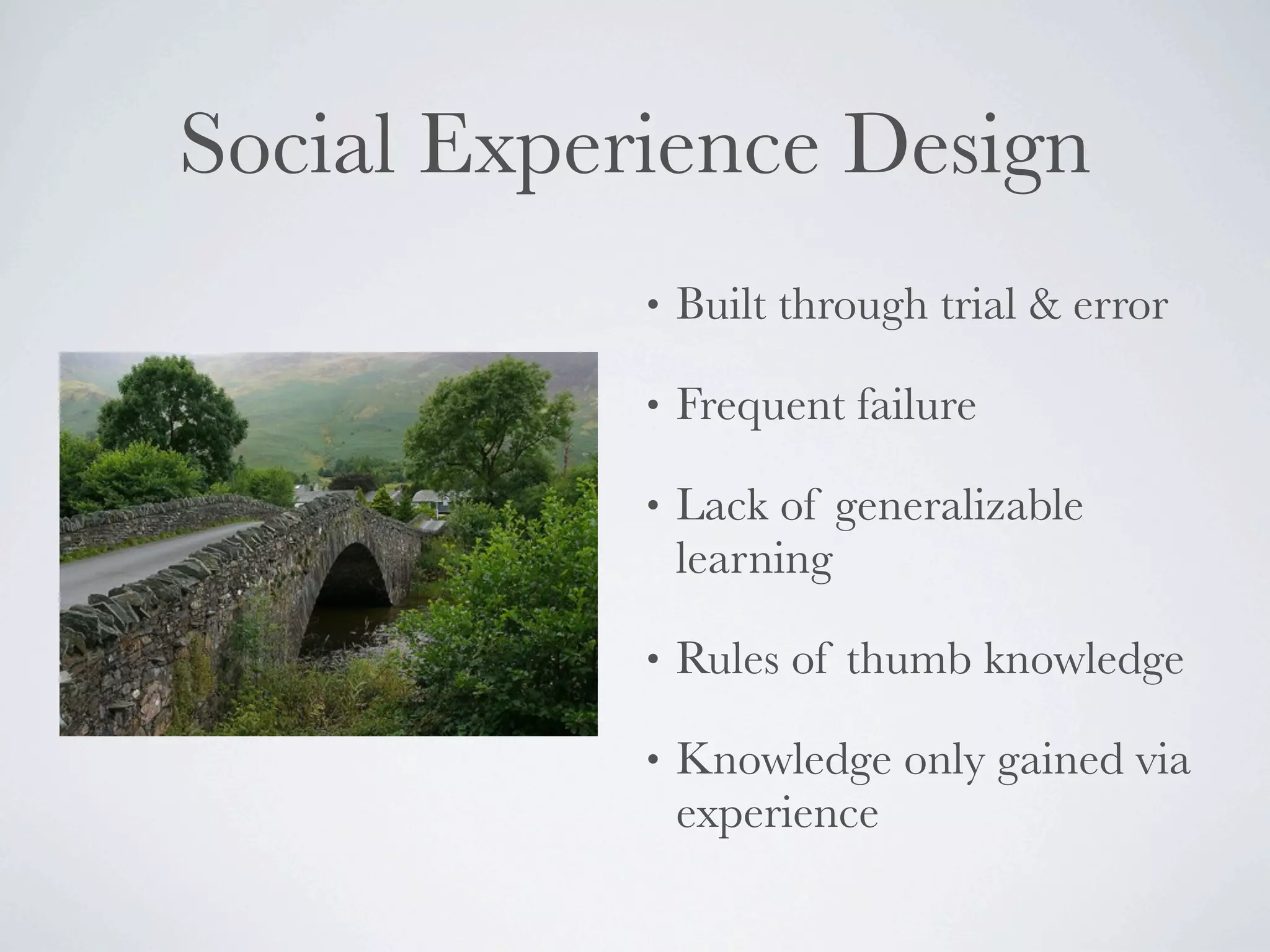
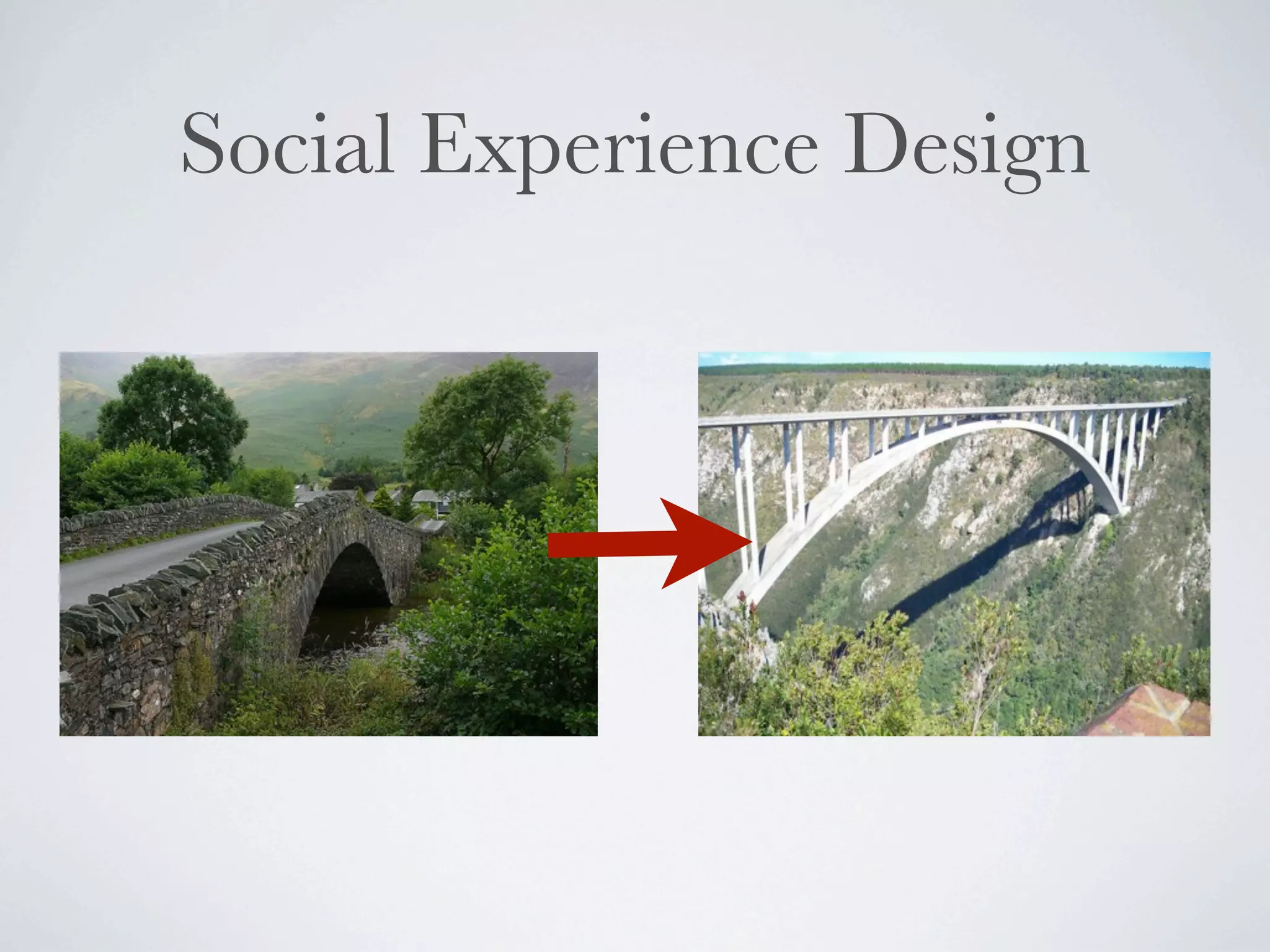
A Tale of Two Bridges


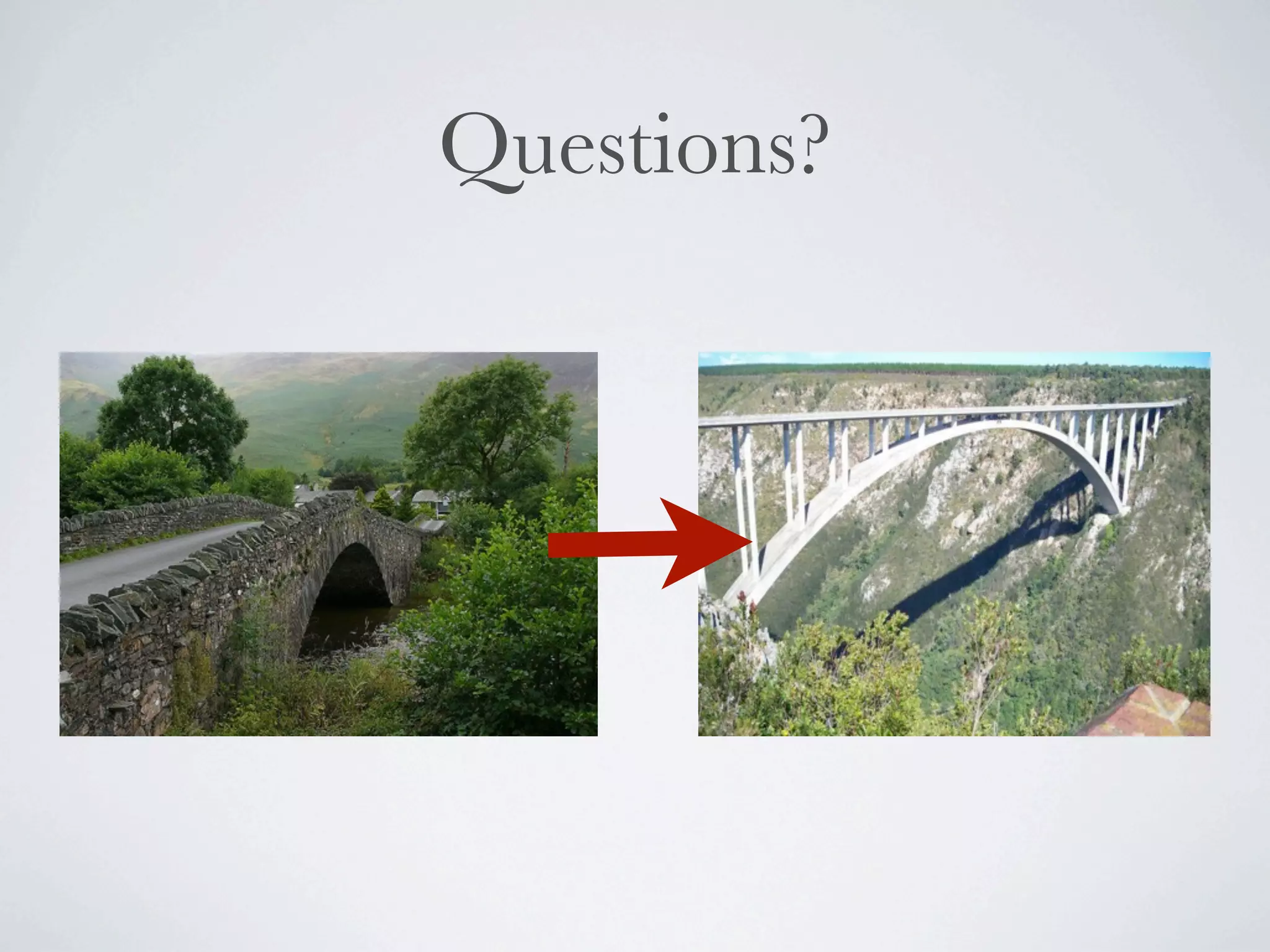
Grange Bridge, Cumbria   Bloukrans Bridge, South Africa
        1675                         1984
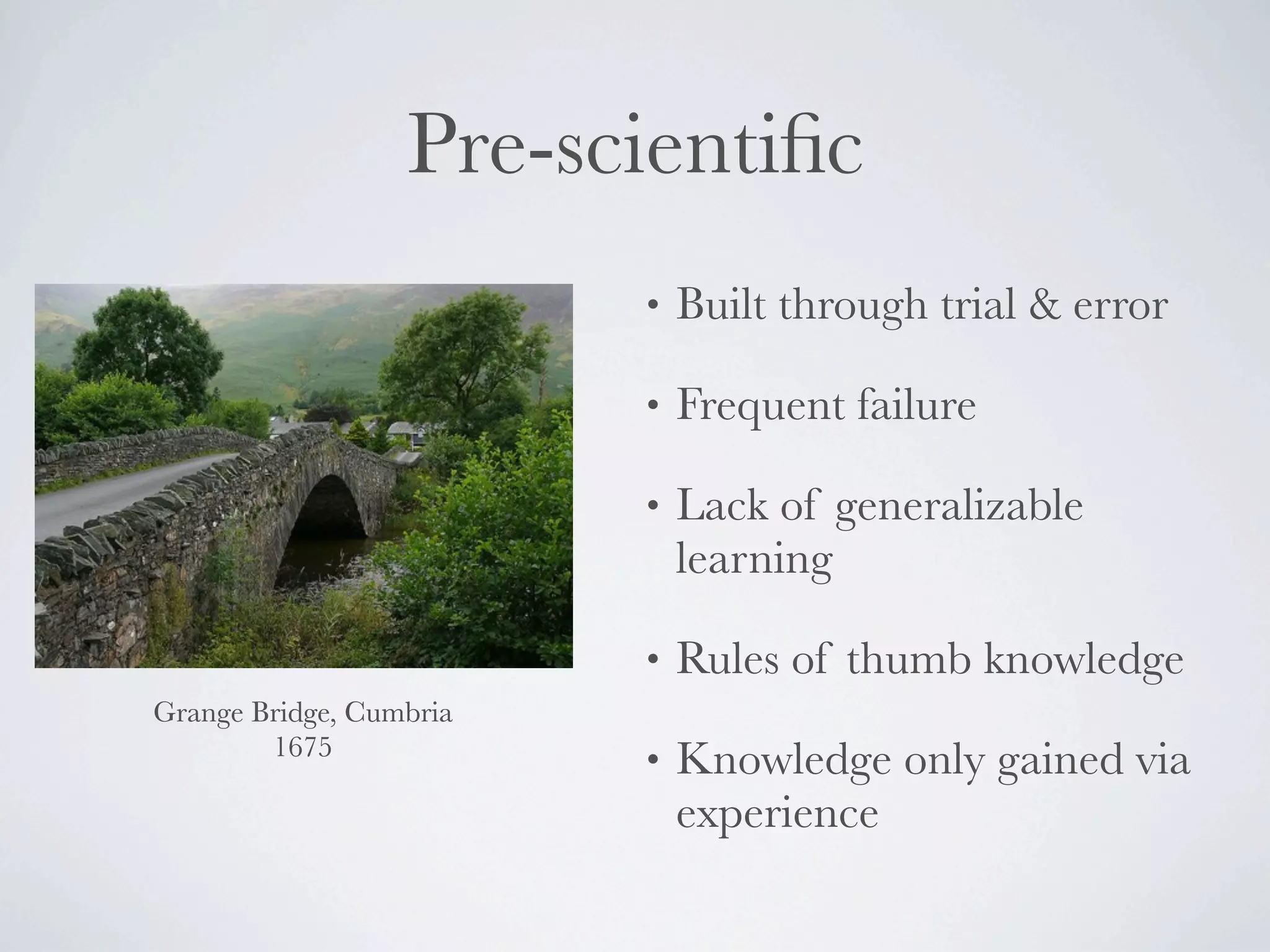
Pre-scientific
                         •   Built through trial & error

                         •   Frequent failure

                         •   Lack of generalizable
                             learning

                         •   Rules of thumb knowledge
Grange Bridge, Cumbria
        1675
                         •   Knowledge only gained via
                             experience
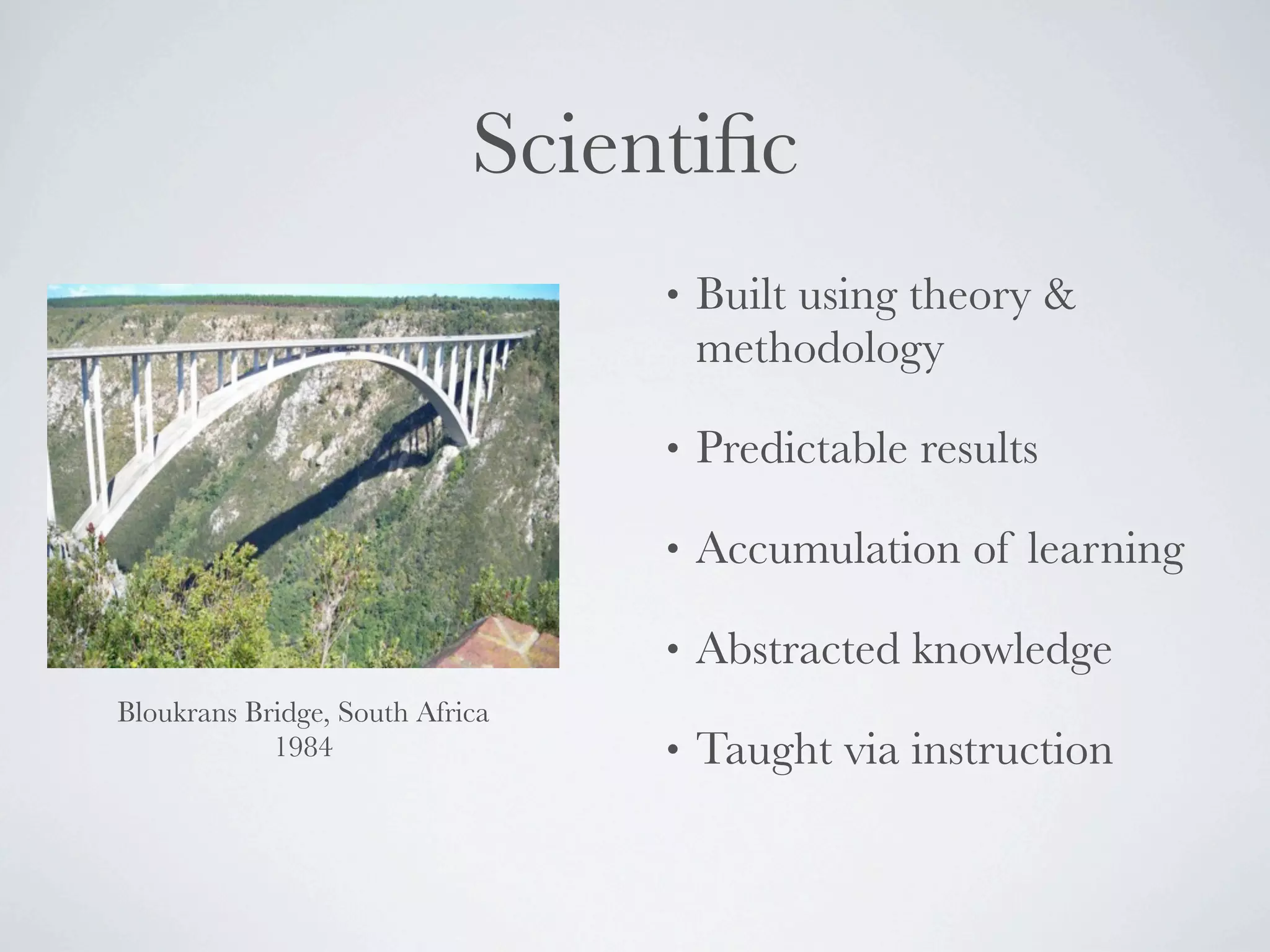
Scientific
                                 •   Built using theory &
                                     methodology

                                 •   Predictable results

                                 •   Accumulation of learning

                                 •   Abstracted knowledge
Bloukrans Bridge, South Africa
            1984                 •   Taught via instruction
My Background

•   BSc Computer Science (University of New South Wales)

•


•   HCI work with Tabletop Computing (University of Sydney)
Interaction Design
         •   User Centered Design

         •   Usability Testing

         •   Personas & Use Cases

         •   Mental Models

         •   Fitts’ Law & GOMS

         •   etc...
My Background

•   BSc Computer Science (University of New South Wales)

•


•   HCI work with Tabletop Computing (University of Sydney)

•   PhD Candidate (University of Washington)...
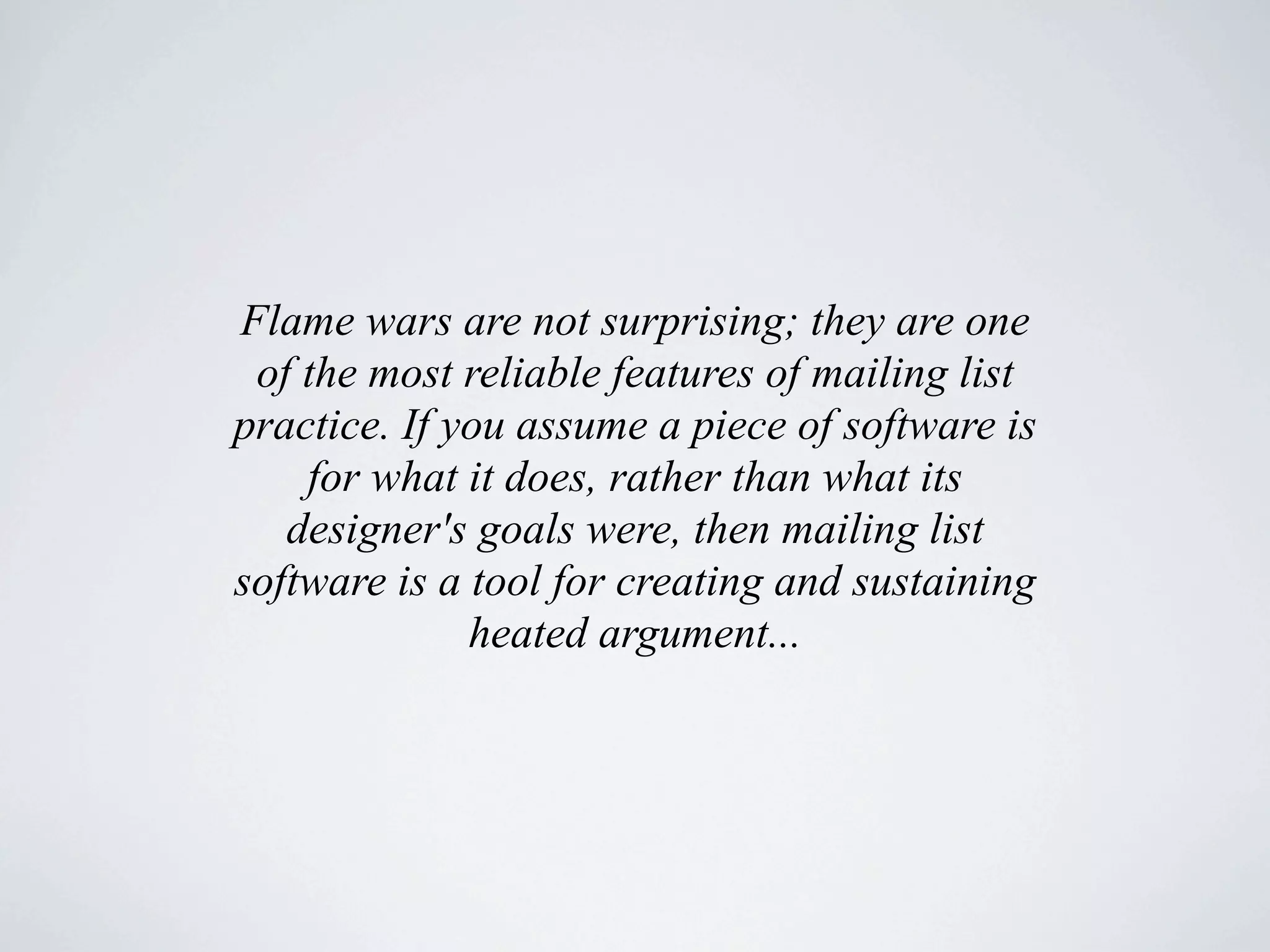
Flame wars are not surprising; they are one
 of the most reliable features of mailing list
practice. If you assume a piece of software is
    for what it does, rather than what its
   designer's goals were, then mailing list
software is a tool for creating and sustaining
              heated argument...
You couldn't go through the code of Mailman
 and find the comment that reads "The next
 subroutine ensures that misunderstandings
 between users will be amplified, leading to
 name-calling and vitriol." Yet the software
 will frequently produce just that outcome...
In thirty years, the principal engineering
   work on mailing lists has been on the
 administrative experience. Mailman now
   offers administrator nearly a hundred
 configurable options, many with multiple
choices. However, the social experience of a
  mailing list over those three decades has
           hardly changed at all...
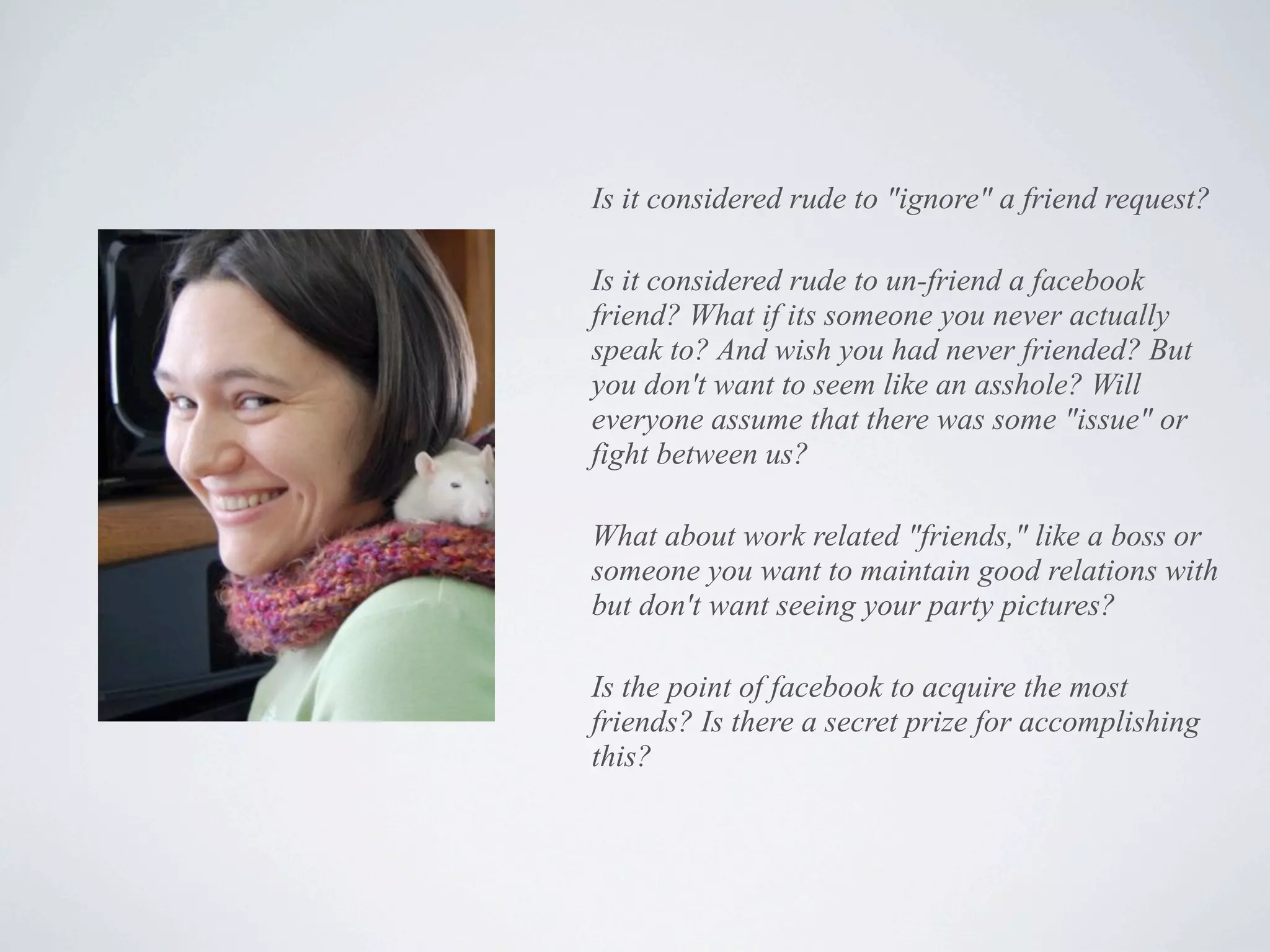
Is it considered rude to "ignore" a friend request?

Is it considered rude to un-friend a facebook
friend? What if its someone you never actually
speak to? And wish you had never friended? But
you don't want to seem like an asshole? Will
everyone assume that there was some "issue" or
fight between us?

What about work related "friends," like a boss or
someone you want to maintain good relations with
but don't want seeing your party pictures?

Is the point of facebook to acquire the most
friends? Is there a secret prize for accomplishing
this?
What is Social Experience Design?

•   Designing the Social Interactions around a product/service

•   A distinct & separate field from Interaction Design

•   Designing for nuance, politeness, ambiguity, identity &
    privacy

•   Does not require an interactive technology

•   An example...
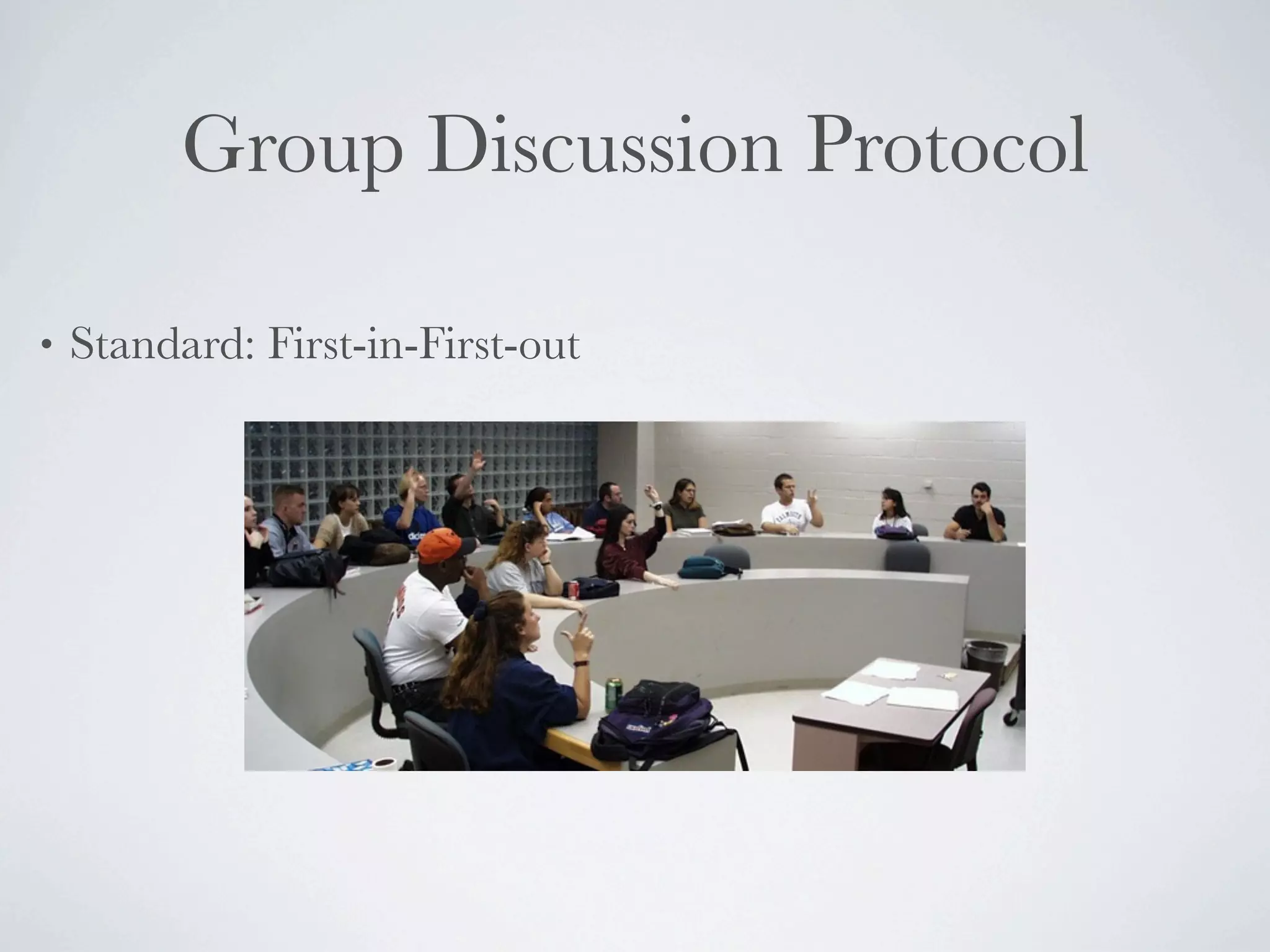
Group Discussion Protocol

•   Standard: First-in-First-out
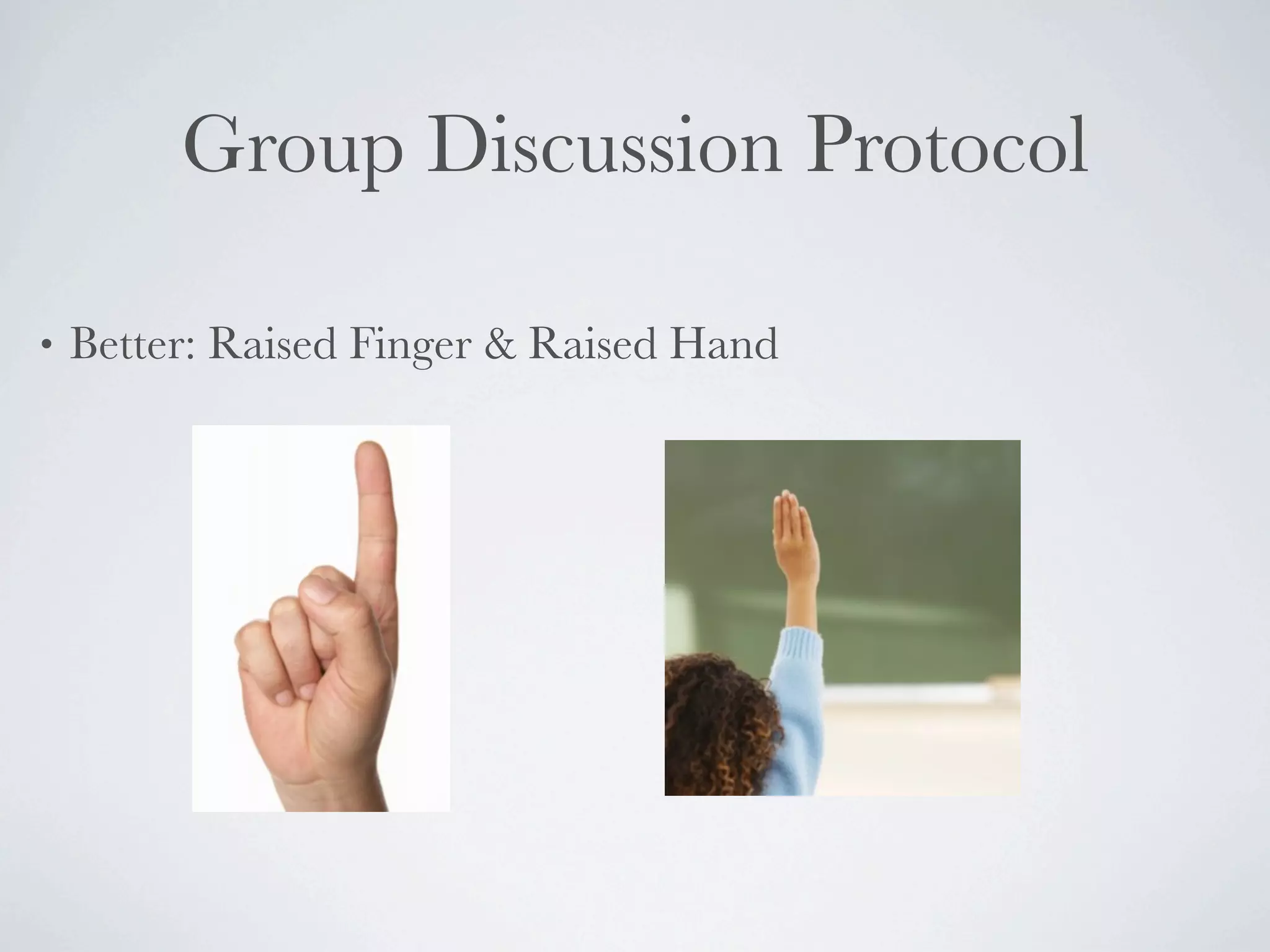
Group Discussion Protocol

•   Better: Raised Finger & Raised Hand
My Background
•


•   HCI work with Tabletop Computing (University of Sydney)

•   PhD Candidate (University of Washington)

•   Bumblebee Labs (Founder)

•   Peel (Social Experience Designer)

•   Product Design Guild (Founder)
Social Experience Design
            •   Built through trial & error

            •   Frequent failure

            •   Lack of generalizable
                learning

            •   Rules of thumb knowledge

            •   Knowledge only gained via
                experience
Social Experience Design
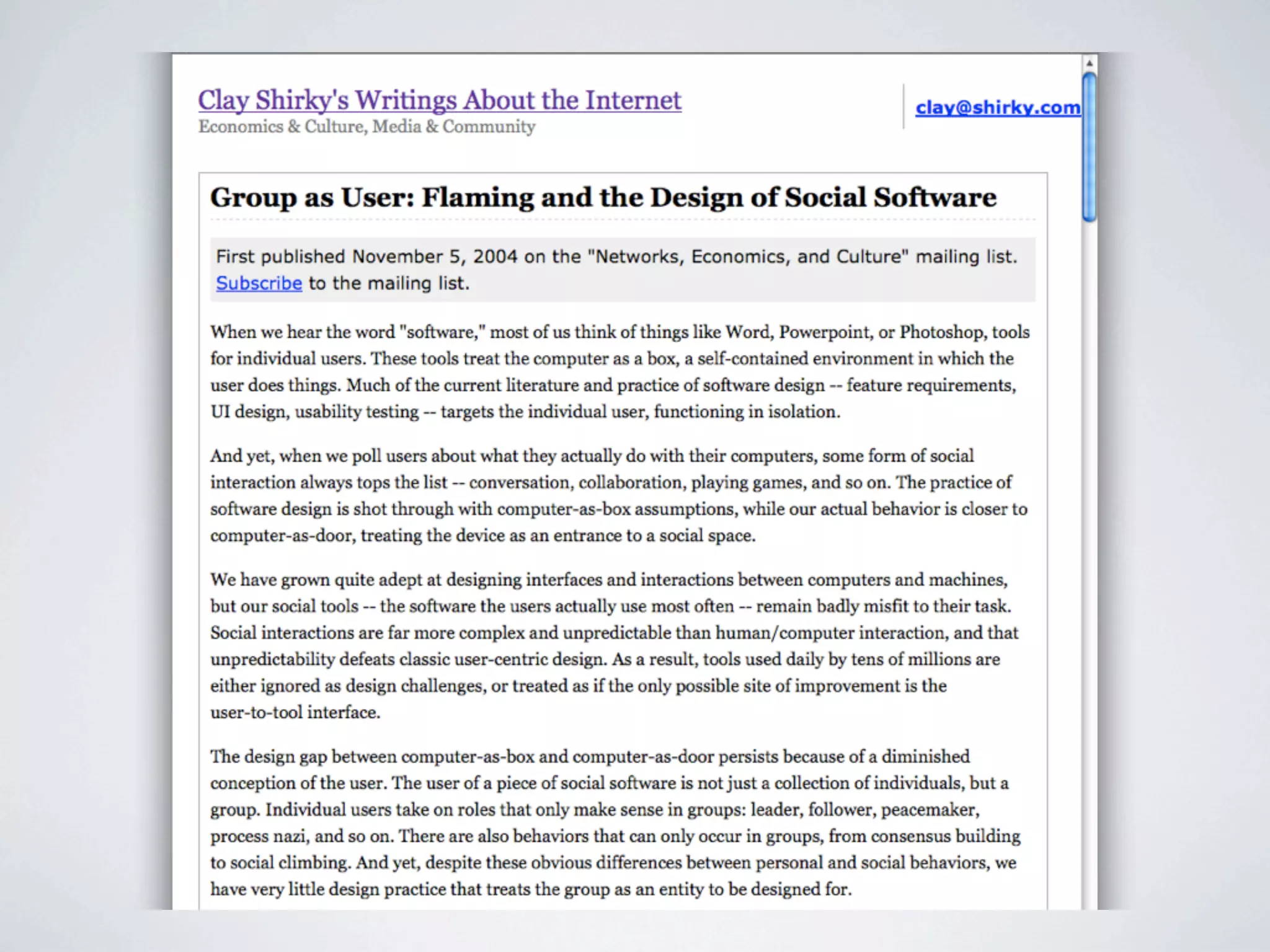
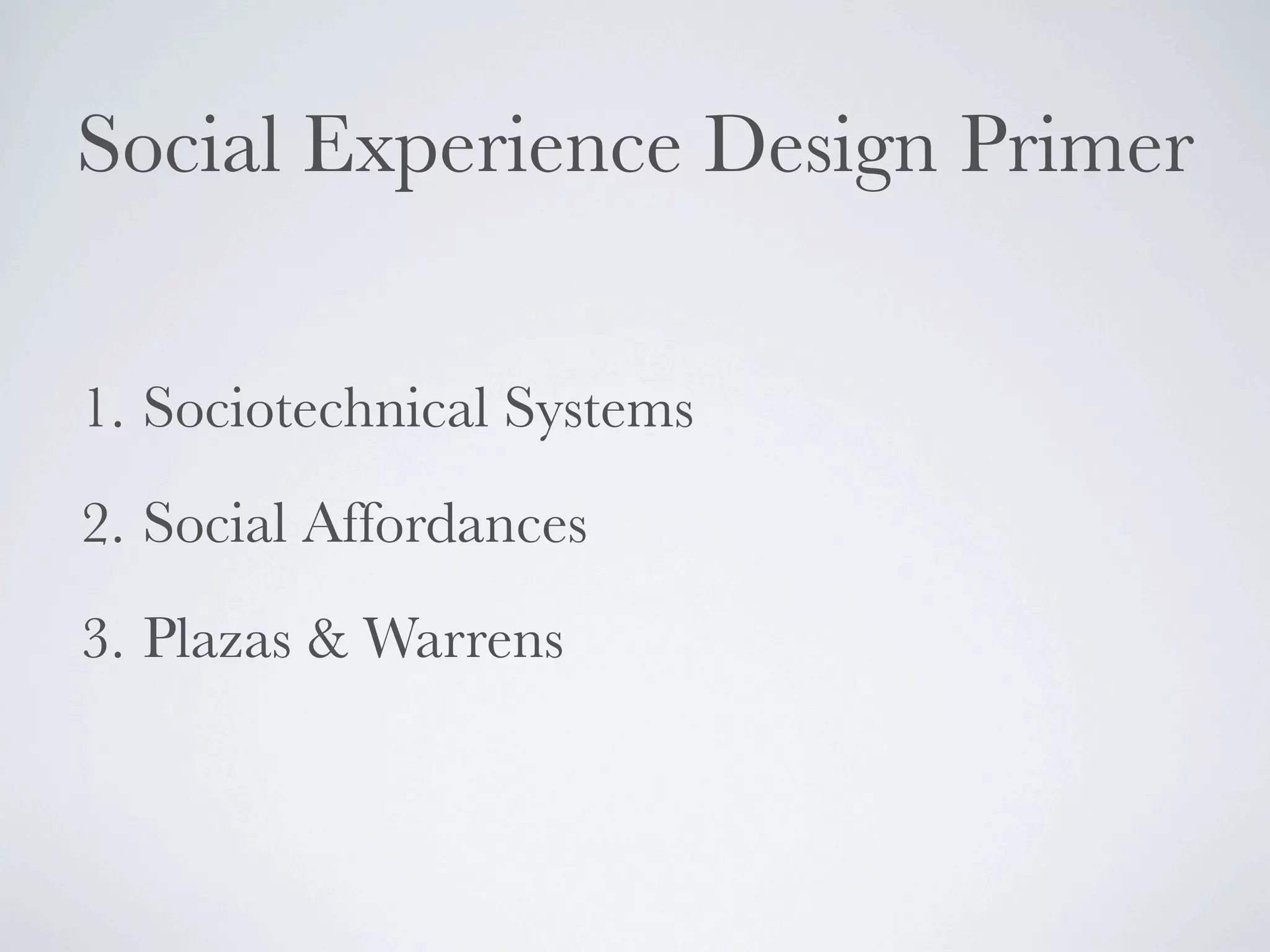
Social Experience Design Primer


1. Sociotechnical Systems
2. Social Affordances
3. Plazas & Warrens
•   Rapid increase in demand for designers

•   Design education isn’t reflecting skills SV employers want

•   Technology teams now 3 - 5 engineers & 1 designer

•   Mentorship is a losing economic proposition
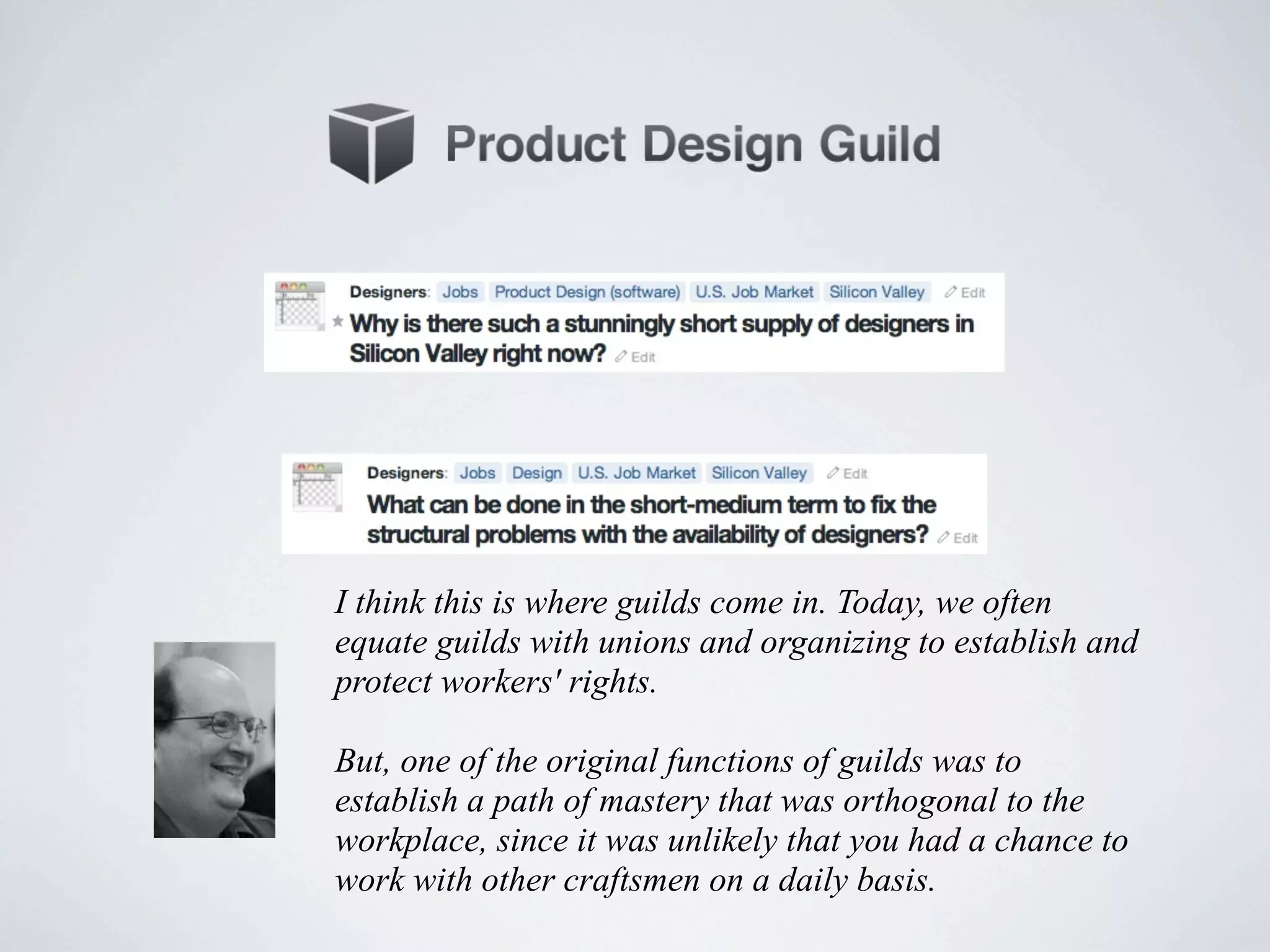
I think this is where guilds come in. Today, we often
equate guilds with unions and organizing to establish and
protect workers' rights.

But, one of the original functions of guilds was to
establish a path of mastery that was orthogonal to the
workplace, since it was unlikely that you had a chance to
work with other craftsmen on a daily basis.
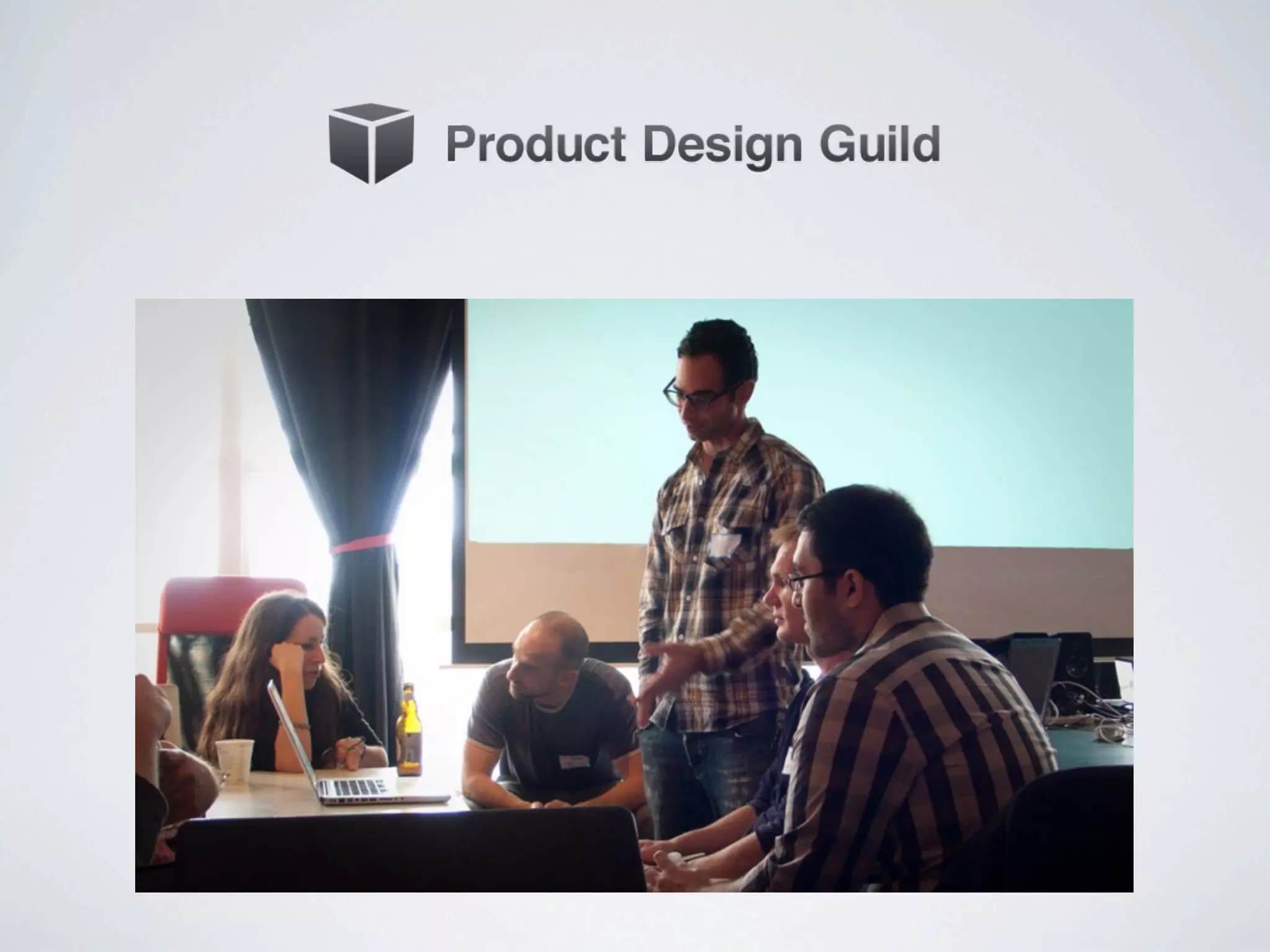
Mission: To enable the creation of more &
better designers by providing a path of
mastery that is orthogonal to the workplace
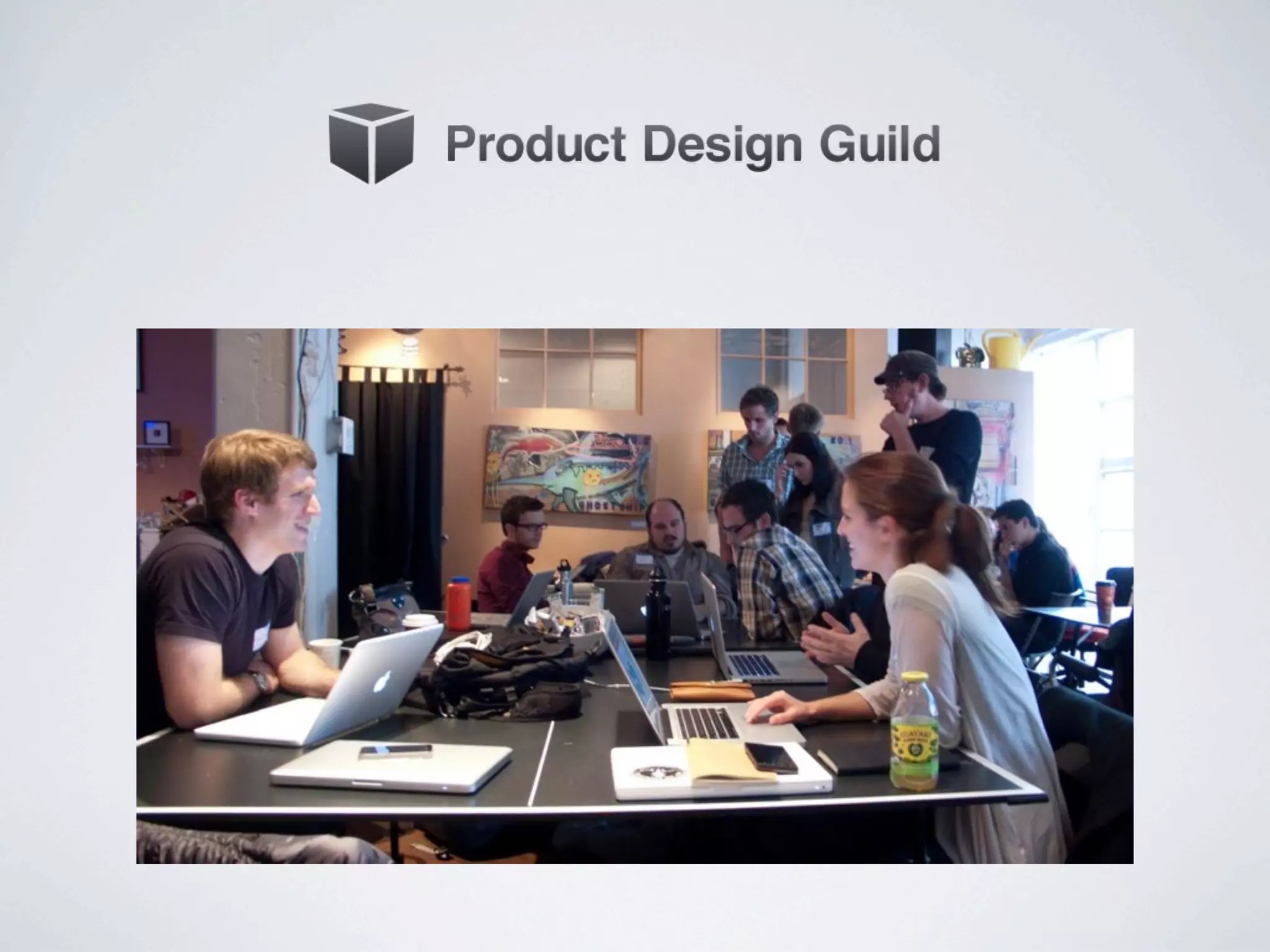
Pilot #1

•   30 designers

•   Bringing real work in order to engage in collaborative design

•   Noon - 6pm

•   Largely free-form collaboration
Rules

•   You need to bring work: This is a place for work to be
    done. There is no room for tourists

•   Give before you receive: We want this to be a community
    for contribution, not a resource for exploitation

•   Be articulate about what you can offer: We are looking
    for people who can contribute to the education of fellow
    designers
Rules (continued)
•   Seek permission from all of your stakeholders
    before sharing: Don't sneak work into the guild under
    your client's or boss' nose
•   We operate under the FriendDA: Seek explicit
    permission before sharing anything you saw outside of the
    guild
•   Disclose any possible conflicts of interest before
    collaborating: It's up to the requester to decide whether to
    proceed
•   Any guild work you do belongs to the requester: The
    requester is free to use it however they like without reseeking
    your consent
Designing a Design Guild
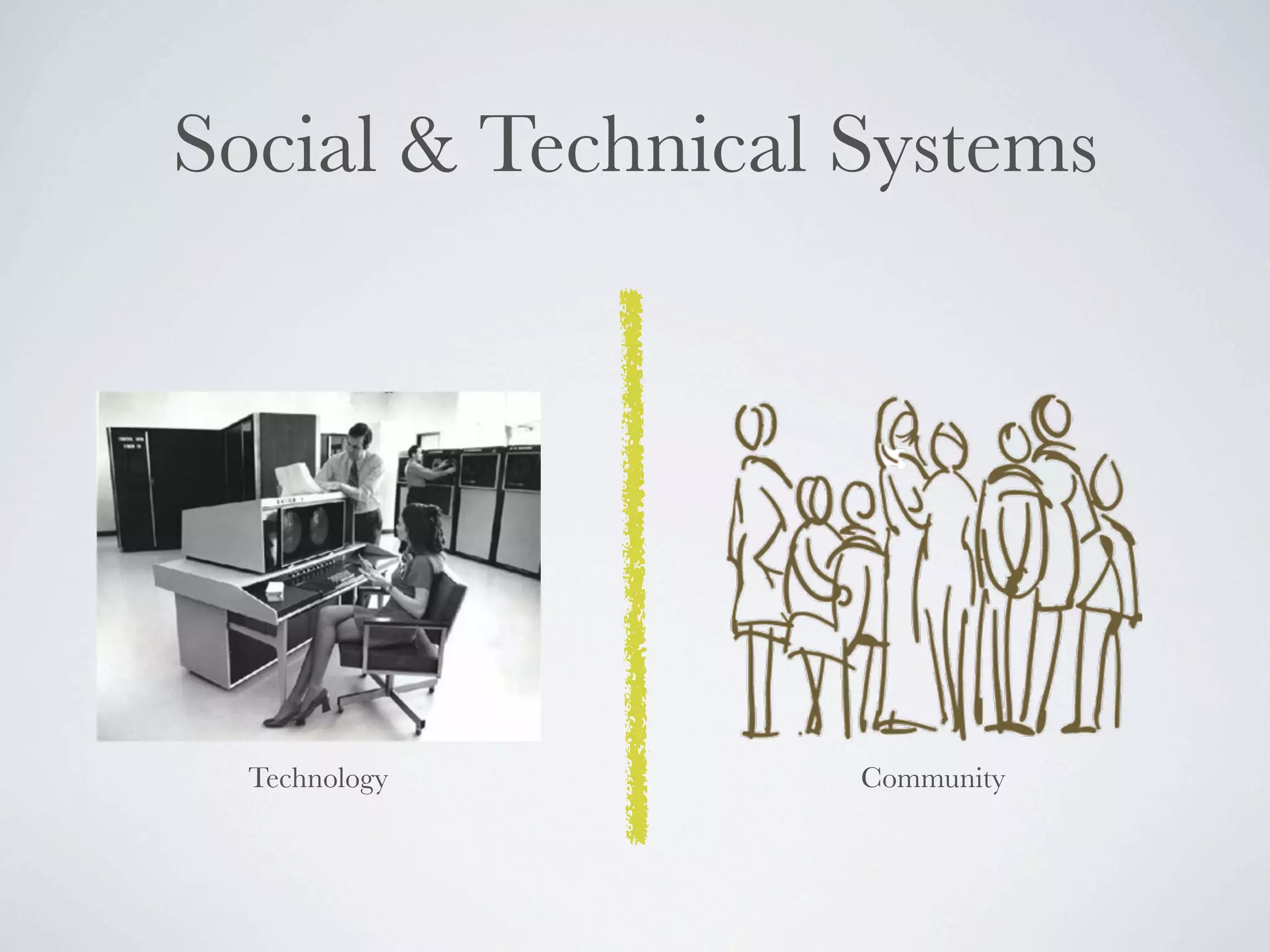
Sociotechnical Systems
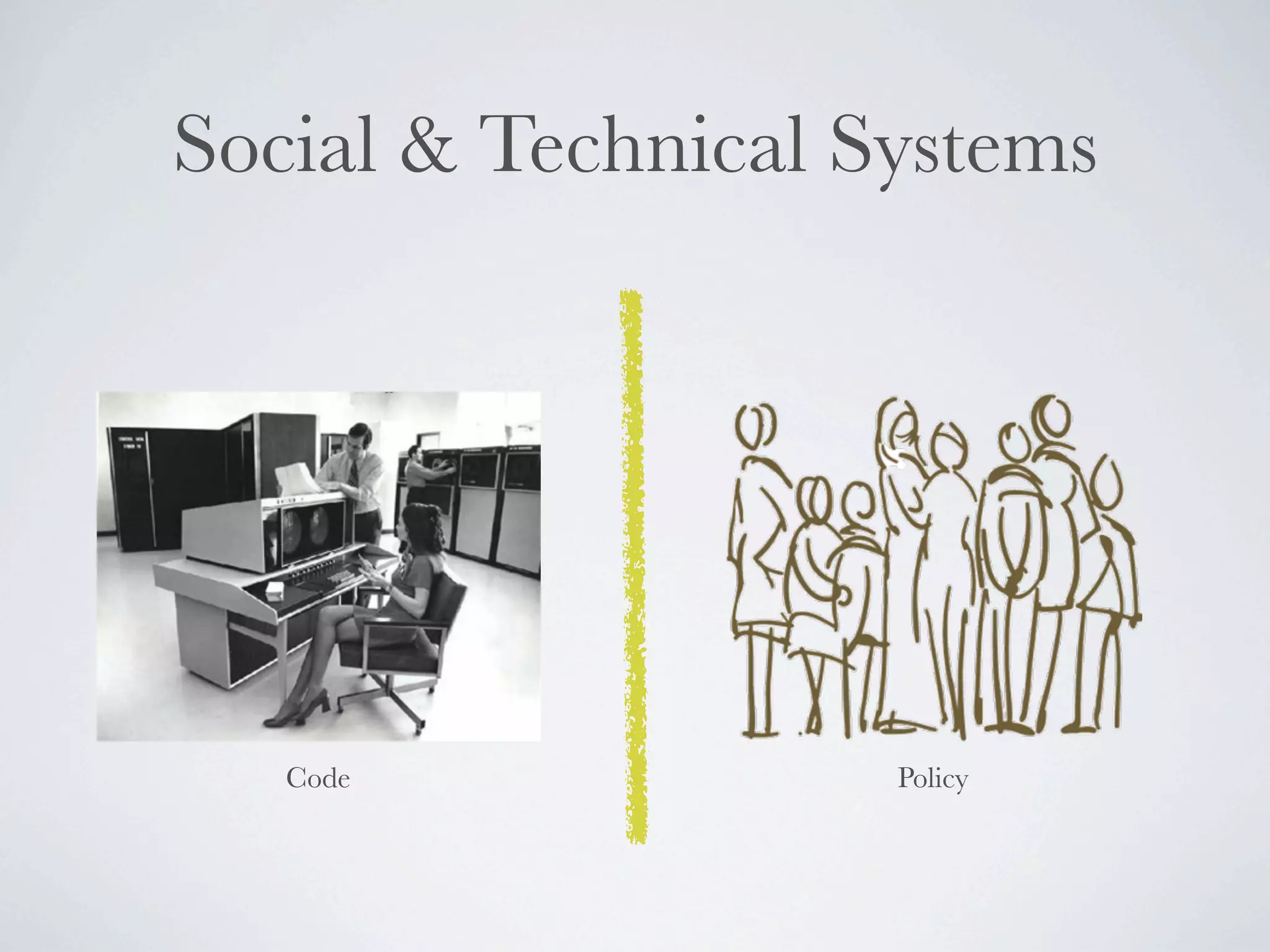
Social & Technical Systems


  Technology       Community
Social & Technical Systems


   Code             Policy
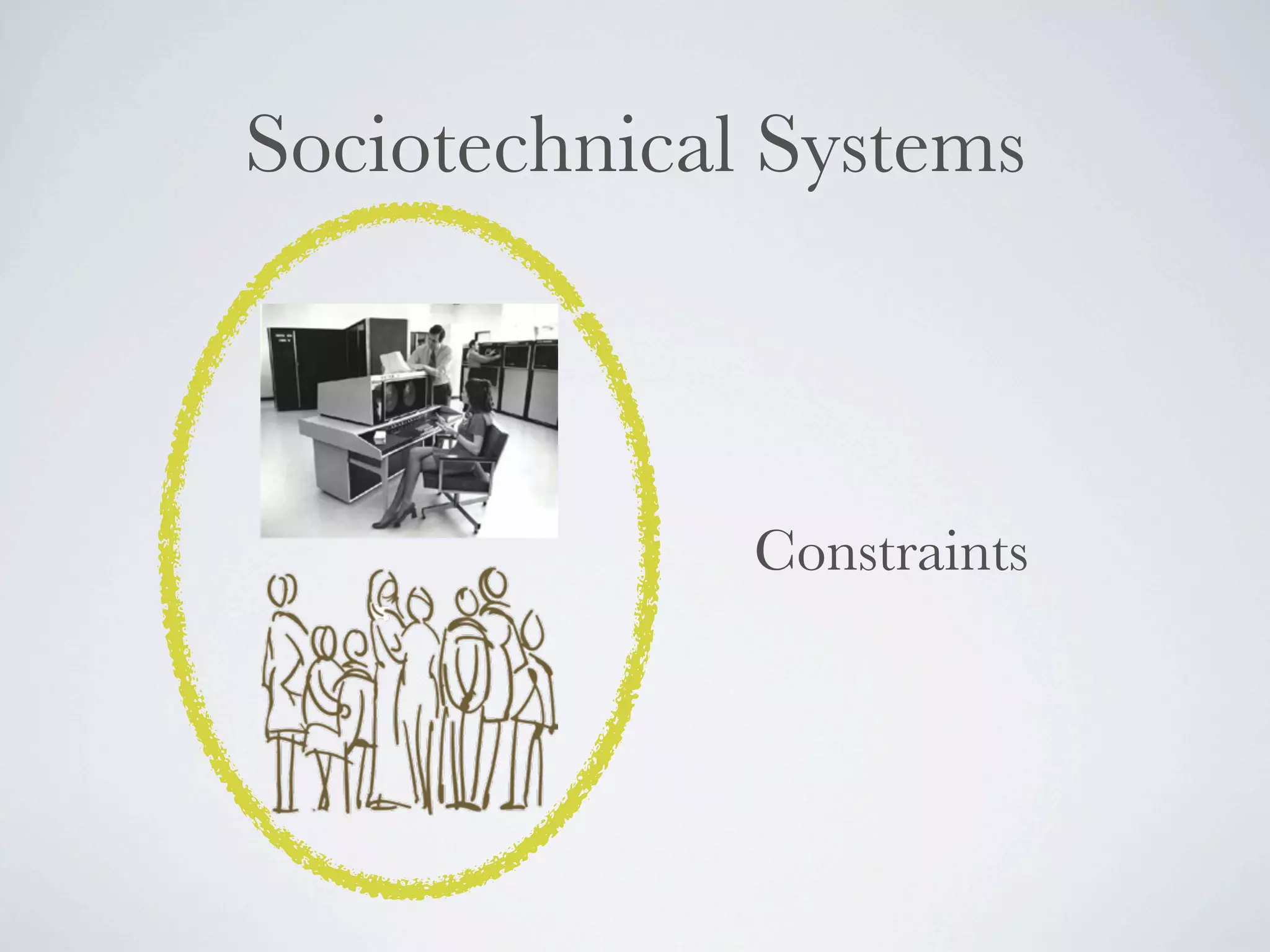
Sociotechnical Systems


              Constraints
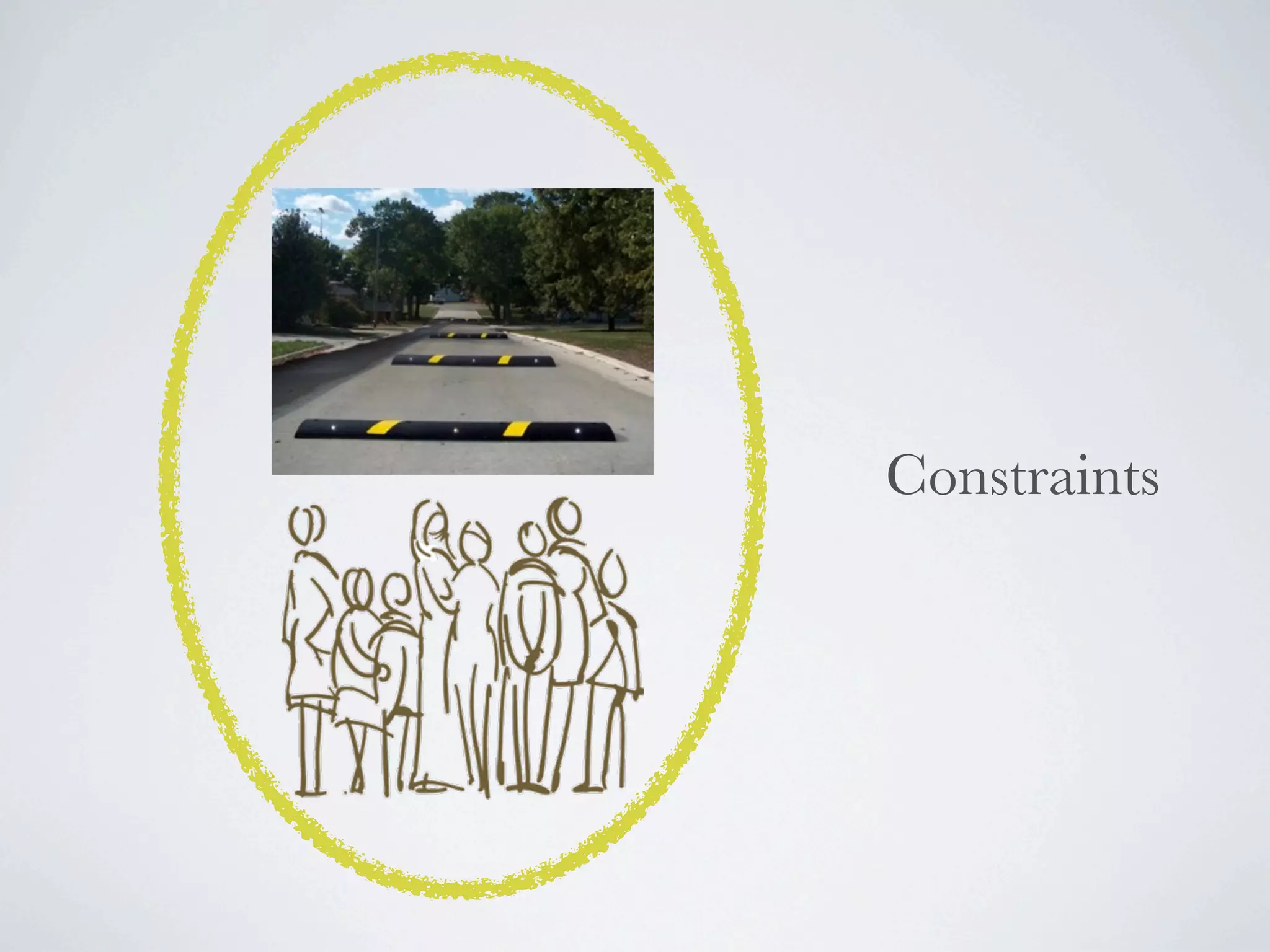
Constraints
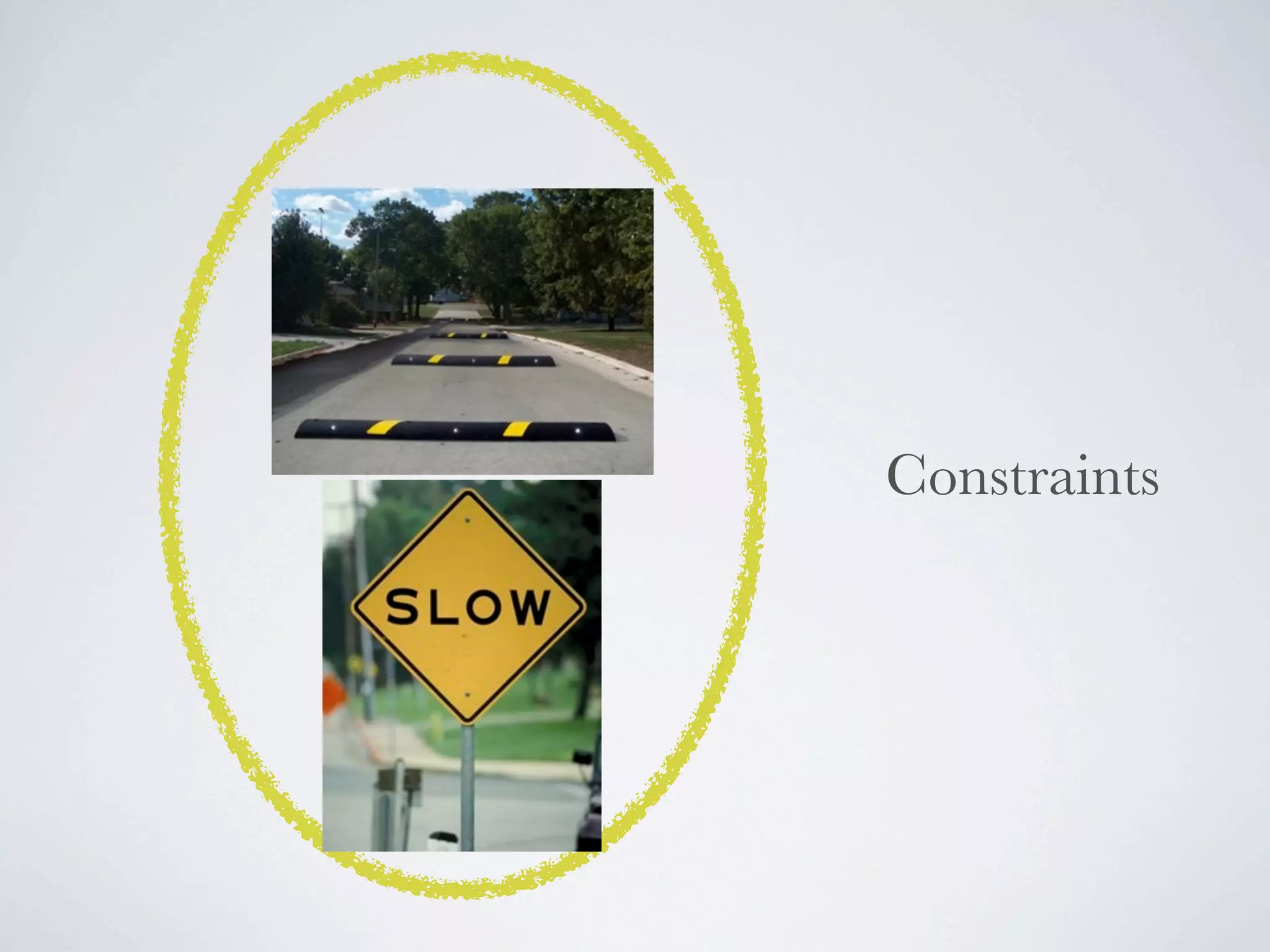
Constraints
Sociotechnical Systems are successful when the
right constraints are in place, regardless of where
              they are implemented
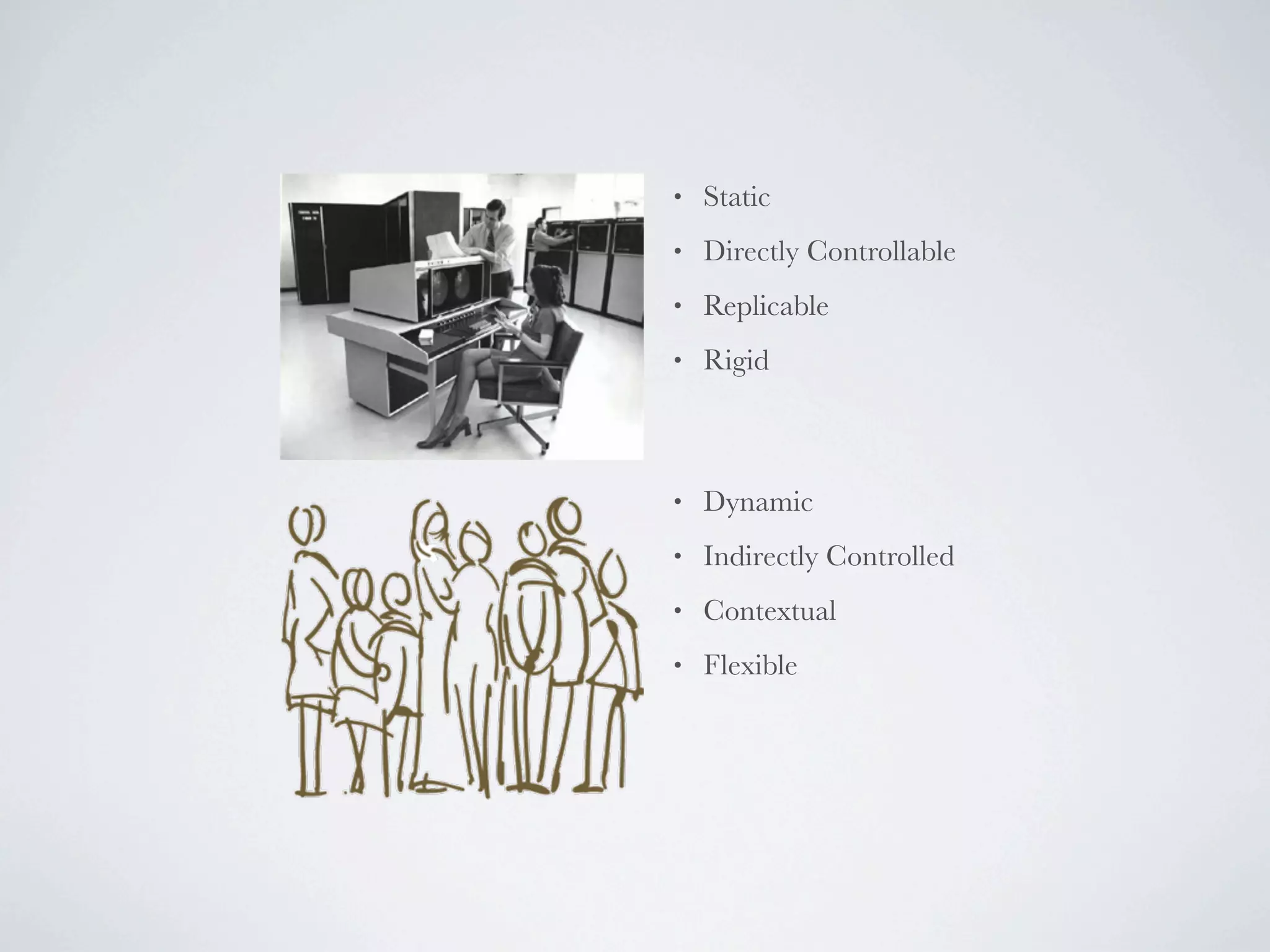
•   Static
•   Directly Controllable
•   Replicable
•   Rigid


•   Dynamic
•   Indirectly Controlled
•   Contextual
•   Flexible
Implications

•   Static analysis is impossible

•   All analysis must be done in the context of use

•   To derive generalizable findings, study constraints rather
    than artifacts

•   Successful sociotechnical systems last by maintaining
    constraints in the face of changing social environments
•   Start with the social system first
•   Use technology to augment
•   Three projects:
      •   Situational Awareness
      •   Human Expertise Routing Network
      •   Measuring Contribution
•   Use technology to help deal with scale
Social Affordances
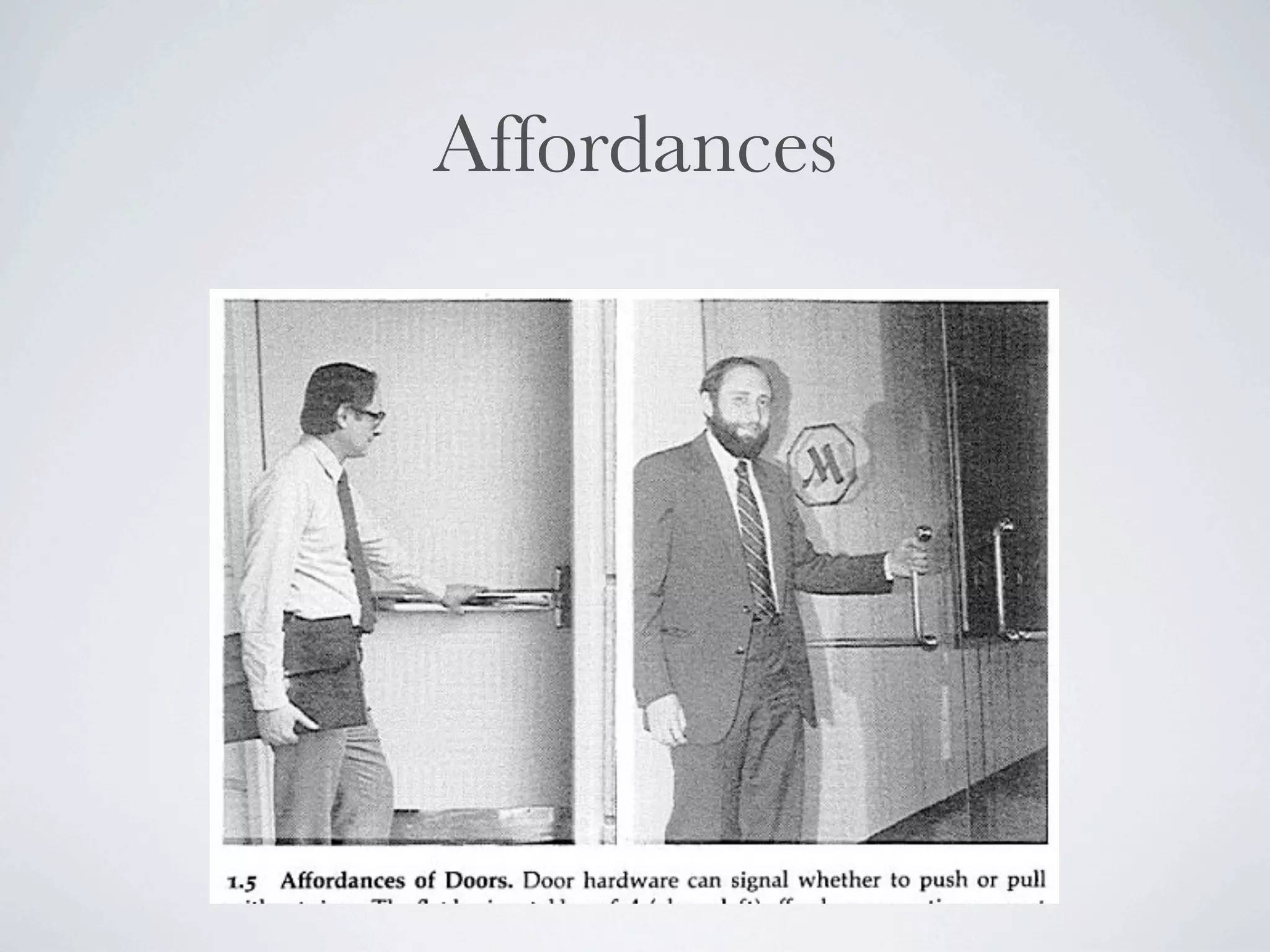
Affordances
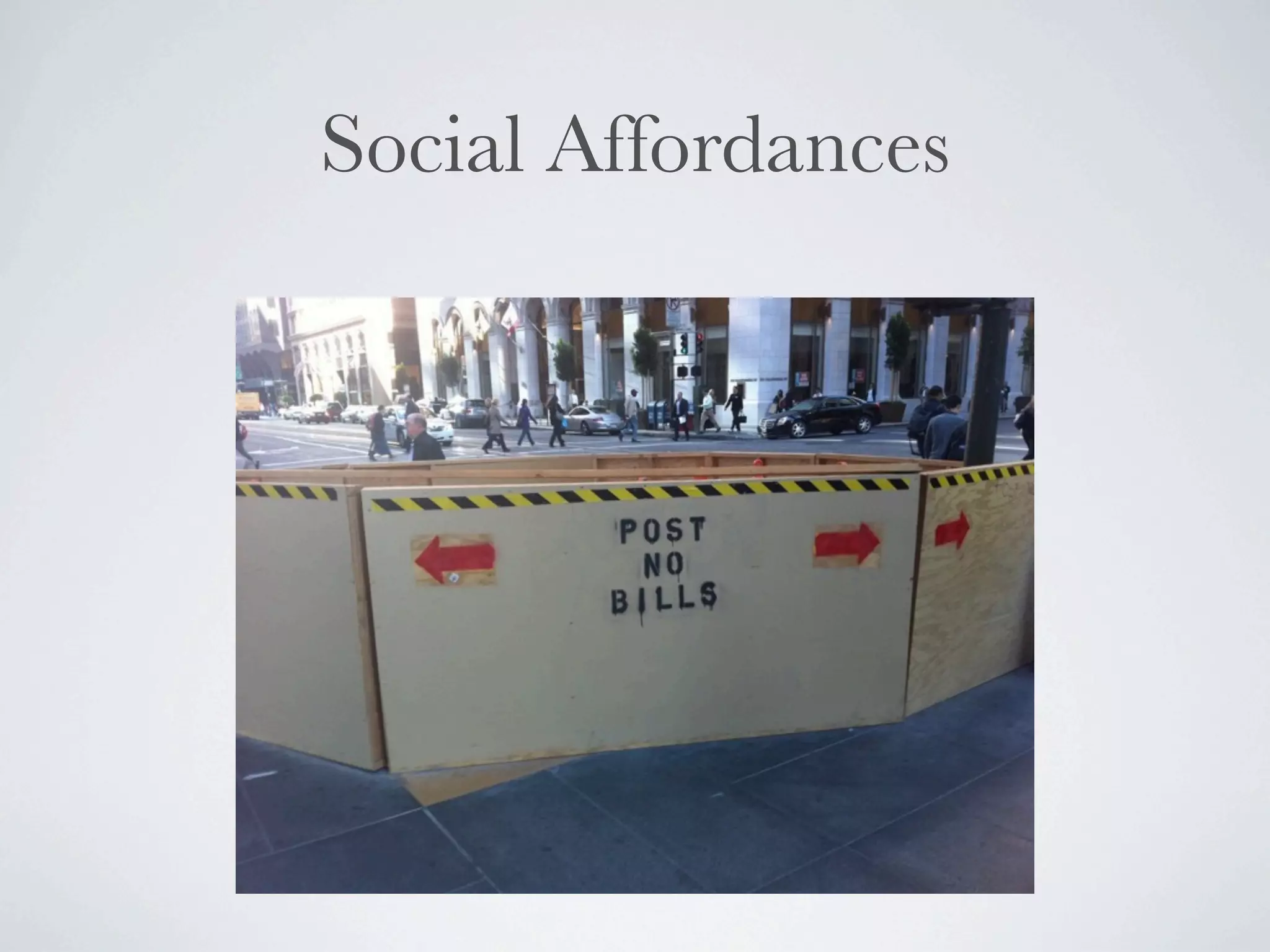
Social Affordances
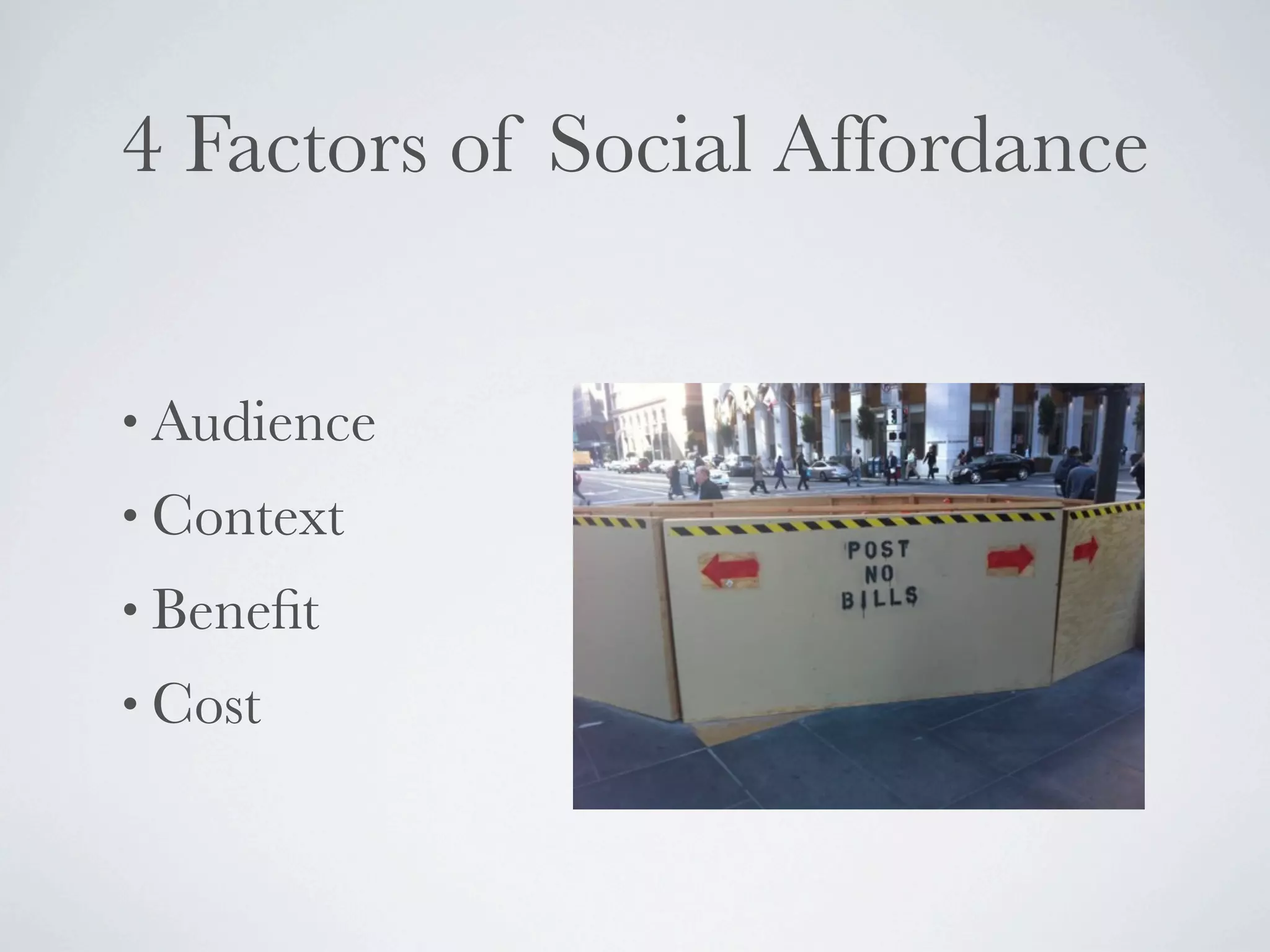
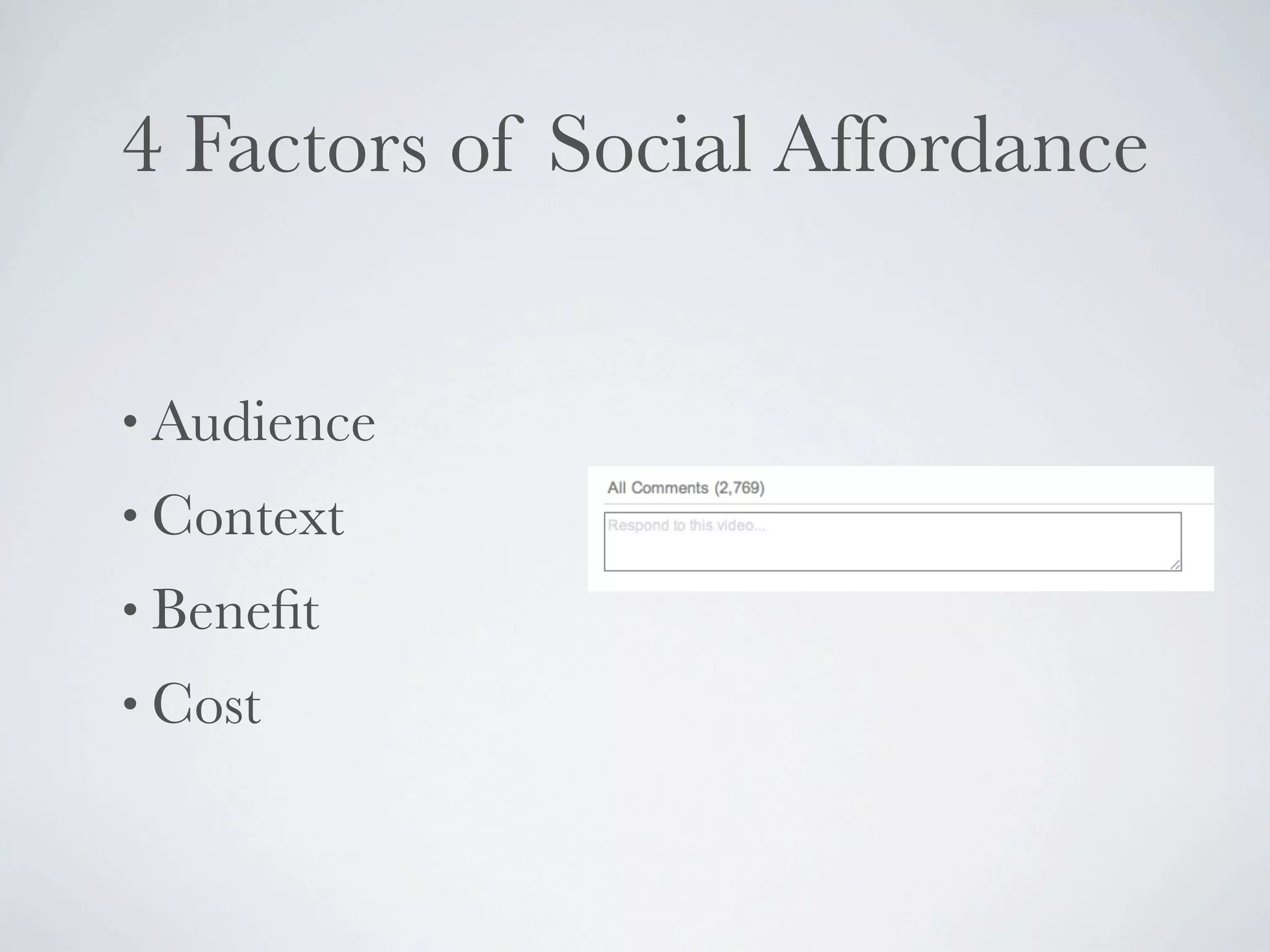
4 Factors of Social Affordance


• Audience
• Context
• Benefit
• Cost
4 Factors of Social Affordance


• Audience
• Context
• Benefit
• Cost
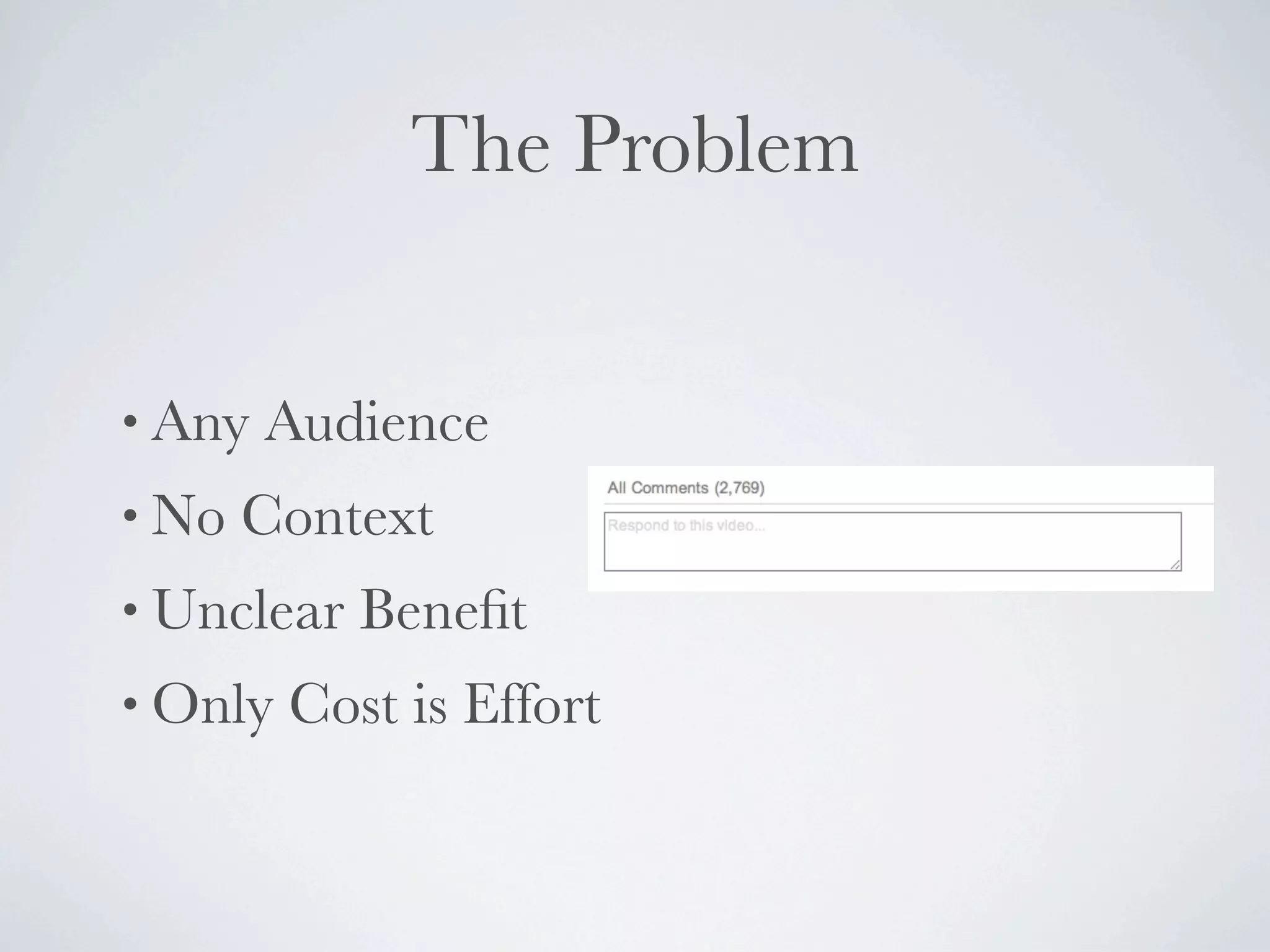
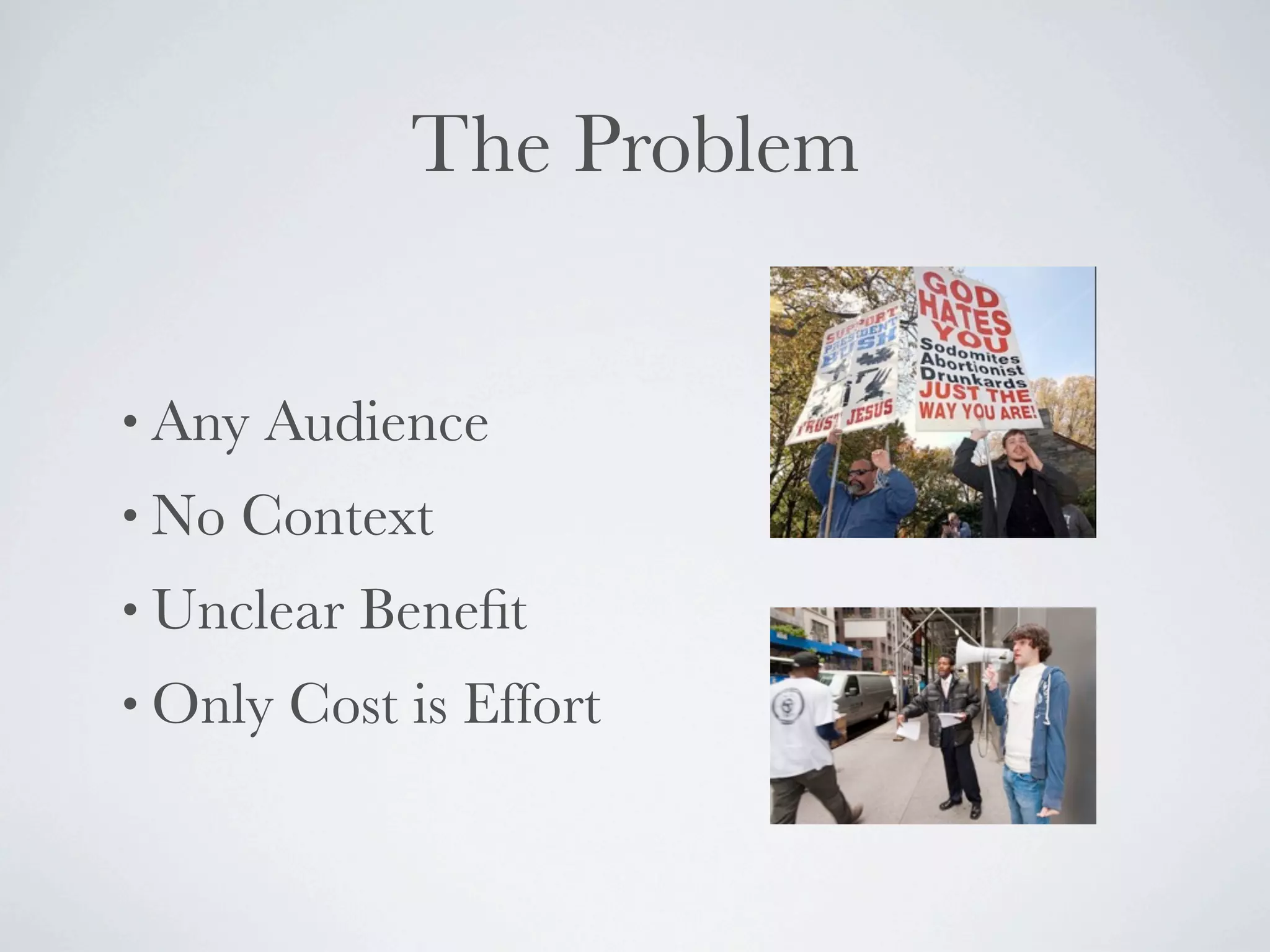
The Problem


• Any   Audience
• No   Context
• Unclear   Benefit
• Only   Cost is Effort
The Problem


• Any   Audience
• No   Context
• Unclear   Benefit
• Only   Cost is Effort
Goal: A place for meaningful, substantive & productive
interaction
Audience:
 •   Pre-screened
 •   Committee of peers
 •   Base level of design talent
Context:
 •   Basic level of design literacy expected
 •   Work framed the conversation
 •   Helpfulness as a norm
Benefit:
 •   Connect with other designers
 •   Exposure to new skills/techniques/knowledge
 •   Produce better design
Costs:
 •   Time
 •   Unwanted Social Obligation
 •   Possibility of breach of confidentiality
 •   Reputational Risk
These affordances will change over time, the
    challenge is to stay true to the goal
Plazas vs Warrens
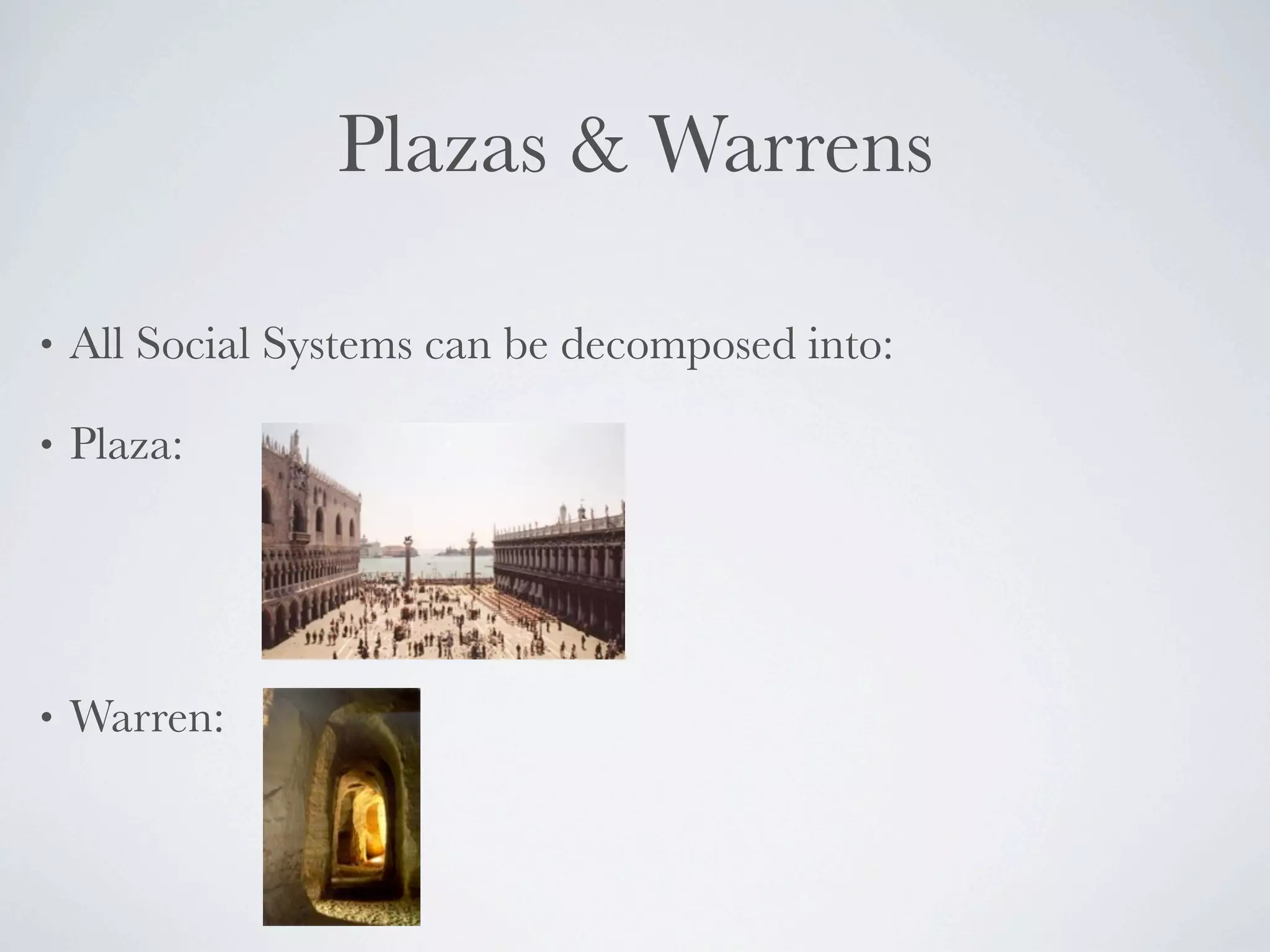
Plazas & Warrens

•   All Social Systems can be decomposed into:

•   Plaza:


•   Warren:
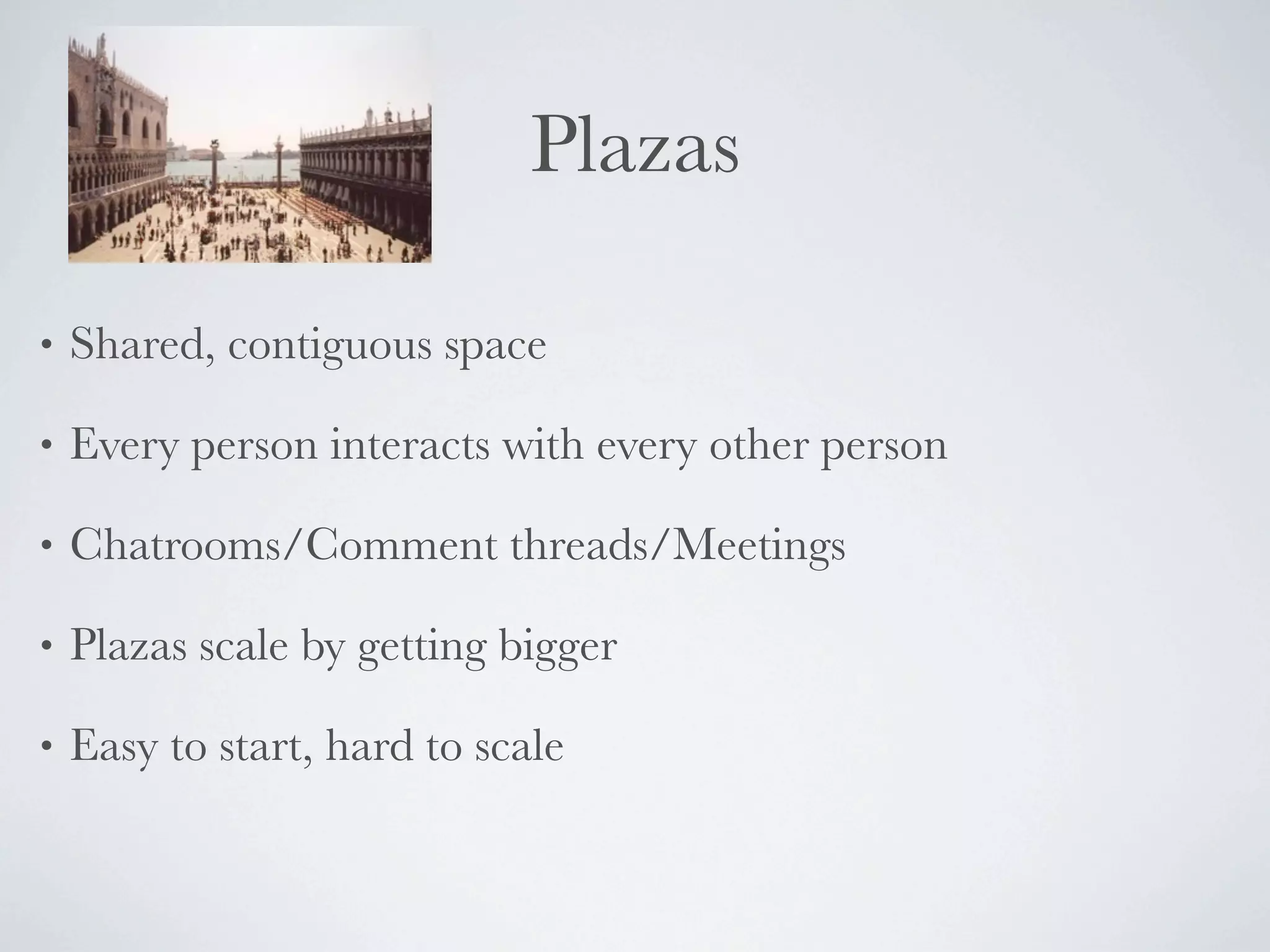
Plazas

•   Shared, contiguous space

•   Every person interacts with every other person

•   Chatrooms/Comment threads/Meetings

•   Plazas scale by getting bigger

•   Easy to start, hard to scale
Warrens

•   Fragmented, personalized spaces

•   Can only interact with immediate surrounds

•   Facebook/IM/Cities

•   Warrens scale by adding more warrens

•   Hard to start, easy to scale
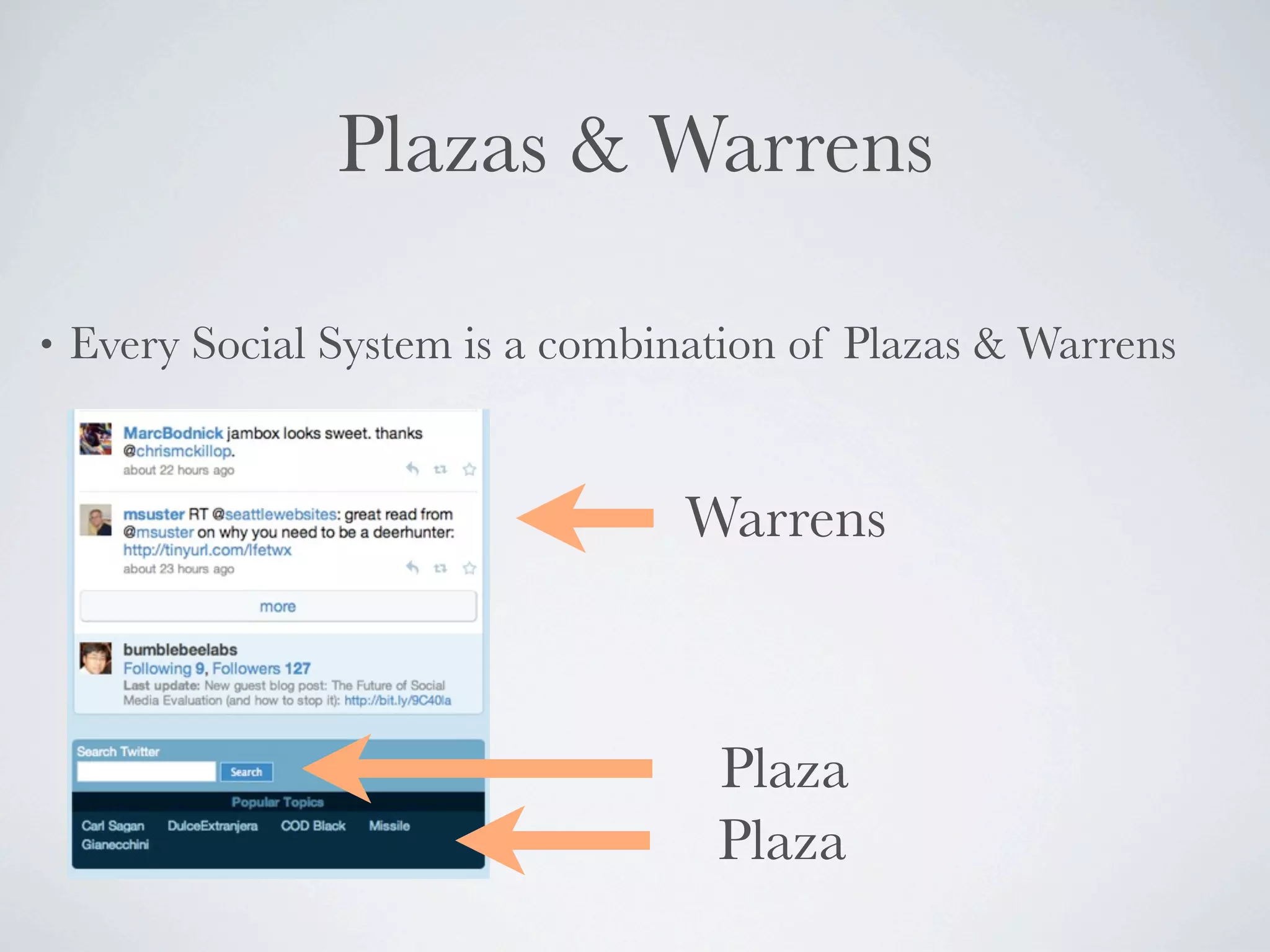
Plazas & Warrens

•   Every Social System is a combination of Plazas & Warrens


                                   Warrens


                                    Plaza
                                    Plaza
•   Currently, mainly a plaza

•   How do we scale?

•   How do we avoid bad elements?

•   Journeyman/Apprentice/Master?

•   Geographical/Time Segregation?
Plazas & Warrens

•   The architecture of your product will determine how people
    communicate

•   Designing the correct Social Experience involves making sure
    this architecture is correct

•   The necessity of Plazas vs Warrens will change as your
    community changes
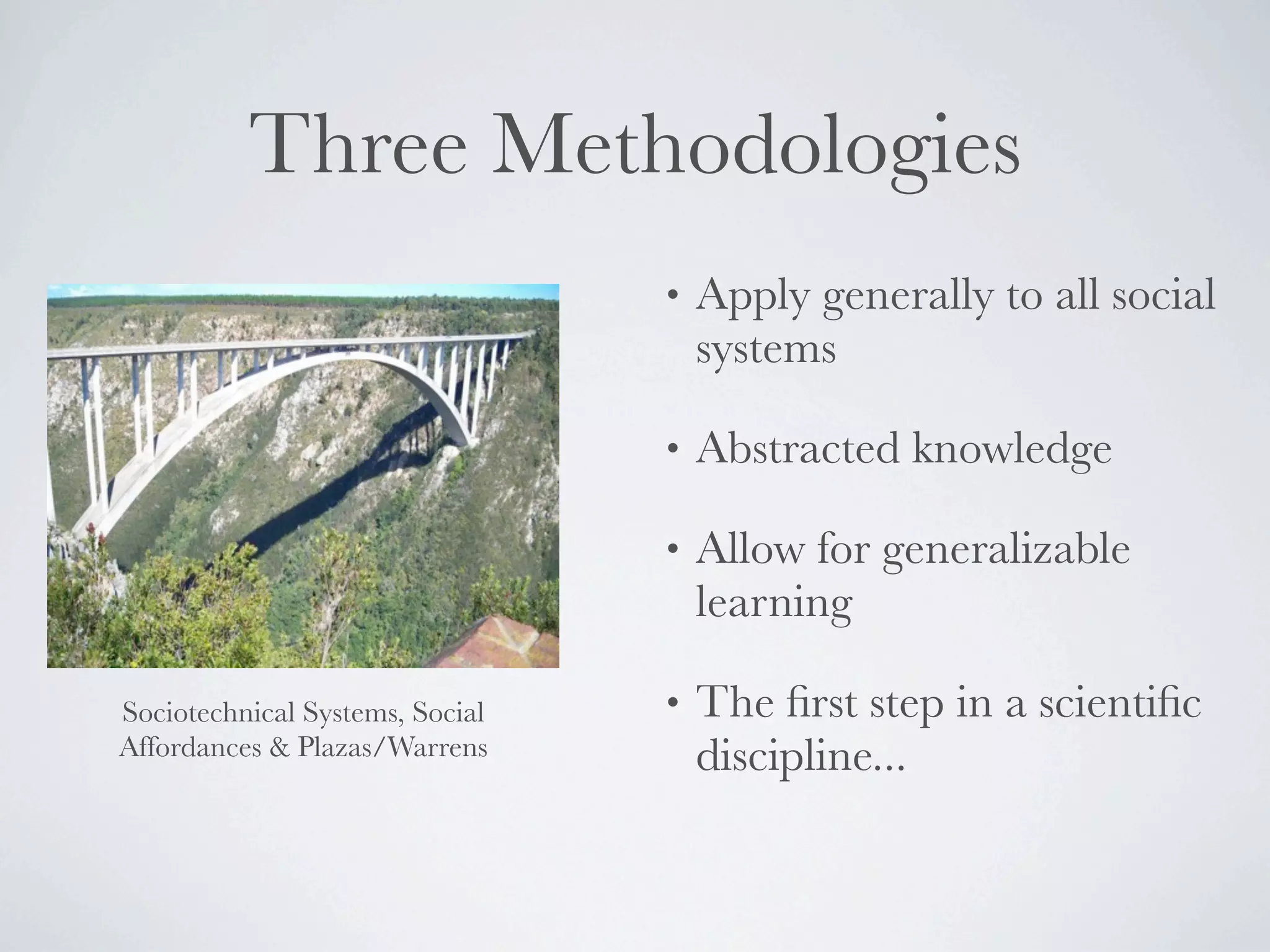
Three Methodologies
                                 •   Apply generally to all social
                                     systems

                                 •   Abstracted knowledge

                                 •   Allow for generalizable
                                     learning

Sociotechnical Systems, Social   •   The first step in a scientific
Affordances & Plazas/Warrens         discipline...
Conclusions
1. Social Experience Design is a
     distinct problem space
2. We are still in a Pre-Scientific
era for Social Experience Design
3. The Product Design Guild is
          Awesome!
  (come talk to me after about how you can help)
         Or sign up at: http://www.productdesignguild.com
Questions?

Xianhang Zhang: Lessons from Social Software: From Facebook to Face to Face Design Guild

  • 1.
    Lessons from SocialSoftware: From Facebook to a Face to Face Design Guild Xianhang Zhang - BayCHI
  • 2.
    A Tale ofTwo Bridges Grange Bridge, Cumbria Bloukrans Bridge, South Africa 1675 1984
  • 3.
    Pre-scientific • Built through trial & error • Frequent failure • Lack of generalizable learning • Rules of thumb knowledge Grange Bridge, Cumbria 1675 • Knowledge only gained via experience
  • 4.
    Scientific • Built using theory & methodology • Predictable results • Accumulation of learning • Abstracted knowledge Bloukrans Bridge, South Africa 1984 • Taught via instruction
  • 5.
    My Background • BSc Computer Science (University of New South Wales) • • HCI work with Tabletop Computing (University of Sydney)
  • 6.
    Interaction Design • User Centered Design • Usability Testing • Personas & Use Cases • Mental Models • Fitts’ Law & GOMS • etc...
  • 7.
    My Background • BSc Computer Science (University of New South Wales) • • HCI work with Tabletop Computing (University of Sydney) • PhD Candidate (University of Washington)...
  • 9.
    Flame wars arenot surprising; they are one of the most reliable features of mailing list practice. If you assume a piece of software is for what it does, rather than what its designer's goals were, then mailing list software is a tool for creating and sustaining heated argument...
  • 10.
    You couldn't gothrough the code of Mailman and find the comment that reads "The next subroutine ensures that misunderstandings between users will be amplified, leading to name-calling and vitriol." Yet the software will frequently produce just that outcome...
  • 11.
    In thirty years,the principal engineering work on mailing lists has been on the administrative experience. Mailman now offers administrator nearly a hundred configurable options, many with multiple choices. However, the social experience of a mailing list over those three decades has hardly changed at all...
  • 12.
    Is it consideredrude to "ignore" a friend request? Is it considered rude to un-friend a facebook friend? What if its someone you never actually speak to? And wish you had never friended? But you don't want to seem like an asshole? Will everyone assume that there was some "issue" or fight between us? What about work related "friends," like a boss or someone you want to maintain good relations with but don't want seeing your party pictures? Is the point of facebook to acquire the most friends? Is there a secret prize for accomplishing this?
  • 13.
    What is SocialExperience Design? • Designing the Social Interactions around a product/service • A distinct & separate field from Interaction Design • Designing for nuance, politeness, ambiguity, identity & privacy • Does not require an interactive technology • An example...
  • 14.
    Group Discussion Protocol • Standard: First-in-First-out
  • 15.
    Group Discussion Protocol • Better: Raised Finger & Raised Hand
  • 16.
    My Background • • HCI work with Tabletop Computing (University of Sydney) • PhD Candidate (University of Washington) • Bumblebee Labs (Founder) • Peel (Social Experience Designer) • Product Design Guild (Founder)
  • 17.
    Social Experience Design • Built through trial & error • Frequent failure • Lack of generalizable learning • Rules of thumb knowledge • Knowledge only gained via experience
  • 18.
  • 19.
    Social Experience DesignPrimer 1. Sociotechnical Systems 2. Social Affordances 3. Plazas & Warrens
  • 21.
    Rapid increase in demand for designers • Design education isn’t reflecting skills SV employers want • Technology teams now 3 - 5 engineers & 1 designer • Mentorship is a losing economic proposition
  • 22.
    I think thisis where guilds come in. Today, we often equate guilds with unions and organizing to establish and protect workers' rights. But, one of the original functions of guilds was to establish a path of mastery that was orthogonal to the workplace, since it was unlikely that you had a chance to work with other craftsmen on a daily basis.
  • 23.
    Mission: To enablethe creation of more & better designers by providing a path of mastery that is orthogonal to the workplace
  • 24.
    Pilot #1 • 30 designers • Bringing real work in order to engage in collaborative design • Noon - 6pm • Largely free-form collaboration
  • 25.
    Rules • You need to bring work: This is a place for work to be done. There is no room for tourists • Give before you receive: We want this to be a community for contribution, not a resource for exploitation • Be articulate about what you can offer: We are looking for people who can contribute to the education of fellow designers
  • 26.
    Rules (continued) • Seek permission from all of your stakeholders before sharing: Don't sneak work into the guild under your client's or boss' nose • We operate under the FriendDA: Seek explicit permission before sharing anything you saw outside of the guild • Disclose any possible conflicts of interest before collaborating: It's up to the requester to decide whether to proceed • Any guild work you do belongs to the requester: The requester is free to use it however they like without reseeking your consent
  • 29.
  • 30.
  • 31.
    Social & TechnicalSystems Technology Community
  • 32.
    Social & TechnicalSystems Code Policy
  • 33.
  • 34.
  • 35.
  • 36.
    Sociotechnical Systems aresuccessful when the right constraints are in place, regardless of where they are implemented
  • 37.
    Static • Directly Controllable • Replicable • Rigid • Dynamic • Indirectly Controlled • Contextual • Flexible
  • 38.
    Implications • Static analysis is impossible • All analysis must be done in the context of use • To derive generalizable findings, study constraints rather than artifacts • Successful sociotechnical systems last by maintaining constraints in the face of changing social environments
  • 39.
    Start with the social system first • Use technology to augment • Three projects: • Situational Awareness • Human Expertise Routing Network • Measuring Contribution • Use technology to help deal with scale
  • 40.
  • 41.
  • 42.
  • 43.
    4 Factors ofSocial Affordance • Audience • Context • Benefit • Cost
  • 44.
    4 Factors ofSocial Affordance • Audience • Context • Benefit • Cost
  • 45.
    The Problem • Any Audience • No Context • Unclear Benefit • Only Cost is Effort
  • 46.
    The Problem • Any Audience • No Context • Unclear Benefit • Only Cost is Effort
  • 47.
    Goal: A placefor meaningful, substantive & productive interaction
  • 48.
    Audience: • Pre-screened • Committee of peers • Base level of design talent
  • 49.
    Context: • Basic level of design literacy expected • Work framed the conversation • Helpfulness as a norm
  • 50.
    Benefit: • Connect with other designers • Exposure to new skills/techniques/knowledge • Produce better design
  • 51.
    Costs: • Time • Unwanted Social Obligation • Possibility of breach of confidentiality • Reputational Risk
  • 52.
    These affordances willchange over time, the challenge is to stay true to the goal
  • 53.
  • 54.
    Plazas & Warrens • All Social Systems can be decomposed into: • Plaza: • Warren:
  • 55.
    Plazas • Shared, contiguous space • Every person interacts with every other person • Chatrooms/Comment threads/Meetings • Plazas scale by getting bigger • Easy to start, hard to scale
  • 56.
    Warrens • Fragmented, personalized spaces • Can only interact with immediate surrounds • Facebook/IM/Cities • Warrens scale by adding more warrens • Hard to start, easy to scale
  • 57.
    Plazas & Warrens • Every Social System is a combination of Plazas & Warrens Warrens Plaza Plaza
  • 58.
    Currently, mainly a plaza • How do we scale? • How do we avoid bad elements? • Journeyman/Apprentice/Master? • Geographical/Time Segregation?
  • 59.
    Plazas & Warrens • The architecture of your product will determine how people communicate • Designing the correct Social Experience involves making sure this architecture is correct • The necessity of Plazas vs Warrens will change as your community changes
  • 60.
    Three Methodologies • Apply generally to all social systems • Abstracted knowledge • Allow for generalizable learning Sociotechnical Systems, Social • The first step in a scientific Affordances & Plazas/Warrens discipline...
  • 61.
  • 62.
    1. Social ExperienceDesign is a distinct problem space
  • 63.
    2. We arestill in a Pre-Scientific era for Social Experience Design
  • 64.
    3. The ProductDesign Guild is Awesome! (come talk to me after about how you can help) Or sign up at: http://www.productdesignguild.com
  • 65.