

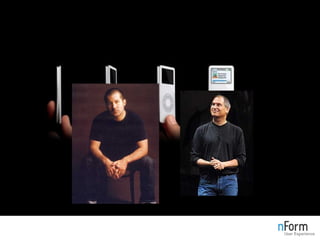









Massive Failure What Disasters Can Teach Us About Experience Design 7 th  Society and Information Technologies Encounter November 13, 2006 Santiago, Chile
 
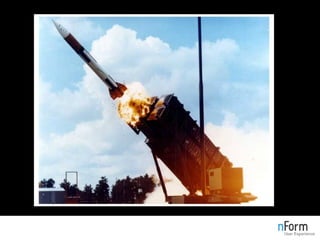
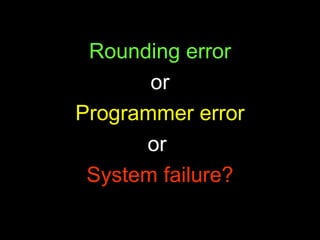
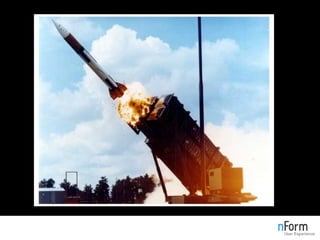
Rounding error
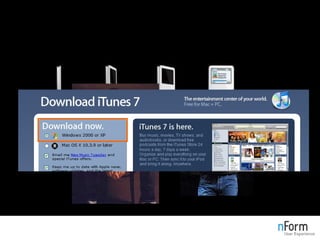
Rounding error or Programmer error?
Rounding error or Programmer error or  System failure?
 
Why disasters? Reveal real-world complexity Defy our expectations about accountability and corrective action Cascade of ordinary failures Attract small-problem solutions Blame and shame
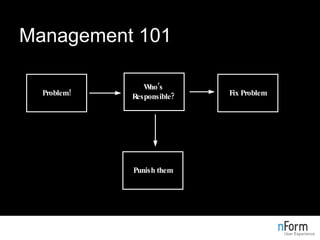
Management 101
What is a system? Collection of “stuff” Dynamic, complex, interdependent relationships Can't be decomposed into linear processes Can't be separated from the environment or context in which they occur Small changes    big effects
What are systems? Economies Ecosystems Organizations Markets Projects Social Networks
Do Systems Matter? GM closes plant in Fremont, California (1982) Worst quality record Worst labour relations Highest employee absenteeism and drug use Toyota opens Fremont plant in 1984 Hires 80% of GM’s workforce Outstanding quality record
Relevance to Experience Design Web is an ecosystem Systems within the web eBay Blogosphere Digg, Flickr, MySpace Cross-channel experiences
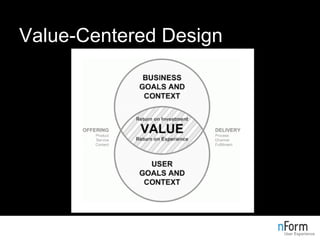
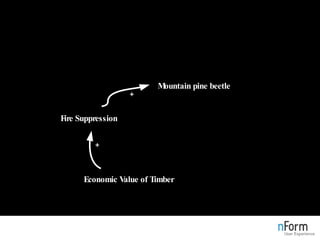
Value-Centered Design
 
Lessons Learned Cascade of ordinary failures Complex accountability Real-world tests


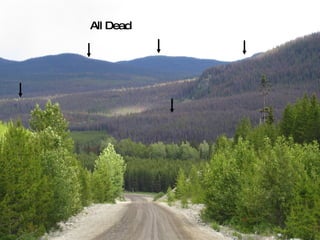
All Dead


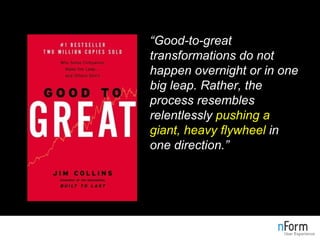
“ Good-to-great transformations do not happen overnight or in one big leap. Rather, the process resembles relentlessly  pushing a giant, heavy flywheel  in one direction.”
Lessons Learned Real-world tests Complex accountability Big problems have shared ownership Assumed safety nets can vanish easily Small changes    Big impact The Flywheel Effect
 
 
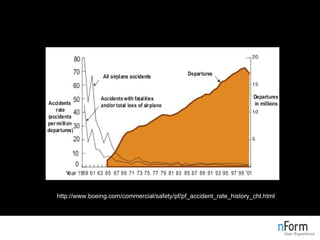
http://www.boeing.com/commercial/safety/pf/pf_accident_rate_history_cht.html
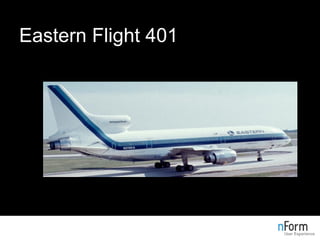
Eastern Flight 401
NASA Research (1979) Primary cause of most aviation accidents: Leadership Decision-making Interpersonal communication Led to teamwork training for flight crews Reporting of near misses
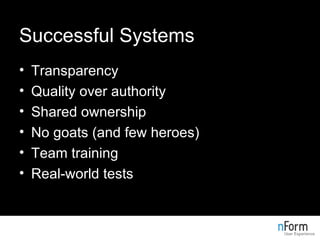
Successful Systems Transparency Quality over authority Shared ownership No goats (and few heroes) Team training Real-world tests
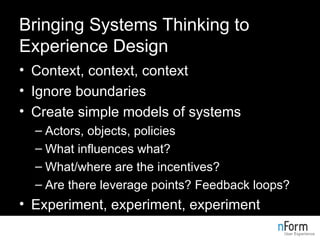
Bringing Systems Thinking to Experience Design Context, context, context Ignore boundaries Create simple models of systems Actors, objects, policies What influences what? What/where are the incentives? Are there leverage points? Feedback loops? Experiment, experiment, experiment
“ Screw around vigorously” - Tom Peters


Questions? Email:  [email_address] URL:  http://atomiq.org/etc/massive_failure_chile_2006.pdf

Massive Failure: What Disasters Can Teach Us About Experience Design

  • 1.
    Massive Failure WhatDisasters Can Teach Us About Experience Design 7 th Society and Information Technologies Encounter November 13, 2006 Santiago, Chile
  • 2.
  • 3.
  • 4.
    Rounding error orProgrammer error?
  • 5.
    Rounding error orProgrammer error or System failure?
  • 6.
  • 7.
    Why disasters? Revealreal-world complexity Defy our expectations about accountability and corrective action Cascade of ordinary failures Attract small-problem solutions Blame and shame
  • 8.
  • 9.
    What is asystem? Collection of “stuff” Dynamic, complex, interdependent relationships Can't be decomposed into linear processes Can't be separated from the environment or context in which they occur Small changes  big effects
  • 10.
    What are systems?Economies Ecosystems Organizations Markets Projects Social Networks
  • 11.
    Do Systems Matter?GM closes plant in Fremont, California (1982) Worst quality record Worst labour relations Highest employee absenteeism and drug use Toyota opens Fremont plant in 1984 Hires 80% of GM’s workforce Outstanding quality record
  • 12.
    Relevance to ExperienceDesign Web is an ecosystem Systems within the web eBay Blogosphere Digg, Flickr, MySpace Cross-channel experiences
  • 13.
  • 14.
  • 15.
    Lessons Learned Cascadeof ordinary failures Complex accountability Real-world tests
  • 16.
  • 17.
  • 18.
  • 19.
  • 20.
  • 21.
  • 22.
  • 23.
  • 24.
    “ Good-to-great transformationsdo not happen overnight or in one big leap. Rather, the process resembles relentlessly pushing a giant, heavy flywheel in one direction.”
  • 25.
    Lessons Learned Real-worldtests Complex accountability Big problems have shared ownership Assumed safety nets can vanish easily Small changes  Big impact The Flywheel Effect
  • 26.
  • 27.
  • 28.
  • 29.
  • 30.
    NASA Research (1979)Primary cause of most aviation accidents: Leadership Decision-making Interpersonal communication Led to teamwork training for flight crews Reporting of near misses
  • 31.
    Successful Systems TransparencyQuality over authority Shared ownership No goats (and few heroes) Team training Real-world tests
  • 32.
    Bringing Systems Thinkingto Experience Design Context, context, context Ignore boundaries Create simple models of systems Actors, objects, policies What influences what? What/where are the incentives? Are there leverage points? Feedback loops? Experiment, experiment, experiment
  • 33.
    “ Screw aroundvigorously” - Tom Peters
  • 34.
  • 35.
  • 36.
  • 37.
  • 38.
    Questions? Email: [email_address] URL: http://atomiq.org/etc/massive_failure_chile_2006.pdf