Chapter 8:
Group Influence
Maicah Saballegue
What is a Group?
Exist when two or
more people interact
for more than a few
moments, affect one
another in some way,
and think of
themselves as “us”.
Different groups help us meet different human
needs…
Affiliate – to belong to and connect with others.
Achieve – to gain social identity.
3 examples of Collective Influence
Social facilitation
Social loafing
Deindividuation
These three phenomena
can occur in Minimal
interaction “Minimal
Group Situations”
Social Facilitation: How are we affected by the
presence of others?
 The tendency of people to
perform simple or well-
learned tasks better when
others are present.
Example:
Do you ride faster when
bicycling with others?
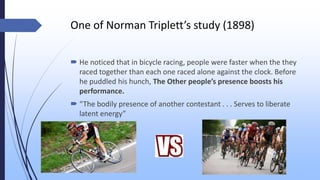
One of Norman Triplett’s study (1898)
 He noticed that in bicycle racing, people were faster when the they
raced together than each one raced alone against the clock. Before
he puddled his hunch, The Other people’s presence boosts his
performance.
 “The bodily presence of another contestant . . . Serves to liberate
latent energy”
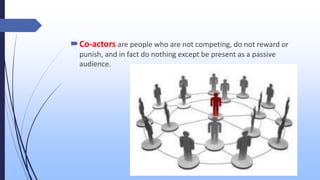
Co-actors are people who are not competing, do not reward or
punish, and in fact do nothing except be present as a passive
audience.
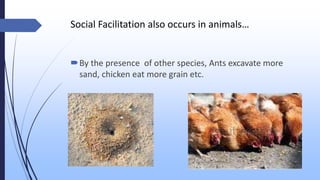
Social Facilitation also occurs in animals…
By the presence of other species, Ants excavate more
sand, chicken eat more grain etc.
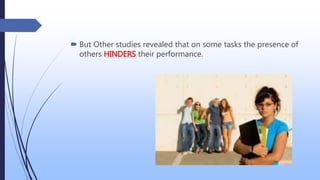
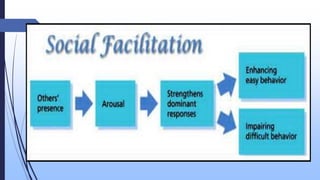
 But Other studies revealed that on some tasks the presence of
others HINDERS their performance.
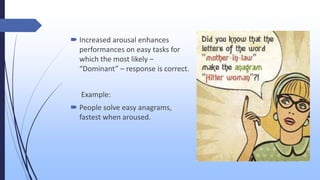
 Increased arousal enhances
performances on easy tasks for
which the most likely –
“Dominant” – response is correct.
Example:
 People solve easy anagrams,
fastest when aroused.
 But on complex tasks, for which
the correct answer is NOT
DOMINANT. Increased arousal
promotes Incorrect responding.
Example;
Problem-solving, abstract
reasoning, Mathematical
computations.
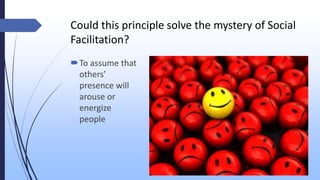
Could this principle solve the mystery of Social
Facilitation?
To assume that
others’
presence will
arouse or
energize
people
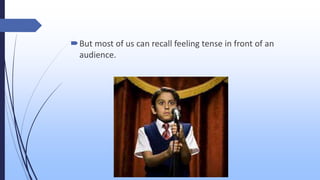
But most of us can recall feeling tense in front of an
audience.
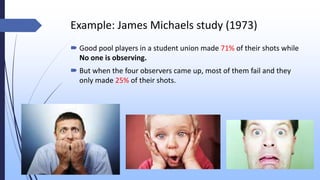
Example: James Michaels study (1973)
 Good pool players in a student union made 71% of their shots while
No one is observing.
 But when the four observers came up, most of them fail and they
only made 25% of their shots.
“Social Arousal facilitates dominant responses and boost
performance on easy tasks and hurt performance on
difficult tasks, when other people are present”
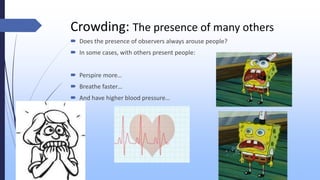
Crowding: The presence of many others
 Does the presence of observers always arouse people?
 In some cases, with others present people:
 Perspire more…
 Breathe faster…
 And have higher blood pressure…
Example:
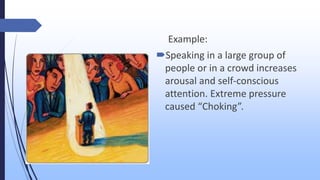
Speaking in a large group of
people or in a crowd increases
arousal and self-conscious
attention. Extreme pressure
caused “Choking”.
Why are we aroused in the presence of
others?
 What is about other people that creates arousal?
 Evidence supports three possible factors…
1. Evaluation Apprehension
 Is the concern of how others
are evaluating us.
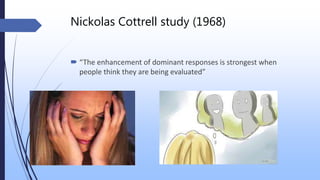
Nickolas Cottrell study (1968)
 “The enhancement of dominant responses is strongest when
people think they are being evaluated”
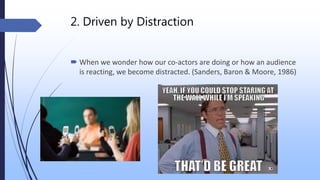
2. Driven by Distraction
 When we wonder how our co-actors are doing or how an audience
is reacting, we become distracted. (Sanders, Baron & Moore, 1986)
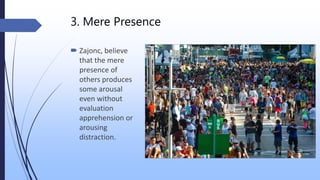
3. Mere Presence
 Zajonc, believe
that the mere
presence of
others produces
some arousal
even without
evaluation
apprehension or
arousing
distraction.
Social Loafing: Do individuals exert less
effort in a group?
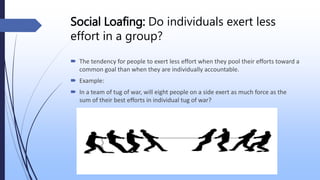
 The tendency for people to exert less effort when they pool their efforts toward a
common goal than when they are individually accountable.
 Example:
 In a team of tug of war, will eight people on a side exert as much force as the
sum of their best efforts in individual tug of war?
Many hands make light work…
 “In unity there is strength”
 Group members may be actually less motivated when performing
additive task.
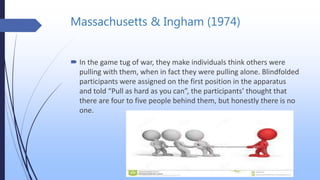
Massachusetts & Ingham (1974)
 In the game tug of war, they make individuals think others were
pulling with them, when in fact they were pulling alone. Blindfolded
participants were assigned on the first position in the apparatus
and told “Pull as hard as you can”, the participants’ thought that
there are four to five people behind them, but honestly there is no
one.
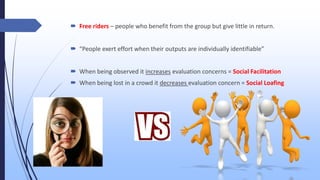
 Free riders – people who benefit from the group but give little in return.
 “People exert effort when their outputs are individually identifiable”
 When being observed it increases evaluation concerns = Social Facilitation
 When being lost in a crowd it decreases evaluation concern = Social Loafing
 “People may, however, put forth even more effort in a group when
the goal is important, rewards are significant, and team spirit
exists”

Group influence

  • 1.
  • 2.
    What is aGroup? Exist when two or more people interact for more than a few moments, affect one another in some way, and think of themselves as “us”.
  • 3.
    Different groups helpus meet different human needs… Affiliate – to belong to and connect with others. Achieve – to gain social identity.
  • 4.
    3 examples ofCollective Influence Social facilitation Social loafing Deindividuation These three phenomena can occur in Minimal interaction “Minimal Group Situations”
  • 5.
    Social Facilitation: Howare we affected by the presence of others?  The tendency of people to perform simple or well- learned tasks better when others are present. Example: Do you ride faster when bicycling with others?
  • 6.
    One of NormanTriplett’s study (1898)  He noticed that in bicycle racing, people were faster when the they raced together than each one raced alone against the clock. Before he puddled his hunch, The Other people’s presence boosts his performance.  “The bodily presence of another contestant . . . Serves to liberate latent energy”
  • 7.
    Co-actors are peoplewho are not competing, do not reward or punish, and in fact do nothing except be present as a passive audience.
  • 8.
    Social Facilitation alsooccurs in animals… By the presence of other species, Ants excavate more sand, chicken eat more grain etc.
  • 9.
     But Otherstudies revealed that on some tasks the presence of others HINDERS their performance.
  • 11.
     Increased arousalenhances performances on easy tasks for which the most likely – “Dominant” – response is correct. Example:  People solve easy anagrams, fastest when aroused.
  • 12.
     But oncomplex tasks, for which the correct answer is NOT DOMINANT. Increased arousal promotes Incorrect responding. Example; Problem-solving, abstract reasoning, Mathematical computations.
  • 13.
    Could this principlesolve the mystery of Social Facilitation? To assume that others’ presence will arouse or energize people
  • 14.
    But most ofus can recall feeling tense in front of an audience.
  • 15.
    Example: James Michaelsstudy (1973)  Good pool players in a student union made 71% of their shots while No one is observing.  But when the four observers came up, most of them fail and they only made 25% of their shots.
  • 16.
    “Social Arousal facilitatesdominant responses and boost performance on easy tasks and hurt performance on difficult tasks, when other people are present”
  • 17.
    Crowding: The presenceof many others  Does the presence of observers always arouse people?  In some cases, with others present people:  Perspire more…  Breathe faster…  And have higher blood pressure…
  • 18.
    Example: Speaking in alarge group of people or in a crowd increases arousal and self-conscious attention. Extreme pressure caused “Choking”.
  • 19.
    Why are wearoused in the presence of others?  What is about other people that creates arousal?  Evidence supports three possible factors…
  • 20.
    1. Evaluation Apprehension Is the concern of how others are evaluating us.
  • 21.
    Nickolas Cottrell study(1968)  “The enhancement of dominant responses is strongest when people think they are being evaluated”
  • 22.
    2. Driven byDistraction  When we wonder how our co-actors are doing or how an audience is reacting, we become distracted. (Sanders, Baron & Moore, 1986)
  • 23.
    3. Mere Presence Zajonc, believe that the mere presence of others produces some arousal even without evaluation apprehension or arousing distraction.
  • 24.
    Social Loafing: Doindividuals exert less effort in a group?  The tendency for people to exert less effort when they pool their efforts toward a common goal than when they are individually accountable.  Example:  In a team of tug of war, will eight people on a side exert as much force as the sum of their best efforts in individual tug of war?
  • 25.
    Many hands makelight work…  “In unity there is strength”  Group members may be actually less motivated when performing additive task.
  • 26.
    Massachusetts & Ingham(1974)  In the game tug of war, they make individuals think others were pulling with them, when in fact they were pulling alone. Blindfolded participants were assigned on the first position in the apparatus and told “Pull as hard as you can”, the participants’ thought that there are four to five people behind them, but honestly there is no one.
  • 27.
     Free riders– people who benefit from the group but give little in return.  “People exert effort when their outputs are individually identifiable”  When being observed it increases evaluation concerns = Social Facilitation  When being lost in a crowd it decreases evaluation concern = Social Loafing
  • 28.
     “People may,however, put forth even more effort in a group when the goal is important, rewards are significant, and team spirit exists”