IntroductiontoStructuralEquationModels|15May2013|KimmoVehkalahti
Introduction to
Structural Equation Models
Kimmo Vehkalahti
Adjunct Professor, University Lecturer
University of Helsinki, Department of Social Research, Statistics
http://www.helsinki.fi/people/Kimmo.Vehkalahti
Analyzing and Interpreting Data – Annual Seminar of FiDPEL:
The Finnish Doctoral Programme in Education and Learning
15 May 2013
1 / 29
IntroductiontoStructuralEquationModels|15May2013|KimmoVehkalahti
Introduction to Structural Equation Models
Outline
Models, Modeling and Model-fitting
Basic Concepts and Ideas of SEM
Analyzing and Interpreting Data
2 / 29
IntroductiontoStructuralEquationModels|15May2013|KimmoVehkalahti
Models, Modeling and Model-fitting
Models are simplifications of real-world phenomena.
Models are grounded on some substantial theory.
Statistical modeling:
primary task is to determine the goodness-of-fit between the
hypothesized model and the sample data
process of model-fitting can be summarized as
Data = Model + Residual, where
Data represent measurements of the observed variables,
Model represents the hypothesized structure, and
Residual represents the discrepancy between them
ultimate objective: to find a model that is both
1) substantive meaningful and 2) statistically well fitting
3 / 29
IntroductiontoStructuralEquationModels|15May2013|KimmoVehkalahti
Models, Modeling and Model-fitting
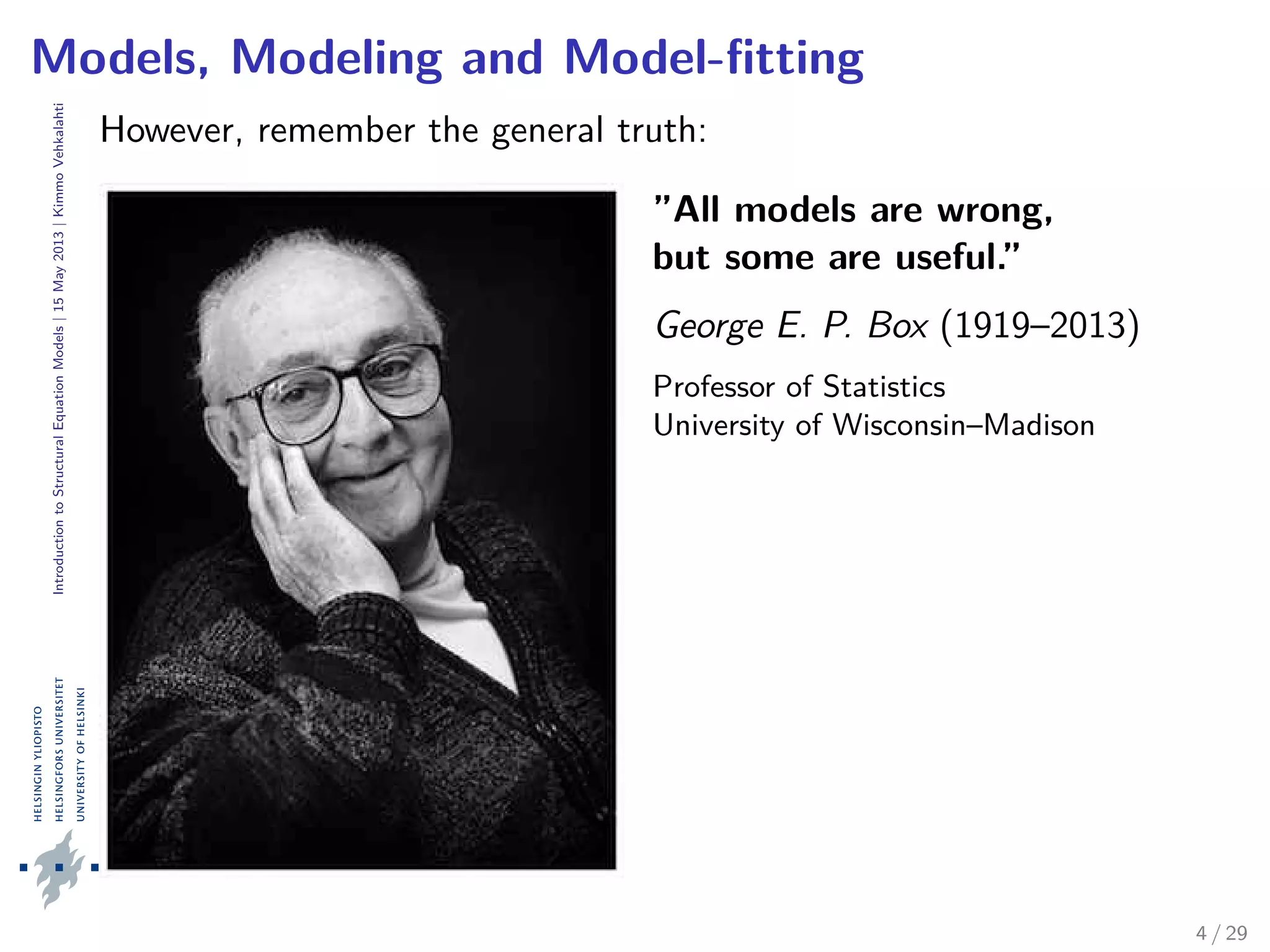
However, remember the general truth:
”All models are wrong,
but some are useful.”
George E. P. Box (1919–2013)
Professor of Statistics
University of Wisconsin–Madison
4 / 29
IntroductiontoStructuralEquationModels|15May2013|KimmoVehkalahti
Models – what about the Structural Equations?
Equations are used for defining any details of models.
Example of a simple equation (linear regression model):
y = β0 + β1x + ε,
where we are interested in the relationship of y and x:
y is the dependent variable (in the data),
x is the independent variable (in the data),
β0 and β1 are the regression coefficients, and
ε represents the random variation.
Structural equations are used for defining causal processes:
much more complicated structures than the one above
simultaneous analysis of an entire system of variables
can be modeled pictorially: clearer conceptualization
hypothesized model can be tested statistically
but: causality is not a statistical concept: theory required!
5 / 29
IntroductiontoStructuralEquationModels|15May2013|KimmoVehkalahti
Basic Concepts and Ideas of SEM
Latent variables and observed variables
Latent variables
latent: not observed directly, cannot be measured directly
operationally defined in terms of the believed behavior
indirectly measured via observed variables
Observed variables
responses to scales, scores in tests, coded responses etc.
indicators of the underlying construct they represent
choice of psychometrically sound measurement instruments
crucial for assessing the underlying constructs
6 / 29
IntroductiontoStructuralEquationModels|15May2013|KimmoVehkalahti
Basic Concepts and Ideas of SEM
(Sort of) combination of factor analysis and regression analysis
Factor analysis
links the observed variables with the latent variables (factors)
primary interest: the strength of the regression paths from the
factors to the observed variables (i.e. the factor loadings)
this part of SEM is called a measurement model
exploratory vs confirmatory factor analysis (EFA, CFA)
The full latent variable (SEM) model
regression structure among the latent variables (factors)
hypothesized causal impacts of one factor on another
measurement (CFA) model and a structural model
Generalizations: growth curve models, multilevel models, non-linear
models, time-series models, longitudinal models etc.
7 / 29
IntroductiontoStructuralEquationModels|15May2013|KimmoVehkalahti
Basic Concepts and Ideas of SEM
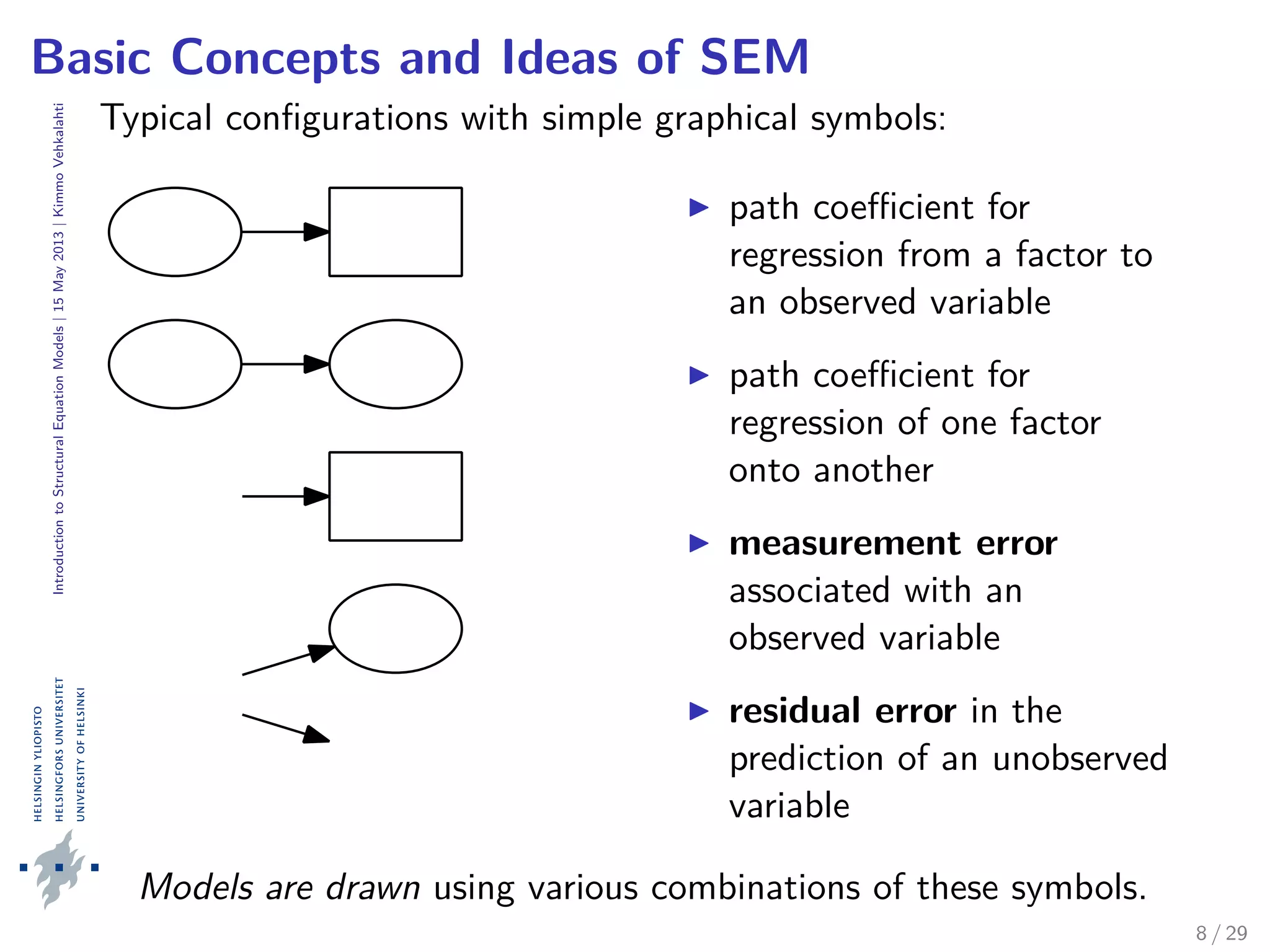
Typical configurations with simple graphical symbols:
path coefficient for
regression from a factor to
an observed variable
path coefficient for
regression of one factor
onto another
measurement error
associated with an
observed variable
residual error in the
prediction of an unobserved
variable
Models are drawn using various combinations of these symbols.
8 / 29
IntroductiontoStructuralEquationModels|15May2013|KimmoVehkalahti
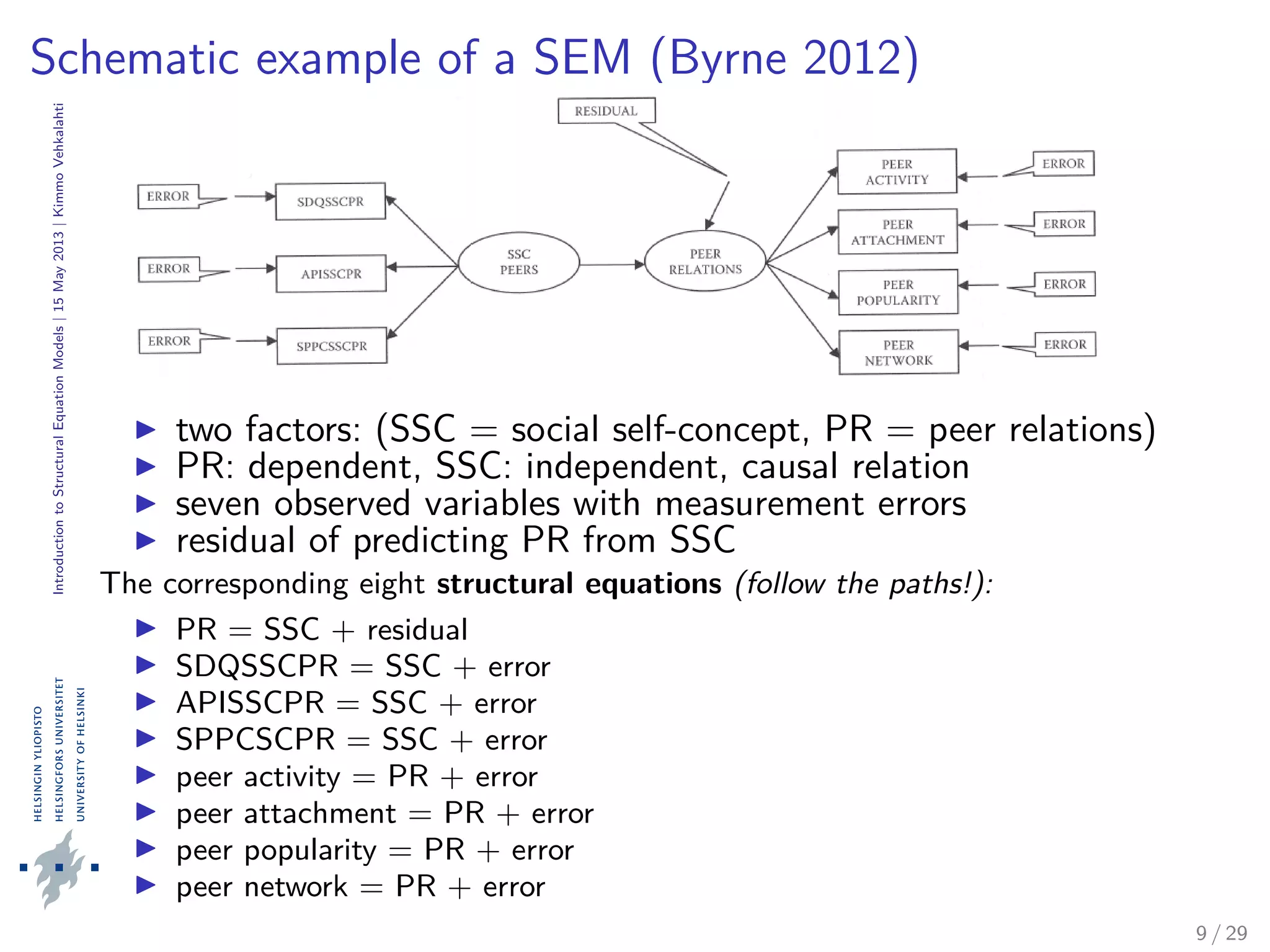
Schematic example of a SEM (Byrne 2012)
two factors: (SSC = social self-concept, PR = peer relations)
PR: dependent, SSC: independent, causal relation
seven observed variables with measurement errors
residual of predicting PR from SSC
The corresponding eight structural equations (follow the paths!):
PR = SSC + residual
SDQSSCPR = SSC + error
APISSCPR = SSC + error
SPPCSCPR = SSC + error
peer activity = PR + error
peer attachment = PR + error
peer popularity = PR + error
peer network = PR + error
9 / 29
IntroductiontoStructuralEquationModels|15May2013|KimmoVehkalahti
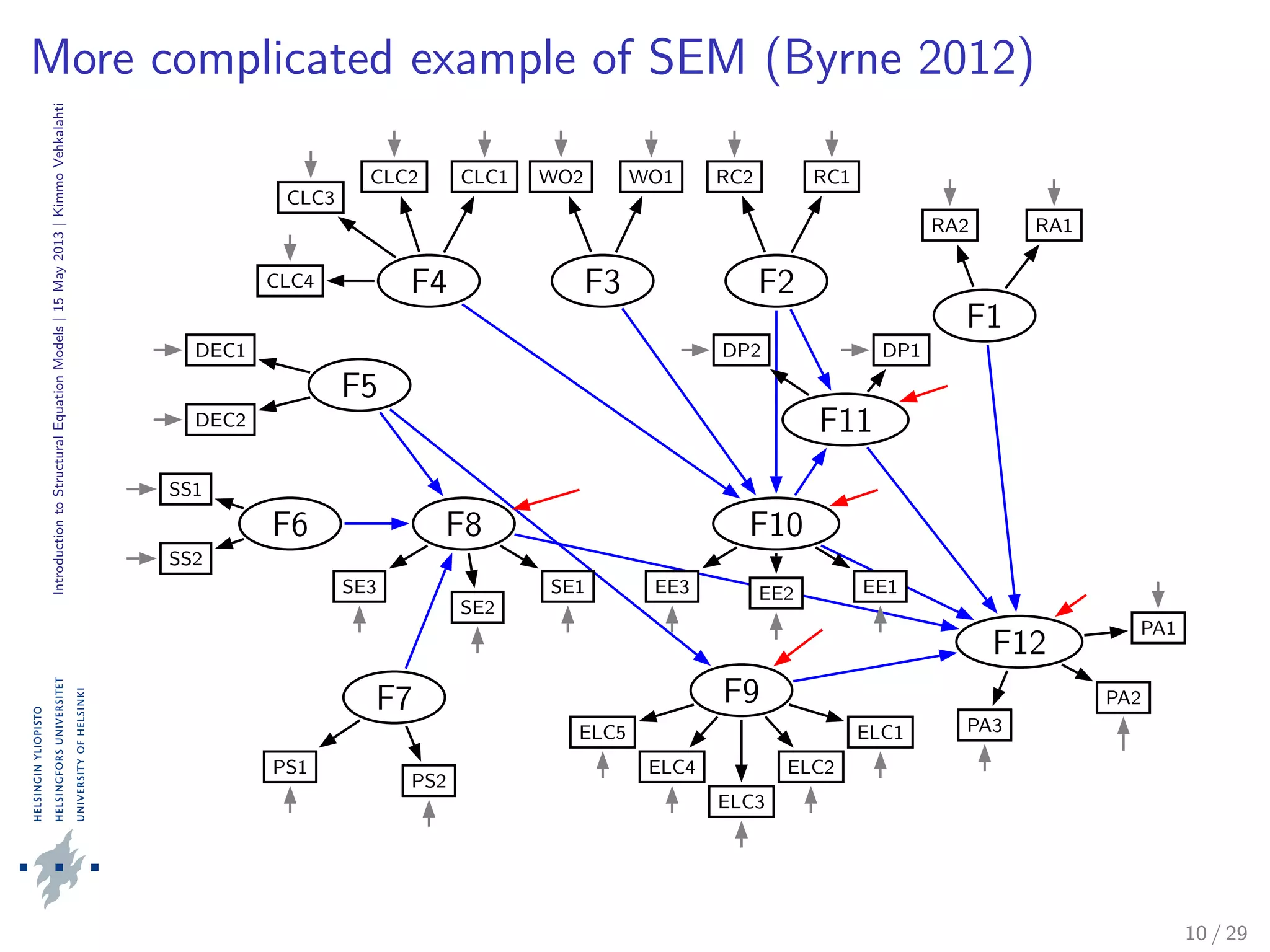
More complicated example of SEM (Byrne 2012)
F1
F2F3F4
F5
F6
F7
F8
F9
F10
F11
F12
RA1RA2
RC1RC2WO1WO2CLC1CLC2
CLC3
CLC4
DEC1
DEC2
SS1
SS2
PS1
PS2
SE1
SE2
SE3
ELC1
ELC2
ELC3
ELC4
ELC5
EE1EE2EE3
DP1DP2
PA1
PA2
PA3
10 / 29
IntroductiontoStructuralEquationModels|15May2013|KimmoVehkalahti
Analyzing and Interpreting Data
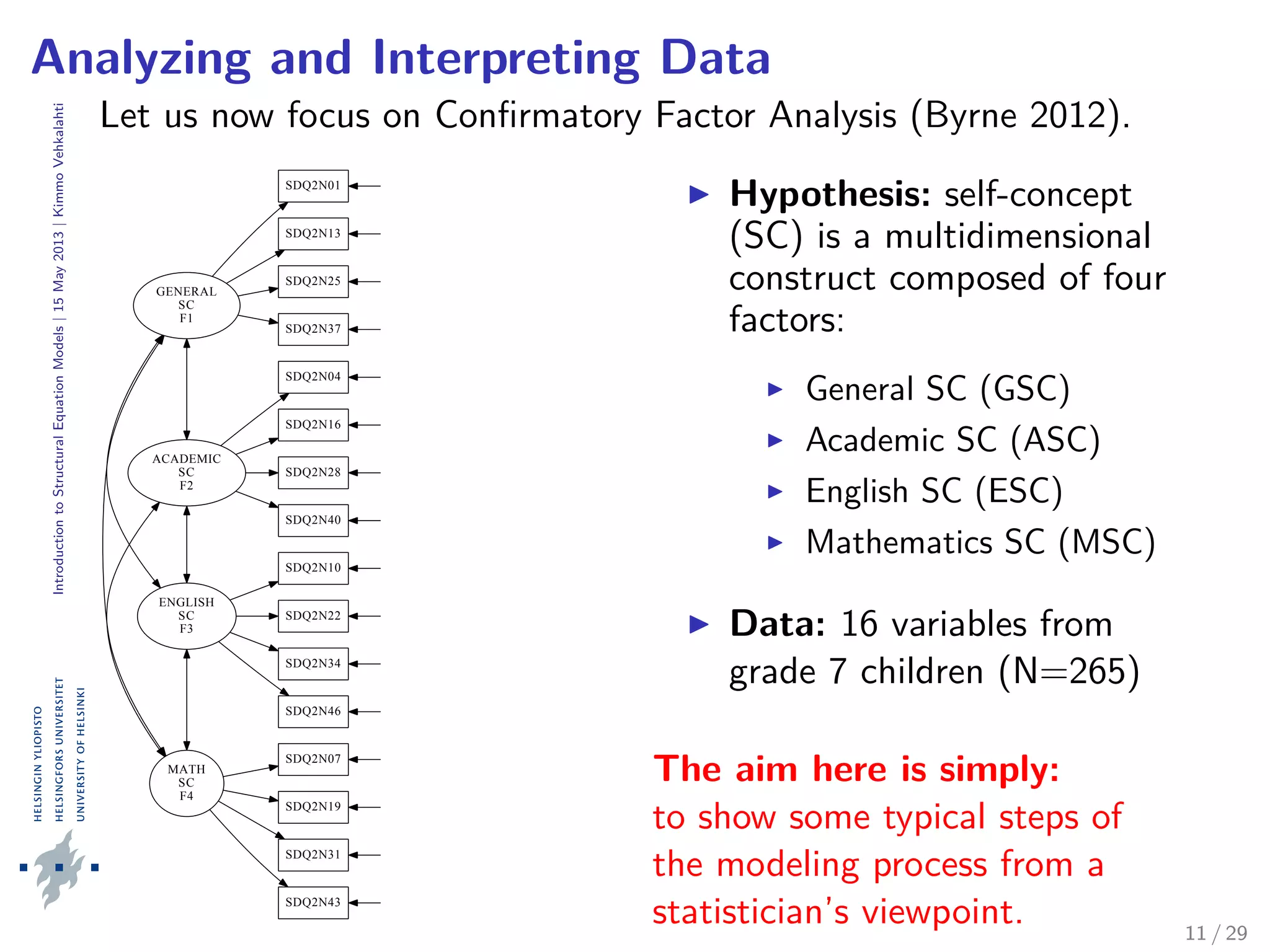
Let us now focus on Confirmatory Factor Analysis (Byrne 2012).
MATH
SC
F4
SDQ2N07
SDQ2N19
SDQ2N31
SDQ2N43
ENGLISH
SC
F3
SDQ2N10
SDQ2N22
SDQ2N34
SDQ2N46
ACADEMIC
SC
F2
SDQ2N04
SDQ2N16
SDQ2N28
SDQ2N40
GENERAL
SC
F1
SDQ2N01
SDQ2N13
SDQ2N25
SDQ2N37
Hypothesis: self-concept
(SC) is a multidimensional
construct composed of four
factors:
General SC (GSC)
Academic SC (ASC)
English SC (ESC)
Mathematics SC (MSC)
Data: 16 variables from
grade 7 children (N=265)
The aim here is simply:
to show some typical steps of
the modeling process from a
statistician’s viewpoint. 11 / 29
IntroductiontoStructuralEquationModels|15May2013|KimmoVehkalahti
Analyzing and Interpreting Data
Assessment of the model
primary interest: the extent to which a model fits the data
several criteria for a) model as a whole, b) parameter
estimates
Model fitting
Null hypothesis H0: the postulated model holds in the
population
We hope not to reject H0 (cf. traditional procedures).
Statistical significance
As always, merely a starting point, not a result as such!
Practical significance is important: values of estimates,
effect sizes, confidence intervals etc.
12 / 29
IntroductiontoStructuralEquationModels|15May2013|KimmoVehkalahti
Hypothesized four-factor CFA model (Mplus output)
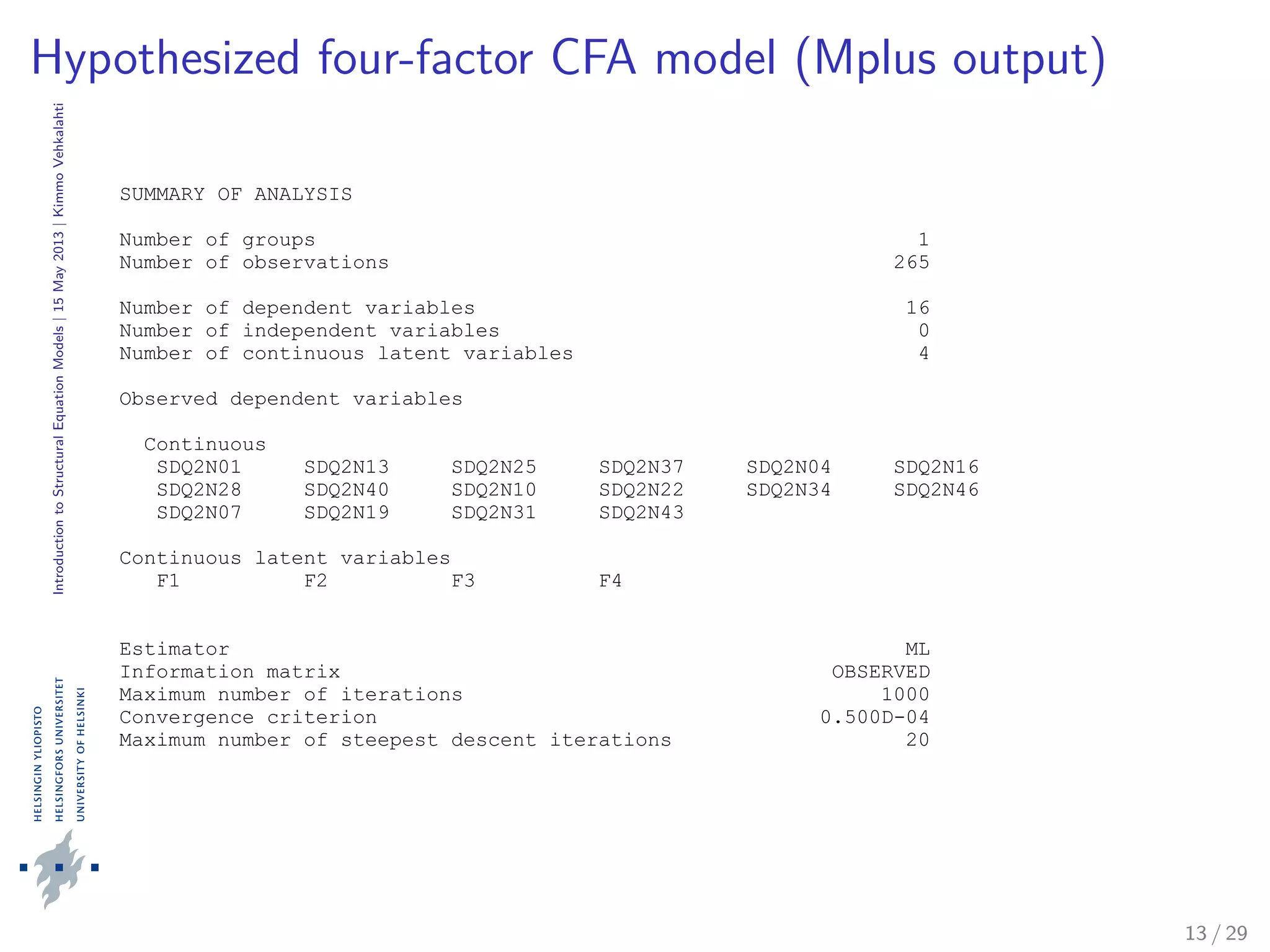
SUMMARY OF ANALYSIS
Number of groups 1
Number of observations 265
Number of dependent variables 16
Number of independent variables 0
Number of continuous latent variables 4
Observed dependent variables
Continuous
SDQ2N01 SDQ2N13 SDQ2N25 SDQ2N37 SDQ2N04 SDQ2N16
SDQ2N28 SDQ2N40 SDQ2N10 SDQ2N22 SDQ2N34 SDQ2N46
SDQ2N07 SDQ2N19 SDQ2N31 SDQ2N43
Continuous latent variables
F1 F2 F3 F4
Estimator ML
Information matrix OBSERVED
Maximum number of iterations 1000
Convergence criterion 0.500D-04
Maximum number of steepest descent iterations 20
13 / 29
IntroductiontoStructuralEquationModels|15May2013|KimmoVehkalahti
Hypothesized four-factor CFA model (Mplus output)
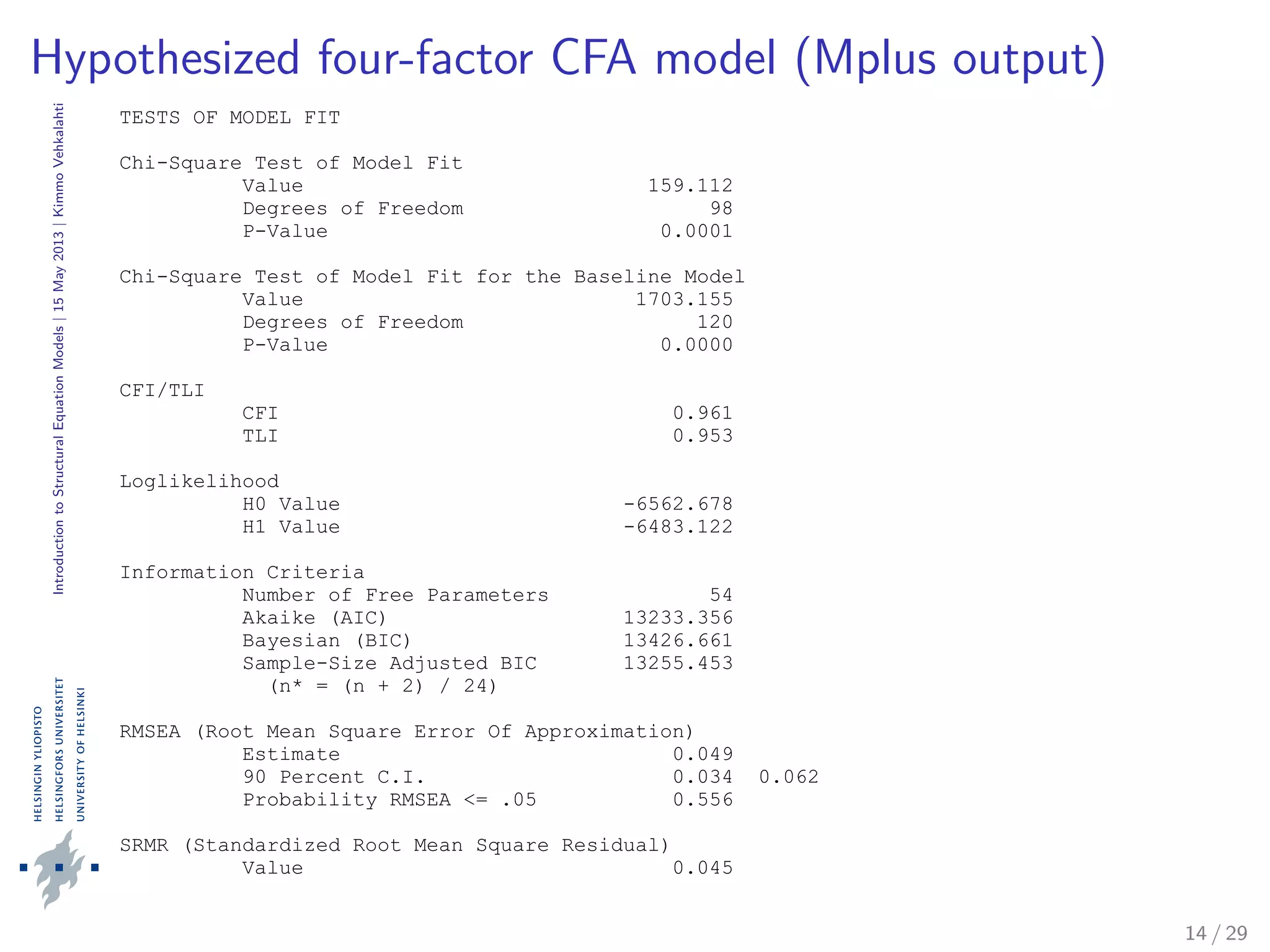
TESTS OF MODEL FIT
Chi-Square Test of Model Fit
Value 159.112
Degrees of Freedom 98
P-Value 0.0001
Chi-Square Test of Model Fit for the Baseline Model
Value 1703.155
Degrees of Freedom 120
P-Value 0.0000
CFI/TLI
CFI 0.961
TLI 0.953
Loglikelihood
H0 Value -6562.678
H1 Value -6483.122
Information Criteria
Number of Free Parameters 54
Akaike (AIC) 13233.356
Bayesian (BIC) 13426.661
Sample-Size Adjusted BIC 13255.453
(n* = (n + 2) / 24)
RMSEA (Root Mean Square Error Of Approximation)
Estimate 0.049
90 Percent C.I. 0.034 0.062
Probability RMSEA <= .05 0.556
SRMR (Standardized Root Mean Square Residual)
Value 0.045
14 / 29
IntroductiontoStructuralEquationModels|15May2013|KimmoVehkalahti
Analyzing and Interpreting Data
The goodness-of-fit statistics
Chi-Square Test of Model Fit
traditional Likelihood Ratio Test statistic, expressed as a
chi-square (χ2) statistic
p-value represents the likelihood of obtaining a χ2 value that
exceeds the χ2 value when H0 is true, so the higher the p, the
closer the fit.
always reported but rarely used as the sole index of model fit
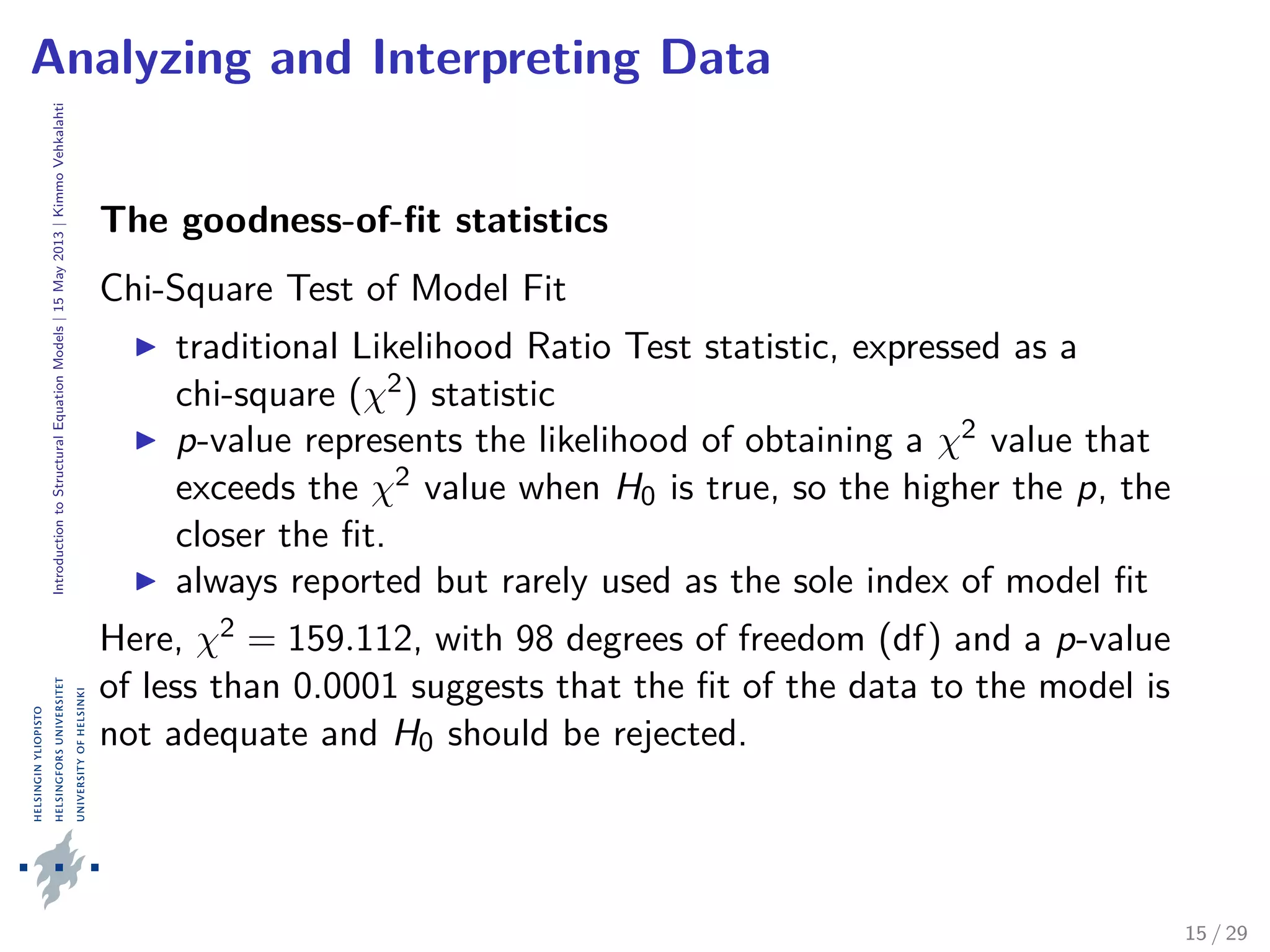
Here, χ2 = 159.112, with 98 degrees of freedom (df) and a p-value
of less than 0.0001 suggests that the fit of the data to the model is
not adequate and H0 should be rejected.
15 / 29
IntroductiontoStructuralEquationModels|15May2013|KimmoVehkalahti
Analyzing and Interpreting Data
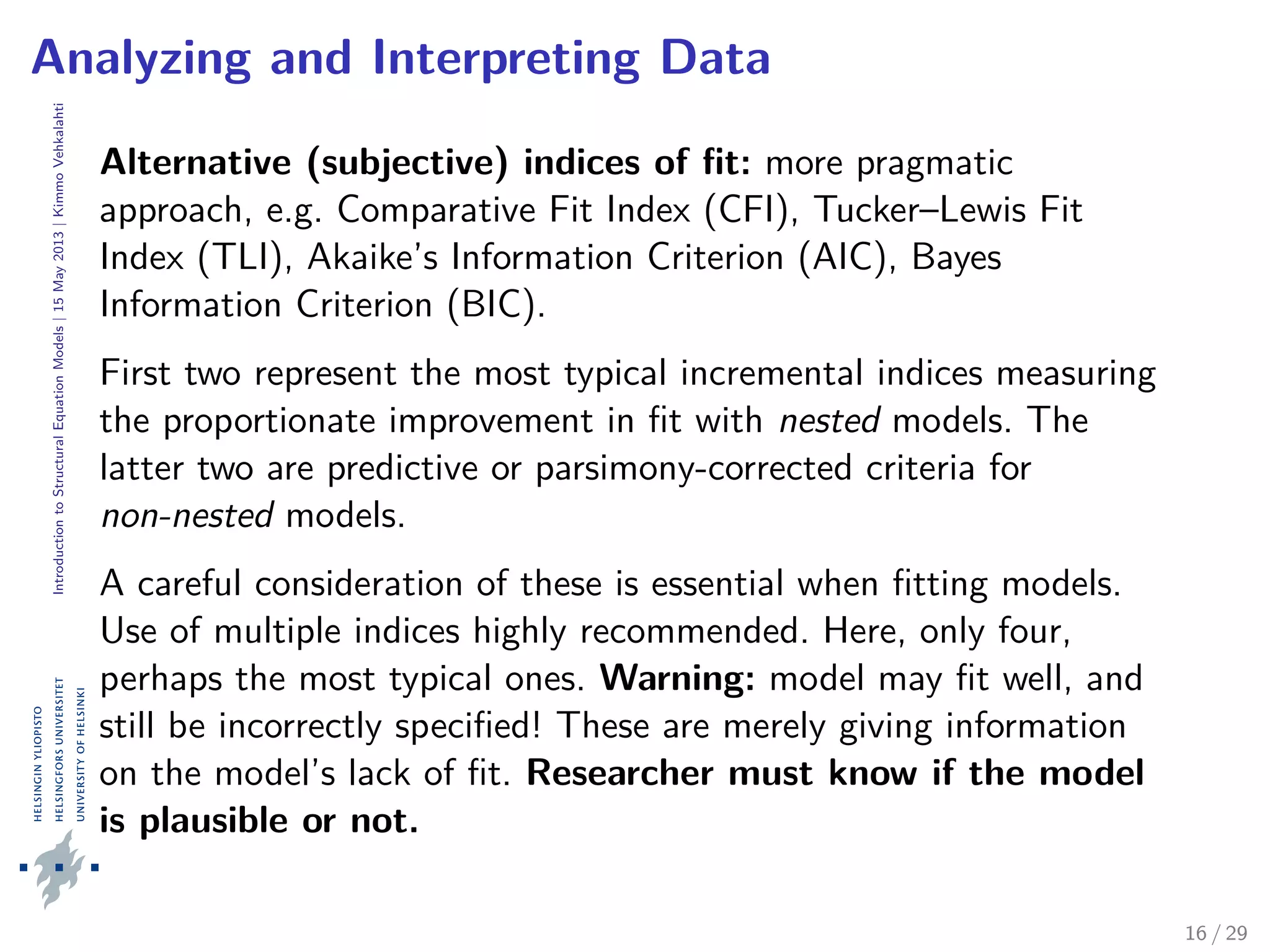
Alternative (subjective) indices of fit: more pragmatic
approach, e.g. Comparative Fit Index (CFI), Tucker–Lewis Fit
Index (TLI), Akaike’s Information Criterion (AIC), Bayes
Information Criterion (BIC).
First two represent the most typical incremental indices measuring
the proportionate improvement in fit with nested models. The
latter two are predictive or parsimony-corrected criteria for
non-nested models.
A careful consideration of these is essential when fitting models.
Use of multiple indices highly recommended. Here, only four,
perhaps the most typical ones. Warning: model may fit well, and
still be incorrectly specified! These are merely giving information
on the model’s lack of fit. Researcher must know if the model
is plausible or not.
16 / 29
IntroductiontoStructuralEquationModels|15May2013|KimmoVehkalahti
Analyzing and Interpreting Data
The assessment of model adequacy must be based on multiple
criteria that take into account
a) theoretical, b) statistical, and c) practical considerations.
CFI (Comparative Fit Index):
compares the hypothesized (H) and the baseline model (B)
range: [0, 1], well-fitting models have CFI > 0.95
TLI (Tucker–Lewis Fit Index):
quite similar as CFI, but nonnormed (may extend [0, 1])
includes a penalty function for overly complex models (H)
well-fitting models have TLI close to 1
17 / 29
IntroductiontoStructuralEquationModels|15May2013|KimmoVehkalahti
Analyzing and Interpreting Data
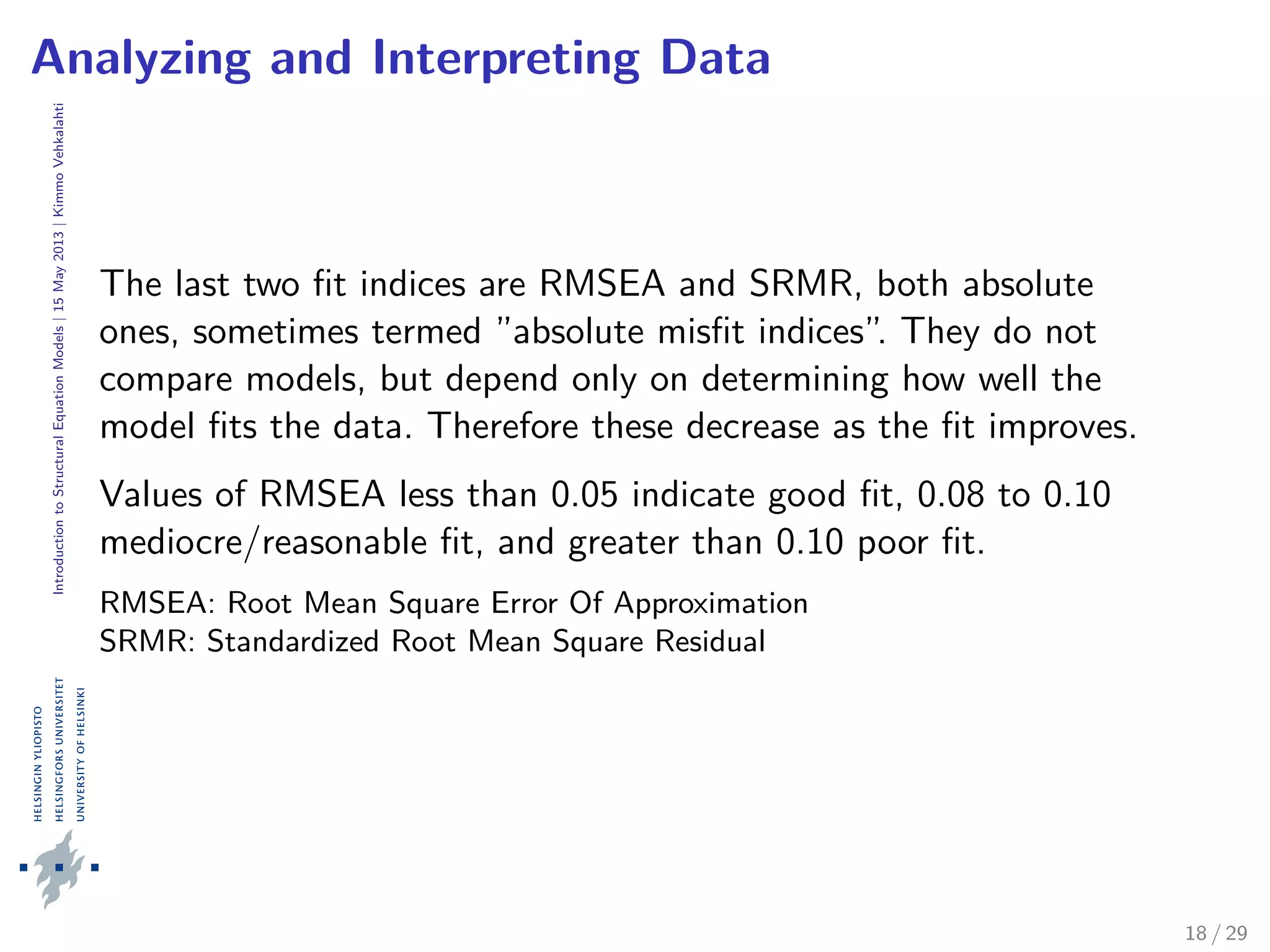
The last two fit indices are RMSEA and SRMR, both absolute
ones, sometimes termed ”absolute misfit indices”. They do not
compare models, but depend only on determining how well the
model fits the data. Therefore these decrease as the fit improves.
Values of RMSEA less than 0.05 indicate good fit, 0.08 to 0.10
mediocre/reasonable fit, and greater than 0.10 poor fit.
RMSEA: Root Mean Square Error Of Approximation
SRMR: Standardized Root Mean Square Residual
18 / 29
IntroductiontoStructuralEquationModels|15May2013|KimmoVehkalahti
Analyzing and Interpreting Data
RMSEA is sensitive to the number of estimated parameters (model
complexity). Routine use of RMSEA is strongly recommended in
literature. Here: 0.049 (with a 90 % C.I. [0.034, 0.062]), indicating
a good precision.
SRMR represents the average residual value of the fit
(standardized, i.e., range [0, 1]). In well-fitting models, it will be
small, less than 0.05. Here: 0.045, that is, model explains the
correlations to within an average error of 0.045.
RMSEA: Root Mean Square Error Of Approximation
SRMR: Standardized Root Mean Square Residual
19 / 29
IntroductiontoStructuralEquationModels|15May2013|KimmoVehkalahti
Analyzing and Interpreting Data
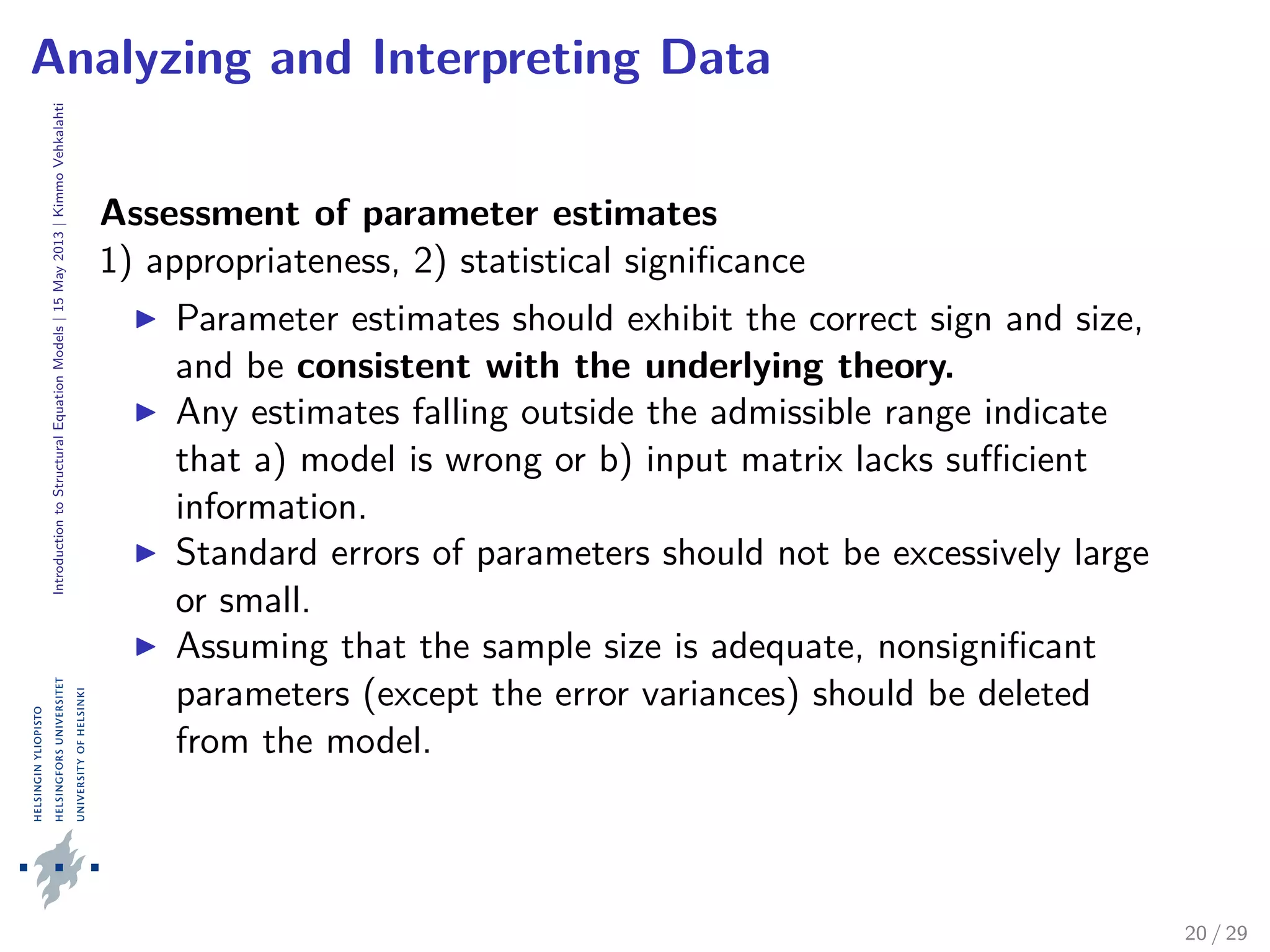
Assessment of parameter estimates
1) appropriateness, 2) statistical significance
Parameter estimates should exhibit the correct sign and size,
and be consistent with the underlying theory.
Any estimates falling outside the admissible range indicate
that a) model is wrong or b) input matrix lacks sufficient
information.
Standard errors of parameters should not be excessively large
or small.
Assuming that the sample size is adequate, nonsignificant
parameters (except the error variances) should be deleted
from the model.
20 / 29
IntroductiontoStructuralEquationModels|15May2013|KimmoVehkalahti
Hypothesized four-factor CFA model (Mplus output)
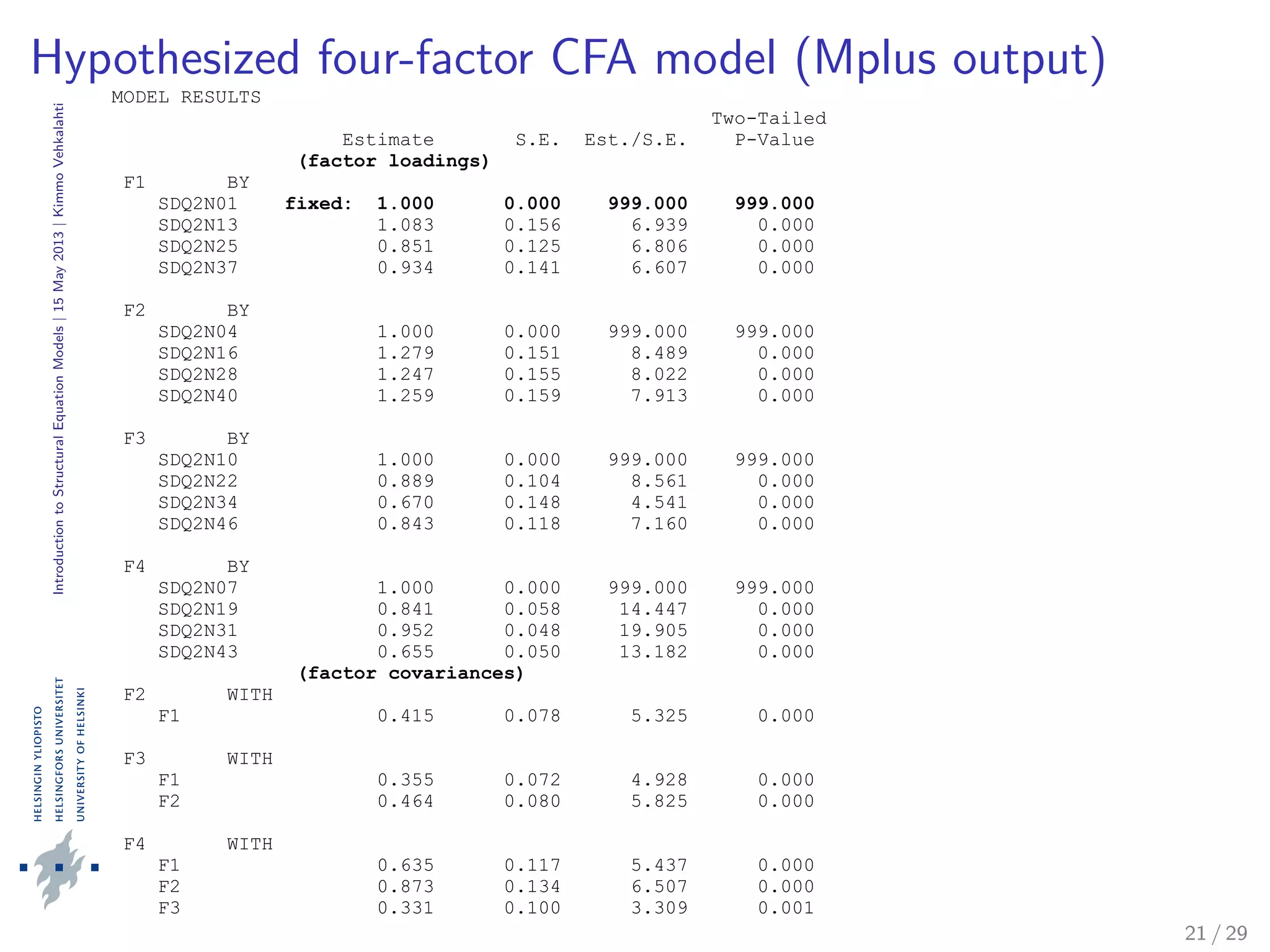
MODEL RESULTS
Two-Tailed
Estimate S.E. Est./S.E. P-Value
(factor loadings)
F1 BY
SDQ2N01 fixed: 1.000 0.000 999.000 999.000
SDQ2N13 1.083 0.156 6.939 0.000
SDQ2N25 0.851 0.125 6.806 0.000
SDQ2N37 0.934 0.141 6.607 0.000
F2 BY
SDQ2N04 1.000 0.000 999.000 999.000
SDQ2N16 1.279 0.151 8.489 0.000
SDQ2N28 1.247 0.155 8.022 0.000
SDQ2N40 1.259 0.159 7.913 0.000
F3 BY
SDQ2N10 1.000 0.000 999.000 999.000
SDQ2N22 0.889 0.104 8.561 0.000
SDQ2N34 0.670 0.148 4.541 0.000
SDQ2N46 0.843 0.118 7.160 0.000
F4 BY
SDQ2N07 1.000 0.000 999.000 999.000
SDQ2N19 0.841 0.058 14.447 0.000
SDQ2N31 0.952 0.048 19.905 0.000
SDQ2N43 0.655 0.050 13.182 0.000
(factor covariances)
F2 WITH
F1 0.415 0.078 5.325 0.000
F3 WITH
F1 0.355 0.072 4.928 0.000
F2 0.464 0.080 5.825 0.000
F4 WITH
F1 0.635 0.117 5.437 0.000
F2 0.873 0.134 6.507 0.000
F3 0.331 0.100 3.309 0.001
21 / 29
IntroductiontoStructuralEquationModels|15May2013|KimmoVehkalahti
Hypothesized four-factor CFA model (Mplus output)
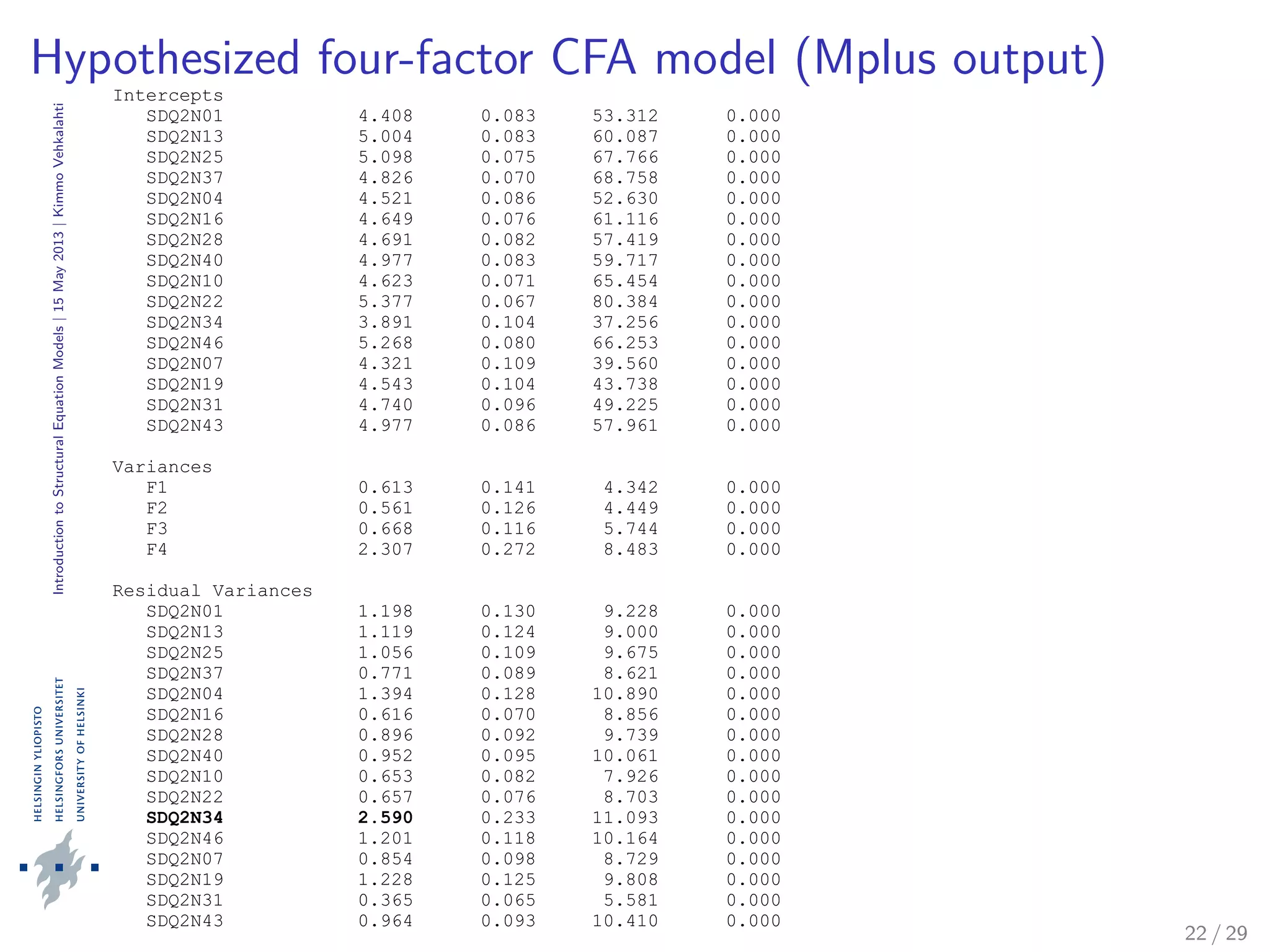
Intercepts
SDQ2N01 4.408 0.083 53.312 0.000
SDQ2N13 5.004 0.083 60.087 0.000
SDQ2N25 5.098 0.075 67.766 0.000
SDQ2N37 4.826 0.070 68.758 0.000
SDQ2N04 4.521 0.086 52.630 0.000
SDQ2N16 4.649 0.076 61.116 0.000
SDQ2N28 4.691 0.082 57.419 0.000
SDQ2N40 4.977 0.083 59.717 0.000
SDQ2N10 4.623 0.071 65.454 0.000
SDQ2N22 5.377 0.067 80.384 0.000
SDQ2N34 3.891 0.104 37.256 0.000
SDQ2N46 5.268 0.080 66.253 0.000
SDQ2N07 4.321 0.109 39.560 0.000
SDQ2N19 4.543 0.104 43.738 0.000
SDQ2N31 4.740 0.096 49.225 0.000
SDQ2N43 4.977 0.086 57.961 0.000
Variances
F1 0.613 0.141 4.342 0.000
F2 0.561 0.126 4.449 0.000
F3 0.668 0.116 5.744 0.000
F4 2.307 0.272 8.483 0.000
Residual Variances
SDQ2N01 1.198 0.130 9.228 0.000
SDQ2N13 1.119 0.124 9.000 0.000
SDQ2N25 1.056 0.109 9.675 0.000
SDQ2N37 0.771 0.089 8.621 0.000
SDQ2N04 1.394 0.128 10.890 0.000
SDQ2N16 0.616 0.070 8.856 0.000
SDQ2N28 0.896 0.092 9.739 0.000
SDQ2N40 0.952 0.095 10.061 0.000
SDQ2N10 0.653 0.082 7.926 0.000
SDQ2N22 0.657 0.076 8.703 0.000
SDQ2N34 2.590 0.233 11.093 0.000
SDQ2N46 1.201 0.118 10.164 0.000
SDQ2N07 0.854 0.098 8.729 0.000
SDQ2N19 1.228 0.125 9.808 0.000
SDQ2N31 0.365 0.065 5.581 0.000
SDQ2N43 0.964 0.093 10.410 0.000
22 / 29
IntroductiontoStructuralEquationModels|15May2013|KimmoVehkalahti
Analyzing and Interpreting Data
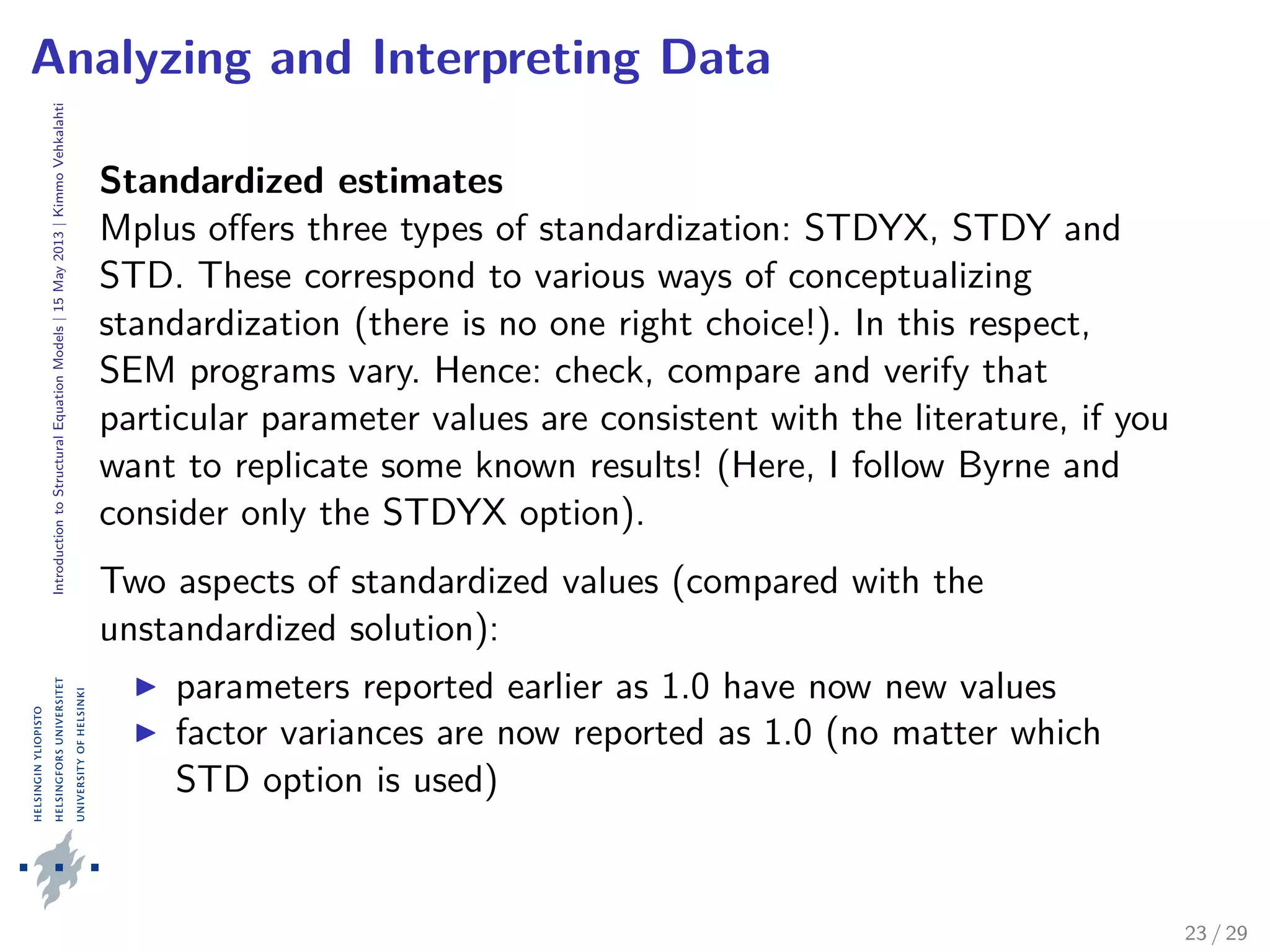
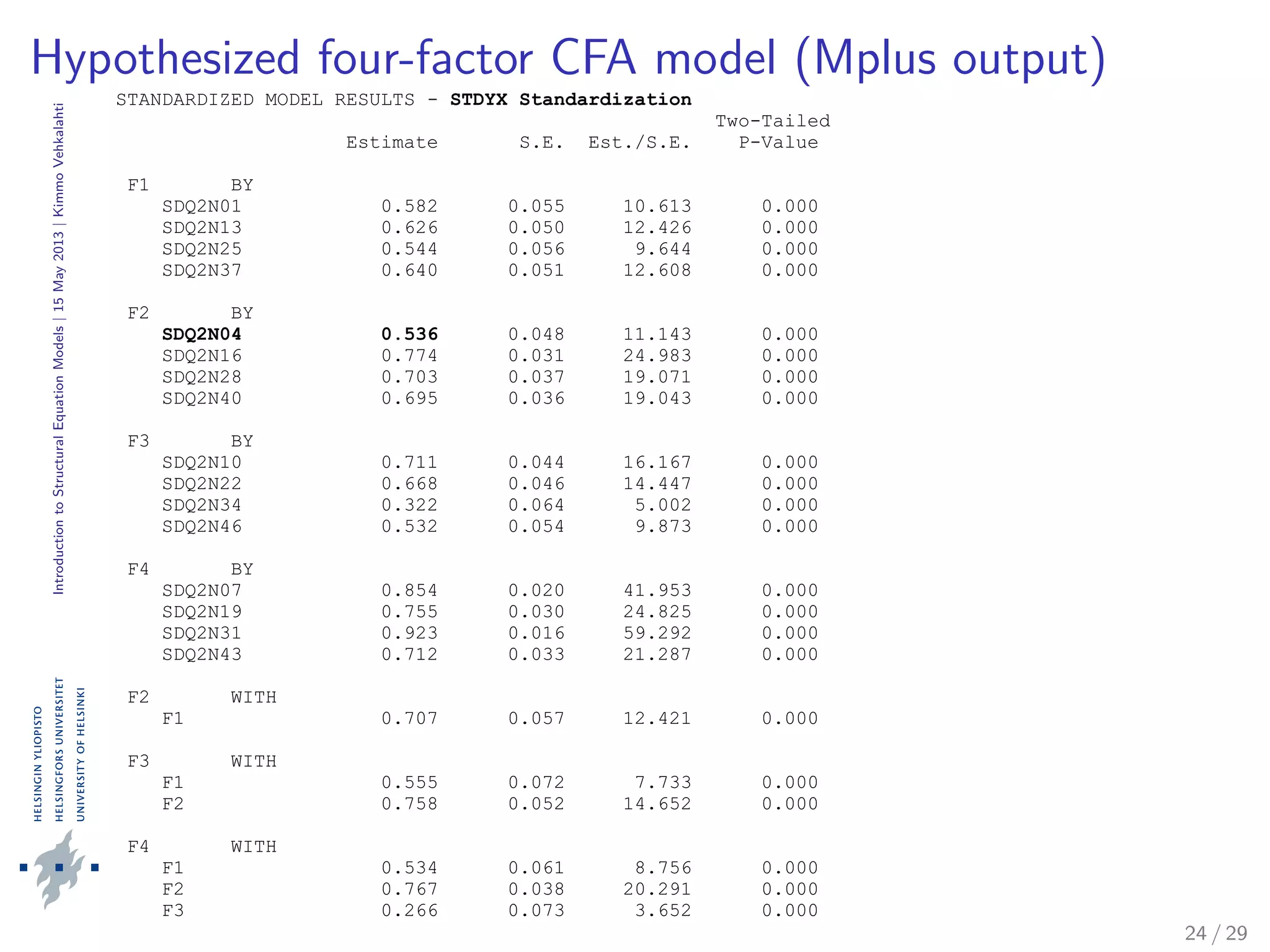
Standardized estimates
Mplus offers three types of standardization: STDYX, STDY and
STD. These correspond to various ways of conceptualizing
standardization (there is no one right choice!). In this respect,
SEM programs vary. Hence: check, compare and verify that
particular parameter values are consistent with the literature, if you
want to replicate some known results! (Here, I follow Byrne and
consider only the STDYX option).
Two aspects of standardized values (compared with the
unstandardized solution):
parameters reported earlier as 1.0 have now new values
factor variances are now reported as 1.0 (no matter which
STD option is used)
23 / 29
IntroductiontoStructuralEquationModels|15May2013|KimmoVehkalahti
Hypothesized four-factor CFA model (Mplus output)
STANDARDIZED MODEL RESULTS - STDYX Standardization
Two-Tailed
Estimate S.E. Est./S.E. P-Value
F1 BY
SDQ2N01 0.582 0.055 10.613 0.000
SDQ2N13 0.626 0.050 12.426 0.000
SDQ2N25 0.544 0.056 9.644 0.000
SDQ2N37 0.640 0.051 12.608 0.000
F2 BY
SDQ2N04 0.536 0.048 11.143 0.000
SDQ2N16 0.774 0.031 24.983 0.000
SDQ2N28 0.703 0.037 19.071 0.000
SDQ2N40 0.695 0.036 19.043 0.000
F3 BY
SDQ2N10 0.711 0.044 16.167 0.000
SDQ2N22 0.668 0.046 14.447 0.000
SDQ2N34 0.322 0.064 5.002 0.000
SDQ2N46 0.532 0.054 9.873 0.000
F4 BY
SDQ2N07 0.854 0.020 41.953 0.000
SDQ2N19 0.755 0.030 24.825 0.000
SDQ2N31 0.923 0.016 59.292 0.000
SDQ2N43 0.712 0.033 21.287 0.000
F2 WITH
F1 0.707 0.057 12.421 0.000
F3 WITH
F1 0.555 0.072 7.733 0.000
F2 0.758 0.052 14.652 0.000
F4 WITH
F1 0.534 0.061 8.756 0.000
F2 0.767 0.038 20.291 0.000
F3 0.266 0.073 3.652 0.000
24 / 29
IntroductiontoStructuralEquationModels|15May2013|KimmoVehkalahti
Hypothesized four-factor CFA model (Mplus output)
Intercepts
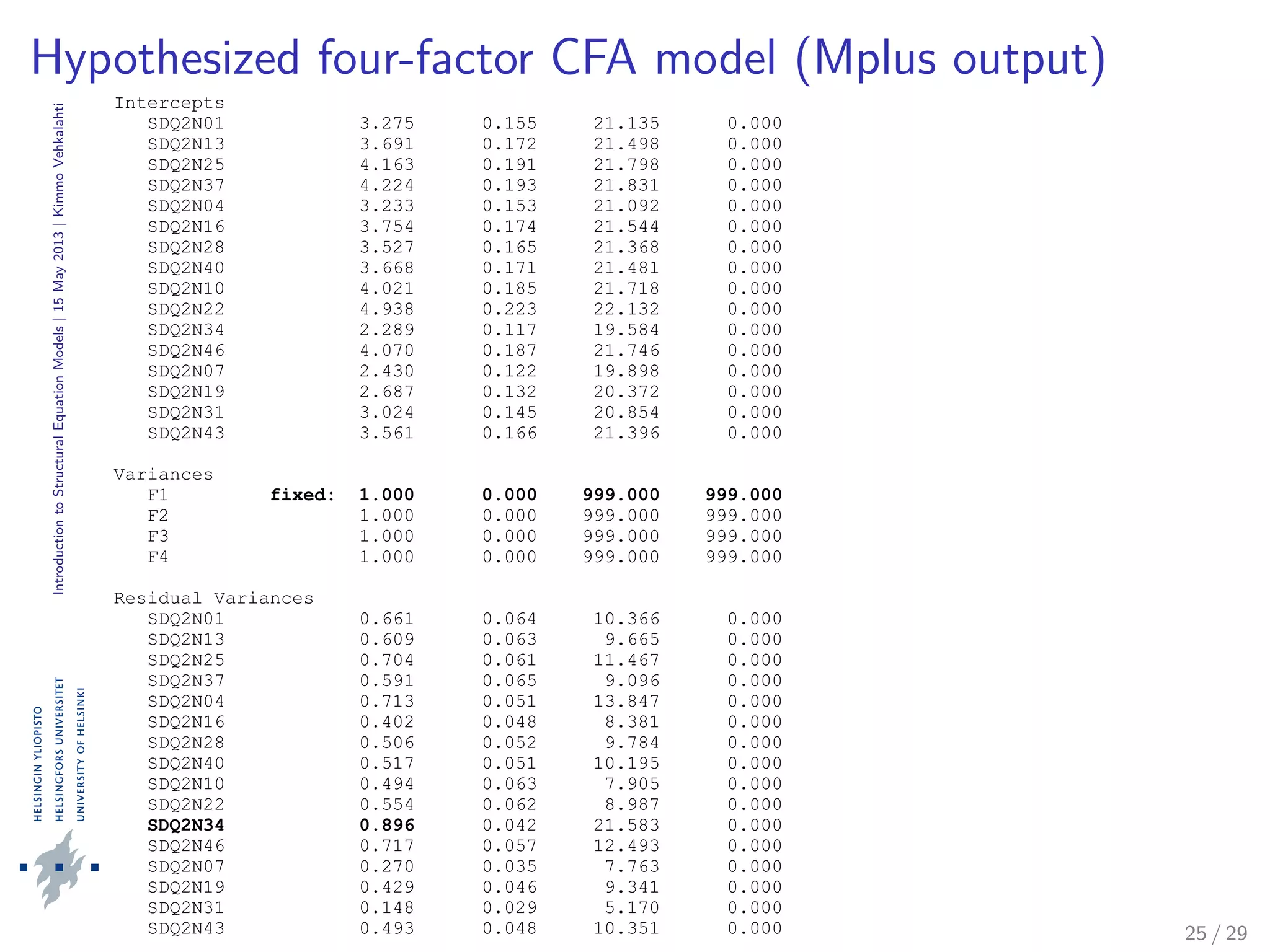
SDQ2N01 3.275 0.155 21.135 0.000
SDQ2N13 3.691 0.172 21.498 0.000
SDQ2N25 4.163 0.191 21.798 0.000
SDQ2N37 4.224 0.193 21.831 0.000
SDQ2N04 3.233 0.153 21.092 0.000
SDQ2N16 3.754 0.174 21.544 0.000
SDQ2N28 3.527 0.165 21.368 0.000
SDQ2N40 3.668 0.171 21.481 0.000
SDQ2N10 4.021 0.185 21.718 0.000
SDQ2N22 4.938 0.223 22.132 0.000
SDQ2N34 2.289 0.117 19.584 0.000
SDQ2N46 4.070 0.187 21.746 0.000
SDQ2N07 2.430 0.122 19.898 0.000
SDQ2N19 2.687 0.132 20.372 0.000
SDQ2N31 3.024 0.145 20.854 0.000
SDQ2N43 3.561 0.166 21.396 0.000
Variances
F1 fixed: 1.000 0.000 999.000 999.000
F2 1.000 0.000 999.000 999.000
F3 1.000 0.000 999.000 999.000
F4 1.000 0.000 999.000 999.000
Residual Variances
SDQ2N01 0.661 0.064 10.366 0.000
SDQ2N13 0.609 0.063 9.665 0.000
SDQ2N25 0.704 0.061 11.467 0.000
SDQ2N37 0.591 0.065 9.096 0.000
SDQ2N04 0.713 0.051 13.847 0.000
SDQ2N16 0.402 0.048 8.381 0.000
SDQ2N28 0.506 0.052 9.784 0.000
SDQ2N40 0.517 0.051 10.195 0.000
SDQ2N10 0.494 0.063 7.905 0.000
SDQ2N22 0.554 0.062 8.987 0.000
SDQ2N34 0.896 0.042 21.583 0.000
SDQ2N46 0.717 0.057 12.493 0.000
SDQ2N07 0.270 0.035 7.763 0.000
SDQ2N19 0.429 0.046 9.341 0.000
SDQ2N31 0.148 0.029 5.170 0.000
SDQ2N43 0.493 0.048 10.351 0.000 25 / 29
IntroductiontoStructuralEquationModels|15May2013|KimmoVehkalahti
Analyzing and Interpreting Data
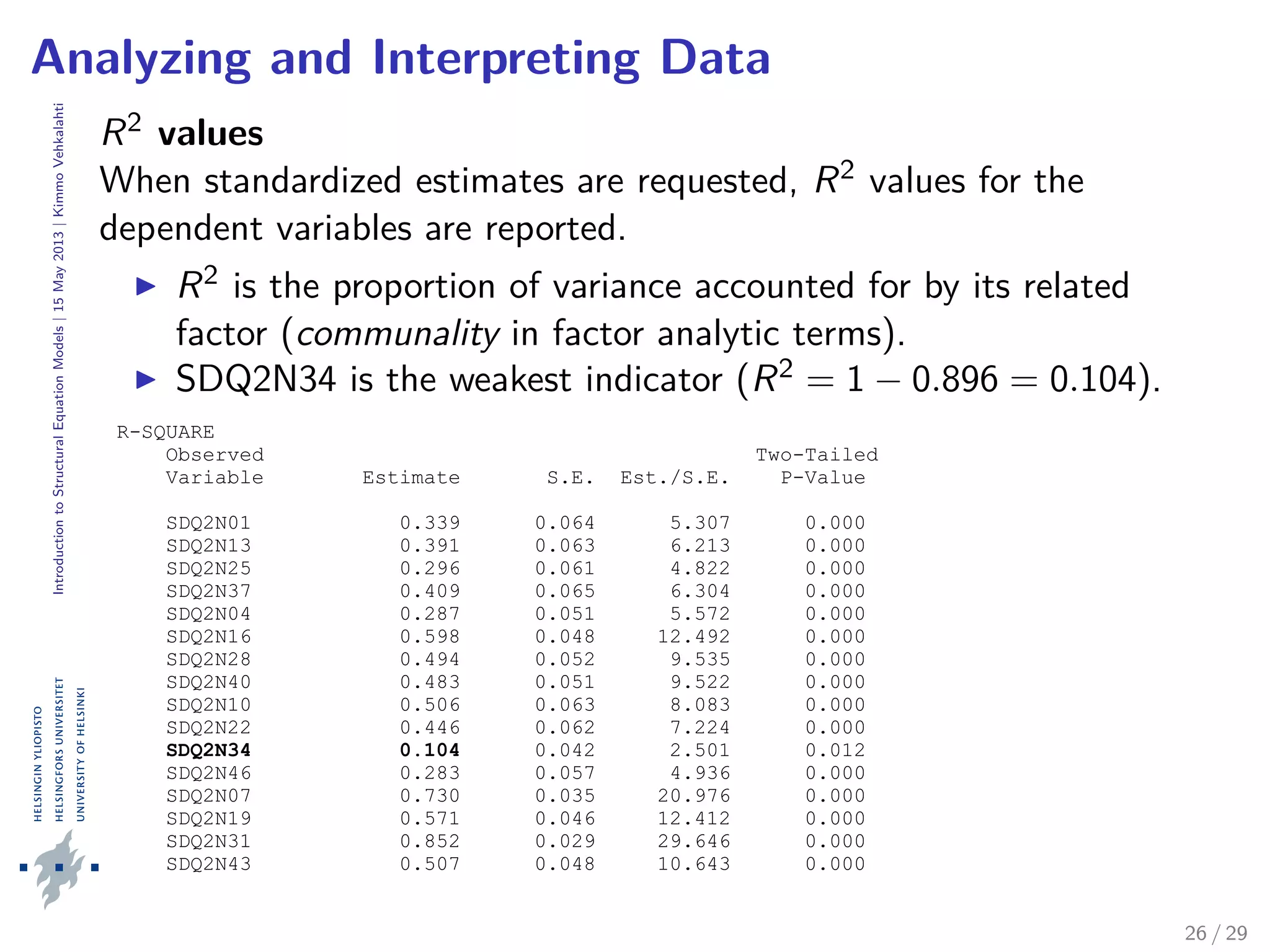
R2 values
When standardized estimates are requested, R2 values for the
dependent variables are reported.
R2 is the proportion of variance accounted for by its related
factor (communality in factor analytic terms).
SDQ2N34 is the weakest indicator (R2 = 1 − 0.896 = 0.104).
R-SQUARE
Observed Two-Tailed
Variable Estimate S.E. Est./S.E. P-Value
SDQ2N01 0.339 0.064 5.307 0.000
SDQ2N13 0.391 0.063 6.213 0.000
SDQ2N25 0.296 0.061 4.822 0.000
SDQ2N37 0.409 0.065 6.304 0.000
SDQ2N04 0.287 0.051 5.572 0.000
SDQ2N16 0.598 0.048 12.492 0.000
SDQ2N28 0.494 0.052 9.535 0.000
SDQ2N40 0.483 0.051 9.522 0.000
SDQ2N10 0.506 0.063 8.083 0.000
SDQ2N22 0.446 0.062 7.224 0.000
SDQ2N34 0.104 0.042 2.501 0.012
SDQ2N46 0.283 0.057 4.936 0.000
SDQ2N07 0.730 0.035 20.976 0.000
SDQ2N19 0.571 0.046 12.412 0.000
SDQ2N31 0.852 0.029 29.646 0.000
SDQ2N43 0.507 0.048 10.643 0.000
26 / 29
IntroductiontoStructuralEquationModels|15May2013|KimmoVehkalahti
Analyzing and Interpreting Data
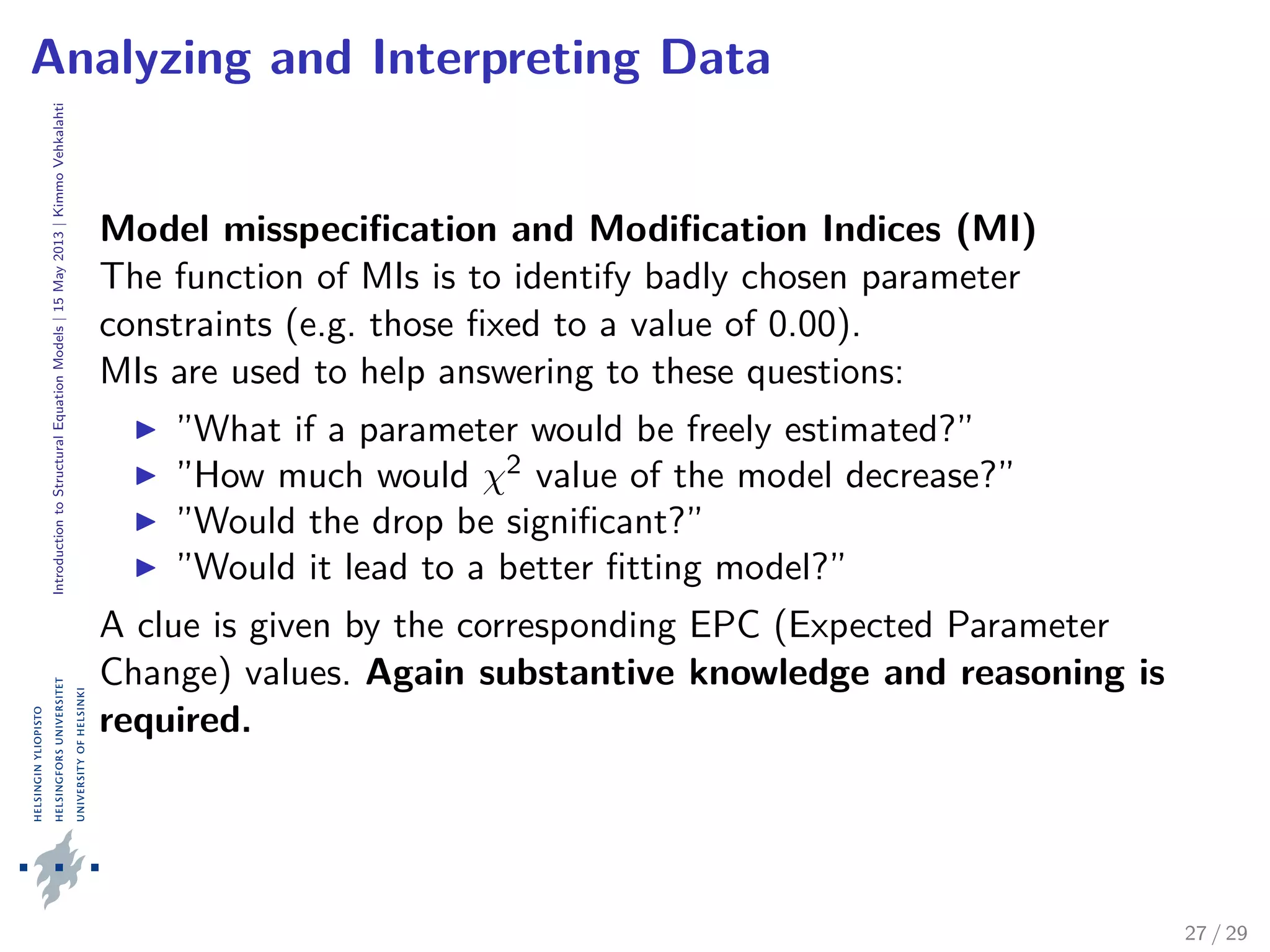
Model misspecification and Modification Indices (MI)
The function of MIs is to identify badly chosen parameter
constraints (e.g. those fixed to a value of 0.00).
MIs are used to help answering to these questions:
”What if a parameter would be freely estimated?”
”How much would χ2 value of the model decrease?”
”Would the drop be significant?”
”Would it lead to a better fitting model?”
A clue is given by the corresponding EPC (Expected Parameter
Change) values. Again substantive knowledge and reasoning is
required.
27 / 29
IntroductiontoStructuralEquationModels|15May2013|KimmoVehkalahti
Analyzing and Interpreting Data
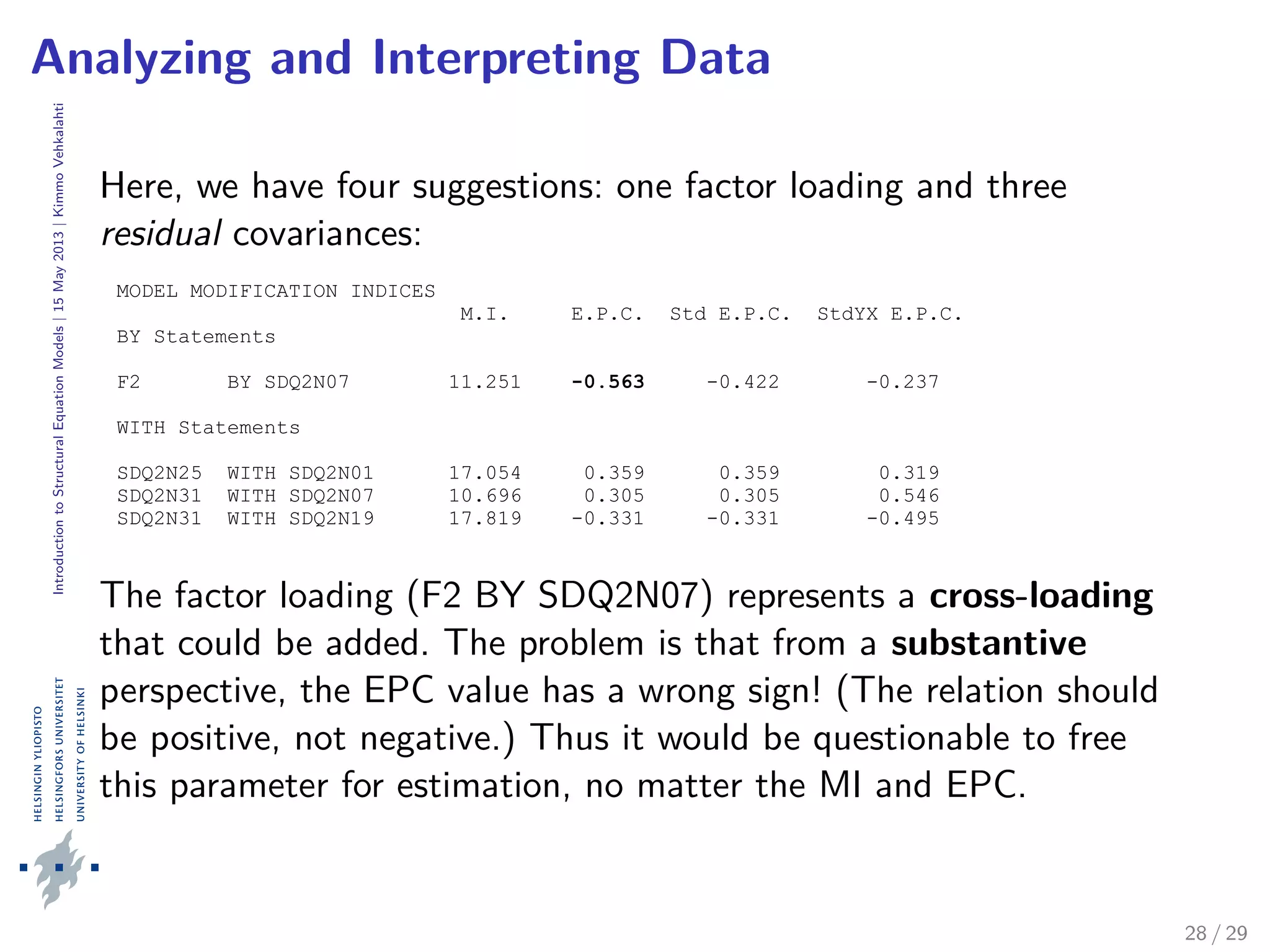
Here, we have four suggestions: one factor loading and three
residual covariances:
MODEL MODIFICATION INDICES
M.I. E.P.C. Std E.P.C. StdYX E.P.C.
BY Statements
F2 BY SDQ2N07 11.251 -0.563 -0.422 -0.237
WITH Statements
SDQ2N25 WITH SDQ2N01 17.054 0.359 0.359 0.319
SDQ2N31 WITH SDQ2N07 10.696 0.305 0.305 0.546
SDQ2N31 WITH SDQ2N19 17.819 -0.331 -0.331 -0.495
The factor loading (F2 BY SDQ2N07) represents a cross-loading
that could be added. The problem is that from a substantive
perspective, the EPC value has a wrong sign! (The relation should
be positive, not negative.) Thus it would be questionable to free
this parameter for estimation, no matter the MI and EPC.
28 / 29
IntroductiontoStructuralEquationModels|15May2013|KimmoVehkalahti
Analyzing and Interpreting Data
Overall: the residual covariances seem to be rather small and not
worthy of inclusion in a subsequently specified model. Remember
the topic of scientific parsimony: avoid too many parameters and
hence too complex models! First of all: model must be
substantively meaningful.
In general, model respecification is commonly conducted in SEM.
It is important to realize that when we move to these Post Hoc
analyses, they will then be framed within exploratory, not anymore
confirmatory modeling approach! Combination of 1) substantive
and 2) statistical aspects is required (always in this order!).
”When to stop fitting a model?” – a good question...
29 / 29

Structural equation-models-introduction-kimmo-vehkalahti-2013

  • 1.
    IntroductiontoStructuralEquationModels|15May2013|KimmoVehkalahti Introduction to Structural EquationModels Kimmo Vehkalahti Adjunct Professor, University Lecturer University of Helsinki, Department of Social Research, Statistics http://www.helsinki.fi/people/Kimmo.Vehkalahti Analyzing and Interpreting Data – Annual Seminar of FiDPEL: The Finnish Doctoral Programme in Education and Learning 15 May 2013 1 / 29
  • 2.
    IntroductiontoStructuralEquationModels|15May2013|KimmoVehkalahti Introduction to StructuralEquation Models Outline Models, Modeling and Model-fitting Basic Concepts and Ideas of SEM Analyzing and Interpreting Data 2 / 29
  • 3.
    IntroductiontoStructuralEquationModels|15May2013|KimmoVehkalahti Models, Modeling andModel-fitting Models are simplifications of real-world phenomena. Models are grounded on some substantial theory. Statistical modeling: primary task is to determine the goodness-of-fit between the hypothesized model and the sample data process of model-fitting can be summarized as Data = Model + Residual, where Data represent measurements of the observed variables, Model represents the hypothesized structure, and Residual represents the discrepancy between them ultimate objective: to find a model that is both 1) substantive meaningful and 2) statistically well fitting 3 / 29
  • 4.
    IntroductiontoStructuralEquationModels|15May2013|KimmoVehkalahti Models, Modeling andModel-fitting However, remember the general truth: ”All models are wrong, but some are useful.” George E. P. Box (1919–2013) Professor of Statistics University of Wisconsin–Madison 4 / 29
  • 5.
    IntroductiontoStructuralEquationModels|15May2013|KimmoVehkalahti Models – whatabout the Structural Equations? Equations are used for defining any details of models. Example of a simple equation (linear regression model): y = β0 + β1x + ε, where we are interested in the relationship of y and x: y is the dependent variable (in the data), x is the independent variable (in the data), β0 and β1 are the regression coefficients, and ε represents the random variation. Structural equations are used for defining causal processes: much more complicated structures than the one above simultaneous analysis of an entire system of variables can be modeled pictorially: clearer conceptualization hypothesized model can be tested statistically but: causality is not a statistical concept: theory required! 5 / 29
  • 6.
    IntroductiontoStructuralEquationModels|15May2013|KimmoVehkalahti Basic Concepts andIdeas of SEM Latent variables and observed variables Latent variables latent: not observed directly, cannot be measured directly operationally defined in terms of the believed behavior indirectly measured via observed variables Observed variables responses to scales, scores in tests, coded responses etc. indicators of the underlying construct they represent choice of psychometrically sound measurement instruments crucial for assessing the underlying constructs 6 / 29
  • 7.
    IntroductiontoStructuralEquationModels|15May2013|KimmoVehkalahti Basic Concepts andIdeas of SEM (Sort of) combination of factor analysis and regression analysis Factor analysis links the observed variables with the latent variables (factors) primary interest: the strength of the regression paths from the factors to the observed variables (i.e. the factor loadings) this part of SEM is called a measurement model exploratory vs confirmatory factor analysis (EFA, CFA) The full latent variable (SEM) model regression structure among the latent variables (factors) hypothesized causal impacts of one factor on another measurement (CFA) model and a structural model Generalizations: growth curve models, multilevel models, non-linear models, time-series models, longitudinal models etc. 7 / 29
  • 8.
    IntroductiontoStructuralEquationModels|15May2013|KimmoVehkalahti Basic Concepts andIdeas of SEM Typical configurations with simple graphical symbols: path coefficient for regression from a factor to an observed variable path coefficient for regression of one factor onto another measurement error associated with an observed variable residual error in the prediction of an unobserved variable Models are drawn using various combinations of these symbols. 8 / 29
  • 9.
    IntroductiontoStructuralEquationModels|15May2013|KimmoVehkalahti Schematic example ofa SEM (Byrne 2012) two factors: (SSC = social self-concept, PR = peer relations) PR: dependent, SSC: independent, causal relation seven observed variables with measurement errors residual of predicting PR from SSC The corresponding eight structural equations (follow the paths!): PR = SSC + residual SDQSSCPR = SSC + error APISSCPR = SSC + error SPPCSCPR = SSC + error peer activity = PR + error peer attachment = PR + error peer popularity = PR + error peer network = PR + error 9 / 29
  • 10.
    IntroductiontoStructuralEquationModels|15May2013|KimmoVehkalahti More complicated exampleof SEM (Byrne 2012) F1 F2F3F4 F5 F6 F7 F8 F9 F10 F11 F12 RA1RA2 RC1RC2WO1WO2CLC1CLC2 CLC3 CLC4 DEC1 DEC2 SS1 SS2 PS1 PS2 SE1 SE2 SE3 ELC1 ELC2 ELC3 ELC4 ELC5 EE1EE2EE3 DP1DP2 PA1 PA2 PA3 10 / 29
  • 11.
    IntroductiontoStructuralEquationModels|15May2013|KimmoVehkalahti Analyzing and InterpretingData Let us now focus on Confirmatory Factor Analysis (Byrne 2012). MATH SC F4 SDQ2N07 SDQ2N19 SDQ2N31 SDQ2N43 ENGLISH SC F3 SDQ2N10 SDQ2N22 SDQ2N34 SDQ2N46 ACADEMIC SC F2 SDQ2N04 SDQ2N16 SDQ2N28 SDQ2N40 GENERAL SC F1 SDQ2N01 SDQ2N13 SDQ2N25 SDQ2N37 Hypothesis: self-concept (SC) is a multidimensional construct composed of four factors: General SC (GSC) Academic SC (ASC) English SC (ESC) Mathematics SC (MSC) Data: 16 variables from grade 7 children (N=265) The aim here is simply: to show some typical steps of the modeling process from a statistician’s viewpoint. 11 / 29
  • 12.
    IntroductiontoStructuralEquationModels|15May2013|KimmoVehkalahti Analyzing and InterpretingData Assessment of the model primary interest: the extent to which a model fits the data several criteria for a) model as a whole, b) parameter estimates Model fitting Null hypothesis H0: the postulated model holds in the population We hope not to reject H0 (cf. traditional procedures). Statistical significance As always, merely a starting point, not a result as such! Practical significance is important: values of estimates, effect sizes, confidence intervals etc. 12 / 29
  • 13.
    IntroductiontoStructuralEquationModels|15May2013|KimmoVehkalahti Hypothesized four-factor CFAmodel (Mplus output) SUMMARY OF ANALYSIS Number of groups 1 Number of observations 265 Number of dependent variables 16 Number of independent variables 0 Number of continuous latent variables 4 Observed dependent variables Continuous SDQ2N01 SDQ2N13 SDQ2N25 SDQ2N37 SDQ2N04 SDQ2N16 SDQ2N28 SDQ2N40 SDQ2N10 SDQ2N22 SDQ2N34 SDQ2N46 SDQ2N07 SDQ2N19 SDQ2N31 SDQ2N43 Continuous latent variables F1 F2 F3 F4 Estimator ML Information matrix OBSERVED Maximum number of iterations 1000 Convergence criterion 0.500D-04 Maximum number of steepest descent iterations 20 13 / 29
  • 14.
    IntroductiontoStructuralEquationModels|15May2013|KimmoVehkalahti Hypothesized four-factor CFAmodel (Mplus output) TESTS OF MODEL FIT Chi-Square Test of Model Fit Value 159.112 Degrees of Freedom 98 P-Value 0.0001 Chi-Square Test of Model Fit for the Baseline Model Value 1703.155 Degrees of Freedom 120 P-Value 0.0000 CFI/TLI CFI 0.961 TLI 0.953 Loglikelihood H0 Value -6562.678 H1 Value -6483.122 Information Criteria Number of Free Parameters 54 Akaike (AIC) 13233.356 Bayesian (BIC) 13426.661 Sample-Size Adjusted BIC 13255.453 (n* = (n + 2) / 24) RMSEA (Root Mean Square Error Of Approximation) Estimate 0.049 90 Percent C.I. 0.034 0.062 Probability RMSEA <= .05 0.556 SRMR (Standardized Root Mean Square Residual) Value 0.045 14 / 29
  • 15.
    IntroductiontoStructuralEquationModels|15May2013|KimmoVehkalahti Analyzing and InterpretingData The goodness-of-fit statistics Chi-Square Test of Model Fit traditional Likelihood Ratio Test statistic, expressed as a chi-square (χ2) statistic p-value represents the likelihood of obtaining a χ2 value that exceeds the χ2 value when H0 is true, so the higher the p, the closer the fit. always reported but rarely used as the sole index of model fit Here, χ2 = 159.112, with 98 degrees of freedom (df) and a p-value of less than 0.0001 suggests that the fit of the data to the model is not adequate and H0 should be rejected. 15 / 29
  • 16.
    IntroductiontoStructuralEquationModels|15May2013|KimmoVehkalahti Analyzing and InterpretingData Alternative (subjective) indices of fit: more pragmatic approach, e.g. Comparative Fit Index (CFI), Tucker–Lewis Fit Index (TLI), Akaike’s Information Criterion (AIC), Bayes Information Criterion (BIC). First two represent the most typical incremental indices measuring the proportionate improvement in fit with nested models. The latter two are predictive or parsimony-corrected criteria for non-nested models. A careful consideration of these is essential when fitting models. Use of multiple indices highly recommended. Here, only four, perhaps the most typical ones. Warning: model may fit well, and still be incorrectly specified! These are merely giving information on the model’s lack of fit. Researcher must know if the model is plausible or not. 16 / 29
  • 17.
    IntroductiontoStructuralEquationModels|15May2013|KimmoVehkalahti Analyzing and InterpretingData The assessment of model adequacy must be based on multiple criteria that take into account a) theoretical, b) statistical, and c) practical considerations. CFI (Comparative Fit Index): compares the hypothesized (H) and the baseline model (B) range: [0, 1], well-fitting models have CFI > 0.95 TLI (Tucker–Lewis Fit Index): quite similar as CFI, but nonnormed (may extend [0, 1]) includes a penalty function for overly complex models (H) well-fitting models have TLI close to 1 17 / 29
  • 18.
    IntroductiontoStructuralEquationModels|15May2013|KimmoVehkalahti Analyzing and InterpretingData The last two fit indices are RMSEA and SRMR, both absolute ones, sometimes termed ”absolute misfit indices”. They do not compare models, but depend only on determining how well the model fits the data. Therefore these decrease as the fit improves. Values of RMSEA less than 0.05 indicate good fit, 0.08 to 0.10 mediocre/reasonable fit, and greater than 0.10 poor fit. RMSEA: Root Mean Square Error Of Approximation SRMR: Standardized Root Mean Square Residual 18 / 29
  • 19.
    IntroductiontoStructuralEquationModels|15May2013|KimmoVehkalahti Analyzing and InterpretingData RMSEA is sensitive to the number of estimated parameters (model complexity). Routine use of RMSEA is strongly recommended in literature. Here: 0.049 (with a 90 % C.I. [0.034, 0.062]), indicating a good precision. SRMR represents the average residual value of the fit (standardized, i.e., range [0, 1]). In well-fitting models, it will be small, less than 0.05. Here: 0.045, that is, model explains the correlations to within an average error of 0.045. RMSEA: Root Mean Square Error Of Approximation SRMR: Standardized Root Mean Square Residual 19 / 29
  • 20.
    IntroductiontoStructuralEquationModels|15May2013|KimmoVehkalahti Analyzing and InterpretingData Assessment of parameter estimates 1) appropriateness, 2) statistical significance Parameter estimates should exhibit the correct sign and size, and be consistent with the underlying theory. Any estimates falling outside the admissible range indicate that a) model is wrong or b) input matrix lacks sufficient information. Standard errors of parameters should not be excessively large or small. Assuming that the sample size is adequate, nonsignificant parameters (except the error variances) should be deleted from the model. 20 / 29
  • 21.
    IntroductiontoStructuralEquationModels|15May2013|KimmoVehkalahti Hypothesized four-factor CFAmodel (Mplus output) MODEL RESULTS Two-Tailed Estimate S.E. Est./S.E. P-Value (factor loadings) F1 BY SDQ2N01 fixed: 1.000 0.000 999.000 999.000 SDQ2N13 1.083 0.156 6.939 0.000 SDQ2N25 0.851 0.125 6.806 0.000 SDQ2N37 0.934 0.141 6.607 0.000 F2 BY SDQ2N04 1.000 0.000 999.000 999.000 SDQ2N16 1.279 0.151 8.489 0.000 SDQ2N28 1.247 0.155 8.022 0.000 SDQ2N40 1.259 0.159 7.913 0.000 F3 BY SDQ2N10 1.000 0.000 999.000 999.000 SDQ2N22 0.889 0.104 8.561 0.000 SDQ2N34 0.670 0.148 4.541 0.000 SDQ2N46 0.843 0.118 7.160 0.000 F4 BY SDQ2N07 1.000 0.000 999.000 999.000 SDQ2N19 0.841 0.058 14.447 0.000 SDQ2N31 0.952 0.048 19.905 0.000 SDQ2N43 0.655 0.050 13.182 0.000 (factor covariances) F2 WITH F1 0.415 0.078 5.325 0.000 F3 WITH F1 0.355 0.072 4.928 0.000 F2 0.464 0.080 5.825 0.000 F4 WITH F1 0.635 0.117 5.437 0.000 F2 0.873 0.134 6.507 0.000 F3 0.331 0.100 3.309 0.001 21 / 29
  • 22.
    IntroductiontoStructuralEquationModels|15May2013|KimmoVehkalahti Hypothesized four-factor CFAmodel (Mplus output) Intercepts SDQ2N01 4.408 0.083 53.312 0.000 SDQ2N13 5.004 0.083 60.087 0.000 SDQ2N25 5.098 0.075 67.766 0.000 SDQ2N37 4.826 0.070 68.758 0.000 SDQ2N04 4.521 0.086 52.630 0.000 SDQ2N16 4.649 0.076 61.116 0.000 SDQ2N28 4.691 0.082 57.419 0.000 SDQ2N40 4.977 0.083 59.717 0.000 SDQ2N10 4.623 0.071 65.454 0.000 SDQ2N22 5.377 0.067 80.384 0.000 SDQ2N34 3.891 0.104 37.256 0.000 SDQ2N46 5.268 0.080 66.253 0.000 SDQ2N07 4.321 0.109 39.560 0.000 SDQ2N19 4.543 0.104 43.738 0.000 SDQ2N31 4.740 0.096 49.225 0.000 SDQ2N43 4.977 0.086 57.961 0.000 Variances F1 0.613 0.141 4.342 0.000 F2 0.561 0.126 4.449 0.000 F3 0.668 0.116 5.744 0.000 F4 2.307 0.272 8.483 0.000 Residual Variances SDQ2N01 1.198 0.130 9.228 0.000 SDQ2N13 1.119 0.124 9.000 0.000 SDQ2N25 1.056 0.109 9.675 0.000 SDQ2N37 0.771 0.089 8.621 0.000 SDQ2N04 1.394 0.128 10.890 0.000 SDQ2N16 0.616 0.070 8.856 0.000 SDQ2N28 0.896 0.092 9.739 0.000 SDQ2N40 0.952 0.095 10.061 0.000 SDQ2N10 0.653 0.082 7.926 0.000 SDQ2N22 0.657 0.076 8.703 0.000 SDQ2N34 2.590 0.233 11.093 0.000 SDQ2N46 1.201 0.118 10.164 0.000 SDQ2N07 0.854 0.098 8.729 0.000 SDQ2N19 1.228 0.125 9.808 0.000 SDQ2N31 0.365 0.065 5.581 0.000 SDQ2N43 0.964 0.093 10.410 0.000 22 / 29
  • 23.
    IntroductiontoStructuralEquationModels|15May2013|KimmoVehkalahti Analyzing and InterpretingData Standardized estimates Mplus offers three types of standardization: STDYX, STDY and STD. These correspond to various ways of conceptualizing standardization (there is no one right choice!). In this respect, SEM programs vary. Hence: check, compare and verify that particular parameter values are consistent with the literature, if you want to replicate some known results! (Here, I follow Byrne and consider only the STDYX option). Two aspects of standardized values (compared with the unstandardized solution): parameters reported earlier as 1.0 have now new values factor variances are now reported as 1.0 (no matter which STD option is used) 23 / 29
  • 24.
    IntroductiontoStructuralEquationModels|15May2013|KimmoVehkalahti Hypothesized four-factor CFAmodel (Mplus output) STANDARDIZED MODEL RESULTS - STDYX Standardization Two-Tailed Estimate S.E. Est./S.E. P-Value F1 BY SDQ2N01 0.582 0.055 10.613 0.000 SDQ2N13 0.626 0.050 12.426 0.000 SDQ2N25 0.544 0.056 9.644 0.000 SDQ2N37 0.640 0.051 12.608 0.000 F2 BY SDQ2N04 0.536 0.048 11.143 0.000 SDQ2N16 0.774 0.031 24.983 0.000 SDQ2N28 0.703 0.037 19.071 0.000 SDQ2N40 0.695 0.036 19.043 0.000 F3 BY SDQ2N10 0.711 0.044 16.167 0.000 SDQ2N22 0.668 0.046 14.447 0.000 SDQ2N34 0.322 0.064 5.002 0.000 SDQ2N46 0.532 0.054 9.873 0.000 F4 BY SDQ2N07 0.854 0.020 41.953 0.000 SDQ2N19 0.755 0.030 24.825 0.000 SDQ2N31 0.923 0.016 59.292 0.000 SDQ2N43 0.712 0.033 21.287 0.000 F2 WITH F1 0.707 0.057 12.421 0.000 F3 WITH F1 0.555 0.072 7.733 0.000 F2 0.758 0.052 14.652 0.000 F4 WITH F1 0.534 0.061 8.756 0.000 F2 0.767 0.038 20.291 0.000 F3 0.266 0.073 3.652 0.000 24 / 29
  • 25.
    IntroductiontoStructuralEquationModels|15May2013|KimmoVehkalahti Hypothesized four-factor CFAmodel (Mplus output) Intercepts SDQ2N01 3.275 0.155 21.135 0.000 SDQ2N13 3.691 0.172 21.498 0.000 SDQ2N25 4.163 0.191 21.798 0.000 SDQ2N37 4.224 0.193 21.831 0.000 SDQ2N04 3.233 0.153 21.092 0.000 SDQ2N16 3.754 0.174 21.544 0.000 SDQ2N28 3.527 0.165 21.368 0.000 SDQ2N40 3.668 0.171 21.481 0.000 SDQ2N10 4.021 0.185 21.718 0.000 SDQ2N22 4.938 0.223 22.132 0.000 SDQ2N34 2.289 0.117 19.584 0.000 SDQ2N46 4.070 0.187 21.746 0.000 SDQ2N07 2.430 0.122 19.898 0.000 SDQ2N19 2.687 0.132 20.372 0.000 SDQ2N31 3.024 0.145 20.854 0.000 SDQ2N43 3.561 0.166 21.396 0.000 Variances F1 fixed: 1.000 0.000 999.000 999.000 F2 1.000 0.000 999.000 999.000 F3 1.000 0.000 999.000 999.000 F4 1.000 0.000 999.000 999.000 Residual Variances SDQ2N01 0.661 0.064 10.366 0.000 SDQ2N13 0.609 0.063 9.665 0.000 SDQ2N25 0.704 0.061 11.467 0.000 SDQ2N37 0.591 0.065 9.096 0.000 SDQ2N04 0.713 0.051 13.847 0.000 SDQ2N16 0.402 0.048 8.381 0.000 SDQ2N28 0.506 0.052 9.784 0.000 SDQ2N40 0.517 0.051 10.195 0.000 SDQ2N10 0.494 0.063 7.905 0.000 SDQ2N22 0.554 0.062 8.987 0.000 SDQ2N34 0.896 0.042 21.583 0.000 SDQ2N46 0.717 0.057 12.493 0.000 SDQ2N07 0.270 0.035 7.763 0.000 SDQ2N19 0.429 0.046 9.341 0.000 SDQ2N31 0.148 0.029 5.170 0.000 SDQ2N43 0.493 0.048 10.351 0.000 25 / 29
  • 26.
    IntroductiontoStructuralEquationModels|15May2013|KimmoVehkalahti Analyzing and InterpretingData R2 values When standardized estimates are requested, R2 values for the dependent variables are reported. R2 is the proportion of variance accounted for by its related factor (communality in factor analytic terms). SDQ2N34 is the weakest indicator (R2 = 1 − 0.896 = 0.104). R-SQUARE Observed Two-Tailed Variable Estimate S.E. Est./S.E. P-Value SDQ2N01 0.339 0.064 5.307 0.000 SDQ2N13 0.391 0.063 6.213 0.000 SDQ2N25 0.296 0.061 4.822 0.000 SDQ2N37 0.409 0.065 6.304 0.000 SDQ2N04 0.287 0.051 5.572 0.000 SDQ2N16 0.598 0.048 12.492 0.000 SDQ2N28 0.494 0.052 9.535 0.000 SDQ2N40 0.483 0.051 9.522 0.000 SDQ2N10 0.506 0.063 8.083 0.000 SDQ2N22 0.446 0.062 7.224 0.000 SDQ2N34 0.104 0.042 2.501 0.012 SDQ2N46 0.283 0.057 4.936 0.000 SDQ2N07 0.730 0.035 20.976 0.000 SDQ2N19 0.571 0.046 12.412 0.000 SDQ2N31 0.852 0.029 29.646 0.000 SDQ2N43 0.507 0.048 10.643 0.000 26 / 29
  • 27.
    IntroductiontoStructuralEquationModels|15May2013|KimmoVehkalahti Analyzing and InterpretingData Model misspecification and Modification Indices (MI) The function of MIs is to identify badly chosen parameter constraints (e.g. those fixed to a value of 0.00). MIs are used to help answering to these questions: ”What if a parameter would be freely estimated?” ”How much would χ2 value of the model decrease?” ”Would the drop be significant?” ”Would it lead to a better fitting model?” A clue is given by the corresponding EPC (Expected Parameter Change) values. Again substantive knowledge and reasoning is required. 27 / 29
  • 28.
    IntroductiontoStructuralEquationModels|15May2013|KimmoVehkalahti Analyzing and InterpretingData Here, we have four suggestions: one factor loading and three residual covariances: MODEL MODIFICATION INDICES M.I. E.P.C. Std E.P.C. StdYX E.P.C. BY Statements F2 BY SDQ2N07 11.251 -0.563 -0.422 -0.237 WITH Statements SDQ2N25 WITH SDQ2N01 17.054 0.359 0.359 0.319 SDQ2N31 WITH SDQ2N07 10.696 0.305 0.305 0.546 SDQ2N31 WITH SDQ2N19 17.819 -0.331 -0.331 -0.495 The factor loading (F2 BY SDQ2N07) represents a cross-loading that could be added. The problem is that from a substantive perspective, the EPC value has a wrong sign! (The relation should be positive, not negative.) Thus it would be questionable to free this parameter for estimation, no matter the MI and EPC. 28 / 29
  • 29.
    IntroductiontoStructuralEquationModels|15May2013|KimmoVehkalahti Analyzing and InterpretingData Overall: the residual covariances seem to be rather small and not worthy of inclusion in a subsequently specified model. Remember the topic of scientific parsimony: avoid too many parameters and hence too complex models! First of all: model must be substantively meaningful. In general, model respecification is commonly conducted in SEM. It is important to realize that when we move to these Post Hoc analyses, they will then be framed within exploratory, not anymore confirmatory modeling approach! Combination of 1) substantive and 2) statistical aspects is required (always in this order!). ”When to stop fitting a model?” – a good question... 29 / 29