The U. S. ConstitutionZhuravlev  Alexander MSLU 2009
What is the US Constitution?The supreme law of the United States. It is the foundation and source of the legal authority underlying the existence of the United States of America and the Federal Government of the United States. It provides the framework for the organization of the United States Government.
Basic informationThe United States Constitution was created on September 17, 1787. “Constitutional Convention”
It was ratified June 21, 1788
The United States Constitution was written in the Philadelphia State House. Now the building is called  “The Independence Hall”
There were 55 Delegates who drafted the United States Constitution
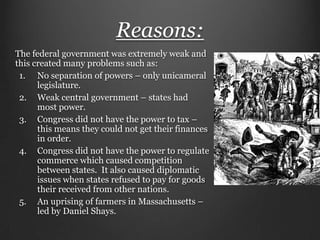
The Constitution, which is over 200 years old, can be seen in Washington, D.C.Reasons:	The federal government was extremely weak and this created many problems such as: No separation of powers – only unicameral legislature. Weak central government – states had most power. Congress did not have the power to tax – this means they could not get their finances in order. Congress did not have the power to regulate commerce which caused competition between states.  It also caused diplomatic issues when states refused to pay for goods their received from other nations.An uprising of farmers in Massachusetts – led by Daniel Shays.
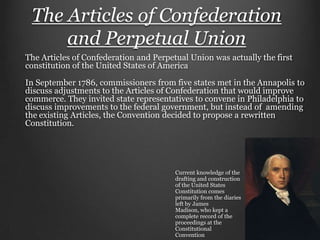
The Articles of Confederation and Perpetual Union	The Articles of Confederation and Perpetual Union was actually the first constitution of the United States of America	In September 1786, commissioners from five states met in the Annapolis to discuss adjustments to the Articles of Confederation that would improve commerce. They invited state representatives to convene in Philadelphia to discuss improvements to the federal government, but instead of  amending the existing Articles, the Convention decided to propose a rewritten Constitution. 	Current knowledge of the drafting and construction of the United States Constitution comes primarily from the diaries left by James Madison, who kept a complete record of the proceedings at the Constitutional Convention
Outcomes of the Constitutional ConventionVirginia Plan (James Madison, considered to be "The Father of the Constitution“)
Separation of powers
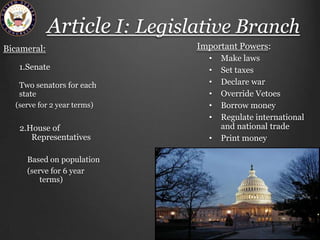
Bicameral legislature based on population
Federal government had increased powers
New Jersey Plan (William Paterson)
Unicameral legislature where every state received equal representation.
Great Compromise (Roger Sherman, Connecticut)
Hybrid of VA and NJ Plans:
Bicameral legislature:
House of Reps based on population
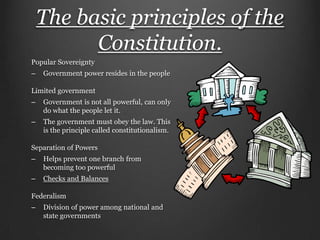
Senate based upon equal representationThe basic principles of the Constitution.	Popular SovereigntyGovernment power resides in the people 	Limited governmentGovernment is not all powerful, can only do what the people let it.
The government must obey the law. This is the principle called constitutionalism. 	Separation of PowersHelps prevent one branch from becoming too powerful
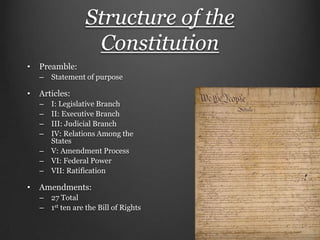
Checks and Balances	FederalismDivision of power among national and state governmentsThe general scheme

US Constitution

  • 1.
    The U. S.ConstitutionZhuravlev Alexander MSLU 2009
  • 2.
    What is theUS Constitution?The supreme law of the United States. It is the foundation and source of the legal authority underlying the existence of the United States of America and the Federal Government of the United States. It provides the framework for the organization of the United States Government.
  • 3.
    Basic informationThe UnitedStates Constitution was created on September 17, 1787. “Constitutional Convention”
  • 4.
    It was ratifiedJune 21, 1788
  • 5.
    The United StatesConstitution was written in the Philadelphia State House. Now the building is called “The Independence Hall”
  • 6.
    There were 55Delegates who drafted the United States Constitution
  • 7.
    The Constitution, whichis over 200 years old, can be seen in Washington, D.C.Reasons: The federal government was extremely weak and this created many problems such as: No separation of powers – only unicameral legislature. Weak central government – states had most power. Congress did not have the power to tax – this means they could not get their finances in order. Congress did not have the power to regulate commerce which caused competition between states. It also caused diplomatic issues when states refused to pay for goods their received from other nations.An uprising of farmers in Massachusetts – led by Daniel Shays.
  • 8.
    The Articles ofConfederation and Perpetual Union The Articles of Confederation and Perpetual Union was actually the first constitution of the United States of America In September 1786, commissioners from five states met in the Annapolis to discuss adjustments to the Articles of Confederation that would improve commerce. They invited state representatives to convene in Philadelphia to discuss improvements to the federal government, but instead of amending the existing Articles, the Convention decided to propose a rewritten Constitution. Current knowledge of the drafting and construction of the United States Constitution comes primarily from the diaries left by James Madison, who kept a complete record of the proceedings at the Constitutional Convention
  • 9.
    Outcomes of theConstitutional ConventionVirginia Plan (James Madison, considered to be "The Father of the Constitution“)
  • 10.
  • 11.
  • 12.
    Federal government hadincreased powers
  • 13.
    New Jersey Plan(William Paterson)
  • 14.
    Unicameral legislature whereevery state received equal representation.
  • 15.
    Great Compromise (RogerSherman, Connecticut)
  • 16.
    Hybrid of VAand NJ Plans:
  • 17.
  • 18.
    House of Repsbased on population
  • 19.
    Senate based uponequal representationThe basic principles of the Constitution. Popular SovereigntyGovernment power resides in the people Limited governmentGovernment is not all powerful, can only do what the people let it.
  • 20.
    The government mustobey the law. This is the principle called constitutionalism. Separation of PowersHelps prevent one branch from becoming too powerful
  • 21.
    Checks and Balances FederalismDivisionof power among national and state governmentsThe general scheme