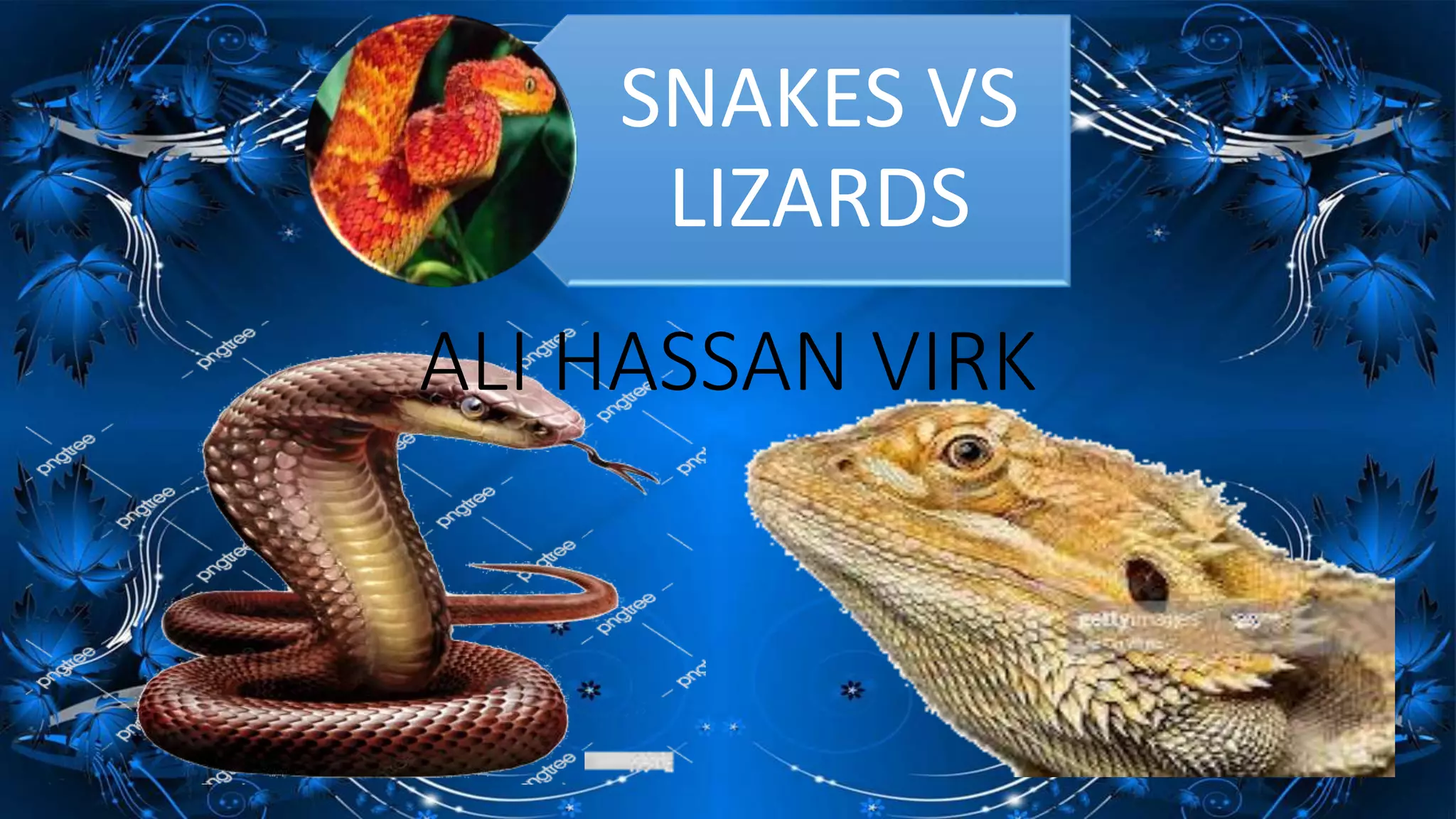
SNAKES VS
LIZARDS
ALI HASSAN VIRK
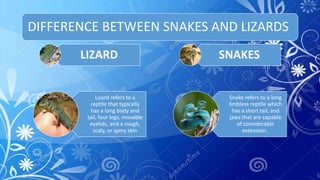
DIFFERENCE BETWEEN SNAKES AND LIZARDS
LIZARD
Lizard refers to a
reptile that typically
has a long body and
tail, four legs, movable
eyelids, and a rough,
scaly, or spiny skin
SNAKES
Snake refers to a long
limbless reptile which
has a short tail, and
jaws that are capable
of considerable
extension.
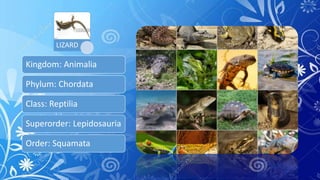
LIZARD
Kingdom: Animalia
Phylum: Chordata
Class: Reptilia
Superorder: Lepidosauria
Order: Squamata
Brief Description
Most lizards are quadrupedal,
running with a strong side-to-
side motion. Others are
legless, and have long snake-
like bodies.
Some such as the
forestdwelling Draco lizards
are able to glide.
They are often territorial, the
males fighting off other males
and signalling, often with
brightly colours, to attract
mates and to intimidate rivals.
Lizards are mainly
carnivorous, often being sit-
and-wait predators; many
smaller species eat insects,
while the Komodo eats
mammals as big as water
buffalo.
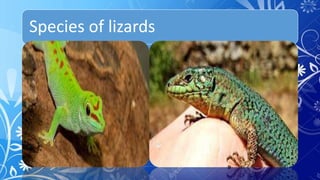
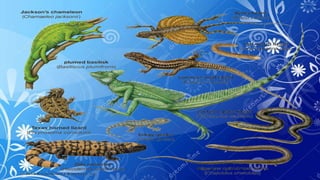
Species of lizards
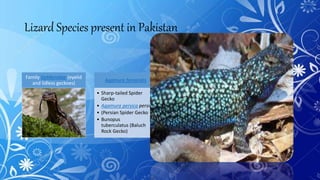
Lizard Species present in Pakistan
Family Gekkonidae (eyelid
and lidless geckoes)
Agamura femoralis
• Sharp-tailed Spider
Gecko
• Agamura persica persica
• (Persian Spider Gecko
• Bunopus
tuberculatus (Baluch
Rock Gecko)
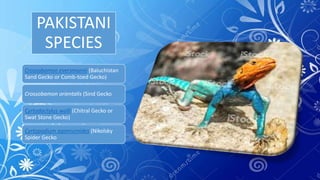
PAKISTANI
SPECIES
Crossobamon eversmanni (Baluchistan
Sand Gecko or Comb-toed Gecko)
Crossobamon orientalis (Sind Gecko
Cyrtodactylus walli (Chitral Gecko or
Swat Stone Gecko)
Cyrtopodium agamuroides (Nikolsky
Spider Gecko
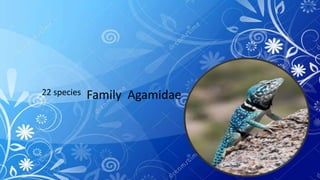
Family Agamidae22 species
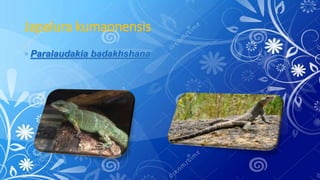
Japalura kumaonensis
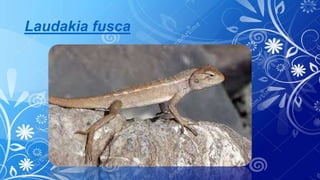
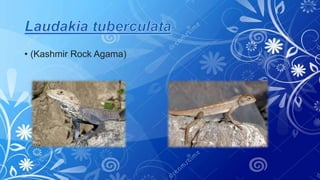
Laudakia fusca
• (Kashmir Rock Agama)
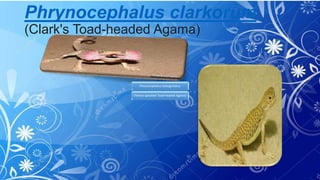
Phrynocephalus clarkorum
(Clark's Toad-headed Agama)
Phrynocephalus luteoguttatus
(Yellow-speckled Toad-headed Agama)
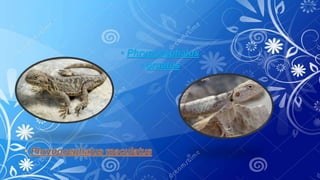
• Phrynocephalus
• ornatus
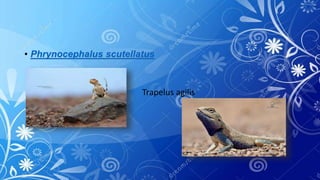
• Phrynocephalus scutellatus
Trapelus agilis
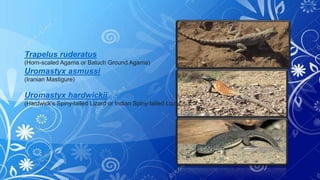
Trapelus ruderatus
(Horn-scaled Agama or Baluch Ground Agama)
Uromastyx asmussi
(Iranian Mastigure)
Uromastyx hardwickii
(Hardwick's Spiny-tailed Lizard or Indian Spiny-tailed Lizard)
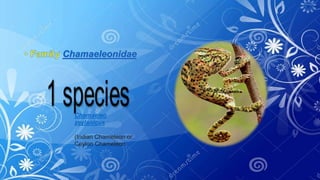
Chamaeleo
zeylanicus
(Indian Chameleon or
Ceylon Chameleon
(monitor lizards)
3 species
• Varanus flavescens
• Varanus griseus
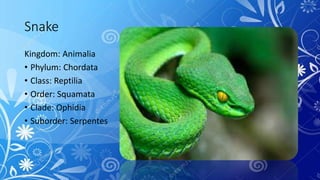
Snake
Kingdom: Animalia
• Phylum: Chordata
• Class: Reptilia
• Order: Squamata
• Clade: Ophidia
• Suborder: Serpentes
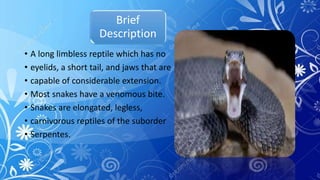
Brief
Description
• A long limbless reptile which has no
• eyelids, a short tail, and jaws that are
• capable of considerable extension.
• Most snakes have a venomous bite.
• Snakes are elongated, legless,
• carnivorous reptiles of the suborder
• Serpentes.
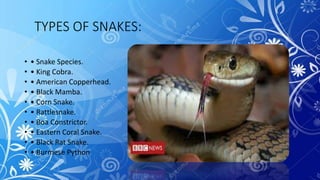
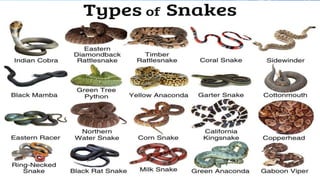
TYPES OF SNAKES:
• • Snake Species.
• • King Cobra.
• • American Copperhead.
• • Black Mamba.
• • Corn Snake.
• • Rattlesnake.
• • Boa Constrictor.
• • Eastern Coral Snake.
• • Black Rat Snake.
• • Burmese Python
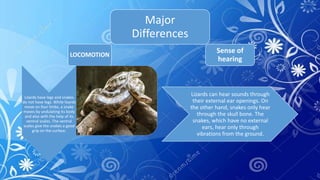
Major
Differences
LOCOMOTION
Lizards have legs and snakes
do not have legs. While lizards
move on four limbs, a snake
moves by undulating its body
and also with the help of its
ventral scales. The ventral
scales give the snakes a good
grip on the surface.
Sense of
hearing
Lizards can hear sounds through
their external ear openings. On
the other hand, snakes only hear
through the skull bone. The
snakes, which have no external
ears, hear only through
vibrations from the ground.
Summarization of the differences
• 1. Lizards have legs and snakes
• do not have legs.
• 2. While lizards move on four
• limbs, a snake moves by
• undulating its body and also
• with the help of its ventral
• scales.
• 3. Lizards can hear sounds
• through their external ear
• openings. On the other hand,
• snakes only hear through the
• skull bone. The snakes, which
• have no external ears, hear
Summarization of the differences
• only through vibrations from
• the ground.
• 4. While lizards can close their
• eyes, snakes cannot close their
• eyes.
• 5. Lizards have two moveable
• eyelids, but a transparent scale is
• what covers the eye of a snake.
• 6. A lizard sheds its tail when
• agitated or in times of danger,
• but snakes shed their skin.
• 7. While a lizard comes with
• two lungs, a snake has only one
• lung that works.
SNAKES VS LIZARDS
SNAKES VS LIZARDS
SNAKES VS LIZARDS

SNAKES VS LIZARDS

  • 1.
  • 2.
    DIFFERENCE BETWEEN SNAKESAND LIZARDS LIZARD Lizard refers to a reptile that typically has a long body and tail, four legs, movable eyelids, and a rough, scaly, or spiny skin SNAKES Snake refers to a long limbless reptile which has a short tail, and jaws that are capable of considerable extension.
  • 3.
    LIZARD Kingdom: Animalia Phylum: Chordata Class:Reptilia Superorder: Lepidosauria Order: Squamata
  • 4.
    Brief Description Most lizardsare quadrupedal, running with a strong side-to- side motion. Others are legless, and have long snake- like bodies. Some such as the forestdwelling Draco lizards are able to glide. They are often territorial, the males fighting off other males and signalling, often with brightly colours, to attract mates and to intimidate rivals. Lizards are mainly carnivorous, often being sit- and-wait predators; many smaller species eat insects, while the Komodo eats mammals as big as water buffalo.
  • 5.
  • 7.
    Lizard Species presentin Pakistan Family Gekkonidae (eyelid and lidless geckoes) Agamura femoralis • Sharp-tailed Spider Gecko • Agamura persica persica • (Persian Spider Gecko • Bunopus tuberculatus (Baluch Rock Gecko)
  • 8.
    PAKISTANI SPECIES Crossobamon eversmanni (Baluchistan SandGecko or Comb-toed Gecko) Crossobamon orientalis (Sind Gecko Cyrtodactylus walli (Chitral Gecko or Swat Stone Gecko) Cyrtopodium agamuroides (Nikolsky Spider Gecko
  • 9.
  • 11.
  • 13.
  • 15.
  • 16.
    Phrynocephalus clarkorum (Clark's Toad-headedAgama) Phrynocephalus luteoguttatus (Yellow-speckled Toad-headed Agama)
  • 17.
  • 18.
  • 19.
    Trapelus ruderatus (Horn-scaled Agamaor Baluch Ground Agama) Uromastyx asmussi (Iranian Mastigure) Uromastyx hardwickii (Hardwick's Spiny-tailed Lizard or Indian Spiny-tailed Lizard)
  • 20.
  • 21.
  • 23.
  • 24.
    Snake Kingdom: Animalia • Phylum:Chordata • Class: Reptilia • Order: Squamata • Clade: Ophidia • Suborder: Serpentes
  • 25.
    Brief Description • A longlimbless reptile which has no • eyelids, a short tail, and jaws that are • capable of considerable extension. • Most snakes have a venomous bite. • Snakes are elongated, legless, • carnivorous reptiles of the suborder • Serpentes.
  • 26.
    TYPES OF SNAKES: •• Snake Species. • • King Cobra. • • American Copperhead. • • Black Mamba. • • Corn Snake. • • Rattlesnake. • • Boa Constrictor. • • Eastern Coral Snake. • • Black Rat Snake. • • Burmese Python
  • 27.
    Major Differences LOCOMOTION Lizards have legsand snakes do not have legs. While lizards move on four limbs, a snake moves by undulating its body and also with the help of its ventral scales. The ventral scales give the snakes a good grip on the surface. Sense of hearing Lizards can hear sounds through their external ear openings. On the other hand, snakes only hear through the skull bone. The snakes, which have no external ears, hear only through vibrations from the ground.
  • 28.
    Summarization of thedifferences • 1. Lizards have legs and snakes • do not have legs. • 2. While lizards move on four • limbs, a snake moves by • undulating its body and also • with the help of its ventral • scales. • 3. Lizards can hear sounds • through their external ear • openings. On the other hand, • snakes only hear through the • skull bone. The snakes, which • have no external ears, hear
  • 29.
    Summarization of thedifferences • only through vibrations from • the ground. • 4. While lizards can close their • eyes, snakes cannot close their • eyes. • 5. Lizards have two moveable • eyelids, but a transparent scale is • what covers the eye of a snake. • 6. A lizard sheds its tail when • agitated or in times of danger, • but snakes shed their skin. • 7. While a lizard comes with • two lungs, a snake has only one • lung that works.