
SCT-Related Video Film content: The role of chance (fortuity) in human lives as seen in Bandura’s own life              Bandura’s Triadic Reciprocal Model              The processes involved in modeling and observational learning                          Attention                          Symbolic representation                          Transformation into action                           Motivational incentives              The ways people develop efficacy                          Personal mastery                          Social modeling                          Social persuasion                          Learning to read one’s own physical and emotional states              Results of efficacy beliefs                          Optimism vs. pessimism                          What challenges people take on                          How people emotionally cope with stress and depression                          What choices people make in their lives              Moral disengagement                          De-humanizing foes                          Discounting others’ suffering                          Seeing destructive acts as serving higher purposes                          Shifting responsibility to others              Visuals:  It is a Davidson company joke that everyone in the world is in this film, reflecting the wide range of Dr. Bandura’s concerns. Among them are: On camera segments with Dr. Bandura speaking of his life              Graphics illustrating the Triadic Reciprocal model               A reenactment of Bandura’s crossing-the-street against-a red-light study                           Dr. Bandura’s original film of the Bobo Doll experiment              Dr. Bandura’s original film sequences of therapy sessions for a snake phobia              Scenes of Peace Corps volunteers working in Africa              Television social dramas from Mexico, China and India with English subtitles              Current college students talking about the role of efficacy in their lives              Film segment of the Stanford Women’s Basketball team at practice              1960 newsreel clip of a Civil Rights March with Dr. King              Newsreel clips from recent wars              Film segments of an Amish cooperative barn raising An eloquent interview with a native sculptor from Labrador who talks of the social forces that shaped his work life
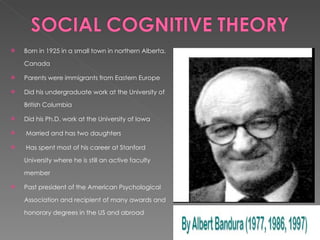
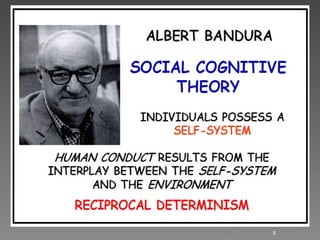
Born in 1925 in a small town in northern Alberta, Canada Parents were immigrants from Eastern Europe Did his undergraduate work at the University of British Columbia Did his Ph.D. work at the University of Iowa   Married and has two daughters   Has spent most of his career at Stanford University where he is still an active faculty member Past president of the American Psychological Association and recipient of many awards and honorary degrees in the US and abroad
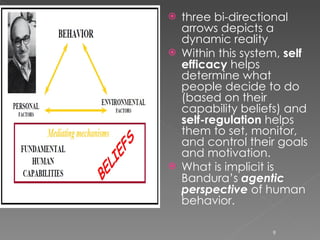
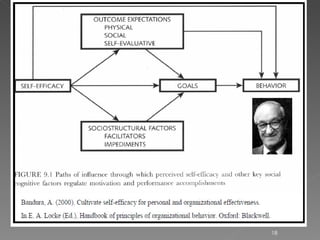
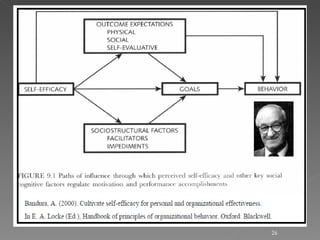
three bi-directional arrows depicts a dynamic reality Within this system,  self efficacy  helps determine what people decide to do (based on their capability beliefs) and  self-regulation  helps them to set, monitor, and control their goals and motivation.  What is implicit is Bandura’s  agentic perspective  of human behavior.
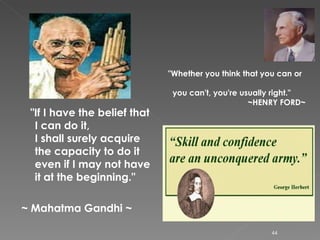
"If I have the belief that I can do it, I shall surely acquire the capacity to do it even if I may not have it at the beginning."  ~ Mahatma Gandhi ~   "Whether you think that you can or  you can't, you're usually right."       ~HENRY FORD~
"Truth be told, it is self-efficacy that drives the Ph.D. student to complete the most daunting and exhausting tasks under excruciating deadlines!"   ~ James Bohn, PhD 2003, University of Wisconsin  [Dissertation: "The relationship of perceived leadership behaviors to organizational efficacy."] "Life is not easy for any of us. But what of that? We must have perseverance and above all confidence in ourselves. We must believe that we are gifted for something and that this thing must be attained.“ ~Marie Curie~
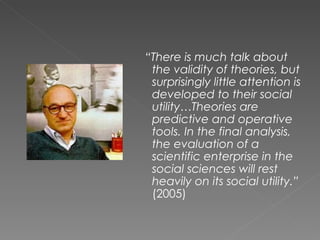
“ There is much talk about the validity of theories, but surprisingly little attention is developed to their social utility…Theories are predictive and operative tools. In the final analysis, the evaluation of a scientific enterprise in the social sciences will rest heavily on its social utility.”  (2005)
Strengths Interdisciplinary and integrative Helps link agency and social structure  SCT passes the test of self-reference  Strong research methodology One of only a handful of social scientists to discuss fortuity Path models Many applications leading to social betterment
Weaknesses Perhaps gives too much weight to human freedom of action Perhaps gives too much weight to human rationality Downplays biological and upward causation (he does a great job on downward causation: agency/mind directing one’s intentionality and behavior) Perhaps tries to include too much conceptual territory in a single theory
•  Bandura, A. (1977). Self-efficacy: Toward a Unifying Theory of Behavioural Change. Psychological Review, 84(2), 191-215. •  Bandura, A. (1997). Self-Efficacy: The Exercise of Control. New York: W.H. Freeman. •  Bandura, A. (2000). Health promotion from the perspective of social cognitive theory. In: P. Norman, C. Abraham, & M. Conner. (Eds) Understanding and Changing Health Behaviour: from Health Beliefs to  Self-Regulation (pp. 299-343). Amsterdam: Harwood Academic Publishers. •  Bandura, A. (2001) Guide for Constructing Self-Efficacy Scales.  URL www.emory.edu/Education/mfp/effguide.pdf. •  Ewart, C. K. (1992). The role of physical self-efficacy in recovery from heart attack. In: R. Schwarzer (Ed) Self-efficacy: thought control of action. London: Taylor Francis. http://www.des.emory.edu/mfp/Bandura/   http://www.gifted.uconn.edu/siegle/SelfEfficacy/section0.html Pajares (2002).  Overview of social cognitive theory and of self-efficacy . Retreived: January 8, 2009 from  http://www.emory.edu/EDUCATION/mfp/eff.html http://www.davidsonfilmsstore.com/support.htm I Can’t Accept Not Trying:  Michael Jordan on the Pursuit of Excellence  is published by HarperSanFrancisco, a division of HarperCollinsPublishers (ISBN 0-06-25119)
SME 604 - Social Cognitive Theory (Self-Efficacy)

SME 604 - Social Cognitive Theory (Self-Efficacy)

  • 2.
    SCT-Related Video Filmcontent: The role of chance (fortuity) in human lives as seen in Bandura’s own life             Bandura’s Triadic Reciprocal Model             The processes involved in modeling and observational learning                         Attention                         Symbolic representation                         Transformation into action                         Motivational incentives             The ways people develop efficacy                         Personal mastery                         Social modeling                         Social persuasion                         Learning to read one’s own physical and emotional states             Results of efficacy beliefs                         Optimism vs. pessimism                         What challenges people take on                         How people emotionally cope with stress and depression                         What choices people make in their lives             Moral disengagement                         De-humanizing foes                         Discounting others’ suffering                         Seeing destructive acts as serving higher purposes                         Shifting responsibility to others             Visuals:  It is a Davidson company joke that everyone in the world is in this film, reflecting the wide range of Dr. Bandura’s concerns. Among them are: On camera segments with Dr. Bandura speaking of his life             Graphics illustrating the Triadic Reciprocal model             A reenactment of Bandura’s crossing-the-street against-a red-light study                         Dr. Bandura’s original film of the Bobo Doll experiment             Dr. Bandura’s original film sequences of therapy sessions for a snake phobia             Scenes of Peace Corps volunteers working in Africa             Television social dramas from Mexico, China and India with English subtitles             Current college students talking about the role of efficacy in their lives             Film segment of the Stanford Women’s Basketball team at practice             1960 newsreel clip of a Civil Rights March with Dr. King             Newsreel clips from recent wars             Film segments of an Amish cooperative barn raising An eloquent interview with a native sculptor from Labrador who talks of the social forces that shaped his work life
  • 3.
    Born in 1925in a small town in northern Alberta, Canada Parents were immigrants from Eastern Europe Did his undergraduate work at the University of British Columbia Did his Ph.D. work at the University of Iowa   Married and has two daughters   Has spent most of his career at Stanford University where he is still an active faculty member Past president of the American Psychological Association and recipient of many awards and honorary degrees in the US and abroad
  • 9.
    three bi-directional arrowsdepicts a dynamic reality Within this system, self efficacy helps determine what people decide to do (based on their capability beliefs) and self-regulation helps them to set, monitor, and control their goals and motivation. What is implicit is Bandura’s agentic perspective of human behavior.
  • 44.
    "If I havethe belief that I can do it, I shall surely acquire the capacity to do it even if I may not have it at the beginning." ~ Mahatma Gandhi ~   "Whether you think that you can or you can't, you're usually right."     ~HENRY FORD~
  • 45.
    "Truth be told,it is self-efficacy that drives the Ph.D. student to complete the most daunting and exhausting tasks under excruciating deadlines!" ~ James Bohn, PhD 2003, University of Wisconsin [Dissertation: "The relationship of perceived leadership behaviors to organizational efficacy."] "Life is not easy for any of us. But what of that? We must have perseverance and above all confidence in ourselves. We must believe that we are gifted for something and that this thing must be attained.“ ~Marie Curie~
  • 46.
    “ There ismuch talk about the validity of theories, but surprisingly little attention is developed to their social utility…Theories are predictive and operative tools. In the final analysis, the evaluation of a scientific enterprise in the social sciences will rest heavily on its social utility.” (2005)
  • 47.
    Strengths Interdisciplinary andintegrative Helps link agency and social structure SCT passes the test of self-reference Strong research methodology One of only a handful of social scientists to discuss fortuity Path models Many applications leading to social betterment
  • 48.
    Weaknesses Perhaps givestoo much weight to human freedom of action Perhaps gives too much weight to human rationality Downplays biological and upward causation (he does a great job on downward causation: agency/mind directing one’s intentionality and behavior) Perhaps tries to include too much conceptual territory in a single theory
  • 49.
    • Bandura,A. (1977). Self-efficacy: Toward a Unifying Theory of Behavioural Change. Psychological Review, 84(2), 191-215. • Bandura, A. (1997). Self-Efficacy: The Exercise of Control. New York: W.H. Freeman. • Bandura, A. (2000). Health promotion from the perspective of social cognitive theory. In: P. Norman, C. Abraham, & M. Conner. (Eds) Understanding and Changing Health Behaviour: from Health Beliefs to Self-Regulation (pp. 299-343). Amsterdam: Harwood Academic Publishers. • Bandura, A. (2001) Guide for Constructing Self-Efficacy Scales. URL www.emory.edu/Education/mfp/effguide.pdf. • Ewart, C. K. (1992). The role of physical self-efficacy in recovery from heart attack. In: R. Schwarzer (Ed) Self-efficacy: thought control of action. London: Taylor Francis. http://www.des.emory.edu/mfp/Bandura/ http://www.gifted.uconn.edu/siegle/SelfEfficacy/section0.html Pajares (2002). Overview of social cognitive theory and of self-efficacy . Retreived: January 8, 2009 from http://www.emory.edu/EDUCATION/mfp/eff.html http://www.davidsonfilmsstore.com/support.htm I Can’t Accept Not Trying:  Michael Jordan on the Pursuit of Excellence  is published by HarperSanFrancisco, a division of HarperCollinsPublishers (ISBN 0-06-25119)