WEALTH BUILDING
STRATEGIES                                                                 5

  – F     I N A N C I A L   S   U C C E S S   2 0 0 7 P R E S E N T HEADLINE
                                                                    S –


                  S U C C E S S       S T R A T E G I E S
WEALTH
BUILDING
 STRATEGIES
MAXIMIZING YOUR PERSONAL
 FINANCIAL PERFORMANCE

   S U C C E S S   S T R A T E G I E S
Wealth Building Strategies—Maximizing Your Personal Financial Performance
Published by Financial Success 2007
4710 Eisenhower Blvd., Suite B-5
Tampa, FL 33634
www.financialsuccess2007.com


This book or parts thereof may not be reproduced in any form, stored in a retrieval system, or transmitted
in any form by any means—electronic, mechanical, photocopy, recording, or otherwise—without prior
written permission of the publisher, except as provided by United States of America copyright law.


ISBN-10: 1-934225-04-5
ISBN-13: 978-1-934225-04-2


Copyright © 2007 by Financial Success 2007, Get Motivated Seminars, Inc.
All rights reserved


PUBLISHER’S NOTE: This publication is designed to provide competent and reliable information regarding the
subject matter covered. However, it is distributed with the understanding that the author and publisher are not
engaged in rendering legal, financial, or other professional advice. Laws and practices often vary from state to state;
and if legal, financial, or other expert assistance is required, the services of a professional should be sought. The
publisher specifically disclaims any liability that is incurred from the use or application of the contents of this book.


                      S U C C E S S                      S T R A T E G I E S
STOCK MARKET
  STRATEGIES


     TABLE OF
    CONTENTS


         S U C C E S S   S T R A T E G I E S
WEALTH BUILDING
    STRATEGIES                                                             6

                                                           TABLE OF CONTENTS


Introduction                                                               7
SECTION ONE: Financial Goals and General Principles of Wealth              9
Financial Goals                                                           11
General Principles of Wealth                                              22
SECTION TWO: Personal Finance Basics                                      33
Savings Accounts                                                          35
The Power of Compounding Interest                                         42
Insuring Your Family’s Future                                             46
SECTION THREE: Investing to Increase Personal Wealth                     103
The Stock Market                                                         106
Building an Investment Portfolio                                         124
Taxes                                                                    145
Protecting Your Wealth                                                   157
Glossary of Personal Finance Terms                                       173
Worksheet for Financial Goal Setting                                     203
Budget Worksheet                                                         204
Daily Expense Tracking Worksheet                                         205


                      S U C C E S S    S T R A T E G I E S
INTRODUCTION


  S U C C E S S   S T R A T E G I E S
WEALTH BUILDING
    STRATEGIES                                                                    8

                                                                   INTRODUCTION


       very great athlete, musician, professor, or mentor must master the basic

E      techniques of their chosen art or passion before branching out into more
       advanced techniques and methods. The exact same philosophy is true
when dealing with personal financial matters. It is important to learn how to
build personal wealth through various methods including smart choices
involving saving, real estate investments, stock market investments, and other
investment vehicles for building personal wealth, but first, you must master the
basic techniques for managing money and building personal wealth. The pur-
pose of this report is to help you to build a sound knowledge of the basics and
venture into some of the sound vehicles you can use to build personal financial
wealth so that you can lay a sound foundation for your family’s and your
wealthy future. Everyone, no matter how much your income or how small your
income, must be conscious of their personal finances and work toward build-
ing a bright financial future.

The concepts in this report will work for you regardless of your age or the
amount of money you make, enabling you to build personal financial security
and personal wealth. There are no magic tricks, just sound financial concepts to
help ensure your future ability to live the lifestyle you desire for yourself and
your family and to even leave a legacy for your children and their descendants
after your passing.

By reading this report, you will learn how to establish financial goals and how to
achieve them.The most common and most successful financial investment vehi-
cles for building wealth are explained so that you can fully understand how to use
these methods to increase and protect your personal wealth.

We’ll show you how to break large goals down into manageable,achievable goals.
We’ll show you how to track those goals and how to stay on track toward achiev-
ing those goals. We’ll even show you how to adjust your goals as your situation
changes to help you reach your financial dreams.

After reading this report in full, it will be time for you to implement the concepts
that will put you on the road to building true personal wealth. Follow that road,
and your assets and wealth will continue to grow.

                      S U C C E S S    S T R A T E G I E S
SECTION ONE:
FINANCIAL GOALS
  AND GENERAL
  PRINCIPLES OF
     WEALTH
  S U C C E S S   S T R A T E G I E S
WEALTH BUILDING
     STRATEGIES                                                                    10

          SECTION ONE: FINANCIAL GOALS AND GENERAL PRINCIPLES OF WEALTH


Introduction to Financial Goals and General Wealth Principles
In this section of this report, you’ll find information about financial goals and
how to establish these goals for you and your particular financial situation.

You’ll also learn about general principles of building personal wealth.

You’ll learn basics in this section and, to go with these helpful facts, you’ll find a
set of worksheets to help you establish a family budget, personal financial goals,
and help you establish your goals and build your personal wealth.
FINANCIAL
  GOALS


S U C C E S S   S T R A T E G I E S
WEALTH BUILDING
    STRATEGIES                                                                  12

                                                                FINANCIAL GOALS


            any people today live from pay-check to pay-check.When asked, they

M           respond that they do not make enough money to save any money and
            that they certainly do not earn enough money in order to permit them
to invest any money into stocks.Another common response is that they believe
they are too old to start saving or investing now and because that isn’t enough
time for those savings or investments to build up into enough money to proper-
ly fund their retirement years. The truth of the matter is that anyone can man-
age their personal finances in such a way that they can save money on a regular,
disciplined basis, invest money into wise investment choices and, thereby turn
their money into even more money. This is the way people become millionaires,
and this is the way that people can build true personal wealth and financial
security. It is also a fact that no one is too young or too old to begin saving and

                      S U C C E S S    S T R A T E G I E S
WEALTH BUILDING
     STRATEGIES                                                                       13

                                                                     FINANCIAL GOALS


managing their personal finances in ways that will provide for a brighter future.
Anyone can and should set financial goals. Even if your goal is not to become a
millionaire, you certainly should have financial goals that set your sights on
becoming financially secure and preparing for your financial future and the
future of your family.

Everyone, no matter how large or small their income, makes enough money to
invest in their future wealth.Too many people feel this isn’t true because they tend
to spend money whenever and wherever they see something they desire at that
particular moment without any thought of their real, long-term goals. They sim-
ply keep putting off until tomorrow what they need to be saving today. They tell
themselves they will put aside some money next week or next month, but soon-
er than later it is next year or many years later. Instead, everyone should realize
that even small savings, when managed correctly, can ultimately grow into real
wealth.Today is the day to begin creating a better financial future for yourself and
your family.

Financial goals are very much like road maps that show you the pathway from
where you are today to where you wish to be in the future.Like a road map,if you
get off the best course, you must get back on the pathway defined and continue
your journey toward your goals. No one is perfect, and if you should happen to
venture from your defined path, which you probably will from time to time, sim-
ply turn around, get back on the pathway you defined, and continue working
toward reaching your dreams. Learn from your mistakes, and promise yourself
not to repeat your errors when you do drift from your personal financial goals.
You will find yourself a much happier person as a result.

Financial goals can seem daunting if the goals are looked at as only a single very
large goal. Perhaps you have a goal of having one million dollars in savings when
you retire. That number seems awfully large and intimidating when you look at
it alone. If you thought of it as only a single, big goal, it might make it difficult for


                       S U C C E S S      S T R A T E G I E S
WEALTH BUILDING
    STRATEGIES                                                                   14

                                                                 FINANCIAL GOALS


you to begin saving because you feel intimidated. Instead, you should be taking
small, manageable steps to achieve large, specific goals. You must realize that
everyone who has retired before you with one million dollars in savings began by
placing that first dollar into savings,keeping it there over the long term,adding to
it on a regular basis, and building their wealth over time.


Financial goals can be viewed in many different ways. You can set short-term
goals, which can be achieved in weeks or a few months.You can set longer range
goals, which cover a year or more. You can set very long-term goals that cover
years such as preparing for retirement or even beyond retirement toward leaving
a heritage or legacy for your children, grandchildren, and even great-grandchil-
dren to enjoy. No matter how you look at your personally chosen financial goals,


                      S U C C E S S    S T R A T E G I E S
WEALTH BUILDING
    STRATEGIES                                                                   15

                                                                 FINANCIAL GOALS


if you set goals, track your progress toward achievements, and adjust your goals
periodically to meet your changing situation, you will obtain the wealth you
desire. The advantage of setting goals is that you will have a plan to work toward
rather than working in the dark, hoping things work out for you. Failing to plan
is said to be the same as planning to fail. This applies to personal finances as
much as to any other type of projects that you might become involved in; perhaps
it is even truer when applied to money.

In order to generate personal financial wealth, you have to become passionate
about setting and achieving financial goals. If you must, think of your personal
financial goals as hard milestones so that you will strive to achieve them. If you
maintain a mindset that nothing whatsoever has the ability to stop you from
achieving your goals, you will find yourself progressing steadily toward financial
wealth. Let nothing stop you from achieving your financial goals.

In order to set financial goals,you must think about what you want your life to be
in the future.You must look at where you are today and where you want to be in
the future based on the money you have to work with. What do you want your
financial position to be in five years? Where do you want to be in ten years?
Twenty years? How much money do you want to have when you retire? What sort
of inheritance would you like to leave for your family when you leave this world?

You certainly are already aware that you have income and expenses. You should
already have a budget in place,but a surprising number of people do not use this
essential tool.If you do not have a budget, now is the time to create one by sitting
down with your family and determining how to use the money that comes into
your hands.If, on the other hand,you already have a budget in place but you find
that every month you just barely making ends meet,it is time to throw that budg-
et away and start over by creating a budget that will support your financial goals
as well as meet your current needs by adjusting how the money is spent.


                      S U C C E S S    S T R A T E G I E S
WEALTH BUILDING
    STRATEGIES                                                                   16

                                                                 FINANCIAL GOALS


Financial goals are different for different people because of differing circum-
stances and differing desires. There is no set of goals that will work for everyone.
You must examine your life and your desires, determine what you want your
financial future to become, and set goals accordingly. Although you can seek
advice from a professional financial counselor regarding how to meet your goals
once you know what your financial desires include, this is something that no one


else can do for you and your family. You may also find the advice of a financial
advisor essential in figuring out how to reduce your debt burden if you have been
overusing credit cards or other debts and are now paying high rates of interest
that could better be used elsewhere.


                      S U C C E S S    S T R A T E G I E S
WEALTH BUILDING
    STRATEGIES                                                                 17

                                                               FINANCIAL GOALS


If you have children, your goal may be to have enough money to provide them a
quality education while still having enough money to retire comfortably. Another
person might have a goal of retiring early and enjoying life without having to
work every day. Still another person will have another answer to the questions of
where they want to be financially at certain periods in their lives. The one thing
each of these people has in common and every person who wants to have sound
personal finances is the need to set aside money for the future and allow that
money to grow, untouched, until their goals have been reached.

How to Set Goals
When setting goals for most situations, such as your career, you first set short-
term goals that support long-term goals. With personal finance, you want to
look at your goals more or less in reverse order. First, you need to determine
where you want to be financially during your later years of life such as when
you reach retirement and are no longer earning money from your career or
business. Then, you should allow these long-term goals to drive your goal set-
ting for the near term. However, you still have to be sure your financial goals
allow you to meet today’s needs as well, so you do have to look at that as well.
It would not make good sense to set a financial goal to save x dollars if that
goal means you cannot pay the mortgage payment on your home today. After
all, your home is an investment and one of the biggest savings accounts most
people ever own.

You should obtain and utilize a dedicated notebook or perhaps a computer
software application for setting and tracking goals. Write down your long-
term goals that reflect where you and your family want to be in twenty or thir-
ty or more years. Let's look at an example of a person who wishes to retire in
thirty years with one million dollars in assets available during retirement.That
goal would reflect the long-term, ultimate goal. It can be achieved, and per-
haps even more can be achieved, with dedication and the willingness to apply
self discipline.

                      S U C C E S S    S T R A T E G I E S
WEALTH BUILDING
    STRATEGIES                                                                 18

                                                               FINANCIAL GOALS


Next, look at your family’s debt load. Paying off debt as quickly as possible can
allow you to save and invest money into growth vehicles to reach your goal.
Paying high interest rates on credit cards will only keep you from achieving
your personal financial goals.Establish a goal for paying off all credit card debt
and any other short-term debt as quickly as your income permits. Determine
that the money you have been using to pay these debts will, once the debts are
paid off, be placed into your savings and investments to accumulate wealth.
Since you have been spending the money by sending it to credit card compa-
nies, you’ll be able to pay yourself that same amount without even missing it
each month!

Set your own ultimate personal financial goal for yourself and your family,and
write that goal down. Reflect on the goal, and keep it always in mind. Remind
yourself daily of your goal, and remind your family members of the goal and
the benefits they will enjoy by working toward that financial goal. Know that
you can achieve the goal if you focus on it daily. Never allow anyone to con-
vince you that you cannot achieve your goals and dreams, because you truly
can if you only work methodically toward them.

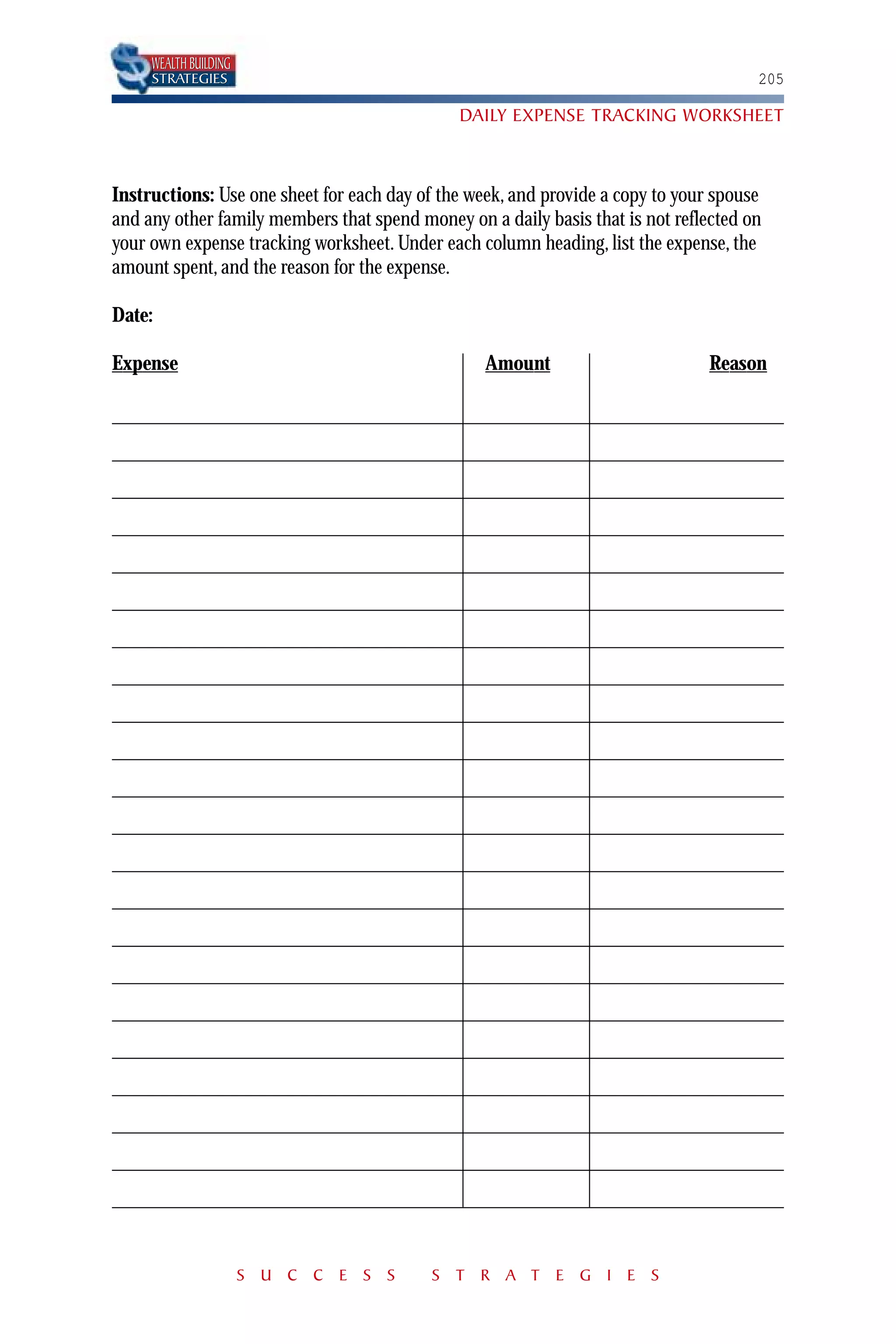
Next, you must look at your spending patterns as well as the spending patterns
of your family. Where does your spendable money go? For a period of one
week, keep a spending journal and ask every member of the family to do the
same thing. Write down every single thing you spend money on during each
day. This list isn’t for including the expenses you have to pay for the household
such as electricity, mortgage, and water. It should be used for tracking your
personal, unplanned spending decisions. While your children may only have
an allowance to account for, you want to note any extra money provided to
them from your pocket. You also want to ask your spouse to keep the same
type of spending journal in order to get a complete picture of how your fami-
ly spends money to make this exercise most effective.


                      S U C C E S S    S T R A T E G I E S
WEALTH BUILDING
    STRATEGIES                                                               19

                                                              FINANCIAL GOALS


At the end of the week, sit down and study your expenditure journal. You
will almost certainly see many things that are impulse purchases, money
spent for things you didn’t really need and perhaps didn’t really want, or
money spent for things you could have obtained in different ways at much
lower cost.

Sit down and look at your list carefully. If you purchase coffee on the way to
work at a coffee boutique that charges four dollars for a cup of exotic coffee,
and you do this every work day for ten years, you can save over twenty thou-
sand dollars over that same ten years just by placing that four dollars per day
into your savings! That’s a lot of money to accumulate from simply making
your own coffee at home instead of buying boutique coffee.

Look at other expenses that are unnecessary or that can be provided for more
economically. Do you eat lunch in a restaurant every day? If you do this, could
you cut back to eating lunch out to only two times each week and still be just
as happy? Would once a week be sufficient to make you feel good and satisfied?
The average lunch at a good restaurant, including something to drink and a
reasonable tip, costs at least ten dollars. If you choose to cut back from five
lunches out to one lunch out per week and you consistently place the money
you have saved as a result into investments or savings, over the course of ten
years you will have just gained over thirty thousand dollars in your savings
based on calculating the savings to include compound interest over the peri-
od of years.

Notice that only two really very minor changes in lifestyle over a period of ten
years can have effectively put fifty thousand dollars into your personal sav-
ings! Look for money you spend that isn’t necessary, and place that money into
savings instead of spending it on things that do not provide for the financial
security of you and your family. You’ll be truly amazed when you realize the
amount and the places where your expendable cash is spent needlessly.


                      S U C C E S S   S T R A T E G I E S
WEALTH BUILDING
     STRATEGIES                                                                    20

                                                                  FINANCIAL GOALS


When setting your personal financial goals, you want to plan your expenditures
and budget so that you do not feel deprived, but simply focus on cutting out the
excess expenses that really do not mean much to you and your family.If you take
a family of four out to a nice restaurant to eat dinner every weekend, would you
and the rest of the family members be just as happy and fulfilled if your family
only ate out at this type of nice restaurant once per month and saved the money
from the other weekend outings? Perhaps you would be happy if you chose less
expensive restaurants but continued to go out regularly as a family outing.
Determine what is right for you and your family to feel happy and fulfilled while
still saving money. Choose the level of comfort that will allow you to save with-
out feeling that you’re not living a full and happy family lifestyle today.You’ll be
amazed at how much you can save by cutting out only a few things that have
become habit and really do not add any real value to your life and the lives of
your family.

Using the information you have gathered from studying your financial situa-
tion and focusing on your long range goal, write down goals for the near term
such as paying off credit cards within two years, saving money from unneces-
sary expenses equal to a specific amount each week, and others that apply to
your situation.

When looking at the financial goals you are setting, do not think small. Instead
think big—really big! Do you wish to retire in comfort and leave a legacy to your
children for their future? There is no reason that you can’t aim high with your
financial goals.After all,it is far better to set your goals high and come near reach-
ing those goals than to set your sights low and achieve the goals too easily. It is
more meaningful to provide a challenge for yourself and your family.

Now that you have set some financial goals, keep in mind that you can change
them or adjust them at any time to better suit your changing needs as well as the


                       S U C C E S S    S T R A T E G I E S
WEALTH BUILDING
    STRATEGIES                                                                   21

                                                                 FINANCIAL GOALS


changing economy. As your family grows or family members reach maturity,
your goals will certainly need to be reviewed and adjusted to reflect the changing
situation of your family life.If your or your spouses career situation changes, you
should again readjust your family’s financial goals to reflect those changes.
During periods of unemployment or short-term disability, you may have to
change your financial road map for a period of time in order to adjust for the
changes in family income. Whatever you do, dedicate yourself to changing the
goals upward whenever possible rather than changing your goals downward,
unless you must make a short-term change to reflect income changes due to
short periods of lowered income.Do not allow yourself or your family to become
victims of falling into the pattern of spending part of your savings or liquidating
part of your investments with the intention of putting it back later.It can be quite
difficult to ever return your investments and savings to the level you had before.
Keep savings and investments intact so they can grow and allow you to reach
your goal of personal financial success.

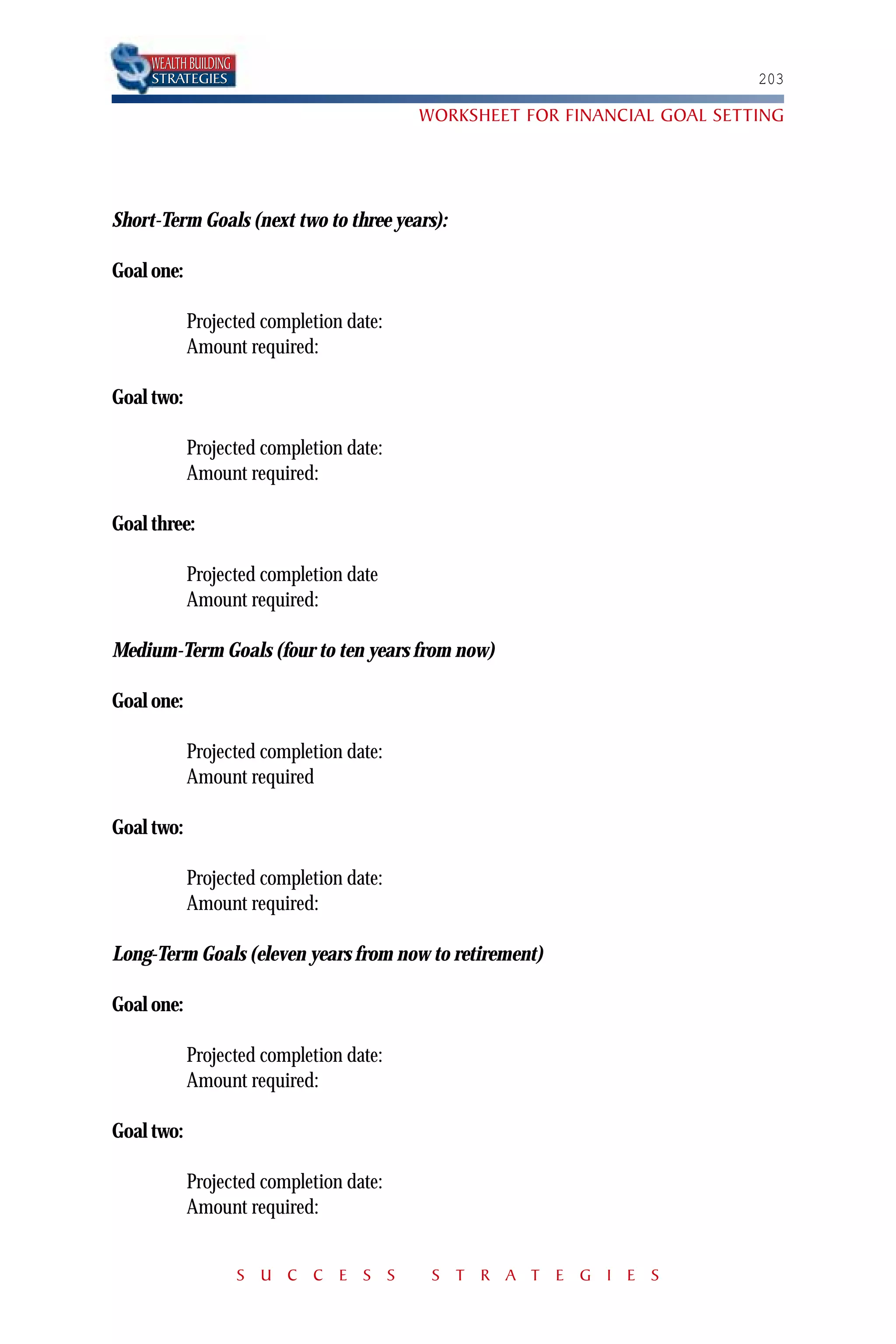
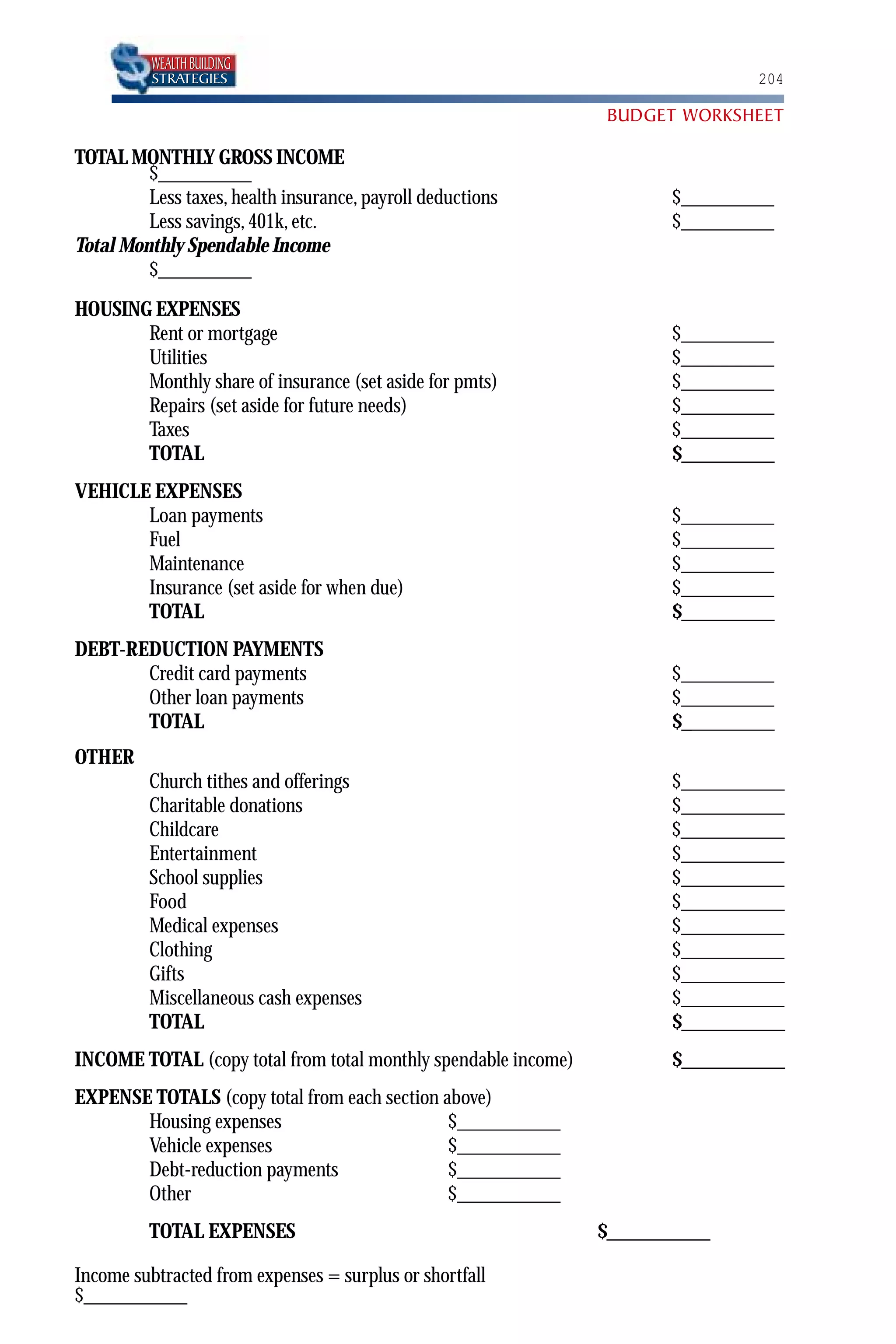
At the back of this report, you’ll find worksheets to help you set a budget, track
daily expenses, and set goals. Use these as you build your own notebook of goals
and follow your goals to reach your dreams.
GENERAL
PRINCIPLES
OF WEALTH


S U C C E S S   S T R A T E G I E S
WEALTH BUILDING
    STRATEGIES                                                                 23

                                                GENERAL PRINCIPLES OF WEALTH


           any people before you have accomplished personal financial goals that

M          allowed them to enjoy true personal wealth.All of these successful peo-
           ple followed some general personal financial principles that helped
them accumulate money and build wealth instead of spending money frivolous-
ly.The following are some general wealth principles to help you plan your road to
personal wealth.

General Principle #1: Pay Yourself First
The vast majority of people who have achieved their financial goals say they have
accomplished the task by paying themselves first each payday. By having
reviewed spending practices and identifying ways to cut back on nonessential
expenses,the amount to apply to building personal wealth is set aside before pay-
ing any of the other expenses. That money, no matter how large or small the
amount, goes directly into a vehicle for savings.

In fact, the easiest way to save money toward your goals is to have direct payroll
deductions so that you never see the money. Many employers offer savings plans
that allow you to define an amount of money to be removed from your paycheck
and placed into a savings plan or a choice of savings plans. The plans may vary
greatly from employer to employer, but the common thread is the money that
never reaches your hands is seldom missed.

If you do not use this type of savings plan, you must practice self-discipline by
placing a defined amount of money into an account where it will be held and
not spent. It is far too easy to spend money that is simply placed into your
checking account. A passbook savings account is a good place to hold the
money until you are ready to invest it into investment vehicles that pay a much
higher return rate. Whatever you do, don’t put that money that you’ve defined
as savings into your pocket! It is too easy to spend without thinking about it if
you hold the funds in cash.


                      S U C C E S S    S T R A T E G I E S
WEALTH BUILDING
     STRATEGIES                                                                    24

                                                  GENERAL PRINCIPLES OF WEALTH


General Principle #2: Pay Off Credit Card Debt
First of all, the very best way to get rid of debt—credit card or otherwise—is to
avoid accumulating debt in the first place. However, there are certain debts that
must be incurred and we’ll discuss them later.


It can be so easy to pull out a plastic credit card and purchase something you see
that you don’t really need and perhaps don’t even want.With credit card interest
rates as high as 21 percent annual percentage rate (APR), your purchase can end
up costing you a great deal more than the amount on the price tag of that item. It
can take years to pay off credit card debt if you pay only the minimum monthly
payment each month. The interest continues to grow and costs you more and
more over time.

Strive to pay off all credit card debt,beginning with the credit card that charges the
highest rate of interest. Consider transferring the balance from high interest credit

                       S U C C E S S    S T R A T E G I E S
WEALTH BUILDING
     STRATEGIES                                                                     25

                                                   GENERAL PRINCIPLES OF WEALTH


cards to credit cards that charge a lower rate of interest, making it easier to pay off
the balance quickly.Get rid of any credit cards that charge annual fees.

Study the payoff plan you intend to use for getting rid of your credit card debt.
At Feed the Pig (http://www.feedthepig.com), you’ll find a handy calculator to
help you create a credit card payoff plan. Using an example, if you have $2,000
in credit card debt on a card that charges 17.5 percent APR, if you stop charg-
ing anything new and the card does not charge an annual fee, payments of only
$99 per month will get your balance paid in full within 24 months. Of course,
the more you can pay, the faster the debt will reduce. Calculate different
amounts,find the best payment plan for you,and place that debt reduction pay-
ment into your monthly budget.

If you are the type of person who has five or six credit cards, choose a single low
interest rate credit card and use it only in emergencies.As the other accounts are
paid off,cancel the credit card.There is no need to have more than two low inter-
est rate credit cards at the very most,and you should never charge more than you
can pay in full each month.

Be aware of and cautious about “teaser” offers provided by some credit cards,
most often department store charge cards. An example of this type of teaser
incentive is a card from a specific store where you shop that offers you thirty dol-
lars in free merchandise the first time you use your new charge card. The prob-
lem with these teaser offers is that you obtain the free merchandise but also
charge an additional sum that incurs interest, often high interest rates, and you
become tempted to charge more and more. Read these types of offers carefully
and understand them before you consider using these teaser offers or even before
accepting the new, usually unsolicited, credit card.

Also, be aware of and cautious about “teaser” rates offered by some major credit
cards. It is not unusual to receive an unsolicited offer from a charge card compa-


                       S U C C E S S     S T R A T E G I E S
WEALTH BUILDING
     STRATEGIES                                                                     26

                                                   GENERAL PRINCIPLES OF WEALTH


ny that offers an amazing low interest rate. The questions you need to answer in
your research include:

           ● How long do you get this great interest rate?

           ●   How soon after the initial low interest rate ends can you cancel the
               card if paid in full?
           ● Are there any hidden expenses such as yearly fees to keep the card?


Whether these offers are good for you and your particular financial situation is
something you must determine individually. No hard and fast rule is true for
everyone. The rule you must follow is that knowledge is power, so learn all about
the offer before making any decision whatsoever.

Avoid adding to your credit card debt unless it is an absolute emergency. Never
make purchases for food,clothing,or incidentals with your credit card unless you
know you can pay off the entire balance as soon as the bill arrives and are only
using the credit card as a means of compiling budgeted expenses on a charge card
so you can write one check and avoid carrying cash or writing multiple checks.

Seek out a credit card that offers a zero interest rate as long as the card is paid in
full each month.You may even find some credit cards that offer a zero interest rate
on balances carried forward for a short period of time and no yearly fee for the
credit card. Avoid maintaining any credit cards that carry a high interest rate or
that charge a yearly fee to keep the credit card.

If you are offered a credit card with a purchase incentive such as free merchan-
dise,find out if you can use the special offer and then cancel the credit card with-
out penalty. If this is possible, you might find yourself in a position to get a really
good deal on a purchase you already wanted or needed. Be certain, before mak-
ing that purchase, that you can cancel the credit card and are not forced to keep
the card after using the special incentive benefit. If you find that you can obtain

                       S U C C E S S     S T R A T E G I E S
WEALTH BUILDING
    STRATEGIES                                                                27

                                               GENERAL PRINCIPLES OF WEALTH


free merchandise or deeply discounted purchases on items you already have bud-
geted, this can be a great way to obtain your budgeted merchandise at less than
the price you had budgeted. Just be sure to use prudence and read all the fine
print before making the purchase!

General Wealth Principle #3: Invest Money in Growth
Opportunities
Initially, you may want to save money in regular savings accounts. However, to
make your money grow, you need to invest in the opportunities that offer the
largest growth potential to maximize the increases offered by compounding.
Don’t stick your money under a mattress; instead find the best investment oppor-
tunities and put your money into these wealth-generating vehicles. We’ll look
more closely at the investment growth opportunities in a later section of this
report.

General Wealth Principle #4: Small Amounts Add Up to Big
Amounts
Perhaps you think you don’t have enough income to save sufficient funds to tie up
any of your money in lucrative investments.This is completely untrue.Even if you
have only a small amount of investment money with which to begin, you can
make a start and keep adding to that initial investment. You will be amazed at
how your personal financial situation will change as you continue investing in
your future on a regular basis. Even a few dollars each week can be grown into a
large retirement fund if you are consistent in saving.

General Wealth Principle #5: Start Immediately
Don’t put off until tomorrow what you should be saving today. Even if you only
have a few dollars, that can be the start of a lucrative investment. Give up one
small but unnecessary item each day or each week,and place that money aside as
savings. It will grow and before you know it, you’ll have the funds needed to get


                      S U C C E S S   S T R A T E G I E S
WEALTH BUILDING
    STRATEGIES                                                                   28

                                                 GENERAL PRINCIPLES OF WEALTH


involved with wealth-generating investments such as stocks,bonds,or real estate.
The key is that you must start now—today.Waiting for next week,next month,or
next year will only ensure that you will have less personal wealth later than if you
started right now.

General Wealth Principle #6: Don’t Allow a Set Back to Get You
Off Track
On your path to building personal wealth, you are certain to encounter some set
backs along the way. Perhaps a storm damages the roof on your home and you


need to spend money on repairs.Perhaps a medical emergency causes a set back.
Whatever the reason for a set back in your savings program,accept it as a tempo-
rary issue and jump right back on track, sticking with your defined savings plan.
Before dipping into your savings and assets,however,determine whether there is
another way to take care of the problem without touching your principal savings.

                      S U C C E S S    S T R A T E G I E S
WEALTH BUILDING
     STRATEGIES                                                                    29

                                                  GENERAL PRINCIPLES OF WEALTH


Look for creative solutions. Can you get the problem solved with a “90-days-
same-as-cash” plan? Ask questions and learn of available options before choos-
ing how to handle the situation.

General Wealth Principle #7: Use Creative Savings Techniques
Some people feel saving is very difficult.If you feel you will have problems saving
any significant sum, try some creative savings techniques. One woman who had
trouble saving vowed never to spend a one-dollar bill.Instead,she placed them in
a drawer until the stack reach one hundred dollars and then added them to her
savings account. When the account reached one thousand dollars, which only
required a few months to accomplish, she moved the funds into a more lucrative
investment plan. By continuing her practice of never spending a one-dollar bill,
she built up savings of over fifteen thousand dollars within only two years.A lit-
tle technique like this can go a long way to building your initial savings so that you
feel more comfortable about your ability to gain true personal financial wealth.

General Wealth Principle #8: The Power of Compounding
When money is placed in an investment vehicle where it earns interest,the inter-
est is paid to the account and becomes part of the principal on which the next
interest payment is made. This is the magic of compounding interest. Money
placed in interest-bearing accounts or investments will grow because of this
compounding.

Here’s an example of how compounding helps you increase your personal wealth.
If you have $1,000 in a savings that pays 5 percent interest, compounded daily,
and you add $1,000 per year for 20 years, you will end up not with $21,000 but
over $37,000.That’s $18,000 more than if the money had simply been placed in a
box or noninterest-bearing account.Increase your yearly additions to the account
to only $2,000 and you’ll have over $71,000 in 20 years. Of course, many invest-
ments may pay a higher return on investment (ROI) than 5 percent,which would
allow the savings to grow even higher in the same period.

                       S U C C E S S    S T R A T E G I E S
WEALTH BUILDING
    STRATEGIES                                                                  30

                                                GENERAL PRINCIPLES OF WEALTH


General Wealth Principle #9: Give Something Back—The Power
of Tithing
People who have accumulated wealth are also people who give something back.
Whether you tithe to your church,give to charity,or whatever meets your person-
al beliefs and spiritual support system values, wealth always seems to come to
those who give something back.A good policy for giving is 10 percent,that being
the traditional tithe you may have been taught as a child. Give back not only of
your money but also of your time to those less fortunate than yourself.Teach your
children to do the same.

General Wealth Principle #10: Adjust Your Goals Upwards
As you find yourself moving toward goals you have set, review those goals peri-
odically. Sit down with your spouse and look at goals that can be adjusted
upwards. Perhaps you have enjoyed getting a raise. Could you better place that
money in savings rather than expanding your lifestyle? Are there more ways you
can stop “keeping up with the Joneses”and remain happy as a family? Adjust your
goals upward, but never adjust them downward. Expect more, and you’ll receive
more!

General Wealth Principle #11: Choose the Debts Your Incur
Wisely
There are certain debts that are not only necessary but actually wise to incur.
There are very few people who can purchase their primary residence without tak-
ing out a mortgage loan. This is a wise form of debt, provided you select a mort-
gage you can afford to pay on a monthly basis and you live in an area where real
estate values are not declining.Some areas are experiencing declines in real estate
value whether due to the economy or the neighborhood itself. Choose wisely
where you select your residence on which to take out a mortgage loan because it
takes years to pay off the mortgage.


                      S U C C E S S    S T R A T E G I E S
WEALTH BUILDING
     STRATEGIES                                                                    31

                                                  GENERAL PRINCIPLES OF WEALTH


The reason this is a smart debt is that you will be making payments of a set amount
that build equity in your home rather than spending money on rent.Also, you will
be making payments on your mortgage in the future when the value of the dollars
used for payments may not be equal to the value of the dollars you spend today.

Real estate investments, whether for your own residence or for investment prop-
erty are, in general, wise debts. They are not always the only wise debts to incur.
Really big ticket items sometimes must be paid through loans or debt. Major
home improvements, for example, that increase the equity in your property sig-
nificantly, can fall into the area of a wise debt. Just be sure you carefully consider
taking on debt for any reason whatsoever.

Sometimes emergencies must be dealt with by incurring debt. If a part of your
home is seriously damaged or deteriorates badly and the insurance you carry does
not cover that specific type of situation,you simply can’t allow the investment you
hold in your property to decrease by allowing the property to deteriorate.

If you must obtain reliable transportation in order to commute to and from your
job and your car has become so old that maintenance and repairs are extremely
costly, taking out a car loan might be a wise debt for your situation. Lifesaving
medical emergencies may require that you incur some debt to pay for that por-
tion of the cost that is not paid by your insurance or health care coverage. Low
interest student loans for education can be wiser than removing money from
high interest investments when your children need college funds.

A rule of thumb to consider in these situations is: if incurring debt at low interest
allows you to keep investments that are paying a much higher rate of return than
that which will be a direct result of the debt you are incurring,then the debt should
be thoroughly investigated and considered as a possible sound solution. On the
other hand, if the debt you are thinking of incurring carries a much higher inter-
est rate than your investments are currently paying and the expense causing you


                       S U C C E S S    S T R A T E G I E S
WEALTH BUILDING
     STRATEGIES                                                                   32

                                                 GENERAL PRINCIPLES OF WEALTH


to consider incurring the debt is crucial or extremely important to you and your
family or your life and the lives of your family,then you may want to seriously con-
sider finding a lower interest means of financing or even consider removing some
funds from your investments to avoid incurring the high interest rate expense.

These situations and the possible solutions to resolve them must be studied care-
fully and completely and made on a case-by-case basis. These situations and
solutions should also be discussed and determined with the assistance of your
financial advisor or unbiased financial counselor.

The general rule of thumb is to acquire as little debt as possible and, when you
do acquire debt, choose the debts you incur wisely. Do not incur debt for
impulse purchases or nondurable goods unless you can pay for the charges in
full within thirty days.

Some people like to charge their daily and monthly necessities simply because it
is easier to write a single check to pay off the total credit card balance each month
or because it provides a good means of tracking expenses for business needs.
This can build your credit rating and doesn't have to cause you to pay large
amounts of interest if you pay the balance in full each month. In fact, if you have
selected a credit card carefully, you should not have to pay any interest or fees at
all as long as you pay off the balance in full each month and pay it on or before
the date the payment is due.This can be a smart move since it allows you to avoid
carrying cash for purchases and makes keeping expense accounts and other
financial records much easier. The key here is to avoid overspending by sticking
to your budget even when charging to a credit card.
SECTION TWO:
PERSONAL FINANCE
     BASICS


  S U C C E S S   S T R A T E G I E S
WEALTH BUILDING
    STRATEGIES                                                                  34

                                                      PERSONAL FINANCE BASICS


Introduction to Personal Finance Basics
Now that you have established some personal financial goals, you need to look at
the basics of personal finance. Understanding savings, compounding interest,
insurance, and other financial basics is crucial to ensuring you protect yourself
and your family.

The following chapters in this section of this report will focus on personal finan-
cial basics that you need to understand in order to make sounds decisions for you
and your family.

In this section of the report you will find information about:

Savings Accounts – Types of savings accounts available as well as the details and
potential benefits of each different type will be addressed in this section. These
types of savings accounts should be discussed with your financial advisor before
deciding which types are best for you and your particular financial situation, but
you still want to have a basic understand of what each type of savings method
offers you as well as restrictions to watch for in the fine print.

Compounding Interest – This will help you understand how interest com-
pounds in order to help your money earn even more money. This concept really
makes a huge difference in your savings and investment balances so you will
want to understand how interest compounds to help your money grow.

Insurance – Here you will learn about the many types of insurance that can help
make certain your family is cared for in various situations that you cannot con-
trol. Included will be the various types of life insurance, home, auto, medical, as
well as benefits and details of each of these types of insurance.
SAVINGS
ACCOUNTS


S U C C E S S   S T R A T E G I E S
WEALTH BUILDING
    STRATEGIES                                                                 36

                                                              SAVING ACCOUNTS


       nce upon a time, the only type of savings account commonly offered was

O      a passbook account.You were given a little book, and you brought it to the
       bank with your deposits. Each record was stamped into this little pass-
book, both deposits and withdrawals, always including a total balance in the
account.

Today, there are many different types of savings account that are offered that can
help you save. In order to choose the ones that are right for you and your person-
al financial goals and situation, you need to be aware of all the choices.

Instant Access Savings
Instant access savings accounts, also commonly called regular savings accounts,
are accounts that allow you to have ready access to the funds in the account. This
type of savings account pays the lowest amount of interest but does allow you to


                      S U C C E S S    S T R A T E G I E S
WEALTH BUILDING
    STRATEGIES                                                                  37

                                                               SAVING ACCOUNTS


get to your money should you need to at any time. These accounts can even be
part of your ATM card, allowing withdrawals 24 hours each day, 365 days per
year. The minimum required to open this type of savings account is usually very
low, some banks offer this type of savings with an initial deposit of only $50 or
$100.The interest rate paid on this type of savings account fluctuates as the econ-
omy changes and can go up or down in the rate of interest paid to the account
holder. Some of these accounts have daily interest compounding while others
compound monthly or even yearly.

Use this type of savings account only for an emergency fund or as a holding place
to save up enough money to move into a better type of savings or investment.You
should avoid placing the bulk of your savings into this type of account for two
major reasons:

          ●   The interest rate is lower than other types of savings account or
              investments

          ●   Ready access allows you to spend the money without giving careful
              forethought to your expenditure

However, this type of account is great to have on hand for holding the equivalent
of one-month’s salary as an emergency fund. Once you build your balance to
higher levels, move the excess money into a better form of savings that pays a
higher interest rate.

These accounts, when opened with a banking institution, are insured by the
Federal Insurance Deposit Corporation (FDIC) up to an amount of $100,000.
This means that should the bank go bankrupt for any reason, such as those that
resulted from the 1920s’ stock market crash, the United States government
insures your money will be paid to you.


                      S U C C E S S    S T R A T E G I E S
WEALTH BUILDING
    STRATEGIES                                                                  38

                                                               SAVING ACCOUNTS


Many banking institutions offer an automatic transfer from your checking
account each month to help you save money without thinking about it. However,
you must be certain the funds are in your checking account at the time of the
transfer, so be sure this option is for you before establishing an automatic trans-
fer. Overdraft fees usually do apply if the funds are not available for transfer on
the pre-set date.

Money Market Savings Accounts
Money market savings accounts are a way to get a higher interest rate than regu-
lar, instant access savings, but still maintain easy access to your funds.With this
type of savings,the banking institution invests the money placed in their trust in
secure investments, allowing them to pay a higher return to you. Usually, money
market accounts require a minimum initial deposit to open that is much higher
than an instant access savings account,often one thousand dollars.Interest earn-
ings may be higher for larger balances. Often, banks offer the money market
account holder the right to write a limited amount of checks on this type of
account each month without penalty, but this varies greatly from institution to
institution. You must be sure to fully understand the policies of any bank with
which you are considering opening this type of account.

Money market savings can be a good next step up from regular savings once you
have built a balance greater than the minimum required for the minimum to
open a money market account.These accounts are also insured by the FDIC when
the funds are held by a bank.

Investment firms also offer money market accounts which are not insured by the
FDIC and therefore may have some risk.Those will be discussed later in this report.

Short-Term Certificates of Deposit
Certificates of deposit (CDs) are a type of savings where you deposit a sum of
money with a bank for a specified period of time at a set interest rate.Short-term

                      S U C C E S S    S T R A T E G I E S
WEALTH BUILDING
    STRATEGIES                                                                   39

                                                               SAVING ACCOUNTS


CDs are usually considered to be any specified deposit length of one year or less.
If money is removed from this type of account before the date of maturity, the
payoff date of the CD, a substantial penalty must be paid.

CDs that mature in as little as one month can be found,but most short-term cer-
tificates of deposit are based on a three-month, six-month, or one-year maturity.
On or after the date of maturity,the money can be removed from the CD without
penalty.You can also arrange for automatic rollover, which means that if you do
not notify the bank you want the money removed from the CD without a specif-
ic number of days before or after maturity, the money will automatically be
invested in another CD of the same type.

Certificate of deposit accounts usually require a larger initial deposit amount than
other saving vehicles, but you may find that your local banking institution offers
short-term CDs for as little as one thousand dollars. Some other banking institu-
tions require a minimum of five thousand dollars or more for an initial deposit.

The short-term CD is a good way to earn a higher,defined interest rate on savings
that you might need to have access to in the future without penalty. Just be cer-
tain that you can leave the money in the CD until it matures or the penalty for
early withdrawal will result in earning even less return on your investment than
if you had held the money in your money market account. A good strategy for
using this type of CD is to purchase multiple CDs that mature on different dates,
perhaps one month apart,so that you can gain access to funds reasonably quick-
ly should the need arise.

Long-Term Certificates of Deposit
Long-term certificates of deposit are those that require your money to remain in
the interest-bearing account for a predefined period that is longer than one year.
These CDs earn a defined rate of interest over the life of the CD, compounded as
defined by the account terms. The rate of interest is higher than for short-term

                      S U C C E S S    S T R A T E G I E S
WEALTH BUILDING
    STRATEGIES                                                                   40

                                                               SAVING ACCOUNTS


CDs and with larger CDs the interest rate can be quite good. The interest rate on
this type of investment vehicle will not adjust should the average rate of interest
being paid on other accounts increase—but it also will not decrease should the
average rate of interest go down either.

These CDs offer secure savings when purchased through a banking institution
because they are FDIC insured. You know exactly how much the CD will grow
over the life of the CD and what amount will be paid to you at maturity. Usually,
this type of CD requires a minimum deposit of one thousand dollars or more.

If purchased during a period of high interest, this can be a good vehicle for sav-
ing for retirement, college for the children, or for a family legacy. You must be
certain that the money will not be required during the entire life of the CD,which
can be as long as twenty years, or you will have to pay a high penalty, negating
the higher interest rate.Again, this type of CD can be great if you purchase sev-
eral that mature on different dates, allowing your money to be available at stag-
gered dates.

No-Risk Certificates of Deposit
A newer type of certificate of deposit that is being offered by some banking insti-
tutions is the no-risk CD. These CDs require a large initial deposit in most cases,
but after a short period of time, money can be withdrawn without penalty. The
interest rate on these CDs can fluctuate with the economy,meaning that the inter-
est can go up or down. The basic idea behind the no-risk CD is that the CD is
actually a short-term CD that automatically rolls over without your having to do
anything. These CDs, like all bank-issued CDs are FDIC insured.

Laddering Certificates of Deposit
One way to effective use certificates of deposit to your benefit is what is known as
“laddering.” CD laddering applies the strategy of purchasing CDs of various
amounts with varying maturity dates. This strategy allows you access to money

                      S U C C E S S    S T R A T E G I E S
WEALTH BUILDING
    STRATEGIES                                                                   41

                                                               SAVING ACCOUNTS


within a short period of time without penalty since one of your CDs purchased
will mature soon.

Most people who elect to use CD laddering invest in several smaller, short-term
CDs that mature at monthly or quarterly periods, and investment in several
longer term CDs that mature at varying periods such as every three to six
months.

If you choose to invest a part of your personal savings in CDs,this strategy makes
it both practical and a way to take advantage of increasing interest rates. When
each CD matures,you have the choice to renew it at the then-current interest rate.
However,if interest rates go down,the current rate at maturity is the rate that will
be offered to you for renewal.
THE POWER OF
COMPOUNDING
  INTEREST

  S U C C E S S   S T R A T E G I E S
WEALTH BUILDING
     STRATEGIES                                                                       43

                                          THE POWER OF COMPOUNDING INTEREST


           oney placed in an account with compounding interest will grow

M          because you get to earn interest on the money previously paid to you
           interest. This concept of compounding impacts so many investment
issues that it is important to understand as a basic of personal finance. It may
sound quite complicated, but it truly isn’t that difficult to understand when it is
broken down and explained.

Simple Interest: The Opposite of Compound Interest
First, let’s look at the opposite of compound interest. Simple interest is very
straightforward and easy to understand. If you have $100 principal and some
institution were to offer you an interest-bearing account that pays simple interest
of 5 percent one time per year, you would, at the end of that year, have $105. The
formula to calculate this type of interest is very simple: simply multiple the prin-
cipal amount, in this case $100, by the simple interest rate, 5 percent in the case
of our example. Then multiple by the number of times each year the interest is
paid,in our example this would be one because the example interest is paid once
per year to make the example simple to understand.

Now, clearly there is money being earned on the money held as a savings in this
simple interest example, but once you learn about compounding, you’ll quickly
see why this is not the best type of interest and you’ll want to earn compound
interest on all your investments.

Compound Interest
When you place a deposit into an interest-bearing account of any kind that offers
compound interest, the money you placed in the financial institution’s trust will
earn at a specified rate of interest that will be paid at specific periods of time.
Once the interest is paid, it is treated as if it were part of the initial deposit and it
begins to earn interest. Therefore, your money is earning money on the money
that has been earned in interest already!


                       S U C C E S S      S T R A T E G I E S
WEALTH BUILDING
    STRATEGIES                                                                  44

                                       THE POWER OF COMPOUNDING INTEREST


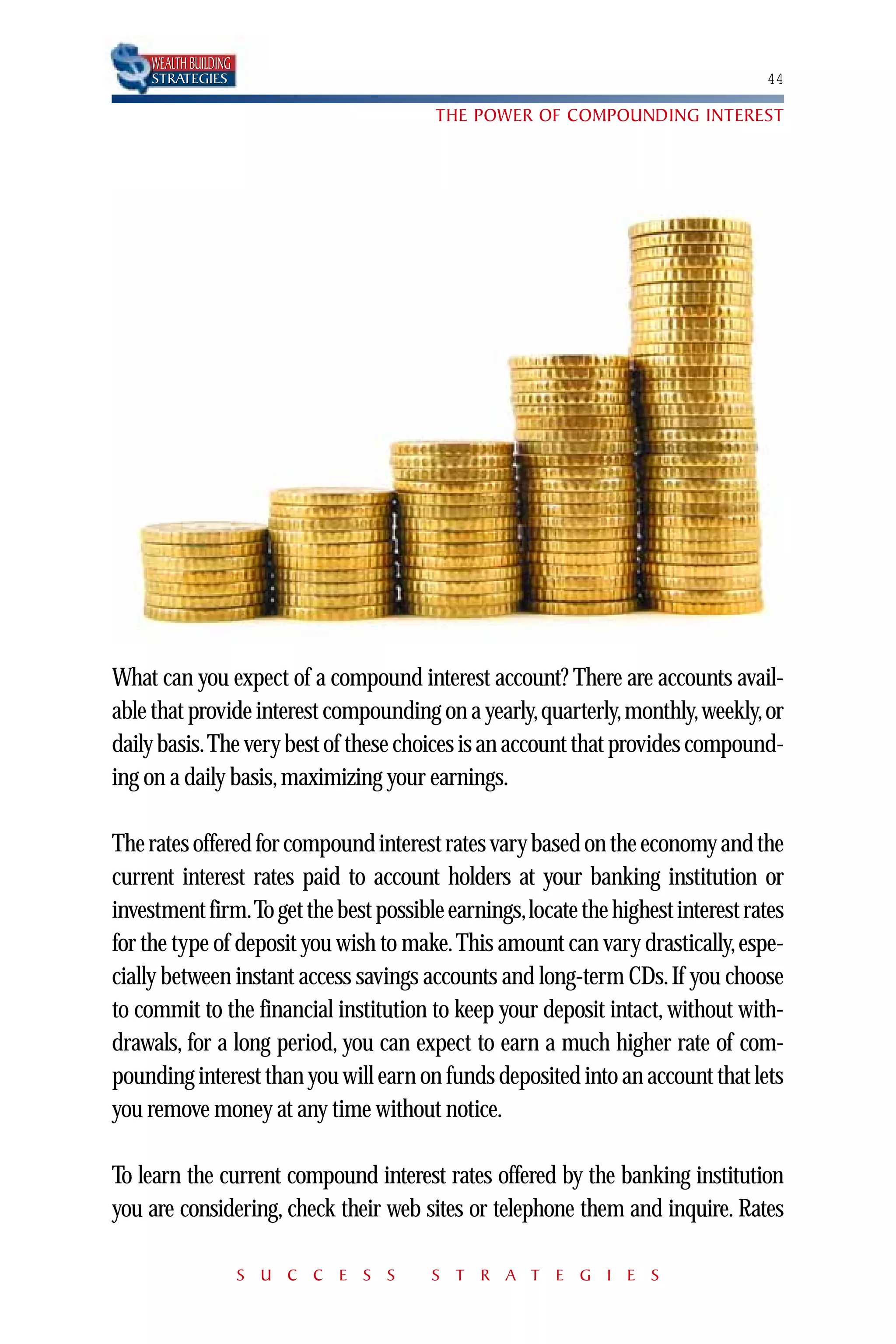
What can you expect of a compound interest account? There are accounts avail-
able that provide interest compounding on a yearly,quarterly,monthly,weekly,or
daily basis.The very best of these choices is an account that provides compound-
ing on a daily basis, maximizing your earnings.

The rates offered for compound interest rates vary based on the economy and the
current interest rates paid to account holders at your banking institution or
investment firm.To get the best possible earnings,locate the highest interest rates
for the type of deposit you wish to make. This amount can vary drastically, espe-
cially between instant access savings accounts and long-term CDs. If you choose
to commit to the financial institution to keep your deposit intact, without with-
drawals, for a long period, you can expect to earn a much higher rate of com-
pounding interest than you will earn on funds deposited into an account that lets
you remove money at any time without notice.

To learn the current compound interest rates offered by the banking institution
you are considering, check their web sites or telephone them and inquire. Rates

                      S U C C E S S    S T R A T E G I E S
WEALTH BUILDING
     STRATEGIES                                                                   45

                                        THE POWER OF COMPOUNDING INTEREST


can change quite quickly, so be certain that you know the exact compound inter-
est rates you will receive when you actually make deposits with your banking insti-
tution and also find out how often the rates are subject to change if you are not
choosing a fixed-rate vehicle such as a long-term, fixed-rate certificate of deposit.

A Closer Look at Compounding and How It Works
Let’s break it down into very simple terms.If you have $1,000 and are paid 10 per-
cent interest on that $1,000 compounding daily, then after a year you will have
earned $105.16. That’s $5.16 more than the $1,100 you would earn if the interest
compounded yearly.While this example is for a small amount to make it easy to
understand,you can easily see how if the interest is being compounded on a sum
of, let’s say, $100,000 each day, compound interest will really make your money
work for you.While the rate of interest shown is simply to make the example sim-
ple to follow, no matter what the current interest rate is on a compound interest
savings vehicle, your money will grow and grow.

Annual Percentage Yield (APY)
Annual percentage yield (APY) is a term used for the effective yield as a result of
compound interest. The formula for calculating APY is a bit tricky. But there are
many handy online calculators for checking APY such as the one at Bank of
Internet (http://www.bankofinternet.com/interest-calculator.aspx). You simply
need to understand that if you place funds into an account that pays 6 percent
interest but that interest is compounded daily, your APY will be 6.183 percent. In
other words, you will earn more than you expected due to compounding interest
making your annual percentage yield higher. This is part of the magic of com-
pounding interest rates.
INSURING
  YOUR
 FAMILY’S
 FUTURE
S U C C E S S   S T R A T E G I E S
WEALTH BUILDING
     STRATEGIES                                                                   47

                                                 INSURING YOUR FAMILY’S FUTURE


    nsurance is a topic that no one really likes to think about. However, it can be

I   a necessity for ensuring your financial future. There are many types of insur-
    ance that will be presented here. Insurance, as a rule of thumb, is not some-
thing that is used for covering moderate expenses or losses. If your loss is only a
small amount, perhaps a few hundred dollars, insurance for that loss can cost
more than the loss itself. However, large losses, natural disasters, loss of life or
productivity, and events that can truly impact the financial future of you or your
family are things you need to consider insuring against.No one wants to be forced
to spend all of their hard-earned savings in order to recover from a major loss.
Neither do they want to find themselves without the means of recovering from a
major loss.

No one likes to think of a time that you or your spouse will no longer be living.
However, it is a fact of life that people do pass on. Unfortunately, this passing can
occur before it is expected through accident or illness. This makes insurance a
basic of personal financial security and wealth. Your personal financial goal is
not only for you to live comfortably but also for your entire family to live comfort-
ably and securely. That means thinking of what could happen to surviving fami-
ly members if one or all of the major breadwinners were to pass away.

Every day people pass on due to medical conditions that can’t be predicted. Car
accidents and accidents in the home kill millions each year. Death due to crimes
occur whether we like to think of that or not.

While it is hoped that none of these things ever shortens your life or the life of
your spouse, you simply must think about that possible future. We cannot fore-
tell the future therefore, preparations are important.

What would happen to your family if you or your spouse suddenly passed? Would
the loss of one of the major breadwinners cause your family to lose the family res-
idence? Would they be forced to change their lives from a comfortable lifestyle to


                       S U C C E S S    S T R A T E G I E S
WEALTH BUILDING
     STRATEGIES                                                                   48

                                                 INSURING YOUR FAMILY’S FUTURE


a struggle to get enough food and clothing to survive? Would the children have no
means of attending college and beginning their adult lives with proper educa-
tion? Would the cost of basic health care cause your surviving family members to
sacrifice basic needs such as food or clothing?

But insurance isn’t only for death. There are medical and health care insurance
policies to protect you from expenses in these areas. There are home insurance
policies to cover your home, and there is auto insurance to cover your liability and
losses should you be involved in an auto accident.

Think about what you would do if your child experienced a catastrophic illness
and only expensive medical care, possibly costing hundreds of thousands of dol-
lars could potentially save him or her. Also, think about what would happen if
this type of illness happened to you or your spouse.Would you be able to afford
to care for you, your spouse, or your children properly?

Social Security Disability Insurance (SSDI) and Supplemental
Security Income (SSI)
What would happen if you or your spouse experienced a physical or mental dis-
ability that prevented either of you from working any longer? While there is Social
Security Disability Insurance (SSDI) for those who have worked long enough and
paid into the system, would the payments provide for the needs of your family?
The number of periods you need to have worked varies based on age,and it is not
simple to calculate this for yourself. It is much easier to obtain the facts from the
Social Security Administration.

For those people who have not worked enough to quality for social security dis-
ability insurance payments, there is another program called supplemental secu-
rity income (SSI). The exact facts and determination as to whether you would fit
into the SSDI or SSI programs can be learned by contacting your local Social
Security Administration office or contacting (http://www.ssa.gov).

                       S U C C E S S    S T R A T E G I E S
WEALTH BUILDING
    STRATEGIES                                                                  49

                                                INSURING YOUR FAMILY’S FUTURE


There is a significant waiting period (six months in most situations) before any
payments are made to you,and that waiting period is only begun after your claim
is approved by the Social Security Administration.The process of getting a claim
approved can require a very significant period of time in itself. It is not uncom-
mon for the claim processing to require a year, or even several years, and for the
applicant to experience being denied and having to appeal more than once.You
may require the assistance of an attorney in order to get your social security dis-
ability claim approved.

In most cases, SSDI payments will not provide for a really secure financial future
for your family. Take this into account when considering insurance policies.You
can easily learn an estimate of the amount of SSDI or SSI payments that would
be available to you in the event that you become disabled as well as those avail-
able when you retire by simply contacting your local social security office or vis-
iting their web site (http://www.ssa.gov) and filling out a simple form requesting
a printout of the information contained in your file.

A word of caution: with the current government financial situation regarding
social security, you must decide if you wish to count on payments in your retire-
ment years or should you become disabled. Here again, the decision is up to you
and your family.

A Note Regarding Required and Optional Insurance Coverages
Before we get into the facts about the various types of insurance available, it
should be noted that some insurance such as automobile and home owner’s
insurance may be required by the lender who provides financing for your
home or car. Also, some states require certain insurance to legally own and
operate a vehicle. This report is not intended to provide advice about what
types of policies to purchase. You must consult your own state’s agencies or
your lender to learn what is required rather than optional. However, we do
want to make you aware of the various types of insurance that can protect you

                      S U C C E S S    S T R A T E G I E S
WEALTH BUILDING
     STRATEGIES                                                                    50

                                                  INSURING YOUR FAMILY’S FUTURE


and allow you to choose what is right for you and your own personal financial
situation.

First, let’s look at types of insurance that can protect your family in the event of
untimely death or that can provide a financial investment if untimely death does
not occur to a covered family member. These types of coverage all fall under the
umbrella of life insurance even though some of them actually build cash value.

Types of Life Insurance
Life insurance is, quite simply, a type of insurance that pays benefits in the event
of untimely death.Some types also pay benefits in the event of loss of limbs,eye-
sight, and other similar losses involving body parts.

Life insurance can be purchased for adults and even children. In some cases, it
requires proof of insurability, which means that a physical examination proving
that no major existing health conditions likely to result in loss of life are present.
Other types of policies do not require this proof. Some types of policies will
insure those who use tobacco, but they are more costly than for the nonsmoker
due to the proven increased health risks to tobacco users.

Term Life Insurance
Term life insurance is the least costly type of insurance and covers the insured for
a specific period of time. It builds no cash value, so if the insured does not pass
away during the term of the insurance,there is no recovery of the premiums paid.
It provides a flat benefit amount to the named beneficiary should the insured die.
Term life insurance may, in some cases, also pay a benefit in the event of loss of
limbs,eyesight,or other physical loss,but you must read and understand the pol-
icy to learn if this applies to the policy you are considering.The commonly avail-
able term periods are ten, twenty, and thirty years, but other terms may be avail-
able. The premiums remain the same for the entire life of the policy. Should an
insured wish to purchase term life insurance after the term policy has expired,

                       S U C C E S S    S T R A T E G I E S
WEALTH BUILDING
    STRATEGIES                                                                    51

                                                 INSURING YOUR FAMILY’S FUTURE


the cost will certainly be greater due to the increased age and increased likelihood
of death during the term. There are some term life insurance policies that allow
them to be converted to whole life or universal life insurance policies. These will
be explained later in this section of this report.

Term life insurance is the simplest form of life insurance to understand.Basically,
if you purchase a term life insurance policy for twenty years with death benefits
of one hundred thousand dollars, you will pay a monthly premium each month
for the life of the policy. Should the person insured die during the term, a flat,
one-time payment will be paid to the named beneficiary equal to the amount of
coverage, in this case one hundred thousand dollars. The beneficiary is then at
liberty to use the funds as they wish, ideally to invest into investments that will
help them replace the lost earnings of the insured. The funds can also be used to
pay final expenses such as funeral costs.

Term life insurance can be practical for several reasons:
          1. Term life insurance can be very practical for expenses that will go away
             in the future. For example, if your home mortgage payments last for
             another twenty years, covering the life of the major breadwinner for
             that term and at least the amount of the mortgage and other debts to
             help ensure that the family will be able to pay off these obligations in
             the event of the death of the breadwinner. During the years that chil-
             dren must be financially supported by their parents,this type of insur-
             ance can help provide the surviving parent with the means to raise the
             children to the age they can support themselves, and the amount of
             insurance should reflect the anticipated needs that only you can decide
             if you choose this as your major type of life insurance coverage.
          2. Higher coverage amounts can be obtained with term life insurance
             than with whole or universal life insurance for lower premiums due to
             the fact that no cash value is built with this type of policy.


                      S U C C E S S     S T R A T E G I E S
WEALTH BUILDING
    STRATEGIES                                                                    52

                                                 INSURING YOUR FAMILY’S FUTURE


          3.The benefits of a term life insurance policy are usually income tax free
            (consult your accountant or financial advisor for the most current
            information).
          4. Depending on your term life insurance policy, conversion to whole or
             universal life can be an option.
          5. Benefits are paid to the person or persons named as beneficiaries in
             the term life insurance policy. Therefore, one term life policy could
             name a child as a beneficiary to provide for college while another pol-
             icy benefits go to the spouse to cover the cost of the mortgage and loss
             of the income of the deceased spouse.
          6. Beneficiaries can be changed easily should your situation require a
             change in who receives the death benefits upon your death,should the
             event occur during the period your life is insured by the term life pol-
             icy. These types of changes can be driven by marriage, divorce, wid-
             owhood, children growing up, additional children being born, and
             many other reasons. It is usually as simple as submitting the proper
             form to the insurance company to alter the death benefit payouts to
             meet your changing needs.


Disadvantages to consider about term life insurance:
          1.There is no cash value built by this type of policy. This type of insur-
            ance coverage only pays the beneficiary a flat sum based on the
            insurance amount no matter how long you have paid premiums on
            the policy.
          2. Employers often provide a level of term insurance for their employ-
             ees—so you may be duplicating what you already have. However,
             should you change employers, that situation might change.
          3. It can be difficult to determine the amount of term life insurance to
             carry to meet your family’s needs due to inflation and the general

                      S U C C E S S     S T R A T E G I E S
WEALTH BUILDING
    STRATEGIES                                                                 53

                                                INSURING YOUR FAMILY’S FUTURE


              economy as well as whether or not your spouse will work or be unable
              to continue working should you pass away.


Whole Life Insurance
Whole life insurance, unlike term life insurance, covers an insured person for
their whole life from the point of purchase to the point of their death or, in
most cases, until age one hundred, whichever comes first, as long as the pre-
mium payments are submitted on a timely basis. It is a form of permanent
insurance. There are, in actuality, several sub-types of whole life insurance
that will be discussed, but first we need to understand fully the basic concepts
of whole life insurance before going into the details of sub-varieties of whole
life insurance.

One of the great differences between whole life insurance and term life insur-
ance is that a whole life insurance policy actually builds cash value over time.
This means that if you choose, after years of paying premiums, to access the
cash value of your policy, you can surrender all the benefits or a part of the
benefits based on your cash withdrawal and get a portion of the premiums you
have paid back. You can even take out loans against the cash value of your
whole life insurance policy.

You should realize that in no case will the cash value of a whole life insurance
policy equal the benefit amount, nor will the cash value necessarily be equal to
all the premium payments which have been paid.In some cases,the cash value
will be equal to the premiums paid plus interest earned. As the investments
earned change, in many cases the interest rate earned on those policies that
offer interest earnings may fluctuate while some may have a minimum guar-
antee stated in the initial policy.

The cash value is based on the fact that the insurance company held and invest-
ed the money they received as premiums and are offering a portion of this back

                      S U C C E S S     S T R A T E G I E S
WEALTH BUILDING
    STRATEGIES                                                                      54

                                                   INSURING YOUR FAMILY’S FUTURE


to the policy owner in exchange for the benefits that would be paid at the time of
death of the insured.

This concept is explained best by Life Insurance Quote (http://www.lifeinsur
ancequote.com/universal_ compared_to_whole_life_web_article.htm). At this
web site,they explain that there are four parts of whole and universal life policies
(universal life will be covered later in this report). The following is quoted from
the above named web source:

          ●   Mortality cost - the part of the deposit that covers the pure cost of the
              life insurance death benefit. We recommend that this cost of insur-
              ance be level or the same over the insured’s lifetime.

          ● Administration charge - This is the charge for administering the
              policy and premium tax.

          ●   Savings or investment - This is what is left from your deposit after
              the above two charges—the cost of insurance and the administration
              charge—are deducted.You will have been provided with an illustra-
              tion of how your savings will grow. It is frequently referred to as the
              cash value, fund value, or cash surrender value of your policy.

          ●   Return on the savings - This is the interest rate that is credited to the
              cash value in your account each year.

          ●   In addition, some policies guarantee that the above costs will not
              change and a minimum return on investments.

As you can see from the above excerpt, the insurance provider must use a
portion of the premium paid to cover the cost of the payouts required when a
covered insured within their many whole life or universal life insurance poli-


                      S U C C E S S       S T R A T E G I E S
WEALTH BUILDING
    STRATEGIES                                                                 55

                                               INSURING YOUR FAMILY’S FUTURE


cies dies and benefits must be paid. A charge for the accounting, administra-
tion, and other overhead costs of providing insurance coverage as well as
taxes must be covered by the cost of premiums paid by insured policyhold-
ers. The remainder of the premiums is used to cover the cash value of poli-
cies, and the return on investment (ROI) allows the insurance company to
add interest to policyholder’s money when they ask for a cash value with-
drawal. Of course, all the costs named above will not be revealed to policy-
holders, but the general idea is that you can build up cash value and possi-
bly even some interest on this type of life insurance while covering your
family against the impact of the loss of the insured in the event of untimely
death.

The charge noted as mortality cost is a factor that increases as the person
insured by the whole life policy ages. This is simply because of the fact that
the older a person gets, the more likely they are to pass away. Also, the cash
value of the policy, in many cases, can fluctuate greatly based on the stock
market and other investments in which the funds from premiums have been
invested.

The great benefit with whole life insurance is the fact that should the insured
pass away, a benefit equal to the policy benefit amount is paid to the named sur-
viving beneficiaries, just as with term life insurance. Also, when purchased at a
young age,the cost of the insurance is relatively low and does not increase as the
person ages.

You can expect to be required to prove that you are in good health by submitting
to a physical by a doctor chosen by the insurance company or by releasing med-
ical information from your own doctor. However, once you are approved for
insurance, you will not be canceled due to changing health conditions.
Whole life insurance can be practical because:


                      S U C C E S S    S T R A T E G I E S
WEALTH BUILDING
STRATEGIES                                                                       56

                                               INSURING YOUR FAMILY’S FUTURE


      1. The policy builds cash value that can be withdrawn in exchange for
         some or all of the death benefits, and loans can be taken out against
         the cash value of the policy to meet expenses without extracting funds
         from more lucrative investments.
      2. When purchased early in life, the cost is affordable even though it
         always costs more than term life insurance.
      3. The policy covers the insured as long as premiums are paid on time for life
         or until age one hundred (in most cases), whichever comes first or until
         the full cash value is withdrawn from the policy,thereby canceling it.
      4. The whole life insurance benefits can be used in any way needed such
         as paying off a mortgage, providing college education, or other needs
         of the surviving family members. The death benefits are paid to one
         or more named beneficiary or even to trust funds.
      5. The payments made for this type of insurance can act as a good
         investment for people who do not have any interest in learning about
         investments.
      6. The amount of death benefits will not change as the insured person ages
         and payments do not go up as the person ages or their health changes
         as long as the premiums are paid on time and the insurance is kept in
         effect.
      7. Under current laws, the benefits paid upon death of the insured are
         usually not subject to income tax on the part of the beneficiary.
         However, this should be verified with your financial advisor because
         legislation changes and your specific situation may vary sufficiently to
         impact this point.
      8. You are guaranteed a cash value on your whole life insurance policy
         regardless of stock market changes or changes in the commonly
         offered interest rates on savings accounts. Should the stock market go
         down greatly, your cash value is guaranteed at a certain limit.

                  S U C C E S S       S T R A T E G I E S
WEALTH BUILDING
    STRATEGIES                                                                    57

                                                 INSURING YOUR FAMILY’S FUTURE


          9. It is simple and easy to change the benefit beneficiaries should you
             wish to change who receives the payment of benefits upon your death
             or if you wish to alter the percentages of benefits paid to various ben-
             eficiaries.This can be very helpful should another child be born, or to
             change the benefits when a child reaches adulthood and no longer
             requires benefits to ensure they have funds to obtain their college edu-
             cation., or for any of a multitude of other reasons including marriage,
             divorce, or your spouse passing away.
         10.Should you be in a financial position that you know you will leave
            your spouse in a position that,upon your death,there will be unavoid-
            able estate taxes which are this insurance can serve as a means of
            ensuring your spouse can pay these expenses or pay capital gains tax
            if the spouse chooses to sell the large family home and move without
            making a qualified purchase of a new home within the required peri-
            od of time. These points, however, require that you seek advice from
            your financial counsel or tax accountant.


Disadvantages to consider about whole life insurance:
          1. While the premiums paid into the insurance company for whole life
             insurance are invested, you do not have any input as to what type of
             investments or where the funds are invested. The decisions are made
             by the insurance company alone.
          2. It can be difficult or impossible to purchase additional whole life
             insurance later in life or if your health deteriorates.
          3. Certain causes of death may not be covered by the whole life insurance
             policy in certain situations, and you must be certain that you fully
             understand the terms of the policy you are purchasing.
          4. While there is a cash value built on whole life insurance policies, the
             return on the investments may be much lower than if the same amount

                      S U C C E S S     S T R A T E G I E S
WEALTH BUILDING
    STRATEGIES                                                                    58

                                                  INSURING YOUR FAMILY’S FUTURE


              of money were invested into other investment vehicles or funds. If the
              stock market soars or interest rates on other investment vehicles soar,
              your whole life insurance policy may continue to build cash value at a
              limited maximum rate stated when purchasing the policy.
          5. If you decide, some time a few years or many years after purchasing
             your whole life insurance policy, that you want a different level or
             amount of coverage,the new insurance policy purchase is treated as if
             you do not already carry any insurance with that insurance provider
             or any other insurance provider. Physical proof of insurability will be
             required and premiums will be more costly because of the purchase
             as a later age. There are no provisions to convert the insurance to
             another type of insurance. However, some insurance providers may
             offer some options so you must research your specific insurance com-
             pany to learn exactly what your options might be should you wish to
             increase or change your coverage.
          6. This type of insurance may be offered through your employer or your
             spouses’employer.However,you may or may not be able to convert the
             employer-provided policy to continue coverage should you voluntari-
             ly change employers or when you retire.
Whole life insurance is great as a means of insuring that your spouse is able to
raise your children and provide for their education should your death occur
during the child rearing years. It can also provide a legacy for your children
and grandchildren should you live a lengthy life and your spouse proceed you
in death.

Universal Life Insurance
Universal life insurance is one of the newer types of insurance and,like whole life
insurance, is a permanent form of insurance in that it covers the named insured
as long as the policy is carried in force and the premiums are paid on a timely
basis. It also builds cash value. However, unlike whole life insurance, the benefit

                      S U C C E S S      S T R A T E G I E S
WEALTH BUILDING
    STRATEGIES                                                                   59

                                                 INSURING YOUR FAMILY’S FUTURE


amount can be adjusted, allowing you much more control over the amount of
premium you must pay each month.

In addition, universal life insurance allows you to determine the portion of each
payment that will be used for death benefits and how much of each payment will
be used for your plan’s investments. Universal life frequently returns significant-
ly higher investment yields, increasing the cash value sometimes so much that
the increases will even pay the premiums.

This type of life insurance has a predetermined, set minimum rate of return on
investment that is stated in the insurance policy. Each year, you will be provided
with an annual report showing the current cash value of your insurance policy
and other pertinent information about the insurance policy, much like a state-
ment from any other type of investment.

Universal life insurance is a much more flexible type of insurance than whole life.
As the insured ages and their financial needs change, perhaps due to children
reaching maturity or mortgages being paid in full, the insurance policy can be
adjusted to pay a lower death benefit, lowering the monthly premium significant-
ly without the problem of proving insurability.

This type of insurance allows the insured to select one or more beneficiaries to
receive the death benefits, and the beneficiaries can be changed at any time easi-
ly by completing and submitting a form.

Universal life insurance can be practical because:
          1. You can adjust the benefits paid to the beneficiaries as insurance cov-
             erage needs change.
          2. If necessary, you can borrow money against the cash value, and the
             loan funds are usually nontaxable.


                      S U C C E S S     S T R A T E G I E S
WEALTH BUILDING
    STRATEGIES                                                                  60

                                                INSURING YOUR FAMILY’S FUTURE


          3. Because you can change the amount of coverage, you can also control
             the amount of the monthly premiums to a greater extent than with
             other types of insurance.
          4. The death benefits paid to the beneficiaries upon the passing of the
             named insured may not be subject to income tax in many situations.
             Of course, you must seek the advice of your accountant or tax advisor
             to determine if this applies to your situation.
          5. Your premiums invested in this type of insurance will return at least
             a minimum stated rate per the insurance policy and,if the funds earn
             more,the return can be significantly greater than the stated minimum
             return.


Disadvantages to consider about universal life insurance:
          1. The return on the money invested in this type of insurance could be
             only the minimum defined in the policy if the insurance carrier does
             not invest wisely.You do not control how or where the money will be
             invested, only the amount that will be invested.
          2. Your monthly premiums can change over time based on the returns
             on invested premiums making it uncertain exactly how much you
             may have to pay to keep the same amount of insurance coverage in
             future years.
          3. Some universal life insurance policies guarantee a specific rate of
             return only for a defined period, and you must know and understand
             how long the return rates are guaranteed and how they will change
             once the guarantee period has expired.
          4. Not all universal life insurance investment return rates are calculat-
             ed the same way, and you must understand how your policy’s returns
             are calculated and how this may impact the value of your policy.


                      S U C C E S S     S T R A T E G I E S
WEALTH BUILDING
     STRATEGIES                                                                   61

                                                 INSURING YOUR FAMILY’S FUTURE


Variable Life Insurance
Variable life insurance, like whole life insurance, is a permanent type of insur-
ance protection.However,the amount of benefits paid should the named insured
pass away varies with variable life insurance based on the return on the invest-
ments the insurance company has made with your premium payments.While it
is a bit more risky than term life insurance, whole life insurance, or universal life
insurance,it does offer a reasonably low-risk means of accumulating money that
may be income tax free, depending on your situation, should you choose to
remove cash from the cash value of the policy or when death benefits are paid to
a named beneficiary.

Unlike the previously discussed types of life insurance, variable life insurance
allows you to determine into which investment funds your premium payments
will be invested. These choices usually include fixed income investments,stocks,
bonds,money market funds,or similar secure investments. You can change your
choices of where your premium funds are invested at time periods and frequen-
cy determined by the specific terms of your insurance policy. Some allow you to
change investment funds only twice each year while other policies may allow you
to change investment funds as many as six times per year.

Because you have control over the investments made with this type of life
insurance, many people feel much more empowered when purchasing this life
insurance. However, because there is no guaranteed return on your investment,
the choices you make on the investments could result in the return going up or
down, causing the cash value of the insurance to vary up or down. Due to the
fact that you, the insured, determine where the money paid to the insurance
company is invested, this form of life insurance is legally considered a security
and laws controlling securities apply to the insurance. For example, by law a
prospectus must be provided by the insurance company offering the insurance
to any potential buyer.


                       S U C C E S S    S T R A T E G I E S
WEALTH BUILDING
    STRATEGIES                                                                   62

                                                INSURING YOUR FAMILY’S FUTURE


The death benefit paid on variable life insurance is, however, an amount which
cannot fall below the benefit you purchased. It can, however, increase based on
the return on investment.

Since you choose where the funds paid as premiums on your variable life insur-
ance policy are to be invested, this form of insurance is legally considered to be a
security and is governed by the laws which apply to securities. This means that
the company offering this type of life insurance must provide a prospectus which
include facts about the company offering the security and about the security
itself, in this case the life insurance policy.

The cash value of variable life insurance, under current regulations, is not
impacted by income tax until the cash value of the policy is cashed in. The
income tax impacts when death benefits are paid by this type of insurance poli-
cy should be determined by your financial advisor or tax advisor.

Variable life insurance can be practical because:
          1. It is an easy way to build reasonably low-risk,income tax–free invest-
             ment savings and can be great for people who are leery of“playing the
             stock market.”
          2. You can borrow against the cash value of the insurance policy in the
             event of an emergency requiring access to funds, without canceling
             the insurance.
          3. Because the money from premiums is invested, the cash value of the
             policy and the death benefits from the policy can be greater than
             expected due to high returns on investments.
          4. The policyholder has control over what types of investments the
             money from their premiums is invested into and therefore can enjoy
             a sense of control over their money.


                      S U C C E S S     S T R A T E G I E S
WEALTH BUILDING
    STRATEGIES                                                                    63

                                                 INSURING YOUR FAMILY’S FUTURE


Disadvantages to consider about variable life insurance:
          1. Because variable life insurance is a security or investment, there is no
             guarantee how much, if any, the death benefit will be above the
             amount guaranteed when the policy is purchased.
          2. There are no guarantees as to what the cash value of the variable life
             insurance policy may be because the value changes based on the
             investments and can go either up or down.
          3. Since it is the responsibility of the policyholder to choose the invest-
             ment types into which funds are placed, a policyholder who doesn’t
             remain current on economic trends may make poor choices, impact-
             ing the ultimate cash value of their policy.
Variable Universal Life Insurance
For some, this type of insurance can be the best of both worlds. It is permanent
life insurance, having all the attributes of universal life but because the insur-
ance provider invests the funds, based on your directions, into various types of
investments,the cash value and the death benefit is likely to increase significant-
ly if the investments provide a good rate of return. Of course, the investments
could perform poorly resulting in a decrease in cash value and death benefits
only of the minimum provided by the insurance policy.The value of the variable
universal life insurance is taxable only when funds are removed from the policy.
The death benefits may or may not be subject to income tax and only your per-
sonal financial counselor or tax consultant can advise you about your specific
situation in this area.

Variable universal life insurance can be practical if:
          1. You want to have the benefits of universal life insurance such as the
             ability to adjust the benefits as coverage needs change and the control
             over the amount of premiums combined with the benefits of variable
             life insurance such as the control over investments.

                      S U C C E S S     S T R A T E G I E S
WEALTH BUILDING
    STRATEGIES                                                                    64

                                                 INSURING YOUR FAMILY’S FUTURE


Disadvantages to consider about variable universal life insurance:
          1. Because the cash value of the policy is in investment vehicles chosen
             by the insured, the cash value and in some cases the death benefits
             can go down as well as increase.
          2. If too much money is borrowed against a variable universal life insur-
             ance policy’s cash value, and the investments supporting the value of
             the policy go down, it is possible for the insurance policy to collapse,
             resulting in no death benefit protection for your beneficiaries.


Return of Premium Life Insurance
This type of life insurance is also called return of premium term life insurance.It
is the most recently introduced form of life insurance and that not only provides
death benefit protection for your family but also has a feature for the return of
premiums. Because many people object to paying for life insurance, thinking
their family will most likely not need the funds paid by the death benefit during
the period they are really needed, this type of insurance removes that objection
since the premiums will be returned.

Return of premium life insurance is basically purchased with the intention of
keeping the policy in effect for fifteen,twenty,or thirty years.If the premiums are
paid on a timely basis and the death benefits are not used during the term of the
insurance, the insurance company returns the actual amount of premiums paid
into the policy.

In some cases,there are policies that provide for partial return of premiums if the
policy is canceled prior to the term expiration. However, this type of policy does
not build any cash value. The only amount that will be returned if death benefits
do not have to be paid because of the untimely passing of the named insured is
equal to the actual amount of premiums submitted.


                      S U C C E S S     S T R A T E G I E S
WEALTH BUILDING
    STRATEGIES                                                                      65

                                                  INSURING YOUR FAMILY’S FUTURE


Because you are getting back only money you paid into the insurance, the
funds returned as the return of premium are normally not subject to income
tax. However, always consult with your personal tax advisor regarding these
matters.

Return of premium life insurance can be practical only:
          1. If the head of household, considered here the major breadwinner in
             the family, absolutely refuses to carry any other type of life insurance.
          2. If you are not seeking to use life insurance as a vehicle to create wealth
             but only to cover some major expenses that might be left in the event
             of the death of one of the persons in the household who earns money
             to pay the bills, mortgage, and other expenses.


Disadvantages of return of premium life insurance to consider:
          1. The same value of insurance could be purchased with a type of life
             insurance that builds cash value and potentially returns more than
             just the premiums paid.
          2. Because this is a form of term insurance, if the named insured were
             to pass away just one day past the term of the policy, there would be
             no death benefits, unlike permanent life insurance types which pay
             death benefits as long as the insurance is in effect, usually up to age
             one hundred.
          3. The increase in investments generated by the insurance company
             using premiums to invest in order to create profit provides no benefit
             to you, the policyholder.
          4. There are many types of life insurance to select from which these
             have much greater benefits than the return of premium life
             insurance.


                      S U C C E S S      S T R A T E G I E S
WEALTH BUILDING
     STRATEGIES                                                                     66

                                                  INSURING YOUR FAMILY’S FUTURE


How Much Life Insurance Should You Carry?
The question of how much life insurance you should carry is quite important
and the answer may vary at different times in your life. You must look at the
big picture that includes your family’s financial needs per year, surviving
spouse’s earnings and ability to continue earning, and many other factors to
determine exactly what is the right amount of life insurance for you to carry
as well as how much to carry on other members of the family.

Because there are investment vehicles that can provide higher rates of return on
your money, it isn't necessarily wise to carry excessive amounts of life insurance
just because the policy builds cash value. It also isn’t wise to carry too little life
insurance either.

ReliaQuote (http://www.reliaquote.com/termlife/cgi-bin/needs_analysis.asp?sour-
ceid=00000000000000000001&App=) provides a handy needs analysis tool that
can help you estimate a proper amount of life insurance. There are many other
online tools for estimating your life insurance needs and the amounts of life
insurance you should carry on yourself and the members of your family.

You will probably also want to discuss decisions about the amounts and types of
life insurance you should carry on yourself and your family members with your
financial advisor, accountant, or other objective professional. You may want to
discuss types of insurance with your insurance agent, but your insurance agent
cannot provide a truly unbiased estimate of your insurance needs because they
have a vested interest in selling larger amounts of life insurance. It is wise to get
advice from truly objective advisors before making decisions on life insurance
purchases.It can also be wise to review your life insurance amounts and compare
that to current needs periodically, especially at major milestones such as when
children are born,when children leave home,when the home mortgage is paid in
full, when term life insurance policies mature, and at least once every five years
or so even if no major life changes have occurred. The logic behind this is that

                       S U C C E S S     S T R A T E G I E S
WEALTH BUILDING
    STRATEGIES                                                                  67

                                                INSURING YOUR FAMILY’S FUTURE


your life insurance requirements at age thirty may be much different than what
you need at age forty-five or age sixty.

Homeowners Insurance
Another form of insurance coverage that will help ensure your personal finan-
cial security and that of your family is specifically for those people who own or
are purchasing their own homes. Homeowners insurance covers losses of vari-
ous types, depending on the specific type of policy involving insurance against
losses to the home. In this section, we will look at the various types of home-
owners insurance coverage available to the home owner to ensure their home
against loss.

Standard Homeowners Insurance
Standard homeowners insurance is designed to cover the home owner for the
most common types of loss which, depending on the specific insurance policy,
include but may not be limited to:

          1. Liability, up to the limit amounts purchased, incurred because
             someone is injured on or inside your property due to negligence on
             your or your family’s part. This part of your homeowners policy
             may, with some policies, cover you and your family members if they
             are hurt on someone else’s property due to you or the family mem-
             ber’s negligence.
          2. Theft of property from your personal property
          3. Losses due to fire, windstorm, hail, smoke damage, vandalism, or
             other specified losses causing damage to your property or loss of pos-
             sessions on your premises
          4. These policies usually cover the contents of your home against loss,
             liability, and other hazards up to certain specified limits.


                      S U C C E S S     S T R A T E G I E S
WEALTH BUILDING
    STRATEGIES                                                                  68

                                                INSURING YOUR FAMILY’S FUTURE


It is very important to insure your home against loss. It is also a requirement of
virtually every mortgage lender that you carry homeowners insurance against
loss to the property into which that lender has invested funds that you are repay-
ing through your mortgage payments. The reason for this is to protect the mort-
gage holder’s interest in the property so that their investment will not be a total
loss should something happen to the property.

Even if your home is paid for and you’ve “burned the mortgage” already, home-
owners insurance is still an important protection for you and your family and
their financial future. If someone who is not a family member who resides in the
home becomes injured or dies as a result of something which happened on your
property,especially if the root causes was negligence on the part of you or a fam-
ily member, you could potentially be sued and lose your assets, including your
home.

Even if your home is paid for and you have assets that would allow you to pur-
chase another home, should fire, wind or hail storm, smoke damage, or another
covered loss occur, the homeowners insurance would pay you funds to prevent
you being forced to reduce you assets significantly in order to keep providing a
roof over your and your family’s heads.

The premiums for homeowners insurance are really quite low compared to the
amount of money that may be paid by that insurance coverage in the event of a
significant or total loss of the home. This insurance is one of the most important
types of insurance coverage you can possibly carry, because it ensures your fam-
ily will have a place to live should a horrible event occur,causing your home to be
destroyed or severely damaged.

While exact numbers of insurance claims each year due to fire, windstorm, hail-
storm, smoke damage, vandalism, theft, and covered liabilities are difficult to
determine and are not readily available to the general public, you can be certain


                      S U C C E S S    S T R A T E G I E S
WEALTH BUILDING
    STRATEGIES                                                                   69

                                                INSURING YOUR FAMILY’S FUTURE


that during the period that a family lives in their home, it is not unlikely that
some type of covered loss will occur, although the loss may be minor rather than
causing a total loss of the home. You can also be certain that each year many
homes are destroyed completely due to covered losses.According to the U.S.Army
(www.usaac.army.mil/accw/div/safety/Off-Duty_Acc_Fire_%20Prevent
/Fire/Home%20Fire%20Prevention.ppt) there are, on average, about 59,100
reported home fires each year in America caused by heating equipment alone,
91,700 associated with cooking, and 38,400 per year based on electrical fires. So,
you can easily see that fire loss alone is a huge risk. Fire is just one of the many
loss risks covered by the homeowners insurance coverage.

Many, if not most, basic homeowners insurance policies cover temporary
housing during a period when the home cannot be lived in safely. Depending
on the type of homeowners insurance policy you purchase, the losses may be


                      S U C C E S S    S T R A T E G I E S
WEALTH BUILDING
    STRATEGIES                                                                   70

                                                INSURING YOUR FAMILY’S FUTURE


replaced based on fair market value, cost of replacement value, or the
appraised value as in the case of special riders for collections, antiques, and
other unusual contents.

When purchasing homeowners insurance, it is wise to compare policies that
offer cost of replacement value rather than policies that offer only fair market
value. Fair market value is the value if that exact item were offered on the mar-
ket today. This means that a shirt that you have worn is probably valued using
fair market value at about one dollar to five dollars, not the thirty dollars to one
hundred dollars or more you paid for it. It also means that the leather sofa in
your living room would be valued at the three hundred dollars or so that you
could market it as a used item rather than the two thousand dollars or more you
paid when you originally purchased the sofa.

Why should you consider replacement cost homeowners insurance? The reasons
are two-fold. First, contents when valued at fair market value are not worth near-
ly the cost required to replace the items at the time of the loss.Also, many items
increase in cost due to inflation so, even if you were being paid the original pur-
chase price, you might not be able to replace the items lost. For example, look at
an average pair of shoes. A matter of only a few years ago, a good pair of shoes
might have cost $29.99 to purchase, but that same pair of shoes, if purchased
today, might cost $69.95 or more due to economic changes such as inflation. A
bedroom suite you bought 10 years ago might have cost only $1,000 but to pur-
chase a bedroom suite of like quality today could potentially cost you $3,000. You
want to purchase insurance that will allow you to replace the items that have been
lost in the event of a catastrophe with “like items,” meaning that you want to be
able to purchase items of the same quality as you have enjoyed before the loss.

It should be noted that some homeowners replacement cost insurance policies
carry certain limitations as to the cost that will be repaid the event the home is
lost. Some policies may state that no more than, for example, 125 percent of the


                      S U C C E S S    S T R A T E G I E S
WEALTH BUILDING
    STRATEGIES                                                                71

                                               INSURING YOUR FAMILY’S FUTURE


original purchase price of the home will be repaid on the replacement cost
insurance policy, however, the cost of rebuilding the same home may have
increased 150 percent or 200 percent. These types of limitations have been put
into place and sanctioned by some state government insurance commissioners
in order to control the ever-rising costs of homeowners insurance and permit
the insurance underwriters to insure homes while still making a profit.Be care-
ful and read the entire home owners insurance policy provisions before pur-
chasing any policy.Ask questions about anything you do not understand.

Another area that has changed in recent years in regard to homeowners insur-
ance protection is known as the “hurricane deductible.” While windstorms
and hailstorms are covered by most standard home owners insurance
policies, hurricanes and devastating tropical weather systems may not be
covered in the same way. According to the Real Estate Journal
 http://www.realestatejournal.com/
(http://www.realestatejournal.com/),“One trend is a ‘hurricane deductible’ that
requires owners to pay a much bigger share of any hurricane-related damage
than they would, say, after a fire. Some policies even set deductibles as a per-
centage of a property’s insured value, which means homeowners will be on the
hook for much more than a fixed-dollar deductible if disaster hits. What is
more, homeowners are facing a greater number of exclusions from hurricane-
related damage, such as mold and fungus damage.” Please see the section on
hurricane insurance for more information on this type of homeowners insur-
ance coverage.

In a standard homeowners insurance policy, jewelry and other especially
valuable items may have coverage limits of one or two thousand dollars.
According to the Federal Citizens Information Center (FCIC)
(http://www.pueblo.gsa.gov/cic_text/housing/covered/covered.htm)
(http://www.pueblo.gsa.gov/cic_text/housing/covered/covered.htm), “You
may wish to add a rider to your policy to cover specific pieces of jewelry and
other expensive possessions such as paintings, electronic equipment, stamp
collections or silverware, for example. The rider will provide both higher limits


                      S U C C E S S   S T R A T E G I E S
WEALTH BUILDING
    STRATEGIES                                                                 72

                                               INSURING YOUR FAMILY’S FUTURE


and protect you from additional risks, not covered in your normal policy.”
Scheduled personal property loss insurance is a sub-form of homeowners
insurance that is incorporated into some homeowners insurance policies when
a home owner or family member owns certain items that are of significant
value such as jewelry, paintings, collections, antiques, furs, or other items that
can be costly to replace. Even expensive camera or video equipment may fall
into this category. Your insurance agent can help you determine if you own
items that must be placed under this type of coverage and how to get the insur-
ance rider or floater to cover those items against loss.

Many mortgage lenders incorporate the cost of homeowners insurance cover-
age into the mortgage payments.If this is the case with your home loan,be sure
what type of coverage is included.

Homeowners insurance is not a place to try to save a few dollars. The cost of a
policy that will repay any losses at replacement cost will cause you to pay only
slightly more than a less effective coverage. When providing for your family’s
housing needs,saving a few dollars per year is not necessarily a wise move,even
though it is quite easy to tell yourself,“A loss will not happen to me that hap-
pens only to other people.” A loss, either catastrophic or minor but costly, can
happen to you and your family.

It is important to know what is contained in your home and outside your home
in order to process any home insurance claims that might be required in the
event of a loss.At the back of this report, you will find a home inventory work-
sheet to help you record exactly what your home contents are and keep track of
any changes to these items.

Flood Insurance
In your standard homeowners insurance policy coverage provisions, losses due
to water damage caused by rising water are probably not covered. This includes

                      S U C C E S S    S T R A T E G I E S
WEALTH BUILDING
    STRATEGIES                                                                 73

                                               INSURING YOUR FAMILY’S FUTURE


rising water from a source outside your home such as a river or flash flood or
water damage resulting from water rising caused by a source inside your home
such as a broken pipe.

Wind damage and hailstorm damage is normally covered by standard home-
owners insurance policies, however, a storm capable of producing these types
of hazards can result in abnormal rainfall amounts sufficient to cause your
home to flood. However, your standard homeowners insurance policy cover-
age probably does not cover the losses caused by such an event. Rising water
can happen to anyone, so seriously consider carrying this type of homeown-
ers protection.

Referring to flood hazards and flood insurance for home owners, Insure.com
(http://info.insure.com/flood-insurance/buying-flood-insurance.htm) quoted
in a recent article on their web site,“It could pay you to buy flood insurance,and
here’s evidence. ‘Flooding is far and away the most common natural disaster
type in the country,and flood is not covered by your typical homeowners insur-
ance policy,’ explains Mark Stevens, public affairs officer for the National Flood
Insurance Program (NFIP).”

Insure.com goes on to add in their article on flood insurance for homeown-
ers, “Flood insurance could be perceived as a solid hedge against the prospect
of you suffering a huge financial setback stemming from flood-caused dam-
age to your property. NFIP coverage can protect your house, business and
possessions.”

It can often be very difficult to determine what the root cause of a property loss
may have been in the case of losses due to unexpected storms or severe weath-
er systems exactly. For example, if the roof is damaged on one portion of the
home and that damage is clearly due to wind rising during a storm but flood-
ing occurred in an area far away from that roof damage, the question may arise


                      S U C C E S S    S T R A T E G I E S
WEALTH BUILDING
    STRATEGIES                                                                  74

                                                INSURING YOUR FAMILY’S FUTURE


as to whether the water damage to your home property and its contents result-
ed from a covered risk such as windstorm or a non-covered risk of flooding.
Much time, stress, and potential heartbreak can be prevented by simply carry-
ing both types of insurance so that in a situation where it is questionable as to
exactly whether the property was damaged due to wind or due to flooding,your
home and the contents of your house can be covered against the losses.

If you purchase a home located in a defined flood plain, your mortgage lender
will require that you carry flood insurance. However, any area can flood unex-
pectedly due to unusual weather systems and you can experience losses due to
water coming from inside your own home that may not be covered by your
standard homeowners insurance coverage.

Depending on where you live and how high the risk of flood in your area may
be, you may find that flood insurance carries a very low premium. Only those
areas that are located in an area that carries an extremely high risk of flooding,
such as those located on a river bank that has a history of flood, will result in a
substantially high premium on flood insurance coverage.

Flood insurance not only covers, in most cases, the same items covered by
your standard home insurance policy coverage, but it also covers the items
when the loss is caused specifically by rising waters from any source. This is
an important form of homeowners insurance coverage and, even if your
mortgage lender does not require that you carry this form of insurance cov-
erage, you should consider purchasing this type of coverage to protect your
home and its contents. Rising water can come from many sources other than
those you might think of initially. For example, your home could flood
because your water heater bursts, or because a pipe breaks inside your home.
Your home could also flood because a water pipe supplying water to your
home and those around it fails.


                      S U C C E S S    S T R A T E G I E S
WEALTH BUILDING
    STRATEGIES                                                                  75

                                                INSURING YOUR FAMILY’S FUTURE


A crucial point to consider about flood insurance for home owners and why
you need to carry this type of insurance at all times is the fact that flood insur-
ance policies often have a thirty-day waiting period between the date of pur-
chase and the date at which coverage takes effect. The reason for this waiting
period is to prevent home owners from rushing out to purchase flood insur-
ance policies only after situations such as storms are predicted and, thereby,
bankrupting the insurance providers. Be sure you understand exactly what
and when your flood insurance for home owners covers your residential prop-
erty and the contents of your home.

Hurricane Insurance
Yet another type of homeowners insurance policy coverage is specifically for
losses due to hurricanes and the associated damage resulting from these often
devastating tropical weather systems. Hurricane damage occurs in as many as
20 of the 50 states in the U.S. or 40 percent of the nation. Of course, some areas
are more prone to hurricane damage than others.

The states from Florida to Maine on the Eastern Seaboard are prone to hurricane
damage with the southernmost states of Florida, Georgia, North Carolina, and
South Carolina being the most likely to experience direct hits by hurricanes or
tropical storms. Also, those states along the Gulf Coast experience a high risk of
hurricanes.

Many people associate damage from a hurricane with beachfront and
oceanfront homes. Too often people believe that because they live a few miles
inland, their homes will not be devastated by a hurricane. Unfortunately,
this is not the case at all. An especially strong hurricane, such as the category
4 storms of Camille and Katrina, can result in damage to property
hundreds of miles inland. While both of these specific storms made landfall
along the Gulf Coast of the United States, property damage was experienced
in Tennessee and even farther north. As an example of how serious this risk

                      S U C C E S S    S T R A T E G I E S
WEALTH BUILDING
     STRATEGIES                                                                              76

                                                       INSURING YOUR FAMILY’S FUTURE


is to home owners, Floodsmart.gov (http://www.floodsmart.gov/floods
mart/pages/nfip_on_everyone_at_risk.jsp) provides this surprising infor-
mation:“Many consumers think that flooding related to hurricanes and other
tropical disturbances are limited to coastal areas. However, some of the most
damaging flooding can happen well inland and days after a storm makes its
initial landfall. In 2004, Pennsylvania, which has no ocean coastline, received
more than $175 million in flood insurance payments—second only to
Florida.” You probably would never think of hurricane damage in land-
locked Pennsylvania, but it does happen!

Hurricane insurance for home owners must be purchased in advance because
insurance underwriters will not provide insurance coverage during a period of
time in which a named storm is active in your area and often this type of insur-
ance requires a thirty-day waiting period for the benefits to become active
(ht t p : / / w w w. co a st a l l iv i ng . com / co a st a l / home s / co a st a l c ar p e n
(http://www.coastalliving.com/coastal/homes/coastalcarpenter/arti-
ter/article/0,14587,1192323,00.html).
cle/0,14587,1192323,00.html).

Of course, the most serious and devastating damage may occur directly on
the coastline where the rising waters from hurricane driven storm surges
can easily remove a home from its foundation and leave nothing but a con-
crete slab. People who live in areas that are most likely to be impacted by
hurricane damage are required by their mortgage company to carry specific
types of insurance that may include hurricane insurance and flood insur-
ance in order to obtain home financing loans from these lenders. This is
because the mortgage underwriter wants to ensure that the property in
which they have an interest will not be lost and not replaced. You, as the
home owner, want this type of insurance coverage if you live in an area that
is prone to hurricane damaged, because you want to ensure you and your
family have a place to live the items they enjoy that have accumulated in the
contents of your home.


                       S U C C E S S         S T R A T E G I E S
WEALTH BUILDING
    STRATEGIES                                                                 77

                                               INSURING YOUR FAMILY’S FUTURE


The cost of hurricane insurance for home owners usually reflects the location
of your home. The cost of this type of insurance for people who choose to own
homes directly on the oceanfront where the risk of damage and loss is highest
must pay the highest premiums. These home owners may have to accept a sig-
nificant deductible amount in order to obtain an insurance policy that is
designed to specifically cover the risk of loss of structure and/or contents of a
home that is located directly on the Atlantic Ocean or Gulf of Mexico. As the
distance from the waterfront increases, the cost of premiums for hurricane
insurance becomes lower and lower as the risk of losses reduces.

If hurricane insurance is not required by your home mortgage lender and you
do not live extremely close to the Atlantic Ocean or Gulf of Mexico, your choice
to carry it can only be made you along with the advice of your financial advisor
and insurance agent. Obviously, however, there are some states where this form
of insurance is unlikely to be needed and perhaps not even offered due to the
distance from any hurricane prone waters.

Earthquake Insurance
In some areas,especially in California,earthquakes are common hazards and can
destroy a home in seconds without warning.However,any part of the country can
experience an earth movement.In 2001,Puget Sound experienced an earthquake
causing damage to homes. Unfortunately, many home owners learned that their
standard homeowners insurance coverage did not apply to their losses due to the
earth movement (Mike Kreidler, “Facts About Earthquake Insurance,”
http://www.insurance.wa.gov/factsheets/factsheet_detail.asp?FctShtRcdNum=20).

Like hurricane insurance, this type of homeowners insurance coverage is pur-
chased as a separate policy and the rates are generally reflective of the location
of the property as well as the value of the property. It covers losses due to the
movement of the earth, which includes mudslides, sink holes, landslides, as
well as earthquakes. In earthquake prone areas, you may be required to carry

                      S U C C E S S    S T R A T E G I E S
WEALTH BUILDING
    STRATEGIES                                                                   78

                                                INSURING YOUR FAMILY’S FUTURE


this type of homeowners insurance protection in order to obtain a home mort-
gage loan.

You and your financial advisor should discuss whether this type of homeown-
ers is important to insuring you and your family’s financial future. It is impor-
tant to be aware, however, that this type of loss is normally not covered in basic
homeowners insurance policy coverage.

How Much Homeowners Insurance Should You Carry?
When determining how much homeowners insurance coverage you should
carry, you must consider the structural building of your home, the items con-
tained in your home that are personal possessions,potential liability issues,and
the cost of living expenses should your home be damaged forcing you to seek
temporary housing.

If your home is destroyed, you would need to be able to rebuild your home at
current cost of construction. This doesn’t take into account the land on which
your home is built.When determining the cost to rebuild your home, you must
realize that it should not be based on the purchase price, but on what it would
cost to rebuild the structure today.This might be significantly more or less than
your purchase price or even the price you could obtain if you sold the house on
today’s market. In most cases, you will be required to carry homeowners insur-
ance coverage that covers at least the amount of your mortgage if your home is
not paid for in full. Of course, if the home is paid for, you still need to carry
homeowners insurance protection.

The Insurance Information Institute (http://www.iii.org/individuals/homei/hbs
/howmuch/) offers some good guidelines for a way to determine quick estimates
of homeowners insurance needs:“Multiply the total square footage of your home
by local building costs per square foot.To find out construction costs in your com-
munity, call your local real estate agent, builders association or insurance agent.”

                      S U C C E S S    S T R A T E G I E S
WEALTH BUILDING
    STRATEGIES                                                               79

                                              INSURING YOUR FAMILY’S FUTURE


You may want to consider purchasing homeowners insurance protection
that covers the cost associated with rebuilding your home to meet any
changes in the building codes since the construction of your home.You may
also want to consider purchasing homeowners insurance protection that has
a clause to guard against inflation, adjusting the limits on your insurance at
renewal to reflect changes to costs in your region. In cases of older homes,
you may want to choose modified replacement cost homeowners insurance
protection. This type of coverage allows the home to be repaired using
today’s techniques and materials. These policies vary greatly, and if you pur-
chase an older home, you’ll want to carefully investigate what the available
homeowners insurance policies cover.

If you have items inside your home of special value such as collectibles or
antiques, you will certainly want to address this coverage with your insurance
agent and purchase an endorsement or rider that adds specific coverage to your
policy to cover items such as these at the appraised or replacement cost.

Coverage for temporary living expenses after a coverage loss that causes your
home to be uninhabitable during repairs can be quite important. Loss of use
coverage varies greatly from one insurance underwriter to another. The cost of
living in a hotel or other form of temporary housing can be a significant finan-
cial impact if your home must be completely rebuilt or if damage is significant.
This is an area you should talk to your insurance agent and financial advisor
about to determine what coverage amounts are best for your personal situation.

Protection against potential liability to others is an important consideration
when reviewing homeowners insurance coverage amounts. It can be very
expensive if you must defend yourself against a lawsuit brought about
because of bodily injury or property damage caused by you, your family
members, or your pets. Also, the court could determine that you must pay a
huge amount to the party bringing the lawsuit against you should they win


                      S U C C E S S   S T R A T E G I E S
WEALTH BUILDING
    STRATEGIES                                                              80

                                             INSURING YOUR FAMILY’S FUTURE


their case. You need to carry enough liability insurance to cover your finan-
cial assets that may be significantly more than in your standard home own-
ers insurance policy. Many standard homeowners insurance policies provide
one hundred thousand dollars in liability coverage. Investigate the amount
in the policies you are considering and, if necessary, consider purchasing
excess or umbrella liability insurance coverage.

Health, Dental, Prescription Medication, and Disability
Insurance
Insurance coverage that covers costs of medical care, health maintenance, pre-
scription medication, and even insurance to cover the loss of income should
you or your covered spouse become unable to work can be very important to
the financial security of you and your family. Understanding your insurance
needs in these areas is a smart way to make sure your family maintains their
financial position in the event of a major health problem or even catastrophic
medical issue.

In 2005, studies indicate 46.6 million people were without health insurance
(http://www.census.gov/hhes/www/hlthins/hlthin05/hlth05asc.html). Each
state has different laws regarding health care, health maintenance, and various
types of insurance coverage. These can be quite complex, but you can find a
guide for the state in which you live at the Health Insurance Consumer Guide
web site (http://www.healthinsuranceinfo.net). Simply enter the state in which
you reside, and you will be able to access a guide that covers the laws in your
locale. This report will only address general concepts of health, medical, pre-
scription medication, and disability insurance.

If you work for a large company, chances are that you may be offered very good
insurance coverage at reasonable prices. However, in most if not all states, no
employer is required by law to offer any type of employee health or medical
insurance coverage.Also, if you leave the employ of that company, you may not

                      S U C C E S S   S T R A T E G I E S
WEALTH BUILDING
    STRATEGIES                                                                81

                                               INSURING YOUR FAMILY’S FUTURE


be able to convert your insurance into an individual family policy. Depending
on the size of the employer’s staff and other issues, you may be able to contin-
ue insurance coverage under COBRA (Consolidated Omnibus Budget
Reconciliation Act), a federal law enacted in 1986.There are specific limitations
on the time period that coverage can be extended under COBRA, but it allows
you a means of carrying coverage should you leave the employ of one employ-
er for any reason until you either obtain coverage through another employer or
make arrangements for your own insurance coverage needs.

Types of Health Insurance Coverage
Insurance to cover basic health care is available in many types of coverage. The
exact type of health care insurance coverage that is right for you and your fam-
ily will depend on your personal situation. No one answer is right for everyone.


                      S U C C E S S   S T R A T E G I E S
WEALTH BUILDING
    STRATEGIES                                                                82

                                               INSURING YOUR FAMILY’S FUTURE


Traditional or Indemnity Health Care Insurance
This type of health care insurance was, only a matter of a few decades ago, the
main form of health coverage available. With this type of insurance, you
choose your doctor, hospital, or other health care professional and the covered
expenses are paid by your insurance company after meeting the annual
deductible. Even today, this type of health care coverage is offered by some
large employers.

Traditional health care insurance coverage is the most costly type of health
insurance. The insurance policy states exactly what the amount of the annual
deductible per person and, in the case of family policies, for the family as a
whole; i.e., the total out of pocket deductible expense per family may be less
than the total if the deductible amount is multiplied by the number of family
members covered by the insurance, depending on the provisions of that specif-
ic health care insurance policy. After the deductible amount is met, the insur-
ance begins paying covered expenses or the percentage of covered expenses as
provided in the specific insurance policy. For example, one policy might pay for
80 percent of covered expenses after the deductible, meaning that if you visit
your doctor for a reason that is covered by the policy and your deductible has
already been met for that annual period, and the cost of the office visit were
$100, you would pay $20 out of pocket and the insurance company would pay
$80. The portion of the service you are required to pay is commonly called the
co-payment.

This type of health care insurance may require proof of insurability or investi-
gate your past medical history. Certain conditions that exist before the insur-
ance is purchased may not be covered by the insurance for a specific period or
even for the rest of your life, again depending on the provisions of the specific
health care insurance policy being considered. The amount paid by the insur-
ance company over the lifetime of an insured policyholder almost always has a
cap amount defined in the health care policy.

                      S U C C E S S   S T R A T E G I E S
WEALTH BUILDING
    STRATEGIES                                                                   83

                                                INSURING YOUR FAMILY’S FUTURE


Health Maintenance Organizations (HMOs)
Because of ever-increasing cost of medical and health care,HMOs have become
a type of health care plan that many people turn toward in seeking affordable
health coverage.When you choose an HMO plan, you must use the doctors and
medical facilities that are members of the HMO in order for any part of the
expense to be paid for you. HMOs offer low or even no annual deductibles and
small co-payments for regular doctor visits. HMOs also provide more options
for preventative services.

With an HMO plan, you usually select a primary care physician (PCP) from the
HMO doctors available in your area.This doctor then directs and manages your
overall health care, directing you to preventive procedures, specialists, and
other services as required.

Some HMOs offer a network that extends nationwide so that you can obtain
medical care during periods of travel; while other HMOs have provisions for
emergency medical care if no HMO services are readily available. There are
some HMOs that operate their own facilities including hospitals, while others
contract with doctors and hospitals to provide services. HMOs cannot normal-
ly exclude prexisting conditions nor require proof of insurability. Often, HMOs
do not have a lifetime maximum payment for an insured member. However, it
is your responsibility to understand any provisions of an HMO you might
choose to join.

Point of Service Plans (POS)
Point of Service plans operate much like an HMO except that you can select a
doctor or medical facility as long as that doctor or facility is within the POS net-
work. Being a member of a POS network means that the service provider or
facility has agreed to accept payments for specific services at specific rates
negotiated between the POS underwriter and the provider or facility. In the
event you choose to seek services that are not part of the POS network,you may

                      S U C C E S S    S T R A T E G I E S
WEALTH BUILDING
    STRATEGIES                                                                  84

                                                INSURING YOUR FAMILY’S FUTURE


be responsible for the difference in cost or all of the cost, depending on the pro-
visions in your specific health coverage policy.

With POS plans, you choose a primary care physician (PCP) from the POS net-
work. That PCP controls and directs your health care, referring you to special-
ists if necessary. There are usually provisions with a POS plan that provide
access to emergency and urgent medical care during travel but may require that
you contact your PCP by phone no matter where you are within a specific peri-
od of time after seeking care.An annual deductible of a specific amount is part
of most POS plans, and you can expect to be required to pay co-payments for
some or all services with a POS plan. There is often a lifetime maximum that a
POS will pay for any one insured person.A POS plan may exclude payment for
prexisting conditions,but frequently this is only for a period of time rather than
permanently. However, each health care insurance coverage provider may offer
differences in this area, and it is your responsibility to fully understand the
specifics of any policy you are considering.

Preferred Provider Organization (PPO) Plans
Preferred Provider Organizations (PPO) coverage offers a wide range of health
care options. Members of PPO plans are provided a list of doctors and facilities
which are “preferred providers.” Benefits are paid for services based on specifics
of the policy,usually carrying a low co-payment as long as you choose to use PPO
member services.If you choose to obtain services outside the PPO plan network,
you will be required to pay more, or perhaps all, of the costs, depending on the
specifics of a particular plan.Many PPO plans require you to select a primary care
provider (PCP) as your main doctor and allow that doctor to refer you to special-
ists, but your choice of specialists in a PPO network is almost certain to be much
broader than with some of the other types of health care coverage.

PPO health care plans often carry an annual deductible that may range from very
low to quite high and, of course, the premiums tend to reflect the deductible size

                      S U C C E S S    S T R A T E G I E S
WEALTH BUILDING
    STRATEGIES                                                                   85

                                                  INSURING YOUR FAMILY’S FUTURE


with higher premiums being paid for low deductible policies.There may also be
co-payments that you must pay for doctor visits and services. There may be a
lifetime maximum payment for any single insured person with this type of
coverage.

Seven Important Points to Consider When Comparing Health Insurance
          ●   Will you have to change doctors in order to obtain benefits
              through this plan? If you have a long-term relationship with a doc-
              tor and do not wish to change doctors, you will want to seek out
              health care insurance coverage that allows you to continue to see
              that health care provider.

          ●   Will your relationship with your doctor change significantly?
              Many health care plans require that doctors follow specific guide-
              lines when treating a patient covered by a particular plan. Talk to
              your doctor to learn how your relationship might have to change if
              you chose to participate in a certain health care plan.

          ●   Is a primary care physician (PCP) required by the plan, and how
              easy or hard is it to change PCPs if you wish to change? Also, is your
              current doctor listed as an accepted PCP?

          ●   Are the doctors participating in the plan board certified? A doc-
              tor must pass extensive examinations directly related to the areas of
              health care services he or she provides in order to become board
              certified. The more board certified doctors that are included in the
              plan the better; however, this is no guarantee of a specific level of
              service.

          ●   What happens if you have to go outside the plan to seek medical
              help? You may be traveling,become ill,and find that no doctors in the

                      S U C C E S S      S T R A T E G I E S
WEALTH BUILDING
    STRATEGIES                                                                    86

                                                  INSURING YOUR FAMILY’S FUTURE


              area are members of your network. Does the plan provide for situa-
              tions such as these? Is emergency medical care provided for in an
              effective and reasonable manner both locally and out of area? Will
              you have to pay the cost of care upfront if you go outside the plan and
              wait for reimbursement? Can you afford to do this is the situation
              were to arise?

          ●   Does the plan provide readily available care? When comparing
              health care coverage,you want to be certain that many of the doctors
              and medical facilities included in the plan or network are conve-
              niently located or within easy driving distance for you. Do you have
              to wait for weeks to get to an appointment with a PCP? How is criti-
              cal care handled? What happens if you need a specialist? Are there
              specialists included in the plan or network that are nearby?

          ●   What about preexisting conditions? If you have had serious med-
              ical problems in the recent past, or in some cases even many years
              ago, you may find exclusion clauses limiting or completely voiding
              any payment either for a period of time or permanently for that par-
              ticular problem. This could even include certain chronic diseases
              such as diabetes or treatment requirements such as dialysis.
              Compare your specific situation to the exclusions involved in each
              available option to determine which type of coverage or plan is best
              for you and your family members. If you must change health care
              plans,can you afford to cover the necessary expenses until the insur-
              ance begins to provide benefits if there is a waiting period.

Prescription Medication Coverage
This type of insurance coverage may be purchased as a part of your health care
coverage or as a separate insurance coverage. The benefits of this insurance gen-
erally pay for part or all of the cost of medications prescribed by any of your doc-

                      S U C C E S S      S T R A T E G I E S
WEALTH BUILDING
    STRATEGIES                                                                 87

                                               INSURING YOUR FAMILY’S FUTURE


tors after meeting an annual deductible amount specified in the policy. Some
prescription medication coverage pays a large portion of the cost of the medica-
tion and the patient only pays a small co-payment.The co-payment is often lower
when generic medications are selected. Some prescription medication coverage
will not pay for name brand prescription medication if a generic medication is
available unless your doctor specifically requests that non-generic medication be
provided.

Some prescription medication coverage plans use pharmacy networks where
they have negotiated the price they will pay the pharmacy for specific medica-
tions and therefore will only pay benefits if you use a pharmacy inside the net-
work of medication providers. Some of these programs also offer reduced cost
prescription medication by mail.

Dental Insurance Coverage
Dental insurance coverage is very similar to health care insurance except that it
covers dental preventive maintenance, required services, dental surgeries, and
services related to the mouth and teeth. There are plans that can be purchased
for dental insurance coverage that are similar in type of each of the types of
medical insurance coverage plans.You may also find the option of adding den-
tal coverage to your health care policy at an affordable cost is available to you.

Catastrophic Medical Insurance
This type of insurance coverage is often called major medical insurance.
Catastrophic health care insurance usually has a very low monthly premium
rate and a very high deductible amount. Some of these policies are designed,
in fact, to kick in benefits after other medical insurance has paid the lifetime
maximum. The catastrophic health insurance generally pays benefits for
major in-hospital medical expenses such as surgeries, intensive care, diagnos-
tic testing using X-ray, CT, MRI or other technologies, lab testing, and medica-
tion while in the hospital. These policies are not designed to pay a benefit for

                      S U C C E S S    S T R A T E G I E S
WEALTH BUILDING
    STRATEGIES                                                                88

                                               INSURING YOUR FAMILY’S FUTURE


the normal doctor’s office visit. These policies are not designed to cover the
cost of prenatal care.

You can select insurance coverage of this type with deductibles as low as five
hundred dollars or as high as many thousands of dollars. Some catastrophic
health insurance coverage policies do have a cap on the maximum amount of
benefits that will be paid for any one insured person.However, the maximum is
often higher than with other types of health insurance and, if you obtain this
type of insurance to pick up expenses only after your basic health care insur-
ance has paid the maximum, the increase in maximum benefits paid is virtu-
ally added to the maximum of your other insurance.

This type of high deductible insurance coverage is popular for people who are
self-employed and most of the self-employed choose the higher premium poli-
cies that carry lower deductibles. Healthy older adults also find these types of
insurance policies suitable for them, often choosing policies with higher
deductibles and lower premiums, to cover heart attacks, cancer, and other
expensive medical care that could easily exhaust their other medical care cov-
erages or because they do not have other coverage.

Another group of people that find this type of insurance quite practical are
young adults who work for employers that do not provide group insurance
benefits.

Long-Term Care Insurance
Long-term care insurance covers the care that could be required if a person is
placed into a longterm care facility due to age, Alzheimer’s disease, brain
injury, or other reason that requires long-term care. Something thought of as
nursing home insurance, this form of insurance coverage is not just for the
elderly, nor does it pay just for nursing home care. While it is true that elder-
ly people often seek and use this type of insurance, any person can experi-

                      S U C C E S S   S T R A T E G I E S
WEALTH BUILDING
    STRATEGIES                                                                  89

                                                INSURING YOUR FAMILY’S FUTURE


ence an accident or injury that results in their requiring long-term care serv-
ices in order to live a normal, quality life including the activities of daily liv-
ing. Long-term care facilities services can easily cost fifty thousand dollars
per year for basic service programs, and in some areas, the costs are nearly
double that figure.

Some of the services you may find covered by long-term care insurance bene-
fits include: visiting nurses, home health care aids, home delivered meals,
homemaking or housekeeping services,day care services for adults,and respite
services for caregivers that need a break from caring for a family member.

The cost of premiums for this type of insurance can be quite high if the insur-
ance is purchased late in life. Most long-term care insurance has a set premium
amount and does not increase, so the younger you are when you purchase this
type of insurance, the less the monthly premiums.

Long-term care insurance generally pays benefits on a per-day basis rather than
a percentage of cost. There is no type of insurance available that will guarantee
to pay all the costs of long term care, but you can certainly protect against the
costs.Many long-term care insurance policies have limitations on the maximum
dollar amount or the maximum number of days of benefits are available under
the policy. These limitations may be broken down to the various services cov-
ered by the policy.

Today, some long-term care insurance policies offer return of premium or
shortened benefit period as a form of nonforfeiture benefit.This means that the
insurance policy may have a cash value if the policy is canceled or the policy-
holder dies without using the benefits of the policy.

Preexisting conditions are certainly a consideration when purchasing or alter-
ing existing long-term care insurance coverage. Some policies will not pay ben-


                      S U C C E S S    S T R A T E G I E S
WEALTH BUILDING
    STRATEGIES                                                                     90

                                                   INSURING YOUR FAMILY’S FUTURE


efits for long-term care resulting from the preexisting condition for a period of
time or the preexisting condition may be completely excluded.

These specifics of these benefits and limitations are included in the insurance
policy. You must be certain you understand the coverage in order to determine
whether is it coverage that you want or need.

What to Consider When Buying Long-Term Care Insurance
          ●   Does the policy cover Alzheimer’s disease if developed after pur-
              chasing the policy?

          ● Does the policy provide nursing home care, home health care, inter-
              mediate care, and custodial care? How long are the benefit periods
              for each type of care, and how much will the benefits cover?

          ●   Is there an inflation protection clause in the policy that will allow
              you to either automatically increase the benefit level on an annual
              basis or guarantee you the right to increase benefit levels without
              proof of insurability.

          ●   Is there a guarantee that the policy will not be canceled on you or ter-
              minated as you get older or your health changes? Is there a guarantee
              that you will be able to renew the policy and what,if any,are the condi-
              tions?

          ● Do you have a thirty-day period during which you can decide to can-
              cel a newly obtained policy and get a premium refund?

          ●   Be certain that hospitalization is not required to occur before any
              nursing home or home health care benefits will be available.


                      S U C C E S S       S T R A T E G I E S
WEALTH BUILDING
    STRATEGIES                                                                    91

                                                  INSURING YOUR FAMILY’S FUTURE


          ●   Ascertain that there is no requirement to receive skilled nursing
              home care before receiving intermediate or custodial nursing care,
              and that it is not necessary to receive nursing home care before
              being eligible for home health care.

          ●    Is assisted living included in the benefits? Will adult day care serv-
              ices be provided under the benefits of the policy? If a family mem-
              ber chooses to care for the long-term care patient,is respite care pro-
              vided for them? How much of each of these types of services is pro-
              vided for in the benefits? How long will the services be provided?

          ●   Is there a lifetime benefit payment cap? If so, is it high enough to
              meet your needs? Is there a different cap for different services?

          ●   Are preexisting conditions covered and if so, how long is the waiting
              period?

          ●   Does the policy offer any nonforfeiture benefits if the policy is not
              used?

          ●   Are the premiums waived when benefits are being paid by the poli-
              cy or must the payments continue in order to continue receiving
              benefits? What types of care provide premium waiver provisions?

Disability or Income Replacement Insurance
What financial position would you and your family find themselves in if you or
your spouse were unable to work for six months? What if you were unable to work
for a full year? Would you be able to survive if you could not work for even longer?

A very important protection for you and your family can be disability insur-
ance or income replacement insurance. This type of insurance is available in

                      S U C C E S S      S T R A T E G I E S
WEALTH BUILDING
    STRATEGIES                                                                 92

                                               INSURING YOUR FAMILY’S FUTURE


both short-term coverage, which covers short periods of time during which
the insured wage earner cannot work due to accident, illness, or medical con-
ditions. It is also available in long-term coverage, which covers longer periods
of time that the insured wage earner may be unable to earn income due to dis-
ability. Both types of coverage may be tied together in a single insurance plan,
or you may purchase these types of coverage separately.They can be one of the
most important types of insurance coverage, especially for those who do not
have significant assets on which to fall back should they be unable to earn
money for a period of time.

Social security disability income (SSDI) is not the same as having income
replacement insurance. Should you become unable to work, social security dis-
ability requires a minimum waiting period of six months after you become dis-
abled before paying any benefits and that is if you can actually get your claim
approved on a timely basis. Many people experience delays of several years and
get their claims denied once or more before finally getting through the red-tape
required to obtain SSDI. Even once you obtain any SSDI benefits to which you
are entitled, you may find that the amounts paid to you do not allow your fami-
ly to maintain a lifestyle similar to the one they had enjoyed before your loss of
income.

According to government statistics, you have a 40 percent chance of becoming
disabled for some period at sometime during your career before you reach age
forty.As your age increases, your chances of experiencing a period of disability
or permanent disability become greater and greater. That is a rather high risk
of experiencing one or more periods of being unable to perform your normal
work for some period of time during your working lifetime.

By purchasing short-term disability insurance, you are protecting your income
against periods you cannot work that are longer than a normal two-week vaca-
tion but not greater than six months. These policies are great for providing


                      S U C C E S S    S T R A T E G I E S
WEALTH BUILDING
    STRATEGIES                                                                  93

                                                INSURING YOUR FAMILY’S FUTURE


income should you require surgery that will take you away from work for a sev-
eral months during rehabilitation. This coverage is especially crucial for young
families that do not have substantial savings built up to survive in the event of
an emergency situation where a major breadwinner is unable to work.

Long-term disability insurance normally begins to pay, if purchased as a sepa-
rate policy that compliments a short-term disability policy, at or just before the
benefits from your short-term disability insurance benefits expire. This type of
policy can insure your family maintains their lifestyle should one of the major
breadwinners be unable to work for a long period of time or even permanently.

With long-term individual disability insurance policies through private insur-
ers rather than employer group insurance plans, you will pay a premium based
on the amount of insurance you need. The maximum amount of insurance
benefits available to you are generally calculated based on a percentage of your
earnings over the past three-year period.

It is very important to see if an insurance coverage plan offers true income
replacement. This term sounds complex, but it really means, quite simply, that
you will be able to obtain benefits when you are unable to perform your regu-
lar job duties. The big deal here is that if your job requires that you stand for
long periods and you are medically unable to stand long enough to meet the
requirements of your job, you will be able to collect benefits until you are either
able to return to your normal job or can find employment that allows you to
earn enough not to need the disability income any longer.

When you are receiving benefits from a disability income replacement insur-
ance policy, you will not receive the same amount of money as you earned at
your job. The benefits are based on a percentage of that income. The amount of
premium you pay is tightly tied to the amount of benefits with higher premi-
ums being charged for policies that pay 80 percent or more of previous income


                      S U C C E S S    S T R A T E G I E S
WEALTH BUILDING
    STRATEGIES                                                                  94

                                                INSURING YOUR FAMILY’S FUTURE


and lower premiums being charged for those that offer 60 percent of previous
income.

Income replacement insurance will not provide benefits, generally, for any acts
of self-injury regardless of the period of time you have carried the policy.When
you initially purchase a disability insurance policy, there is usually a period
from thirty to ninety days during which you will not be covered. This is called
the elimination period. This is to prevent people who know they have a debili-
tating condition from purchasing insurance and fraudulently obtain benefits.
The time to purchase this type of insurance is while you are healthy and don’t
expect to require the benefit.

The majority of these types of insurance policies will either expire or reduce ben-
efits by up to one half once you reach the age to qualify for Medicare.Some insur-
ance providers will let you convert an income replacement policy to a long-term
care insurance policy without medical proof of insurability once you reach age
sixty-five.

If you become unable to return to your previous type of employment, you may
be able to work on a part-time or full-time basis and still collect some of your
income replacement insurance benefits depending on the provisions contained
in the policy. Generally, you cannot earn more between your gainful employ-
ment and your benefits that you earned before your disability, but this does
allow some people to return to the workplace and maintain their lifestyles
either in different types of jobs or with reduced duties at their former work-
place, which can be fulfilling and help them feel less disabled.

Vehicle Insurance
Almost everyone owns vehicles of some type or another. You probably own a
car, sport utility vehicle, truck, or other daily transportation. You might also
own a motorcycle, boat, snowmobile, all-terrain vehicle, recreational vehicle,

                      S U C C E S S    S T R A T E G I E S
WEALTH BUILDING
    STRATEGIES                                                                  95

                                                INSURING YOUR FAMILY’S FUTURE


travel trailer, or other type of equipment that may be used on or off road. These
types of vehicles must be registered and most must also have license plates.All
these vehicles need to be covered by insurance and most are legally required to
carry certain types of insurance based on the laws of the area in which you live.

The term auto insurance covers cars,trucks,SUVs,and standard types of trans-
portation that are used on the highway on a regular basis. During 2002, the last
year for which final information is available, the number of highway fatalities
totaled over 43,000 nationwide. That equates to about 115 highway fatalities
per day. And those numbers only reflect the accidents involving autos where
someone died. There are millions of fender benders each year in this nation. It
may be your fault; it may be the fault of another driver; or it may be a mechan-
ical fault or other cause for the accident, but the result is the same: one or more
vehicles are damaged and one or more people are potentially injured.That vehi-
cle and those people could be your vehicle and you or your family members.


                      S U C C E S S    S T R A T E G I E S
WEALTH BUILDING
     STRATEGIES                                                                   96

                                                 INSURING YOUR FAMILY’S FUTURE


In most states, if not all, it is a legal requirement to carry certain auto insurance
coverage that usually includes minimum liability coverage to cover the dam-
ages you might cause to another driver’s vehicle and/or person. Some states,
especially those that have no fault insurance laws require that every driver
carry personal injury protection (PIP) coverage and that the first medical pay-
ments incurred by them or the passengers in their vehicle, regardless of who is
at fault in the auto accident, be paid to that auto owner’s insurance policy up to
limits stated in the specific legislation.

If you have financed your vehicle and are making monthly payments to your
lender, you are almost certainly required by the lender to cover their interest in
your vehicle by carrying collision insurance. Collision insurance covers the cost
of repairing your car in the event you damage your vehicle in a one-car accident
or pays for the damage to your car in an accident that is your fault, after certain
deductible amounts are met.

Comprehensive coverage covers your vehicle against losses from theft, glass
breakage, storms (with certain limitations), vandalism, fire damage not cov-
ered by your homeowners insurance policy, and other specific hazards, usually
after a deductible has been met on many of the hazards.

It is crucial to your personal financial security that you carry sufficient liabili-
ty insurance coverage to insure yourself against any lawsuit that could be filed
against you in the event that you or one of your family members become
involved in an auto accident that causes another person to be injured or their
property to be damaged. It is also crucial that you cover your and your family’s
medical needs should an auto accident result in the need for medical treat-
ments, which can be extremely expensive and may not be covered under other
medical insurance if your state laws required that you carry insurance coverage
for that type of loss.


                       S U C C E S S    S T R A T E G I E S
WEALTH BUILDING
    STRATEGIES                                                                  97

                                                INSURING YOUR FAMILY’S FUTURE


The same features that are involved with auto insurance apply to any other
type of on-road or off-road vehicle you own that could cause damage to a per-
son or any property. The same features also apply to any on-road or off-road
vehicle on which you are legally required to carry insurance coverage or one
that you are financing to cover the lender’s interest in the vehicle.

Before Purchasing Any Type of Insurance
Before you begin considering various types of insurance, there are a few points
to consider to help you decide what types of insurance you wish to purchase to
cover you, your family, your home, your health and your family’s health, and
your ability to earn money.

          1. When comparing insurance prices for any type of insurance,be sure
             you compare apples to apples and oranges to oranges. In other
             words, be sure the comparison is between different insurance poli-
             cies that provide the exact same coverage. Read any exclusions. You
             may find that one policy is much less expensive because it covers
             fewer situations. If the comparison is not between like products, you
             can not make an informed decision.
          2. Determine exactly what is the deductible and what is paid by
             the policies. Many policies for almost every type of insurance,
             except life insurance, carry a deductible payment amount. This is a
             set amount of money you must pay out of your own funds toward
             the expenses before the insurance policy begins paying the cost
             incurred that are covered in the insurance policy. This deductible
             amount can vary from as little as zero in some cases up to quite large
             sums such as one thousand dollars or even five thousand dollars or
             more, depending on the particular insurance type and policy provi-
             sions.Again, do not compare policies that have different amounts of
             deductibles but compare policies that have equal deductibles in
             order to make an informed decision. The amount of deductible you

                      S U C C E S S     S T R A T E G I E S
WEALTH BUILDING
STRATEGIES                                                                        98

                                                INSURING YOUR FAMILY’S FUTURE


          choose for policies is entirely up to you in most cases, and a good
          rule of thumb is to select a deductible amount that you feel you can
          realistically afford to pay in the event of a loss or in the case of a need
          to use the benefits of the policy coverage. For instance, if you feel
          comfortable with health insurance that has a five-hundred-dollar
          deductible payment for each family member before that family
          member’s medical expenses begin to be paid by the health insur-
          ance company, then that could be the best level of deductible for you
          to choose. If you feel more comfortable paying a much smaller
          amount before the health insurance begins to pay expenses, for
          example one hundred dollars per each family member, then you
          should choose a health insurance policy that has a low a deductible
          payment as possible. The same concepts regarding insurance
          deductible provisions are true of car and home insurance. You, and
          only you, can make these decisions.
      3. Understand any required co-payments. The concept of co-pay-
         ment applies mainly to medical, prescription medication, and
         health care insurance coverage. It is, however, a very important
         point about these policies to understand before making your choic-
         es. In the case of a health insurance policy that has a $500
         deducible, after which it pays 90 percent of covered expenses, the
         amount you are required to pay for each covered doctor’s visit or
         treatment is 10 percent of the cost. This is called the co-payment. It
         usually must be paid at the time of the service. The higher the co-
         payment, the lower the cost of the insurance policy in most cases.
         However,you must pay the co-payment each time you seek treatment
         or services covered by the policy. Another area where co-payments
         are often required is in the case of prescription medication coverage.
         These co-payments may be a percentage of the cost of the prescrip-
         tion medication or a flat amount per prescription. Prescription med-
         ication co-payments for generic medications are often much lower

                  S U C C E S S        S T R A T E G I E S
WEALTH BUILDING
STRATEGIES                                                                  99

                                            INSURING YOUR FAMILY’S FUTURE


          than for name brand medications.Be sure to inquire and understand
          any co-payments required for each situation before buying an insur-
          ance policy. Also, learn if there is a payment amount that, when you
          have paid that much out of pocket expenses,your insurance coverage
          begins to pay without any co-payment.
      4. Investigate the record of the insurance company you are think-
         ing of purchasing insurance from to learn if they pay quickly and if
         claims are easy to file. Some insurance companies require lengthy
         forms, others are quite simple. Again, this investigation and choice
         must be yours alone.
      5. Do you wish to purchase through an insurance agent or direct-
         ly from the insurance company through online choices? For
         some people, the insurance agent and their ability to explain techni-
         calities is very helpful. Others prefer the additional savings of buy-
         ing insurance on their own because they are well-versed in what to
         look for in insurance policies.Here,again,is a choice you must make
         that no one can make for you.
      6. Don’t rush to purchase the first insurance choice offered.
         Investigate, compare, shop around before you choose. While this is
         only common sense, many people buy the first policy that sounds
         good and find later they could have saved money by making a dif-
         ferent choice.
      7. Learn if your employer provides affordable choices before buy-
         ing coverage on your own for items like health care, disability, cata-
         strophic medical (cancer insurance), and even life insurance. Group
         rates are almost always much less expensive than buying a single
         policy. While you may wish to buy through your employer and pur-
         chase additional insurance privately, be sure to ask questions about
         which policies will pay what, which pays first, and other details so
         you can make a wise choice in purchasing insurance.

                  S U C C E S S     S T R A T E G I E S
WEALTH BUILDING
STRATEGIES                                                                  100

                                            INSURING YOUR FAMILY’S FUTURE


      8. Learn about insurance from both your employer and your
         spouse’s employer if both of you are working outside the home.
         Sometimes having duplicate insurance doesn’t pay off while other
         times it does. That investigation and decision is, again, something
         we can’t advise you about, but you must investigate and make an
         informed decision on your own.Also, consider whether you or your
         spouse may be thinking of leaving the workplace in the near future.
         This can impact which employer you wish to purchase insurance
         coverage through.
      9. Learn what insurance policies your employer provides for free,
         if there are any. Some employers provide a certain amount of life
         insurance or disability insurance at no charge to the employee as an
         employee benefit. If this is the case with your employer, you’ll want
         to determine if the insurance provided fulfills your needs or if you
         want to purchase additional coverage.
    10. Learn from experiences of others. People who have experienced
        losses to their homes due to storms and flooding have learned the
        hard way that not every policy for home owners pays for the same
        items.You must shop for what you and your family need and desire,
        and it is wise to not simply purchase only the minimum required by
        your mortgage company. An informed insurance shopper is a wise
        and effective insurance shopper.Learn exactly what the different def-
        initions in the policies you consider actually mean when it comes to
        what will be paid. Storm, wind, hurricane, and flood may mean
        entirely different situations,and one policy may not pay for all events.
    11. Never make any assumptions whatsoever when shopping for any
        type of insurance. Ask lots of questions whether you choose to use
        an agent or an online insurance information source.If the insurance
        company is not willing to answer every question you have, you
        might want to move on to another insurance provider.


                  S U C C E S S     S T R A T E G I E S
WEALTH BUILDING
STRATEGIES                                                                 101

                                            INSURING YOUR FAMILY’S FUTURE


    12. Note any exceptions. Some insurance policies will pay no benefits
        in the event of death due to suicide regardless of the length of time
        the policy has been held in effect. Other insurance policies will pay
        benefits for death due to suicide after the policy has been held for
        a lengthy time. Many, perhaps even all, insurance policies do not
        pay for death if caused due to acts of God or acts of war. If this is
        included in any policy you are considering, you must fully under-
        stand the exact definition of these terms as they are used and
        applied by that specific insurance policy. For example, would an
        insured’s death in a terrorist attack such as those of 9/11 be con-
        sidered an act of war under the definition used by that insurance
        company? Would being struck by lightning be construed as an act
        of God under a specific insurance policy? Ask questions, and be
        sure you understand these terms as applied to a policy you are
        considering. They are not defined exactly the same from company
        to company due to small differences in the fine print so always be
        certain to read all that tiny fine print! You are responsible for fully
        understanding any insurance coverage that you purchase and what
        that insurance may exclude.
    13.Seek unbiased professional advice when you need help determin-
       ing exactly what your insurance needs include. Your personal
       financial advisor, accountant, or another professional that has a
       clear understanding of your situation, the type of insurance you
       are considering, and who is not attempting to convince you to pur-
       chase anything but instead is able to view your situation from an
       objective point of view should be consulted if you do not under-
       stand what insurance coverages you may need or what provisions
       and coverages would be wisest for you and your family. Insurance
       is a complicated and complex issue, and it is well worth spending
       the time and money to obtain objective professional advice to pre-
       vent making an expensive mistake.

                  S U C C E S S    S T R A T E G I E S
WEALTH BUILDING
    STRATEGIES                                                                102

                                               INSURING YOUR FAMILY’S FUTURE


These are only meant to be some rough guidelines to assist you in your own
search for appropriate insurance coverages for you and your family’s specific
situation and insurance needs as well as food for thought when you ask ques-
tions about insurance of various types. The only hard and fast advice provided
above is that it is only practical to compare policies offering the same coverages
rather than policies with significantly different covered benefits. The other
points are only suggestions, and you must pick and choose which ones to
implement in your own personal financial situation and that of your family.
SECTION THREE:
  INVESTING TO
    INCREASE
PERSONAL WEALTH

  S U C C E S S   S T R A T E G I E S
WEALTH BUILDING
     STRATEGIES                                                                  104

                                       INVESTING TO INCREASE PERSONAL WEALTH


Introduction to Investing to Increase Personal Wealth
        obert G.Allen, the bestselling author of One Minute Millionaire, Creating

R       Wealth, and other best-selling financial advice books, is renowned for
        having said: “How many millionaires do you know who have become
wealthy by investing in savings accounts? I rest my case.” Of course, he was (and
is) absolutely correct. Savings accounts are very safe and secure ways to earn a
small amount of interest on money, but they are poor ways to generate true per-
sonal wealth.

So where do you start doing something about your financial future? It doesn’t
matter whether you are young or old, you have to begin somewhere and some
time. There is no time like the present! So, in this section, we will try to remove
some of the mystery about investment to increase personal wealth.We will look
at stocks,bonds,mutual funds,and other elements of an investment portfolio.We
will also look at fees charged when buying or selling these instruments,and other
facts you’ll want to know when looking at investments and beginning to build
your investment portfolio.

Of course, just as with any other personal financial arena, you want to seek unbi-
ased, professional advice as to exactly what investment strategies, instruments,
and risks make sense for you and your family’s financial situation.Your personal
financial advisor or accountant can provide help for you in this area as well as fur-
ther explain any specific concepts or strategies about which you want more infor-
mation.Knowing when to seek further advice is one of the most important pieces
of knowledge an investor can have in their investment tool box.

There is one asset that every investor shares and that asset is time.While making
your move on stock purchases can at times be time sensitive,you can invest your
time into learning as much as possible about investments and the strategies and
risks associated with them to make you a smart investor so that you can make the
best possible decisions when investing your hard-earned money into invest-

                       S U C C E S S    S T R A T E G I E S
WEALTH BUILDING
    STRATEGIES                                                                  105

                                     INVESTING TO INCREASE PERSONAL WEALTH


ments so that you increase your personal wealth as much as possible and avoid
the pitfalls that may be out there in the financial world.

With basic knowledge and some sound advice, any investor can improve their
financial standing. The concepts may sound quite complicated at first, but they
are really simple to employ once you fully comprehend them and you can apply
them to your investment strategies.

It requires money to invest in a stock or other financial investment. However,
unlike many people believe, you do not have to have a great deal of money to
begin to build a portfolio.You can begin with only a little money, as little as $500
or $1,000.Some discount brokers advertise you can begin with as little as $50,but
because of commissions charged for making trades, it is a good idea to begin
with a bit more than that. Of course, the more money you place in wise invest-
ments that pay dividends and grow in value, the more money you will make. But
you can still begin small and work you way up; many millionaires have begun
with only a small investment fund and made smart decisions.
THE STOCK
 MARKET


S U C C E S S   S T R A T E G I E S
WEALTH BUILDING
     STRATEGIES                                                                  107

                                                               THE STOCK MARKET


    nvesting is not some mysterious, magic formula that you somehow missed

I   out on learning. In fact, in reality the investing is as simple as opening a bro-
    kerage account that permits you to purchase or sell stocks, bonds, mutual
funds, and other investment instruments based on instructions that you provide
to the brokerage. You can provide these instructions to a local brokerage where
you actually meet the brokers face-to-face or you can use an online brokerage.
Most investors prefer to use an online brokerage only after they understand the
basic concepts and know how to make informed decisions on their own.

Understanding the Stock Market
The stock market is the mechanism that allows the buying and selling of stocks
of various companies and other investments. The stock market is used by com-
panies as a means of raising money by offering stocks to investors. It is also a
place for people who own stocks to sell them or buy more.

The stock market is often used as an economic indicator. When the economy is
strong, stock prices tend to increase because companies are in a position to


                       S U C C E S S    S T R A T E G I E S
WEALTH BUILDING
    STRATEGIES                                                                   108

                                                                THE STOCK MARKET


increase their business based on consumer needs and demands. On the other
hand,when the economy is weak,the price and value of stocks tends to decrease
on the stock market due to consumers purchasing less of the products or serv-
ices offered by the companies listed on the stock exchanges. This means the
value of a company and the value of a stock held in a company can change quite
radically and rather quickly.For this reason, many people view the stock market
as risky.With sound investment advice, you should not think of investing in the
stock market as a risky proposition but as a sound means of increasing person-
al wealth.

During periods that the values of stocks on the stock market are generally
increasing, people refer to the situation as a bull market. When the values of
stocks on the stock market are generally decreasing, causing investors to suffer
financial losses, the situation is referred to as a bear market. Of course, you want
to keep on your toes so that you buy and sell stocks at the optimum times and
cause your personal wealth to increase as much as possible.

Stock Exchanges
Stocks and investments are bought and sold on a stock exchange. This is an
organization that brings people together who buy and sell stock in a single place,
and there are several stock exchanges. The largest and most well known of these
stock exchanges are:

          ●   New York Stock Exchange (NYSE) (http://www.nyse.com) – The
              NYSE, based in New York City, is the largest of the stock exchanges in
              terms of dollar value.This stock exchange is commonly represented in
              the minds of people as “Wall Street,” because it is located on Wall
              Street in New York City in the center of New York’s financial district.

          ●   NASDAQ (http://www.nasdaq.com) – The NASDAQ Exchange was
              originally known as the National Association of Securities Dealers

                      S U C C E S S      S T R A T E G I E S
WEALTH BUILDING
    STRATEGIES                                                                  109

                                                               THE STOCK MARKET


              Automated Quotations, but people found that quite a mouthful so
              commonly called it NASDAQ,and the official name eventually became
              just NASDAQ. The NASDAQ trades more companies than any other
              exchange but is not as large as the New York Stock Exchange in terms
              of dollar value traded. The NASDAQ is an electronic stock exchange,
              which means that trading happens online. It was the first electronic
              stock exchange in the world and is preferred by many investors
              because electronic trading is so fast and convenient.

          ●   American Stock Exchange (AMEX) (http://www.amex.com) – The
              AMEX, also based in New York City like the NYSE, trades mainly
              stocks of small to medium companies. It is significantly more liberal
              about the listing rules that control what companies can trade on that
              exchange than either the NYSE or the NASDAQ.

It is simple to buy and sell stock on a stock exchange. You do not have to deal
directly with a person who is willing to buy a stock you want to sell or try to find
a person who is willing to sell a stock you want to buy. Even if you were some-
how able to locate these people, you would probably be in a poor position to
obtain the best possible deal on the transaction. The stock exchanges, whether
their transactions occur online or occur because of licensed traders on the trad-
ing floor, are operated much like an auction. The person authorized to sell a
stock offers stocks for sale to the highest bidder who is authorized to purchase a
stock. It really is much less complex that it all seems at first!

Who Trades on the Stock Markets?
Anyone, including you, can buy and sell stocks via the stock markets. However,
it would make little sense if you, personally, were to go to one of the stock mar-
kets and attempt to bid on stocks in person. The process on the trading floor is
so fast paced and chaotic, you would almost certainly be completely over-
whelmed when you probably only want to buy or sell a small number of shares


                      S U C C E S S      S T R A T E G I E S
WEALTH BUILDING
    STRATEGIES                                                                 110

                                                              THE STOCK MARKET


of stock compared to the massive number of stocks traded every single day the
market is opened for business.

For this reason, professional stockbrokers are employed by the average investor
and these trained and licensed professionals handle the stock market trades for
you. The actual purchase or sale of the trade may occur because a licensed stock
trader employed by a brokerage actually stands on the trading floor at the physi-
cal location of the stock market, as is the case with trades accomplished on the
New York Stock Exchange and AMEX, or the trade may be accomplished elec-
tronically in the case of NASDAQ.

This trading process only makes sense. The actual trading floor of the stock
exchanges is chaotic to say the least.It would be completely unmanageable if each
of the millions of people who wanted to trade on the market were required to
show up in person and try to effect a trade. Therefore, professional stockbrokers
perform the actual trades on the stock market for individuals and companies.
What this means to you, a private individual trying to increase your personal
financial wealth by investing, is that you will need a stockbroker to help you per-
form trades on the stock markets.

The Trade Transaction Process
The precise process of buying or selling a stock varies somewhat based on factors
such as the type of brokerage you are using, but the general process is much the
same except for some minor nuances. The general process of the transaction is:
          1. You, the investor, provide money to your broker for the purpose of
             investing.
          2. Your broker deposits the funds received into your personal trading
             account.
          3.You decide to buy or sell a certain stock and how many shares of that
            stock to trade.

                      S U C C E S S    S T R A T E G I E S
WEALTH BUILDING
    STRATEGIES                                                                      111

                                                                  THE STOCK MARKET


          4. You inform and authorize your broker to perform the desired trade
             transaction.
          5. In the case of a full-service broker making a trade on the NYSE or
             AMEX,a stock trader representing the broker physically goes onto the
             stock exchange trading floor and executes the transaction. Or, in the
             case of a NASDAQ trade, the broker performs the transaction online.
             If you are using a discount brokerage, the service performs the trans-
             action by communicating electronically with the stock exchange to
             execute the trade.
          6. If you are buying a stock, the stock exchange locates a stock owner
             willing to sell the stock to process your trade.If are selling a stock, the
             stock exchange locates a buyer who is willing to purchase the stock.
             The buyers and sellers are matched as near instantly as possible so the
             exchange can be completed.
          7. Shares that are purchased for you are registered in your name and
             stock certificates are issued. The actual certificates are generally held
             by the brokerage but a person can request the certificates to hold
             themselves if they wish.

Choosing a Brokerage
Stockbrokers, or just brokers, are professional agents who are authorized to rep-
resent their clients in the purchase and sale of shares of stock or other invest-
ments handled on the stock exchanges. This makes choosing the broker that will
represent you and your investments a crucial step in building personal wealth
through investments.You want to locate a broker that you can trust and in whom
you have great confidence and respect.

Every broker must be registered with the National Association of Securities
Dealers (NASD) (http://www.nasd.com). They must also pass a licensing exami-
nation,either a series 6 exam,covering securities law on a national level,or series

                      S U C C E S S       S T R A T E G I E S
WEALTH BUILDING
    STRATEGIES                                                                 112

                                                               THE STOCK MARKET


7 that is a general securities exam.A broker must also have training and on-the-
job experience and,depending on the specific state in which the broker operates,
they also have to meet and maintain certain state licensing requirements that
vary from state to state. In many states, the minimum requirements include a
bachelor’s degree, certification by the NASD, and often additional experience or
training requirements must be met.

Brokers earn money by charging fees for their services. These fees, are called
commissions are charged for any share trades or other transactions performed
by the brokers on behalf of their clients. Some commissions are flat-fee based.
Other commissions are calculated on a per-trade basis; still other commissions
are calculated as a percentage of the value of the transaction. Commissions vary
depending on the brokerage, the brokerage type, and the services selected by the
investor.

Full-service brokers represent their clients in the buying and selling of invest-
ments owned by the client,but they also provide investment advice and guidance
to the clients.As a result, their commissions are generally higher than those of a
discount broker who provides little or no advice and guidance. While commis-
sions are much lower when using a discount broker, the beginning investor may
find the advice and guidance offered by the full-service broker to be more than
worth the higher commissions charged. Only you, with the advice of your finan-
cial advisor, can determine what type of broker and which specific broker is the
right choice for you.

There are certain points, however, that are crucial to determine and consider
when selecting a broker who will be granted permission to oversee your invest-
ments and perform transactions based on your instructions. These include:
          ●   The broker you choose should be bonded and insured. Depending
              on the requirements of the specific state, stockbrokers are generally
              not required to be bonded,which means that the brokerage firm is not

                      S U C C E S S      S T R A T E G I E S
WEALTH BUILDING
STRATEGIES                                                                    113

                                                             THE STOCK MARKET


          required to provide insurance protecting their clients against any pos-
          sible broker misconduct or fraud. Even though it may not be required,
          it is nonetheless wise to search for a broker that is bonded and insured
          to best protect yourself and your investments. No matter how good a
          job a particular broker does for you or other clients,and no matter how
          much you trust them, there is never a full guarantee that a broker or
          one of their employees will not fall victim to temptation and abuse that
          trust you have placed in them, resulting in the loss of money invested
          by their clients.Choosing a broker that is bonded and insured provides
          you protection against losses that could impact your financial position.
          Even if you really like a broker and feel you can trust him or her, be
          smart and only do business with a broker that is bonded and insured.

      ●   Find out how many clients the broker handles. The more clients a
          broker represents on a long-term basis,the more it indicates that he or
          she is competent and good at what they do professionally because
          their clients must be pleased with their representation and perform-
          ance or they would not continue to allow the broker to represent them.
          But on the other hand, you should take into account the fact that the
          more clients a broker represents, the less time he or she has to devote
          to each individual client. If you desire a substantial amount of guid-
          ance and frequent, personalized attention, you might not be comfort-
          able using the services of a broker if your share of the broker’s time
          and attention is limited.

      ●   Determine how many communication options are available.
          Depending on you and your personal style,you may be perfectly com-
          fortable working with a broker that can only be reached by telephone
          or by making an appointment to see them personally. But, you might
          want a broker that also uses e-mail for communications.You might be
          most comfortable with a broker that has a direct telephone line rather


                  S U C C E S S       S T R A T E G I E S
WEALTH BUILDING
STRATEGIES                                                                    114

                                                             THE STOCK MARKET


          than one who requires that your call be first answered by an assistant
          or receptionist every time you try to contact him or her. If you like to
          communicate via e-mail, you may want to know whether your broker
          checks their e-mail personally and how frequently he or she does so.
          This question impacts not only privacy but also security.You want to
          inquire whether you can fax authorizations regarding trades or
          whether you must personally appear and sign authorizations for
          transactions. Also, be sure to ask what hours the broker can be
          reached, because the stock market is quite volatile and you might
          want to provide a trade authorization during hours other than 8:00
          a.m. to 5:00 p.m. This is especially a consideration if you live outside
          the Eastern U.S. time zone or trade in international markets.

      ● You need to know how quickly the broker can accomplish a trans-
          action on the stock market after receiving authorization from you.
          The stock market changes so fast at times that it can be crucial to have
          a transaction performed immediately once you have made a trade
          decision and provide instructions for your broker to initiate the trade.
          Remember that it is your broker’s professional responsibility to act
          according to your wishes. Ask how long a typical turnaround of a
          trade requires from the time that a client makes the authorization
          until the trade is completed. Compare turnaround times for various
          brokers in order to make certain you choose a broker that is willing
          and capable of acting quickly in order to make certain your transac-
          tion is performed as fast as possible.

      ● Choose a broker that provides the level of advice and guidance you
          want and need. Some full-service brokers are very in-depth about
          details and background information and are willing to devote a lot of
          time to explaining options to you and offering you advice to help you
          maximize your investment earnings. On the other hand, some bro-


                  S U C C E S S       S T R A T E G I E S
WEALTH BUILDING
STRATEGIES                                                                      115

                                                              THE STOCK MARKET


          kers, even full-service brokers, may not be readily available and may
          not offer as much in-depth information as you prefer. You may find
          that at different periods in your investing you desire different levels of
          service or that you need different amounts of advice about different
          types of investments. Depending on how self-sufficient you are as an
          investor, you may or may not require that a broker have patience and
          provide explicit direction.You want to select a broker that can provide
          for your level of needs regarding advice and guidance. If the broker
          you begin working with does not provide what you need, change bro-
          kers! You are paying a commission to a broker that represents you, so
          you want to locate and pay for the level of service that you desire and
          need. Your broker can be compared to an employee, and his or her
          duty is to provide the services you need when you need them at the
          level at which you are paying for them.If you are not getting what you
          are paying for from a particular broker,choose someone else who can
          provide you with the advice you require to make the best possible
          investments and the largest possible profit. This is an area where you
          will see a big difference between discount brokerages and full-service
          brokerages. Discount brokerages do not provide the level of advice
          and guidance that the full-service broker provides, but they also
          charge commissions that reflect this different level of service. You
          want to get what you pay for and pay for what you need to make smart
          decisions about investments.

      ● Learn about the fees and commissions charged and compare vari-
          ous brokers’fees.Brokers charge a fee,or a commission,for their serv-
          ices.Most commonly,a full-service broker will charge based on a per-
          centage of the value of the transactions being performed. In the case
          of discount brokers, it is more common to be charged a flat fee per
          transaction. However, the amount of commission charged from one
          broker to another is not necessarily the same and can vary widely.


                  S U C C E S S       S T R A T E G I E S
WEALTH BUILDING
    STRATEGIES                                                                   116

                                                                THE STOCK MARKET


              Compare the fees among various brokers that provide the same level
              of service.You will pay a higher commission for a broker that provides
              more guidance and advice because they will spend more time making
              sure you choose the best investment trades for you. However, if you
              compare full-service brokers to full-service brokers, you’ll get a good
              idea of which commissions are lowest. The same is true of discount
              brokers.They charge much lower commissions but provide much less
              advice and guidance, counting on the investor to be self-sufficient in
              research and decision making. But, you will find that some discount
              brokers that charge much less than others for exactly the same level
              and competence of service.

          ●   Investigate the broker’s reputation. A good, helpful, well-qualified,
              and effective broker builds a reputation that is talked about by their
              clients.Ask your friends and colleagues if they have a broker to recom-
              mend to you. Do not expect them to tell you specifics about actual
              amounts of money they have made; after all,that is personal informa-
              tion.Most people simply love to tell others about their great stockbro-
              ker when they are pleased with the services they enjoy. A competent
              broker should also be more than willing to provide some long-term
              clients as references if you ask for them. Check with long-term clients
              and learn how satisfied they are with the services they receive.
              Check the broker’s history by checking their standing with your state
              securities regulatory commission, which can be located through
              the North American Securities Administrators Association
              (http://www.nasaa.org/QuickLinks/ContactYourRegulator.cfm).

Choosing a broker is an important decision, and you should never be intimidat-
ed about asking plenty of questions.It is your hard-earned money you are invest-
ing, and you have every right to know who is going to represent you in making
investment transactions.Any broker who is not willing to provide you answers to


                      S U C C E S S      S T R A T E G I E S
WEALTH BUILDING
    STRATEGIES                                                                   117

                                                                THE STOCK MARKET


your questions should be cause to simply mark them off your list of potential bro-
kers and choose someone who is more professional and forthcoming.

A stockbroker may recommend a specific stock to you. When this happens, you
should ask for additional information to back up the recommendation and to
learn exactly why the broker is making the recommendation.You want to ascer-
tain if there is any hidden motive for suggesting that investment to you that might
not be in your best interest.When a broker recommends a stock, you should ask:

          ●   How has the stock performed historically, or why is the investment
              a good choice? If a broker is recommending shares of stock in a par-
              ticular company, he or she should have information readily available
              regarding the past performance of that particular stock and the com-
              pany offering it. Perhaps the stock has consistently been profitable or
              the company has made changes that have caused the stock to rebound
              from a recent low. In the event the stock is an initial public offering
              (IPO) by a company just entering the stock market, find out why the
              broker feels it will soar.

          ● What is the projected revenue for the stock? A good broker will read-
              ily provide you with information regarding the outlook for a stock he
              or she is recommending as well as the methods he or she used to come
              to that conclusion.Always ask for specific evidence to back up the pro-
              jections, which might include things like what independent profes-
              sional financial analysts are saying about the expected performance of
              the stock.These independent professional financial analysts should in
              no way be in a close relationship with the broker. Also, learn how,
              based on past trends of the specific stock or of the industry in which
              the company functions, the broker has determined what the future is
              likely to hold as far as performance. Find out for yourself whether
              stock analysts and publications related to the investment field foresee


                      S U C C E S S      S T R A T E G I E S
WEALTH BUILDING
     STRATEGIES                                                                  118

                                                                THE STOCK MARKET


               the stock as a good investment. While no one can tell the future or
               guarantee stock performance,professional analysts are quite skilled at
               watching market and industry trends and predicting what stocks will
               perform better than others.

Never rely solely on a broker’s recommendation. Even if he or she appears to be
objective and unbiased as well as completely convinced that a particular stock is
worthy of suggesting to you as a profitable investment, it is still wise to do some
research and checking on your own.Of course,you are never obligated in any way
to act on any recommendation of any broker regarding any stock or investment
transaction.If you have any doubts whatsoever about whether a choice is the right
one for you and your particular situation, do not act on the recommendation.

It is true,on the other hand,the good,competent brokers are up to date on finan-
cial trends and information and know the ins and outs and ups and downs of the
industry. Therefore, they are a good source of valuable information. If a relation-
ship builds over time with a good broker,you may find that many of their recom-
mendations prove to be very smart.The broker should never pressure you in any
way regarding any investment or trade.They should provide advice and guidance
when requested but never pressure.

Discount Brokerages
While all brokers were once full-service brokers and charged hefty commissions,
today that is not the case. Once, it was difficult for a small investor to be able to
buy and sell stock readily because of the commissions on each transaction.Today,
with advanced technology and ready access to the Internet,discount brokers who
operate online have provided low commissions and transactions that are so fast
they are almost instantaneous. The disadvantage, of course, is that there is mini-
mum guidance provided for the extremely low fees. Discount brokers are “no
frills” brokers, and the client must perform their own research and determine
what investments are smart for them.


                       S U C C E S S      S T R A T E G I E S
WEALTH BUILDING
    STRATEGIES                                                                    119

                                                                 THE STOCK MARKET


If you choose to use an online discount broker, you should be watchful that you
do not do business with a scam artist that promises you service but ends up only
taking your money. You should never do business with a discount broker that
contacts you via telephone or unsolicited e-mail, nor should you reveal any per-
sonal information to anyone online unless you now exactly who you are dealing
with in the communication or transaction.There are many skilled and innovative
scam artists out there who can easily trick you. If you choose one of the well-
established,respected,and recognized online brokerages you can feel much safer.
A few of the best known include:

          ●   TD Ameritrade (http://www.tdameritrade.com) – Commonly called
              Ameritrade, this discount online brokerage currently charges $9.99
              for most trades and no maintenance fees are added. Their web site
              offers posted research from well-trusted sources such as Standard &
              Poor’s, which evaluates financial data and statistics so that their
              investors can have help choosing when it is wisest to buy or sell shares
              of stock. The web site also provides contact information for
              Ameritrade employees who provide limited advice and support and
              provide answers to some basic investing questions. This level of serv-
              ice is completely unique in the world of discount brokerage services,
              making Ameritrade a very popular service with those new to discount
              brokerages. There are also many online tools to help investors com-
              pare stocks and aid in making smart investment decisions.

          ● E*Trade (https://us.etrade.com) – E*Trade offers a range of financial
              services, including stock market investing options, retirement plan-
              ning, college savings, and more. E*Trade charges a flat commission
              beginning at approximately $7.00 for unlimited trades through their
              web site. The exact fee does vary slightly based on the number of
              trades performed. There are numerous useful online tools for
              investors such as programs to evaluate earnings potential of invested


                      S U C C E S S       S T R A T E G I E S
WEALTH BUILDING
STRATEGIES                                                                      120

                                                              THE STOCK MARKET


          funds, a risk analyzer to help an investor determine the risk associat-
          ed with an individual investment, and an investment portfolio.

      ●   Fidelity Investments (http://www.fidelity.com) – Fidelity Investments
          charges no standard fee and offers stock trades beginning at $8.00 per
          trade. The customer service provided is available twenty-four hours
          per day, every day of the week through toll-free telephone lines or the
          company’s web site. The web site provides investment advice, a port-
          folio planning tool, and research results that indicate performance of
          stocks on the market to help an investor make smart investments.
          Free, in-depth management advice is available for large investors.
          Fidelity also offers information,advice,and services for other types of
          investments such as retirement accounts, IRAs, annuities, and more.

      ●   ShareBuilder (http://www.sharebuilder.com) – ShareBuilder charges
          $4.00 per investment and approximately $16.00 per trade with their
          basic free membership.There are other membership plans available for
          a monthly fee that offer reduced trade charges.So if you are considering
          this brokerage,you’ll want to compare paid membership to find out if it
          will save you money in the long run.If you plan to make multiple invest-
          ments and frequent trades, the paid monthly membership plans may
          well be the smartest option for you. There is an option for automatic
          investment in which money is automatically placed into stock invest-
          ments from sources such as a direct deposit from your bank account,
          thereby reducing time and effort you would need to make regular
          investments and helping you build your investment portfolio. The web
          site at ShareBuilder offers a selection of tools, investment advice, and a
          personal portfolio builder that many people find quite helpful.

      ●   Scottrade (http://www.scottrade.com) – Scottrade charges $7.00 per
          trade no matter how many shares are being traded in the transaction,


                  S U C C E S S       S T R A T E G I E S
WEALTH BUILDING
    STRATEGIES                                                                   121

                                                                THE STOCK MARKET


              and there are no maintenance fees or charges applied to inactive
              accounts. The company’s web site hosts lots of very useful tools
              including current research results and streaming stock values. Their
              Internet-based support services allow their staff members to provide
              limited investment advice,and there are also physical locations of this
              brokerage located throughout the United States where you can sched-
              ule an appointment to meet with a financial advisor to discuss invest-
              ments and obtain some guidance.

Seeking Stock Advice from Professional Financial Analysts
A resource you may find helpful when determining what investments to select or
whether a certain stock is a good one for you is a professional analyst.These ana-
lysts are considered experts, and their advice can be found in press releases and
financial and investment publications like the Wall Street Journal. The term ana-
lyst is rather general and nonspecific and could mean anyone who offers an opin-
ion so you shouldn’t take advice from just anyone who decides they are a finan-
cial expert. However, there are analysts that you can trust and to whom it is wise


                      S U C C E S S      S T R A T E G I E S
WEALTH BUILDING
    STRATEGIES                                                                       122

                                                                    THE STOCK MARKET


to pay attention because their predictions of investment performance have his-
torically be very accurate. How can you choose what professional financial ana-
lysts to whom you should pay attention? When considering whether a financial
analyst is qualified, look at these factors:

          ●   Education: Some colleges offer bachelor’s and master’s degrees in
              financial analysis.

          ● Reputation: Financial analysts that are regularly published in respect-
              ed financial publications such as the Wall Street Journal are usually
              well qualified because these publications cannot afford to publish
              half-baked information to their subscribers and readers. Financial
              news networks offering views from professional financial analysts
              also select well-qualified contributors.

          ● Professional certification:
                      ❖   Membership in the American Academy of Financial
                          Management (AAFM) (http://www.financialcertified.com) is a
                          clear signal that an analyst is qualified to analyze financial
                          trends and data. Certification that can be earned through edu-
                          cation,passing examinations,and work experience include the
                          registered business analyst (RBA),certified risk analyst (CRA),
                          chartered market analyst (CMA),and a number of others.Most
                          certifications from AAFM require at least five years of profes-
                          sional experience combined with a college degree. Many ana-
                          lysts have upper level degrees such as master’s or doctorates,
                          and they may have other designations such as being certified
                          public accounts (CPAs).

                      ❖   The Chartered Financial Analyst Institute (CFAI)
                          (http://www.cfainstitute.org) is another organization that pro-


                      S U C C E S S           S T R A T E G I E S
WEALTH BUILDING
STRATEGIES                                                                   123

                                                            THE STOCK MARKET


                  vides proof of having become an expert in the financial field.
                  Financial analysts can become certified only after passing a
                  series of professional examinations and obtaining at least four
                  years of full-time employment in a position that requires
                  investment decision making. The CFAI requires certification
                  holders to adhere to a code of ethics and standards regarding
                  their professional conduct to help ensure their analyses are
                  unbiased, objective, and helpful to investors who are seeking
                  information and advice regarding where to invest their money.
BUILDING AN
INVESTMENT
 PORTFOLIO

 S U C C E S S   S T R A T E G I E S
WEALTH BUILDING
     STRATEGIES                                                                   125

                                             BUILDING AN INVESTMENT PORTFOLIO


        n investment portfolio is really just a collection of all of your investments.

A       A portfolio might contain a variety of different individual stocks,or stocks
        combined with other investment options, such as certificates of deposit,
money market accounts, mutual funds, or bond funds. Most highly successful
investment portfolios reflect a balance of investments so that the funds are placed
in different investments with different levels of risk.Your investment portfolio is
your key to building personal financial security for you and your family.

Possible Contents of an Investment Portfolio
There are a number of types of investments you might have in your investment
portfolio. Stocks are almost certainly going to be one facet of your investments,
but in most portfolios they are not the only instrument contained in the group of
investments. Diversification can help increase the growth of the portfolio as well
as provide different levels of risk.The contents of your portfolio may change over
time based on your strategy at that point in your investing life. The following are
investments that might be in a portfolio:

           ● Certificate of deposit (CD) – A CD, as you have learned earlier in this
               report, is simply an investment similar to a savings account but pur-
               chased for a specific duration, from several months to many years. It
               requires that your money remain until the maturity date and early
               withdrawal carries a substantial penalty. CDs are an extremely safe
               investment, carrying virtually no risk, making these popular for con-
               servative investors who prefer small but guaranteed returns on their
               investment rather than potentially higher but more risky investments.

           ● Money market accounts –Money market accounts are simply savings
               accounts that are offered by most banks and by brokerage firms that
               have certain requirements. Usually, a limited number of transactions
               can be made using the funds in the account, for example, five per
               month, depending on the specific terms of the financial institution.
               Money market accounts general require a minimum balance that is

                       S U C C E S S      S T R A T E G I E S
WEALTH BUILDING
STRATEGIES                                                                   126

                                         BUILDING AN INVESTMENT PORTFOLIO


          higher than the minimum amounts commonly required for regular or
          traditional savings accounts. Money market accounts offer a higher
          interest rate than traditional savings accounts and represent no-risk
          investment opportunities.

      ●    Mutual funds – Mutual funds are funds created when groups of
          investors pool financial resources into a single investment goal. It is
          overseen by a fund manager who is responsible for making invest-
          ments on behalf of the mutual fund group. Investors in the mutual
          fund hold shares of the fund rather than individual stocks in which
          the mutual fund is invested.The cost of investing is distributed among
          all the mutual fund members, making the cost of investment low.
          However if you invest in a mutual fund, you do not fully control the
          investment, only the number of shares in the fund that you choose to
          buy or sell.These funds do carry risk since they are typically based on
          stocks, but they can provide high returns.

      ●   Bond funds – Bond funds are mutual funds where the investment is
          made into bonds rather than stocks.Bonds are loans that you make of
          your money to a company or to the government. The borrower then
          pays you back in periodic installments along with interest that you
          earn for allowing the borrower to use your money.Bonds are general-
          ly less of an investment risk than stocks but there is some risk
          involved. The safest choices are government or insured bonds. Bond
          funds provide less potential earnings than some other investments
          but also carry less risk than some other choices.

      ● Annuities – Annuities are investments that are paid out over a peri-
          od of time in specified installment amounts.You invest your money
          into an annuity by either paying a lump sum or making payments
          into the annuity over a period of time that can extend over a peri-


                  S U C C E S S      S T R A T E G I E S
WEALTH BUILDING
    STRATEGIES                                                                  127

                                            BUILDING AN INVESTMENT PORTFOLIO


              od of years. When the annuity reaches maturity, you are paid
              money in regular installments, usually monthly. Put quite simply,
              when you purchase an annuity, you are entering a contract with the
              issuer of the annuity that agrees to pay you principal and interest
              after the annuity matures in exchange for the money you invested.
              These can be good investments, especially for retirement income,
              because the income used to pay into some annuities is not taxable
              until the returns after maturity begin to be paid, and at which time
              you may be in a much different tax bracket.

          ● Real estate – Real estate investments refer to any investments in real
              property, including land, a house in which you reside, a single or
              multiple family rental property, or a commercial property. The idea
              behind using real estate as an investment tool is to purchase the
              real estate at a low price, cause its value to increase through
              upgrades or renovation, and reselling at a higher price. While there
              is some risk involved with real estate investments, there is also a
              high potential for return.

          ●    Precious metals – Precious metals are any metals that have a high
              value such as gold,silver,and platinum.The term precious refers to the
              rarity of these metals. Just like stock, precious metals can be traded
              and their value frequently changes. They are considered to be good
              investments since their values are not as volatile as stocks and since
              they are tangible items.

Building Your Personal Investment Portfolio
Your personal investment strategy will be based on your personal goals,needs,and
personality. You may choose an aggressive posture if you are young. You might
choose a very conservative strategy if you are older.Or,you might choose a blend of
risk levels anywhere in between.In general,there are three categories of investors:


                      S U C C E S S      S T R A T E G I E S
WEALTH BUILDING
    STRATEGIES                                                                     128

                                              BUILDING AN INVESTMENT PORTFOLIO


          ●   Aggressive: This type of investor is often younger, with more time
              available to recover from any losses that might happen when investing
              in higher risk stocks. An aggressive portfolio is often populated with
              stocks of growing companies that you believe are good choices for
              potential growth in value in the future.

          ●   Moderate: This type of investor falls in between aggressive and con-
              servative. Many investors who are a bit older and don’t want the high
              risk associated with some growth investments yet is still young
              enough to recover from some minor losses should they happen fre-
              quently fall into this category.This type of portfolio probably contains
              some low-risk stocks and a limited amount of higher risk stocks com-
              panies.The best balance for you will shift based on your age and your
              specific financial position as well as the fluctuation of the market dur-
              ing your investment years.

          ●   Conservative: This type of investor is often older or has fewer
              resources with which to work. People approaching retirement move
              into conservative postures to ensure their financial resources against
              possible losses due to market changes.

Portfolio Diversification
Diversification is simply choosing diverse investments for your portfolio.
Diversification can mean different things to different people. In all cases it
involves spreading the risk associated with investing money in instruments that
can fluctuate in value so that some funds are investments in high-risk, high-
growth potential stocks. Some funds are invested in moderate risk, moderate
return investments, and some funds are invested in low risk or even no risk
investments with lower returns.

The idea behind diversification is,obviously,the fact that you sincerely hope your
high-risk investments do provide a high return on investment, but should they

                      S U C C E S S       S T R A T E G I E S
WEALTH BUILDING
     STRATEGIES                                                                     129

                                             BUILDING AN INVESTMENT PORTFOLIO


instead lose value, you will have moderate and low-risk investments that are still
earning. This philosophy will allow you to recover from any losses over a period
of time. For that reason, a person nearing retirement wants mainly low- and no-
risk investments,because at that point in life security is the best investment strat-
egy since the need to use money to supplement retirement income and there is
much less time to recover from any losses that might be caused by a high-risk
stock going down significantly in value.

If you invest mainly in stocks, diversification means buying stocks from more
than one company. You might begin by purchasing stocks in only two companies,
one that is a sound but growing company and one that is a company that provides
high potential growth. Of course, you might want to hold stocks in several differ-
ent companies.

Mutual funds are, by their very nature, diversified because when you buy shares
in a mutual fund,the money is invested into the various stocks held by the mutu-
al fund. This can be a very easy way to diversify investments in a way that does-
n’t require spending a lot of time in research because the mutual fund manager
does that for you.

You can also diversify by buying stocks in various companies, buying shares in
mutual funds, investing in CDs, bonds, and annuities yourself. This method of
diversification is called asset allocation.Just be sure you spread your risk into sev-
eral different levels.

You should also look at correlations in your portfolio.This terms refers to the fact
that stocks and other investments may be related in subtle but important ways.
For example, if the price of beef rises suddenly, the values of stock in restaurants
that serve hamburgers may decline as a result. If the cost of corn rises dramati-
cally,the price of beef may rise as a result of the fact that corn is used to feed beef.
Do you see the relationship? Of course,not all cases of stocks rising or falling rep-


                       S U C C E S S     S T R A T E G I E S
WEALTH BUILDING
     STRATEGIES                                                                      130

                                              BUILDING AN INVESTMENT PORTFOLIO


resent correlations.If the price of rice rises and the price of stock in fertilizer rises
at the same time, these could be totally unrelated. However, if you do have stocks
in your portfolio that are correlated, you should watch for changes that can
impact large portions of your portfolio due to the domino effect from a single
major change.

You can also diversify through asset allocation,which simply means placing your
investments into each of the various types of investments

Understanding Stock Values
You can diversify and build a portfolio by choosing individual stocks in which to
place your personal investment funds.You’ll need to know how much your stocks
are worth at any particular time so you can make trades when it is smart to do so.
You’ll also need to understand the numbers used in publications, press releases,
and other research resources when investigating potential stocks in which to
invest.

The values of individual stocks can be depicted in various ways.Some of the most
common ways to describe the value of a stock may seem quite confusing at first,
but once you understand each method,you will find it much easier to understand
the information discussed by financial analysts, printed in newspapers, pub-
lished online, and contained in prospectus documentation. Here are some of the
common ways that the value of stocks may be described:

           ●   Earnings per share (EPS): The EPS is a number that represents the
               total money realized by a company in income divided by the number
               of shares of stock that are owned by stockholders called outstanding
               stock. The EPS value may be adjusted in some ways such as the com-
               pany may adjust the net income amount used in the calculation to
               exclude certain major one-time expenses such as charitable dona-
               tions. This type of adjustment can cause a stock to appear more prof-


                       S U C C E S S      S T R A T E G I E S
WEALTH BUILDING
STRATEGIES                                                                      131

                                          BUILDING AN INVESTMENT PORTFOLIO


          itable than it is in reality.Generally,you should look for stocks with an
          EPS value that matches the company’s predicted growth rate or is at
          least close to that growth rate. EPS, however, is not the sole indicator
          of how good an investment choice a stock is, and you must take into
          account all the information before choosing to invest.

      ●   Earnings before interest, taxes, depreciation, and amortization (EBIT-
          DA): This long term represents how much cash flow the company
          enjoys. Generally, the value of a company should be three to six times
          the EBITDA in order to be a good investment possibility.However,the
          EBITDA may vary based on the condition of the stock market in gen-
          eral and facts in the particular industry in which the company issuing
          the stock does business.

      ●   Enterprise value (EV): The enterprise value is the total value of the
          company at the actual price it is traded on the stock market. The fig-
          ure is calculated by the total value of all stocks that represents the
          market cap from which the total debt owed by the company is sub-
          tracted. This is a good point of reference for the actual price of the
          stock, but it can fluctuate quite rapidly just as the stock prices fluctu-
          ate. The EV is used in calculating other ratios that reveal meaningful
          data about the company’s true value.

      ●   Growth rate: This is the rate at which the company is expected to grow
          and increase in value in the future. Historic growth is no guarantee of
          future growth, but you can learn what the historic growth rates and
          the projected growth rates are for stocks you are considering. Simply
          research by checking several different respected sources for financial
          analysis projections.As a general rule, a company with a growth rate
          expected to be at least 10 percent or more over the next 5 years is a
          good candidate for consideration.


                  S U C C E S S       S T R A T E G I E S
WEALTH BUILDING
STRATEGIES                                                                           132

                                            BUILDING AN INVESTMENT PORTFOLIO


      ● Price-to-earnings     ratio (P/E ratio): This is the ratio generated when
          the price of a stock is divided by the earnings per share (EPS). It can
          be computed from past earnings, but it is more helpful to look at for-
          ward P/E that is based on the projections for the company’s future. To
          generate this ratio, divide the current stock price by the EPS projec-
          tions for the next four quarters. These projections are widely pub-
          lished in financial industry publications, company press releases, and
          many online sources.

      ●   Price-to-sales ratio: This ratio compares the current stock price to the
          company’s annual sales, indicating how much the stock costs com-
          pared to the earnings. It is computed by dividing the total of all the
          company’s sales for the past year by the number of outstanding
          shares. While it is useful for comparing to the price-to-sales ratios of
          other companies, it does not take into account the debt owed by the
          company and may be reflected as a high ratio even though the com-
          pany is deeply in debt.Look for stocks, in general, where the price-to-
          sales ratio is two or less,indicating a stock that has a low market price
          and is undervalued but may offer great dividends. If the ratio is
          greater than two,the stock is considered a growth stock and can carry
          the risks associated with growth stocks.

      ●   Return on invested capital (ROIC): This measures how much money
          a company makes each year per dollar of invested capital. The money
          that has been invested in the company by stockholders and through loans
          or other incurred debts are all taken into account in this ratio that is deter-
          mined by dividing net annual income by the amount of invested capital.
          In the case of this ratio,the higher the number,the better the stock.

      ● Return on assets (ROA): This ratio is a measure of the company’s net
          annual income divided by its total assets,reflecting how much money


                  S U C C E S S         S T R A T E G I E S
WEALTH BUILDING
    STRATEGIES                                                                    133

                                             BUILDING AN INVESTMENT PORTFOLIO


              the company is making from its assets and indicating the company’s
              ability to manage assets. However, because the ROA can vary signifi-
              cantly because of certain events such as large charitable donations,
              write-offs, or certain other issues, be wary if the ROA is exceptionally
              high or low.


Choosing Mutual Funds
Mutual funds can be a great choice for some of your investment portfolio. They
are cost effective since you pay only part of the investment cost of each stock the
fund invests into, and the sometimes tedious work of researching individual
stocks is performed by the fund manager. That makes investing in mutual funds
easy. Even better, they provide automatic diversification by providing a spread of
the risk. If you have investments in more than one mutual fund, the diversifica-
tion is greater and the risk is spread even more.

The advantages of mutual funds lie in the fact that they provide easy diversifica-
tion and as a result a spread risk associated with investing in stocks. This, com-
bined with the sharing of fees associated with the fund transactions by all the
many mutual fund investors involved in that particular mutual fund,makes these
investments popular.

The only real disadvantage—and for many investors this can really represent a
benefit rather than disadvantage—is the fact that you do not personally control
the decisions about which stocks the mutual funds are invested. If you are the
type of investor that does not wish to spend a lot of time researching stocks and
attempting to make smart choices as to which stocks to buy and which to avoid,
the mutual fund is a perfect investment method.The fund employs a profession-
al mutual fund manager to do all that hard decision making for you. They are
trained and experienced in making smart choices for the mutual fund investors.
If, however, you like to have a great deal of control over exactly what stocks are


                      S U C C E S S       S T R A T E G I E S
WEALTH BUILDING
    STRATEGIES                                                                   134

                                             BUILDING AN INVESTMENT PORTFOLIO


purchased and traded, then other investments may appeal to you more than the
mutual fund.

Stock Funds
Stock funds operate almost exactly like mutual funds in that the money of
many different investors who are involved in the stock fund is placed into a
fund for the purpose of purchasing stocks. These funds can provide a large
profit, but they also do have some risk. Just like a mutual fund, you enjoy auto-
matic diversification and the risk is spread over a selection of stocks—but just
as with any investment involving stocks, there is no guarantee as to whether
the stocks will go up or down in value and how much the change in value
might be at any given time. There are several different types of stock funds
into which you might invest. Each different type of stock fund differs in risk
and potential profits:

          ●   Growth funds: These are stock funds where the fund’s money is
              invested in stocks that are projected to be among the fastest growing
              and most profitable stocks available on the stock market. These, of
              course, by the very nature of the fact that they are projected, are not
              guaranteed. Typically stocks with the highest growth potential are
              also the most risky as well.

          ●   Value funds: These are stock funds where the investors’ money is
              invested in stocks of large companies and some select medium-sized
              companies that are underappreciated and tend to pay significant div-
              idends. They do carry some risk, but not nearly as much as with
              growth funds.

          ●   Blend funds: These stock funds include some growth companies,
              some value companies, and some well-established companies. They
              are funds that provide an opportunity for the moderate investor who


                      S U C C E S S      S T R A T E G I E S
WEALTH BUILDING
STRATEGIES                                                                     135

                                          BUILDING AN INVESTMENT PORTFOLIO


          wants less risk but still does not want to go into a totally conservative
          investment posture.

      ●   No-load funds: These are stock funds in which the investments in the
          form of stock shares are sold without commission or other fees
          because the shares are distributed by the investment company rather
          than through a middle man who takes a share of the money. These
          funds let all the money work for the investor and can be a good invest-
          ment choice.

      ● Large-cap funds: These stock funds invest the money provided by the
          investors into companies with an exceptionally high market value that
          are very well established firms. These are also commonly called blue
          chip stocks issued by blue chip companies, because these investment
          choices tend to pay large dividends regularly and the stocks are great
          investment choices offering rather small risk.

      ● Mid-cap funds: These stock funds invest in medium-sized companies
          that are reasonably well established but are not as well established as
          the blue chip companies.These stock funds provide moderate growth
          and moderate risk and can be good investments.

      ● Small-cap funds: These stock funds invest the money placed in their
          trust by the investors mainly into newly emerging companies that
          have low market value and great growth potential. These types of
          investments are much riskier than some other types of investments.
          However, when the growth companies become successful, they can
          return quite large dividends and really pay off for the investors.

      ● Index funds: These stock funds are those in which the money provided
          by the investors is invested in stocks selected to match a specific index


                  S U C C E S S       S T R A T E G I E S
WEALTH BUILDING
STRATEGIES                                                                  136

                                        BUILDING AN INVESTMENT PORTFOLIO


          chosen by the agreement of the investors. These stock funds can be
          quite cost effective and may provide very good earnings, but, as with
          any stock, there is always some risk.

      ●   International funds: These stock funds may include global funds
          where domestic and international stocks are included, foreign funds
          where international stocks are included, or funds focused on stocks
          from a particular country or a particular overseas emerging market.


      ● Sector funds: These stock funds invest in a specific sector or industry
          such as pharmaceuticals, health care, or another specific industry.
          There is limited diversification in sector funds because a market
          change can result in the stocks of all companies in that sector chang-
          ing, but it does provide some spread to the risk and can provide good
          earnings.


                  S U C C E S S      S T R A T E G I E S
WEALTH BUILDING
     STRATEGIES                                                                   137

                                            BUILDING AN INVESTMENT PORTFOLIO


Adding Real Estate to Your Portfolio
Investing in real estate can be a great investment to include in your portfolio.Real
estate includes single-family homes, multiple-family housing, and commercial
property. Most people invest in at least one piece of real estate—their primary
residence and that is,in itself,a great investment.But it isn’t the only way to invest
in real estate.

For many American families, the equity built into their primary residence due to
the portion of the value of the property that has been paid for via their mortgage
represents the largest single savings account they own. Purchasing the home in
which you and your family lives is the best way to provide for housing, because
each payment made on a mortgage adds at least some portion of that payment
toward the principal of the loan, building value in the home you own. The down
payment made on a home when the house is originally purchased is automatical-
ly,for the most part,turned into equity,because the home mortgage is reduced by
the amount of the down payment. When a home you are purchasing through a
mortgage is sold to another person, the portion of the proceeds that is not
required to pay off any remaining mortgage due is owned by you, the seller.
Historically,homes maintained in good condition in good neighborhoods tend to
increase in value simply as time passes, so the amount for which you sell your
home, should you decide to relocate or upgrade to a larger home, may be much
more than the price for which you bought the home some years ago.

One reason that real estate is such a wonderful investment is that people need
places to live and places to conduct business. That is just a fact of life. Some peo-
ple,for one of many different reasons,want to live in properties they lease or rent.
Many businesses lease the premises on which they conduct their day-to-day
business functions. This can offer a real estate investor a good opportunity to
invest in properties they wish to keep their money invested in over the long term.
These situations can even provide income for the real estate investor well into
their retirement years. By purchasing rental properties, the amount the renters

                       S U C C E S S    S T R A T E G I E S
WEALTH BUILDING
     STRATEGIES                                                                   138

                                            BUILDING AN INVESTMENT PORTFOLIO


pay to you, the landlord, should be enough to cover the cost of the mortgage,
taxes, and maintenance, allowing you to build equity in the property. Then, you
can sell the property at any time you wish, having obtained the equity, in effect,
for free.This can involve an investment in time in order to manage and maintain
the properties, but the pay off can be quite large.

Another way to make money in the real estate market, is to buy low and sell high
rather than to purchase property with the intention of holding it for the long term
and leasing or renting it or even living in the property yourself or using it as a
vacation home. When using this strategy, you purchase a piece of property,
improve the structure, and then find a buyer willing to pay significantly more
than the cost you originally paid for the property and improvements. Or, you can
purchase a piece of property and hold it until the property value goes up signifi-
cantly and then locate a buyer.

Because people will always need places to live and places to do business,either of
these real estate investment strategies can be very profitable.The risk of the value
of real estate going down drastically is small. It is true, however, that real estate
values can fluctuate over short periods of time as the general economy changes.
Yet, even if the real estate market takes a downturn, if you are in a financial posi-
tion to hold on to the property until prices rebound and you hold a diversified
portfolio rather than just real estate investment,you should be in a good position
to wait out the real estate value fluctuation by simply holding on to the property
until the real estate market soars again. Traditionally, over long periods of time,
real estate holds its value very well, making it a very good investment prospect.

The process of buying property,upgrading it,and then selling it for profit is called
flipping real estate. In this type of real estate project, it is important to locate a
structure that is basically sound but needs some changes to make it more up to
date, more attractive, and more livable before offering the property for resale.
The ideal situation is one in which the upgrades require minor investment for


                       S U C C E S S    S T R A T E G I E S
WEALTH BUILDING
    STRATEGIES                                                                139

                                          BUILDING AN INVESTMENT PORTFOLIO


maximum added value.In the case of a home that simply needs paint,new appli-
ances, flooring upgrades, and minor changes for curb appeal, the cost of the
upgrades can be turned into a large profit.

Choosing the right property to purchase either for flipping or holding over the
long term is very important. You must seek out property that is structurally
sound and well located. You will also have to make certain that the title to the
property is free and clear of any liens. You want to select property that is in a
neighborhood where other properties similar to the one you are considering are
located and where the zoning is appropriate for the type of use you plan for the
property.

Online resources include Realty Times (http://realtytimes.com/) and Creative
Real Estate Online (http://www.creonline.com/). They have lots of articles that
can help you.You’ll find many others as well.

Adding Retirement Accounts to Your Portfolio
One of the smartest things you can add to your personal investment portfolio,
regardless of your current age or how many years it will be before you plan to
retire, is one or more retirement accounts. After all, you will eventually retire
and be without the steady stream of income you have enjoyed during your
career. Just because you no longer work at a job, however, doesn’t change the
reality of having to pay bills, buy food, take care of your health and the health
of your family members, and all the other expenses associated with living a
quality lifestyle.You will want to plan for those retirement years so that you can
enjoy yourself and your family and can do some of the things you’ve always
dreamed of such as traveling, enjoying sports like golf, or whatever your retire-
ment plans might include.

While you may well qualify to draw Social Security retirement income, it is
becoming more and more uncertain whether that program will survive the


                      S U C C E S S    S T R A T E G I E S
WEALTH BUILDING
    STRATEGIES                                                                   140

                                             BUILDING AN INVESTMENT PORTFOLIO


volatility of the economy. This makes it crucial that you address your own retire-
ment funding plans. Even if you do retire and obtain benefits from Social
Security, the amount of your benefits may not be sufficient to allow you to live in
the way and do the things that you desire. Therefore, it only makes good sense to
include retirement accounts into your personal investment portfolio.Your finan-
cial security is a life-long goal for which you must strive.

There are several different types of retirement accounts into which you can invest
and each works slightly different. Many of them provide substantial tax benefits
allowing you to pay less income tax now, paying taxes only when the funds are
distributed at which time you will probably be in a much lower tax bracket than
you are today. Here are some of the most common types of retirement accounts
available:

          ●   Defined contribution plans: Defined contribution plans are retirement
              plans that are made through your place of employment. The employ-
              er may pay a specific amount into your account as well as the accounts
              of all the other employees who participate in the defined contribution
              plan, and the employee pays a defined contribution into the plan. In
              some great plans, the employer may actually match the contribution
              of the employee up to certain limitation that is controlled by law.You
              may also be able to place additional funds into some of these plans
              above the amount that the employer will match at your personal
              option. These funds are then invested into various types of invest-
              ments such as stocks so that the amount of the money will increase
              over time. The returns on the investments are reflected in the value of
              the defined contribution account, and that value may go up or down
              depending on the performance of the investments.This means that if
              the stock market falls drastically the sum of money in your defined
              contribution plan may decrease. When the stock market soars, the
              sum of money in the plan may increase significantly.All stock market


                      S U C C E S S      S T R A T E G I E S
WEALTH BUILDING
STRATEGIES                                                                        141

                                           BUILDING AN INVESTMENT PORTFOLIO


          changes on the stocks into which the funds of the plan are invested
          reflect positively or negatively on the amount of money contained in
          your portion of the plan. Individual retirement accounts (IRAs) and
          401(k)s are specific types of funds that can be defined contribution
          plans used by companies providing for their employees’ retirement
          years.In these two types of accounts,the employee selects the types of
          investments into which the money contributed on their behalf is
          invested, and those choices may be quite broad or may be limited to
          only a few options. Depending on the policies of the company for
          which you work, you may be able to have funds deducted from your
          payroll check to add to the investments in the fund. In the defined
          contribution plan,you are normally unable to remove any funds from
          the plan before you reach a specific age that is usually at least fifty-five
          or more, depending on the policies of the specific company providing
          the plan.

      ●   Defined benefit plans: These plans are many times offered by
          employers for their employees, by special institutions that work
          only with defined benefits plans, and by the United States govern-
          ment for their employees’ benefit. The defined benefit plans are
          normally based on what is known as final salary, making your
          retirement income based on the number of years you worked with
          consideration to the amount of your salary during your time of
          employment multiplied by the accrual rate, which is a factor that
          reflects the speed your pension funds accrue with the employer
          from whom you worked. This formula is applied to determine the
          exact amount you are entitled to receive when you retire, and it is
          ordinarily paid to you in monthly installments or it can, at your
          option, be paid as a lump sum at the time you retire. The plan used
          by your employer if this type of plan is available may be a funded
          defined benefit plan where the contributions from both you and


                  S U C C E S S        S T R A T E G I E S
WEALTH BUILDING
STRATEGIES                                                                 142

                                        BUILDING AN INVESTMENT PORTFOLIO


          your employer go into your account and are invested into mutual
          funds causing you to not know exactly what your future benefits
          might be at the time you choose to retire and begin drawing ben-
          efits. An unfunded defined benefit plan is the most common form
          of this type of plan and is the type of plan that is used by the U.S.
          government for social security. The funds paid into the plan go
          immediately into a fund to pay benefits to those already drawing
          benefits from the defined contribution plan.

      ● Roth IRA: The Roth IRA is a type of      retirement account that has a
          special benefit of providing tax-free earnings even when you with-
          draw money from the fund at any time. This type of IRA does not
          carry a penalty for early withdrawal, but you must meet specific
          conditions in order to qualify for this newest type of IRA plan. The
          qualifications you must meet are an income lower than an estab-
          lished maximum, which for 2006 was $95,000 for an individual
          earner and $150,000 for a married couple filing income taxes
          jointly. You can convert a regular IRA into a Roth IRA if your
          income meets certain criteria, but this conversion involves paying
          taxes in the year that you convert your IRA. During other years, the
          IRA is tax free. The Roth IRA contributions are not tax free as with
          some other types of retirement accounts, but it can still be a very
          good type of retirement account to add to your portfolio.

      ● Keogh plans: These retirement accounts are very similar to an IRA
          but are designed to be used by the self-employed person. There are
          three types of Keogh plans. Each have contribution limits of
          $30,000 per year. A profit-sharing Keogh limits contributions to
          only 15 percent of yearly compensation, which can change annual-
          ly. The money purchase Keogh plan limits contributions to 25 per-
          cent of compensation, and no changes are allowed for the entire


                  S U C C E S S      S T R A T E G I E S
WEALTH BUILDING
    STRATEGIES                                                                143

                                           BUILDING AN INVESTMENT PORTFOLIO


              life of this type of Keogh. The pair Keogh plan combines the other
              two types, limiting contributions to 25 percent but with profit
              sharing alterable annually and the money portion being
              unchangeable during the life of the plan. These plans are a great
              retirement investment options, because they are tax deferred until
              funds are withdrawn. However, the contribution limits are much
              more liberal, allowing significantly higher contributions per year.
              There are some penalties associated with early withdrawal and
              exactly which apply can be quite complex and may require advice
              from a professional financial advisor to fully comprehend and
              determine if they are wise moves for you.


Plan your retirement accounts to have enough money to last throughout your
expected lifespan. This can be determined by using a standard figure of one
hundred years of age if you are in good health, lead a healthy lifestyle, and live
in a healthy environment. There are resources that can help you estimate your
life expectancy based on your lifestyle. One resource is the Alliance for Aging


                      S U C C E S S     S T R A T E G I E S
WEALTH BUILDING
    STRATEGIES                                                             144

                                        BUILDING AN INVESTMENT PORTFOLIO


Research life expectancy calculator where you can input various factors
at (http://www.livingto100.com) and find out how long you might expect to
live. Another resource is appendix C of the IRS Publication 590
(http://www.irs.gov/publications/p590/ar02.html). Plan your finances to
exceed the expenses planned for the number of years you expect to live,
because Americans are living longer and longer as medical care and
advanced research find new ways to help us live longer, productive lives.

Of course, you also want to plan to put enough money aside to provide a lega-
cy for your children and grandchildren to help them have a good start in life.

When you decide to retire, you’ll be faced with the choice of a lump sum pay-
ment from your retirement accounts or installment payments. The decision
about what is best for you is up to you and your specific situation. However,
there are tax advantages to accepting installments.

In the next section, we will discuss tax situations you will need to consider.
TAXES


S U C C E S S   S T R A T E G I E S
WEALTH BUILDING
     STRATEGIES                                                                     146

                                                                                 TAXES


      n this world nothing can be said to be certain except death and taxes”is an
“
  I   often-used cliché that is attributed to Benjamin Franklin,but it is also quite
      true.It is certain that each of us will die,and it is certain that each of us liv-
ing in the United States of America will be expected to pay taxes to the govern-
ment and possibly to the state in which we live. There is just no getting around
the fact that taxes are a part of the life we live.

Whether you earn your income from traditional employment,as a self-employed
entrepreneur, through earnings on investments, or in some cases from inheri-
tance, all the money that comes into and passes through your hands is, in most
cases, taxable by the United States government in the form in income tax and,
depending on where you live, by your own state in the form of state income tax.
No one likes paying taxes, but it is the price of living in a free country where cer-
tain services are funded by the people for the people. It is, however, a fact that a
person can become knowledgeable about taxes and use the laws and regulations
to reduce the tax burden they must carry while staying entirely within their legal
rights and without violating any morals by which they live.


                       S U C C E S S     S T R A T E G I E S
WEALTH BUILDING
     STRATEGIES                                                                  147

                                                                              TAXES


Unfortunately, whenever the American citizen makes money from any of the
sources by which we enjoy income, the Internal Revenue Service (IRS) is always
there waiting to take a piece of your earnings or windfalls. Even worse, the more
money that you earn, the more taxes that you have to pay. So, it might almost
seem as if investing and,as a result,increasing personal wealth can be quite frus-
trating due to the share that Uncle Sam and other taxes take from your increases
in wealth. There is no avoiding paying taxes, but we will look at some ways to
reduce your personal share of the overall tax burden. Smart investors frequently
seek out the advice of professional financial advisors and certified public
accountants (CPAs) specializing in tax advice in order to help them seek out and
utilize the very best means to increase their personal wealth while paying as lit-
tle in taxes as possible.

We are all familiar with the standard income tax that is withheld from our pay-
checks. Self-employed people must also pay their share of federal income tax
by placing money aside and paying their taxes, in some cases in the form of
quarter tax estimates. However, there are other taxes that are specifically asso-
ciated with investments.As an investor, you must become aware of these taxes,
the implications they have regarding your personal investment portfolio and
perhaps seek professional advice regarding these taxes and their impact on
your finances.

There are two different types of taxes that are specifically associated with stock
market investments and the gains or losses associated with investing in stocks on
the stock market.Let us look at each of these specific taxes in detail,because they
will certainly have an impact on you as a successful stock investor.

Capital Gains Tax
A capital gain is,quite simply,the financial gain you experience when you choose
to sell any asset that you have owned for a profit for an amount that is greater than
the sum you initially paid when you purchased that particular asset. The asset


                       S U C C E S S    S T R A T E G I E S
WEALTH BUILDING
     STRATEGIES                                                                  148

                                                                              TAXES


increase amount on which you realize a capital gain could be applied to any type
of property including your house, car, land, furniture, collectibles, stocks, or
bonds.

The difference between the amount of money you paid for the asset and the
amount of money for which you were able to sell the same asset is profit,and that
profit is considered to be a capital gain.That capital gain is taxable in most cases.

The rules for capital gains on real estate are rather complex and can be avoided if
the capital gain is reinvested in another property provided certain rather complex
rules are met if the capital gain is on your primary residence. When you choose
to invest in real estate other than your primary residence, however, capital gains
taxes may apply to the profits.Your financial advisor, accountant, or other finan-
cial professional can help you understand these rules and how to use them in
your best interest.

In the case of capital gains taxes as they apply to money earned from your invest-
ments, the capital gains tax applies to the difference between your basis in the
stock and the sales price.Basis is an interesting term,and you may not know what
it means as it applies to stocks and other investments. Your basis in a stock in
which you invest is really simply the money you put into the investment.In other
words, the basis is what you paid to originally obtain your share of ownership in
the stock, bond, or other investment. There is a caveat, however, if you inherited
the shares of stock that you are now placing on the market for sale.The basis that
applies to those shares in this type of situation is not zero even though you did
not spend any of your own actual money for the stock or investment originally.
Instead it is the dollar amount of the original purchase of the investment made
by the person who bought the stock and later left it to you after their death. This
means that you can incur capital gains tax on inherited stocks and other invest-
ments even though you did not personally pay anything for the investment.


                       S U C C E S S    S T R A T E G I E S
WEALTH BUILDING
     STRATEGIES                                                                    149

                                                                                TAXES


The sales price is simply the amount of money you obtain when you turn around
and sell your shares of the stock or investment at the time you elect to do so.
Ideally, the sales price will be some or much higher than the basis, allowing you
to increase your personal wealth as a result of selling your interest in the invest-
ment. But that may not always be the situation. You might sell stocks or invest-
ments at a lower amount of money than you originally paid for that investment
in order to liquidate funds for some reason.In this situation you have lost money
on your investment, making your sales price lower than your basis, and that will
represent a loss.

The difference in your basis and the sales price of the stocks or investments is the
amount that is subject to capital gains tax.If you sell your shares of stock at a loss,
of course,there will be no capital gains tax incurred on that sale.If you have made
money on the sale of the stocks,bonds,or other investments of whatever type,you
will pay capital gains tax on the amount of increase. This sounds really bad, but it
is much better to make a profit and have to pay taxes as a result than it is to lose
money on an investment. It is simply a part of the process of buying and selling
stocks or other investments that must be accepted when you make money on your
investment choices. It just means your investment strategy is paying off for you.

When you do, unfortunately, suffer a loss when you must sell a stock or other
investment vehicle, you have suffered a capital loss. This capital loss can be used
to offset, at least in part, any capital gains that you have earned on your other
investments. Since you should have a portfolio that is diversified and you should
make money on most of your investment, hopefully you will not be in this situa-
tion frequently but the losses you might experience can mitigate somewhat the
taxes on your capital gains.

There are basically two types of capital gains: long-term capital gains and
short-term capital gains. It is necessary to look at each of these types of capital
gains in detail.


                       S U C C E S S     S T R A T E G I E S
WEALTH BUILDING
     STRATEGIES                                                                    150

                                                                                TAXES


The long-term capital gains are those that you make on stocks or other invest-
ments in which you have invested money and have held the investment for a min-
imum of one year or longer.These long-term capital gains are taxed at a rate of 15
percent for a person who would normally have to pay 25 percent income tax or
more. Investors who have income that places them in an income tax bracket
where their income is taxed at 15 percent or less will normally only have to pay 5
percent capital gains tax on their long-term capital gains. This means there are
only two different rates of capital gains taxes so it is really easy for an investor to
calculate how much they must set aside in order to cover their capital gains on
long-term investments. This also means that the money you earn from investing
your hard-earned money into stocks and other investment vehicles is actually
taxed much lower than if you simply worked harder and earned more money
through employment or through working in your own business.

This should make you feel much better about the idea of having to pay tax on the
money gained from investments in stocks and other investment securities. By
simply placing money into sound investments and holding the investments for
over one year, the profit you earn by letting your money work hard for you is
much less in every case than the tax levied on the money you work hard to earn!

The capital gains tax also applies to short-term capital gains,which are any invest-
ments held less than one year. These capital gains are taxed at the same as the rate
your other income is taxed. In other words, if you are in a 25 percent tax bracket,
your capital gains realized from short-term investments will be taxed at 25 percent.
You do not get to enjoy the lower capital gains tax rates that apply to long-term cap-
ital gains. Ideally, most of your investments will be held long term and will not fall
into the short-term capital gain tax category, but in the event that you do trade
stocks at a profit frequently on the short term,you will pay tax on those gains.

The magic number to enjoy the lower capital gains tax rate applied to long-term cap-
ital gains is 365,which is the number of days in one year.This means that you should


                       S U C C E S S     S T R A T E G I E S
WEALTH BUILDING
     STRATEGIES                                                                   151

                                                                               TAXES


consider carefully before selling stocks or other investment that you have held short
of one year. Should you need to access funds,look at investments that have been held
for a longer period of time that might be candidates for sale while holding newer
investments for a longer period of time.Of course,each situation is different and you
may feel you want to sell in the short term.You should just be prepared to pay the
applicable taxes when you choose to do so. Even one single day less than one year
makes the difference.So,if you have held an investment for 364 days,ask yourself if
you can wait until 365 days have passed before you make the sale in order to save
substantially on capital gains tax applied to the profits enjoyed from the investment.

In the case of mutual fund investments, your money is invested in the stock mar-
ket in an automatically diversified manner, and the mutual fund is managed by a
mutual fund manager who has control over the monies in the fund.These managers
are tasked with acting in the best interests of the people who have invested money
into the fund by buying and selling stocks to make profit for those investments.The
money earned through a mutual fund is taxable. Since you do not actually control
each stock in the mutual fund,some of the stocks may have lots of money but if there
is an overall gain in the value of your shares in the mutual fund,you will have to pay
capital gains tax on that amount of money earned. However, if you have purchased
shares in an extremely sound mutual fund that is well managed, you will make
money and will simply have to accept that the United States government,through the
Internal Revenue Service,is going to ask for their share of this money.

Dividend Tax
A dividend is simply a monetary payment to you as one of the shareholders of a
stock offered by a specific company and is paid to you by the company when the
company earns a profit.Dividends are considered to be income and therefore are
taxable just like other income.

Dividends are currently taxed at 15 percent across the board, and this rate is one
of the few places where your government is really helping you out by allowing you


                       S U C C E S S    S T R A T E G I E S
WEALTH BUILDING
    STRATEGIES                                                                  152

                                                                             TAXES


to keep slightly more of what you have made as a return on your investment.The
15 percent tax rate is a tax relief provision, and it applies to all dividends paid
until the year 2008.After that time,the United States Congress may elect to renew
the tax provision, so you will want to stay abreast of changes in the dividend tax
situation in the coming years. However, there is no assurance the provision will
be renewed.

If the provision is not renewed, dividends would then automatically carry a tax
rate equal to that imposed based to your income tax bracket. This tax percent-
age might be higher or lower than the current 15 percent, depending on your
personal income and tax situation. It could be as high as 25 percent or even
more if you fall into a higher tax bracket. Of course, the United States govern-
ment may choose to vote in other legislation that changes the tax provision
without renewing the tax relief provision currently in effect, so it behooves you
to pay attention to this situation. In the meantime, it is wise to begin investing
now while the benefits of profits paid to you by companies in dividends are
taxed at relatively low rates.

Planning and Offsetting Capital Gains and Capital Losses
Everyone wants to pay as little tax as they possibly can and that includes paying
taxes on capital gains. Everyone wants to experience as few capital losses as pos-
sible, but when investing in stocks, capital losses can happen. You can use any
losses that you experience to help you pay less capital gains tax through a process
called offsetting. It requires some careful planning and understanding of the
process, but it can help you reduce your tax bill.

Offsetting, basically, permits you to reduce the amount of capital gains that are
subject to the capital gains tax by the amount of any capital losses you have expe-
rienced. First, you must be prepared to calculate the dollar value of each type of
capital gain and each type of capital loss because of the differences in the capital
gains tax rates for long-term capital gains and short-term capital gains.As previ-


                      S U C C E S S    S T R A T E G I E S
WEALTH BUILDING
    STRATEGIES                                                                153

                                                                           TAXES


ously discussed, a short-term capital gain is any capital gain resultant from buy-
ing a stock or certain other investments and holding that investment for less than
one full year. A long-term capital gain is one obtained from an investment that
has been held for longer than one year.

It would seem as if you should be able to just calculate how much your total
capital gains and total capital losses were for each category but, as with many
things involving taxes, it just isn’t that simple. There are what is known as
ordering rules applied by the Internal Revenue Service that state that you are
required to apply the same types of capital gains and capital losses against
each other before you can mix the types of capital gains and losses. This
means, in other words, that you must first offset your long-term capital gains
by any long-term capital losses and your short-term capital gains against any
short-term capital losses.After you have offset each of your respective types of
capital gains with the matching types of capital losses, if you still have any net
capital gains left over,then that amount may be offset with any remaining loss-
es, whether long-term or short-term. This can be quite a complex process and
might be best handled by your tax advisor to ensure that the ordering rules are
followed exactly to avoid any problems with your taxes.

Any qualified certified public accountant (CPA) or other income tax profes-
sional should be well aware of the process of offsetting and how it works to
help you minimize your tax burden. If you do your own taxes, you should
investigate this tax implication in depth before submitting taxes that employ
offsetting of capital gains and capital losses.

An interesting caveat when using capital losses for taxes is a rule imposed by
the Internal Revenue Service called the wash rule. If you sell as stock that had
resulted in a loss to you, whether it was due to part of your investment strate-
gy that did not work out for you or purchased as an offset strategy to reduce
your capital gains, your loss will not apply for tax purposes if you buy that


                      S U C C E S S    S T R A T E G I E S
WEALTH BUILDING
    STRATEGIES                                                                 154

                                                                            TAXES


same stock back within thirty days. If you sell your shares of a particular com-
pany’s stock and then, for whatever reason, regret your decision and if you
plan to use the capital loss as part of your offsetting, you must wait at least one
month to reinvest in that particular company. In other words, if you buy the
stock back in only twenty-nine days, you would have no benefit in regards to
your capital gains taxes for the money you had lost when you sold your stocks
initially.

For planning how to best situate yourself in regards to using capital gains and
capital losses to your advantage,your broker or professional financial advisor can
give you sound advice. It is true that there are scenarios that you might actually
need to plan to lose money in order to place yourself in the best possible tax sit-
uation. However, it requires sophisticated knowledge and experience to fully
understand how the many complex rules and nuances of the tax code operate
when it comes to these tax situations. It is the wise taxpayer that chooses not to
go it alone and seeks professional counsel.

How to Minimize Taxes and Maximize Income
As with most situations that involve income taxes, retirement accounts can be
quite complex when it comes to understanding the tax code.However,most retire-
ment accounts,with the major exception of the newer Roth IRA,are subject to tax
that is paid on the funds in the account only at the time when they are withdrawn
by the owner.In fact,the money that is contributed by the account owner into any
retirement account, other than a Roth IRA, is tax deductible either in part or in
whole during the tax period in which the contribution is made into the retirement
account.There are specific limits on how much tax deductible money can be con-
tributed into these types of accounts. But if you contribute the maximum tax
deductible amount each year, you can enjoy substantial tax burden reduction.

Here’s an example of how you can save tax dollars by contributing to your
retirement accounts and paying tax later when you are probably in a much


                      S U C C E S S    S T R A T E G I E S
WEALTH BUILDING
    STRATEGIES                                                                 155

                                                                            TAXES


lower tax bracket. Let’s say you contribute two thousand dollars into an indi-
vidual retirement account in one single year.You can then deduct that entire
two thousand dollars from your yearly income tax return, reducing your tax-
able income by the full two thousand dollars. Then, when you eventually do
retire, you will almost certain not be in as high a tax bracket as you are dur-
ing the years in which you are contributing to your retirement accounts. So,
in the future, you withdraw that two thousand dollars to use during a year
and it becomes taxable that year. During all the years that the two thousand
dollars has been invested in your retirement account, the money has been
earning compound interest and has grown. So, not only will you pay less tax
on what you withdraw during retirement in most cases, of course depending
on your income in those years, but you will also have seen your money grow
and grow. Each year the increase in the amount of the retirement account
has not been taxed so no money is paid on the fact that your investment is
growing during the years that the money remains invested in the retirement
account either.

There are rules in place that apply to when you absolutely must begin taking
money from your retirement accounts. Usually that rule is that when you reach
seventy years of age, you must begin removing proceeds from your retirement
accounts. However, you will have deferred any taxes that may eventually be owed
for a long time. Also, during your retirement years, you will most likely not be
earning money at the level at which you are earning during your career and your
tax burden will be very low.If that turns out not to be the case and you do pay tax
on the money taken from your IRA, you have still had many years of tax-free
investment earnings to add to your retirement income.

Retirement accounts do carry penalties in the case of early withdrawal, and
they should be the last type of asset you choose to access if you need to
acquire funds in an emergency. Also, the tax implications are complex
enough that you should seek professional counsel to ensure that you are


                      S U C C E S S    S T R A T E G I E S
WEALTH BUILDING
    STRATEGIES                                                      156

                                                                 TAXES


investing in these types of accounts to best maximize your earnings and
minimize your tax burden.
PROTECTING
YOUR WEALTH


 S U C C E S S   S T R A T E G I E S
WEALTH BUILDING
    STRATEGIES                                                                 158

                                                      PROTECTING YOUR WEALTH


          anaging your personal finances so that you build wealth is very satis-

M         fying,but you also need to protect the wealth you’ve built.A legal judg-
          ment against you in a court of law can result in assets being taken away
from you. You should consider ways to protect your hard-earned money from
legal judgments or any other situation that could result in losing large sums of
money. Several ways to protect your wealth will be discussed below.


Become a Corporation or LLC
When you think of a corporation,you may think only of a business that incorpo-
rates, but incorporating isn’t for businesses only.You do not have to be a million-
aire or mogul to incorporate yourself in order to protect your assets from legal
damages.Anyone can create a corporation that can be used to protect their per-
sonal wealth.Of course,if you own a business,it makes even more sense to incor-
porate your business under one corporation and your personal assets under a
different corporation.

A corporation is a business entity that is liable for its debts and damages. It is
owned by shareholders who vote on major issues. In the case of protecting your


                      S U C C E S S    S T R A T E G I E S
WEALTH BUILDING
    STRATEGIES                                                                  159

                                                      PROTECTING YOUR WEALTH


assets, you become the major shareholder of a corporation you establish. The
board of directors of the corporation is generally comprised of family members
in corporations formed to protect assets.At times,it may even make sense to cre-
ate more than one corporation to protect your assets.

By incorporating yourself, you gain significant protection from any legal judg-
ment that might take away or impound assets you hold. This is called the “cor-
porate veil” and, because the corporation is legally considered an entity, only
the corporation can be held liable for its actions.

Let’s look at an example of how incorporating can protect assets. Suppose your
house, automobile, and all other assets are in your name. Your minor child gets
his or her drivers license at age sixteen and drives your automobile. Soon after,
your minor child has a wreck in the car and another driver is seriously injured.
The accident is clearly the fault of your minor child.The other driver is injured so
badly that they will never be able to work again, and they file a lawsuit against
you, as the vehicle owner, for damages.

If, in this example, all your assets are owned by you, you could have a legal
judgment against you for all your assets, effectively bankrupting you and tak-
ing everything you have worked so hard to gain. If, however, you incorporate
and all your major assets are held by the corporation that would leave you per-
sonally owning only the car your child was driving and a small bank account.
Then when a judgment is filed against you, you have virtually no assets in your
name for the court to attach. The corporation continues untouched while you,
as a person with no assets, appear to be financially bankrupt. You get to keep
your home and financial assets, which are held by the corporation.

Another scenario that people use to protect themselves when they have
built significant wealth is to hold several corporations, allowing each cor-
poration to own a small portion of their wealth. In this scenario, the car


                      S U C C E S S    S T R A T E G I E S
WEALTH BUILDING
    STRATEGIES                                                              160

                                                    PROTECTING YOUR WEALTH


driven by the minor child might be owned by one of the corporations. That
corporation might also own a sum of cash assets. Other corporations
would hold other cash assets, houses, vehicles, and other holdings so that
no one corporation owns a large amount of your wealth. In this scenario,
the corporation owning the vehicle involved in the accident could be sued
and its assets taken, but the other corporations would be protected. Your
loss would be restricted to a smaller liability than if you owned all your
assets yourself.

Of course, the best way to protect yourself and your assets using incorpora-
tion depends on your specific financial situations, the laws of the state in
which you live, and other factors. You should seek professional counsel to
learn what corporate structure can best protect your assets in your
situation.

Two Types of Structures Ideal for Individuals and Small
Corporations
The C corporation is usually formed by larger businesses and is not frequently
used to protect an individual’s assets. Depending on the state and specific fed-
eral regulations and laws, your attorney can explain these limits to you. The
main disadvantage of the C corporation is the fact that profits of the corpora-
tion are taxed and then money paid to the board of directors and shareholders
is also taxed, creating a double taxation situation.

S Corporation
An S corporation is a smaller type of corporation that was created to convey
protections and tax benefits for individuals and small businesses. For tax rea-
sons, an S corporation is taxed like a partnership. This means that no double
taxation will occur for the shareholders of the corporation. Instead, the share-
holders will be taxed only on the profits they receive as dividends like income
taxes.


                      S U C C E S S   S T R A T E G I E S
WEALTH BUILDING
    STRATEGIES                                                                 161

                                                      PROTECTING YOUR WEALTH


In order to qualify as an S corporation, the corporation can have no more than
seventy-five shareholders. Further, the shareholders must all be U.S. citizens and
all must consent to the S corporation status.

An S corporation is the perfect solution for many businesses. It has the advan-
tages of being taxed as a partnership or sole proprietorship,but it offers the same
protections from liability as a corporation.

   ADVANTAGES OF AN S CORPORATION
   Limited personal liability for shareholders
   No double taxation
   Ease of establishing credit
   Ease of obtaining financing
   Upon death of a shareholder, business continues
   Tax benefits on items such as employee benefits

   DISADVANTAGES OF AN S CORPORATION
   Regulations in formation
   Only allows for maximum of seventy-five shareholders
   Complex tax filings and reporting
   Business losses are not deductible
   Only one class of stock permitted


Limited Liability Companies (LLCs)
Forming either a C corporation or an S corporation could be the right solution for
you. There is, however, one other option very worthy of consideration and that is
the limited liability company (LLC).

An LLC does not require a board of directors.It can be formed by a single person,
making it a very good choice for many small businesses in which the owner

                      S U C C E S S    S T R A T E G I E S
WEALTH BUILDING
     STRATEGIES                                                                  162

                                                       PROTECTING YOUR WEALTH


wants to maintain full control rather than allowing stockholders to own part of
the business.

Let’s look at the major advantages of LLCs.First,the taxation of LLCs permits the
profits and losses of the business to be taxed only one time, unlike C corpora-
tions. Then, liability of the company is limited to only the assets of the LLC, pro-
tecting the owner’s personal assets from legal judgments against the LLC. The
LLC provides extreme flexibility in organization and management.Also, the flex-
ibility provided in how monies are paid out to owners and partners in an LLC is
quite different than corporations and does not have to be based on the percent-
age of ownership.

There is only one real disadvantage of forming an LLC.Unlike corporations,LLCs
are dissolved if the owner dies or declares bankruptcy.

There are tax benefits associated with forming an LLC as well.The money that the
LLC pays the business owner is taxed at the personal level. This avoids the dou-
ble taxation inherent to C corporations and is much like the tax advantage of the
S corporation.

An LLC, as a business entity, offers much of the same legal protection as do cor-
porations.An asset owned by the LLC cannot be touched in a legal action against
the owner of the business. If the owner of the business is sued, the LLC and its
assets are protected.While there are a few exceptions on this protection, and the
laws vary somewhat from state to state,this is still a very viable solution for small
business owners. The major exceptions to the LLC protection are legal scenarios
in which fraud, negligence, or intentional illegal activities are involved, according
to LLC-Explained.com (http://www.llc-explained.com/LLC11.html).

An LLC can be operated by the owner or owners of the business, known as
member management. It could be manager managed, meaning that the own-


                       S U C C E S S    S T R A T E G I E S
WEALTH BUILDING
     STRATEGIES                                                                  163

                                                       PROTECTING YOUR WEALTH


ers delegate authority to managers who may or may not own interest in the
LLC.

The flexibility of distributing money to the owners of the LLC makes this solu-
tion especially attractive to small businesses. In a corporation, money is distrib-
uted to shareholders based on how many share each one owns in the corporation.
In the case of an LLC, the distribution of funds does not have to follow this pat-
tern.Any distribution of funds agreed to by the owners can be followed.

Let’s look at an example that better explains this distribution of funds flexibility.
First, we will look at how this would be handled by a corporation and compare
that to an LLC.

In this example, John Doe invested only 10 percent of the funds needed to start
the business Flowers for You, Inc. John’s uncle, Steve Doe, invested 90 percent of
the funds needed to start the business. Business is thriving, and the corporation
has made money during the past year. John manages the business full-time, and


                       S U C C E S S    S T R A T E G I E S
WEALTH BUILDING
    STRATEGIES                                                                   164

                                                        PROTECTING YOUR WEALTH


Uncle Steve only drops by occasionally to help out with deliveries.Yet,because the
business is incorporated, the distribution of money would give John Doe only 10
percent of the earnings while Steve Doe would get 90 percent.

Now,let’s examine how this could differ if John and Steve Doe chose to operate as
an LLC. John invested 10 percent of the money needed while Steve provided the
other 90 percent. John runs the business full-time with only a little help from
Steve.John and Steve could decide to split the profits 50/50 or to pay Steve a stan-
dard salary and distribute the balance of the profits in any way they choose.They
might choose to give Steve 20 percent of profits and John the balance plus his
salary or any other distribution they desire.

If you decide that an LLC is the right solution for your business,what do you have
to do to create the LLC? It is a fairly simple process that may differ slightly from
state to state. Here are the basic steps you will probably be required to perform:

          ●   Select a name for the LLC that complies with the rules of your state.

          ●   Prepare articles of organization, and file these with your state along
              with filing fees which range from $100 to $800, depending on your
              state.

          ● Define the rights and responsibility of LLC members in a formal oper-
              ating agreement.

          ● Publish a notice in local newspapers of the intention to form the LLC,
              depending on your state.

          ●   Obtain licenses and permits that may be required by your state to
              operate the business.


                      S U C C E S S      S T R A T E G I E S
WEALTH BUILDING
    STRATEGIES                                                                  165

                                                       PROTECTING YOUR WEALTH


While the LLC is the right solution for many small businesses, you want to make
certain it is right for you before the formation of the LLC. It can be a bit complex
to change an LLC into a publicly held company if the business takes off and grows
to a size much larger than you expected. For many businesses, however, the LLC
is the best possible way to structure the business.

   ADVANTAGES OF A LIMITED LIABILITY COMPANY
   Limited personal liability for shareholders
   No double taxation
   Ease of establishing credit
   Ease of obtaining financing
   Upon death of a shareholder, business continues
   Tax benefits on items such as employee benefits

   DISADVANTAGES OF A LIMITED LIABILITY COMPANY
   Regulations in formation
   Filing requirements
   Business may not continue upon death of member


Consider Incorporating in Nevada
When a corporation is formed for the purpose of managing and protecting a
family’s assets,it may be best to create a Nevada corporation.The laws regulating
corporations in Nevada provide greater protection than incorporating in most
other states and you do not have to live in Nevada, or even visit there, in order to
form a corporation under Nevada law.

By choosing to incorporate under Nevada law, you’ll enjoy some useful tax bene-
fits.There are no corporate taxes in Nevada; many other states require a corpora-
tion to pay corporate taxes. Nevada corporations have limited liability protection
by law, which means the officers and directors (you and your family in most

                      S U C C E S S    S T R A T E G I E S
WEALTH BUILDING
    STRATEGIES                                                                166

                                                      PROTECTING YOUR WEALTH


cases) are provided protection from lawsuits. There is no IRS Information
Sharing Agreement between Nevada and the federal government. Reporting and
disclosure requirements are very minimal. In fact, Nevada does not even require
that the names of corporate executives be made public record.

Some of the minimal reporting requirements include such things as:

          ● Officers of a corporation are automatically indemnified.


          ● The list of officers must only be updated annually.


          ● For a limited liability company in Nevada,the members of the limited
              liability company are not required to be listed in state records.

You may need to register as a foreign corporation in the state in which you reside
if you do not live in Nevada. But because of the liability protection and minimal
reporting requirements, you may come out ahead even if you must register as a
foreign corporation and provide some reporting to the state government where
you reside and do business.

You can incorporate in Nevada for as little as $300. You can learn more about
incorporating your business in Nevada by contacting an attorney in the State of
Nevada or by doing an Internet search for “Nevada incorporation.”

Offshore Investments
You’ve probably heard of Swiss bank accounts that are numbered and the name
of the account owner is held in strictest confidence.You may not know, however,
that you can make investments and open bank accounts in the Caribbean, the
Cayman Islands,and other places outside the U.S.These offer a another means of
protecting your assets. The information on the holders of these investments is
also held in confidence.


                      S U C C E S S    S T R A T E G I E S
WEALTH BUILDING
    STRATEGIES                                                                        167

                                                           PROTECTING YOUR WEALTH


There are several reasons you may want to use offshore investments to protect
your assets. These investments are often top-performing investments. Some of
the benefits of offshore investing include:

          ●   Portfolio diversity is provided,making your overall portfolio less volatile.

          ●   Many currencies are stronger than the U.S. dollar, which has been
              declining in value in recent years.

          ●   Liability protection from legal judgment or divorce is provided,
              because the U.S. asset tracking capabilities do not extend to offshore
              banking and investments.

          ●   You can invest with privacy because many countries,by their own leg-
              islation, cannot legally reveal information about the owners of
              accounts and investments in their country.

These benefits combine to make offshore investments very attractive. You can
learn more about offshore investments and bank accounts by simply searching
the Internet for “offshore investment.”

The downside of investing your assets offshore, however, is that your accounts
are not protected or insured as many such institutions and financial vehicles
are in the United States. If an economic disaster cause a bank to fail or an
employee of the institution where your money is invested embezzles your
funds, you do not have the same recourse for recovery of funds as when your
money is invested in American banks and covered by the FDIC.

Gifts
Another way to protect your assets and keep them within the family is to give
money as gifts to family members.On an annual basis,a person may give money


                      S U C C E S S        S T R A T E G I E S
WEALTH BUILDING
     STRATEGIES                                                                   168

                                                        PROTECTING YOUR WEALTH


as a gift without any gift tax being levied on the money as long as the amount of
the gift is $10,000 or less in the case of a single person or $20,000 in the case of a
married couple receiving a monetary gift.

One benefit of gifting money in large amounts to family members is that it reduces
your tax burden.Also, the amount given to a family member reduces the amount
that could be considered an asset should you become involved in a liability lawsuit.

Here’s an example of how this can work to benefit you and your family. If you
have managed to accumulate a great deal of wealth and want to avoid as much
tax burden as possible, you could give your minor child $10,000 by depositing
the amount into a bank account with the child as primary owner, by purchasing
a CD in the child’s name, or buying another type of investment vehicle in the
child’s name. If the child is young, he or she has no tax burden yet because they
have no income. Once the gift is made, your taxable income is reduced by
$10,000 and the child probably does not have to report income,making their tax
burden zero. Even if the child is old enough to be employed part-time, their
income would certainly place them into a much lower tax bracket than the
bracket in which you fall.

Wills
In the event that you die and have no will, all your assets would go through pro-
bate,probably resulting in a large amount of probate tax and lengthy delays,after
which your next of kin would end up with the remaining assets according to a set
formula.This may not be at all what you intended for you assets.A will can define
exactly who gets what from your wealth and even some restrictions on how the
wealth can be used—and that’s why it’s so important.

It is very easy to create a will.Your attorney can provide assistance or you can use
one of the available software applications such as Intuit’s WillMaker.These software
applications take you step by step through the process of creating a simple will.


                       S U C C E S S    S T R A T E G I E S
WEALTH BUILDING
     STRATEGIES                                                                    169

                                                        PROTECTING YOUR WEALTH


The laws regarding wills vary from state to state somewhat, and you’ll want a
qualified attorney practicing in the state where you live to draw up this important
legal document.You can change your will at any time to reflect changing life sit-
uations such as marriage, divorce, birth of another child, minor children coming
of age, and other changes that occur over time.

If you feel it would be unwise to give your children full access to all your wealth at
the time of your death,you can establish in the will how much can be made avail-
able at certain times in their life while the balance is held in a trust. Often, a per-
son’s will states that an executor of the estate will provide living expenses for the
children until they reach the age of majority and then a set amount of funds will
be provided for each child to receive each year or on various birthdays.
Sometimes people who have immature children will make provisions in their will
that only small amounts of money will be made available to the children until


                       S U C C E S S     S T R A T E G I E S
WEALTH BUILDING
     STRATEGIES                                                                  170

                                                       PROTECTING YOUR WEALTH


their reach age thirty or some other milestone. Once they have reached the pre-
determined age of maturity, they can access the full amount of their inheritance.
Whatever arrangements you feel that best provide for your legacy while protect-
ing your assets from misuse can usually be set up in your will. In fact, some peo-
ple even make provisions in their wills to set aside funds to create a trust, for the
care of a special, well-loved pet.

Living Wills
The latest statistics on death are in—one out of every one people die. It is wise
to prepare for that day—not only spiritually, but also financially as well. The
nest egg you’ve worked and planned so hard to accumulate can be sometimes
be completely exhausted by medical bills at the end of life. These medical bills
are not only created from procedures that extend life, but they can also be cre-
ated by expenses that merely prolong death.That’s why it’s so important to cre-
ate a living will that defines your wishes regarding your medical care should
you be incapacitated through illness or injury.A living will is a document that
your health care professionals must follow regarding what extraordinary
measures (or lack of them) you wish to be used to keep you alive. If you wish
to be placed on life-support equipment for an indefinitely period, that can be
outlined. If you wish to have no life-support measures taken in specific situa-
tions, that can be legally documented and prevent you from lying in a coma for
years on end while your finances are eaten away by medical bills. Most hospi-
tals have living will information packages and forms that can help you draw
up a legally binding living will. Programs such as WillMaker also allow you to
create a living will.

Trust Funds
By creating a trust fund, you can protect assets held in the trust fund from legal
judgments,creditors,or other financial attacks that might bankrupt your person-
ally held funds.Trust funds can also be useful to help you avoid probate and min-
imize or even eliminate the amount of estate state tax paid at death.If you choose

                       S U C C E S S    S T R A T E G I E S
WEALTH BUILDING
    STRATEGIES                                                                 171

                                                      PROTECTING YOUR WEALTH


to set up trust funds with your assets, when you die your final expenses such as
outstanding credit card bills are not due from the trust fund, but only from any
personal assets remaining in your name.

A popular method of asset protection through trust funds is the discretionary
trust where the beneficiary of the trust may be the same person who established
the trust fund. The funds, however, are controlled by the trust fund administra-
tor and can be disbursed according to the specifics laid out in the trust fund’s
legal documentation.

You could create a discretionary trust fund with your child as beneficiary and you
as the administrator.You could create a trust fund where you are the beneficiary
and another family member or your attorney is the administrator. In either case,
your assets held in trust are protected and your tax burden is reduced because
you no longer own the asset.

There are many types of trust funds, and your attorney or accountant can help
you learn about each type. One of the types of trust funds commonly used to
protect assets is the revocable living trust,also sometimes called “family trust”or
“living trust.” The trust is created to avoid probate of your estate when you die,
reduce estate taxes, maintain privacy, and manage finances.

The revocable living trust is establed by you, and you can make changes to the
trust any time you wish, hence the “revocable” part of this type of trust. Money
and/or property are transferred into the trust, and the trust document establish-
es how the funds are to be managed during your lifetime. It also states how the
funds can be distributed after your death.

When a person without a trust dies, there is a probate process that distributes
property held solely in the name of the deceased. A last will and testament can
help the probate process determine how to disburse the property and assets but


                      S U C C E S S    S T R A T E G I E S
WEALTH BUILDING
    STRATEGIES                                                               172

                                                     PROTECTING YOUR WEALTH


does not provide a means of avoiding probate. If a revocable living trust exists,
however, there will be no probate process on the assets held in the trust.
GLOSSARY OF
 FINANCIAL
   TERMS

 S U C C E S S   S T R A T E G I E S
WEALTH BUILDING
     STRATEGIES                                                                       174

                                                     GLOSSARY OF FINANCIAL TERMS


accrual rate: The rate at which pension funds are accrued in a retirement
account through a particular employer

American Academy of Financial Management: An international organization
of financial professionals

American Stock Exchange (AMEX): A stock exchange based in New York City
with relatively liberal listing requirements, trading stock of small to medium
companies

amortization: Regular, periodic payments for debts incurred by a company

annual credit card fee: A charge, often as high as $35 or $50, that is applied to a
credit card annually for the right to carry and use that credit card. It is undesir-
able to hold credit cards that carry annual fees

annual report: A report,issued annually by a company’s management,about the
company’s financial performance

annual sales: The volume of sales conducted by a company in the course of one
year

annuity: A specified income payable at stated intervals for a period of time in
return for the payment by the recipient of prior installment payments

annual percentage rate (APR):The equivalent interest rate including all added costs
for any given debt or loan.It takes into consideration the interest rate, any added costs,
and the terms of the interest applied to the loan.The annual percentage rate would be
equal to the interest rate if there were no added costs, but because interest charged
against a debt is compounded, the annual percentage rate is higher than the stated
interest rate on debts that incur interest at specific periods such as monthly


                       S U C C E S S      S T R A T E G I E S
WEALTH BUILDING
    STRATEGIES                                                                  175

                                                  GLOSSARY OF FINANCIAL TERMS


annual percentage yield (APY): The equivalent interest rate including all inter-
est earned for any given investment or savings which has earnings calculated as
compound interest. The annual percentage yield would be equal to the rate of
interest earned in the case of simple (non-compounding) interest,but in the case
of compound interest,interest is earned on the principle at a state percentage rate.
Once that interest payment is incorporated into the account,the next interest pay-
ment is calculated on the then-current total balance in the account, including
interest previously paid. This causes the annual percentage yield to be greater
than the interest rate stated.

asset: A resource that has economic value that an individual or entity owns or
controls and that may provide future benefit

asset allocation: The process of dividing investment funds among stocks and
other categories

asset category: Categories into which assets are divided, such as stocks, bonds,
or annuities

authorization: Approval by a shareholder for his or her broker to proceed with a
market transaction of his or her shares of stock

balance sheet: A statement of a company’s financial position at a specific point
in time that sets forth the company’s assets, liabilities, and shareholders’ equity

bear market: A market decreasing in strength

beneficiary: The person or persons, defined by the policyholder and subject to
change by the policyholder,who will receive death benefits in the event the owner
of a life insurance policy dies during the period of insurance coverage.


                      S U C C E S S    S T R A T E G I E S
WEALTH BUILDING
    STRATEGIES                                                                 176

                                                 GLOSSARY OF FINANCIAL TERMS


bid: The sum offered as the amount a buyer is willing to pay

blend fund: A mutual fund investing in a blend of growth and value stocks

blue chip company: A company whose stock sells at a high price because of
public confidence in its long record of steady earnings

blue chip stock: The stock offered in a class A company or a blue chip company

bond: An investment in which the investor loans money to an entity for a specif-
ic period of time, which is repaid to the investor at a specified rate of interest

bond fund: A mutual fund that invests in bonds

broker: A professional agent who represents a client by executing the client’s pur-
chases and sales of shares of stock on the stock exchange

budget: A financial plan taking into account income and expenditures that a
family uses to ensure their financial needs are met

bull market: A market increasing in strength

capital gain: Any financial gain experienced by an investor when he or she sells
an asset for a profit over what he or she initially bought it for

capital gains tax: The tax imposed upon capital gains realized by an investor

capital loss: Any financial loss experienced by an investor when he or she sells
an asset for a loss compared to what he or she initially bought it for


                      S U C C E S S    S T R A T E G I E S
WEALTH BUILDING
    STRATEGIES                                                                  177

                                                  GLOSSARY OF FINANCIAL TERMS


carry-forward: Net capital losses in any given taxable year that are greater than
the combination of long-term and short-term capital gains,plus up to three thou-
sand dollars that an investor can apply to offset his or her regular income, which
can be carried to the subsequent tax year in order to offset future capital gains

cash-flow statement: A statement showing all instances of a company’s money
incoming and outgoing

cash value (life insurance): Also called cash surrender value. The savings com-
ponent of certain life insurance policies that pays the policyholder an amount of
money if they choose to terminate the life insurance.Loans against cash value are
sometime issued, allowing the life insurance policy to remain in effect but using
the cash surrender value of the life insurance as collateral against the debt.

cause-of-death exclusions: Any stated causes of death for which a specific
insurance policy will not pay death benefits to the beneficiary or beneficiar-
ies. Suicide is an example of a cause-of-death exclusion in some life insurance
policies.

certificate of deposit: A time deposit certificate issued by a financial institution
or bank that normally earns a specific rate of interest. CDs issued by banks in
either negotiable or nonnegotiable form have stated maturity dates ranging from
seven days to many years and are insured by the FDIC up to $100,000 in princi-
pal and interest.

certification: Receipt of a certificate of designation as evidence of completion of
a program of education, experience, examination, or a combination thereof

certified public accountant (CPA): A professional financial expert who
advises clients regarding financial matters and, most commonly, taxes.
Certified public accountants must have passed a rigorous examination called


                      S U C C E S S    S T R A T E G I E S
WEALTH BUILDING
    STRATEGIES                                                               178

                                                GLOSSARY OF FINANCIAL TERMS


the Uniform Certified Public Accountant Examination and must have met any
required additional state-specific education and experience requirements

charitable donation: A donation by a person or entity to a charitable organiza-
tion; usually tax deductible in whole or in part

Charles Schwab: An established, trusted financial company offering mutual
fund investment opportunities (http://www.schwab.com)

chartered financial analyst: A professional designation from the Chartered
Financial Analyst Institute requiring professional examinations and a minimum
of four years of employment in an investment decision-making capacity, as well
as adherence to a code of ethics and standards

Chartered Financial Analyst Institute: An organization offering certification to
financial professionals as chartered financial analysts and that imposes upon
members a code of ethics and standards

class: The designation of shares of stock, where different classes have different
voting power and vary in dividend payment amounts

class A: Usually the highest class of stock, class A shares have greatest voting
power and highest dividend payments, also called blue chip stocks.

class B: Usually a lower class of stock than class A stock, Class B shares are
less expensive but are associated with less voting power and lower dividend
payments.

client: An investor on whose behalf a stockbroker acts and to whom the stock-
broker owes a fiduciary duty


                      S U C C E S S   S T R A T E G I E S
WEALTH BUILDING
     STRATEGIES                                                                  179

                                                  GLOSSARY OF FINANCIAL TERMS


COBRA: The Consolidated Omnibus Budget Reconciliation Act. A federal law
enacted in 1986 that permits a person and their dependents to continue insur-
ance coverages through their employer’s group health insurance plan after the
job ends. If there are twenty or more employees at the company for which you
work, you may be eligible for COBRA continuation coverage should you retire,
quit the job, be fired, or have your work hours reduced. COBRA extends to sur-
viving, divorced, or separated spouses; dependent children; and children who
lose their dependent status under their parent’s plan rules. In most cases,
COBRA continuation coverage extends for eighteen months or thirty-six
months under certain circumstances, and you must pay the full cost of the
premium including the portion that may have been paid by the employer in
the past.

code of ethics and standards: A set of ethical regulations to which chartered
financial analysts certified by the Chartered Financial Analyst Institute must
adhere; created and enforced by the Chartered Financial Analyst Institute

commission: The payment a broker receives for his or her actions on behalf of
an investor client; calculated as a contracted flat fee or as a percentage of a stock
transaction

common stock: Shares of stock, also called ordinary stock, that allow investors
to elect a company’s board of directors; the last shares to be paid out if a compa-
ny faces liquidation

company: A group of people or entities incorporated under applicable law for
business purposes

company information: Information about a company,including financial infor-
mation and information regarding managers, directors, and other executives


                       S U C C E S S    S T R A T E G I E S
WEALTH BUILDING
    STRATEGIES                                                                180

                                                 GLOSSARY OF FINANCIAL TERMS


company ownership: A group of executives who own and control a company,
and the shareholders who invest in a company

company size: The size of a company, usually measured by the number of
employees of the company or company revenue

company specialty: The industry of which a company is a part based on the
nature of goods or services offered by the company

competitor: A person or entity offering the same or similar goods or services as
another at a competitive price

competitive stock analysis: An analysis of how a particular stock compares in
its valuation to other comparable stocks


compound interest: Interest that is paid on an investment, either on a flat, pre-
viously agreed upon percentage or based on an interest amount that is tied to the
prime interest rate or the earnings based on stocks and bonds, which is added to
an account at predefined periods of time,allowing the interest paid to earn inter-
est during the next period before interest payment. The best compound interest
account is one that compounds daily.


conversion (insurance): Changing one type of life insurance into another type of
life insurance, for example converting term life insurance into whole life insur-
ance. Not all types of insurance policies provide the option for conversion.

death benefit: An amount of money, defined in a life insurance policy, that will
be paid to the named beneficiary or beneficiaries upon the death of the named
insured or policy owner provided the cause of death is covered by the life insur-
ance policy and the policy was in effect with premiums current at the time of
death of the insured.

                      S U C C E S S    S T R A T E G I E S
WEALTH BUILDING
    STRATEGIES                                                               181

                                                GLOSSARY OF FINANCIAL TERMS


deductible: The amount an insured person must pay out of pocket before
they are eligible for any insurance benefits on a particular covered expense
or loss. Often, medical, dental, prescription medication, long-term care,
homeowners, and vehicle insurance coverages have provisions for
deductible amounts either annually or on a per loss basis for specific losses
or expenses.

defined benefit plan: A retirement plan, usually offered by an individual’s
employer, that may be funded or unfunded, and with which the employee who
owns the account has input into how the account funds are invested

defined contribution plan: A retirement plan,usually offered by an individual’s
employer,in which funds that are contributed are invested in investments such as
stocks or bonds, with the benefits distributed to the employee at the time of his
or her retirement; examples include independent retirement accounts (IRAs)
and 401(k) plans

discount broker: A less expensive alternative to a full-service broker,most com-
monly found through online brokerages, offering stock market transactions at
low commissions but limited in the amount of guidance, advice, and support
offered to investors

diversification: An investment strategy that involves investing in a variety of
investments that usually involve various levels of risk and varied growth poten-
tial based on that risk in order to maximize profit and minimize risk

dividend: A payment made by a company to a shareholder when the company
makes a profit

dividend tax: A tax imposed on dividends received by a stockholder from the
company of which he or she owns stock


                      S U C C E S S   S T R A T E G I E S
WEALTH BUILDING
    STRATEGIES                                                               182

                                                GLOSSARY OF FINANCIAL TERMS


E*Trade: An online brokerage offering discount stock market transactions and
other financial services and advice (https://us.etrade.com)

earnings per share (EPS): A value that represents the total amount of money a
company realizes in income divided by the number of shares it has outstanding

earnings trends: Trends or patterns in a company’s earnings and losses

EBITDA: The total earnings of a company before deductions for interest, taxes,
depreciation, and amortization

electronic filing: The process of filing by a company, using EDGAR, financial
information with the United States Securities and Exchange Commission, to
make the information available to company shareholders and consumers

electronic stock exchange: A stock exchange in which trading is conducted
electronically, allowing for cheaper and faster stock market transactions

electronic trading: Participation in stock market transactions through an elec-
tronic stock exchange, making trading cheaper and faster for the investor

electronic transmission: The nearly instantaneous transmission of stock orders
for buying or selling shares of stock by electronic means

enterprise value: The total value of the company at the actual price for which it
is traded on the stock market, calculated by the total value of all company stock
less the total debt owed by the company

equity: The value of the total company stock divided by the number of outstand-
ing shares


                      S U C C E S S   S T R A T E G I E S
WEALTH BUILDING
    STRATEGIES                                                                 183

                                                 GLOSSARY OF FINANCIAL TERMS


equity fund: Mutual funds composed of stock investments

fair market value: The value of an item if it were purchased on the open mar-
ket at the age and quality that the item is currently. When referring to insur-
ance coverage for contents of a home, it means the value of items if they were
purchased from sources that would provide goods that were the same age
(used) as your lost goods. This value may be significantly less than the cost of
purchasing like items from new retail sources at today’s cost. (See also replace-
ment value.)

Federal Deposit Insurance Corporation (FDIC): The means by which money
deposited into banks and other covered financial institutions is insured against
loss due to theft, fraud, or economic disasters, providing protection to the depos-
itor. The FDIC came about as a result of the economic crash of the 1920s. Many
banks were forced out of business by depositors demanding all their money from
the bank at one time,resulting in many people losing money that had been placed
in unprotected deposits at the banks. Today, coverage is based on legislation and
usually covers $100,000 per depositor at any bank.

federal income tax: A tax charged by the United States federal government that
is owed by income earners based on the amount of their income and the number
of deductions from that income they may exclude

financial analysis: An analysis, usually conducted by a professional analyst, of
financial information related to a particular stock or to the stock market in gen-
eral, revealing valuations, trends and patterns, and predictions for future per-
formance

financial analyst: A financial professional who analyzes stock data to produce a
financial analysis


                      S U C C E S S    S T R A T E G I E S
WEALTH BUILDING
     STRATEGIES                                                                  184

                                                  GLOSSARY OF FINANCIAL TERMS


financial expert: A financial professional who, by virtue of experience, educa-
tion,examination,or a combination thereof,is able to offer analysis of stock mar-
ket financial information and investment suggestions and advice to investors

financial statement: A record or report of a company’s financial information,
such as a balance sheet, cash flow statement, or income statement

first in first out (FIFO): The accounting concept that when any funds are with-
drawn from an insurance policy or other type of investment or savings vehicle,it is
assumed that the first money placed into the vehicle is also the first money removed.
This results in the initial funds being withdrawn being viewed as payments or con-
tributions made rather than money earned from interest on the investment. This
concept can have significant income tax implications that your personal financial
advisor or tax consultant can explain as it applies to your personal situation.

flat fee: An agreed-upon fee, stated in a contract, that is to be paid by an investor
to his or her broker without regard to the frequency or amount of stock market
transactions

forward P/E: A value determined by dividing a company’s stock price at a given
time by its projected earnings per share for the subsequent four quarters; a reflec-
tion of the anticipated future growth of a stock

full-service broker: A professional who offers a full range of investment servic-
es,including the handling of trades,as well as offering guidance and advice; gen-
erally more accessible and personal, but more expensive, than a discount or
online broker

fund manager: The overseer of a mutual fund, responsible for making invest-
ment and management decisions on behalf of and in the best interests of
investors in the fund group


                       S U C C E S S    S T R A T E G I E S
WEALTH BUILDING
    STRATEGIES                                                                  185

                                                  GLOSSARY OF FINANCIAL TERMS


future performance: A prediction of how a company’s stock will perform finan-
cially at a future time

goals: Aims set by an individual, a company, or a stock market investor regard-
ing how they expect their financial situation to improve or their investments to
perform and over a certain period of time.

gross profit margin: An indication of a firm’s ability to turn one-dollar’s worth
of sales into a profit after deducting the cost of goods sold,calculated by dividing
gross profit by net sales

growth fund: A stock fund (equity fund) in which the pooled money is invested
in stocks of what are thought to be the fastest growing companies in the stock
market

growth rate: A measure of value that represents the predicted growth of a com-
pany’s stock; growth rate can also be used to reflect past growth, which is a less
useful measure for investment considerations

growth stock: Shares in a company,the earning of which are expected to grow at
a rate that is above average as compared to the stock market as a whole

health maintenance organization (HMO): A type of health care plan that pro-
vides coverage for care only from doctors and facilities that contract with the
HMO. There are often no deductibles required and very low co-payments for
services such as doctor visits and, when covered, even prescription medications.


income statement: A record that shows how profitable a company is over time
by revealing the financial picture for the company over a specific period of time;
also called a profit and loss statement


                      S U C C E S S    S T R A T E G I E S
WEALTH BUILDING
    STRATEGIES                                                                186

                                                 GLOSSARY OF FINANCIAL TERMS


index: A source of data regarding companies’ financial information, analyses,
and predictions for future performance; popular examples include the Dow Jones
Industrial Average (http://www.dowjones.com), Standard & Poors
(http://www.standardandpoors.com),and Value Line (http://www.valueline.com)

index fund: A mutual fund with an agreed goal to match a particular index;
index funds are usually very cost efficient and have low costs of operation

industry: A category of companies characterized by the particular goods or
services they offer

industry group: A group of industry leaders organized to make decisions on
behalf of a given industry and to represent the industry to outsiders

industry publication: A publication issued by a specific industry or by an inde-
pendent source regarding a specific industry

industry report: A report issued by an industry group or by an independent
organization that reveals data, including financial information, related to a par-
ticular industry

inflation: A persistent rise in the general level of prices of goods and services,
related to an increase in the volume of money available and resulting in the loss
of value of currency

initial public offering (IPO): The first time a company offers the public an
opportunity to invest money in the company by purchasing shares of stock that
represent ownership of a part of the company

instant access savings account: A type of saving account, often called regular
savings,that allows an account holder to withdraw funds from the account at any


                      S U C C E S S    S T R A T E G I E S
WEALTH BUILDING
    STRATEGIES                                                               187

                                                GLOSSARY OF FINANCIAL TERMS


time without prior notice and without penalty and interest is earned on the funds
held in the account.

insurance: An insurance policy is a legal agreement between an insurance
underwriter (insurer) and an individual or corporation (insured) that wishes to
indemnify against potential losses due to named hazards contained in the insur-
ance policy contract. In the event of a loss because of a covered hazard named in
the insurance policy, the insurance underwriter must pay the insured based on
the provisions of the insurance policy contract upon receipt of an insurance
claim and proper documentation as defined in the insurance agreement, provid-
ed that premiums on the insurance policy had been paid and the policy was
therefore in effect and providing coverage at the time of the covered loss.

interest-bearing account: Any type of financial account on which interest is
paid on the principal invested in the account. Types of interest-bearing accounts
include checking, savings, money market, and certificates of deposit.

interest rate: The percentage rate at which (1) money is earned on an interest-
bearing account or (2) charges are added to a loan or debt,increasing the amount
of money owed above the original principal amount of the debt

Internal Revenue Service (IRS): The government agency that is responsible for
instituting and collecting taxes on income, including income earned by stock
market investors as capital gains

international: Encompassing persons and entities, such as companies, that
operate or are based in nations outside of the United States

international fund: A mutual fund that consists, entirely or in part, of invest-
ments in international or foreign stocks


                      S U C C E S S   S T R A T E G I E S
WEALTH BUILDING
    STRATEGIES                                                               188

                                                GLOSSARY OF FINANCIAL TERMS


investment: The placement of money or capital in a stock or other investment in
order to gain profitable returns, as interest, income, or appreciation in value.

investment fund: A personal fund, such as a savings account, into which an
investor puts money regularly to be used ultimately for stock market investment

investment objective: A statement in an account prospectus that describes the
investment goals of the account

investment options: Types of investments,such as stocks,mutual funds,bonds,
bond funds,certificates of deposit,money market accounts,annuities,real estate,
or precious metals

investment portfolio: A collection of investments of various types

investment strategy: The amount of risk an investor is willing to accept based
on their investment goals and other factors. They may choose a growth strategy
that is higher risk but higher possible return, a conservative strategy that pro-
vides less return but much less risk or a combination of these strategies.

Keogh plan: A type of retirement plan,for self-employed sole proprietors or part-
nerships, similar to an IRA but with a contribution limit of $30,000 annually

laddering:A philosophy of purchasing multiple CDs that mature at various dates
so that at any given time one or more CDs will be within a short period of reach-
ing maturity, providing quick access to those funds if needed

large-cap fund: Mutual funds that invest in companies with a high market
value and that are usually long-time, well-established entities; also referred to
as blue chip


                      S U C C E S S   S T R A T E G I E S
WEALTH BUILDING
     STRATEGIES                                                                  189

                                                  GLOSSARY OF FINANCIAL TERMS


liability: Money debt owed; the opposite of an asset

life expectancy: The number of years a person expects to live based on their
lifestyle and health.For retirement planning purposes,age one hundred is usual-
ly used as a base factor for healthy, active persons.

life insurance: A form of insurance that pays benefits to survivors in the event of
death of the insured or, in the case of a family policy, in the event of the death of
one of the insured parties. Some forms of life insurance may earn cash value;
some are permanent insurance, and others are only for specific periods of time.

longevity: The length of time a company has been established and/or trading on
the market; also the predicted future life of a company

long-term capital gain: Capital gains earned on a long-term investment,that is,
an investment with a holding period of more than one year

long-term capital loss: Capital loss suffered on a long-term investment, that is,
an investment with a holding period of more than one year

long-term investment:An investment that is held by the investor for a long peri-
od of time; with respect to capital gains, over one year

lump sum: A payment that is made all at one time, rather than distributed
among periodic installment payments

market analysis: A set of data that reflects financial information regarding com-
panies within a particular industry, narrowed to specifications that may have an
effect on the value of a company’s stock

market cap: The total value of all stock of a company


                       S U C C E S S    S T R A T E G I E S
WEALTH BUILDING
    STRATEGIES                                                                  190

                                                  GLOSSARY OF FINANCIAL TERMS


market cycle:An extended period of time in which the stock market experiences
a predominant trend, such as increase or decrease in stock value

market dip: A period of time during which market-wide stock values experience
a decrease

market strength: The value of stocks on the market and the likelihood that
stocks will retain their value over a particular time period

mid-cap fund: A mutual fund with investments in middle-sized companies,
usually fairly well established but with market values less than those of large-cap
funds

minimum investment: The minimum amount of money required by some bro-
kers, brokerage firms, or mutual funds to be invested by an investor

money market account: A type of bank or other financial institution deposit
account that permits the institution to invest the money into money market
funds earning a higher interest rate than some other types of accounts but that
may have restrictions on the account such as minimum balances that must be
maintained, maximum withdrawals that may be made without penalty, and oth-
ers based on the specific bank or financial institution and their account policies
and regulations

mortgage: A type of loan or financing arrangement where one party, usually a
bank or financial institution, provides funds to a person who wishes to purchase
real estate so that the seller of the real estate receives payment and the buyer has
a defined payment to be made at specific periods that include principal and inter-
est as defined in the mortgage loan documentation


                      S U C C E S S    S T R A T E G I E S
WEALTH BUILDING
    STRATEGIES                                                                  191

                                                  GLOSSARY OF FINANCIAL TERMS


mutual fund: A fund,overseen by a fund manager,in which a group of investors
pools their investment resources for diversified investments with a view to meet-
ing a common investment goal

mutual fund company: A company that offers mutual fund investment oppor-
tunities to investors

named insured: An individual named in an insurance policy as the person cov-
ered by the insurance

named beneficiary: A person, trust, or in some cases a corporation or other
organization that a named insured has requested receive benefits paid by life
insurance should the named insured died during the period of insurance cover-
age thereby resulting in the benefits of the insurance policy being paid to the ben-
eficiary or beneficiaries

NASDAQ: The most popular and highest trade volume electronic stock exchange
that was also the first to allow electronic stock trading (http://www.nasdaq.com)

negative yield: An overall loss on an investment

net asset value: The current value per share of a stock,as determined by the total
value of the assets of a mutual fund less the fund’s liabilities and divided by the
number of shares outstanding

net assets: The total assets of an individual, company, or mutual fund before the
deduction of liabilities and debts

New York Stock Exchange (NYSE): A New York City–based stock exchange; the
largest stock exchange in terms of monetary value


                      S U C C E S S    S T R A T E G I E S
WEALTH BUILDING
    STRATEGIES                                                                 192

                                                 GLOSSARY OF FINANCIAL TERMS


online broker: A brokerage option available online, offering low trading fees but
associated with limited guidance and personalized investing advice

optional insurance: Insurance coverage that is available for purchase but for
which there is no legislation requiring that you carry this type of insurance cov-
erage

outlook: A future projection for how well a particular stock,mutual fund,indus-
try, or the stock market generally is expected to perform

outstanding share: A share of stock issued by a company to a shareholder
owned by the investor

passbook savings account: See instant access savings account.

past performance: The history of a company’s financial performance

per-share earnings: Earnings of a company divided by the number of stock-
holders holding shares of the company stock

per-share value: The value of a company divided by the number of stockholders
holding shares of the company’s stock

personal trading account: An investment account into which a broker deposits
the money of an investor for draw and deposit by the broker pursuant to the
investor’s directives regarding stock market activity

per-trade: The schedule of fees charged by some brokers, requiring payment by
the investor of either a flat fee per stock market trade accomplished by the broker
or a percentage of the amount of money transacted in a particular market trade


                      S U C C E S S    S T R A T E G I E S
WEALTH BUILDING
    STRATEGIES                                                                 193

                                                 GLOSSARY OF FINANCIAL TERMS


portfolio: The complete set of investments of an individual investor

portfolio adviser: A financial professional, often a broker, who advises an
investor regarding composition and diversification of an investment portfolio; an
adviser who works with a mutual fund manager to determine how to best allo-
cate the fund’s resources

positive trend: A general increase in stock value over an extended period of
time.

positive yield: An overall profit on an investment.

precious metals: Metals that are treated as an investment due to their value and
their ability to retain value over time, and which are tradable assets, including
gold, silver, platinum, and some others

prediction: A forecast regarding the anticipated future performance of a stock
usually made by on the part of a financial analyst or other professional in the
financial field

preferred stock: Shares of stock whose owners have priority over common
shareholders to company assets in the event of a liquidation or bankruptcy; pre-
ferred stock is limited in terms of shareholders’ voting rights

preexisting condition: When referring to insurance coverage, a condition that
exists or has existed in the past that could impact the risk incurred to the insur-
ance underwriter should they cover you.Often,insurance coverage may not cover
a specific condition for a period of time if that condition was existing before the
insurance was purchased.


                      S U C C E S S    S T R A T E G I E S
WEALTH BUILDING
    STRATEGIES                                                                  194

                                                  GLOSSARY OF FINANCIAL TERMS


press release: A public statement by a company describing the company’s finan-
cial status or informing the public about changes or decisions regarding the com-
pany that have the potential to change the value of its stock

price: The cost of a share of stock on the market at a given point in time

price-to-earnings ratio: The price of a stock divided by the stock’s annual earn-
ings per share

price-to-sales ratio: A comparison of the price of a particular company’s stock
at a specific point in time to the total annual sales of the company

principal: In the case of investments or savings, the basic amount of an invest-
ment before any interest or dividends are earned. In the case of a debt, the basic
amount of money borrowed before any interest charges or other fees are applied
to the debt.

professional analyst or professional financial analyst: A professional who
analyzes stocks and the stock market based on a number of financial factors to
predict future activity and offers an overall picture of the financial strength of a
stock or the market as a whole

professional experience: On-the-job experience in a financial capacity,required
in many instances of financial professionals before they can secure particular
jobs or specific professional certifications or designations

profit: The monetary value of a company’s income, as determined by the total
sales of a company’s goods or services reduced by liabilities and operational costs

profit and loss statement: A financial statement that reflects a company’s prof-
it and its loss for a particular period of time, usually issued annually


                      S U C C E S S    S T R A T E G I E S
WEALTH BUILDING
    STRATEGIES                                                                 195

                                                 GLOSSARY OF FINANCIAL TERMS


profitability: The past profit-realizing capability of a company and the anticipat-
ed future ability of a company to realize a profit

projected revenue: A future forecast of the volume of sales a company is expect-
ed to make of its goods or services

proof of insurability: When purchasing some types of insurance such as med-
ical or life insurance coverage,in some situations you may be required to provide
proof that you do not have any serious medical problems that might cause you to
be an extremely poor insurance risk to the insurance underwriter

prospectus: A prospectus is a document that provides the potential buyer of a
security, including variable life insurance and important facts about the compa-
ny and the investment offered.

quality: A general description of how well the stock has performed in the past,
what its current value is, and how it is expected to perform in the future
quarterly—the frequency with which some company financial information is
made available, every three months

quarterly gross income: The total income realized by a company over a three-
month period

quarterly report: A report issued by a company every three months offering
financial information

real estate: Property that is “real,” or land based,such as land,a house,or a phys-
ical business or other building.

regular savings account: See instant access savings account.


                      S U C C E S S    S T R A T E G I E S
WEALTH BUILDING
    STRATEGIES                                                                196

                                                 GLOSSARY OF FINANCIAL TERMS


reinvestment: An investment strategy that involves putting money made on an
investment back into the stock market rather than cashing out

replacement value: The value of an item if it had to be replaced in today’s mar-
ket from a new retail source. This term is used to refer to insurance coverage on
the building structure and contents of your home and some types of other insur-
ance coverages to refer to amount of money that would be required to rebuild a
structure of the same quality and type as the lost structure or to purchase items
of the same quality and type as the contents lost in case of a covered loss due to
a covered hazard. (See also fair market value.)

required insurance: Insurance that are you compelled to purchase because of
legal requirements in your state or legal contract with a lender holding an inter-
est in an item you are purchasing through a financing contract such as a home or
automobile

resale: The sale of shares of stock by an investor after his or her holding period
of those shares; the sale of shares of stock on the market by a company that the
company has repurchased back from investors

research: The process of gathering and evaluating information regarding indi-
vidual stocks, mutual funds, the stock market, companies, and industries from a
variety of sources in order to create an investment strategy

retirement: The point in one’s life when he or she leaves the work force

return on assets: A value of a company’s stock calculated by dividing the com-
pany’s net annual income by its total assets


                      S U C C E S S    S T R A T E G I E S
WEALTH BUILDING
    STRATEGIES                                                                 197

                                                 GLOSSARY OF FINANCIAL TERMS


return on invested capital: A measure of how much money a company makes
per year per dollar of invested capital, or the amount of money that has been
invested in the company by its shareholders and by debtors who owe the compa-
ny money for goods or services

return of premium life insurance: A type of life insurance that will pay the pol-
icyholder the actually premiums paid to the insurance underwriter if the insur-
ance benefits do not have to be paid because the named insured did not die.

returns: Money made by an investor on his or her stock market investment

return on investment (ROI): The amount of money that increases an invest-
ment due to the interest earnings, including compound interest, causing the
growth of that investment. ROI is usually expressed as a percentage

revenue: The dollar amount earned by a company over a specific period of time;
growth in revenue is a common indicator of a company’s financial health

risk: The danger associated with investment in the stock market, representing
the possibility of a loss on one’s investment

risk tolerance: An individual investor’s ability to risk a loss by investing in the
stock market in exchange for profits realized from money made through stock
market investment

Roth IRA: A type of retirement account that is completely tax-deferred and has
no withdrawal restrictions,but contributions to which cannot be deducted on an
individual’s income tax return

Scottrade: An online brokerage offering discount stock market transactions and
other financial services and advice (http://www.scottrade.com)


                      S U C C E S S    S T R A T E G I E S
WEALTH BUILDING
    STRATEGIES                                                                 198

                                                 GLOSSARY OF FINANCIAL TERMS


sector: A category of goods or services,also referred to as an industry such as the
pharmaceutical sector.

sector fund: A mutual fund the investments of which are limited to a particular
sector, or industry, thus offering limited diversification potential

state income tax: A tax placed on a person’s income because of legislation enact-
ed by the state in which the person resides or the person is employed. Some, but
not all, states extract an income tax from their residents.

short-term capital gain: Capital gain realized on a stock that is held short term,
or less than one year.

short-term capital loss: Capital loss suffered from an investment in a stock that
is held short term, or less than one year

short-term investment: An investment that is held by the investor for a short
period of time; with respect to capital gains, less than one year

small-cap fund: A mutual fund that invests primarily in new, growing, emerg-
ing companies with low market values, with investments intended to used to
encourage and support growth, rather than to pay substantial dividends; a riski-
er investment strategy than mid- and large-cap funds but with high earnings
potential

simple interest: Formula for calculating interest by multiplying the principal
times the rate of interest times the number of times the interest is paid with-
out ever adding any interest to the principal. Savings accounts and debts are
calculated in almost all cases on compound interest formulas rather than sim-
ple interest.


                      S U C C E S S    S T R A T E G I E S
WEALTH BUILDING
    STRATEGIES                                                                  199

                                                  GLOSSARY OF FINANCIAL TERMS


Social Security Administration (SSA): An independent agency of the United
States government that was established to manage the social insurance program
that consists of retirement,disability,and survivors’benefits that are paid to qual-
ifying American workers upon meeting certain criteria and qualifications

Social Security Disability Income (SSDI): A benefit paid to qualifying
Americans workers who have become disabled and are no longer able to work but
have worked in the past and paid taxes into the Social Security funds.

stock: The combined shares of ownership of a company

stock analyst: A financial professional who analyzes stock data to produce a
financial analysis

stock exchange: An organization that brings together persons and entities to
facilitate the sale and purchase of stocks

stock fund: A mutual fund with investments in a variety of stocks

stock market: A market in which shares of stock are bought and sold, called
trading.

stock split: An action by a corporation that increases the total number of shares
of the company’s stock

stockbroker: A professional agent who represents a client by executing the
client’s purchases and sales of shares of stock on the stock exchange

stockholder:An investor who owns one or more shares of a company’s stock and
can sell their share or shares at will through the stock market as well as vote on
actions the company makes through proxy voting


                      S U C C E S S    S T R A T E G I E S
WEALTH BUILDING
     STRATEGIES                                                                   200

                                                   GLOSSARY OF FINANCIAL TERMS


Supplemental Security Income: A benefit paid to qualifying American workers
who have become disable and are no longer able to work but have not paid
enough into the Social Security fund to qualify for Social Security Disability
Income.

tax: Money payable to the government in exchange for its support of particular
services, which is levied upon income of all kinds, including capital gains from
investments

tax consequence: A tax payment that results from certain actions by investors
with respect to their stock market investments

TD Ameritrade: An online brokerage offering discount stock market transac-
tions and other financial services and advice (http://www.tdameritrade.com)

teaser offers: Any offer made by a credit card company or any other type of busi-
ness that offers a special rate, free merchandise, or other special incentive to get
your business, but after a certain period of time, the teaser rate or price changes
to a much higher level or the free merchandise is used to get you to use a credit
card to qualify for the “free”items.

teaser rates: An offer made by a credit card or other interest-charging type of
financing that offers an exceptionally low interest rate for a specific period of
time, after which the interest rate increases to an interest rate that is either aver-
age for that market or may be even higher than average.

term life insurance: Life insurance that is purchased for a specific period of
time, usually ten, twenty, or thirty years, and for which the insured must submit
monthly premium payments to keep the policy in force. This type of insurance
builds no cash value.


                       S U C C E S S    S T R A T E G I E S
WEALTH BUILDING
    STRATEGIES                                                                 201

                                                 GLOSSARY OF FINANCIAL TERMS


trading: The process of conducting transactions of stock (buying and selling
shares of stock) on the stock market; typically accomplished by a broker on
behalf of an investor

trading floor: A large room in a stock exchange, such as the New York Stock
Exchange of the American Stock Exchange,in which brokers meet to buy and sell
stock shares

universal fife insurance: This is a form of life insurance that allows the poli-
cy owner to determine the portion of each payment that will be used for death
benefits and how much of each payment will be used for your plan’s invest-
ments. Universal life frequently returns significantly higher investment yields,
increasing the cash value sometimes so much that the increases will even pay
the premiums

universal variable life insurance: See variable universal life insurance.

value: The investment worthiness of a particular company’s stock, determined
by the cost of shares of stock compared to the potential for making a profit on the
investment

value fund: Mutual funds that invest specifically in companies that are large or
at least medium-sized and are underappreciated

Value Line: A comprehensive stock market index that publishes the Value Line
Investment Survey, a report that offers information and advice on numerous
stocks, industries, the stock market as a whole, and the economy as a whole
(http://www.valueline.com)


                      S U C C E S S    S T R A T E G I E S
WEALTH BUILDING
     STRATEGIES                                                                   202

                                                   GLOSSARY OF FINANCIAL TERMS


variable life insurance: This is a form of permanent type of insurance protec-
tion in which the amount of benefits paid should the named insured pass away
varies based on the return on the investments the insurance company has made
with your premium payments.

value stock: An underappreciated stock that sells for a low price and is likely to
increase in value,allowing an investor to resell the stock for a higher price to real-
ize a profit

variable universal life insurance: A type of life insurance that combines the
features of universal life insurance and variable life insurance

Wall Street: The street in New York City that is the location for the physical trad-
ing floor of the New York Stock Exchange

Wall Street Journal: A long-established,highly respected finance- and business-
focused newspaper publication offering information on stocks,the stock market,
and related issues

whole life insurance: One of the types of permanent life insurance that is pur-
chased for an amount and builds cash value that can be withdrawn in exchange
for reducing the policy benefits.This type of insurance also permits loans against
the cash value of the policy. The death benefits are paid to a defined beneficiary
or to several defined beneficiaries based on the amount the policy owner deter-
mined each beneficiary should receive. This insurance type is more costly than
term life insurance but also has significant benefits that are not available with
term life insurance.


                       S U C C E S S    S T R A T E G I E S
WEALTH BUILDING
     STRATEGIES                                                           203

                                         WORKSHEET FOR FINANCIAL GOAL SETTING


Short-Term Goals (next two to three years):

Goal one:

            Projected completion date:
            Amount required:

Goal two:

            Projected completion date:
            Amount required:

Goal three:

            Projected completion date
            Amount required:

Medium-Term Goals (four to ten years from now)

Goal one:

            Projected completion date:
            Amount required

Goal two:

            Projected completion date:
            Amount required:

Long-Term Goals (eleven years from now to retirement)

Goal one:

            Projected completion date:
            Amount required:

Goal two:

            Projected completion date:
            Amount required:


                       S U C C E S S      S T R A T E G I E S
WEALTH BUILDING
          STRATEGIES                                                           204

                                                                BUDGET WORKSHEET

TOTAL MONTHLY GROSS INCOME
         $_________
         Less taxes, health insurance, payroll deductions              $_________
         Less savings, 401k, etc.                                      $_________
Total Monthly Spendable Income
         $_________
HOUSING EXPENSES
       Rent or mortgage                                                $_________
       Utilities                                                       $_________
       Monthly share of insurance (set aside for pmts)                 $_________
       Repairs (set aside for future needs)                            $_________
       Taxes                                                           $_________
       TOTAL                                                           $_________
VEHICLE EXPENSES
       Loan payments                                                   $_________
       Fuel                                                            $_________
       Maintenance                                                     $_________
       Insurance (set aside for when due)                              $_________
       TOTAL                                                           $_________
DEBT-REDUCTION PAYMENTS
       Credit card payments                                            $_________
       Other loan payments                                             $_________
       TOTAL                                                           $_________
OTHER
          Church tithes and offerings                                  $__________
          Charitable donations                                         $__________
          Childcare                                                    $__________
          Entertainment                                                $__________
          School supplies                                              $__________
          Food                                                         $__________
          Medical expenses                                             $__________
          Clothing                                                     $__________
          Gifts                                                        $__________
          Miscellaneous cash expenses                                  $__________
          TOTAL                                                        $__________
INCOME TOTAL (copy total from total monthly spendable income)          $__________
EXPENSE TOTALS (copy total from each section above)
       Housing expenses                       $__________
       Vehicle expenses                       $__________
       Debt-reduction payments                $__________
       Other                                  $__________
          TOTAL EXPENSES                                        $__________

Income subtracted from expenses = surplus or shortfall
$__________
WEALTH BUILDING
     STRATEGIES                                                                       205

                                              DAILY EXPENSE TRACKING WORKSHEET


Instructions: Use one sheet for each day of the week, and provide a copy to your spouse
and any other family members that spend money on a daily basis that is not reflected on
your own expense tracking worksheet. Under each column heading, list the expense, the
amount spent, and the reason for the expense.

Date:

Expense                                           Amount                        Reason


                       S U C C E S S      S T R A T E G I E S

Wealth e book

  • 1.
    WEALTH BUILDING STRATEGIES 5 – F I N A N C I A L S U C C E S S 2 0 0 7 P R E S E N T HEADLINE S – S U C C E S S S T R A T E G I E S
  • 2.
    WEALTH BUILDING STRATEGIES MAXIMIZING YOURPERSONAL FINANCIAL PERFORMANCE S U C C E S S S T R A T E G I E S
  • 3.
    Wealth Building Strategies—MaximizingYour Personal Financial Performance Published by Financial Success 2007 4710 Eisenhower Blvd., Suite B-5 Tampa, FL 33634 www.financialsuccess2007.com This book or parts thereof may not be reproduced in any form, stored in a retrieval system, or transmitted in any form by any means—electronic, mechanical, photocopy, recording, or otherwise—without prior written permission of the publisher, except as provided by United States of America copyright law. ISBN-10: 1-934225-04-5 ISBN-13: 978-1-934225-04-2 Copyright © 2007 by Financial Success 2007, Get Motivated Seminars, Inc. All rights reserved PUBLISHER’S NOTE: This publication is designed to provide competent and reliable information regarding the subject matter covered. However, it is distributed with the understanding that the author and publisher are not engaged in rendering legal, financial, or other professional advice. Laws and practices often vary from state to state; and if legal, financial, or other expert assistance is required, the services of a professional should be sought. The publisher specifically disclaims any liability that is incurred from the use or application of the contents of this book. S U C C E S S S T R A T E G I E S
  • 4.
    STOCK MARKET STRATEGIES TABLE OF CONTENTS S U C C E S S S T R A T E G I E S
  • 5.
    WEALTH BUILDING STRATEGIES 6 TABLE OF CONTENTS Introduction 7 SECTION ONE: Financial Goals and General Principles of Wealth 9 Financial Goals 11 General Principles of Wealth 22 SECTION TWO: Personal Finance Basics 33 Savings Accounts 35 The Power of Compounding Interest 42 Insuring Your Family’s Future 46 SECTION THREE: Investing to Increase Personal Wealth 103 The Stock Market 106 Building an Investment Portfolio 124 Taxes 145 Protecting Your Wealth 157 Glossary of Personal Finance Terms 173 Worksheet for Financial Goal Setting 203 Budget Worksheet 204 Daily Expense Tracking Worksheet 205 S U C C E S S S T R A T E G I E S
  • 6.
    INTRODUCTION SU C C E S S S T R A T E G I E S
  • 7.
    WEALTH BUILDING STRATEGIES 8 INTRODUCTION very great athlete, musician, professor, or mentor must master the basic E techniques of their chosen art or passion before branching out into more advanced techniques and methods. The exact same philosophy is true when dealing with personal financial matters. It is important to learn how to build personal wealth through various methods including smart choices involving saving, real estate investments, stock market investments, and other investment vehicles for building personal wealth, but first, you must master the basic techniques for managing money and building personal wealth. The pur- pose of this report is to help you to build a sound knowledge of the basics and venture into some of the sound vehicles you can use to build personal financial wealth so that you can lay a sound foundation for your family’s and your wealthy future. Everyone, no matter how much your income or how small your income, must be conscious of their personal finances and work toward build- ing a bright financial future. The concepts in this report will work for you regardless of your age or the amount of money you make, enabling you to build personal financial security and personal wealth. There are no magic tricks, just sound financial concepts to help ensure your future ability to live the lifestyle you desire for yourself and your family and to even leave a legacy for your children and their descendants after your passing. By reading this report, you will learn how to establish financial goals and how to achieve them.The most common and most successful financial investment vehi- cles for building wealth are explained so that you can fully understand how to use these methods to increase and protect your personal wealth. We’ll show you how to break large goals down into manageable,achievable goals. We’ll show you how to track those goals and how to stay on track toward achiev- ing those goals. We’ll even show you how to adjust your goals as your situation changes to help you reach your financial dreams. After reading this report in full, it will be time for you to implement the concepts that will put you on the road to building true personal wealth. Follow that road, and your assets and wealth will continue to grow. S U C C E S S S T R A T E G I E S
  • 8.
    SECTION ONE: FINANCIAL GOALS AND GENERAL PRINCIPLES OF WEALTH S U C C E S S S T R A T E G I E S
  • 9.
    WEALTH BUILDING STRATEGIES 10 SECTION ONE: FINANCIAL GOALS AND GENERAL PRINCIPLES OF WEALTH Introduction to Financial Goals and General Wealth Principles In this section of this report, you’ll find information about financial goals and how to establish these goals for you and your particular financial situation. You’ll also learn about general principles of building personal wealth. You’ll learn basics in this section and, to go with these helpful facts, you’ll find a set of worksheets to help you establish a family budget, personal financial goals, and help you establish your goals and build your personal wealth.
  • 10.
    FINANCIAL GOALS SU C C E S S S T R A T E G I E S
  • 11.
    WEALTH BUILDING STRATEGIES 12 FINANCIAL GOALS any people today live from pay-check to pay-check.When asked, they M respond that they do not make enough money to save any money and that they certainly do not earn enough money in order to permit them to invest any money into stocks.Another common response is that they believe they are too old to start saving or investing now and because that isn’t enough time for those savings or investments to build up into enough money to proper- ly fund their retirement years. The truth of the matter is that anyone can man- age their personal finances in such a way that they can save money on a regular, disciplined basis, invest money into wise investment choices and, thereby turn their money into even more money. This is the way people become millionaires, and this is the way that people can build true personal wealth and financial security. It is also a fact that no one is too young or too old to begin saving and S U C C E S S S T R A T E G I E S
  • 12.
    WEALTH BUILDING STRATEGIES 13 FINANCIAL GOALS managing their personal finances in ways that will provide for a brighter future. Anyone can and should set financial goals. Even if your goal is not to become a millionaire, you certainly should have financial goals that set your sights on becoming financially secure and preparing for your financial future and the future of your family. Everyone, no matter how large or small their income, makes enough money to invest in their future wealth.Too many people feel this isn’t true because they tend to spend money whenever and wherever they see something they desire at that particular moment without any thought of their real, long-term goals. They sim- ply keep putting off until tomorrow what they need to be saving today. They tell themselves they will put aside some money next week or next month, but soon- er than later it is next year or many years later. Instead, everyone should realize that even small savings, when managed correctly, can ultimately grow into real wealth.Today is the day to begin creating a better financial future for yourself and your family. Financial goals are very much like road maps that show you the pathway from where you are today to where you wish to be in the future.Like a road map,if you get off the best course, you must get back on the pathway defined and continue your journey toward your goals. No one is perfect, and if you should happen to venture from your defined path, which you probably will from time to time, sim- ply turn around, get back on the pathway you defined, and continue working toward reaching your dreams. Learn from your mistakes, and promise yourself not to repeat your errors when you do drift from your personal financial goals. You will find yourself a much happier person as a result. Financial goals can seem daunting if the goals are looked at as only a single very large goal. Perhaps you have a goal of having one million dollars in savings when you retire. That number seems awfully large and intimidating when you look at it alone. If you thought of it as only a single, big goal, it might make it difficult for S U C C E S S S T R A T E G I E S
  • 13.
    WEALTH BUILDING STRATEGIES 14 FINANCIAL GOALS you to begin saving because you feel intimidated. Instead, you should be taking small, manageable steps to achieve large, specific goals. You must realize that everyone who has retired before you with one million dollars in savings began by placing that first dollar into savings,keeping it there over the long term,adding to it on a regular basis, and building their wealth over time. Financial goals can be viewed in many different ways. You can set short-term goals, which can be achieved in weeks or a few months.You can set longer range goals, which cover a year or more. You can set very long-term goals that cover years such as preparing for retirement or even beyond retirement toward leaving a heritage or legacy for your children, grandchildren, and even great-grandchil- dren to enjoy. No matter how you look at your personally chosen financial goals, S U C C E S S S T R A T E G I E S
  • 14.
    WEALTH BUILDING STRATEGIES 15 FINANCIAL GOALS if you set goals, track your progress toward achievements, and adjust your goals periodically to meet your changing situation, you will obtain the wealth you desire. The advantage of setting goals is that you will have a plan to work toward rather than working in the dark, hoping things work out for you. Failing to plan is said to be the same as planning to fail. This applies to personal finances as much as to any other type of projects that you might become involved in; perhaps it is even truer when applied to money. In order to generate personal financial wealth, you have to become passionate about setting and achieving financial goals. If you must, think of your personal financial goals as hard milestones so that you will strive to achieve them. If you maintain a mindset that nothing whatsoever has the ability to stop you from achieving your goals, you will find yourself progressing steadily toward financial wealth. Let nothing stop you from achieving your financial goals. In order to set financial goals,you must think about what you want your life to be in the future.You must look at where you are today and where you want to be in the future based on the money you have to work with. What do you want your financial position to be in five years? Where do you want to be in ten years? Twenty years? How much money do you want to have when you retire? What sort of inheritance would you like to leave for your family when you leave this world? You certainly are already aware that you have income and expenses. You should already have a budget in place,but a surprising number of people do not use this essential tool.If you do not have a budget, now is the time to create one by sitting down with your family and determining how to use the money that comes into your hands.If, on the other hand,you already have a budget in place but you find that every month you just barely making ends meet,it is time to throw that budg- et away and start over by creating a budget that will support your financial goals as well as meet your current needs by adjusting how the money is spent. S U C C E S S S T R A T E G I E S
  • 15.
    WEALTH BUILDING STRATEGIES 16 FINANCIAL GOALS Financial goals are different for different people because of differing circum- stances and differing desires. There is no set of goals that will work for everyone. You must examine your life and your desires, determine what you want your financial future to become, and set goals accordingly. Although you can seek advice from a professional financial counselor regarding how to meet your goals once you know what your financial desires include, this is something that no one else can do for you and your family. You may also find the advice of a financial advisor essential in figuring out how to reduce your debt burden if you have been overusing credit cards or other debts and are now paying high rates of interest that could better be used elsewhere. S U C C E S S S T R A T E G I E S
  • 16.
    WEALTH BUILDING STRATEGIES 17 FINANCIAL GOALS If you have children, your goal may be to have enough money to provide them a quality education while still having enough money to retire comfortably. Another person might have a goal of retiring early and enjoying life without having to work every day. Still another person will have another answer to the questions of where they want to be financially at certain periods in their lives. The one thing each of these people has in common and every person who wants to have sound personal finances is the need to set aside money for the future and allow that money to grow, untouched, until their goals have been reached. How to Set Goals When setting goals for most situations, such as your career, you first set short- term goals that support long-term goals. With personal finance, you want to look at your goals more or less in reverse order. First, you need to determine where you want to be financially during your later years of life such as when you reach retirement and are no longer earning money from your career or business. Then, you should allow these long-term goals to drive your goal set- ting for the near term. However, you still have to be sure your financial goals allow you to meet today’s needs as well, so you do have to look at that as well. It would not make good sense to set a financial goal to save x dollars if that goal means you cannot pay the mortgage payment on your home today. After all, your home is an investment and one of the biggest savings accounts most people ever own. You should obtain and utilize a dedicated notebook or perhaps a computer software application for setting and tracking goals. Write down your long- term goals that reflect where you and your family want to be in twenty or thir- ty or more years. Let's look at an example of a person who wishes to retire in thirty years with one million dollars in assets available during retirement.That goal would reflect the long-term, ultimate goal. It can be achieved, and per- haps even more can be achieved, with dedication and the willingness to apply self discipline. S U C C E S S S T R A T E G I E S
  • 17.
    WEALTH BUILDING STRATEGIES 18 FINANCIAL GOALS Next, look at your family’s debt load. Paying off debt as quickly as possible can allow you to save and invest money into growth vehicles to reach your goal. Paying high interest rates on credit cards will only keep you from achieving your personal financial goals.Establish a goal for paying off all credit card debt and any other short-term debt as quickly as your income permits. Determine that the money you have been using to pay these debts will, once the debts are paid off, be placed into your savings and investments to accumulate wealth. Since you have been spending the money by sending it to credit card compa- nies, you’ll be able to pay yourself that same amount without even missing it each month! Set your own ultimate personal financial goal for yourself and your family,and write that goal down. Reflect on the goal, and keep it always in mind. Remind yourself daily of your goal, and remind your family members of the goal and the benefits they will enjoy by working toward that financial goal. Know that you can achieve the goal if you focus on it daily. Never allow anyone to con- vince you that you cannot achieve your goals and dreams, because you truly can if you only work methodically toward them. Next, you must look at your spending patterns as well as the spending patterns of your family. Where does your spendable money go? For a period of one week, keep a spending journal and ask every member of the family to do the same thing. Write down every single thing you spend money on during each day. This list isn’t for including the expenses you have to pay for the household such as electricity, mortgage, and water. It should be used for tracking your personal, unplanned spending decisions. While your children may only have an allowance to account for, you want to note any extra money provided to them from your pocket. You also want to ask your spouse to keep the same type of spending journal in order to get a complete picture of how your fami- ly spends money to make this exercise most effective. S U C C E S S S T R A T E G I E S
  • 18.
    WEALTH BUILDING STRATEGIES 19 FINANCIAL GOALS At the end of the week, sit down and study your expenditure journal. You will almost certainly see many things that are impulse purchases, money spent for things you didn’t really need and perhaps didn’t really want, or money spent for things you could have obtained in different ways at much lower cost. Sit down and look at your list carefully. If you purchase coffee on the way to work at a coffee boutique that charges four dollars for a cup of exotic coffee, and you do this every work day for ten years, you can save over twenty thou- sand dollars over that same ten years just by placing that four dollars per day into your savings! That’s a lot of money to accumulate from simply making your own coffee at home instead of buying boutique coffee. Look at other expenses that are unnecessary or that can be provided for more economically. Do you eat lunch in a restaurant every day? If you do this, could you cut back to eating lunch out to only two times each week and still be just as happy? Would once a week be sufficient to make you feel good and satisfied? The average lunch at a good restaurant, including something to drink and a reasonable tip, costs at least ten dollars. If you choose to cut back from five lunches out to one lunch out per week and you consistently place the money you have saved as a result into investments or savings, over the course of ten years you will have just gained over thirty thousand dollars in your savings based on calculating the savings to include compound interest over the peri- od of years. Notice that only two really very minor changes in lifestyle over a period of ten years can have effectively put fifty thousand dollars into your personal sav- ings! Look for money you spend that isn’t necessary, and place that money into savings instead of spending it on things that do not provide for the financial security of you and your family. You’ll be truly amazed when you realize the amount and the places where your expendable cash is spent needlessly. S U C C E S S S T R A T E G I E S
  • 19.
    WEALTH BUILDING STRATEGIES 20 FINANCIAL GOALS When setting your personal financial goals, you want to plan your expenditures and budget so that you do not feel deprived, but simply focus on cutting out the excess expenses that really do not mean much to you and your family.If you take a family of four out to a nice restaurant to eat dinner every weekend, would you and the rest of the family members be just as happy and fulfilled if your family only ate out at this type of nice restaurant once per month and saved the money from the other weekend outings? Perhaps you would be happy if you chose less expensive restaurants but continued to go out regularly as a family outing. Determine what is right for you and your family to feel happy and fulfilled while still saving money. Choose the level of comfort that will allow you to save with- out feeling that you’re not living a full and happy family lifestyle today.You’ll be amazed at how much you can save by cutting out only a few things that have become habit and really do not add any real value to your life and the lives of your family. Using the information you have gathered from studying your financial situa- tion and focusing on your long range goal, write down goals for the near term such as paying off credit cards within two years, saving money from unneces- sary expenses equal to a specific amount each week, and others that apply to your situation. When looking at the financial goals you are setting, do not think small. Instead think big—really big! Do you wish to retire in comfort and leave a legacy to your children for their future? There is no reason that you can’t aim high with your financial goals.After all,it is far better to set your goals high and come near reach- ing those goals than to set your sights low and achieve the goals too easily. It is more meaningful to provide a challenge for yourself and your family. Now that you have set some financial goals, keep in mind that you can change them or adjust them at any time to better suit your changing needs as well as the S U C C E S S S T R A T E G I E S
  • 20.
    WEALTH BUILDING STRATEGIES 21 FINANCIAL GOALS changing economy. As your family grows or family members reach maturity, your goals will certainly need to be reviewed and adjusted to reflect the changing situation of your family life.If your or your spouses career situation changes, you should again readjust your family’s financial goals to reflect those changes. During periods of unemployment or short-term disability, you may have to change your financial road map for a period of time in order to adjust for the changes in family income. Whatever you do, dedicate yourself to changing the goals upward whenever possible rather than changing your goals downward, unless you must make a short-term change to reflect income changes due to short periods of lowered income.Do not allow yourself or your family to become victims of falling into the pattern of spending part of your savings or liquidating part of your investments with the intention of putting it back later.It can be quite difficult to ever return your investments and savings to the level you had before. Keep savings and investments intact so they can grow and allow you to reach your goal of personal financial success. At the back of this report, you’ll find worksheets to help you set a budget, track daily expenses, and set goals. Use these as you build your own notebook of goals and follow your goals to reach your dreams.
  • 21.
    GENERAL PRINCIPLES OF WEALTH S UC C E S S S T R A T E G I E S
  • 22.
    WEALTH BUILDING STRATEGIES 23 GENERAL PRINCIPLES OF WEALTH any people before you have accomplished personal financial goals that M allowed them to enjoy true personal wealth.All of these successful peo- ple followed some general personal financial principles that helped them accumulate money and build wealth instead of spending money frivolous- ly.The following are some general wealth principles to help you plan your road to personal wealth. General Principle #1: Pay Yourself First The vast majority of people who have achieved their financial goals say they have accomplished the task by paying themselves first each payday. By having reviewed spending practices and identifying ways to cut back on nonessential expenses,the amount to apply to building personal wealth is set aside before pay- ing any of the other expenses. That money, no matter how large or small the amount, goes directly into a vehicle for savings. In fact, the easiest way to save money toward your goals is to have direct payroll deductions so that you never see the money. Many employers offer savings plans that allow you to define an amount of money to be removed from your paycheck and placed into a savings plan or a choice of savings plans. The plans may vary greatly from employer to employer, but the common thread is the money that never reaches your hands is seldom missed. If you do not use this type of savings plan, you must practice self-discipline by placing a defined amount of money into an account where it will be held and not spent. It is far too easy to spend money that is simply placed into your checking account. A passbook savings account is a good place to hold the money until you are ready to invest it into investment vehicles that pay a much higher return rate. Whatever you do, don’t put that money that you’ve defined as savings into your pocket! It is too easy to spend without thinking about it if you hold the funds in cash. S U C C E S S S T R A T E G I E S
  • 23.
    WEALTH BUILDING STRATEGIES 24 GENERAL PRINCIPLES OF WEALTH General Principle #2: Pay Off Credit Card Debt First of all, the very best way to get rid of debt—credit card or otherwise—is to avoid accumulating debt in the first place. However, there are certain debts that must be incurred and we’ll discuss them later. It can be so easy to pull out a plastic credit card and purchase something you see that you don’t really need and perhaps don’t even want.With credit card interest rates as high as 21 percent annual percentage rate (APR), your purchase can end up costing you a great deal more than the amount on the price tag of that item. It can take years to pay off credit card debt if you pay only the minimum monthly payment each month. The interest continues to grow and costs you more and more over time. Strive to pay off all credit card debt,beginning with the credit card that charges the highest rate of interest. Consider transferring the balance from high interest credit S U C C E S S S T R A T E G I E S
  • 24.
    WEALTH BUILDING STRATEGIES 25 GENERAL PRINCIPLES OF WEALTH cards to credit cards that charge a lower rate of interest, making it easier to pay off the balance quickly.Get rid of any credit cards that charge annual fees. Study the payoff plan you intend to use for getting rid of your credit card debt. At Feed the Pig (http://www.feedthepig.com), you’ll find a handy calculator to help you create a credit card payoff plan. Using an example, if you have $2,000 in credit card debt on a card that charges 17.5 percent APR, if you stop charg- ing anything new and the card does not charge an annual fee, payments of only $99 per month will get your balance paid in full within 24 months. Of course, the more you can pay, the faster the debt will reduce. Calculate different amounts,find the best payment plan for you,and place that debt reduction pay- ment into your monthly budget. If you are the type of person who has five or six credit cards, choose a single low interest rate credit card and use it only in emergencies.As the other accounts are paid off,cancel the credit card.There is no need to have more than two low inter- est rate credit cards at the very most,and you should never charge more than you can pay in full each month. Be aware of and cautious about “teaser” offers provided by some credit cards, most often department store charge cards. An example of this type of teaser incentive is a card from a specific store where you shop that offers you thirty dol- lars in free merchandise the first time you use your new charge card. The prob- lem with these teaser offers is that you obtain the free merchandise but also charge an additional sum that incurs interest, often high interest rates, and you become tempted to charge more and more. Read these types of offers carefully and understand them before you consider using these teaser offers or even before accepting the new, usually unsolicited, credit card. Also, be aware of and cautious about “teaser” rates offered by some major credit cards. It is not unusual to receive an unsolicited offer from a charge card compa- S U C C E S S S T R A T E G I E S
  • 25.
    WEALTH BUILDING STRATEGIES 26 GENERAL PRINCIPLES OF WEALTH ny that offers an amazing low interest rate. The questions you need to answer in your research include: ● How long do you get this great interest rate? ● How soon after the initial low interest rate ends can you cancel the card if paid in full? ● Are there any hidden expenses such as yearly fees to keep the card? Whether these offers are good for you and your particular financial situation is something you must determine individually. No hard and fast rule is true for everyone. The rule you must follow is that knowledge is power, so learn all about the offer before making any decision whatsoever. Avoid adding to your credit card debt unless it is an absolute emergency. Never make purchases for food,clothing,or incidentals with your credit card unless you know you can pay off the entire balance as soon as the bill arrives and are only using the credit card as a means of compiling budgeted expenses on a charge card so you can write one check and avoid carrying cash or writing multiple checks. Seek out a credit card that offers a zero interest rate as long as the card is paid in full each month.You may even find some credit cards that offer a zero interest rate on balances carried forward for a short period of time and no yearly fee for the credit card. Avoid maintaining any credit cards that carry a high interest rate or that charge a yearly fee to keep the credit card. If you are offered a credit card with a purchase incentive such as free merchan- dise,find out if you can use the special offer and then cancel the credit card with- out penalty. If this is possible, you might find yourself in a position to get a really good deal on a purchase you already wanted or needed. Be certain, before mak- ing that purchase, that you can cancel the credit card and are not forced to keep the card after using the special incentive benefit. If you find that you can obtain S U C C E S S S T R A T E G I E S
  • 26.
    WEALTH BUILDING STRATEGIES 27 GENERAL PRINCIPLES OF WEALTH free merchandise or deeply discounted purchases on items you already have bud- geted, this can be a great way to obtain your budgeted merchandise at less than the price you had budgeted. Just be sure to use prudence and read all the fine print before making the purchase! General Wealth Principle #3: Invest Money in Growth Opportunities Initially, you may want to save money in regular savings accounts. However, to make your money grow, you need to invest in the opportunities that offer the largest growth potential to maximize the increases offered by compounding. Don’t stick your money under a mattress; instead find the best investment oppor- tunities and put your money into these wealth-generating vehicles. We’ll look more closely at the investment growth opportunities in a later section of this report. General Wealth Principle #4: Small Amounts Add Up to Big Amounts Perhaps you think you don’t have enough income to save sufficient funds to tie up any of your money in lucrative investments.This is completely untrue.Even if you have only a small amount of investment money with which to begin, you can make a start and keep adding to that initial investment. You will be amazed at how your personal financial situation will change as you continue investing in your future on a regular basis. Even a few dollars each week can be grown into a large retirement fund if you are consistent in saving. General Wealth Principle #5: Start Immediately Don’t put off until tomorrow what you should be saving today. Even if you only have a few dollars, that can be the start of a lucrative investment. Give up one small but unnecessary item each day or each week,and place that money aside as savings. It will grow and before you know it, you’ll have the funds needed to get S U C C E S S S T R A T E G I E S
  • 27.
    WEALTH BUILDING STRATEGIES 28 GENERAL PRINCIPLES OF WEALTH involved with wealth-generating investments such as stocks,bonds,or real estate. The key is that you must start now—today.Waiting for next week,next month,or next year will only ensure that you will have less personal wealth later than if you started right now. General Wealth Principle #6: Don’t Allow a Set Back to Get You Off Track On your path to building personal wealth, you are certain to encounter some set backs along the way. Perhaps a storm damages the roof on your home and you need to spend money on repairs.Perhaps a medical emergency causes a set back. Whatever the reason for a set back in your savings program,accept it as a tempo- rary issue and jump right back on track, sticking with your defined savings plan. Before dipping into your savings and assets,however,determine whether there is another way to take care of the problem without touching your principal savings. S U C C E S S S T R A T E G I E S
  • 28.
    WEALTH BUILDING STRATEGIES 29 GENERAL PRINCIPLES OF WEALTH Look for creative solutions. Can you get the problem solved with a “90-days- same-as-cash” plan? Ask questions and learn of available options before choos- ing how to handle the situation. General Wealth Principle #7: Use Creative Savings Techniques Some people feel saving is very difficult.If you feel you will have problems saving any significant sum, try some creative savings techniques. One woman who had trouble saving vowed never to spend a one-dollar bill.Instead,she placed them in a drawer until the stack reach one hundred dollars and then added them to her savings account. When the account reached one thousand dollars, which only required a few months to accomplish, she moved the funds into a more lucrative investment plan. By continuing her practice of never spending a one-dollar bill, she built up savings of over fifteen thousand dollars within only two years.A lit- tle technique like this can go a long way to building your initial savings so that you feel more comfortable about your ability to gain true personal financial wealth. General Wealth Principle #8: The Power of Compounding When money is placed in an investment vehicle where it earns interest,the inter- est is paid to the account and becomes part of the principal on which the next interest payment is made. This is the magic of compounding interest. Money placed in interest-bearing accounts or investments will grow because of this compounding. Here’s an example of how compounding helps you increase your personal wealth. If you have $1,000 in a savings that pays 5 percent interest, compounded daily, and you add $1,000 per year for 20 years, you will end up not with $21,000 but over $37,000.That’s $18,000 more than if the money had simply been placed in a box or noninterest-bearing account.Increase your yearly additions to the account to only $2,000 and you’ll have over $71,000 in 20 years. Of course, many invest- ments may pay a higher return on investment (ROI) than 5 percent,which would allow the savings to grow even higher in the same period. S U C C E S S S T R A T E G I E S
  • 29.
    WEALTH BUILDING STRATEGIES 30 GENERAL PRINCIPLES OF WEALTH General Wealth Principle #9: Give Something Back—The Power of Tithing People who have accumulated wealth are also people who give something back. Whether you tithe to your church,give to charity,or whatever meets your person- al beliefs and spiritual support system values, wealth always seems to come to those who give something back.A good policy for giving is 10 percent,that being the traditional tithe you may have been taught as a child. Give back not only of your money but also of your time to those less fortunate than yourself.Teach your children to do the same. General Wealth Principle #10: Adjust Your Goals Upwards As you find yourself moving toward goals you have set, review those goals peri- odically. Sit down with your spouse and look at goals that can be adjusted upwards. Perhaps you have enjoyed getting a raise. Could you better place that money in savings rather than expanding your lifestyle? Are there more ways you can stop “keeping up with the Joneses”and remain happy as a family? Adjust your goals upward, but never adjust them downward. Expect more, and you’ll receive more! General Wealth Principle #11: Choose the Debts Your Incur Wisely There are certain debts that are not only necessary but actually wise to incur. There are very few people who can purchase their primary residence without tak- ing out a mortgage loan. This is a wise form of debt, provided you select a mort- gage you can afford to pay on a monthly basis and you live in an area where real estate values are not declining.Some areas are experiencing declines in real estate value whether due to the economy or the neighborhood itself. Choose wisely where you select your residence on which to take out a mortgage loan because it takes years to pay off the mortgage. S U C C E S S S T R A T E G I E S
  • 30.
    WEALTH BUILDING STRATEGIES 31 GENERAL PRINCIPLES OF WEALTH The reason this is a smart debt is that you will be making payments of a set amount that build equity in your home rather than spending money on rent.Also, you will be making payments on your mortgage in the future when the value of the dollars used for payments may not be equal to the value of the dollars you spend today. Real estate investments, whether for your own residence or for investment prop- erty are, in general, wise debts. They are not always the only wise debts to incur. Really big ticket items sometimes must be paid through loans or debt. Major home improvements, for example, that increase the equity in your property sig- nificantly, can fall into the area of a wise debt. Just be sure you carefully consider taking on debt for any reason whatsoever. Sometimes emergencies must be dealt with by incurring debt. If a part of your home is seriously damaged or deteriorates badly and the insurance you carry does not cover that specific type of situation,you simply can’t allow the investment you hold in your property to decrease by allowing the property to deteriorate. If you must obtain reliable transportation in order to commute to and from your job and your car has become so old that maintenance and repairs are extremely costly, taking out a car loan might be a wise debt for your situation. Lifesaving medical emergencies may require that you incur some debt to pay for that por- tion of the cost that is not paid by your insurance or health care coverage. Low interest student loans for education can be wiser than removing money from high interest investments when your children need college funds. A rule of thumb to consider in these situations is: if incurring debt at low interest allows you to keep investments that are paying a much higher rate of return than that which will be a direct result of the debt you are incurring,then the debt should be thoroughly investigated and considered as a possible sound solution. On the other hand, if the debt you are thinking of incurring carries a much higher inter- est rate than your investments are currently paying and the expense causing you S U C C E S S S T R A T E G I E S
  • 31.
    WEALTH BUILDING STRATEGIES 32 GENERAL PRINCIPLES OF WEALTH to consider incurring the debt is crucial or extremely important to you and your family or your life and the lives of your family,then you may want to seriously con- sider finding a lower interest means of financing or even consider removing some funds from your investments to avoid incurring the high interest rate expense. These situations and the possible solutions to resolve them must be studied care- fully and completely and made on a case-by-case basis. These situations and solutions should also be discussed and determined with the assistance of your financial advisor or unbiased financial counselor. The general rule of thumb is to acquire as little debt as possible and, when you do acquire debt, choose the debts you incur wisely. Do not incur debt for impulse purchases or nondurable goods unless you can pay for the charges in full within thirty days. Some people like to charge their daily and monthly necessities simply because it is easier to write a single check to pay off the total credit card balance each month or because it provides a good means of tracking expenses for business needs. This can build your credit rating and doesn't have to cause you to pay large amounts of interest if you pay the balance in full each month. In fact, if you have selected a credit card carefully, you should not have to pay any interest or fees at all as long as you pay off the balance in full each month and pay it on or before the date the payment is due.This can be a smart move since it allows you to avoid carrying cash for purchases and makes keeping expense accounts and other financial records much easier. The key here is to avoid overspending by sticking to your budget even when charging to a credit card.
  • 32.
    SECTION TWO: PERSONAL FINANCE BASICS S U C C E S S S T R A T E G I E S
  • 33.
    WEALTH BUILDING STRATEGIES 34 PERSONAL FINANCE BASICS Introduction to Personal Finance Basics Now that you have established some personal financial goals, you need to look at the basics of personal finance. Understanding savings, compounding interest, insurance, and other financial basics is crucial to ensuring you protect yourself and your family. The following chapters in this section of this report will focus on personal finan- cial basics that you need to understand in order to make sounds decisions for you and your family. In this section of the report you will find information about: Savings Accounts – Types of savings accounts available as well as the details and potential benefits of each different type will be addressed in this section. These types of savings accounts should be discussed with your financial advisor before deciding which types are best for you and your particular financial situation, but you still want to have a basic understand of what each type of savings method offers you as well as restrictions to watch for in the fine print. Compounding Interest – This will help you understand how interest com- pounds in order to help your money earn even more money. This concept really makes a huge difference in your savings and investment balances so you will want to understand how interest compounds to help your money grow. Insurance – Here you will learn about the many types of insurance that can help make certain your family is cared for in various situations that you cannot con- trol. Included will be the various types of life insurance, home, auto, medical, as well as benefits and details of each of these types of insurance.
  • 34.
    SAVINGS ACCOUNTS S U CC E S S S T R A T E G I E S
  • 35.
    WEALTH BUILDING STRATEGIES 36 SAVING ACCOUNTS nce upon a time, the only type of savings account commonly offered was O a passbook account.You were given a little book, and you brought it to the bank with your deposits. Each record was stamped into this little pass- book, both deposits and withdrawals, always including a total balance in the account. Today, there are many different types of savings account that are offered that can help you save. In order to choose the ones that are right for you and your person- al financial goals and situation, you need to be aware of all the choices. Instant Access Savings Instant access savings accounts, also commonly called regular savings accounts, are accounts that allow you to have ready access to the funds in the account. This type of savings account pays the lowest amount of interest but does allow you to S U C C E S S S T R A T E G I E S
  • 36.
    WEALTH BUILDING STRATEGIES 37 SAVING ACCOUNTS get to your money should you need to at any time. These accounts can even be part of your ATM card, allowing withdrawals 24 hours each day, 365 days per year. The minimum required to open this type of savings account is usually very low, some banks offer this type of savings with an initial deposit of only $50 or $100.The interest rate paid on this type of savings account fluctuates as the econ- omy changes and can go up or down in the rate of interest paid to the account holder. Some of these accounts have daily interest compounding while others compound monthly or even yearly. Use this type of savings account only for an emergency fund or as a holding place to save up enough money to move into a better type of savings or investment.You should avoid placing the bulk of your savings into this type of account for two major reasons: ● The interest rate is lower than other types of savings account or investments ● Ready access allows you to spend the money without giving careful forethought to your expenditure However, this type of account is great to have on hand for holding the equivalent of one-month’s salary as an emergency fund. Once you build your balance to higher levels, move the excess money into a better form of savings that pays a higher interest rate. These accounts, when opened with a banking institution, are insured by the Federal Insurance Deposit Corporation (FDIC) up to an amount of $100,000. This means that should the bank go bankrupt for any reason, such as those that resulted from the 1920s’ stock market crash, the United States government insures your money will be paid to you. S U C C E S S S T R A T E G I E S
  • 37.
    WEALTH BUILDING STRATEGIES 38 SAVING ACCOUNTS Many banking institutions offer an automatic transfer from your checking account each month to help you save money without thinking about it. However, you must be certain the funds are in your checking account at the time of the transfer, so be sure this option is for you before establishing an automatic trans- fer. Overdraft fees usually do apply if the funds are not available for transfer on the pre-set date. Money Market Savings Accounts Money market savings accounts are a way to get a higher interest rate than regu- lar, instant access savings, but still maintain easy access to your funds.With this type of savings,the banking institution invests the money placed in their trust in secure investments, allowing them to pay a higher return to you. Usually, money market accounts require a minimum initial deposit to open that is much higher than an instant access savings account,often one thousand dollars.Interest earn- ings may be higher for larger balances. Often, banks offer the money market account holder the right to write a limited amount of checks on this type of account each month without penalty, but this varies greatly from institution to institution. You must be sure to fully understand the policies of any bank with which you are considering opening this type of account. Money market savings can be a good next step up from regular savings once you have built a balance greater than the minimum required for the minimum to open a money market account.These accounts are also insured by the FDIC when the funds are held by a bank. Investment firms also offer money market accounts which are not insured by the FDIC and therefore may have some risk.Those will be discussed later in this report. Short-Term Certificates of Deposit Certificates of deposit (CDs) are a type of savings where you deposit a sum of money with a bank for a specified period of time at a set interest rate.Short-term S U C C E S S S T R A T E G I E S
  • 38.
    WEALTH BUILDING STRATEGIES 39 SAVING ACCOUNTS CDs are usually considered to be any specified deposit length of one year or less. If money is removed from this type of account before the date of maturity, the payoff date of the CD, a substantial penalty must be paid. CDs that mature in as little as one month can be found,but most short-term cer- tificates of deposit are based on a three-month, six-month, or one-year maturity. On or after the date of maturity,the money can be removed from the CD without penalty.You can also arrange for automatic rollover, which means that if you do not notify the bank you want the money removed from the CD without a specif- ic number of days before or after maturity, the money will automatically be invested in another CD of the same type. Certificate of deposit accounts usually require a larger initial deposit amount than other saving vehicles, but you may find that your local banking institution offers short-term CDs for as little as one thousand dollars. Some other banking institu- tions require a minimum of five thousand dollars or more for an initial deposit. The short-term CD is a good way to earn a higher,defined interest rate on savings that you might need to have access to in the future without penalty. Just be cer- tain that you can leave the money in the CD until it matures or the penalty for early withdrawal will result in earning even less return on your investment than if you had held the money in your money market account. A good strategy for using this type of CD is to purchase multiple CDs that mature on different dates, perhaps one month apart,so that you can gain access to funds reasonably quick- ly should the need arise. Long-Term Certificates of Deposit Long-term certificates of deposit are those that require your money to remain in the interest-bearing account for a predefined period that is longer than one year. These CDs earn a defined rate of interest over the life of the CD, compounded as defined by the account terms. The rate of interest is higher than for short-term S U C C E S S S T R A T E G I E S
  • 39.
    WEALTH BUILDING STRATEGIES 40 SAVING ACCOUNTS CDs and with larger CDs the interest rate can be quite good. The interest rate on this type of investment vehicle will not adjust should the average rate of interest being paid on other accounts increase—but it also will not decrease should the average rate of interest go down either. These CDs offer secure savings when purchased through a banking institution because they are FDIC insured. You know exactly how much the CD will grow over the life of the CD and what amount will be paid to you at maturity. Usually, this type of CD requires a minimum deposit of one thousand dollars or more. If purchased during a period of high interest, this can be a good vehicle for sav- ing for retirement, college for the children, or for a family legacy. You must be certain that the money will not be required during the entire life of the CD,which can be as long as twenty years, or you will have to pay a high penalty, negating the higher interest rate.Again, this type of CD can be great if you purchase sev- eral that mature on different dates, allowing your money to be available at stag- gered dates. No-Risk Certificates of Deposit A newer type of certificate of deposit that is being offered by some banking insti- tutions is the no-risk CD. These CDs require a large initial deposit in most cases, but after a short period of time, money can be withdrawn without penalty. The interest rate on these CDs can fluctuate with the economy,meaning that the inter- est can go up or down. The basic idea behind the no-risk CD is that the CD is actually a short-term CD that automatically rolls over without your having to do anything. These CDs, like all bank-issued CDs are FDIC insured. Laddering Certificates of Deposit One way to effective use certificates of deposit to your benefit is what is known as “laddering.” CD laddering applies the strategy of purchasing CDs of various amounts with varying maturity dates. This strategy allows you access to money S U C C E S S S T R A T E G I E S
  • 40.
    WEALTH BUILDING STRATEGIES 41 SAVING ACCOUNTS within a short period of time without penalty since one of your CDs purchased will mature soon. Most people who elect to use CD laddering invest in several smaller, short-term CDs that mature at monthly or quarterly periods, and investment in several longer term CDs that mature at varying periods such as every three to six months. If you choose to invest a part of your personal savings in CDs,this strategy makes it both practical and a way to take advantage of increasing interest rates. When each CD matures,you have the choice to renew it at the then-current interest rate. However,if interest rates go down,the current rate at maturity is the rate that will be offered to you for renewal.
  • 41.
    THE POWER OF COMPOUNDING INTEREST S U C C E S S S T R A T E G I E S
  • 42.
    WEALTH BUILDING STRATEGIES 43 THE POWER OF COMPOUNDING INTEREST oney placed in an account with compounding interest will grow M because you get to earn interest on the money previously paid to you interest. This concept of compounding impacts so many investment issues that it is important to understand as a basic of personal finance. It may sound quite complicated, but it truly isn’t that difficult to understand when it is broken down and explained. Simple Interest: The Opposite of Compound Interest First, let’s look at the opposite of compound interest. Simple interest is very straightforward and easy to understand. If you have $100 principal and some institution were to offer you an interest-bearing account that pays simple interest of 5 percent one time per year, you would, at the end of that year, have $105. The formula to calculate this type of interest is very simple: simply multiple the prin- cipal amount, in this case $100, by the simple interest rate, 5 percent in the case of our example. Then multiple by the number of times each year the interest is paid,in our example this would be one because the example interest is paid once per year to make the example simple to understand. Now, clearly there is money being earned on the money held as a savings in this simple interest example, but once you learn about compounding, you’ll quickly see why this is not the best type of interest and you’ll want to earn compound interest on all your investments. Compound Interest When you place a deposit into an interest-bearing account of any kind that offers compound interest, the money you placed in the financial institution’s trust will earn at a specified rate of interest that will be paid at specific periods of time. Once the interest is paid, it is treated as if it were part of the initial deposit and it begins to earn interest. Therefore, your money is earning money on the money that has been earned in interest already! S U C C E S S S T R A T E G I E S
  • 43.
    WEALTH BUILDING STRATEGIES 44 THE POWER OF COMPOUNDING INTEREST What can you expect of a compound interest account? There are accounts avail- able that provide interest compounding on a yearly,quarterly,monthly,weekly,or daily basis.The very best of these choices is an account that provides compound- ing on a daily basis, maximizing your earnings. The rates offered for compound interest rates vary based on the economy and the current interest rates paid to account holders at your banking institution or investment firm.To get the best possible earnings,locate the highest interest rates for the type of deposit you wish to make. This amount can vary drastically, espe- cially between instant access savings accounts and long-term CDs. If you choose to commit to the financial institution to keep your deposit intact, without with- drawals, for a long period, you can expect to earn a much higher rate of com- pounding interest than you will earn on funds deposited into an account that lets you remove money at any time without notice. To learn the current compound interest rates offered by the banking institution you are considering, check their web sites or telephone them and inquire. Rates S U C C E S S S T R A T E G I E S
  • 44.
    WEALTH BUILDING STRATEGIES 45 THE POWER OF COMPOUNDING INTEREST can change quite quickly, so be certain that you know the exact compound inter- est rates you will receive when you actually make deposits with your banking insti- tution and also find out how often the rates are subject to change if you are not choosing a fixed-rate vehicle such as a long-term, fixed-rate certificate of deposit. A Closer Look at Compounding and How It Works Let’s break it down into very simple terms.If you have $1,000 and are paid 10 per- cent interest on that $1,000 compounding daily, then after a year you will have earned $105.16. That’s $5.16 more than the $1,100 you would earn if the interest compounded yearly.While this example is for a small amount to make it easy to understand,you can easily see how if the interest is being compounded on a sum of, let’s say, $100,000 each day, compound interest will really make your money work for you.While the rate of interest shown is simply to make the example sim- ple to follow, no matter what the current interest rate is on a compound interest savings vehicle, your money will grow and grow. Annual Percentage Yield (APY) Annual percentage yield (APY) is a term used for the effective yield as a result of compound interest. The formula for calculating APY is a bit tricky. But there are many handy online calculators for checking APY such as the one at Bank of Internet (http://www.bankofinternet.com/interest-calculator.aspx). You simply need to understand that if you place funds into an account that pays 6 percent interest but that interest is compounded daily, your APY will be 6.183 percent. In other words, you will earn more than you expected due to compounding interest making your annual percentage yield higher. This is part of the magic of com- pounding interest rates.
  • 45.
    INSURING YOUR FAMILY’S FUTURE S U C C E S S S T R A T E G I E S
  • 46.
    WEALTH BUILDING STRATEGIES 47 INSURING YOUR FAMILY’S FUTURE nsurance is a topic that no one really likes to think about. However, it can be I a necessity for ensuring your financial future. There are many types of insur- ance that will be presented here. Insurance, as a rule of thumb, is not some- thing that is used for covering moderate expenses or losses. If your loss is only a small amount, perhaps a few hundred dollars, insurance for that loss can cost more than the loss itself. However, large losses, natural disasters, loss of life or productivity, and events that can truly impact the financial future of you or your family are things you need to consider insuring against.No one wants to be forced to spend all of their hard-earned savings in order to recover from a major loss. Neither do they want to find themselves without the means of recovering from a major loss. No one likes to think of a time that you or your spouse will no longer be living. However, it is a fact of life that people do pass on. Unfortunately, this passing can occur before it is expected through accident or illness. This makes insurance a basic of personal financial security and wealth. Your personal financial goal is not only for you to live comfortably but also for your entire family to live comfort- ably and securely. That means thinking of what could happen to surviving fami- ly members if one or all of the major breadwinners were to pass away. Every day people pass on due to medical conditions that can’t be predicted. Car accidents and accidents in the home kill millions each year. Death due to crimes occur whether we like to think of that or not. While it is hoped that none of these things ever shortens your life or the life of your spouse, you simply must think about that possible future. We cannot fore- tell the future therefore, preparations are important. What would happen to your family if you or your spouse suddenly passed? Would the loss of one of the major breadwinners cause your family to lose the family res- idence? Would they be forced to change their lives from a comfortable lifestyle to S U C C E S S S T R A T E G I E S
  • 47.
    WEALTH BUILDING STRATEGIES 48 INSURING YOUR FAMILY’S FUTURE a struggle to get enough food and clothing to survive? Would the children have no means of attending college and beginning their adult lives with proper educa- tion? Would the cost of basic health care cause your surviving family members to sacrifice basic needs such as food or clothing? But insurance isn’t only for death. There are medical and health care insurance policies to protect you from expenses in these areas. There are home insurance policies to cover your home, and there is auto insurance to cover your liability and losses should you be involved in an auto accident. Think about what you would do if your child experienced a catastrophic illness and only expensive medical care, possibly costing hundreds of thousands of dol- lars could potentially save him or her. Also, think about what would happen if this type of illness happened to you or your spouse.Would you be able to afford to care for you, your spouse, or your children properly? Social Security Disability Insurance (SSDI) and Supplemental Security Income (SSI) What would happen if you or your spouse experienced a physical or mental dis- ability that prevented either of you from working any longer? While there is Social Security Disability Insurance (SSDI) for those who have worked long enough and paid into the system, would the payments provide for the needs of your family? The number of periods you need to have worked varies based on age,and it is not simple to calculate this for yourself. It is much easier to obtain the facts from the Social Security Administration. For those people who have not worked enough to quality for social security dis- ability insurance payments, there is another program called supplemental secu- rity income (SSI). The exact facts and determination as to whether you would fit into the SSDI or SSI programs can be learned by contacting your local Social Security Administration office or contacting (http://www.ssa.gov). S U C C E S S S T R A T E G I E S
  • 48.
    WEALTH BUILDING STRATEGIES 49 INSURING YOUR FAMILY’S FUTURE There is a significant waiting period (six months in most situations) before any payments are made to you,and that waiting period is only begun after your claim is approved by the Social Security Administration.The process of getting a claim approved can require a very significant period of time in itself. It is not uncom- mon for the claim processing to require a year, or even several years, and for the applicant to experience being denied and having to appeal more than once.You may require the assistance of an attorney in order to get your social security dis- ability claim approved. In most cases, SSDI payments will not provide for a really secure financial future for your family. Take this into account when considering insurance policies.You can easily learn an estimate of the amount of SSDI or SSI payments that would be available to you in the event that you become disabled as well as those avail- able when you retire by simply contacting your local social security office or vis- iting their web site (http://www.ssa.gov) and filling out a simple form requesting a printout of the information contained in your file. A word of caution: with the current government financial situation regarding social security, you must decide if you wish to count on payments in your retire- ment years or should you become disabled. Here again, the decision is up to you and your family. A Note Regarding Required and Optional Insurance Coverages Before we get into the facts about the various types of insurance available, it should be noted that some insurance such as automobile and home owner’s insurance may be required by the lender who provides financing for your home or car. Also, some states require certain insurance to legally own and operate a vehicle. This report is not intended to provide advice about what types of policies to purchase. You must consult your own state’s agencies or your lender to learn what is required rather than optional. However, we do want to make you aware of the various types of insurance that can protect you S U C C E S S S T R A T E G I E S
  • 49.
    WEALTH BUILDING STRATEGIES 50 INSURING YOUR FAMILY’S FUTURE and allow you to choose what is right for you and your own personal financial situation. First, let’s look at types of insurance that can protect your family in the event of untimely death or that can provide a financial investment if untimely death does not occur to a covered family member. These types of coverage all fall under the umbrella of life insurance even though some of them actually build cash value. Types of Life Insurance Life insurance is, quite simply, a type of insurance that pays benefits in the event of untimely death.Some types also pay benefits in the event of loss of limbs,eye- sight, and other similar losses involving body parts. Life insurance can be purchased for adults and even children. In some cases, it requires proof of insurability, which means that a physical examination proving that no major existing health conditions likely to result in loss of life are present. Other types of policies do not require this proof. Some types of policies will insure those who use tobacco, but they are more costly than for the nonsmoker due to the proven increased health risks to tobacco users. Term Life Insurance Term life insurance is the least costly type of insurance and covers the insured for a specific period of time. It builds no cash value, so if the insured does not pass away during the term of the insurance,there is no recovery of the premiums paid. It provides a flat benefit amount to the named beneficiary should the insured die. Term life insurance may, in some cases, also pay a benefit in the event of loss of limbs,eyesight,or other physical loss,but you must read and understand the pol- icy to learn if this applies to the policy you are considering.The commonly avail- able term periods are ten, twenty, and thirty years, but other terms may be avail- able. The premiums remain the same for the entire life of the policy. Should an insured wish to purchase term life insurance after the term policy has expired, S U C C E S S S T R A T E G I E S
  • 50.
    WEALTH BUILDING STRATEGIES 51 INSURING YOUR FAMILY’S FUTURE the cost will certainly be greater due to the increased age and increased likelihood of death during the term. There are some term life insurance policies that allow them to be converted to whole life or universal life insurance policies. These will be explained later in this section of this report. Term life insurance is the simplest form of life insurance to understand.Basically, if you purchase a term life insurance policy for twenty years with death benefits of one hundred thousand dollars, you will pay a monthly premium each month for the life of the policy. Should the person insured die during the term, a flat, one-time payment will be paid to the named beneficiary equal to the amount of coverage, in this case one hundred thousand dollars. The beneficiary is then at liberty to use the funds as they wish, ideally to invest into investments that will help them replace the lost earnings of the insured. The funds can also be used to pay final expenses such as funeral costs. Term life insurance can be practical for several reasons: 1. Term life insurance can be very practical for expenses that will go away in the future. For example, if your home mortgage payments last for another twenty years, covering the life of the major breadwinner for that term and at least the amount of the mortgage and other debts to help ensure that the family will be able to pay off these obligations in the event of the death of the breadwinner. During the years that chil- dren must be financially supported by their parents,this type of insur- ance can help provide the surviving parent with the means to raise the children to the age they can support themselves, and the amount of insurance should reflect the anticipated needs that only you can decide if you choose this as your major type of life insurance coverage. 2. Higher coverage amounts can be obtained with term life insurance than with whole or universal life insurance for lower premiums due to the fact that no cash value is built with this type of policy. S U C C E S S S T R A T E G I E S
  • 51.
    WEALTH BUILDING STRATEGIES 52 INSURING YOUR FAMILY’S FUTURE 3.The benefits of a term life insurance policy are usually income tax free (consult your accountant or financial advisor for the most current information). 4. Depending on your term life insurance policy, conversion to whole or universal life can be an option. 5. Benefits are paid to the person or persons named as beneficiaries in the term life insurance policy. Therefore, one term life policy could name a child as a beneficiary to provide for college while another pol- icy benefits go to the spouse to cover the cost of the mortgage and loss of the income of the deceased spouse. 6. Beneficiaries can be changed easily should your situation require a change in who receives the death benefits upon your death,should the event occur during the period your life is insured by the term life pol- icy. These types of changes can be driven by marriage, divorce, wid- owhood, children growing up, additional children being born, and many other reasons. It is usually as simple as submitting the proper form to the insurance company to alter the death benefit payouts to meet your changing needs. Disadvantages to consider about term life insurance: 1.There is no cash value built by this type of policy. This type of insur- ance coverage only pays the beneficiary a flat sum based on the insurance amount no matter how long you have paid premiums on the policy. 2. Employers often provide a level of term insurance for their employ- ees—so you may be duplicating what you already have. However, should you change employers, that situation might change. 3. It can be difficult to determine the amount of term life insurance to carry to meet your family’s needs due to inflation and the general S U C C E S S S T R A T E G I E S
  • 52.
    WEALTH BUILDING STRATEGIES 53 INSURING YOUR FAMILY’S FUTURE economy as well as whether or not your spouse will work or be unable to continue working should you pass away. Whole Life Insurance Whole life insurance, unlike term life insurance, covers an insured person for their whole life from the point of purchase to the point of their death or, in most cases, until age one hundred, whichever comes first, as long as the pre- mium payments are submitted on a timely basis. It is a form of permanent insurance. There are, in actuality, several sub-types of whole life insurance that will be discussed, but first we need to understand fully the basic concepts of whole life insurance before going into the details of sub-varieties of whole life insurance. One of the great differences between whole life insurance and term life insur- ance is that a whole life insurance policy actually builds cash value over time. This means that if you choose, after years of paying premiums, to access the cash value of your policy, you can surrender all the benefits or a part of the benefits based on your cash withdrawal and get a portion of the premiums you have paid back. You can even take out loans against the cash value of your whole life insurance policy. You should realize that in no case will the cash value of a whole life insurance policy equal the benefit amount, nor will the cash value necessarily be equal to all the premium payments which have been paid.In some cases,the cash value will be equal to the premiums paid plus interest earned. As the investments earned change, in many cases the interest rate earned on those policies that offer interest earnings may fluctuate while some may have a minimum guar- antee stated in the initial policy. The cash value is based on the fact that the insurance company held and invest- ed the money they received as premiums and are offering a portion of this back S U C C E S S S T R A T E G I E S
  • 53.
    WEALTH BUILDING STRATEGIES 54 INSURING YOUR FAMILY’S FUTURE to the policy owner in exchange for the benefits that would be paid at the time of death of the insured. This concept is explained best by Life Insurance Quote (http://www.lifeinsur ancequote.com/universal_ compared_to_whole_life_web_article.htm). At this web site,they explain that there are four parts of whole and universal life policies (universal life will be covered later in this report). The following is quoted from the above named web source: ● Mortality cost - the part of the deposit that covers the pure cost of the life insurance death benefit. We recommend that this cost of insur- ance be level or the same over the insured’s lifetime. ● Administration charge - This is the charge for administering the policy and premium tax. ● Savings or investment - This is what is left from your deposit after the above two charges—the cost of insurance and the administration charge—are deducted.You will have been provided with an illustra- tion of how your savings will grow. It is frequently referred to as the cash value, fund value, or cash surrender value of your policy. ● Return on the savings - This is the interest rate that is credited to the cash value in your account each year. ● In addition, some policies guarantee that the above costs will not change and a minimum return on investments. As you can see from the above excerpt, the insurance provider must use a portion of the premium paid to cover the cost of the payouts required when a covered insured within their many whole life or universal life insurance poli- S U C C E S S S T R A T E G I E S
  • 54.
    WEALTH BUILDING STRATEGIES 55 INSURING YOUR FAMILY’S FUTURE cies dies and benefits must be paid. A charge for the accounting, administra- tion, and other overhead costs of providing insurance coverage as well as taxes must be covered by the cost of premiums paid by insured policyhold- ers. The remainder of the premiums is used to cover the cash value of poli- cies, and the return on investment (ROI) allows the insurance company to add interest to policyholder’s money when they ask for a cash value with- drawal. Of course, all the costs named above will not be revealed to policy- holders, but the general idea is that you can build up cash value and possi- bly even some interest on this type of life insurance while covering your family against the impact of the loss of the insured in the event of untimely death. The charge noted as mortality cost is a factor that increases as the person insured by the whole life policy ages. This is simply because of the fact that the older a person gets, the more likely they are to pass away. Also, the cash value of the policy, in many cases, can fluctuate greatly based on the stock market and other investments in which the funds from premiums have been invested. The great benefit with whole life insurance is the fact that should the insured pass away, a benefit equal to the policy benefit amount is paid to the named sur- viving beneficiaries, just as with term life insurance. Also, when purchased at a young age,the cost of the insurance is relatively low and does not increase as the person ages. You can expect to be required to prove that you are in good health by submitting to a physical by a doctor chosen by the insurance company or by releasing med- ical information from your own doctor. However, once you are approved for insurance, you will not be canceled due to changing health conditions. Whole life insurance can be practical because: S U C C E S S S T R A T E G I E S
  • 55.
    WEALTH BUILDING STRATEGIES 56 INSURING YOUR FAMILY’S FUTURE 1. The policy builds cash value that can be withdrawn in exchange for some or all of the death benefits, and loans can be taken out against the cash value of the policy to meet expenses without extracting funds from more lucrative investments. 2. When purchased early in life, the cost is affordable even though it always costs more than term life insurance. 3. The policy covers the insured as long as premiums are paid on time for life or until age one hundred (in most cases), whichever comes first or until the full cash value is withdrawn from the policy,thereby canceling it. 4. The whole life insurance benefits can be used in any way needed such as paying off a mortgage, providing college education, or other needs of the surviving family members. The death benefits are paid to one or more named beneficiary or even to trust funds. 5. The payments made for this type of insurance can act as a good investment for people who do not have any interest in learning about investments. 6. The amount of death benefits will not change as the insured person ages and payments do not go up as the person ages or their health changes as long as the premiums are paid on time and the insurance is kept in effect. 7. Under current laws, the benefits paid upon death of the insured are usually not subject to income tax on the part of the beneficiary. However, this should be verified with your financial advisor because legislation changes and your specific situation may vary sufficiently to impact this point. 8. You are guaranteed a cash value on your whole life insurance policy regardless of stock market changes or changes in the commonly offered interest rates on savings accounts. Should the stock market go down greatly, your cash value is guaranteed at a certain limit. S U C C E S S S T R A T E G I E S
  • 56.
    WEALTH BUILDING STRATEGIES 57 INSURING YOUR FAMILY’S FUTURE 9. It is simple and easy to change the benefit beneficiaries should you wish to change who receives the payment of benefits upon your death or if you wish to alter the percentages of benefits paid to various ben- eficiaries.This can be very helpful should another child be born, or to change the benefits when a child reaches adulthood and no longer requires benefits to ensure they have funds to obtain their college edu- cation., or for any of a multitude of other reasons including marriage, divorce, or your spouse passing away. 10.Should you be in a financial position that you know you will leave your spouse in a position that,upon your death,there will be unavoid- able estate taxes which are this insurance can serve as a means of ensuring your spouse can pay these expenses or pay capital gains tax if the spouse chooses to sell the large family home and move without making a qualified purchase of a new home within the required peri- od of time. These points, however, require that you seek advice from your financial counsel or tax accountant. Disadvantages to consider about whole life insurance: 1. While the premiums paid into the insurance company for whole life insurance are invested, you do not have any input as to what type of investments or where the funds are invested. The decisions are made by the insurance company alone. 2. It can be difficult or impossible to purchase additional whole life insurance later in life or if your health deteriorates. 3. Certain causes of death may not be covered by the whole life insurance policy in certain situations, and you must be certain that you fully understand the terms of the policy you are purchasing. 4. While there is a cash value built on whole life insurance policies, the return on the investments may be much lower than if the same amount S U C C E S S S T R A T E G I E S
  • 57.
    WEALTH BUILDING STRATEGIES 58 INSURING YOUR FAMILY’S FUTURE of money were invested into other investment vehicles or funds. If the stock market soars or interest rates on other investment vehicles soar, your whole life insurance policy may continue to build cash value at a limited maximum rate stated when purchasing the policy. 5. If you decide, some time a few years or many years after purchasing your whole life insurance policy, that you want a different level or amount of coverage,the new insurance policy purchase is treated as if you do not already carry any insurance with that insurance provider or any other insurance provider. Physical proof of insurability will be required and premiums will be more costly because of the purchase as a later age. There are no provisions to convert the insurance to another type of insurance. However, some insurance providers may offer some options so you must research your specific insurance com- pany to learn exactly what your options might be should you wish to increase or change your coverage. 6. This type of insurance may be offered through your employer or your spouses’employer.However,you may or may not be able to convert the employer-provided policy to continue coverage should you voluntari- ly change employers or when you retire. Whole life insurance is great as a means of insuring that your spouse is able to raise your children and provide for their education should your death occur during the child rearing years. It can also provide a legacy for your children and grandchildren should you live a lengthy life and your spouse proceed you in death. Universal Life Insurance Universal life insurance is one of the newer types of insurance and,like whole life insurance, is a permanent form of insurance in that it covers the named insured as long as the policy is carried in force and the premiums are paid on a timely basis. It also builds cash value. However, unlike whole life insurance, the benefit S U C C E S S S T R A T E G I E S
  • 58.
    WEALTH BUILDING STRATEGIES 59 INSURING YOUR FAMILY’S FUTURE amount can be adjusted, allowing you much more control over the amount of premium you must pay each month. In addition, universal life insurance allows you to determine the portion of each payment that will be used for death benefits and how much of each payment will be used for your plan’s investments. Universal life frequently returns significant- ly higher investment yields, increasing the cash value sometimes so much that the increases will even pay the premiums. This type of life insurance has a predetermined, set minimum rate of return on investment that is stated in the insurance policy. Each year, you will be provided with an annual report showing the current cash value of your insurance policy and other pertinent information about the insurance policy, much like a state- ment from any other type of investment. Universal life insurance is a much more flexible type of insurance than whole life. As the insured ages and their financial needs change, perhaps due to children reaching maturity or mortgages being paid in full, the insurance policy can be adjusted to pay a lower death benefit, lowering the monthly premium significant- ly without the problem of proving insurability. This type of insurance allows the insured to select one or more beneficiaries to receive the death benefits, and the beneficiaries can be changed at any time easi- ly by completing and submitting a form. Universal life insurance can be practical because: 1. You can adjust the benefits paid to the beneficiaries as insurance cov- erage needs change. 2. If necessary, you can borrow money against the cash value, and the loan funds are usually nontaxable. S U C C E S S S T R A T E G I E S
  • 59.
    WEALTH BUILDING STRATEGIES 60 INSURING YOUR FAMILY’S FUTURE 3. Because you can change the amount of coverage, you can also control the amount of the monthly premiums to a greater extent than with other types of insurance. 4. The death benefits paid to the beneficiaries upon the passing of the named insured may not be subject to income tax in many situations. Of course, you must seek the advice of your accountant or tax advisor to determine if this applies to your situation. 5. Your premiums invested in this type of insurance will return at least a minimum stated rate per the insurance policy and,if the funds earn more,the return can be significantly greater than the stated minimum return. Disadvantages to consider about universal life insurance: 1. The return on the money invested in this type of insurance could be only the minimum defined in the policy if the insurance carrier does not invest wisely.You do not control how or where the money will be invested, only the amount that will be invested. 2. Your monthly premiums can change over time based on the returns on invested premiums making it uncertain exactly how much you may have to pay to keep the same amount of insurance coverage in future years. 3. Some universal life insurance policies guarantee a specific rate of return only for a defined period, and you must know and understand how long the return rates are guaranteed and how they will change once the guarantee period has expired. 4. Not all universal life insurance investment return rates are calculat- ed the same way, and you must understand how your policy’s returns are calculated and how this may impact the value of your policy. S U C C E S S S T R A T E G I E S
  • 60.
    WEALTH BUILDING STRATEGIES 61 INSURING YOUR FAMILY’S FUTURE Variable Life Insurance Variable life insurance, like whole life insurance, is a permanent type of insur- ance protection.However,the amount of benefits paid should the named insured pass away varies with variable life insurance based on the return on the invest- ments the insurance company has made with your premium payments.While it is a bit more risky than term life insurance, whole life insurance, or universal life insurance,it does offer a reasonably low-risk means of accumulating money that may be income tax free, depending on your situation, should you choose to remove cash from the cash value of the policy or when death benefits are paid to a named beneficiary. Unlike the previously discussed types of life insurance, variable life insurance allows you to determine into which investment funds your premium payments will be invested. These choices usually include fixed income investments,stocks, bonds,money market funds,or similar secure investments. You can change your choices of where your premium funds are invested at time periods and frequen- cy determined by the specific terms of your insurance policy. Some allow you to change investment funds only twice each year while other policies may allow you to change investment funds as many as six times per year. Because you have control over the investments made with this type of life insurance, many people feel much more empowered when purchasing this life insurance. However, because there is no guaranteed return on your investment, the choices you make on the investments could result in the return going up or down, causing the cash value of the insurance to vary up or down. Due to the fact that you, the insured, determine where the money paid to the insurance company is invested, this form of life insurance is legally considered a security and laws controlling securities apply to the insurance. For example, by law a prospectus must be provided by the insurance company offering the insurance to any potential buyer. S U C C E S S S T R A T E G I E S
  • 61.
    WEALTH BUILDING STRATEGIES 62 INSURING YOUR FAMILY’S FUTURE The death benefit paid on variable life insurance is, however, an amount which cannot fall below the benefit you purchased. It can, however, increase based on the return on investment. Since you choose where the funds paid as premiums on your variable life insur- ance policy are to be invested, this form of insurance is legally considered to be a security and is governed by the laws which apply to securities. This means that the company offering this type of life insurance must provide a prospectus which include facts about the company offering the security and about the security itself, in this case the life insurance policy. The cash value of variable life insurance, under current regulations, is not impacted by income tax until the cash value of the policy is cashed in. The income tax impacts when death benefits are paid by this type of insurance poli- cy should be determined by your financial advisor or tax advisor. Variable life insurance can be practical because: 1. It is an easy way to build reasonably low-risk,income tax–free invest- ment savings and can be great for people who are leery of“playing the stock market.” 2. You can borrow against the cash value of the insurance policy in the event of an emergency requiring access to funds, without canceling the insurance. 3. Because the money from premiums is invested, the cash value of the policy and the death benefits from the policy can be greater than expected due to high returns on investments. 4. The policyholder has control over what types of investments the money from their premiums is invested into and therefore can enjoy a sense of control over their money. S U C C E S S S T R A T E G I E S
  • 62.
    WEALTH BUILDING STRATEGIES 63 INSURING YOUR FAMILY’S FUTURE Disadvantages to consider about variable life insurance: 1. Because variable life insurance is a security or investment, there is no guarantee how much, if any, the death benefit will be above the amount guaranteed when the policy is purchased. 2. There are no guarantees as to what the cash value of the variable life insurance policy may be because the value changes based on the investments and can go either up or down. 3. Since it is the responsibility of the policyholder to choose the invest- ment types into which funds are placed, a policyholder who doesn’t remain current on economic trends may make poor choices, impact- ing the ultimate cash value of their policy. Variable Universal Life Insurance For some, this type of insurance can be the best of both worlds. It is permanent life insurance, having all the attributes of universal life but because the insur- ance provider invests the funds, based on your directions, into various types of investments,the cash value and the death benefit is likely to increase significant- ly if the investments provide a good rate of return. Of course, the investments could perform poorly resulting in a decrease in cash value and death benefits only of the minimum provided by the insurance policy.The value of the variable universal life insurance is taxable only when funds are removed from the policy. The death benefits may or may not be subject to income tax and only your per- sonal financial counselor or tax consultant can advise you about your specific situation in this area. Variable universal life insurance can be practical if: 1. You want to have the benefits of universal life insurance such as the ability to adjust the benefits as coverage needs change and the control over the amount of premiums combined with the benefits of variable life insurance such as the control over investments. S U C C E S S S T R A T E G I E S
  • 63.
    WEALTH BUILDING STRATEGIES 64 INSURING YOUR FAMILY’S FUTURE Disadvantages to consider about variable universal life insurance: 1. Because the cash value of the policy is in investment vehicles chosen by the insured, the cash value and in some cases the death benefits can go down as well as increase. 2. If too much money is borrowed against a variable universal life insur- ance policy’s cash value, and the investments supporting the value of the policy go down, it is possible for the insurance policy to collapse, resulting in no death benefit protection for your beneficiaries. Return of Premium Life Insurance This type of life insurance is also called return of premium term life insurance.It is the most recently introduced form of life insurance and that not only provides death benefit protection for your family but also has a feature for the return of premiums. Because many people object to paying for life insurance, thinking their family will most likely not need the funds paid by the death benefit during the period they are really needed, this type of insurance removes that objection since the premiums will be returned. Return of premium life insurance is basically purchased with the intention of keeping the policy in effect for fifteen,twenty,or thirty years.If the premiums are paid on a timely basis and the death benefits are not used during the term of the insurance, the insurance company returns the actual amount of premiums paid into the policy. In some cases,there are policies that provide for partial return of premiums if the policy is canceled prior to the term expiration. However, this type of policy does not build any cash value. The only amount that will be returned if death benefits do not have to be paid because of the untimely passing of the named insured is equal to the actual amount of premiums submitted. S U C C E S S S T R A T E G I E S
  • 64.
    WEALTH BUILDING STRATEGIES 65 INSURING YOUR FAMILY’S FUTURE Because you are getting back only money you paid into the insurance, the funds returned as the return of premium are normally not subject to income tax. However, always consult with your personal tax advisor regarding these matters. Return of premium life insurance can be practical only: 1. If the head of household, considered here the major breadwinner in the family, absolutely refuses to carry any other type of life insurance. 2. If you are not seeking to use life insurance as a vehicle to create wealth but only to cover some major expenses that might be left in the event of the death of one of the persons in the household who earns money to pay the bills, mortgage, and other expenses. Disadvantages of return of premium life insurance to consider: 1. The same value of insurance could be purchased with a type of life insurance that builds cash value and potentially returns more than just the premiums paid. 2. Because this is a form of term insurance, if the named insured were to pass away just one day past the term of the policy, there would be no death benefits, unlike permanent life insurance types which pay death benefits as long as the insurance is in effect, usually up to age one hundred. 3. The increase in investments generated by the insurance company using premiums to invest in order to create profit provides no benefit to you, the policyholder. 4. There are many types of life insurance to select from which these have much greater benefits than the return of premium life insurance. S U C C E S S S T R A T E G I E S
  • 65.
    WEALTH BUILDING STRATEGIES 66 INSURING YOUR FAMILY’S FUTURE How Much Life Insurance Should You Carry? The question of how much life insurance you should carry is quite important and the answer may vary at different times in your life. You must look at the big picture that includes your family’s financial needs per year, surviving spouse’s earnings and ability to continue earning, and many other factors to determine exactly what is the right amount of life insurance for you to carry as well as how much to carry on other members of the family. Because there are investment vehicles that can provide higher rates of return on your money, it isn't necessarily wise to carry excessive amounts of life insurance just because the policy builds cash value. It also isn’t wise to carry too little life insurance either. ReliaQuote (http://www.reliaquote.com/termlife/cgi-bin/needs_analysis.asp?sour- ceid=00000000000000000001&App=) provides a handy needs analysis tool that can help you estimate a proper amount of life insurance. There are many other online tools for estimating your life insurance needs and the amounts of life insurance you should carry on yourself and the members of your family. You will probably also want to discuss decisions about the amounts and types of life insurance you should carry on yourself and your family members with your financial advisor, accountant, or other objective professional. You may want to discuss types of insurance with your insurance agent, but your insurance agent cannot provide a truly unbiased estimate of your insurance needs because they have a vested interest in selling larger amounts of life insurance. It is wise to get advice from truly objective advisors before making decisions on life insurance purchases.It can also be wise to review your life insurance amounts and compare that to current needs periodically, especially at major milestones such as when children are born,when children leave home,when the home mortgage is paid in full, when term life insurance policies mature, and at least once every five years or so even if no major life changes have occurred. The logic behind this is that S U C C E S S S T R A T E G I E S
  • 66.
    WEALTH BUILDING STRATEGIES 67 INSURING YOUR FAMILY’S FUTURE your life insurance requirements at age thirty may be much different than what you need at age forty-five or age sixty. Homeowners Insurance Another form of insurance coverage that will help ensure your personal finan- cial security and that of your family is specifically for those people who own or are purchasing their own homes. Homeowners insurance covers losses of vari- ous types, depending on the specific type of policy involving insurance against losses to the home. In this section, we will look at the various types of home- owners insurance coverage available to the home owner to ensure their home against loss. Standard Homeowners Insurance Standard homeowners insurance is designed to cover the home owner for the most common types of loss which, depending on the specific insurance policy, include but may not be limited to: 1. Liability, up to the limit amounts purchased, incurred because someone is injured on or inside your property due to negligence on your or your family’s part. This part of your homeowners policy may, with some policies, cover you and your family members if they are hurt on someone else’s property due to you or the family mem- ber’s negligence. 2. Theft of property from your personal property 3. Losses due to fire, windstorm, hail, smoke damage, vandalism, or other specified losses causing damage to your property or loss of pos- sessions on your premises 4. These policies usually cover the contents of your home against loss, liability, and other hazards up to certain specified limits. S U C C E S S S T R A T E G I E S
  • 67.
    WEALTH BUILDING STRATEGIES 68 INSURING YOUR FAMILY’S FUTURE It is very important to insure your home against loss. It is also a requirement of virtually every mortgage lender that you carry homeowners insurance against loss to the property into which that lender has invested funds that you are repay- ing through your mortgage payments. The reason for this is to protect the mort- gage holder’s interest in the property so that their investment will not be a total loss should something happen to the property. Even if your home is paid for and you’ve “burned the mortgage” already, home- owners insurance is still an important protection for you and your family and their financial future. If someone who is not a family member who resides in the home becomes injured or dies as a result of something which happened on your property,especially if the root causes was negligence on the part of you or a fam- ily member, you could potentially be sued and lose your assets, including your home. Even if your home is paid for and you have assets that would allow you to pur- chase another home, should fire, wind or hail storm, smoke damage, or another covered loss occur, the homeowners insurance would pay you funds to prevent you being forced to reduce you assets significantly in order to keep providing a roof over your and your family’s heads. The premiums for homeowners insurance are really quite low compared to the amount of money that may be paid by that insurance coverage in the event of a significant or total loss of the home. This insurance is one of the most important types of insurance coverage you can possibly carry, because it ensures your fam- ily will have a place to live should a horrible event occur,causing your home to be destroyed or severely damaged. While exact numbers of insurance claims each year due to fire, windstorm, hail- storm, smoke damage, vandalism, theft, and covered liabilities are difficult to determine and are not readily available to the general public, you can be certain S U C C E S S S T R A T E G I E S
  • 68.
    WEALTH BUILDING STRATEGIES 69 INSURING YOUR FAMILY’S FUTURE that during the period that a family lives in their home, it is not unlikely that some type of covered loss will occur, although the loss may be minor rather than causing a total loss of the home. You can also be certain that each year many homes are destroyed completely due to covered losses.According to the U.S.Army (www.usaac.army.mil/accw/div/safety/Off-Duty_Acc_Fire_%20Prevent /Fire/Home%20Fire%20Prevention.ppt) there are, on average, about 59,100 reported home fires each year in America caused by heating equipment alone, 91,700 associated with cooking, and 38,400 per year based on electrical fires. So, you can easily see that fire loss alone is a huge risk. Fire is just one of the many loss risks covered by the homeowners insurance coverage. Many, if not most, basic homeowners insurance policies cover temporary housing during a period when the home cannot be lived in safely. Depending on the type of homeowners insurance policy you purchase, the losses may be S U C C E S S S T R A T E G I E S
  • 69.
    WEALTH BUILDING STRATEGIES 70 INSURING YOUR FAMILY’S FUTURE replaced based on fair market value, cost of replacement value, or the appraised value as in the case of special riders for collections, antiques, and other unusual contents. When purchasing homeowners insurance, it is wise to compare policies that offer cost of replacement value rather than policies that offer only fair market value. Fair market value is the value if that exact item were offered on the mar- ket today. This means that a shirt that you have worn is probably valued using fair market value at about one dollar to five dollars, not the thirty dollars to one hundred dollars or more you paid for it. It also means that the leather sofa in your living room would be valued at the three hundred dollars or so that you could market it as a used item rather than the two thousand dollars or more you paid when you originally purchased the sofa. Why should you consider replacement cost homeowners insurance? The reasons are two-fold. First, contents when valued at fair market value are not worth near- ly the cost required to replace the items at the time of the loss.Also, many items increase in cost due to inflation so, even if you were being paid the original pur- chase price, you might not be able to replace the items lost. For example, look at an average pair of shoes. A matter of only a few years ago, a good pair of shoes might have cost $29.99 to purchase, but that same pair of shoes, if purchased today, might cost $69.95 or more due to economic changes such as inflation. A bedroom suite you bought 10 years ago might have cost only $1,000 but to pur- chase a bedroom suite of like quality today could potentially cost you $3,000. You want to purchase insurance that will allow you to replace the items that have been lost in the event of a catastrophe with “like items,” meaning that you want to be able to purchase items of the same quality as you have enjoyed before the loss. It should be noted that some homeowners replacement cost insurance policies carry certain limitations as to the cost that will be repaid the event the home is lost. Some policies may state that no more than, for example, 125 percent of the S U C C E S S S T R A T E G I E S
  • 70.
    WEALTH BUILDING STRATEGIES 71 INSURING YOUR FAMILY’S FUTURE original purchase price of the home will be repaid on the replacement cost insurance policy, however, the cost of rebuilding the same home may have increased 150 percent or 200 percent. These types of limitations have been put into place and sanctioned by some state government insurance commissioners in order to control the ever-rising costs of homeowners insurance and permit the insurance underwriters to insure homes while still making a profit.Be care- ful and read the entire home owners insurance policy provisions before pur- chasing any policy.Ask questions about anything you do not understand. Another area that has changed in recent years in regard to homeowners insur- ance protection is known as the “hurricane deductible.” While windstorms and hailstorms are covered by most standard home owners insurance policies, hurricanes and devastating tropical weather systems may not be covered in the same way. According to the Real Estate Journal http://www.realestatejournal.com/ (http://www.realestatejournal.com/),“One trend is a ‘hurricane deductible’ that requires owners to pay a much bigger share of any hurricane-related damage than they would, say, after a fire. Some policies even set deductibles as a per- centage of a property’s insured value, which means homeowners will be on the hook for much more than a fixed-dollar deductible if disaster hits. What is more, homeowners are facing a greater number of exclusions from hurricane- related damage, such as mold and fungus damage.” Please see the section on hurricane insurance for more information on this type of homeowners insur- ance coverage. In a standard homeowners insurance policy, jewelry and other especially valuable items may have coverage limits of one or two thousand dollars. According to the Federal Citizens Information Center (FCIC) (http://www.pueblo.gsa.gov/cic_text/housing/covered/covered.htm) (http://www.pueblo.gsa.gov/cic_text/housing/covered/covered.htm), “You may wish to add a rider to your policy to cover specific pieces of jewelry and other expensive possessions such as paintings, electronic equipment, stamp collections or silverware, for example. The rider will provide both higher limits S U C C E S S S T R A T E G I E S
  • 71.
    WEALTH BUILDING STRATEGIES 72 INSURING YOUR FAMILY’S FUTURE and protect you from additional risks, not covered in your normal policy.” Scheduled personal property loss insurance is a sub-form of homeowners insurance that is incorporated into some homeowners insurance policies when a home owner or family member owns certain items that are of significant value such as jewelry, paintings, collections, antiques, furs, or other items that can be costly to replace. Even expensive camera or video equipment may fall into this category. Your insurance agent can help you determine if you own items that must be placed under this type of coverage and how to get the insur- ance rider or floater to cover those items against loss. Many mortgage lenders incorporate the cost of homeowners insurance cover- age into the mortgage payments.If this is the case with your home loan,be sure what type of coverage is included. Homeowners insurance is not a place to try to save a few dollars. The cost of a policy that will repay any losses at replacement cost will cause you to pay only slightly more than a less effective coverage. When providing for your family’s housing needs,saving a few dollars per year is not necessarily a wise move,even though it is quite easy to tell yourself,“A loss will not happen to me that hap- pens only to other people.” A loss, either catastrophic or minor but costly, can happen to you and your family. It is important to know what is contained in your home and outside your home in order to process any home insurance claims that might be required in the event of a loss.At the back of this report, you will find a home inventory work- sheet to help you record exactly what your home contents are and keep track of any changes to these items. Flood Insurance In your standard homeowners insurance policy coverage provisions, losses due to water damage caused by rising water are probably not covered. This includes S U C C E S S S T R A T E G I E S
  • 72.
    WEALTH BUILDING STRATEGIES 73 INSURING YOUR FAMILY’S FUTURE rising water from a source outside your home such as a river or flash flood or water damage resulting from water rising caused by a source inside your home such as a broken pipe. Wind damage and hailstorm damage is normally covered by standard home- owners insurance policies, however, a storm capable of producing these types of hazards can result in abnormal rainfall amounts sufficient to cause your home to flood. However, your standard homeowners insurance policy cover- age probably does not cover the losses caused by such an event. Rising water can happen to anyone, so seriously consider carrying this type of homeown- ers protection. Referring to flood hazards and flood insurance for home owners, Insure.com (http://info.insure.com/flood-insurance/buying-flood-insurance.htm) quoted in a recent article on their web site,“It could pay you to buy flood insurance,and here’s evidence. ‘Flooding is far and away the most common natural disaster type in the country,and flood is not covered by your typical homeowners insur- ance policy,’ explains Mark Stevens, public affairs officer for the National Flood Insurance Program (NFIP).” Insure.com goes on to add in their article on flood insurance for homeown- ers, “Flood insurance could be perceived as a solid hedge against the prospect of you suffering a huge financial setback stemming from flood-caused dam- age to your property. NFIP coverage can protect your house, business and possessions.” It can often be very difficult to determine what the root cause of a property loss may have been in the case of losses due to unexpected storms or severe weath- er systems exactly. For example, if the roof is damaged on one portion of the home and that damage is clearly due to wind rising during a storm but flood- ing occurred in an area far away from that roof damage, the question may arise S U C C E S S S T R A T E G I E S
  • 73.
    WEALTH BUILDING STRATEGIES 74 INSURING YOUR FAMILY’S FUTURE as to whether the water damage to your home property and its contents result- ed from a covered risk such as windstorm or a non-covered risk of flooding. Much time, stress, and potential heartbreak can be prevented by simply carry- ing both types of insurance so that in a situation where it is questionable as to exactly whether the property was damaged due to wind or due to flooding,your home and the contents of your house can be covered against the losses. If you purchase a home located in a defined flood plain, your mortgage lender will require that you carry flood insurance. However, any area can flood unex- pectedly due to unusual weather systems and you can experience losses due to water coming from inside your own home that may not be covered by your standard homeowners insurance coverage. Depending on where you live and how high the risk of flood in your area may be, you may find that flood insurance carries a very low premium. Only those areas that are located in an area that carries an extremely high risk of flooding, such as those located on a river bank that has a history of flood, will result in a substantially high premium on flood insurance coverage. Flood insurance not only covers, in most cases, the same items covered by your standard home insurance policy coverage, but it also covers the items when the loss is caused specifically by rising waters from any source. This is an important form of homeowners insurance coverage and, even if your mortgage lender does not require that you carry this form of insurance cov- erage, you should consider purchasing this type of coverage to protect your home and its contents. Rising water can come from many sources other than those you might think of initially. For example, your home could flood because your water heater bursts, or because a pipe breaks inside your home. Your home could also flood because a water pipe supplying water to your home and those around it fails. S U C C E S S S T R A T E G I E S
  • 74.
    WEALTH BUILDING STRATEGIES 75 INSURING YOUR FAMILY’S FUTURE A crucial point to consider about flood insurance for home owners and why you need to carry this type of insurance at all times is the fact that flood insur- ance policies often have a thirty-day waiting period between the date of pur- chase and the date at which coverage takes effect. The reason for this waiting period is to prevent home owners from rushing out to purchase flood insur- ance policies only after situations such as storms are predicted and, thereby, bankrupting the insurance providers. Be sure you understand exactly what and when your flood insurance for home owners covers your residential prop- erty and the contents of your home. Hurricane Insurance Yet another type of homeowners insurance policy coverage is specifically for losses due to hurricanes and the associated damage resulting from these often devastating tropical weather systems. Hurricane damage occurs in as many as 20 of the 50 states in the U.S. or 40 percent of the nation. Of course, some areas are more prone to hurricane damage than others. The states from Florida to Maine on the Eastern Seaboard are prone to hurricane damage with the southernmost states of Florida, Georgia, North Carolina, and South Carolina being the most likely to experience direct hits by hurricanes or tropical storms. Also, those states along the Gulf Coast experience a high risk of hurricanes. Many people associate damage from a hurricane with beachfront and oceanfront homes. Too often people believe that because they live a few miles inland, their homes will not be devastated by a hurricane. Unfortunately, this is not the case at all. An especially strong hurricane, such as the category 4 storms of Camille and Katrina, can result in damage to property hundreds of miles inland. While both of these specific storms made landfall along the Gulf Coast of the United States, property damage was experienced in Tennessee and even farther north. As an example of how serious this risk S U C C E S S S T R A T E G I E S
  • 75.
    WEALTH BUILDING STRATEGIES 76 INSURING YOUR FAMILY’S FUTURE is to home owners, Floodsmart.gov (http://www.floodsmart.gov/floods mart/pages/nfip_on_everyone_at_risk.jsp) provides this surprising infor- mation:“Many consumers think that flooding related to hurricanes and other tropical disturbances are limited to coastal areas. However, some of the most damaging flooding can happen well inland and days after a storm makes its initial landfall. In 2004, Pennsylvania, which has no ocean coastline, received more than $175 million in flood insurance payments—second only to Florida.” You probably would never think of hurricane damage in land- locked Pennsylvania, but it does happen! Hurricane insurance for home owners must be purchased in advance because insurance underwriters will not provide insurance coverage during a period of time in which a named storm is active in your area and often this type of insur- ance requires a thirty-day waiting period for the benefits to become active (ht t p : / / w w w. co a st a l l iv i ng . com / co a st a l / home s / co a st a l c ar p e n (http://www.coastalliving.com/coastal/homes/coastalcarpenter/arti- ter/article/0,14587,1192323,00.html). cle/0,14587,1192323,00.html). Of course, the most serious and devastating damage may occur directly on the coastline where the rising waters from hurricane driven storm surges can easily remove a home from its foundation and leave nothing but a con- crete slab. People who live in areas that are most likely to be impacted by hurricane damage are required by their mortgage company to carry specific types of insurance that may include hurricane insurance and flood insur- ance in order to obtain home financing loans from these lenders. This is because the mortgage underwriter wants to ensure that the property in which they have an interest will not be lost and not replaced. You, as the home owner, want this type of insurance coverage if you live in an area that is prone to hurricane damaged, because you want to ensure you and your family have a place to live the items they enjoy that have accumulated in the contents of your home. S U C C E S S S T R A T E G I E S
  • 76.
    WEALTH BUILDING STRATEGIES 77 INSURING YOUR FAMILY’S FUTURE The cost of hurricane insurance for home owners usually reflects the location of your home. The cost of this type of insurance for people who choose to own homes directly on the oceanfront where the risk of damage and loss is highest must pay the highest premiums. These home owners may have to accept a sig- nificant deductible amount in order to obtain an insurance policy that is designed to specifically cover the risk of loss of structure and/or contents of a home that is located directly on the Atlantic Ocean or Gulf of Mexico. As the distance from the waterfront increases, the cost of premiums for hurricane insurance becomes lower and lower as the risk of losses reduces. If hurricane insurance is not required by your home mortgage lender and you do not live extremely close to the Atlantic Ocean or Gulf of Mexico, your choice to carry it can only be made you along with the advice of your financial advisor and insurance agent. Obviously, however, there are some states where this form of insurance is unlikely to be needed and perhaps not even offered due to the distance from any hurricane prone waters. Earthquake Insurance In some areas,especially in California,earthquakes are common hazards and can destroy a home in seconds without warning.However,any part of the country can experience an earth movement.In 2001,Puget Sound experienced an earthquake causing damage to homes. Unfortunately, many home owners learned that their standard homeowners insurance coverage did not apply to their losses due to the earth movement (Mike Kreidler, “Facts About Earthquake Insurance,” http://www.insurance.wa.gov/factsheets/factsheet_detail.asp?FctShtRcdNum=20). Like hurricane insurance, this type of homeowners insurance coverage is pur- chased as a separate policy and the rates are generally reflective of the location of the property as well as the value of the property. It covers losses due to the movement of the earth, which includes mudslides, sink holes, landslides, as well as earthquakes. In earthquake prone areas, you may be required to carry S U C C E S S S T R A T E G I E S
  • 77.
    WEALTH BUILDING STRATEGIES 78 INSURING YOUR FAMILY’S FUTURE this type of homeowners insurance protection in order to obtain a home mort- gage loan. You and your financial advisor should discuss whether this type of homeown- ers is important to insuring you and your family’s financial future. It is impor- tant to be aware, however, that this type of loss is normally not covered in basic homeowners insurance policy coverage. How Much Homeowners Insurance Should You Carry? When determining how much homeowners insurance coverage you should carry, you must consider the structural building of your home, the items con- tained in your home that are personal possessions,potential liability issues,and the cost of living expenses should your home be damaged forcing you to seek temporary housing. If your home is destroyed, you would need to be able to rebuild your home at current cost of construction. This doesn’t take into account the land on which your home is built.When determining the cost to rebuild your home, you must realize that it should not be based on the purchase price, but on what it would cost to rebuild the structure today.This might be significantly more or less than your purchase price or even the price you could obtain if you sold the house on today’s market. In most cases, you will be required to carry homeowners insur- ance coverage that covers at least the amount of your mortgage if your home is not paid for in full. Of course, if the home is paid for, you still need to carry homeowners insurance protection. The Insurance Information Institute (http://www.iii.org/individuals/homei/hbs /howmuch/) offers some good guidelines for a way to determine quick estimates of homeowners insurance needs:“Multiply the total square footage of your home by local building costs per square foot.To find out construction costs in your com- munity, call your local real estate agent, builders association or insurance agent.” S U C C E S S S T R A T E G I E S
  • 78.
    WEALTH BUILDING STRATEGIES 79 INSURING YOUR FAMILY’S FUTURE You may want to consider purchasing homeowners insurance protection that covers the cost associated with rebuilding your home to meet any changes in the building codes since the construction of your home.You may also want to consider purchasing homeowners insurance protection that has a clause to guard against inflation, adjusting the limits on your insurance at renewal to reflect changes to costs in your region. In cases of older homes, you may want to choose modified replacement cost homeowners insurance protection. This type of coverage allows the home to be repaired using today’s techniques and materials. These policies vary greatly, and if you pur- chase an older home, you’ll want to carefully investigate what the available homeowners insurance policies cover. If you have items inside your home of special value such as collectibles or antiques, you will certainly want to address this coverage with your insurance agent and purchase an endorsement or rider that adds specific coverage to your policy to cover items such as these at the appraised or replacement cost. Coverage for temporary living expenses after a coverage loss that causes your home to be uninhabitable during repairs can be quite important. Loss of use coverage varies greatly from one insurance underwriter to another. The cost of living in a hotel or other form of temporary housing can be a significant finan- cial impact if your home must be completely rebuilt or if damage is significant. This is an area you should talk to your insurance agent and financial advisor about to determine what coverage amounts are best for your personal situation. Protection against potential liability to others is an important consideration when reviewing homeowners insurance coverage amounts. It can be very expensive if you must defend yourself against a lawsuit brought about because of bodily injury or property damage caused by you, your family members, or your pets. Also, the court could determine that you must pay a huge amount to the party bringing the lawsuit against you should they win S U C C E S S S T R A T E G I E S
  • 79.
    WEALTH BUILDING STRATEGIES 80 INSURING YOUR FAMILY’S FUTURE their case. You need to carry enough liability insurance to cover your finan- cial assets that may be significantly more than in your standard home own- ers insurance policy. Many standard homeowners insurance policies provide one hundred thousand dollars in liability coverage. Investigate the amount in the policies you are considering and, if necessary, consider purchasing excess or umbrella liability insurance coverage. Health, Dental, Prescription Medication, and Disability Insurance Insurance coverage that covers costs of medical care, health maintenance, pre- scription medication, and even insurance to cover the loss of income should you or your covered spouse become unable to work can be very important to the financial security of you and your family. Understanding your insurance needs in these areas is a smart way to make sure your family maintains their financial position in the event of a major health problem or even catastrophic medical issue. In 2005, studies indicate 46.6 million people were without health insurance (http://www.census.gov/hhes/www/hlthins/hlthin05/hlth05asc.html). Each state has different laws regarding health care, health maintenance, and various types of insurance coverage. These can be quite complex, but you can find a guide for the state in which you live at the Health Insurance Consumer Guide web site (http://www.healthinsuranceinfo.net). Simply enter the state in which you reside, and you will be able to access a guide that covers the laws in your locale. This report will only address general concepts of health, medical, pre- scription medication, and disability insurance. If you work for a large company, chances are that you may be offered very good insurance coverage at reasonable prices. However, in most if not all states, no employer is required by law to offer any type of employee health or medical insurance coverage.Also, if you leave the employ of that company, you may not S U C C E S S S T R A T E G I E S
  • 80.
    WEALTH BUILDING STRATEGIES 81 INSURING YOUR FAMILY’S FUTURE be able to convert your insurance into an individual family policy. Depending on the size of the employer’s staff and other issues, you may be able to contin- ue insurance coverage under COBRA (Consolidated Omnibus Budget Reconciliation Act), a federal law enacted in 1986.There are specific limitations on the time period that coverage can be extended under COBRA, but it allows you a means of carrying coverage should you leave the employ of one employ- er for any reason until you either obtain coverage through another employer or make arrangements for your own insurance coverage needs. Types of Health Insurance Coverage Insurance to cover basic health care is available in many types of coverage. The exact type of health care insurance coverage that is right for you and your fam- ily will depend on your personal situation. No one answer is right for everyone. S U C C E S S S T R A T E G I E S
  • 81.
    WEALTH BUILDING STRATEGIES 82 INSURING YOUR FAMILY’S FUTURE Traditional or Indemnity Health Care Insurance This type of health care insurance was, only a matter of a few decades ago, the main form of health coverage available. With this type of insurance, you choose your doctor, hospital, or other health care professional and the covered expenses are paid by your insurance company after meeting the annual deductible. Even today, this type of health care coverage is offered by some large employers. Traditional health care insurance coverage is the most costly type of health insurance. The insurance policy states exactly what the amount of the annual deductible per person and, in the case of family policies, for the family as a whole; i.e., the total out of pocket deductible expense per family may be less than the total if the deductible amount is multiplied by the number of family members covered by the insurance, depending on the provisions of that specif- ic health care insurance policy. After the deductible amount is met, the insur- ance begins paying covered expenses or the percentage of covered expenses as provided in the specific insurance policy. For example, one policy might pay for 80 percent of covered expenses after the deductible, meaning that if you visit your doctor for a reason that is covered by the policy and your deductible has already been met for that annual period, and the cost of the office visit were $100, you would pay $20 out of pocket and the insurance company would pay $80. The portion of the service you are required to pay is commonly called the co-payment. This type of health care insurance may require proof of insurability or investi- gate your past medical history. Certain conditions that exist before the insur- ance is purchased may not be covered by the insurance for a specific period or even for the rest of your life, again depending on the provisions of the specific health care insurance policy being considered. The amount paid by the insur- ance company over the lifetime of an insured policyholder almost always has a cap amount defined in the health care policy. S U C C E S S S T R A T E G I E S
  • 82.
    WEALTH BUILDING STRATEGIES 83 INSURING YOUR FAMILY’S FUTURE Health Maintenance Organizations (HMOs) Because of ever-increasing cost of medical and health care,HMOs have become a type of health care plan that many people turn toward in seeking affordable health coverage.When you choose an HMO plan, you must use the doctors and medical facilities that are members of the HMO in order for any part of the expense to be paid for you. HMOs offer low or even no annual deductibles and small co-payments for regular doctor visits. HMOs also provide more options for preventative services. With an HMO plan, you usually select a primary care physician (PCP) from the HMO doctors available in your area.This doctor then directs and manages your overall health care, directing you to preventive procedures, specialists, and other services as required. Some HMOs offer a network that extends nationwide so that you can obtain medical care during periods of travel; while other HMOs have provisions for emergency medical care if no HMO services are readily available. There are some HMOs that operate their own facilities including hospitals, while others contract with doctors and hospitals to provide services. HMOs cannot normal- ly exclude prexisting conditions nor require proof of insurability. Often, HMOs do not have a lifetime maximum payment for an insured member. However, it is your responsibility to understand any provisions of an HMO you might choose to join. Point of Service Plans (POS) Point of Service plans operate much like an HMO except that you can select a doctor or medical facility as long as that doctor or facility is within the POS net- work. Being a member of a POS network means that the service provider or facility has agreed to accept payments for specific services at specific rates negotiated between the POS underwriter and the provider or facility. In the event you choose to seek services that are not part of the POS network,you may S U C C E S S S T R A T E G I E S
  • 83.
    WEALTH BUILDING STRATEGIES 84 INSURING YOUR FAMILY’S FUTURE be responsible for the difference in cost or all of the cost, depending on the pro- visions in your specific health coverage policy. With POS plans, you choose a primary care physician (PCP) from the POS net- work. That PCP controls and directs your health care, referring you to special- ists if necessary. There are usually provisions with a POS plan that provide access to emergency and urgent medical care during travel but may require that you contact your PCP by phone no matter where you are within a specific peri- od of time after seeking care.An annual deductible of a specific amount is part of most POS plans, and you can expect to be required to pay co-payments for some or all services with a POS plan. There is often a lifetime maximum that a POS will pay for any one insured person.A POS plan may exclude payment for prexisting conditions,but frequently this is only for a period of time rather than permanently. However, each health care insurance coverage provider may offer differences in this area, and it is your responsibility to fully understand the specifics of any policy you are considering. Preferred Provider Organization (PPO) Plans Preferred Provider Organizations (PPO) coverage offers a wide range of health care options. Members of PPO plans are provided a list of doctors and facilities which are “preferred providers.” Benefits are paid for services based on specifics of the policy,usually carrying a low co-payment as long as you choose to use PPO member services.If you choose to obtain services outside the PPO plan network, you will be required to pay more, or perhaps all, of the costs, depending on the specifics of a particular plan.Many PPO plans require you to select a primary care provider (PCP) as your main doctor and allow that doctor to refer you to special- ists, but your choice of specialists in a PPO network is almost certain to be much broader than with some of the other types of health care coverage. PPO health care plans often carry an annual deductible that may range from very low to quite high and, of course, the premiums tend to reflect the deductible size S U C C E S S S T R A T E G I E S
  • 84.
    WEALTH BUILDING STRATEGIES 85 INSURING YOUR FAMILY’S FUTURE with higher premiums being paid for low deductible policies.There may also be co-payments that you must pay for doctor visits and services. There may be a lifetime maximum payment for any single insured person with this type of coverage. Seven Important Points to Consider When Comparing Health Insurance ● Will you have to change doctors in order to obtain benefits through this plan? If you have a long-term relationship with a doc- tor and do not wish to change doctors, you will want to seek out health care insurance coverage that allows you to continue to see that health care provider. ● Will your relationship with your doctor change significantly? Many health care plans require that doctors follow specific guide- lines when treating a patient covered by a particular plan. Talk to your doctor to learn how your relationship might have to change if you chose to participate in a certain health care plan. ● Is a primary care physician (PCP) required by the plan, and how easy or hard is it to change PCPs if you wish to change? Also, is your current doctor listed as an accepted PCP? ● Are the doctors participating in the plan board certified? A doc- tor must pass extensive examinations directly related to the areas of health care services he or she provides in order to become board certified. The more board certified doctors that are included in the plan the better; however, this is no guarantee of a specific level of service. ● What happens if you have to go outside the plan to seek medical help? You may be traveling,become ill,and find that no doctors in the S U C C E S S S T R A T E G I E S
  • 85.
    WEALTH BUILDING STRATEGIES 86 INSURING YOUR FAMILY’S FUTURE area are members of your network. Does the plan provide for situa- tions such as these? Is emergency medical care provided for in an effective and reasonable manner both locally and out of area? Will you have to pay the cost of care upfront if you go outside the plan and wait for reimbursement? Can you afford to do this is the situation were to arise? ● Does the plan provide readily available care? When comparing health care coverage,you want to be certain that many of the doctors and medical facilities included in the plan or network are conve- niently located or within easy driving distance for you. Do you have to wait for weeks to get to an appointment with a PCP? How is criti- cal care handled? What happens if you need a specialist? Are there specialists included in the plan or network that are nearby? ● What about preexisting conditions? If you have had serious med- ical problems in the recent past, or in some cases even many years ago, you may find exclusion clauses limiting or completely voiding any payment either for a period of time or permanently for that par- ticular problem. This could even include certain chronic diseases such as diabetes or treatment requirements such as dialysis. Compare your specific situation to the exclusions involved in each available option to determine which type of coverage or plan is best for you and your family members. If you must change health care plans,can you afford to cover the necessary expenses until the insur- ance begins to provide benefits if there is a waiting period. Prescription Medication Coverage This type of insurance coverage may be purchased as a part of your health care coverage or as a separate insurance coverage. The benefits of this insurance gen- erally pay for part or all of the cost of medications prescribed by any of your doc- S U C C E S S S T R A T E G I E S
  • 86.
    WEALTH BUILDING STRATEGIES 87 INSURING YOUR FAMILY’S FUTURE tors after meeting an annual deductible amount specified in the policy. Some prescription medication coverage pays a large portion of the cost of the medica- tion and the patient only pays a small co-payment.The co-payment is often lower when generic medications are selected. Some prescription medication coverage will not pay for name brand prescription medication if a generic medication is available unless your doctor specifically requests that non-generic medication be provided. Some prescription medication coverage plans use pharmacy networks where they have negotiated the price they will pay the pharmacy for specific medica- tions and therefore will only pay benefits if you use a pharmacy inside the net- work of medication providers. Some of these programs also offer reduced cost prescription medication by mail. Dental Insurance Coverage Dental insurance coverage is very similar to health care insurance except that it covers dental preventive maintenance, required services, dental surgeries, and services related to the mouth and teeth. There are plans that can be purchased for dental insurance coverage that are similar in type of each of the types of medical insurance coverage plans.You may also find the option of adding den- tal coverage to your health care policy at an affordable cost is available to you. Catastrophic Medical Insurance This type of insurance coverage is often called major medical insurance. Catastrophic health care insurance usually has a very low monthly premium rate and a very high deductible amount. Some of these policies are designed, in fact, to kick in benefits after other medical insurance has paid the lifetime maximum. The catastrophic health insurance generally pays benefits for major in-hospital medical expenses such as surgeries, intensive care, diagnos- tic testing using X-ray, CT, MRI or other technologies, lab testing, and medica- tion while in the hospital. These policies are not designed to pay a benefit for S U C C E S S S T R A T E G I E S
  • 87.
    WEALTH BUILDING STRATEGIES 88 INSURING YOUR FAMILY’S FUTURE the normal doctor’s office visit. These policies are not designed to cover the cost of prenatal care. You can select insurance coverage of this type with deductibles as low as five hundred dollars or as high as many thousands of dollars. Some catastrophic health insurance coverage policies do have a cap on the maximum amount of benefits that will be paid for any one insured person.However, the maximum is often higher than with other types of health insurance and, if you obtain this type of insurance to pick up expenses only after your basic health care insur- ance has paid the maximum, the increase in maximum benefits paid is virtu- ally added to the maximum of your other insurance. This type of high deductible insurance coverage is popular for people who are self-employed and most of the self-employed choose the higher premium poli- cies that carry lower deductibles. Healthy older adults also find these types of insurance policies suitable for them, often choosing policies with higher deductibles and lower premiums, to cover heart attacks, cancer, and other expensive medical care that could easily exhaust their other medical care cov- erages or because they do not have other coverage. Another group of people that find this type of insurance quite practical are young adults who work for employers that do not provide group insurance benefits. Long-Term Care Insurance Long-term care insurance covers the care that could be required if a person is placed into a longterm care facility due to age, Alzheimer’s disease, brain injury, or other reason that requires long-term care. Something thought of as nursing home insurance, this form of insurance coverage is not just for the elderly, nor does it pay just for nursing home care. While it is true that elder- ly people often seek and use this type of insurance, any person can experi- S U C C E S S S T R A T E G I E S
  • 88.
    WEALTH BUILDING STRATEGIES 89 INSURING YOUR FAMILY’S FUTURE ence an accident or injury that results in their requiring long-term care serv- ices in order to live a normal, quality life including the activities of daily liv- ing. Long-term care facilities services can easily cost fifty thousand dollars per year for basic service programs, and in some areas, the costs are nearly double that figure. Some of the services you may find covered by long-term care insurance bene- fits include: visiting nurses, home health care aids, home delivered meals, homemaking or housekeeping services,day care services for adults,and respite services for caregivers that need a break from caring for a family member. The cost of premiums for this type of insurance can be quite high if the insur- ance is purchased late in life. Most long-term care insurance has a set premium amount and does not increase, so the younger you are when you purchase this type of insurance, the less the monthly premiums. Long-term care insurance generally pays benefits on a per-day basis rather than a percentage of cost. There is no type of insurance available that will guarantee to pay all the costs of long term care, but you can certainly protect against the costs.Many long-term care insurance policies have limitations on the maximum dollar amount or the maximum number of days of benefits are available under the policy. These limitations may be broken down to the various services cov- ered by the policy. Today, some long-term care insurance policies offer return of premium or shortened benefit period as a form of nonforfeiture benefit.This means that the insurance policy may have a cash value if the policy is canceled or the policy- holder dies without using the benefits of the policy. Preexisting conditions are certainly a consideration when purchasing or alter- ing existing long-term care insurance coverage. Some policies will not pay ben- S U C C E S S S T R A T E G I E S
  • 89.
    WEALTH BUILDING STRATEGIES 90 INSURING YOUR FAMILY’S FUTURE efits for long-term care resulting from the preexisting condition for a period of time or the preexisting condition may be completely excluded. These specifics of these benefits and limitations are included in the insurance policy. You must be certain you understand the coverage in order to determine whether is it coverage that you want or need. What to Consider When Buying Long-Term Care Insurance ● Does the policy cover Alzheimer’s disease if developed after pur- chasing the policy? ● Does the policy provide nursing home care, home health care, inter- mediate care, and custodial care? How long are the benefit periods for each type of care, and how much will the benefits cover? ● Is there an inflation protection clause in the policy that will allow you to either automatically increase the benefit level on an annual basis or guarantee you the right to increase benefit levels without proof of insurability. ● Is there a guarantee that the policy will not be canceled on you or ter- minated as you get older or your health changes? Is there a guarantee that you will be able to renew the policy and what,if any,are the condi- tions? ● Do you have a thirty-day period during which you can decide to can- cel a newly obtained policy and get a premium refund? ● Be certain that hospitalization is not required to occur before any nursing home or home health care benefits will be available. S U C C E S S S T R A T E G I E S
  • 90.
    WEALTH BUILDING STRATEGIES 91 INSURING YOUR FAMILY’S FUTURE ● Ascertain that there is no requirement to receive skilled nursing home care before receiving intermediate or custodial nursing care, and that it is not necessary to receive nursing home care before being eligible for home health care. ● Is assisted living included in the benefits? Will adult day care serv- ices be provided under the benefits of the policy? If a family mem- ber chooses to care for the long-term care patient,is respite care pro- vided for them? How much of each of these types of services is pro- vided for in the benefits? How long will the services be provided? ● Is there a lifetime benefit payment cap? If so, is it high enough to meet your needs? Is there a different cap for different services? ● Are preexisting conditions covered and if so, how long is the waiting period? ● Does the policy offer any nonforfeiture benefits if the policy is not used? ● Are the premiums waived when benefits are being paid by the poli- cy or must the payments continue in order to continue receiving benefits? What types of care provide premium waiver provisions? Disability or Income Replacement Insurance What financial position would you and your family find themselves in if you or your spouse were unable to work for six months? What if you were unable to work for a full year? Would you be able to survive if you could not work for even longer? A very important protection for you and your family can be disability insur- ance or income replacement insurance. This type of insurance is available in S U C C E S S S T R A T E G I E S
  • 91.
    WEALTH BUILDING STRATEGIES 92 INSURING YOUR FAMILY’S FUTURE both short-term coverage, which covers short periods of time during which the insured wage earner cannot work due to accident, illness, or medical con- ditions. It is also available in long-term coverage, which covers longer periods of time that the insured wage earner may be unable to earn income due to dis- ability. Both types of coverage may be tied together in a single insurance plan, or you may purchase these types of coverage separately.They can be one of the most important types of insurance coverage, especially for those who do not have significant assets on which to fall back should they be unable to earn money for a period of time. Social security disability income (SSDI) is not the same as having income replacement insurance. Should you become unable to work, social security dis- ability requires a minimum waiting period of six months after you become dis- abled before paying any benefits and that is if you can actually get your claim approved on a timely basis. Many people experience delays of several years and get their claims denied once or more before finally getting through the red-tape required to obtain SSDI. Even once you obtain any SSDI benefits to which you are entitled, you may find that the amounts paid to you do not allow your fami- ly to maintain a lifestyle similar to the one they had enjoyed before your loss of income. According to government statistics, you have a 40 percent chance of becoming disabled for some period at sometime during your career before you reach age forty.As your age increases, your chances of experiencing a period of disability or permanent disability become greater and greater. That is a rather high risk of experiencing one or more periods of being unable to perform your normal work for some period of time during your working lifetime. By purchasing short-term disability insurance, you are protecting your income against periods you cannot work that are longer than a normal two-week vaca- tion but not greater than six months. These policies are great for providing S U C C E S S S T R A T E G I E S
  • 92.
    WEALTH BUILDING STRATEGIES 93 INSURING YOUR FAMILY’S FUTURE income should you require surgery that will take you away from work for a sev- eral months during rehabilitation. This coverage is especially crucial for young families that do not have substantial savings built up to survive in the event of an emergency situation where a major breadwinner is unable to work. Long-term disability insurance normally begins to pay, if purchased as a sepa- rate policy that compliments a short-term disability policy, at or just before the benefits from your short-term disability insurance benefits expire. This type of policy can insure your family maintains their lifestyle should one of the major breadwinners be unable to work for a long period of time or even permanently. With long-term individual disability insurance policies through private insur- ers rather than employer group insurance plans, you will pay a premium based on the amount of insurance you need. The maximum amount of insurance benefits available to you are generally calculated based on a percentage of your earnings over the past three-year period. It is very important to see if an insurance coverage plan offers true income replacement. This term sounds complex, but it really means, quite simply, that you will be able to obtain benefits when you are unable to perform your regu- lar job duties. The big deal here is that if your job requires that you stand for long periods and you are medically unable to stand long enough to meet the requirements of your job, you will be able to collect benefits until you are either able to return to your normal job or can find employment that allows you to earn enough not to need the disability income any longer. When you are receiving benefits from a disability income replacement insur- ance policy, you will not receive the same amount of money as you earned at your job. The benefits are based on a percentage of that income. The amount of premium you pay is tightly tied to the amount of benefits with higher premi- ums being charged for policies that pay 80 percent or more of previous income S U C C E S S S T R A T E G I E S
  • 93.
    WEALTH BUILDING STRATEGIES 94 INSURING YOUR FAMILY’S FUTURE and lower premiums being charged for those that offer 60 percent of previous income. Income replacement insurance will not provide benefits, generally, for any acts of self-injury regardless of the period of time you have carried the policy.When you initially purchase a disability insurance policy, there is usually a period from thirty to ninety days during which you will not be covered. This is called the elimination period. This is to prevent people who know they have a debili- tating condition from purchasing insurance and fraudulently obtain benefits. The time to purchase this type of insurance is while you are healthy and don’t expect to require the benefit. The majority of these types of insurance policies will either expire or reduce ben- efits by up to one half once you reach the age to qualify for Medicare.Some insur- ance providers will let you convert an income replacement policy to a long-term care insurance policy without medical proof of insurability once you reach age sixty-five. If you become unable to return to your previous type of employment, you may be able to work on a part-time or full-time basis and still collect some of your income replacement insurance benefits depending on the provisions contained in the policy. Generally, you cannot earn more between your gainful employ- ment and your benefits that you earned before your disability, but this does allow some people to return to the workplace and maintain their lifestyles either in different types of jobs or with reduced duties at their former work- place, which can be fulfilling and help them feel less disabled. Vehicle Insurance Almost everyone owns vehicles of some type or another. You probably own a car, sport utility vehicle, truck, or other daily transportation. You might also own a motorcycle, boat, snowmobile, all-terrain vehicle, recreational vehicle, S U C C E S S S T R A T E G I E S
  • 94.
    WEALTH BUILDING STRATEGIES 95 INSURING YOUR FAMILY’S FUTURE travel trailer, or other type of equipment that may be used on or off road. These types of vehicles must be registered and most must also have license plates.All these vehicles need to be covered by insurance and most are legally required to carry certain types of insurance based on the laws of the area in which you live. The term auto insurance covers cars,trucks,SUVs,and standard types of trans- portation that are used on the highway on a regular basis. During 2002, the last year for which final information is available, the number of highway fatalities totaled over 43,000 nationwide. That equates to about 115 highway fatalities per day. And those numbers only reflect the accidents involving autos where someone died. There are millions of fender benders each year in this nation. It may be your fault; it may be the fault of another driver; or it may be a mechan- ical fault or other cause for the accident, but the result is the same: one or more vehicles are damaged and one or more people are potentially injured.That vehi- cle and those people could be your vehicle and you or your family members. S U C C E S S S T R A T E G I E S
  • 95.
    WEALTH BUILDING STRATEGIES 96 INSURING YOUR FAMILY’S FUTURE In most states, if not all, it is a legal requirement to carry certain auto insurance coverage that usually includes minimum liability coverage to cover the dam- ages you might cause to another driver’s vehicle and/or person. Some states, especially those that have no fault insurance laws require that every driver carry personal injury protection (PIP) coverage and that the first medical pay- ments incurred by them or the passengers in their vehicle, regardless of who is at fault in the auto accident, be paid to that auto owner’s insurance policy up to limits stated in the specific legislation. If you have financed your vehicle and are making monthly payments to your lender, you are almost certainly required by the lender to cover their interest in your vehicle by carrying collision insurance. Collision insurance covers the cost of repairing your car in the event you damage your vehicle in a one-car accident or pays for the damage to your car in an accident that is your fault, after certain deductible amounts are met. Comprehensive coverage covers your vehicle against losses from theft, glass breakage, storms (with certain limitations), vandalism, fire damage not cov- ered by your homeowners insurance policy, and other specific hazards, usually after a deductible has been met on many of the hazards. It is crucial to your personal financial security that you carry sufficient liabili- ty insurance coverage to insure yourself against any lawsuit that could be filed against you in the event that you or one of your family members become involved in an auto accident that causes another person to be injured or their property to be damaged. It is also crucial that you cover your and your family’s medical needs should an auto accident result in the need for medical treat- ments, which can be extremely expensive and may not be covered under other medical insurance if your state laws required that you carry insurance coverage for that type of loss. S U C C E S S S T R A T E G I E S
  • 96.
    WEALTH BUILDING STRATEGIES 97 INSURING YOUR FAMILY’S FUTURE The same features that are involved with auto insurance apply to any other type of on-road or off-road vehicle you own that could cause damage to a per- son or any property. The same features also apply to any on-road or off-road vehicle on which you are legally required to carry insurance coverage or one that you are financing to cover the lender’s interest in the vehicle. Before Purchasing Any Type of Insurance Before you begin considering various types of insurance, there are a few points to consider to help you decide what types of insurance you wish to purchase to cover you, your family, your home, your health and your family’s health, and your ability to earn money. 1. When comparing insurance prices for any type of insurance,be sure you compare apples to apples and oranges to oranges. In other words, be sure the comparison is between different insurance poli- cies that provide the exact same coverage. Read any exclusions. You may find that one policy is much less expensive because it covers fewer situations. If the comparison is not between like products, you can not make an informed decision. 2. Determine exactly what is the deductible and what is paid by the policies. Many policies for almost every type of insurance, except life insurance, carry a deductible payment amount. This is a set amount of money you must pay out of your own funds toward the expenses before the insurance policy begins paying the cost incurred that are covered in the insurance policy. This deductible amount can vary from as little as zero in some cases up to quite large sums such as one thousand dollars or even five thousand dollars or more, depending on the particular insurance type and policy provi- sions.Again, do not compare policies that have different amounts of deductibles but compare policies that have equal deductibles in order to make an informed decision. The amount of deductible you S U C C E S S S T R A T E G I E S
  • 97.
    WEALTH BUILDING STRATEGIES 98 INSURING YOUR FAMILY’S FUTURE choose for policies is entirely up to you in most cases, and a good rule of thumb is to select a deductible amount that you feel you can realistically afford to pay in the event of a loss or in the case of a need to use the benefits of the policy coverage. For instance, if you feel comfortable with health insurance that has a five-hundred-dollar deductible payment for each family member before that family member’s medical expenses begin to be paid by the health insur- ance company, then that could be the best level of deductible for you to choose. If you feel more comfortable paying a much smaller amount before the health insurance begins to pay expenses, for example one hundred dollars per each family member, then you should choose a health insurance policy that has a low a deductible payment as possible. The same concepts regarding insurance deductible provisions are true of car and home insurance. You, and only you, can make these decisions. 3. Understand any required co-payments. The concept of co-pay- ment applies mainly to medical, prescription medication, and health care insurance coverage. It is, however, a very important point about these policies to understand before making your choic- es. In the case of a health insurance policy that has a $500 deducible, after which it pays 90 percent of covered expenses, the amount you are required to pay for each covered doctor’s visit or treatment is 10 percent of the cost. This is called the co-payment. It usually must be paid at the time of the service. The higher the co- payment, the lower the cost of the insurance policy in most cases. However,you must pay the co-payment each time you seek treatment or services covered by the policy. Another area where co-payments are often required is in the case of prescription medication coverage. These co-payments may be a percentage of the cost of the prescrip- tion medication or a flat amount per prescription. Prescription med- ication co-payments for generic medications are often much lower S U C C E S S S T R A T E G I E S
  • 98.
    WEALTH BUILDING STRATEGIES 99 INSURING YOUR FAMILY’S FUTURE than for name brand medications.Be sure to inquire and understand any co-payments required for each situation before buying an insur- ance policy. Also, learn if there is a payment amount that, when you have paid that much out of pocket expenses,your insurance coverage begins to pay without any co-payment. 4. Investigate the record of the insurance company you are think- ing of purchasing insurance from to learn if they pay quickly and if claims are easy to file. Some insurance companies require lengthy forms, others are quite simple. Again, this investigation and choice must be yours alone. 5. Do you wish to purchase through an insurance agent or direct- ly from the insurance company through online choices? For some people, the insurance agent and their ability to explain techni- calities is very helpful. Others prefer the additional savings of buy- ing insurance on their own because they are well-versed in what to look for in insurance policies.Here,again,is a choice you must make that no one can make for you. 6. Don’t rush to purchase the first insurance choice offered. Investigate, compare, shop around before you choose. While this is only common sense, many people buy the first policy that sounds good and find later they could have saved money by making a dif- ferent choice. 7. Learn if your employer provides affordable choices before buy- ing coverage on your own for items like health care, disability, cata- strophic medical (cancer insurance), and even life insurance. Group rates are almost always much less expensive than buying a single policy. While you may wish to buy through your employer and pur- chase additional insurance privately, be sure to ask questions about which policies will pay what, which pays first, and other details so you can make a wise choice in purchasing insurance. S U C C E S S S T R A T E G I E S
  • 99.
    WEALTH BUILDING STRATEGIES 100 INSURING YOUR FAMILY’S FUTURE 8. Learn about insurance from both your employer and your spouse’s employer if both of you are working outside the home. Sometimes having duplicate insurance doesn’t pay off while other times it does. That investigation and decision is, again, something we can’t advise you about, but you must investigate and make an informed decision on your own.Also, consider whether you or your spouse may be thinking of leaving the workplace in the near future. This can impact which employer you wish to purchase insurance coverage through. 9. Learn what insurance policies your employer provides for free, if there are any. Some employers provide a certain amount of life insurance or disability insurance at no charge to the employee as an employee benefit. If this is the case with your employer, you’ll want to determine if the insurance provided fulfills your needs or if you want to purchase additional coverage. 10. Learn from experiences of others. People who have experienced losses to their homes due to storms and flooding have learned the hard way that not every policy for home owners pays for the same items.You must shop for what you and your family need and desire, and it is wise to not simply purchase only the minimum required by your mortgage company. An informed insurance shopper is a wise and effective insurance shopper.Learn exactly what the different def- initions in the policies you consider actually mean when it comes to what will be paid. Storm, wind, hurricane, and flood may mean entirely different situations,and one policy may not pay for all events. 11. Never make any assumptions whatsoever when shopping for any type of insurance. Ask lots of questions whether you choose to use an agent or an online insurance information source.If the insurance company is not willing to answer every question you have, you might want to move on to another insurance provider. S U C C E S S S T R A T E G I E S
  • 100.
    WEALTH BUILDING STRATEGIES 101 INSURING YOUR FAMILY’S FUTURE 12. Note any exceptions. Some insurance policies will pay no benefits in the event of death due to suicide regardless of the length of time the policy has been held in effect. Other insurance policies will pay benefits for death due to suicide after the policy has been held for a lengthy time. Many, perhaps even all, insurance policies do not pay for death if caused due to acts of God or acts of war. If this is included in any policy you are considering, you must fully under- stand the exact definition of these terms as they are used and applied by that specific insurance policy. For example, would an insured’s death in a terrorist attack such as those of 9/11 be con- sidered an act of war under the definition used by that insurance company? Would being struck by lightning be construed as an act of God under a specific insurance policy? Ask questions, and be sure you understand these terms as applied to a policy you are considering. They are not defined exactly the same from company to company due to small differences in the fine print so always be certain to read all that tiny fine print! You are responsible for fully understanding any insurance coverage that you purchase and what that insurance may exclude. 13.Seek unbiased professional advice when you need help determin- ing exactly what your insurance needs include. Your personal financial advisor, accountant, or another professional that has a clear understanding of your situation, the type of insurance you are considering, and who is not attempting to convince you to pur- chase anything but instead is able to view your situation from an objective point of view should be consulted if you do not under- stand what insurance coverages you may need or what provisions and coverages would be wisest for you and your family. Insurance is a complicated and complex issue, and it is well worth spending the time and money to obtain objective professional advice to pre- vent making an expensive mistake. S U C C E S S S T R A T E G I E S
  • 101.
    WEALTH BUILDING STRATEGIES 102 INSURING YOUR FAMILY’S FUTURE These are only meant to be some rough guidelines to assist you in your own search for appropriate insurance coverages for you and your family’s specific situation and insurance needs as well as food for thought when you ask ques- tions about insurance of various types. The only hard and fast advice provided above is that it is only practical to compare policies offering the same coverages rather than policies with significantly different covered benefits. The other points are only suggestions, and you must pick and choose which ones to implement in your own personal financial situation and that of your family.
  • 102.
    SECTION THREE: INVESTING TO INCREASE PERSONAL WEALTH S U C C E S S S T R A T E G I E S
  • 103.
    WEALTH BUILDING STRATEGIES 104 INVESTING TO INCREASE PERSONAL WEALTH Introduction to Investing to Increase Personal Wealth obert G.Allen, the bestselling author of One Minute Millionaire, Creating R Wealth, and other best-selling financial advice books, is renowned for having said: “How many millionaires do you know who have become wealthy by investing in savings accounts? I rest my case.” Of course, he was (and is) absolutely correct. Savings accounts are very safe and secure ways to earn a small amount of interest on money, but they are poor ways to generate true per- sonal wealth. So where do you start doing something about your financial future? It doesn’t matter whether you are young or old, you have to begin somewhere and some time. There is no time like the present! So, in this section, we will try to remove some of the mystery about investment to increase personal wealth.We will look at stocks,bonds,mutual funds,and other elements of an investment portfolio.We will also look at fees charged when buying or selling these instruments,and other facts you’ll want to know when looking at investments and beginning to build your investment portfolio. Of course, just as with any other personal financial arena, you want to seek unbi- ased, professional advice as to exactly what investment strategies, instruments, and risks make sense for you and your family’s financial situation.Your personal financial advisor or accountant can provide help for you in this area as well as fur- ther explain any specific concepts or strategies about which you want more infor- mation.Knowing when to seek further advice is one of the most important pieces of knowledge an investor can have in their investment tool box. There is one asset that every investor shares and that asset is time.While making your move on stock purchases can at times be time sensitive,you can invest your time into learning as much as possible about investments and the strategies and risks associated with them to make you a smart investor so that you can make the best possible decisions when investing your hard-earned money into invest- S U C C E S S S T R A T E G I E S
  • 104.
    WEALTH BUILDING STRATEGIES 105 INVESTING TO INCREASE PERSONAL WEALTH ments so that you increase your personal wealth as much as possible and avoid the pitfalls that may be out there in the financial world. With basic knowledge and some sound advice, any investor can improve their financial standing. The concepts may sound quite complicated at first, but they are really simple to employ once you fully comprehend them and you can apply them to your investment strategies. It requires money to invest in a stock or other financial investment. However, unlike many people believe, you do not have to have a great deal of money to begin to build a portfolio.You can begin with only a little money, as little as $500 or $1,000.Some discount brokers advertise you can begin with as little as $50,but because of commissions charged for making trades, it is a good idea to begin with a bit more than that. Of course, the more money you place in wise invest- ments that pay dividends and grow in value, the more money you will make. But you can still begin small and work you way up; many millionaires have begun with only a small investment fund and made smart decisions.
  • 105.
    THE STOCK MARKET SU C C E S S S T R A T E G I E S
  • 106.
    WEALTH BUILDING STRATEGIES 107 THE STOCK MARKET nvesting is not some mysterious, magic formula that you somehow missed I out on learning. In fact, in reality the investing is as simple as opening a bro- kerage account that permits you to purchase or sell stocks, bonds, mutual funds, and other investment instruments based on instructions that you provide to the brokerage. You can provide these instructions to a local brokerage where you actually meet the brokers face-to-face or you can use an online brokerage. Most investors prefer to use an online brokerage only after they understand the basic concepts and know how to make informed decisions on their own. Understanding the Stock Market The stock market is the mechanism that allows the buying and selling of stocks of various companies and other investments. The stock market is used by com- panies as a means of raising money by offering stocks to investors. It is also a place for people who own stocks to sell them or buy more. The stock market is often used as an economic indicator. When the economy is strong, stock prices tend to increase because companies are in a position to S U C C E S S S T R A T E G I E S
  • 107.
    WEALTH BUILDING STRATEGIES 108 THE STOCK MARKET increase their business based on consumer needs and demands. On the other hand,when the economy is weak,the price and value of stocks tends to decrease on the stock market due to consumers purchasing less of the products or serv- ices offered by the companies listed on the stock exchanges. This means the value of a company and the value of a stock held in a company can change quite radically and rather quickly.For this reason, many people view the stock market as risky.With sound investment advice, you should not think of investing in the stock market as a risky proposition but as a sound means of increasing person- al wealth. During periods that the values of stocks on the stock market are generally increasing, people refer to the situation as a bull market. When the values of stocks on the stock market are generally decreasing, causing investors to suffer financial losses, the situation is referred to as a bear market. Of course, you want to keep on your toes so that you buy and sell stocks at the optimum times and cause your personal wealth to increase as much as possible. Stock Exchanges Stocks and investments are bought and sold on a stock exchange. This is an organization that brings people together who buy and sell stock in a single place, and there are several stock exchanges. The largest and most well known of these stock exchanges are: ● New York Stock Exchange (NYSE) (http://www.nyse.com) – The NYSE, based in New York City, is the largest of the stock exchanges in terms of dollar value.This stock exchange is commonly represented in the minds of people as “Wall Street,” because it is located on Wall Street in New York City in the center of New York’s financial district. ● NASDAQ (http://www.nasdaq.com) – The NASDAQ Exchange was originally known as the National Association of Securities Dealers S U C C E S S S T R A T E G I E S
  • 108.
    WEALTH BUILDING STRATEGIES 109 THE STOCK MARKET Automated Quotations, but people found that quite a mouthful so commonly called it NASDAQ,and the official name eventually became just NASDAQ. The NASDAQ trades more companies than any other exchange but is not as large as the New York Stock Exchange in terms of dollar value traded. The NASDAQ is an electronic stock exchange, which means that trading happens online. It was the first electronic stock exchange in the world and is preferred by many investors because electronic trading is so fast and convenient. ● American Stock Exchange (AMEX) (http://www.amex.com) – The AMEX, also based in New York City like the NYSE, trades mainly stocks of small to medium companies. It is significantly more liberal about the listing rules that control what companies can trade on that exchange than either the NYSE or the NASDAQ. It is simple to buy and sell stock on a stock exchange. You do not have to deal directly with a person who is willing to buy a stock you want to sell or try to find a person who is willing to sell a stock you want to buy. Even if you were some- how able to locate these people, you would probably be in a poor position to obtain the best possible deal on the transaction. The stock exchanges, whether their transactions occur online or occur because of licensed traders on the trad- ing floor, are operated much like an auction. The person authorized to sell a stock offers stocks for sale to the highest bidder who is authorized to purchase a stock. It really is much less complex that it all seems at first! Who Trades on the Stock Markets? Anyone, including you, can buy and sell stocks via the stock markets. However, it would make little sense if you, personally, were to go to one of the stock mar- kets and attempt to bid on stocks in person. The process on the trading floor is so fast paced and chaotic, you would almost certainly be completely over- whelmed when you probably only want to buy or sell a small number of shares S U C C E S S S T R A T E G I E S
  • 109.
    WEALTH BUILDING STRATEGIES 110 THE STOCK MARKET of stock compared to the massive number of stocks traded every single day the market is opened for business. For this reason, professional stockbrokers are employed by the average investor and these trained and licensed professionals handle the stock market trades for you. The actual purchase or sale of the trade may occur because a licensed stock trader employed by a brokerage actually stands on the trading floor at the physi- cal location of the stock market, as is the case with trades accomplished on the New York Stock Exchange and AMEX, or the trade may be accomplished elec- tronically in the case of NASDAQ. This trading process only makes sense. The actual trading floor of the stock exchanges is chaotic to say the least.It would be completely unmanageable if each of the millions of people who wanted to trade on the market were required to show up in person and try to effect a trade. Therefore, professional stockbrokers perform the actual trades on the stock market for individuals and companies. What this means to you, a private individual trying to increase your personal financial wealth by investing, is that you will need a stockbroker to help you per- form trades on the stock markets. The Trade Transaction Process The precise process of buying or selling a stock varies somewhat based on factors such as the type of brokerage you are using, but the general process is much the same except for some minor nuances. The general process of the transaction is: 1. You, the investor, provide money to your broker for the purpose of investing. 2. Your broker deposits the funds received into your personal trading account. 3.You decide to buy or sell a certain stock and how many shares of that stock to trade. S U C C E S S S T R A T E G I E S
  • 110.
    WEALTH BUILDING STRATEGIES 111 THE STOCK MARKET 4. You inform and authorize your broker to perform the desired trade transaction. 5. In the case of a full-service broker making a trade on the NYSE or AMEX,a stock trader representing the broker physically goes onto the stock exchange trading floor and executes the transaction. Or, in the case of a NASDAQ trade, the broker performs the transaction online. If you are using a discount brokerage, the service performs the trans- action by communicating electronically with the stock exchange to execute the trade. 6. If you are buying a stock, the stock exchange locates a stock owner willing to sell the stock to process your trade.If are selling a stock, the stock exchange locates a buyer who is willing to purchase the stock. The buyers and sellers are matched as near instantly as possible so the exchange can be completed. 7. Shares that are purchased for you are registered in your name and stock certificates are issued. The actual certificates are generally held by the brokerage but a person can request the certificates to hold themselves if they wish. Choosing a Brokerage Stockbrokers, or just brokers, are professional agents who are authorized to rep- resent their clients in the purchase and sale of shares of stock or other invest- ments handled on the stock exchanges. This makes choosing the broker that will represent you and your investments a crucial step in building personal wealth through investments.You want to locate a broker that you can trust and in whom you have great confidence and respect. Every broker must be registered with the National Association of Securities Dealers (NASD) (http://www.nasd.com). They must also pass a licensing exami- nation,either a series 6 exam,covering securities law on a national level,or series S U C C E S S S T R A T E G I E S
  • 111.
    WEALTH BUILDING STRATEGIES 112 THE STOCK MARKET 7 that is a general securities exam.A broker must also have training and on-the- job experience and,depending on the specific state in which the broker operates, they also have to meet and maintain certain state licensing requirements that vary from state to state. In many states, the minimum requirements include a bachelor’s degree, certification by the NASD, and often additional experience or training requirements must be met. Brokers earn money by charging fees for their services. These fees, are called commissions are charged for any share trades or other transactions performed by the brokers on behalf of their clients. Some commissions are flat-fee based. Other commissions are calculated on a per-trade basis; still other commissions are calculated as a percentage of the value of the transaction. Commissions vary depending on the brokerage, the brokerage type, and the services selected by the investor. Full-service brokers represent their clients in the buying and selling of invest- ments owned by the client,but they also provide investment advice and guidance to the clients.As a result, their commissions are generally higher than those of a discount broker who provides little or no advice and guidance. While commis- sions are much lower when using a discount broker, the beginning investor may find the advice and guidance offered by the full-service broker to be more than worth the higher commissions charged. Only you, with the advice of your finan- cial advisor, can determine what type of broker and which specific broker is the right choice for you. There are certain points, however, that are crucial to determine and consider when selecting a broker who will be granted permission to oversee your invest- ments and perform transactions based on your instructions. These include: ● The broker you choose should be bonded and insured. Depending on the requirements of the specific state, stockbrokers are generally not required to be bonded,which means that the brokerage firm is not S U C C E S S S T R A T E G I E S
  • 112.
    WEALTH BUILDING STRATEGIES 113 THE STOCK MARKET required to provide insurance protecting their clients against any pos- sible broker misconduct or fraud. Even though it may not be required, it is nonetheless wise to search for a broker that is bonded and insured to best protect yourself and your investments. No matter how good a job a particular broker does for you or other clients,and no matter how much you trust them, there is never a full guarantee that a broker or one of their employees will not fall victim to temptation and abuse that trust you have placed in them, resulting in the loss of money invested by their clients.Choosing a broker that is bonded and insured provides you protection against losses that could impact your financial position. Even if you really like a broker and feel you can trust him or her, be smart and only do business with a broker that is bonded and insured. ● Find out how many clients the broker handles. The more clients a broker represents on a long-term basis,the more it indicates that he or she is competent and good at what they do professionally because their clients must be pleased with their representation and perform- ance or they would not continue to allow the broker to represent them. But on the other hand, you should take into account the fact that the more clients a broker represents, the less time he or she has to devote to each individual client. If you desire a substantial amount of guid- ance and frequent, personalized attention, you might not be comfort- able using the services of a broker if your share of the broker’s time and attention is limited. ● Determine how many communication options are available. Depending on you and your personal style,you may be perfectly com- fortable working with a broker that can only be reached by telephone or by making an appointment to see them personally. But, you might want a broker that also uses e-mail for communications.You might be most comfortable with a broker that has a direct telephone line rather S U C C E S S S T R A T E G I E S
  • 113.
    WEALTH BUILDING STRATEGIES 114 THE STOCK MARKET than one who requires that your call be first answered by an assistant or receptionist every time you try to contact him or her. If you like to communicate via e-mail, you may want to know whether your broker checks their e-mail personally and how frequently he or she does so. This question impacts not only privacy but also security.You want to inquire whether you can fax authorizations regarding trades or whether you must personally appear and sign authorizations for transactions. Also, be sure to ask what hours the broker can be reached, because the stock market is quite volatile and you might want to provide a trade authorization during hours other than 8:00 a.m. to 5:00 p.m. This is especially a consideration if you live outside the Eastern U.S. time zone or trade in international markets. ● You need to know how quickly the broker can accomplish a trans- action on the stock market after receiving authorization from you. The stock market changes so fast at times that it can be crucial to have a transaction performed immediately once you have made a trade decision and provide instructions for your broker to initiate the trade. Remember that it is your broker’s professional responsibility to act according to your wishes. Ask how long a typical turnaround of a trade requires from the time that a client makes the authorization until the trade is completed. Compare turnaround times for various brokers in order to make certain you choose a broker that is willing and capable of acting quickly in order to make certain your transac- tion is performed as fast as possible. ● Choose a broker that provides the level of advice and guidance you want and need. Some full-service brokers are very in-depth about details and background information and are willing to devote a lot of time to explaining options to you and offering you advice to help you maximize your investment earnings. On the other hand, some bro- S U C C E S S S T R A T E G I E S
  • 114.
    WEALTH BUILDING STRATEGIES 115 THE STOCK MARKET kers, even full-service brokers, may not be readily available and may not offer as much in-depth information as you prefer. You may find that at different periods in your investing you desire different levels of service or that you need different amounts of advice about different types of investments. Depending on how self-sufficient you are as an investor, you may or may not require that a broker have patience and provide explicit direction.You want to select a broker that can provide for your level of needs regarding advice and guidance. If the broker you begin working with does not provide what you need, change bro- kers! You are paying a commission to a broker that represents you, so you want to locate and pay for the level of service that you desire and need. Your broker can be compared to an employee, and his or her duty is to provide the services you need when you need them at the level at which you are paying for them.If you are not getting what you are paying for from a particular broker,choose someone else who can provide you with the advice you require to make the best possible investments and the largest possible profit. This is an area where you will see a big difference between discount brokerages and full-service brokerages. Discount brokerages do not provide the level of advice and guidance that the full-service broker provides, but they also charge commissions that reflect this different level of service. You want to get what you pay for and pay for what you need to make smart decisions about investments. ● Learn about the fees and commissions charged and compare vari- ous brokers’fees.Brokers charge a fee,or a commission,for their serv- ices.Most commonly,a full-service broker will charge based on a per- centage of the value of the transactions being performed. In the case of discount brokers, it is more common to be charged a flat fee per transaction. However, the amount of commission charged from one broker to another is not necessarily the same and can vary widely. S U C C E S S S T R A T E G I E S
  • 115.
    WEALTH BUILDING STRATEGIES 116 THE STOCK MARKET Compare the fees among various brokers that provide the same level of service.You will pay a higher commission for a broker that provides more guidance and advice because they will spend more time making sure you choose the best investment trades for you. However, if you compare full-service brokers to full-service brokers, you’ll get a good idea of which commissions are lowest. The same is true of discount brokers.They charge much lower commissions but provide much less advice and guidance, counting on the investor to be self-sufficient in research and decision making. But, you will find that some discount brokers that charge much less than others for exactly the same level and competence of service. ● Investigate the broker’s reputation. A good, helpful, well-qualified, and effective broker builds a reputation that is talked about by their clients.Ask your friends and colleagues if they have a broker to recom- mend to you. Do not expect them to tell you specifics about actual amounts of money they have made; after all,that is personal informa- tion.Most people simply love to tell others about their great stockbro- ker when they are pleased with the services they enjoy. A competent broker should also be more than willing to provide some long-term clients as references if you ask for them. Check with long-term clients and learn how satisfied they are with the services they receive. Check the broker’s history by checking their standing with your state securities regulatory commission, which can be located through the North American Securities Administrators Association (http://www.nasaa.org/QuickLinks/ContactYourRegulator.cfm). Choosing a broker is an important decision, and you should never be intimidat- ed about asking plenty of questions.It is your hard-earned money you are invest- ing, and you have every right to know who is going to represent you in making investment transactions.Any broker who is not willing to provide you answers to S U C C E S S S T R A T E G I E S
  • 116.
    WEALTH BUILDING STRATEGIES 117 THE STOCK MARKET your questions should be cause to simply mark them off your list of potential bro- kers and choose someone who is more professional and forthcoming. A stockbroker may recommend a specific stock to you. When this happens, you should ask for additional information to back up the recommendation and to learn exactly why the broker is making the recommendation.You want to ascer- tain if there is any hidden motive for suggesting that investment to you that might not be in your best interest.When a broker recommends a stock, you should ask: ● How has the stock performed historically, or why is the investment a good choice? If a broker is recommending shares of stock in a par- ticular company, he or she should have information readily available regarding the past performance of that particular stock and the com- pany offering it. Perhaps the stock has consistently been profitable or the company has made changes that have caused the stock to rebound from a recent low. In the event the stock is an initial public offering (IPO) by a company just entering the stock market, find out why the broker feels it will soar. ● What is the projected revenue for the stock? A good broker will read- ily provide you with information regarding the outlook for a stock he or she is recommending as well as the methods he or she used to come to that conclusion.Always ask for specific evidence to back up the pro- jections, which might include things like what independent profes- sional financial analysts are saying about the expected performance of the stock.These independent professional financial analysts should in no way be in a close relationship with the broker. Also, learn how, based on past trends of the specific stock or of the industry in which the company functions, the broker has determined what the future is likely to hold as far as performance. Find out for yourself whether stock analysts and publications related to the investment field foresee S U C C E S S S T R A T E G I E S
  • 117.
    WEALTH BUILDING STRATEGIES 118 THE STOCK MARKET the stock as a good investment. While no one can tell the future or guarantee stock performance,professional analysts are quite skilled at watching market and industry trends and predicting what stocks will perform better than others. Never rely solely on a broker’s recommendation. Even if he or she appears to be objective and unbiased as well as completely convinced that a particular stock is worthy of suggesting to you as a profitable investment, it is still wise to do some research and checking on your own.Of course,you are never obligated in any way to act on any recommendation of any broker regarding any stock or investment transaction.If you have any doubts whatsoever about whether a choice is the right one for you and your particular situation, do not act on the recommendation. It is true,on the other hand,the good,competent brokers are up to date on finan- cial trends and information and know the ins and outs and ups and downs of the industry. Therefore, they are a good source of valuable information. If a relation- ship builds over time with a good broker,you may find that many of their recom- mendations prove to be very smart.The broker should never pressure you in any way regarding any investment or trade.They should provide advice and guidance when requested but never pressure. Discount Brokerages While all brokers were once full-service brokers and charged hefty commissions, today that is not the case. Once, it was difficult for a small investor to be able to buy and sell stock readily because of the commissions on each transaction.Today, with advanced technology and ready access to the Internet,discount brokers who operate online have provided low commissions and transactions that are so fast they are almost instantaneous. The disadvantage, of course, is that there is mini- mum guidance provided for the extremely low fees. Discount brokers are “no frills” brokers, and the client must perform their own research and determine what investments are smart for them. S U C C E S S S T R A T E G I E S
  • 118.
    WEALTH BUILDING STRATEGIES 119 THE STOCK MARKET If you choose to use an online discount broker, you should be watchful that you do not do business with a scam artist that promises you service but ends up only taking your money. You should never do business with a discount broker that contacts you via telephone or unsolicited e-mail, nor should you reveal any per- sonal information to anyone online unless you now exactly who you are dealing with in the communication or transaction.There are many skilled and innovative scam artists out there who can easily trick you. If you choose one of the well- established,respected,and recognized online brokerages you can feel much safer. A few of the best known include: ● TD Ameritrade (http://www.tdameritrade.com) – Commonly called Ameritrade, this discount online brokerage currently charges $9.99 for most trades and no maintenance fees are added. Their web site offers posted research from well-trusted sources such as Standard & Poor’s, which evaluates financial data and statistics so that their investors can have help choosing when it is wisest to buy or sell shares of stock. The web site also provides contact information for Ameritrade employees who provide limited advice and support and provide answers to some basic investing questions. This level of serv- ice is completely unique in the world of discount brokerage services, making Ameritrade a very popular service with those new to discount brokerages. There are also many online tools to help investors com- pare stocks and aid in making smart investment decisions. ● E*Trade (https://us.etrade.com) – E*Trade offers a range of financial services, including stock market investing options, retirement plan- ning, college savings, and more. E*Trade charges a flat commission beginning at approximately $7.00 for unlimited trades through their web site. The exact fee does vary slightly based on the number of trades performed. There are numerous useful online tools for investors such as programs to evaluate earnings potential of invested S U C C E S S S T R A T E G I E S
  • 119.
    WEALTH BUILDING STRATEGIES 120 THE STOCK MARKET funds, a risk analyzer to help an investor determine the risk associat- ed with an individual investment, and an investment portfolio. ● Fidelity Investments (http://www.fidelity.com) – Fidelity Investments charges no standard fee and offers stock trades beginning at $8.00 per trade. The customer service provided is available twenty-four hours per day, every day of the week through toll-free telephone lines or the company’s web site. The web site provides investment advice, a port- folio planning tool, and research results that indicate performance of stocks on the market to help an investor make smart investments. Free, in-depth management advice is available for large investors. Fidelity also offers information,advice,and services for other types of investments such as retirement accounts, IRAs, annuities, and more. ● ShareBuilder (http://www.sharebuilder.com) – ShareBuilder charges $4.00 per investment and approximately $16.00 per trade with their basic free membership.There are other membership plans available for a monthly fee that offer reduced trade charges.So if you are considering this brokerage,you’ll want to compare paid membership to find out if it will save you money in the long run.If you plan to make multiple invest- ments and frequent trades, the paid monthly membership plans may well be the smartest option for you. There is an option for automatic investment in which money is automatically placed into stock invest- ments from sources such as a direct deposit from your bank account, thereby reducing time and effort you would need to make regular investments and helping you build your investment portfolio. The web site at ShareBuilder offers a selection of tools, investment advice, and a personal portfolio builder that many people find quite helpful. ● Scottrade (http://www.scottrade.com) – Scottrade charges $7.00 per trade no matter how many shares are being traded in the transaction, S U C C E S S S T R A T E G I E S
  • 120.
    WEALTH BUILDING STRATEGIES 121 THE STOCK MARKET and there are no maintenance fees or charges applied to inactive accounts. The company’s web site hosts lots of very useful tools including current research results and streaming stock values. Their Internet-based support services allow their staff members to provide limited investment advice,and there are also physical locations of this brokerage located throughout the United States where you can sched- ule an appointment to meet with a financial advisor to discuss invest- ments and obtain some guidance. Seeking Stock Advice from Professional Financial Analysts A resource you may find helpful when determining what investments to select or whether a certain stock is a good one for you is a professional analyst.These ana- lysts are considered experts, and their advice can be found in press releases and financial and investment publications like the Wall Street Journal. The term ana- lyst is rather general and nonspecific and could mean anyone who offers an opin- ion so you shouldn’t take advice from just anyone who decides they are a finan- cial expert. However, there are analysts that you can trust and to whom it is wise S U C C E S S S T R A T E G I E S
  • 121.
    WEALTH BUILDING STRATEGIES 122 THE STOCK MARKET to pay attention because their predictions of investment performance have his- torically be very accurate. How can you choose what professional financial ana- lysts to whom you should pay attention? When considering whether a financial analyst is qualified, look at these factors: ● Education: Some colleges offer bachelor’s and master’s degrees in financial analysis. ● Reputation: Financial analysts that are regularly published in respect- ed financial publications such as the Wall Street Journal are usually well qualified because these publications cannot afford to publish half-baked information to their subscribers and readers. Financial news networks offering views from professional financial analysts also select well-qualified contributors. ● Professional certification: ❖ Membership in the American Academy of Financial Management (AAFM) (http://www.financialcertified.com) is a clear signal that an analyst is qualified to analyze financial trends and data. Certification that can be earned through edu- cation,passing examinations,and work experience include the registered business analyst (RBA),certified risk analyst (CRA), chartered market analyst (CMA),and a number of others.Most certifications from AAFM require at least five years of profes- sional experience combined with a college degree. Many ana- lysts have upper level degrees such as master’s or doctorates, and they may have other designations such as being certified public accounts (CPAs). ❖ The Chartered Financial Analyst Institute (CFAI) (http://www.cfainstitute.org) is another organization that pro- S U C C E S S S T R A T E G I E S
  • 122.
    WEALTH BUILDING STRATEGIES 123 THE STOCK MARKET vides proof of having become an expert in the financial field. Financial analysts can become certified only after passing a series of professional examinations and obtaining at least four years of full-time employment in a position that requires investment decision making. The CFAI requires certification holders to adhere to a code of ethics and standards regarding their professional conduct to help ensure their analyses are unbiased, objective, and helpful to investors who are seeking information and advice regarding where to invest their money.
  • 123.
    BUILDING AN INVESTMENT PORTFOLIO S U C C E S S S T R A T E G I E S
  • 124.
    WEALTH BUILDING STRATEGIES 125 BUILDING AN INVESTMENT PORTFOLIO n investment portfolio is really just a collection of all of your investments. A A portfolio might contain a variety of different individual stocks,or stocks combined with other investment options, such as certificates of deposit, money market accounts, mutual funds, or bond funds. Most highly successful investment portfolios reflect a balance of investments so that the funds are placed in different investments with different levels of risk.Your investment portfolio is your key to building personal financial security for you and your family. Possible Contents of an Investment Portfolio There are a number of types of investments you might have in your investment portfolio. Stocks are almost certainly going to be one facet of your investments, but in most portfolios they are not the only instrument contained in the group of investments. Diversification can help increase the growth of the portfolio as well as provide different levels of risk.The contents of your portfolio may change over time based on your strategy at that point in your investing life. The following are investments that might be in a portfolio: ● Certificate of deposit (CD) – A CD, as you have learned earlier in this report, is simply an investment similar to a savings account but pur- chased for a specific duration, from several months to many years. It requires that your money remain until the maturity date and early withdrawal carries a substantial penalty. CDs are an extremely safe investment, carrying virtually no risk, making these popular for con- servative investors who prefer small but guaranteed returns on their investment rather than potentially higher but more risky investments. ● Money market accounts –Money market accounts are simply savings accounts that are offered by most banks and by brokerage firms that have certain requirements. Usually, a limited number of transactions can be made using the funds in the account, for example, five per month, depending on the specific terms of the financial institution. Money market accounts general require a minimum balance that is S U C C E S S S T R A T E G I E S
  • 125.
    WEALTH BUILDING STRATEGIES 126 BUILDING AN INVESTMENT PORTFOLIO higher than the minimum amounts commonly required for regular or traditional savings accounts. Money market accounts offer a higher interest rate than traditional savings accounts and represent no-risk investment opportunities. ● Mutual funds – Mutual funds are funds created when groups of investors pool financial resources into a single investment goal. It is overseen by a fund manager who is responsible for making invest- ments on behalf of the mutual fund group. Investors in the mutual fund hold shares of the fund rather than individual stocks in which the mutual fund is invested.The cost of investing is distributed among all the mutual fund members, making the cost of investment low. However if you invest in a mutual fund, you do not fully control the investment, only the number of shares in the fund that you choose to buy or sell.These funds do carry risk since they are typically based on stocks, but they can provide high returns. ● Bond funds – Bond funds are mutual funds where the investment is made into bonds rather than stocks.Bonds are loans that you make of your money to a company or to the government. The borrower then pays you back in periodic installments along with interest that you earn for allowing the borrower to use your money.Bonds are general- ly less of an investment risk than stocks but there is some risk involved. The safest choices are government or insured bonds. Bond funds provide less potential earnings than some other investments but also carry less risk than some other choices. ● Annuities – Annuities are investments that are paid out over a peri- od of time in specified installment amounts.You invest your money into an annuity by either paying a lump sum or making payments into the annuity over a period of time that can extend over a peri- S U C C E S S S T R A T E G I E S
  • 126.
    WEALTH BUILDING STRATEGIES 127 BUILDING AN INVESTMENT PORTFOLIO od of years. When the annuity reaches maturity, you are paid money in regular installments, usually monthly. Put quite simply, when you purchase an annuity, you are entering a contract with the issuer of the annuity that agrees to pay you principal and interest after the annuity matures in exchange for the money you invested. These can be good investments, especially for retirement income, because the income used to pay into some annuities is not taxable until the returns after maturity begin to be paid, and at which time you may be in a much different tax bracket. ● Real estate – Real estate investments refer to any investments in real property, including land, a house in which you reside, a single or multiple family rental property, or a commercial property. The idea behind using real estate as an investment tool is to purchase the real estate at a low price, cause its value to increase through upgrades or renovation, and reselling at a higher price. While there is some risk involved with real estate investments, there is also a high potential for return. ● Precious metals – Precious metals are any metals that have a high value such as gold,silver,and platinum.The term precious refers to the rarity of these metals. Just like stock, precious metals can be traded and their value frequently changes. They are considered to be good investments since their values are not as volatile as stocks and since they are tangible items. Building Your Personal Investment Portfolio Your personal investment strategy will be based on your personal goals,needs,and personality. You may choose an aggressive posture if you are young. You might choose a very conservative strategy if you are older.Or,you might choose a blend of risk levels anywhere in between.In general,there are three categories of investors: S U C C E S S S T R A T E G I E S
  • 127.
    WEALTH BUILDING STRATEGIES 128 BUILDING AN INVESTMENT PORTFOLIO ● Aggressive: This type of investor is often younger, with more time available to recover from any losses that might happen when investing in higher risk stocks. An aggressive portfolio is often populated with stocks of growing companies that you believe are good choices for potential growth in value in the future. ● Moderate: This type of investor falls in between aggressive and con- servative. Many investors who are a bit older and don’t want the high risk associated with some growth investments yet is still young enough to recover from some minor losses should they happen fre- quently fall into this category.This type of portfolio probably contains some low-risk stocks and a limited amount of higher risk stocks com- panies.The best balance for you will shift based on your age and your specific financial position as well as the fluctuation of the market dur- ing your investment years. ● Conservative: This type of investor is often older or has fewer resources with which to work. People approaching retirement move into conservative postures to ensure their financial resources against possible losses due to market changes. Portfolio Diversification Diversification is simply choosing diverse investments for your portfolio. Diversification can mean different things to different people. In all cases it involves spreading the risk associated with investing money in instruments that can fluctuate in value so that some funds are investments in high-risk, high- growth potential stocks. Some funds are invested in moderate risk, moderate return investments, and some funds are invested in low risk or even no risk investments with lower returns. The idea behind diversification is,obviously,the fact that you sincerely hope your high-risk investments do provide a high return on investment, but should they S U C C E S S S T R A T E G I E S
  • 128.
    WEALTH BUILDING STRATEGIES 129 BUILDING AN INVESTMENT PORTFOLIO instead lose value, you will have moderate and low-risk investments that are still earning. This philosophy will allow you to recover from any losses over a period of time. For that reason, a person nearing retirement wants mainly low- and no- risk investments,because at that point in life security is the best investment strat- egy since the need to use money to supplement retirement income and there is much less time to recover from any losses that might be caused by a high-risk stock going down significantly in value. If you invest mainly in stocks, diversification means buying stocks from more than one company. You might begin by purchasing stocks in only two companies, one that is a sound but growing company and one that is a company that provides high potential growth. Of course, you might want to hold stocks in several differ- ent companies. Mutual funds are, by their very nature, diversified because when you buy shares in a mutual fund,the money is invested into the various stocks held by the mutu- al fund. This can be a very easy way to diversify investments in a way that does- n’t require spending a lot of time in research because the mutual fund manager does that for you. You can also diversify by buying stocks in various companies, buying shares in mutual funds, investing in CDs, bonds, and annuities yourself. This method of diversification is called asset allocation.Just be sure you spread your risk into sev- eral different levels. You should also look at correlations in your portfolio.This terms refers to the fact that stocks and other investments may be related in subtle but important ways. For example, if the price of beef rises suddenly, the values of stock in restaurants that serve hamburgers may decline as a result. If the cost of corn rises dramati- cally,the price of beef may rise as a result of the fact that corn is used to feed beef. Do you see the relationship? Of course,not all cases of stocks rising or falling rep- S U C C E S S S T R A T E G I E S
  • 129.
    WEALTH BUILDING STRATEGIES 130 BUILDING AN INVESTMENT PORTFOLIO resent correlations.If the price of rice rises and the price of stock in fertilizer rises at the same time, these could be totally unrelated. However, if you do have stocks in your portfolio that are correlated, you should watch for changes that can impact large portions of your portfolio due to the domino effect from a single major change. You can also diversify through asset allocation,which simply means placing your investments into each of the various types of investments Understanding Stock Values You can diversify and build a portfolio by choosing individual stocks in which to place your personal investment funds.You’ll need to know how much your stocks are worth at any particular time so you can make trades when it is smart to do so. You’ll also need to understand the numbers used in publications, press releases, and other research resources when investigating potential stocks in which to invest. The values of individual stocks can be depicted in various ways.Some of the most common ways to describe the value of a stock may seem quite confusing at first, but once you understand each method,you will find it much easier to understand the information discussed by financial analysts, printed in newspapers, pub- lished online, and contained in prospectus documentation. Here are some of the common ways that the value of stocks may be described: ● Earnings per share (EPS): The EPS is a number that represents the total money realized by a company in income divided by the number of shares of stock that are owned by stockholders called outstanding stock. The EPS value may be adjusted in some ways such as the com- pany may adjust the net income amount used in the calculation to exclude certain major one-time expenses such as charitable dona- tions. This type of adjustment can cause a stock to appear more prof- S U C C E S S S T R A T E G I E S
  • 130.
    WEALTH BUILDING STRATEGIES 131 BUILDING AN INVESTMENT PORTFOLIO itable than it is in reality.Generally,you should look for stocks with an EPS value that matches the company’s predicted growth rate or is at least close to that growth rate. EPS, however, is not the sole indicator of how good an investment choice a stock is, and you must take into account all the information before choosing to invest. ● Earnings before interest, taxes, depreciation, and amortization (EBIT- DA): This long term represents how much cash flow the company enjoys. Generally, the value of a company should be three to six times the EBITDA in order to be a good investment possibility.However,the EBITDA may vary based on the condition of the stock market in gen- eral and facts in the particular industry in which the company issuing the stock does business. ● Enterprise value (EV): The enterprise value is the total value of the company at the actual price it is traded on the stock market. The fig- ure is calculated by the total value of all stocks that represents the market cap from which the total debt owed by the company is sub- tracted. This is a good point of reference for the actual price of the stock, but it can fluctuate quite rapidly just as the stock prices fluctu- ate. The EV is used in calculating other ratios that reveal meaningful data about the company’s true value. ● Growth rate: This is the rate at which the company is expected to grow and increase in value in the future. Historic growth is no guarantee of future growth, but you can learn what the historic growth rates and the projected growth rates are for stocks you are considering. Simply research by checking several different respected sources for financial analysis projections.As a general rule, a company with a growth rate expected to be at least 10 percent or more over the next 5 years is a good candidate for consideration. S U C C E S S S T R A T E G I E S
  • 131.
    WEALTH BUILDING STRATEGIES 132 BUILDING AN INVESTMENT PORTFOLIO ● Price-to-earnings ratio (P/E ratio): This is the ratio generated when the price of a stock is divided by the earnings per share (EPS). It can be computed from past earnings, but it is more helpful to look at for- ward P/E that is based on the projections for the company’s future. To generate this ratio, divide the current stock price by the EPS projec- tions for the next four quarters. These projections are widely pub- lished in financial industry publications, company press releases, and many online sources. ● Price-to-sales ratio: This ratio compares the current stock price to the company’s annual sales, indicating how much the stock costs com- pared to the earnings. It is computed by dividing the total of all the company’s sales for the past year by the number of outstanding shares. While it is useful for comparing to the price-to-sales ratios of other companies, it does not take into account the debt owed by the company and may be reflected as a high ratio even though the com- pany is deeply in debt.Look for stocks, in general, where the price-to- sales ratio is two or less,indicating a stock that has a low market price and is undervalued but may offer great dividends. If the ratio is greater than two,the stock is considered a growth stock and can carry the risks associated with growth stocks. ● Return on invested capital (ROIC): This measures how much money a company makes each year per dollar of invested capital. The money that has been invested in the company by stockholders and through loans or other incurred debts are all taken into account in this ratio that is deter- mined by dividing net annual income by the amount of invested capital. In the case of this ratio,the higher the number,the better the stock. ● Return on assets (ROA): This ratio is a measure of the company’s net annual income divided by its total assets,reflecting how much money S U C C E S S S T R A T E G I E S
  • 132.
    WEALTH BUILDING STRATEGIES 133 BUILDING AN INVESTMENT PORTFOLIO the company is making from its assets and indicating the company’s ability to manage assets. However, because the ROA can vary signifi- cantly because of certain events such as large charitable donations, write-offs, or certain other issues, be wary if the ROA is exceptionally high or low. Choosing Mutual Funds Mutual funds can be a great choice for some of your investment portfolio. They are cost effective since you pay only part of the investment cost of each stock the fund invests into, and the sometimes tedious work of researching individual stocks is performed by the fund manager. That makes investing in mutual funds easy. Even better, they provide automatic diversification by providing a spread of the risk. If you have investments in more than one mutual fund, the diversifica- tion is greater and the risk is spread even more. The advantages of mutual funds lie in the fact that they provide easy diversifica- tion and as a result a spread risk associated with investing in stocks. This, com- bined with the sharing of fees associated with the fund transactions by all the many mutual fund investors involved in that particular mutual fund,makes these investments popular. The only real disadvantage—and for many investors this can really represent a benefit rather than disadvantage—is the fact that you do not personally control the decisions about which stocks the mutual funds are invested. If you are the type of investor that does not wish to spend a lot of time researching stocks and attempting to make smart choices as to which stocks to buy and which to avoid, the mutual fund is a perfect investment method.The fund employs a profession- al mutual fund manager to do all that hard decision making for you. They are trained and experienced in making smart choices for the mutual fund investors. If, however, you like to have a great deal of control over exactly what stocks are S U C C E S S S T R A T E G I E S
  • 133.
    WEALTH BUILDING STRATEGIES 134 BUILDING AN INVESTMENT PORTFOLIO purchased and traded, then other investments may appeal to you more than the mutual fund. Stock Funds Stock funds operate almost exactly like mutual funds in that the money of many different investors who are involved in the stock fund is placed into a fund for the purpose of purchasing stocks. These funds can provide a large profit, but they also do have some risk. Just like a mutual fund, you enjoy auto- matic diversification and the risk is spread over a selection of stocks—but just as with any investment involving stocks, there is no guarantee as to whether the stocks will go up or down in value and how much the change in value might be at any given time. There are several different types of stock funds into which you might invest. Each different type of stock fund differs in risk and potential profits: ● Growth funds: These are stock funds where the fund’s money is invested in stocks that are projected to be among the fastest growing and most profitable stocks available on the stock market. These, of course, by the very nature of the fact that they are projected, are not guaranteed. Typically stocks with the highest growth potential are also the most risky as well. ● Value funds: These are stock funds where the investors’ money is invested in stocks of large companies and some select medium-sized companies that are underappreciated and tend to pay significant div- idends. They do carry some risk, but not nearly as much as with growth funds. ● Blend funds: These stock funds include some growth companies, some value companies, and some well-established companies. They are funds that provide an opportunity for the moderate investor who S U C C E S S S T R A T E G I E S
  • 134.
    WEALTH BUILDING STRATEGIES 135 BUILDING AN INVESTMENT PORTFOLIO wants less risk but still does not want to go into a totally conservative investment posture. ● No-load funds: These are stock funds in which the investments in the form of stock shares are sold without commission or other fees because the shares are distributed by the investment company rather than through a middle man who takes a share of the money. These funds let all the money work for the investor and can be a good invest- ment choice. ● Large-cap funds: These stock funds invest the money provided by the investors into companies with an exceptionally high market value that are very well established firms. These are also commonly called blue chip stocks issued by blue chip companies, because these investment choices tend to pay large dividends regularly and the stocks are great investment choices offering rather small risk. ● Mid-cap funds: These stock funds invest in medium-sized companies that are reasonably well established but are not as well established as the blue chip companies.These stock funds provide moderate growth and moderate risk and can be good investments. ● Small-cap funds: These stock funds invest the money placed in their trust by the investors mainly into newly emerging companies that have low market value and great growth potential. These types of investments are much riskier than some other types of investments. However, when the growth companies become successful, they can return quite large dividends and really pay off for the investors. ● Index funds: These stock funds are those in which the money provided by the investors is invested in stocks selected to match a specific index S U C C E S S S T R A T E G I E S
  • 135.
    WEALTH BUILDING STRATEGIES 136 BUILDING AN INVESTMENT PORTFOLIO chosen by the agreement of the investors. These stock funds can be quite cost effective and may provide very good earnings, but, as with any stock, there is always some risk. ● International funds: These stock funds may include global funds where domestic and international stocks are included, foreign funds where international stocks are included, or funds focused on stocks from a particular country or a particular overseas emerging market. ● Sector funds: These stock funds invest in a specific sector or industry such as pharmaceuticals, health care, or another specific industry. There is limited diversification in sector funds because a market change can result in the stocks of all companies in that sector chang- ing, but it does provide some spread to the risk and can provide good earnings. S U C C E S S S T R A T E G I E S
  • 136.
    WEALTH BUILDING STRATEGIES 137 BUILDING AN INVESTMENT PORTFOLIO Adding Real Estate to Your Portfolio Investing in real estate can be a great investment to include in your portfolio.Real estate includes single-family homes, multiple-family housing, and commercial property. Most people invest in at least one piece of real estate—their primary residence and that is,in itself,a great investment.But it isn’t the only way to invest in real estate. For many American families, the equity built into their primary residence due to the portion of the value of the property that has been paid for via their mortgage represents the largest single savings account they own. Purchasing the home in which you and your family lives is the best way to provide for housing, because each payment made on a mortgage adds at least some portion of that payment toward the principal of the loan, building value in the home you own. The down payment made on a home when the house is originally purchased is automatical- ly,for the most part,turned into equity,because the home mortgage is reduced by the amount of the down payment. When a home you are purchasing through a mortgage is sold to another person, the portion of the proceeds that is not required to pay off any remaining mortgage due is owned by you, the seller. Historically,homes maintained in good condition in good neighborhoods tend to increase in value simply as time passes, so the amount for which you sell your home, should you decide to relocate or upgrade to a larger home, may be much more than the price for which you bought the home some years ago. One reason that real estate is such a wonderful investment is that people need places to live and places to conduct business. That is just a fact of life. Some peo- ple,for one of many different reasons,want to live in properties they lease or rent. Many businesses lease the premises on which they conduct their day-to-day business functions. This can offer a real estate investor a good opportunity to invest in properties they wish to keep their money invested in over the long term. These situations can even provide income for the real estate investor well into their retirement years. By purchasing rental properties, the amount the renters S U C C E S S S T R A T E G I E S
  • 137.
    WEALTH BUILDING STRATEGIES 138 BUILDING AN INVESTMENT PORTFOLIO pay to you, the landlord, should be enough to cover the cost of the mortgage, taxes, and maintenance, allowing you to build equity in the property. Then, you can sell the property at any time you wish, having obtained the equity, in effect, for free.This can involve an investment in time in order to manage and maintain the properties, but the pay off can be quite large. Another way to make money in the real estate market, is to buy low and sell high rather than to purchase property with the intention of holding it for the long term and leasing or renting it or even living in the property yourself or using it as a vacation home. When using this strategy, you purchase a piece of property, improve the structure, and then find a buyer willing to pay significantly more than the cost you originally paid for the property and improvements. Or, you can purchase a piece of property and hold it until the property value goes up signifi- cantly and then locate a buyer. Because people will always need places to live and places to do business,either of these real estate investment strategies can be very profitable.The risk of the value of real estate going down drastically is small. It is true, however, that real estate values can fluctuate over short periods of time as the general economy changes. Yet, even if the real estate market takes a downturn, if you are in a financial posi- tion to hold on to the property until prices rebound and you hold a diversified portfolio rather than just real estate investment,you should be in a good position to wait out the real estate value fluctuation by simply holding on to the property until the real estate market soars again. Traditionally, over long periods of time, real estate holds its value very well, making it a very good investment prospect. The process of buying property,upgrading it,and then selling it for profit is called flipping real estate. In this type of real estate project, it is important to locate a structure that is basically sound but needs some changes to make it more up to date, more attractive, and more livable before offering the property for resale. The ideal situation is one in which the upgrades require minor investment for S U C C E S S S T R A T E G I E S
  • 138.
    WEALTH BUILDING STRATEGIES 139 BUILDING AN INVESTMENT PORTFOLIO maximum added value.In the case of a home that simply needs paint,new appli- ances, flooring upgrades, and minor changes for curb appeal, the cost of the upgrades can be turned into a large profit. Choosing the right property to purchase either for flipping or holding over the long term is very important. You must seek out property that is structurally sound and well located. You will also have to make certain that the title to the property is free and clear of any liens. You want to select property that is in a neighborhood where other properties similar to the one you are considering are located and where the zoning is appropriate for the type of use you plan for the property. Online resources include Realty Times (http://realtytimes.com/) and Creative Real Estate Online (http://www.creonline.com/). They have lots of articles that can help you.You’ll find many others as well. Adding Retirement Accounts to Your Portfolio One of the smartest things you can add to your personal investment portfolio, regardless of your current age or how many years it will be before you plan to retire, is one or more retirement accounts. After all, you will eventually retire and be without the steady stream of income you have enjoyed during your career. Just because you no longer work at a job, however, doesn’t change the reality of having to pay bills, buy food, take care of your health and the health of your family members, and all the other expenses associated with living a quality lifestyle.You will want to plan for those retirement years so that you can enjoy yourself and your family and can do some of the things you’ve always dreamed of such as traveling, enjoying sports like golf, or whatever your retire- ment plans might include. While you may well qualify to draw Social Security retirement income, it is becoming more and more uncertain whether that program will survive the S U C C E S S S T R A T E G I E S
  • 139.
    WEALTH BUILDING STRATEGIES 140 BUILDING AN INVESTMENT PORTFOLIO volatility of the economy. This makes it crucial that you address your own retire- ment funding plans. Even if you do retire and obtain benefits from Social Security, the amount of your benefits may not be sufficient to allow you to live in the way and do the things that you desire. Therefore, it only makes good sense to include retirement accounts into your personal investment portfolio.Your finan- cial security is a life-long goal for which you must strive. There are several different types of retirement accounts into which you can invest and each works slightly different. Many of them provide substantial tax benefits allowing you to pay less income tax now, paying taxes only when the funds are distributed at which time you will probably be in a much lower tax bracket than you are today. Here are some of the most common types of retirement accounts available: ● Defined contribution plans: Defined contribution plans are retirement plans that are made through your place of employment. The employ- er may pay a specific amount into your account as well as the accounts of all the other employees who participate in the defined contribution plan, and the employee pays a defined contribution into the plan. In some great plans, the employer may actually match the contribution of the employee up to certain limitation that is controlled by law.You may also be able to place additional funds into some of these plans above the amount that the employer will match at your personal option. These funds are then invested into various types of invest- ments such as stocks so that the amount of the money will increase over time. The returns on the investments are reflected in the value of the defined contribution account, and that value may go up or down depending on the performance of the investments.This means that if the stock market falls drastically the sum of money in your defined contribution plan may decrease. When the stock market soars, the sum of money in the plan may increase significantly.All stock market S U C C E S S S T R A T E G I E S
  • 140.
    WEALTH BUILDING STRATEGIES 141 BUILDING AN INVESTMENT PORTFOLIO changes on the stocks into which the funds of the plan are invested reflect positively or negatively on the amount of money contained in your portion of the plan. Individual retirement accounts (IRAs) and 401(k)s are specific types of funds that can be defined contribution plans used by companies providing for their employees’ retirement years.In these two types of accounts,the employee selects the types of investments into which the money contributed on their behalf is invested, and those choices may be quite broad or may be limited to only a few options. Depending on the policies of the company for which you work, you may be able to have funds deducted from your payroll check to add to the investments in the fund. In the defined contribution plan,you are normally unable to remove any funds from the plan before you reach a specific age that is usually at least fifty-five or more, depending on the policies of the specific company providing the plan. ● Defined benefit plans: These plans are many times offered by employers for their employees, by special institutions that work only with defined benefits plans, and by the United States govern- ment for their employees’ benefit. The defined benefit plans are normally based on what is known as final salary, making your retirement income based on the number of years you worked with consideration to the amount of your salary during your time of employment multiplied by the accrual rate, which is a factor that reflects the speed your pension funds accrue with the employer from whom you worked. This formula is applied to determine the exact amount you are entitled to receive when you retire, and it is ordinarily paid to you in monthly installments or it can, at your option, be paid as a lump sum at the time you retire. The plan used by your employer if this type of plan is available may be a funded defined benefit plan where the contributions from both you and S U C C E S S S T R A T E G I E S
  • 141.
    WEALTH BUILDING STRATEGIES 142 BUILDING AN INVESTMENT PORTFOLIO your employer go into your account and are invested into mutual funds causing you to not know exactly what your future benefits might be at the time you choose to retire and begin drawing ben- efits. An unfunded defined benefit plan is the most common form of this type of plan and is the type of plan that is used by the U.S. government for social security. The funds paid into the plan go immediately into a fund to pay benefits to those already drawing benefits from the defined contribution plan. ● Roth IRA: The Roth IRA is a type of retirement account that has a special benefit of providing tax-free earnings even when you with- draw money from the fund at any time. This type of IRA does not carry a penalty for early withdrawal, but you must meet specific conditions in order to qualify for this newest type of IRA plan. The qualifications you must meet are an income lower than an estab- lished maximum, which for 2006 was $95,000 for an individual earner and $150,000 for a married couple filing income taxes jointly. You can convert a regular IRA into a Roth IRA if your income meets certain criteria, but this conversion involves paying taxes in the year that you convert your IRA. During other years, the IRA is tax free. The Roth IRA contributions are not tax free as with some other types of retirement accounts, but it can still be a very good type of retirement account to add to your portfolio. ● Keogh plans: These retirement accounts are very similar to an IRA but are designed to be used by the self-employed person. There are three types of Keogh plans. Each have contribution limits of $30,000 per year. A profit-sharing Keogh limits contributions to only 15 percent of yearly compensation, which can change annual- ly. The money purchase Keogh plan limits contributions to 25 per- cent of compensation, and no changes are allowed for the entire S U C C E S S S T R A T E G I E S
  • 142.
    WEALTH BUILDING STRATEGIES 143 BUILDING AN INVESTMENT PORTFOLIO life of this type of Keogh. The pair Keogh plan combines the other two types, limiting contributions to 25 percent but with profit sharing alterable annually and the money portion being unchangeable during the life of the plan. These plans are a great retirement investment options, because they are tax deferred until funds are withdrawn. However, the contribution limits are much more liberal, allowing significantly higher contributions per year. There are some penalties associated with early withdrawal and exactly which apply can be quite complex and may require advice from a professional financial advisor to fully comprehend and determine if they are wise moves for you. Plan your retirement accounts to have enough money to last throughout your expected lifespan. This can be determined by using a standard figure of one hundred years of age if you are in good health, lead a healthy lifestyle, and live in a healthy environment. There are resources that can help you estimate your life expectancy based on your lifestyle. One resource is the Alliance for Aging S U C C E S S S T R A T E G I E S
  • 143.
    WEALTH BUILDING STRATEGIES 144 BUILDING AN INVESTMENT PORTFOLIO Research life expectancy calculator where you can input various factors at (http://www.livingto100.com) and find out how long you might expect to live. Another resource is appendix C of the IRS Publication 590 (http://www.irs.gov/publications/p590/ar02.html). Plan your finances to exceed the expenses planned for the number of years you expect to live, because Americans are living longer and longer as medical care and advanced research find new ways to help us live longer, productive lives. Of course, you also want to plan to put enough money aside to provide a lega- cy for your children and grandchildren to help them have a good start in life. When you decide to retire, you’ll be faced with the choice of a lump sum pay- ment from your retirement accounts or installment payments. The decision about what is best for you is up to you and your specific situation. However, there are tax advantages to accepting installments. In the next section, we will discuss tax situations you will need to consider.
  • 144.
    TAXES S U CC E S S S T R A T E G I E S
  • 145.
    WEALTH BUILDING STRATEGIES 146 TAXES n this world nothing can be said to be certain except death and taxes”is an “ I often-used cliché that is attributed to Benjamin Franklin,but it is also quite true.It is certain that each of us will die,and it is certain that each of us liv- ing in the United States of America will be expected to pay taxes to the govern- ment and possibly to the state in which we live. There is just no getting around the fact that taxes are a part of the life we live. Whether you earn your income from traditional employment,as a self-employed entrepreneur, through earnings on investments, or in some cases from inheri- tance, all the money that comes into and passes through your hands is, in most cases, taxable by the United States government in the form in income tax and, depending on where you live, by your own state in the form of state income tax. No one likes paying taxes, but it is the price of living in a free country where cer- tain services are funded by the people for the people. It is, however, a fact that a person can become knowledgeable about taxes and use the laws and regulations to reduce the tax burden they must carry while staying entirely within their legal rights and without violating any morals by which they live. S U C C E S S S T R A T E G I E S
  • 146.
    WEALTH BUILDING STRATEGIES 147 TAXES Unfortunately, whenever the American citizen makes money from any of the sources by which we enjoy income, the Internal Revenue Service (IRS) is always there waiting to take a piece of your earnings or windfalls. Even worse, the more money that you earn, the more taxes that you have to pay. So, it might almost seem as if investing and,as a result,increasing personal wealth can be quite frus- trating due to the share that Uncle Sam and other taxes take from your increases in wealth. There is no avoiding paying taxes, but we will look at some ways to reduce your personal share of the overall tax burden. Smart investors frequently seek out the advice of professional financial advisors and certified public accountants (CPAs) specializing in tax advice in order to help them seek out and utilize the very best means to increase their personal wealth while paying as lit- tle in taxes as possible. We are all familiar with the standard income tax that is withheld from our pay- checks. Self-employed people must also pay their share of federal income tax by placing money aside and paying their taxes, in some cases in the form of quarter tax estimates. However, there are other taxes that are specifically asso- ciated with investments.As an investor, you must become aware of these taxes, the implications they have regarding your personal investment portfolio and perhaps seek professional advice regarding these taxes and their impact on your finances. There are two different types of taxes that are specifically associated with stock market investments and the gains or losses associated with investing in stocks on the stock market.Let us look at each of these specific taxes in detail,because they will certainly have an impact on you as a successful stock investor. Capital Gains Tax A capital gain is,quite simply,the financial gain you experience when you choose to sell any asset that you have owned for a profit for an amount that is greater than the sum you initially paid when you purchased that particular asset. The asset S U C C E S S S T R A T E G I E S
  • 147.
    WEALTH BUILDING STRATEGIES 148 TAXES increase amount on which you realize a capital gain could be applied to any type of property including your house, car, land, furniture, collectibles, stocks, or bonds. The difference between the amount of money you paid for the asset and the amount of money for which you were able to sell the same asset is profit,and that profit is considered to be a capital gain.That capital gain is taxable in most cases. The rules for capital gains on real estate are rather complex and can be avoided if the capital gain is reinvested in another property provided certain rather complex rules are met if the capital gain is on your primary residence. When you choose to invest in real estate other than your primary residence, however, capital gains taxes may apply to the profits.Your financial advisor, accountant, or other finan- cial professional can help you understand these rules and how to use them in your best interest. In the case of capital gains taxes as they apply to money earned from your invest- ments, the capital gains tax applies to the difference between your basis in the stock and the sales price.Basis is an interesting term,and you may not know what it means as it applies to stocks and other investments. Your basis in a stock in which you invest is really simply the money you put into the investment.In other words, the basis is what you paid to originally obtain your share of ownership in the stock, bond, or other investment. There is a caveat, however, if you inherited the shares of stock that you are now placing on the market for sale.The basis that applies to those shares in this type of situation is not zero even though you did not spend any of your own actual money for the stock or investment originally. Instead it is the dollar amount of the original purchase of the investment made by the person who bought the stock and later left it to you after their death. This means that you can incur capital gains tax on inherited stocks and other invest- ments even though you did not personally pay anything for the investment. S U C C E S S S T R A T E G I E S
  • 148.
    WEALTH BUILDING STRATEGIES 149 TAXES The sales price is simply the amount of money you obtain when you turn around and sell your shares of the stock or investment at the time you elect to do so. Ideally, the sales price will be some or much higher than the basis, allowing you to increase your personal wealth as a result of selling your interest in the invest- ment. But that may not always be the situation. You might sell stocks or invest- ments at a lower amount of money than you originally paid for that investment in order to liquidate funds for some reason.In this situation you have lost money on your investment, making your sales price lower than your basis, and that will represent a loss. The difference in your basis and the sales price of the stocks or investments is the amount that is subject to capital gains tax.If you sell your shares of stock at a loss, of course,there will be no capital gains tax incurred on that sale.If you have made money on the sale of the stocks,bonds,or other investments of whatever type,you will pay capital gains tax on the amount of increase. This sounds really bad, but it is much better to make a profit and have to pay taxes as a result than it is to lose money on an investment. It is simply a part of the process of buying and selling stocks or other investments that must be accepted when you make money on your investment choices. It just means your investment strategy is paying off for you. When you do, unfortunately, suffer a loss when you must sell a stock or other investment vehicle, you have suffered a capital loss. This capital loss can be used to offset, at least in part, any capital gains that you have earned on your other investments. Since you should have a portfolio that is diversified and you should make money on most of your investment, hopefully you will not be in this situa- tion frequently but the losses you might experience can mitigate somewhat the taxes on your capital gains. There are basically two types of capital gains: long-term capital gains and short-term capital gains. It is necessary to look at each of these types of capital gains in detail. S U C C E S S S T R A T E G I E S
  • 149.
    WEALTH BUILDING STRATEGIES 150 TAXES The long-term capital gains are those that you make on stocks or other invest- ments in which you have invested money and have held the investment for a min- imum of one year or longer.These long-term capital gains are taxed at a rate of 15 percent for a person who would normally have to pay 25 percent income tax or more. Investors who have income that places them in an income tax bracket where their income is taxed at 15 percent or less will normally only have to pay 5 percent capital gains tax on their long-term capital gains. This means there are only two different rates of capital gains taxes so it is really easy for an investor to calculate how much they must set aside in order to cover their capital gains on long-term investments. This also means that the money you earn from investing your hard-earned money into stocks and other investment vehicles is actually taxed much lower than if you simply worked harder and earned more money through employment or through working in your own business. This should make you feel much better about the idea of having to pay tax on the money gained from investments in stocks and other investment securities. By simply placing money into sound investments and holding the investments for over one year, the profit you earn by letting your money work hard for you is much less in every case than the tax levied on the money you work hard to earn! The capital gains tax also applies to short-term capital gains,which are any invest- ments held less than one year. These capital gains are taxed at the same as the rate your other income is taxed. In other words, if you are in a 25 percent tax bracket, your capital gains realized from short-term investments will be taxed at 25 percent. You do not get to enjoy the lower capital gains tax rates that apply to long-term cap- ital gains. Ideally, most of your investments will be held long term and will not fall into the short-term capital gain tax category, but in the event that you do trade stocks at a profit frequently on the short term,you will pay tax on those gains. The magic number to enjoy the lower capital gains tax rate applied to long-term cap- ital gains is 365,which is the number of days in one year.This means that you should S U C C E S S S T R A T E G I E S
  • 150.
    WEALTH BUILDING STRATEGIES 151 TAXES consider carefully before selling stocks or other investment that you have held short of one year. Should you need to access funds,look at investments that have been held for a longer period of time that might be candidates for sale while holding newer investments for a longer period of time.Of course,each situation is different and you may feel you want to sell in the short term.You should just be prepared to pay the applicable taxes when you choose to do so. Even one single day less than one year makes the difference.So,if you have held an investment for 364 days,ask yourself if you can wait until 365 days have passed before you make the sale in order to save substantially on capital gains tax applied to the profits enjoyed from the investment. In the case of mutual fund investments, your money is invested in the stock mar- ket in an automatically diversified manner, and the mutual fund is managed by a mutual fund manager who has control over the monies in the fund.These managers are tasked with acting in the best interests of the people who have invested money into the fund by buying and selling stocks to make profit for those investments.The money earned through a mutual fund is taxable. Since you do not actually control each stock in the mutual fund,some of the stocks may have lots of money but if there is an overall gain in the value of your shares in the mutual fund,you will have to pay capital gains tax on that amount of money earned. However, if you have purchased shares in an extremely sound mutual fund that is well managed, you will make money and will simply have to accept that the United States government,through the Internal Revenue Service,is going to ask for their share of this money. Dividend Tax A dividend is simply a monetary payment to you as one of the shareholders of a stock offered by a specific company and is paid to you by the company when the company earns a profit.Dividends are considered to be income and therefore are taxable just like other income. Dividends are currently taxed at 15 percent across the board, and this rate is one of the few places where your government is really helping you out by allowing you S U C C E S S S T R A T E G I E S
  • 151.
    WEALTH BUILDING STRATEGIES 152 TAXES to keep slightly more of what you have made as a return on your investment.The 15 percent tax rate is a tax relief provision, and it applies to all dividends paid until the year 2008.After that time,the United States Congress may elect to renew the tax provision, so you will want to stay abreast of changes in the dividend tax situation in the coming years. However, there is no assurance the provision will be renewed. If the provision is not renewed, dividends would then automatically carry a tax rate equal to that imposed based to your income tax bracket. This tax percent- age might be higher or lower than the current 15 percent, depending on your personal income and tax situation. It could be as high as 25 percent or even more if you fall into a higher tax bracket. Of course, the United States govern- ment may choose to vote in other legislation that changes the tax provision without renewing the tax relief provision currently in effect, so it behooves you to pay attention to this situation. In the meantime, it is wise to begin investing now while the benefits of profits paid to you by companies in dividends are taxed at relatively low rates. Planning and Offsetting Capital Gains and Capital Losses Everyone wants to pay as little tax as they possibly can and that includes paying taxes on capital gains. Everyone wants to experience as few capital losses as pos- sible, but when investing in stocks, capital losses can happen. You can use any losses that you experience to help you pay less capital gains tax through a process called offsetting. It requires some careful planning and understanding of the process, but it can help you reduce your tax bill. Offsetting, basically, permits you to reduce the amount of capital gains that are subject to the capital gains tax by the amount of any capital losses you have expe- rienced. First, you must be prepared to calculate the dollar value of each type of capital gain and each type of capital loss because of the differences in the capital gains tax rates for long-term capital gains and short-term capital gains.As previ- S U C C E S S S T R A T E G I E S
  • 152.
    WEALTH BUILDING STRATEGIES 153 TAXES ously discussed, a short-term capital gain is any capital gain resultant from buy- ing a stock or certain other investments and holding that investment for less than one full year. A long-term capital gain is one obtained from an investment that has been held for longer than one year. It would seem as if you should be able to just calculate how much your total capital gains and total capital losses were for each category but, as with many things involving taxes, it just isn’t that simple. There are what is known as ordering rules applied by the Internal Revenue Service that state that you are required to apply the same types of capital gains and capital losses against each other before you can mix the types of capital gains and losses. This means, in other words, that you must first offset your long-term capital gains by any long-term capital losses and your short-term capital gains against any short-term capital losses.After you have offset each of your respective types of capital gains with the matching types of capital losses, if you still have any net capital gains left over,then that amount may be offset with any remaining loss- es, whether long-term or short-term. This can be quite a complex process and might be best handled by your tax advisor to ensure that the ordering rules are followed exactly to avoid any problems with your taxes. Any qualified certified public accountant (CPA) or other income tax profes- sional should be well aware of the process of offsetting and how it works to help you minimize your tax burden. If you do your own taxes, you should investigate this tax implication in depth before submitting taxes that employ offsetting of capital gains and capital losses. An interesting caveat when using capital losses for taxes is a rule imposed by the Internal Revenue Service called the wash rule. If you sell as stock that had resulted in a loss to you, whether it was due to part of your investment strate- gy that did not work out for you or purchased as an offset strategy to reduce your capital gains, your loss will not apply for tax purposes if you buy that S U C C E S S S T R A T E G I E S
  • 153.
    WEALTH BUILDING STRATEGIES 154 TAXES same stock back within thirty days. If you sell your shares of a particular com- pany’s stock and then, for whatever reason, regret your decision and if you plan to use the capital loss as part of your offsetting, you must wait at least one month to reinvest in that particular company. In other words, if you buy the stock back in only twenty-nine days, you would have no benefit in regards to your capital gains taxes for the money you had lost when you sold your stocks initially. For planning how to best situate yourself in regards to using capital gains and capital losses to your advantage,your broker or professional financial advisor can give you sound advice. It is true that there are scenarios that you might actually need to plan to lose money in order to place yourself in the best possible tax sit- uation. However, it requires sophisticated knowledge and experience to fully understand how the many complex rules and nuances of the tax code operate when it comes to these tax situations. It is the wise taxpayer that chooses not to go it alone and seeks professional counsel. How to Minimize Taxes and Maximize Income As with most situations that involve income taxes, retirement accounts can be quite complex when it comes to understanding the tax code.However,most retire- ment accounts,with the major exception of the newer Roth IRA,are subject to tax that is paid on the funds in the account only at the time when they are withdrawn by the owner.In fact,the money that is contributed by the account owner into any retirement account, other than a Roth IRA, is tax deductible either in part or in whole during the tax period in which the contribution is made into the retirement account.There are specific limits on how much tax deductible money can be con- tributed into these types of accounts. But if you contribute the maximum tax deductible amount each year, you can enjoy substantial tax burden reduction. Here’s an example of how you can save tax dollars by contributing to your retirement accounts and paying tax later when you are probably in a much S U C C E S S S T R A T E G I E S
  • 154.
    WEALTH BUILDING STRATEGIES 155 TAXES lower tax bracket. Let’s say you contribute two thousand dollars into an indi- vidual retirement account in one single year.You can then deduct that entire two thousand dollars from your yearly income tax return, reducing your tax- able income by the full two thousand dollars. Then, when you eventually do retire, you will almost certain not be in as high a tax bracket as you are dur- ing the years in which you are contributing to your retirement accounts. So, in the future, you withdraw that two thousand dollars to use during a year and it becomes taxable that year. During all the years that the two thousand dollars has been invested in your retirement account, the money has been earning compound interest and has grown. So, not only will you pay less tax on what you withdraw during retirement in most cases, of course depending on your income in those years, but you will also have seen your money grow and grow. Each year the increase in the amount of the retirement account has not been taxed so no money is paid on the fact that your investment is growing during the years that the money remains invested in the retirement account either. There are rules in place that apply to when you absolutely must begin taking money from your retirement accounts. Usually that rule is that when you reach seventy years of age, you must begin removing proceeds from your retirement accounts. However, you will have deferred any taxes that may eventually be owed for a long time. Also, during your retirement years, you will most likely not be earning money at the level at which you are earning during your career and your tax burden will be very low.If that turns out not to be the case and you do pay tax on the money taken from your IRA, you have still had many years of tax-free investment earnings to add to your retirement income. Retirement accounts do carry penalties in the case of early withdrawal, and they should be the last type of asset you choose to access if you need to acquire funds in an emergency. Also, the tax implications are complex enough that you should seek professional counsel to ensure that you are S U C C E S S S T R A T E G I E S
  • 155.
    WEALTH BUILDING STRATEGIES 156 TAXES investing in these types of accounts to best maximize your earnings and minimize your tax burden.
  • 156.
    PROTECTING YOUR WEALTH SU C C E S S S T R A T E G I E S
  • 157.
    WEALTH BUILDING STRATEGIES 158 PROTECTING YOUR WEALTH anaging your personal finances so that you build wealth is very satis- M fying,but you also need to protect the wealth you’ve built.A legal judg- ment against you in a court of law can result in assets being taken away from you. You should consider ways to protect your hard-earned money from legal judgments or any other situation that could result in losing large sums of money. Several ways to protect your wealth will be discussed below. Become a Corporation or LLC When you think of a corporation,you may think only of a business that incorpo- rates, but incorporating isn’t for businesses only.You do not have to be a million- aire or mogul to incorporate yourself in order to protect your assets from legal damages.Anyone can create a corporation that can be used to protect their per- sonal wealth.Of course,if you own a business,it makes even more sense to incor- porate your business under one corporation and your personal assets under a different corporation. A corporation is a business entity that is liable for its debts and damages. It is owned by shareholders who vote on major issues. In the case of protecting your S U C C E S S S T R A T E G I E S
  • 158.
    WEALTH BUILDING STRATEGIES 159 PROTECTING YOUR WEALTH assets, you become the major shareholder of a corporation you establish. The board of directors of the corporation is generally comprised of family members in corporations formed to protect assets.At times,it may even make sense to cre- ate more than one corporation to protect your assets. By incorporating yourself, you gain significant protection from any legal judg- ment that might take away or impound assets you hold. This is called the “cor- porate veil” and, because the corporation is legally considered an entity, only the corporation can be held liable for its actions. Let’s look at an example of how incorporating can protect assets. Suppose your house, automobile, and all other assets are in your name. Your minor child gets his or her drivers license at age sixteen and drives your automobile. Soon after, your minor child has a wreck in the car and another driver is seriously injured. The accident is clearly the fault of your minor child.The other driver is injured so badly that they will never be able to work again, and they file a lawsuit against you, as the vehicle owner, for damages. If, in this example, all your assets are owned by you, you could have a legal judgment against you for all your assets, effectively bankrupting you and tak- ing everything you have worked so hard to gain. If, however, you incorporate and all your major assets are held by the corporation that would leave you per- sonally owning only the car your child was driving and a small bank account. Then when a judgment is filed against you, you have virtually no assets in your name for the court to attach. The corporation continues untouched while you, as a person with no assets, appear to be financially bankrupt. You get to keep your home and financial assets, which are held by the corporation. Another scenario that people use to protect themselves when they have built significant wealth is to hold several corporations, allowing each cor- poration to own a small portion of their wealth. In this scenario, the car S U C C E S S S T R A T E G I E S
  • 159.
    WEALTH BUILDING STRATEGIES 160 PROTECTING YOUR WEALTH driven by the minor child might be owned by one of the corporations. That corporation might also own a sum of cash assets. Other corporations would hold other cash assets, houses, vehicles, and other holdings so that no one corporation owns a large amount of your wealth. In this scenario, the corporation owning the vehicle involved in the accident could be sued and its assets taken, but the other corporations would be protected. Your loss would be restricted to a smaller liability than if you owned all your assets yourself. Of course, the best way to protect yourself and your assets using incorpora- tion depends on your specific financial situations, the laws of the state in which you live, and other factors. You should seek professional counsel to learn what corporate structure can best protect your assets in your situation. Two Types of Structures Ideal for Individuals and Small Corporations The C corporation is usually formed by larger businesses and is not frequently used to protect an individual’s assets. Depending on the state and specific fed- eral regulations and laws, your attorney can explain these limits to you. The main disadvantage of the C corporation is the fact that profits of the corpora- tion are taxed and then money paid to the board of directors and shareholders is also taxed, creating a double taxation situation. S Corporation An S corporation is a smaller type of corporation that was created to convey protections and tax benefits for individuals and small businesses. For tax rea- sons, an S corporation is taxed like a partnership. This means that no double taxation will occur for the shareholders of the corporation. Instead, the share- holders will be taxed only on the profits they receive as dividends like income taxes. S U C C E S S S T R A T E G I E S
  • 160.
    WEALTH BUILDING STRATEGIES 161 PROTECTING YOUR WEALTH In order to qualify as an S corporation, the corporation can have no more than seventy-five shareholders. Further, the shareholders must all be U.S. citizens and all must consent to the S corporation status. An S corporation is the perfect solution for many businesses. It has the advan- tages of being taxed as a partnership or sole proprietorship,but it offers the same protections from liability as a corporation. ADVANTAGES OF AN S CORPORATION Limited personal liability for shareholders No double taxation Ease of establishing credit Ease of obtaining financing Upon death of a shareholder, business continues Tax benefits on items such as employee benefits DISADVANTAGES OF AN S CORPORATION Regulations in formation Only allows for maximum of seventy-five shareholders Complex tax filings and reporting Business losses are not deductible Only one class of stock permitted Limited Liability Companies (LLCs) Forming either a C corporation or an S corporation could be the right solution for you. There is, however, one other option very worthy of consideration and that is the limited liability company (LLC). An LLC does not require a board of directors.It can be formed by a single person, making it a very good choice for many small businesses in which the owner S U C C E S S S T R A T E G I E S
  • 161.
    WEALTH BUILDING STRATEGIES 162 PROTECTING YOUR WEALTH wants to maintain full control rather than allowing stockholders to own part of the business. Let’s look at the major advantages of LLCs.First,the taxation of LLCs permits the profits and losses of the business to be taxed only one time, unlike C corpora- tions. Then, liability of the company is limited to only the assets of the LLC, pro- tecting the owner’s personal assets from legal judgments against the LLC. The LLC provides extreme flexibility in organization and management.Also, the flex- ibility provided in how monies are paid out to owners and partners in an LLC is quite different than corporations and does not have to be based on the percent- age of ownership. There is only one real disadvantage of forming an LLC.Unlike corporations,LLCs are dissolved if the owner dies or declares bankruptcy. There are tax benefits associated with forming an LLC as well.The money that the LLC pays the business owner is taxed at the personal level. This avoids the dou- ble taxation inherent to C corporations and is much like the tax advantage of the S corporation. An LLC, as a business entity, offers much of the same legal protection as do cor- porations.An asset owned by the LLC cannot be touched in a legal action against the owner of the business. If the owner of the business is sued, the LLC and its assets are protected.While there are a few exceptions on this protection, and the laws vary somewhat from state to state,this is still a very viable solution for small business owners. The major exceptions to the LLC protection are legal scenarios in which fraud, negligence, or intentional illegal activities are involved, according to LLC-Explained.com (http://www.llc-explained.com/LLC11.html). An LLC can be operated by the owner or owners of the business, known as member management. It could be manager managed, meaning that the own- S U C C E S S S T R A T E G I E S
  • 162.
    WEALTH BUILDING STRATEGIES 163 PROTECTING YOUR WEALTH ers delegate authority to managers who may or may not own interest in the LLC. The flexibility of distributing money to the owners of the LLC makes this solu- tion especially attractive to small businesses. In a corporation, money is distrib- uted to shareholders based on how many share each one owns in the corporation. In the case of an LLC, the distribution of funds does not have to follow this pat- tern.Any distribution of funds agreed to by the owners can be followed. Let’s look at an example that better explains this distribution of funds flexibility. First, we will look at how this would be handled by a corporation and compare that to an LLC. In this example, John Doe invested only 10 percent of the funds needed to start the business Flowers for You, Inc. John’s uncle, Steve Doe, invested 90 percent of the funds needed to start the business. Business is thriving, and the corporation has made money during the past year. John manages the business full-time, and S U C C E S S S T R A T E G I E S
  • 163.
    WEALTH BUILDING STRATEGIES 164 PROTECTING YOUR WEALTH Uncle Steve only drops by occasionally to help out with deliveries.Yet,because the business is incorporated, the distribution of money would give John Doe only 10 percent of the earnings while Steve Doe would get 90 percent. Now,let’s examine how this could differ if John and Steve Doe chose to operate as an LLC. John invested 10 percent of the money needed while Steve provided the other 90 percent. John runs the business full-time with only a little help from Steve.John and Steve could decide to split the profits 50/50 or to pay Steve a stan- dard salary and distribute the balance of the profits in any way they choose.They might choose to give Steve 20 percent of profits and John the balance plus his salary or any other distribution they desire. If you decide that an LLC is the right solution for your business,what do you have to do to create the LLC? It is a fairly simple process that may differ slightly from state to state. Here are the basic steps you will probably be required to perform: ● Select a name for the LLC that complies with the rules of your state. ● Prepare articles of organization, and file these with your state along with filing fees which range from $100 to $800, depending on your state. ● Define the rights and responsibility of LLC members in a formal oper- ating agreement. ● Publish a notice in local newspapers of the intention to form the LLC, depending on your state. ● Obtain licenses and permits that may be required by your state to operate the business. S U C C E S S S T R A T E G I E S
  • 164.
    WEALTH BUILDING STRATEGIES 165 PROTECTING YOUR WEALTH While the LLC is the right solution for many small businesses, you want to make certain it is right for you before the formation of the LLC. It can be a bit complex to change an LLC into a publicly held company if the business takes off and grows to a size much larger than you expected. For many businesses, however, the LLC is the best possible way to structure the business. ADVANTAGES OF A LIMITED LIABILITY COMPANY Limited personal liability for shareholders No double taxation Ease of establishing credit Ease of obtaining financing Upon death of a shareholder, business continues Tax benefits on items such as employee benefits DISADVANTAGES OF A LIMITED LIABILITY COMPANY Regulations in formation Filing requirements Business may not continue upon death of member Consider Incorporating in Nevada When a corporation is formed for the purpose of managing and protecting a family’s assets,it may be best to create a Nevada corporation.The laws regulating corporations in Nevada provide greater protection than incorporating in most other states and you do not have to live in Nevada, or even visit there, in order to form a corporation under Nevada law. By choosing to incorporate under Nevada law, you’ll enjoy some useful tax bene- fits.There are no corporate taxes in Nevada; many other states require a corpora- tion to pay corporate taxes. Nevada corporations have limited liability protection by law, which means the officers and directors (you and your family in most S U C C E S S S T R A T E G I E S
  • 165.
    WEALTH BUILDING STRATEGIES 166 PROTECTING YOUR WEALTH cases) are provided protection from lawsuits. There is no IRS Information Sharing Agreement between Nevada and the federal government. Reporting and disclosure requirements are very minimal. In fact, Nevada does not even require that the names of corporate executives be made public record. Some of the minimal reporting requirements include such things as: ● Officers of a corporation are automatically indemnified. ● The list of officers must only be updated annually. ● For a limited liability company in Nevada,the members of the limited liability company are not required to be listed in state records. You may need to register as a foreign corporation in the state in which you reside if you do not live in Nevada. But because of the liability protection and minimal reporting requirements, you may come out ahead even if you must register as a foreign corporation and provide some reporting to the state government where you reside and do business. You can incorporate in Nevada for as little as $300. You can learn more about incorporating your business in Nevada by contacting an attorney in the State of Nevada or by doing an Internet search for “Nevada incorporation.” Offshore Investments You’ve probably heard of Swiss bank accounts that are numbered and the name of the account owner is held in strictest confidence.You may not know, however, that you can make investments and open bank accounts in the Caribbean, the Cayman Islands,and other places outside the U.S.These offer a another means of protecting your assets. The information on the holders of these investments is also held in confidence. S U C C E S S S T R A T E G I E S
  • 166.
    WEALTH BUILDING STRATEGIES 167 PROTECTING YOUR WEALTH There are several reasons you may want to use offshore investments to protect your assets. These investments are often top-performing investments. Some of the benefits of offshore investing include: ● Portfolio diversity is provided,making your overall portfolio less volatile. ● Many currencies are stronger than the U.S. dollar, which has been declining in value in recent years. ● Liability protection from legal judgment or divorce is provided, because the U.S. asset tracking capabilities do not extend to offshore banking and investments. ● You can invest with privacy because many countries,by their own leg- islation, cannot legally reveal information about the owners of accounts and investments in their country. These benefits combine to make offshore investments very attractive. You can learn more about offshore investments and bank accounts by simply searching the Internet for “offshore investment.” The downside of investing your assets offshore, however, is that your accounts are not protected or insured as many such institutions and financial vehicles are in the United States. If an economic disaster cause a bank to fail or an employee of the institution where your money is invested embezzles your funds, you do not have the same recourse for recovery of funds as when your money is invested in American banks and covered by the FDIC. Gifts Another way to protect your assets and keep them within the family is to give money as gifts to family members.On an annual basis,a person may give money S U C C E S S S T R A T E G I E S
  • 167.
    WEALTH BUILDING STRATEGIES 168 PROTECTING YOUR WEALTH as a gift without any gift tax being levied on the money as long as the amount of the gift is $10,000 or less in the case of a single person or $20,000 in the case of a married couple receiving a monetary gift. One benefit of gifting money in large amounts to family members is that it reduces your tax burden.Also, the amount given to a family member reduces the amount that could be considered an asset should you become involved in a liability lawsuit. Here’s an example of how this can work to benefit you and your family. If you have managed to accumulate a great deal of wealth and want to avoid as much tax burden as possible, you could give your minor child $10,000 by depositing the amount into a bank account with the child as primary owner, by purchasing a CD in the child’s name, or buying another type of investment vehicle in the child’s name. If the child is young, he or she has no tax burden yet because they have no income. Once the gift is made, your taxable income is reduced by $10,000 and the child probably does not have to report income,making their tax burden zero. Even if the child is old enough to be employed part-time, their income would certainly place them into a much lower tax bracket than the bracket in which you fall. Wills In the event that you die and have no will, all your assets would go through pro- bate,probably resulting in a large amount of probate tax and lengthy delays,after which your next of kin would end up with the remaining assets according to a set formula.This may not be at all what you intended for you assets.A will can define exactly who gets what from your wealth and even some restrictions on how the wealth can be used—and that’s why it’s so important. It is very easy to create a will.Your attorney can provide assistance or you can use one of the available software applications such as Intuit’s WillMaker.These software applications take you step by step through the process of creating a simple will. S U C C E S S S T R A T E G I E S
  • 168.
    WEALTH BUILDING STRATEGIES 169 PROTECTING YOUR WEALTH The laws regarding wills vary from state to state somewhat, and you’ll want a qualified attorney practicing in the state where you live to draw up this important legal document.You can change your will at any time to reflect changing life sit- uations such as marriage, divorce, birth of another child, minor children coming of age, and other changes that occur over time. If you feel it would be unwise to give your children full access to all your wealth at the time of your death,you can establish in the will how much can be made avail- able at certain times in their life while the balance is held in a trust. Often, a per- son’s will states that an executor of the estate will provide living expenses for the children until they reach the age of majority and then a set amount of funds will be provided for each child to receive each year or on various birthdays. Sometimes people who have immature children will make provisions in their will that only small amounts of money will be made available to the children until S U C C E S S S T R A T E G I E S
  • 169.
    WEALTH BUILDING STRATEGIES 170 PROTECTING YOUR WEALTH their reach age thirty or some other milestone. Once they have reached the pre- determined age of maturity, they can access the full amount of their inheritance. Whatever arrangements you feel that best provide for your legacy while protect- ing your assets from misuse can usually be set up in your will. In fact, some peo- ple even make provisions in their wills to set aside funds to create a trust, for the care of a special, well-loved pet. Living Wills The latest statistics on death are in—one out of every one people die. It is wise to prepare for that day—not only spiritually, but also financially as well. The nest egg you’ve worked and planned so hard to accumulate can be sometimes be completely exhausted by medical bills at the end of life. These medical bills are not only created from procedures that extend life, but they can also be cre- ated by expenses that merely prolong death.That’s why it’s so important to cre- ate a living will that defines your wishes regarding your medical care should you be incapacitated through illness or injury.A living will is a document that your health care professionals must follow regarding what extraordinary measures (or lack of them) you wish to be used to keep you alive. If you wish to be placed on life-support equipment for an indefinitely period, that can be outlined. If you wish to have no life-support measures taken in specific situa- tions, that can be legally documented and prevent you from lying in a coma for years on end while your finances are eaten away by medical bills. Most hospi- tals have living will information packages and forms that can help you draw up a legally binding living will. Programs such as WillMaker also allow you to create a living will. Trust Funds By creating a trust fund, you can protect assets held in the trust fund from legal judgments,creditors,or other financial attacks that might bankrupt your person- ally held funds.Trust funds can also be useful to help you avoid probate and min- imize or even eliminate the amount of estate state tax paid at death.If you choose S U C C E S S S T R A T E G I E S
  • 170.
    WEALTH BUILDING STRATEGIES 171 PROTECTING YOUR WEALTH to set up trust funds with your assets, when you die your final expenses such as outstanding credit card bills are not due from the trust fund, but only from any personal assets remaining in your name. A popular method of asset protection through trust funds is the discretionary trust where the beneficiary of the trust may be the same person who established the trust fund. The funds, however, are controlled by the trust fund administra- tor and can be disbursed according to the specifics laid out in the trust fund’s legal documentation. You could create a discretionary trust fund with your child as beneficiary and you as the administrator.You could create a trust fund where you are the beneficiary and another family member or your attorney is the administrator. In either case, your assets held in trust are protected and your tax burden is reduced because you no longer own the asset. There are many types of trust funds, and your attorney or accountant can help you learn about each type. One of the types of trust funds commonly used to protect assets is the revocable living trust,also sometimes called “family trust”or “living trust.” The trust is created to avoid probate of your estate when you die, reduce estate taxes, maintain privacy, and manage finances. The revocable living trust is establed by you, and you can make changes to the trust any time you wish, hence the “revocable” part of this type of trust. Money and/or property are transferred into the trust, and the trust document establish- es how the funds are to be managed during your lifetime. It also states how the funds can be distributed after your death. When a person without a trust dies, there is a probate process that distributes property held solely in the name of the deceased. A last will and testament can help the probate process determine how to disburse the property and assets but S U C C E S S S T R A T E G I E S
  • 171.
    WEALTH BUILDING STRATEGIES 172 PROTECTING YOUR WEALTH does not provide a means of avoiding probate. If a revocable living trust exists, however, there will be no probate process on the assets held in the trust.
  • 172.
    GLOSSARY OF FINANCIAL TERMS S U C C E S S S T R A T E G I E S
  • 173.
    WEALTH BUILDING STRATEGIES 174 GLOSSARY OF FINANCIAL TERMS accrual rate: The rate at which pension funds are accrued in a retirement account through a particular employer American Academy of Financial Management: An international organization of financial professionals American Stock Exchange (AMEX): A stock exchange based in New York City with relatively liberal listing requirements, trading stock of small to medium companies amortization: Regular, periodic payments for debts incurred by a company annual credit card fee: A charge, often as high as $35 or $50, that is applied to a credit card annually for the right to carry and use that credit card. It is undesir- able to hold credit cards that carry annual fees annual report: A report,issued annually by a company’s management,about the company’s financial performance annual sales: The volume of sales conducted by a company in the course of one year annuity: A specified income payable at stated intervals for a period of time in return for the payment by the recipient of prior installment payments annual percentage rate (APR):The equivalent interest rate including all added costs for any given debt or loan.It takes into consideration the interest rate, any added costs, and the terms of the interest applied to the loan.The annual percentage rate would be equal to the interest rate if there were no added costs, but because interest charged against a debt is compounded, the annual percentage rate is higher than the stated interest rate on debts that incur interest at specific periods such as monthly S U C C E S S S T R A T E G I E S
  • 174.
    WEALTH BUILDING STRATEGIES 175 GLOSSARY OF FINANCIAL TERMS annual percentage yield (APY): The equivalent interest rate including all inter- est earned for any given investment or savings which has earnings calculated as compound interest. The annual percentage yield would be equal to the rate of interest earned in the case of simple (non-compounding) interest,but in the case of compound interest,interest is earned on the principle at a state percentage rate. Once that interest payment is incorporated into the account,the next interest pay- ment is calculated on the then-current total balance in the account, including interest previously paid. This causes the annual percentage yield to be greater than the interest rate stated. asset: A resource that has economic value that an individual or entity owns or controls and that may provide future benefit asset allocation: The process of dividing investment funds among stocks and other categories asset category: Categories into which assets are divided, such as stocks, bonds, or annuities authorization: Approval by a shareholder for his or her broker to proceed with a market transaction of his or her shares of stock balance sheet: A statement of a company’s financial position at a specific point in time that sets forth the company’s assets, liabilities, and shareholders’ equity bear market: A market decreasing in strength beneficiary: The person or persons, defined by the policyholder and subject to change by the policyholder,who will receive death benefits in the event the owner of a life insurance policy dies during the period of insurance coverage. S U C C E S S S T R A T E G I E S
  • 175.
    WEALTH BUILDING STRATEGIES 176 GLOSSARY OF FINANCIAL TERMS bid: The sum offered as the amount a buyer is willing to pay blend fund: A mutual fund investing in a blend of growth and value stocks blue chip company: A company whose stock sells at a high price because of public confidence in its long record of steady earnings blue chip stock: The stock offered in a class A company or a blue chip company bond: An investment in which the investor loans money to an entity for a specif- ic period of time, which is repaid to the investor at a specified rate of interest bond fund: A mutual fund that invests in bonds broker: A professional agent who represents a client by executing the client’s pur- chases and sales of shares of stock on the stock exchange budget: A financial plan taking into account income and expenditures that a family uses to ensure their financial needs are met bull market: A market increasing in strength capital gain: Any financial gain experienced by an investor when he or she sells an asset for a profit over what he or she initially bought it for capital gains tax: The tax imposed upon capital gains realized by an investor capital loss: Any financial loss experienced by an investor when he or she sells an asset for a loss compared to what he or she initially bought it for S U C C E S S S T R A T E G I E S
  • 176.
    WEALTH BUILDING STRATEGIES 177 GLOSSARY OF FINANCIAL TERMS carry-forward: Net capital losses in any given taxable year that are greater than the combination of long-term and short-term capital gains,plus up to three thou- sand dollars that an investor can apply to offset his or her regular income, which can be carried to the subsequent tax year in order to offset future capital gains cash-flow statement: A statement showing all instances of a company’s money incoming and outgoing cash value (life insurance): Also called cash surrender value. The savings com- ponent of certain life insurance policies that pays the policyholder an amount of money if they choose to terminate the life insurance.Loans against cash value are sometime issued, allowing the life insurance policy to remain in effect but using the cash surrender value of the life insurance as collateral against the debt. cause-of-death exclusions: Any stated causes of death for which a specific insurance policy will not pay death benefits to the beneficiary or beneficiar- ies. Suicide is an example of a cause-of-death exclusion in some life insurance policies. certificate of deposit: A time deposit certificate issued by a financial institution or bank that normally earns a specific rate of interest. CDs issued by banks in either negotiable or nonnegotiable form have stated maturity dates ranging from seven days to many years and are insured by the FDIC up to $100,000 in princi- pal and interest. certification: Receipt of a certificate of designation as evidence of completion of a program of education, experience, examination, or a combination thereof certified public accountant (CPA): A professional financial expert who advises clients regarding financial matters and, most commonly, taxes. Certified public accountants must have passed a rigorous examination called S U C C E S S S T R A T E G I E S
  • 177.
    WEALTH BUILDING STRATEGIES 178 GLOSSARY OF FINANCIAL TERMS the Uniform Certified Public Accountant Examination and must have met any required additional state-specific education and experience requirements charitable donation: A donation by a person or entity to a charitable organiza- tion; usually tax deductible in whole or in part Charles Schwab: An established, trusted financial company offering mutual fund investment opportunities (http://www.schwab.com) chartered financial analyst: A professional designation from the Chartered Financial Analyst Institute requiring professional examinations and a minimum of four years of employment in an investment decision-making capacity, as well as adherence to a code of ethics and standards Chartered Financial Analyst Institute: An organization offering certification to financial professionals as chartered financial analysts and that imposes upon members a code of ethics and standards class: The designation of shares of stock, where different classes have different voting power and vary in dividend payment amounts class A: Usually the highest class of stock, class A shares have greatest voting power and highest dividend payments, also called blue chip stocks. class B: Usually a lower class of stock than class A stock, Class B shares are less expensive but are associated with less voting power and lower dividend payments. client: An investor on whose behalf a stockbroker acts and to whom the stock- broker owes a fiduciary duty S U C C E S S S T R A T E G I E S
  • 178.
    WEALTH BUILDING STRATEGIES 179 GLOSSARY OF FINANCIAL TERMS COBRA: The Consolidated Omnibus Budget Reconciliation Act. A federal law enacted in 1986 that permits a person and their dependents to continue insur- ance coverages through their employer’s group health insurance plan after the job ends. If there are twenty or more employees at the company for which you work, you may be eligible for COBRA continuation coverage should you retire, quit the job, be fired, or have your work hours reduced. COBRA extends to sur- viving, divorced, or separated spouses; dependent children; and children who lose their dependent status under their parent’s plan rules. In most cases, COBRA continuation coverage extends for eighteen months or thirty-six months under certain circumstances, and you must pay the full cost of the premium including the portion that may have been paid by the employer in the past. code of ethics and standards: A set of ethical regulations to which chartered financial analysts certified by the Chartered Financial Analyst Institute must adhere; created and enforced by the Chartered Financial Analyst Institute commission: The payment a broker receives for his or her actions on behalf of an investor client; calculated as a contracted flat fee or as a percentage of a stock transaction common stock: Shares of stock, also called ordinary stock, that allow investors to elect a company’s board of directors; the last shares to be paid out if a compa- ny faces liquidation company: A group of people or entities incorporated under applicable law for business purposes company information: Information about a company,including financial infor- mation and information regarding managers, directors, and other executives S U C C E S S S T R A T E G I E S
  • 179.
    WEALTH BUILDING STRATEGIES 180 GLOSSARY OF FINANCIAL TERMS company ownership: A group of executives who own and control a company, and the shareholders who invest in a company company size: The size of a company, usually measured by the number of employees of the company or company revenue company specialty: The industry of which a company is a part based on the nature of goods or services offered by the company competitor: A person or entity offering the same or similar goods or services as another at a competitive price competitive stock analysis: An analysis of how a particular stock compares in its valuation to other comparable stocks compound interest: Interest that is paid on an investment, either on a flat, pre- viously agreed upon percentage or based on an interest amount that is tied to the prime interest rate or the earnings based on stocks and bonds, which is added to an account at predefined periods of time,allowing the interest paid to earn inter- est during the next period before interest payment. The best compound interest account is one that compounds daily. conversion (insurance): Changing one type of life insurance into another type of life insurance, for example converting term life insurance into whole life insur- ance. Not all types of insurance policies provide the option for conversion. death benefit: An amount of money, defined in a life insurance policy, that will be paid to the named beneficiary or beneficiaries upon the death of the named insured or policy owner provided the cause of death is covered by the life insur- ance policy and the policy was in effect with premiums current at the time of death of the insured. S U C C E S S S T R A T E G I E S
  • 180.
    WEALTH BUILDING STRATEGIES 181 GLOSSARY OF FINANCIAL TERMS deductible: The amount an insured person must pay out of pocket before they are eligible for any insurance benefits on a particular covered expense or loss. Often, medical, dental, prescription medication, long-term care, homeowners, and vehicle insurance coverages have provisions for deductible amounts either annually or on a per loss basis for specific losses or expenses. defined benefit plan: A retirement plan, usually offered by an individual’s employer, that may be funded or unfunded, and with which the employee who owns the account has input into how the account funds are invested defined contribution plan: A retirement plan,usually offered by an individual’s employer,in which funds that are contributed are invested in investments such as stocks or bonds, with the benefits distributed to the employee at the time of his or her retirement; examples include independent retirement accounts (IRAs) and 401(k) plans discount broker: A less expensive alternative to a full-service broker,most com- monly found through online brokerages, offering stock market transactions at low commissions but limited in the amount of guidance, advice, and support offered to investors diversification: An investment strategy that involves investing in a variety of investments that usually involve various levels of risk and varied growth poten- tial based on that risk in order to maximize profit and minimize risk dividend: A payment made by a company to a shareholder when the company makes a profit dividend tax: A tax imposed on dividends received by a stockholder from the company of which he or she owns stock S U C C E S S S T R A T E G I E S
  • 181.
    WEALTH BUILDING STRATEGIES 182 GLOSSARY OF FINANCIAL TERMS E*Trade: An online brokerage offering discount stock market transactions and other financial services and advice (https://us.etrade.com) earnings per share (EPS): A value that represents the total amount of money a company realizes in income divided by the number of shares it has outstanding earnings trends: Trends or patterns in a company’s earnings and losses EBITDA: The total earnings of a company before deductions for interest, taxes, depreciation, and amortization electronic filing: The process of filing by a company, using EDGAR, financial information with the United States Securities and Exchange Commission, to make the information available to company shareholders and consumers electronic stock exchange: A stock exchange in which trading is conducted electronically, allowing for cheaper and faster stock market transactions electronic trading: Participation in stock market transactions through an elec- tronic stock exchange, making trading cheaper and faster for the investor electronic transmission: The nearly instantaneous transmission of stock orders for buying or selling shares of stock by electronic means enterprise value: The total value of the company at the actual price for which it is traded on the stock market, calculated by the total value of all company stock less the total debt owed by the company equity: The value of the total company stock divided by the number of outstand- ing shares S U C C E S S S T R A T E G I E S
  • 182.
    WEALTH BUILDING STRATEGIES 183 GLOSSARY OF FINANCIAL TERMS equity fund: Mutual funds composed of stock investments fair market value: The value of an item if it were purchased on the open mar- ket at the age and quality that the item is currently. When referring to insur- ance coverage for contents of a home, it means the value of items if they were purchased from sources that would provide goods that were the same age (used) as your lost goods. This value may be significantly less than the cost of purchasing like items from new retail sources at today’s cost. (See also replace- ment value.) Federal Deposit Insurance Corporation (FDIC): The means by which money deposited into banks and other covered financial institutions is insured against loss due to theft, fraud, or economic disasters, providing protection to the depos- itor. The FDIC came about as a result of the economic crash of the 1920s. Many banks were forced out of business by depositors demanding all their money from the bank at one time,resulting in many people losing money that had been placed in unprotected deposits at the banks. Today, coverage is based on legislation and usually covers $100,000 per depositor at any bank. federal income tax: A tax charged by the United States federal government that is owed by income earners based on the amount of their income and the number of deductions from that income they may exclude financial analysis: An analysis, usually conducted by a professional analyst, of financial information related to a particular stock or to the stock market in gen- eral, revealing valuations, trends and patterns, and predictions for future per- formance financial analyst: A financial professional who analyzes stock data to produce a financial analysis S U C C E S S S T R A T E G I E S
  • 183.
    WEALTH BUILDING STRATEGIES 184 GLOSSARY OF FINANCIAL TERMS financial expert: A financial professional who, by virtue of experience, educa- tion,examination,or a combination thereof,is able to offer analysis of stock mar- ket financial information and investment suggestions and advice to investors financial statement: A record or report of a company’s financial information, such as a balance sheet, cash flow statement, or income statement first in first out (FIFO): The accounting concept that when any funds are with- drawn from an insurance policy or other type of investment or savings vehicle,it is assumed that the first money placed into the vehicle is also the first money removed. This results in the initial funds being withdrawn being viewed as payments or con- tributions made rather than money earned from interest on the investment. This concept can have significant income tax implications that your personal financial advisor or tax consultant can explain as it applies to your personal situation. flat fee: An agreed-upon fee, stated in a contract, that is to be paid by an investor to his or her broker without regard to the frequency or amount of stock market transactions forward P/E: A value determined by dividing a company’s stock price at a given time by its projected earnings per share for the subsequent four quarters; a reflec- tion of the anticipated future growth of a stock full-service broker: A professional who offers a full range of investment servic- es,including the handling of trades,as well as offering guidance and advice; gen- erally more accessible and personal, but more expensive, than a discount or online broker fund manager: The overseer of a mutual fund, responsible for making invest- ment and management decisions on behalf of and in the best interests of investors in the fund group S U C C E S S S T R A T E G I E S
  • 184.
    WEALTH BUILDING STRATEGIES 185 GLOSSARY OF FINANCIAL TERMS future performance: A prediction of how a company’s stock will perform finan- cially at a future time goals: Aims set by an individual, a company, or a stock market investor regard- ing how they expect their financial situation to improve or their investments to perform and over a certain period of time. gross profit margin: An indication of a firm’s ability to turn one-dollar’s worth of sales into a profit after deducting the cost of goods sold,calculated by dividing gross profit by net sales growth fund: A stock fund (equity fund) in which the pooled money is invested in stocks of what are thought to be the fastest growing companies in the stock market growth rate: A measure of value that represents the predicted growth of a com- pany’s stock; growth rate can also be used to reflect past growth, which is a less useful measure for investment considerations growth stock: Shares in a company,the earning of which are expected to grow at a rate that is above average as compared to the stock market as a whole health maintenance organization (HMO): A type of health care plan that pro- vides coverage for care only from doctors and facilities that contract with the HMO. There are often no deductibles required and very low co-payments for services such as doctor visits and, when covered, even prescription medications. income statement: A record that shows how profitable a company is over time by revealing the financial picture for the company over a specific period of time; also called a profit and loss statement S U C C E S S S T R A T E G I E S
  • 185.
    WEALTH BUILDING STRATEGIES 186 GLOSSARY OF FINANCIAL TERMS index: A source of data regarding companies’ financial information, analyses, and predictions for future performance; popular examples include the Dow Jones Industrial Average (http://www.dowjones.com), Standard & Poors (http://www.standardandpoors.com),and Value Line (http://www.valueline.com) index fund: A mutual fund with an agreed goal to match a particular index; index funds are usually very cost efficient and have low costs of operation industry: A category of companies characterized by the particular goods or services they offer industry group: A group of industry leaders organized to make decisions on behalf of a given industry and to represent the industry to outsiders industry publication: A publication issued by a specific industry or by an inde- pendent source regarding a specific industry industry report: A report issued by an industry group or by an independent organization that reveals data, including financial information, related to a par- ticular industry inflation: A persistent rise in the general level of prices of goods and services, related to an increase in the volume of money available and resulting in the loss of value of currency initial public offering (IPO): The first time a company offers the public an opportunity to invest money in the company by purchasing shares of stock that represent ownership of a part of the company instant access savings account: A type of saving account, often called regular savings,that allows an account holder to withdraw funds from the account at any S U C C E S S S T R A T E G I E S
  • 186.
    WEALTH BUILDING STRATEGIES 187 GLOSSARY OF FINANCIAL TERMS time without prior notice and without penalty and interest is earned on the funds held in the account. insurance: An insurance policy is a legal agreement between an insurance underwriter (insurer) and an individual or corporation (insured) that wishes to indemnify against potential losses due to named hazards contained in the insur- ance policy contract. In the event of a loss because of a covered hazard named in the insurance policy, the insurance underwriter must pay the insured based on the provisions of the insurance policy contract upon receipt of an insurance claim and proper documentation as defined in the insurance agreement, provid- ed that premiums on the insurance policy had been paid and the policy was therefore in effect and providing coverage at the time of the covered loss. interest-bearing account: Any type of financial account on which interest is paid on the principal invested in the account. Types of interest-bearing accounts include checking, savings, money market, and certificates of deposit. interest rate: The percentage rate at which (1) money is earned on an interest- bearing account or (2) charges are added to a loan or debt,increasing the amount of money owed above the original principal amount of the debt Internal Revenue Service (IRS): The government agency that is responsible for instituting and collecting taxes on income, including income earned by stock market investors as capital gains international: Encompassing persons and entities, such as companies, that operate or are based in nations outside of the United States international fund: A mutual fund that consists, entirely or in part, of invest- ments in international or foreign stocks S U C C E S S S T R A T E G I E S
  • 187.
    WEALTH BUILDING STRATEGIES 188 GLOSSARY OF FINANCIAL TERMS investment: The placement of money or capital in a stock or other investment in order to gain profitable returns, as interest, income, or appreciation in value. investment fund: A personal fund, such as a savings account, into which an investor puts money regularly to be used ultimately for stock market investment investment objective: A statement in an account prospectus that describes the investment goals of the account investment options: Types of investments,such as stocks,mutual funds,bonds, bond funds,certificates of deposit,money market accounts,annuities,real estate, or precious metals investment portfolio: A collection of investments of various types investment strategy: The amount of risk an investor is willing to accept based on their investment goals and other factors. They may choose a growth strategy that is higher risk but higher possible return, a conservative strategy that pro- vides less return but much less risk or a combination of these strategies. Keogh plan: A type of retirement plan,for self-employed sole proprietors or part- nerships, similar to an IRA but with a contribution limit of $30,000 annually laddering:A philosophy of purchasing multiple CDs that mature at various dates so that at any given time one or more CDs will be within a short period of reach- ing maturity, providing quick access to those funds if needed large-cap fund: Mutual funds that invest in companies with a high market value and that are usually long-time, well-established entities; also referred to as blue chip S U C C E S S S T R A T E G I E S
  • 188.
    WEALTH BUILDING STRATEGIES 189 GLOSSARY OF FINANCIAL TERMS liability: Money debt owed; the opposite of an asset life expectancy: The number of years a person expects to live based on their lifestyle and health.For retirement planning purposes,age one hundred is usual- ly used as a base factor for healthy, active persons. life insurance: A form of insurance that pays benefits to survivors in the event of death of the insured or, in the case of a family policy, in the event of the death of one of the insured parties. Some forms of life insurance may earn cash value; some are permanent insurance, and others are only for specific periods of time. longevity: The length of time a company has been established and/or trading on the market; also the predicted future life of a company long-term capital gain: Capital gains earned on a long-term investment,that is, an investment with a holding period of more than one year long-term capital loss: Capital loss suffered on a long-term investment, that is, an investment with a holding period of more than one year long-term investment:An investment that is held by the investor for a long peri- od of time; with respect to capital gains, over one year lump sum: A payment that is made all at one time, rather than distributed among periodic installment payments market analysis: A set of data that reflects financial information regarding com- panies within a particular industry, narrowed to specifications that may have an effect on the value of a company’s stock market cap: The total value of all stock of a company S U C C E S S S T R A T E G I E S
  • 189.
    WEALTH BUILDING STRATEGIES 190 GLOSSARY OF FINANCIAL TERMS market cycle:An extended period of time in which the stock market experiences a predominant trend, such as increase or decrease in stock value market dip: A period of time during which market-wide stock values experience a decrease market strength: The value of stocks on the market and the likelihood that stocks will retain their value over a particular time period mid-cap fund: A mutual fund with investments in middle-sized companies, usually fairly well established but with market values less than those of large-cap funds minimum investment: The minimum amount of money required by some bro- kers, brokerage firms, or mutual funds to be invested by an investor money market account: A type of bank or other financial institution deposit account that permits the institution to invest the money into money market funds earning a higher interest rate than some other types of accounts but that may have restrictions on the account such as minimum balances that must be maintained, maximum withdrawals that may be made without penalty, and oth- ers based on the specific bank or financial institution and their account policies and regulations mortgage: A type of loan or financing arrangement where one party, usually a bank or financial institution, provides funds to a person who wishes to purchase real estate so that the seller of the real estate receives payment and the buyer has a defined payment to be made at specific periods that include principal and inter- est as defined in the mortgage loan documentation S U C C E S S S T R A T E G I E S
  • 190.
    WEALTH BUILDING STRATEGIES 191 GLOSSARY OF FINANCIAL TERMS mutual fund: A fund,overseen by a fund manager,in which a group of investors pools their investment resources for diversified investments with a view to meet- ing a common investment goal mutual fund company: A company that offers mutual fund investment oppor- tunities to investors named insured: An individual named in an insurance policy as the person cov- ered by the insurance named beneficiary: A person, trust, or in some cases a corporation or other organization that a named insured has requested receive benefits paid by life insurance should the named insured died during the period of insurance cover- age thereby resulting in the benefits of the insurance policy being paid to the ben- eficiary or beneficiaries NASDAQ: The most popular and highest trade volume electronic stock exchange that was also the first to allow electronic stock trading (http://www.nasdaq.com) negative yield: An overall loss on an investment net asset value: The current value per share of a stock,as determined by the total value of the assets of a mutual fund less the fund’s liabilities and divided by the number of shares outstanding net assets: The total assets of an individual, company, or mutual fund before the deduction of liabilities and debts New York Stock Exchange (NYSE): A New York City–based stock exchange; the largest stock exchange in terms of monetary value S U C C E S S S T R A T E G I E S
  • 191.
    WEALTH BUILDING STRATEGIES 192 GLOSSARY OF FINANCIAL TERMS online broker: A brokerage option available online, offering low trading fees but associated with limited guidance and personalized investing advice optional insurance: Insurance coverage that is available for purchase but for which there is no legislation requiring that you carry this type of insurance cov- erage outlook: A future projection for how well a particular stock,mutual fund,indus- try, or the stock market generally is expected to perform outstanding share: A share of stock issued by a company to a shareholder owned by the investor passbook savings account: See instant access savings account. past performance: The history of a company’s financial performance per-share earnings: Earnings of a company divided by the number of stock- holders holding shares of the company stock per-share value: The value of a company divided by the number of stockholders holding shares of the company’s stock personal trading account: An investment account into which a broker deposits the money of an investor for draw and deposit by the broker pursuant to the investor’s directives regarding stock market activity per-trade: The schedule of fees charged by some brokers, requiring payment by the investor of either a flat fee per stock market trade accomplished by the broker or a percentage of the amount of money transacted in a particular market trade S U C C E S S S T R A T E G I E S
  • 192.
    WEALTH BUILDING STRATEGIES 193 GLOSSARY OF FINANCIAL TERMS portfolio: The complete set of investments of an individual investor portfolio adviser: A financial professional, often a broker, who advises an investor regarding composition and diversification of an investment portfolio; an adviser who works with a mutual fund manager to determine how to best allo- cate the fund’s resources positive trend: A general increase in stock value over an extended period of time. positive yield: An overall profit on an investment. precious metals: Metals that are treated as an investment due to their value and their ability to retain value over time, and which are tradable assets, including gold, silver, platinum, and some others prediction: A forecast regarding the anticipated future performance of a stock usually made by on the part of a financial analyst or other professional in the financial field preferred stock: Shares of stock whose owners have priority over common shareholders to company assets in the event of a liquidation or bankruptcy; pre- ferred stock is limited in terms of shareholders’ voting rights preexisting condition: When referring to insurance coverage, a condition that exists or has existed in the past that could impact the risk incurred to the insur- ance underwriter should they cover you.Often,insurance coverage may not cover a specific condition for a period of time if that condition was existing before the insurance was purchased. S U C C E S S S T R A T E G I E S
  • 193.
    WEALTH BUILDING STRATEGIES 194 GLOSSARY OF FINANCIAL TERMS press release: A public statement by a company describing the company’s finan- cial status or informing the public about changes or decisions regarding the com- pany that have the potential to change the value of its stock price: The cost of a share of stock on the market at a given point in time price-to-earnings ratio: The price of a stock divided by the stock’s annual earn- ings per share price-to-sales ratio: A comparison of the price of a particular company’s stock at a specific point in time to the total annual sales of the company principal: In the case of investments or savings, the basic amount of an invest- ment before any interest or dividends are earned. In the case of a debt, the basic amount of money borrowed before any interest charges or other fees are applied to the debt. professional analyst or professional financial analyst: A professional who analyzes stocks and the stock market based on a number of financial factors to predict future activity and offers an overall picture of the financial strength of a stock or the market as a whole professional experience: On-the-job experience in a financial capacity,required in many instances of financial professionals before they can secure particular jobs or specific professional certifications or designations profit: The monetary value of a company’s income, as determined by the total sales of a company’s goods or services reduced by liabilities and operational costs profit and loss statement: A financial statement that reflects a company’s prof- it and its loss for a particular period of time, usually issued annually S U C C E S S S T R A T E G I E S
  • 194.
    WEALTH BUILDING STRATEGIES 195 GLOSSARY OF FINANCIAL TERMS profitability: The past profit-realizing capability of a company and the anticipat- ed future ability of a company to realize a profit projected revenue: A future forecast of the volume of sales a company is expect- ed to make of its goods or services proof of insurability: When purchasing some types of insurance such as med- ical or life insurance coverage,in some situations you may be required to provide proof that you do not have any serious medical problems that might cause you to be an extremely poor insurance risk to the insurance underwriter prospectus: A prospectus is a document that provides the potential buyer of a security, including variable life insurance and important facts about the compa- ny and the investment offered. quality: A general description of how well the stock has performed in the past, what its current value is, and how it is expected to perform in the future quarterly—the frequency with which some company financial information is made available, every three months quarterly gross income: The total income realized by a company over a three- month period quarterly report: A report issued by a company every three months offering financial information real estate: Property that is “real,” or land based,such as land,a house,or a phys- ical business or other building. regular savings account: See instant access savings account. S U C C E S S S T R A T E G I E S
  • 195.
    WEALTH BUILDING STRATEGIES 196 GLOSSARY OF FINANCIAL TERMS reinvestment: An investment strategy that involves putting money made on an investment back into the stock market rather than cashing out replacement value: The value of an item if it had to be replaced in today’s mar- ket from a new retail source. This term is used to refer to insurance coverage on the building structure and contents of your home and some types of other insur- ance coverages to refer to amount of money that would be required to rebuild a structure of the same quality and type as the lost structure or to purchase items of the same quality and type as the contents lost in case of a covered loss due to a covered hazard. (See also fair market value.) required insurance: Insurance that are you compelled to purchase because of legal requirements in your state or legal contract with a lender holding an inter- est in an item you are purchasing through a financing contract such as a home or automobile resale: The sale of shares of stock by an investor after his or her holding period of those shares; the sale of shares of stock on the market by a company that the company has repurchased back from investors research: The process of gathering and evaluating information regarding indi- vidual stocks, mutual funds, the stock market, companies, and industries from a variety of sources in order to create an investment strategy retirement: The point in one’s life when he or she leaves the work force return on assets: A value of a company’s stock calculated by dividing the com- pany’s net annual income by its total assets S U C C E S S S T R A T E G I E S
  • 196.
    WEALTH BUILDING STRATEGIES 197 GLOSSARY OF FINANCIAL TERMS return on invested capital: A measure of how much money a company makes per year per dollar of invested capital, or the amount of money that has been invested in the company by its shareholders and by debtors who owe the compa- ny money for goods or services return of premium life insurance: A type of life insurance that will pay the pol- icyholder the actually premiums paid to the insurance underwriter if the insur- ance benefits do not have to be paid because the named insured did not die. returns: Money made by an investor on his or her stock market investment return on investment (ROI): The amount of money that increases an invest- ment due to the interest earnings, including compound interest, causing the growth of that investment. ROI is usually expressed as a percentage revenue: The dollar amount earned by a company over a specific period of time; growth in revenue is a common indicator of a company’s financial health risk: The danger associated with investment in the stock market, representing the possibility of a loss on one’s investment risk tolerance: An individual investor’s ability to risk a loss by investing in the stock market in exchange for profits realized from money made through stock market investment Roth IRA: A type of retirement account that is completely tax-deferred and has no withdrawal restrictions,but contributions to which cannot be deducted on an individual’s income tax return Scottrade: An online brokerage offering discount stock market transactions and other financial services and advice (http://www.scottrade.com) S U C C E S S S T R A T E G I E S
  • 197.
    WEALTH BUILDING STRATEGIES 198 GLOSSARY OF FINANCIAL TERMS sector: A category of goods or services,also referred to as an industry such as the pharmaceutical sector. sector fund: A mutual fund the investments of which are limited to a particular sector, or industry, thus offering limited diversification potential state income tax: A tax placed on a person’s income because of legislation enact- ed by the state in which the person resides or the person is employed. Some, but not all, states extract an income tax from their residents. short-term capital gain: Capital gain realized on a stock that is held short term, or less than one year. short-term capital loss: Capital loss suffered from an investment in a stock that is held short term, or less than one year short-term investment: An investment that is held by the investor for a short period of time; with respect to capital gains, less than one year small-cap fund: A mutual fund that invests primarily in new, growing, emerg- ing companies with low market values, with investments intended to used to encourage and support growth, rather than to pay substantial dividends; a riski- er investment strategy than mid- and large-cap funds but with high earnings potential simple interest: Formula for calculating interest by multiplying the principal times the rate of interest times the number of times the interest is paid with- out ever adding any interest to the principal. Savings accounts and debts are calculated in almost all cases on compound interest formulas rather than sim- ple interest. S U C C E S S S T R A T E G I E S
  • 198.
    WEALTH BUILDING STRATEGIES 199 GLOSSARY OF FINANCIAL TERMS Social Security Administration (SSA): An independent agency of the United States government that was established to manage the social insurance program that consists of retirement,disability,and survivors’benefits that are paid to qual- ifying American workers upon meeting certain criteria and qualifications Social Security Disability Income (SSDI): A benefit paid to qualifying Americans workers who have become disabled and are no longer able to work but have worked in the past and paid taxes into the Social Security funds. stock: The combined shares of ownership of a company stock analyst: A financial professional who analyzes stock data to produce a financial analysis stock exchange: An organization that brings together persons and entities to facilitate the sale and purchase of stocks stock fund: A mutual fund with investments in a variety of stocks stock market: A market in which shares of stock are bought and sold, called trading. stock split: An action by a corporation that increases the total number of shares of the company’s stock stockbroker: A professional agent who represents a client by executing the client’s purchases and sales of shares of stock on the stock exchange stockholder:An investor who owns one or more shares of a company’s stock and can sell their share or shares at will through the stock market as well as vote on actions the company makes through proxy voting S U C C E S S S T R A T E G I E S
  • 199.
    WEALTH BUILDING STRATEGIES 200 GLOSSARY OF FINANCIAL TERMS Supplemental Security Income: A benefit paid to qualifying American workers who have become disable and are no longer able to work but have not paid enough into the Social Security fund to qualify for Social Security Disability Income. tax: Money payable to the government in exchange for its support of particular services, which is levied upon income of all kinds, including capital gains from investments tax consequence: A tax payment that results from certain actions by investors with respect to their stock market investments TD Ameritrade: An online brokerage offering discount stock market transac- tions and other financial services and advice (http://www.tdameritrade.com) teaser offers: Any offer made by a credit card company or any other type of busi- ness that offers a special rate, free merchandise, or other special incentive to get your business, but after a certain period of time, the teaser rate or price changes to a much higher level or the free merchandise is used to get you to use a credit card to qualify for the “free”items. teaser rates: An offer made by a credit card or other interest-charging type of financing that offers an exceptionally low interest rate for a specific period of time, after which the interest rate increases to an interest rate that is either aver- age for that market or may be even higher than average. term life insurance: Life insurance that is purchased for a specific period of time, usually ten, twenty, or thirty years, and for which the insured must submit monthly premium payments to keep the policy in force. This type of insurance builds no cash value. S U C C E S S S T R A T E G I E S
  • 200.
    WEALTH BUILDING STRATEGIES 201 GLOSSARY OF FINANCIAL TERMS trading: The process of conducting transactions of stock (buying and selling shares of stock) on the stock market; typically accomplished by a broker on behalf of an investor trading floor: A large room in a stock exchange, such as the New York Stock Exchange of the American Stock Exchange,in which brokers meet to buy and sell stock shares universal fife insurance: This is a form of life insurance that allows the poli- cy owner to determine the portion of each payment that will be used for death benefits and how much of each payment will be used for your plan’s invest- ments. Universal life frequently returns significantly higher investment yields, increasing the cash value sometimes so much that the increases will even pay the premiums universal variable life insurance: See variable universal life insurance. value: The investment worthiness of a particular company’s stock, determined by the cost of shares of stock compared to the potential for making a profit on the investment value fund: Mutual funds that invest specifically in companies that are large or at least medium-sized and are underappreciated Value Line: A comprehensive stock market index that publishes the Value Line Investment Survey, a report that offers information and advice on numerous stocks, industries, the stock market as a whole, and the economy as a whole (http://www.valueline.com) S U C C E S S S T R A T E G I E S
  • 201.
    WEALTH BUILDING STRATEGIES 202 GLOSSARY OF FINANCIAL TERMS variable life insurance: This is a form of permanent type of insurance protec- tion in which the amount of benefits paid should the named insured pass away varies based on the return on the investments the insurance company has made with your premium payments. value stock: An underappreciated stock that sells for a low price and is likely to increase in value,allowing an investor to resell the stock for a higher price to real- ize a profit variable universal life insurance: A type of life insurance that combines the features of universal life insurance and variable life insurance Wall Street: The street in New York City that is the location for the physical trad- ing floor of the New York Stock Exchange Wall Street Journal: A long-established,highly respected finance- and business- focused newspaper publication offering information on stocks,the stock market, and related issues whole life insurance: One of the types of permanent life insurance that is pur- chased for an amount and builds cash value that can be withdrawn in exchange for reducing the policy benefits.This type of insurance also permits loans against the cash value of the policy. The death benefits are paid to a defined beneficiary or to several defined beneficiaries based on the amount the policy owner deter- mined each beneficiary should receive. This insurance type is more costly than term life insurance but also has significant benefits that are not available with term life insurance. S U C C E S S S T R A T E G I E S
  • 202.
    WEALTH BUILDING STRATEGIES 203 WORKSHEET FOR FINANCIAL GOAL SETTING Short-Term Goals (next two to three years): Goal one: Projected completion date: Amount required: Goal two: Projected completion date: Amount required: Goal three: Projected completion date Amount required: Medium-Term Goals (four to ten years from now) Goal one: Projected completion date: Amount required Goal two: Projected completion date: Amount required: Long-Term Goals (eleven years from now to retirement) Goal one: Projected completion date: Amount required: Goal two: Projected completion date: Amount required: S U C C E S S S T R A T E G I E S
  • 203.
    WEALTH BUILDING STRATEGIES 204 BUDGET WORKSHEET TOTAL MONTHLY GROSS INCOME $_________ Less taxes, health insurance, payroll deductions $_________ Less savings, 401k, etc. $_________ Total Monthly Spendable Income $_________ HOUSING EXPENSES Rent or mortgage $_________ Utilities $_________ Monthly share of insurance (set aside for pmts) $_________ Repairs (set aside for future needs) $_________ Taxes $_________ TOTAL $_________ VEHICLE EXPENSES Loan payments $_________ Fuel $_________ Maintenance $_________ Insurance (set aside for when due) $_________ TOTAL $_________ DEBT-REDUCTION PAYMENTS Credit card payments $_________ Other loan payments $_________ TOTAL $_________ OTHER Church tithes and offerings $__________ Charitable donations $__________ Childcare $__________ Entertainment $__________ School supplies $__________ Food $__________ Medical expenses $__________ Clothing $__________ Gifts $__________ Miscellaneous cash expenses $__________ TOTAL $__________ INCOME TOTAL (copy total from total monthly spendable income) $__________ EXPENSE TOTALS (copy total from each section above) Housing expenses $__________ Vehicle expenses $__________ Debt-reduction payments $__________ Other $__________ TOTAL EXPENSES $__________ Income subtracted from expenses = surplus or shortfall $__________
  • 204.
    WEALTH BUILDING STRATEGIES 205 DAILY EXPENSE TRACKING WORKSHEET Instructions: Use one sheet for each day of the week, and provide a copy to your spouse and any other family members that spend money on a daily basis that is not reflected on your own expense tracking worksheet. Under each column heading, list the expense, the amount spent, and the reason for the expense. Date: Expense Amount Reason S U C C E S S S T R A T E G I E S