BY: KATELYN KERVIN Self-Efficacy Theory
 
History/Orientation Social Cognitive Theory (SCT)  Dynamic & ongoing process Factors, environmental factors, human behavior exert influence upon each other. Factors influence likelihood of changed behavior Self-efficacy, goals & outcome expectancies
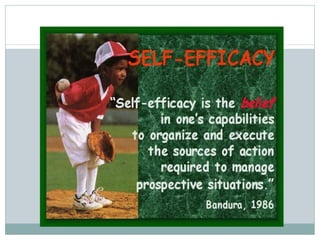
Self-Efficacy Self-efficacy  is a construct in SCT Bandura: Most important personal factor in behavior change Strategies for increasing self-efficacy: Setting goals, behavioral contracting, monitoring and reinforcement
Early Research Bandura focused on extraordinary symbolizing capacity of humans.  When people symbolize their experiences it gives structure, meaning & continuity to their lives.
Common Theme Emphasis given to one’s sense of personal efficacy to produce and regulate events in one’s lives.  Primary determinants of human behavioral change are outcome expectancies & efficacy expectancies.
Outcome & Efficacy Expectancy Outcome expectancy is the probability that engaging in a specific behavior will lead to a specific outcome.  Efficacy expectancy refers to the belief that one is capable of completing the desired behavior.
Development of Self-Efficacy Primitive times, people had limited understanding of the world Appealed supernatural agents who were believed to have control over their lives. People practiced elaborate rituals in an attempt to gain favor from or protection against the supernatural powers.  Even in contemporary life, people tend to call upon superstitious rituals to sway outcomes in their favor.
Rational System of self-efficacy is foundation of human motivations & personal achievements. If people don't believe they can achieve a desired outcome from their actions, they have little to no incentive to act, or continue action when presented with difficulties.
Constructs Personal mastery (performance accomplishments) Verbal encouragement (verbal persuasion) Vicarious mastery (vicarious experience)  Somatic & emotional states (physiological information)
Personal Mastery PRACTICING!
Vicarious Mastery Ability to see others perform successfully
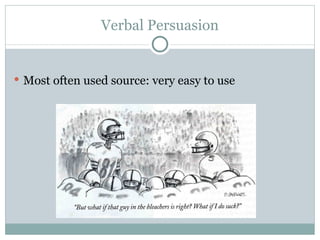
Verbal Persuasion Most often used source: very easy to use
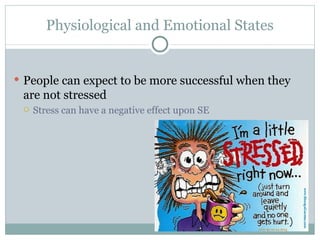
Physiological and Emotional States People can expect to be more successful when they are not stressed Stress can have a negative effect upon SE
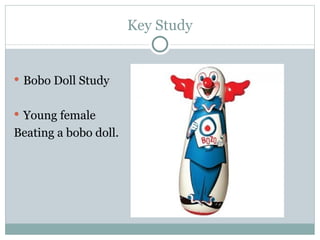
Key Study Bobo Doll Study Young female Beating a bobo doll.
Variations on Bobo Doll Study Model being rewarded or punished Kids were rewarded for their imitations  Model was changed to be less attractive/less prestigious. Focusing on motivation
Motivation Past reinforcement Promised reinforcement (incentives that we can imagine)  Vicarious reinforcement (seeing and recalling the model being reinforced) Negative reinforcements: past punishment, promised punishment & vicarious punishment
Key Study #2 Control Theory Vs. Self Efficacy Theory Control theory asserts that self-awareness plays an important role in self-regulation; the self-efficacy theory does not.
Manipulations Self-efficacy expectancy Outcome expectancy Self-awareness
Results Did not support either self-efficacy theory or control theory. Efficacy, outcome & self-awareness expectancies all contribute to persistence. The results of this study largely supported predictions derived from self-efficacy theory.
Weaknesses Non experimental designs can only suggest how behavior might be controlled.  Experimental designs: know if & how psychosocial variables might be manipulated to effect behavior change.  Participants in nutritional study were affected by their own expectations of negative self-evaluation.
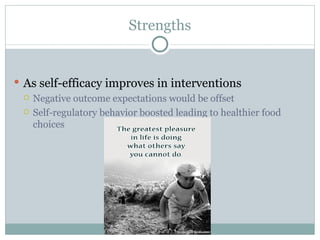
Strengths As self-efficacy improves in interventions Negative outcome expectations would be offset Self-regulatory behavior boosted leading to healthier food choices
Criticisms Argue SE is a cause of behavior, not merely a predictor Interest theory predicts that it is student interest in a subject that predicts student achievement.  Attribution theory
Survey 5 point scale: “Very confident,” “confident,” “neither confident nor not confident,” “not confident,” and “very not confident.”  25 questions total, assessing the four constructs
Subjects 30 student-athlete adolescents from a local north shore high school.  Ages ranged from 14-18 yrs 16 females & 14 males Randomly selected: Track and Field program.
Objective Nutrition Education Intervention  16-week intervention Behavioral approach to lifestyle change & nutrition education to improve self-efficacy.  List of nutritious dietary options  Attend nutrition education & behavior modification sessions every week along with their parent(s).
Goals To have the entire track and field team of 94 individuals to have high self-efficacy about eating healthy and making nutritious decisions daily by the end of the 2009 season. To have the local north shore high school make positive changes in their lunch menu to increase personal mastery of eating healthy and making nutritious decisions.
Goals Continued… To have the communities in which the local north shore high school is located have a positive impact on the changes within the high school. To have local restaurants improve their menu’s to accommodate a healthy student-athlete diet.
To have the parents and colleagues of the student-athletes have a high self-efficacy themselves about eating healthy and making nutritious decisions daily. To have all athletic sports teams to have high self-efficacy about eating healthy and making nutritious decisions daily by the end of the 2010 school year. More Goals
Strategies Healthy foods more accessible at school Discourage foods high in fat & sodium Peer role models Peer led nutrition education activities To provide role models: Teachers, parents, celebrities for healthy eating
Posters & incentives that students design Encourages students to make healthy choices about eating

Self Efficacy Presentation

  • 1.
    BY: KATELYN KERVINSelf-Efficacy Theory
  • 2.
  • 3.
    History/Orientation Social CognitiveTheory (SCT) Dynamic & ongoing process Factors, environmental factors, human behavior exert influence upon each other. Factors influence likelihood of changed behavior Self-efficacy, goals & outcome expectancies
  • 4.
    Self-Efficacy Self-efficacy is a construct in SCT Bandura: Most important personal factor in behavior change Strategies for increasing self-efficacy: Setting goals, behavioral contracting, monitoring and reinforcement
  • 5.
    Early Research Bandurafocused on extraordinary symbolizing capacity of humans. When people symbolize their experiences it gives structure, meaning & continuity to their lives.
  • 6.
    Common Theme Emphasisgiven to one’s sense of personal efficacy to produce and regulate events in one’s lives. Primary determinants of human behavioral change are outcome expectancies & efficacy expectancies.
  • 7.
    Outcome & EfficacyExpectancy Outcome expectancy is the probability that engaging in a specific behavior will lead to a specific outcome. Efficacy expectancy refers to the belief that one is capable of completing the desired behavior.
  • 8.
    Development of Self-EfficacyPrimitive times, people had limited understanding of the world Appealed supernatural agents who were believed to have control over their lives. People practiced elaborate rituals in an attempt to gain favor from or protection against the supernatural powers. Even in contemporary life, people tend to call upon superstitious rituals to sway outcomes in their favor.
  • 9.
    Rational System ofself-efficacy is foundation of human motivations & personal achievements. If people don't believe they can achieve a desired outcome from their actions, they have little to no incentive to act, or continue action when presented with difficulties.
  • 10.
    Constructs Personal mastery(performance accomplishments) Verbal encouragement (verbal persuasion) Vicarious mastery (vicarious experience) Somatic & emotional states (physiological information)
  • 11.
  • 12.
    Vicarious Mastery Abilityto see others perform successfully
  • 13.
    Verbal Persuasion Mostoften used source: very easy to use
  • 14.
    Physiological and EmotionalStates People can expect to be more successful when they are not stressed Stress can have a negative effect upon SE
  • 15.
    Key Study BoboDoll Study Young female Beating a bobo doll.
  • 16.
    Variations on BoboDoll Study Model being rewarded or punished Kids were rewarded for their imitations Model was changed to be less attractive/less prestigious. Focusing on motivation
  • 17.
    Motivation Past reinforcementPromised reinforcement (incentives that we can imagine) Vicarious reinforcement (seeing and recalling the model being reinforced) Negative reinforcements: past punishment, promised punishment & vicarious punishment
  • 18.
    Key Study #2Control Theory Vs. Self Efficacy Theory Control theory asserts that self-awareness plays an important role in self-regulation; the self-efficacy theory does not.
  • 19.
    Manipulations Self-efficacy expectancyOutcome expectancy Self-awareness
  • 20.
    Results Did notsupport either self-efficacy theory or control theory. Efficacy, outcome & self-awareness expectancies all contribute to persistence. The results of this study largely supported predictions derived from self-efficacy theory.
  • 21.
    Weaknesses Non experimentaldesigns can only suggest how behavior might be controlled. Experimental designs: know if & how psychosocial variables might be manipulated to effect behavior change. Participants in nutritional study were affected by their own expectations of negative self-evaluation.
  • 22.
    Strengths As self-efficacyimproves in interventions Negative outcome expectations would be offset Self-regulatory behavior boosted leading to healthier food choices
  • 23.
    Criticisms Argue SEis a cause of behavior, not merely a predictor Interest theory predicts that it is student interest in a subject that predicts student achievement. Attribution theory
  • 24.
    Survey 5 pointscale: “Very confident,” “confident,” “neither confident nor not confident,” “not confident,” and “very not confident.” 25 questions total, assessing the four constructs
  • 25.
    Subjects 30 student-athleteadolescents from a local north shore high school. Ages ranged from 14-18 yrs 16 females & 14 males Randomly selected: Track and Field program.
  • 26.
    Objective Nutrition EducationIntervention 16-week intervention Behavioral approach to lifestyle change & nutrition education to improve self-efficacy. List of nutritious dietary options Attend nutrition education & behavior modification sessions every week along with their parent(s).
  • 27.
    Goals To havethe entire track and field team of 94 individuals to have high self-efficacy about eating healthy and making nutritious decisions daily by the end of the 2009 season. To have the local north shore high school make positive changes in their lunch menu to increase personal mastery of eating healthy and making nutritious decisions.
  • 28.
    Goals Continued… Tohave the communities in which the local north shore high school is located have a positive impact on the changes within the high school. To have local restaurants improve their menu’s to accommodate a healthy student-athlete diet.
  • 29.
    To have theparents and colleagues of the student-athletes have a high self-efficacy themselves about eating healthy and making nutritious decisions daily. To have all athletic sports teams to have high self-efficacy about eating healthy and making nutritious decisions daily by the end of the 2010 school year. More Goals
  • 30.
    Strategies Healthy foodsmore accessible at school Discourage foods high in fat & sodium Peer role models Peer led nutrition education activities To provide role models: Teachers, parents, celebrities for healthy eating
  • 31.
    Posters & incentivesthat students design Encourages students to make healthy choices about eating

Editor's Notes

  • #4 If an individual has a sense of self-efficacy they can change behaviors even when faced with obstacles. If they do not feel that they can exercise control over their health behavior, they are not motivated to act, or to persist through challenges they will not succeed.
  • #6 Theorizes that people draw on these symbolic capabilities to understand their environments by purposeful actions, cognitively solve problems, develop reflective thoughts and effectively communicate with others
  • #9 Rain dances, GOD
  • #12 Practicing is the most important source of self-efficacy because it is based upon an individual’s own experience, based upon direct information, a person experiences immediate success or failure. Experiences of success (the feeling of mastery) enhance self-efficacy, while regular failure decreases it especially when the failure occurs during the learning process
  • #13 Other people can perform as examples or role models and supply information about the degree of difficulty of a specific kind of behavior Observing others is a weaker source of self-efficacy than direct experience but can certainly contribute to a person’s judgment on his or her own self-efficacy.
  • #14 Just by giving instructions, advice and suggestions, health care professionals can try to convince people that they can succeed in a difficult situation. The most important factors in verbal persuasion are the credibility, trustworthiness and importance of the individual doing the persuasion.
  • #15 During emotional situations, one can experience tension, anxiety and depression as signs of personal deficiency. What a person believes about a certain illness or drawback will usually determine the outcome of the situation. How a person interprets their symptoms can also influence their self-efficacy to deal with a certain illness.
  • #16 The woman kicked it, sat on it, hit with a little hammer while shouting various aggressive phrases.  Bandura showed his film to groups of kindergartners who apparently liked it a lot and were then let out to play.  In the play room were several observers with pens and clipboards in hand, a brand new bobo doll and a few little hammers. The observers recorded a lot of little kids beating, punching and shouting at the bobo doll, as they imitated the young lady in the film.
  • #18 Bandura states: punishment in whatever form does not work as well as reinforcement and has a tendency to backfire on us Self-efficacy is noted in the Bobo Doll studies based upon the actions and consequences that were assessed during the study
  • #19 96 introductory psychology students who were randomly assigned to one of the eight conditions and were tested individually
  • #20 Literature Review
  • #21 It appears that Bandura is correct both in differentiating outcome expectancies &efficacy expectancies and in emphasizing the role of efficacy expectations in behavior.
  • #22 behavior arises from complex interactions between unobservable variables which are vaguely defined and cannot be assessed. For an example, the process by which efficacy expectations arise from various sources of information, and the interaction of self-efficacy with levels of skill and motivation, are argued to be important, but there is no model to explain how these processes occur. Since clear-cut predictions cannot be made, it is impossible to test the model in a scientific sense. This weakness seriously compromises the practical usefulness of the theory
  • #23 One study showed that nutrition interventions may be more successful to the extent that they strengthen family social support, build self-efficacy, improve the use of self-regulatory behaviors, dispel negative outcome expectations related to making healthier food choices and are appropriately tailored for certain demographic groups
  • #24 Attribution Theory: predicts that students who believe that success /failure depends on the effort exerted on a particular task, will work harder than students who believe that success or failure depends on ability.
  • #27 Determine the effects of a NEI based upon the daily nutrition habits of student-athlete adolescents at local north shore high school.
  • #32 POSTER