Micro Asteroid Prospector Powered by 
Energetic Radioisotopes: MAPPER 
Steven D. Howe 
Gerald P. Jackson 
Presented at the NIAC Review Meeting 
March 23, 2004
Topics Presented 
zz Goals and objectives 
zz Target characterization characterization- Main Belt Asteroids 
zz Sub Sub-Systems 
zz Preliminary optimization calculations 
zz Issues 
zz Conclusions
Goals and Objectives 
zz Purpose: Catalogue the resources of the Main Belt 
asteroids for future exploration 
zz Goal: Design a light light-weight, in in-expensive spacecraft 
so that a fleet can cruise autonomously through the 
Belt for 20 years 
zz Objectives: 
zz Determine mass, power, and number of spacecraft for 
characterizing a significant fraction of the Main Belt 
asteroids 
zz Identify major issues and future goals
Main Belt Asteroids 
zzThe Asteroid Belt may be the most valuable future resource in the solar systemin system zzThe asteroid belt is estimated to contain 100 billion objects. zzThe total mass is calculated to be around 1/1000 of Earth’s mass --equivalent to breaking the top 1.3 miles of the Earth’s crust into piecescrust pieces zzDiameters range from a few kilometers to a few metersDiameters meters zzMost of the asteroids are silicon dioxide, some are iron and other metals, a lesser number are carbonaceous chondriteschondriteswith up to 10 % water by weight, and a few may be heavy with precious metals. zzAverage separation distance is 2.3x10Average 2.3x1044km for km DminDmin=20m=20m
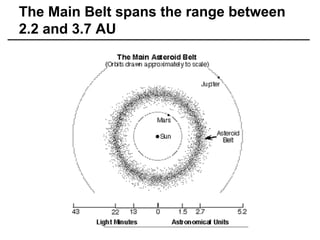
The Main Belt spans the range between 2.2 and 3.7 AU
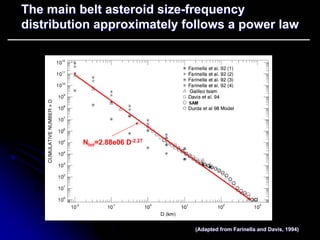
The main belt asteroid size size-frequency 
distribution approximately follows a power law 
Ntot=2.88e06 D-2.27 
(Adapted from Farinella and Davis, 1994)
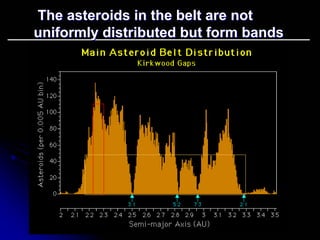
The asteroids in the belt are not uniformly distributed but form bandsuniformly bands
Subsystems
The MAPPER concept requires the 
integration of many subsystems 
zz A power supply to provide electrical power to a platform that 
can propulsively cruise between targets 
zz A radiation detector system that can measure elemental 
constituents at a standoff distance, 
zz A heating system that can extract and store volatiles for 
propulsion, 
zz A tagging method to label the target for future generations. 
zz A method of absolute coordinate location determination via 
star tracking or inter inter-communication with Earth or a fixed 
beacon. 
zz Radar system sufficient to provide guidance to the next 
target and avoidance of smaller objects 
zz A communication link to Earth
POWER
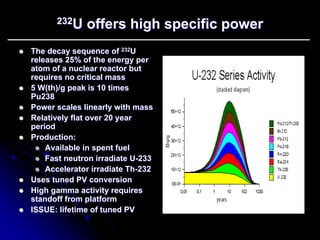
232 232U offers high specific power 
U zz The decay sequence of 232 232U U 
releases 25% of the energy per 
atom of a nuclear reactor but 
requires no critical mass 
zz 5 W(th)/g peak is 10 times 
Pu238 
zz Power scales linearly with mass 
zz Relatively flat over 20 year 
period 
zz Production: 
zz Available in spent fuel 
zz Fast neutron irradiate U U-233 
zz Accelerator irradiate Th Th-232 
zz Uses tuned PV conversion 
zz High gamma activity requires 
standoff from platform 
zz ISSUE: lifetime of tuned PV
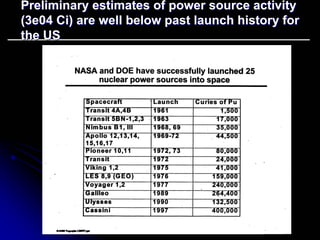
Preliminary estimates of power source activity 
(3e04 Ci Ci) are well below past launch history for 
) the US
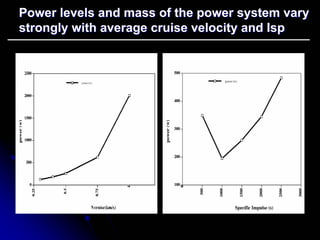
Power levels and mass of the power system vary 
strongly with average cruise velocity and Isp
PROPULSION
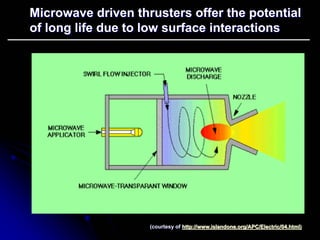
Microwave driven thrusters offer the potential 
of long life due to low surface interactions 
(courtesy of http://www.islandone.org/APC/Electric/04.html)
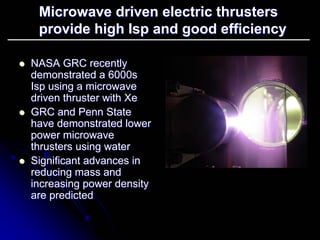
Microwave driven electric thrusters 
provide high Isp and good efficiency 
zz NASA GRC recently 
demonstrated a 6000s 
Isp using a microwave 
driven thruster with Xe 
zz GRC and Penn State 
have demonstrated lower 
power microwave 
thrusters using water 
zz Significant advances in 
reducing mass and 
increasing power density 
are predicted
Refueling
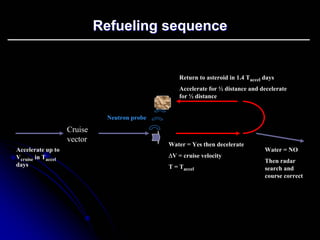
Refueling sequence 
Cruise vector 
Neutron probe 
Water = Yes then decelerate 
ΔV = cruise velocity 
T = TaccelReturn to asteroid in 1.4 TacceldaysAccelerate for ½ distance and decelerate for ½ distance 
Accelerate up to Vcruisein Tacceldays 
Water = NO 
Then radar search and course correct
Microwaves couple to regolith 
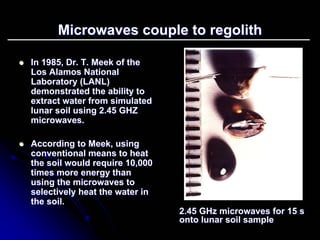
zz In 1985, Dr. T. Meek of the 
Los Alamos National 
Laboratory (LANL) 
demonstrated the ability to 
extract water from simulated 
lunar soil using 2.45 GHZ 
microwaves. 
zz According to Meek, using 
conventional means to heat 
the soil would require 10,000 
times more energy than 
using the microwaves to 
selectively heat the water in 
the soil. 
2.45 GHz microwaves for 15 s 
onto lunar soil sample
The microwave generator for the thruster will also 
serve as the heating source to extract water from 
CC asteroids 
zz 2.45 GHz microwaves will penetrate roughly 30 cm into 10% 
bearing regolith 
zz A 50 cm diameter bell will extract 60 kg of water from a 10% CC 
zz extraction rate is around .025 kg/w w-day 
zz Slight pressure buildup will be countered by operating the 
thruster at low power 
zz Water in the fuel tanks will be maintained as liquid using the 
waste heat transported from the power source, ~160 w required 
zz Condensed water is transported from the extraction unit to the 
fuel tank via capillary action
DETECTION
Neutron Source 
zz Original concept used 232 232U plus Beryllium to make 
U neutrons via ( αα,n ,n) reaction 
) zz 4ππ source 
zz Created too much background 
zz Irradiated components 
zz Required close approach, i.e. < one diameter 
zz Propose H( 6Li,n) mini accelerator 
Li,zz 13.2 MeV 6Li Li 
zz 10 10o cone of emission 
zz Pulsed, intense source fired during flyby closest approach 
zz Optimum standoff distance is 3 X diameter
Flight qualified neutron detector has 
been flown to find water on the Moon 
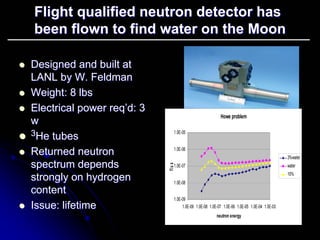
zz Designed and built at 
LANL by W. Feldman 
zz Weight: 8 lbs 
zz Electrical power req’d req’d: 3 
: w 
zz 3He tubes 
He zz Returned neutron 
spectrum depends 
strongly on hydrogen 
content 
zz Issue: lifetimeHowe problem1.0E-091.0E-081.0E-071.0E-061.0E-051.0E-091.0E-081.0E-071.0E-061.0E-051.0E-041.0E-03neutron energy flux 3%waterwater10% 
lifetime
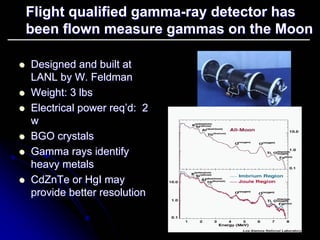
Flight qualified gamma gamma-ray detector has 
been flown measure gammas on the Moon 
zz Designed and built at 
LANL by W. Feldman 
zz Weight: 3 lbs 
zz Electrical power req’d req’d: 2 
: w 
zz BGO crystals 
zz Gamma rays identify 
heavy metals 
zz CdZnTe or HgI may 
provide better resolution
TAGGING and COMMUNICATION
Radioisotope tagging 
zz Carry 100g samples of 5 isotopes 
zz T1/2 greater than 30 yrs 
zz Auto Auto-mixer to randomly mix different amounts of each 
zz Gives passive gamma ray signal with unique spectrum 
zz Pro –– no power needed 
zz Pro –– long lived 
zz Pro -- secure 
zz Con -- Natural background may interfere 
zz Con -- Must be in line of sight to register
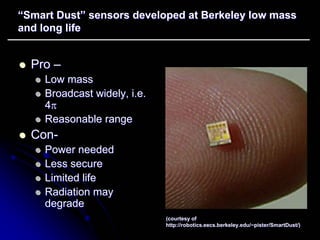
““Smart Dust” sensors developed at Berkeley low mass 
and long life 
zz Pro –– 
zz Low mass 
zz Broadcast widely, i.e. 
4ππ 
zz Reasonable range 
zz Con Con- 
zz Power needed 
zz Less secure 
zz Limited life 
zz Radiation may 
degrade 
(courtesy of 
http:// robotics.eecs.berkeley.edu/~pister/SmartDust SmartDust/) /)
Communications back to Earth rely on 
demonstrated technologies 
zz Galileo transmissions required 400 w on 
board power 
zz Platform will determine location from “split 
field of view star sensors ( StarNav II) 
[http://www.jsc.nasa.gov/aiaa/lal/lljun01/] ““ 
zz Information burst will include location, 
measured gamma gamma-ray and neutron 
spectra, and ship status data
GUIDANCE
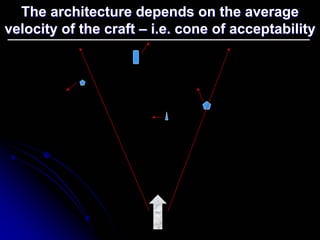
The architecture depends on the average 
velocity of the craft –– i.e. cone of acceptability
A light weight radar is required but does not 
yet exist 
zz Needs to see 156,000 km out 
zz Correlate distance with return signal strength (RSS) and 
target size 
zz Indicate water content (i.e. albedo albedo) with RSS 
) zz Determine relative velocity with multiple returns 
zz May require power accumulator to operate in high high-power 
but pulsed mode 
zz Determines required delta delta-V 
zz Enables target choice 
zz Issues: 
zz baseline needed for Synthetic Aperture Radar ? 
zz power level?
Optimization
Deployment –– Nuclear Thermal Rocket 
zz Current NASA program, Prometheus, is 
interested in recovering the NTR to fulfill the new 
Presidential space exploration direction 
zz NTR is considered to be a demonstrated 
technology that could be recovered within a 
decade 
zz Assumed operating parameters 
zz 5000 lb thrust engine 
zz T/W = 3 
zz Isp Isp= 950 s 
= zz Hohmann transfer orbit –– sum of ΔΔVs Vs= 9.52 km/s 
= zz Reusable for N missions
Preliminary optimization calculations 
are positive 
zz Power level is dictated by the propulsion systems need to 
accelerate over a short period (variable) 
zz The same power level is sufficient for communications back 
to Earth, water extraction, neutron generation, and the radar 
systems. 
zz The average cruise velocity, Isp Isp, time of acceleration, and 
, interception velocity are independent variables 
zz Propellant requirements for initial acceleration to cruise, 
intercepts, and refueling are determined 
zz Power system mass including waste heat radiator is found for 
the tuned PV method
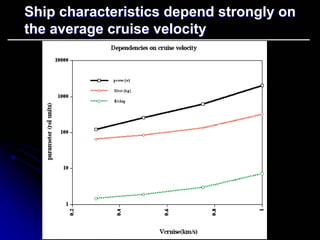
Ship characteristics depend strongly on 
the average cruise velocity
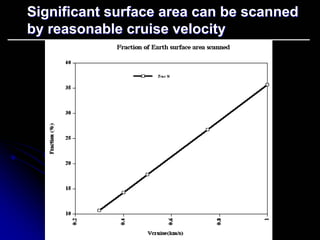
Significant surface area can be scanned 
by reasonable cruise velocity
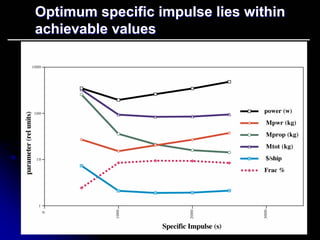
Optimum specific impulse lies within 
achievable values
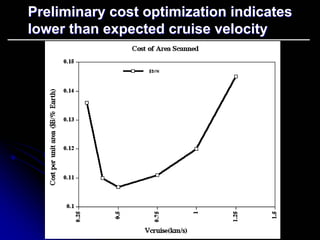
Preliminary cost optimization indicates 
lower than expected cruise velocity
Phase II will strive to resolve several 
issues 
zz Lifetimes Lifetimes- 
zz Power conversion scintillator 
zz RF taggers 
zz Microwave generator 
zz detectors 
zz Need time dependent simulation to develop 
guidance, control algorithms, and Vintercept intercept 
zz Radar –– mass and power 
zz Earth communications 
zz Packaging Packaging- is the platform volume limited or 
mass limited
Conclusions 
zz A host of small platforms can survey a significant 
fraction of the asteroid population in a 20 year 
interval 
zz The land area surveyed could be equal to a 
major fraction of the Earth’s surface area 
zz The energetic radioisotope power supply 
appears adequate for the mission needs 
zz Most subsystem hardware has current current-day 
examples that can be improved 
zz A time time-dependent simulation is needed for flight 
profile demonstration and targeting algorithm 
development

Micro asteroidprospector

  • 1.
    Micro Asteroid ProspectorPowered by Energetic Radioisotopes: MAPPER Steven D. Howe Gerald P. Jackson Presented at the NIAC Review Meeting March 23, 2004
  • 2.
    Topics Presented zzGoals and objectives zz Target characterization characterization- Main Belt Asteroids zz Sub Sub-Systems zz Preliminary optimization calculations zz Issues zz Conclusions
  • 3.
    Goals and Objectives zz Purpose: Catalogue the resources of the Main Belt asteroids for future exploration zz Goal: Design a light light-weight, in in-expensive spacecraft so that a fleet can cruise autonomously through the Belt for 20 years zz Objectives: zz Determine mass, power, and number of spacecraft for characterizing a significant fraction of the Main Belt asteroids zz Identify major issues and future goals
  • 4.
    Main Belt Asteroids zzThe Asteroid Belt may be the most valuable future resource in the solar systemin system zzThe asteroid belt is estimated to contain 100 billion objects. zzThe total mass is calculated to be around 1/1000 of Earth’s mass --equivalent to breaking the top 1.3 miles of the Earth’s crust into piecescrust pieces zzDiameters range from a few kilometers to a few metersDiameters meters zzMost of the asteroids are silicon dioxide, some are iron and other metals, a lesser number are carbonaceous chondriteschondriteswith up to 10 % water by weight, and a few may be heavy with precious metals. zzAverage separation distance is 2.3x10Average 2.3x1044km for km DminDmin=20m=20m
  • 5.
    The Main Beltspans the range between 2.2 and 3.7 AU
  • 6.
    The main beltasteroid size size-frequency distribution approximately follows a power law Ntot=2.88e06 D-2.27 (Adapted from Farinella and Davis, 1994)
  • 7.
    The asteroids inthe belt are not uniformly distributed but form bandsuniformly bands
  • 8.
  • 9.
    The MAPPER conceptrequires the integration of many subsystems zz A power supply to provide electrical power to a platform that can propulsively cruise between targets zz A radiation detector system that can measure elemental constituents at a standoff distance, zz A heating system that can extract and store volatiles for propulsion, zz A tagging method to label the target for future generations. zz A method of absolute coordinate location determination via star tracking or inter inter-communication with Earth or a fixed beacon. zz Radar system sufficient to provide guidance to the next target and avoidance of smaller objects zz A communication link to Earth
  • 10.
  • 11.
    232 232U offershigh specific power U zz The decay sequence of 232 232U U releases 25% of the energy per atom of a nuclear reactor but requires no critical mass zz 5 W(th)/g peak is 10 times Pu238 zz Power scales linearly with mass zz Relatively flat over 20 year period zz Production: zz Available in spent fuel zz Fast neutron irradiate U U-233 zz Accelerator irradiate Th Th-232 zz Uses tuned PV conversion zz High gamma activity requires standoff from platform zz ISSUE: lifetime of tuned PV
  • 12.
    Preliminary estimates ofpower source activity (3e04 Ci Ci) are well below past launch history for ) the US
  • 13.
    Power levels andmass of the power system vary strongly with average cruise velocity and Isp
  • 14.
  • 15.
    Microwave driven thrustersoffer the potential of long life due to low surface interactions (courtesy of http://www.islandone.org/APC/Electric/04.html)
  • 16.
    Microwave driven electricthrusters provide high Isp and good efficiency zz NASA GRC recently demonstrated a 6000s Isp using a microwave driven thruster with Xe zz GRC and Penn State have demonstrated lower power microwave thrusters using water zz Significant advances in reducing mass and increasing power density are predicted
  • 17.
  • 18.
    Refueling sequence Cruisevector Neutron probe Water = Yes then decelerate ΔV = cruise velocity T = TaccelReturn to asteroid in 1.4 TacceldaysAccelerate for ½ distance and decelerate for ½ distance Accelerate up to Vcruisein Tacceldays Water = NO Then radar search and course correct
  • 19.
    Microwaves couple toregolith zz In 1985, Dr. T. Meek of the Los Alamos National Laboratory (LANL) demonstrated the ability to extract water from simulated lunar soil using 2.45 GHZ microwaves. zz According to Meek, using conventional means to heat the soil would require 10,000 times more energy than using the microwaves to selectively heat the water in the soil. 2.45 GHz microwaves for 15 s onto lunar soil sample
  • 20.
    The microwave generatorfor the thruster will also serve as the heating source to extract water from CC asteroids zz 2.45 GHz microwaves will penetrate roughly 30 cm into 10% bearing regolith zz A 50 cm diameter bell will extract 60 kg of water from a 10% CC zz extraction rate is around .025 kg/w w-day zz Slight pressure buildup will be countered by operating the thruster at low power zz Water in the fuel tanks will be maintained as liquid using the waste heat transported from the power source, ~160 w required zz Condensed water is transported from the extraction unit to the fuel tank via capillary action
  • 21.
  • 22.
    Neutron Source zzOriginal concept used 232 232U plus Beryllium to make U neutrons via ( αα,n ,n) reaction ) zz 4ππ source zz Created too much background zz Irradiated components zz Required close approach, i.e. < one diameter zz Propose H( 6Li,n) mini accelerator Li,zz 13.2 MeV 6Li Li zz 10 10o cone of emission zz Pulsed, intense source fired during flyby closest approach zz Optimum standoff distance is 3 X diameter
  • 23.
    Flight qualified neutrondetector has been flown to find water on the Moon zz Designed and built at LANL by W. Feldman zz Weight: 8 lbs zz Electrical power req’d req’d: 3 : w zz 3He tubes He zz Returned neutron spectrum depends strongly on hydrogen content zz Issue: lifetimeHowe problem1.0E-091.0E-081.0E-071.0E-061.0E-051.0E-091.0E-081.0E-071.0E-061.0E-051.0E-041.0E-03neutron energy flux 3%waterwater10% lifetime
  • 24.
    Flight qualified gammagamma-ray detector has been flown measure gammas on the Moon zz Designed and built at LANL by W. Feldman zz Weight: 3 lbs zz Electrical power req’d req’d: 2 : w zz BGO crystals zz Gamma rays identify heavy metals zz CdZnTe or HgI may provide better resolution
  • 25.
  • 26.
    Radioisotope tagging zzCarry 100g samples of 5 isotopes zz T1/2 greater than 30 yrs zz Auto Auto-mixer to randomly mix different amounts of each zz Gives passive gamma ray signal with unique spectrum zz Pro –– no power needed zz Pro –– long lived zz Pro -- secure zz Con -- Natural background may interfere zz Con -- Must be in line of sight to register
  • 27.
    ““Smart Dust” sensorsdeveloped at Berkeley low mass and long life zz Pro –– zz Low mass zz Broadcast widely, i.e. 4ππ zz Reasonable range zz Con Con- zz Power needed zz Less secure zz Limited life zz Radiation may degrade (courtesy of http:// robotics.eecs.berkeley.edu/~pister/SmartDust SmartDust/) /)
  • 28.
    Communications back toEarth rely on demonstrated technologies zz Galileo transmissions required 400 w on board power zz Platform will determine location from “split field of view star sensors ( StarNav II) [http://www.jsc.nasa.gov/aiaa/lal/lljun01/] ““ zz Information burst will include location, measured gamma gamma-ray and neutron spectra, and ship status data
  • 29.
  • 30.
    The architecture dependson the average velocity of the craft –– i.e. cone of acceptability
  • 31.
    A light weightradar is required but does not yet exist zz Needs to see 156,000 km out zz Correlate distance with return signal strength (RSS) and target size zz Indicate water content (i.e. albedo albedo) with RSS ) zz Determine relative velocity with multiple returns zz May require power accumulator to operate in high high-power but pulsed mode zz Determines required delta delta-V zz Enables target choice zz Issues: zz baseline needed for Synthetic Aperture Radar ? zz power level?
  • 32.
  • 33.
    Deployment –– NuclearThermal Rocket zz Current NASA program, Prometheus, is interested in recovering the NTR to fulfill the new Presidential space exploration direction zz NTR is considered to be a demonstrated technology that could be recovered within a decade zz Assumed operating parameters zz 5000 lb thrust engine zz T/W = 3 zz Isp Isp= 950 s = zz Hohmann transfer orbit –– sum of ΔΔVs Vs= 9.52 km/s = zz Reusable for N missions
  • 34.
    Preliminary optimization calculations are positive zz Power level is dictated by the propulsion systems need to accelerate over a short period (variable) zz The same power level is sufficient for communications back to Earth, water extraction, neutron generation, and the radar systems. zz The average cruise velocity, Isp Isp, time of acceleration, and , interception velocity are independent variables zz Propellant requirements for initial acceleration to cruise, intercepts, and refueling are determined zz Power system mass including waste heat radiator is found for the tuned PV method
  • 35.
    Ship characteristics dependstrongly on the average cruise velocity
  • 36.
    Significant surface areacan be scanned by reasonable cruise velocity
  • 37.
    Optimum specific impulselies within achievable values
  • 38.
    Preliminary cost optimizationindicates lower than expected cruise velocity
  • 39.
    Phase II willstrive to resolve several issues zz Lifetimes Lifetimes- zz Power conversion scintillator zz RF taggers zz Microwave generator zz detectors zz Need time dependent simulation to develop guidance, control algorithms, and Vintercept intercept zz Radar –– mass and power zz Earth communications zz Packaging Packaging- is the platform volume limited or mass limited
  • 40.
    Conclusions zz Ahost of small platforms can survey a significant fraction of the asteroid population in a 20 year interval zz The land area surveyed could be equal to a major fraction of the Earth’s surface area zz The energetic radioisotope power supply appears adequate for the mission needs zz Most subsystem hardware has current current-day examples that can be improved zz A time time-dependent simulation is needed for flight profile demonstration and targeting algorithm development