

SMART Objectives
Create SMART objectives, achieve results
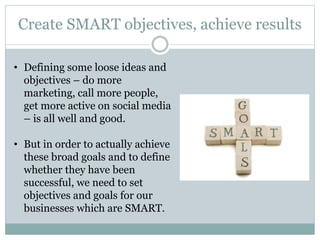
• Defining some loose ideas and
objectives – do more
marketing, call more people,
get more active on social media
– is all well and good.
• But in order to actually achieve
these broad goals and to define
whether they have been
successful, we need to set
objectives and goals for our
businesses which are SMART.
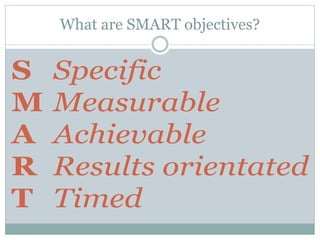
What are SMART objectives?
Specific
• To be specific, an objective
should have a description of a
precise or specific behaviour,
achievement or outcome
which is or can be related to a
percentage, frequency, rate or
number.
• This is key when we look at
the M of SMART, because if
our goal can’t be measured,
we can’t evaluate the success.
Specific
Use verbs which are action orientated to describe those
actions which need to be taken to fulfil objectives:
Non-Specific goal: To encourage more people to visit
our website
Specific: To increase the number of unique visitors
to our website on a monthly basis
Measurable
• We are all motivated by
achievement, so setting
measurement criteria and
being able to track it through
the life of an objective or goal
makes a real difference.
• Without a measure, a goal can
never be achieved, and we can
never get the sense of
achievement of attaining or
exceeding our targets.
Measurable
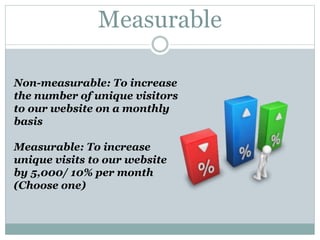
Non-measurable: To increase
the number of unique visitors
to our website on a monthly
basis
Measurable: To increase
unique visits to our website
by 5,000/ 10% per month
(Choose one)
Achievable
• If you set a target that is
simply not possible then
you will end up
demotivating yourself
and your staff. It is a
fine balance though,
because if we aim too
low our achievement
can become devalued.
Achievable
• So we want to look for targets that are stretching yet
realistic, things that if achieved will mean something to
ourselves and the business, but are achievable given the
resource at your disposal.
Results Orientated
• Results orientation is about
making sure that what we
achieve will have an impact on
the business and the overall
goals for the business or
ourselves personally.
• This is a sense check on goal
setting to make sure we aren’t
doing things for the sake of it,
but that whatever goal we set
will contribute to the success
of the business.
Results Orientated
• Results orientation is about
making sure that what we
achieve will have an impact
on the business and the
overall goals for the business
or ourselves personally.
• This is a sense check on goal
setting to make sure we aren’t
doing things for the sake of it,
but that whatever goal we set
will contribute to the success
of the business.
Timed
• An objective without a
time frame has no sense
of urgency and is much
less likely to succeed.
• Deadlines provide you
with a real impetus and
push you to achieve what
can appear to be
stretching targets.
Timed
So, we started with the initial objective:
To encourage more people to visit
our website
To finish our example:
To increase unique visits to our
website as defined by Google
analytics by 5,000 per month, by
the end of Quarter 1 thus
allowing our advertising sales
team to charge an extra 10% for
web advertising space
This Specific,
Measurable,
Achievable, Results
orientated and Timed
(SMART) objective, is
motivating to those
involved and even if
stretching becomes
more achievable by
being anchored in
within a time frame
and because it has a
reason.

Setting SMART Goals and Objectives

  • 1.
  • 2.
    Create SMART objectives,achieve results • Defining some loose ideas and objectives – do more marketing, call more people, get more active on social media – is all well and good. • But in order to actually achieve these broad goals and to define whether they have been successful, we need to set objectives and goals for our businesses which are SMART.
  • 3.
    What are SMARTobjectives?
  • 4.
    Specific • To bespecific, an objective should have a description of a precise or specific behaviour, achievement or outcome which is or can be related to a percentage, frequency, rate or number. • This is key when we look at the M of SMART, because if our goal can’t be measured, we can’t evaluate the success.
  • 5.
    Specific Use verbs whichare action orientated to describe those actions which need to be taken to fulfil objectives: Non-Specific goal: To encourage more people to visit our website Specific: To increase the number of unique visitors to our website on a monthly basis
  • 6.
    Measurable • We areall motivated by achievement, so setting measurement criteria and being able to track it through the life of an objective or goal makes a real difference. • Without a measure, a goal can never be achieved, and we can never get the sense of achievement of attaining or exceeding our targets.
  • 7.
    Measurable Non-measurable: To increase thenumber of unique visitors to our website on a monthly basis Measurable: To increase unique visits to our website by 5,000/ 10% per month (Choose one)
  • 8.
    Achievable • If youset a target that is simply not possible then you will end up demotivating yourself and your staff. It is a fine balance though, because if we aim too low our achievement can become devalued.
  • 9.
    Achievable • So wewant to look for targets that are stretching yet realistic, things that if achieved will mean something to ourselves and the business, but are achievable given the resource at your disposal.
  • 10.
    Results Orientated • Resultsorientation is about making sure that what we achieve will have an impact on the business and the overall goals for the business or ourselves personally. • This is a sense check on goal setting to make sure we aren’t doing things for the sake of it, but that whatever goal we set will contribute to the success of the business.
  • 11.
    Results Orientated • Resultsorientation is about making sure that what we achieve will have an impact on the business and the overall goals for the business or ourselves personally. • This is a sense check on goal setting to make sure we aren’t doing things for the sake of it, but that whatever goal we set will contribute to the success of the business.
  • 12.
    Timed • An objectivewithout a time frame has no sense of urgency and is much less likely to succeed. • Deadlines provide you with a real impetus and push you to achieve what can appear to be stretching targets.
  • 13.
    Timed So, we startedwith the initial objective: To encourage more people to visit our website To finish our example: To increase unique visits to our website as defined by Google analytics by 5,000 per month, by the end of Quarter 1 thus allowing our advertising sales team to charge an extra 10% for web advertising space
  • 14.
    This Specific, Measurable, Achievable, Results orientatedand Timed (SMART) objective, is motivating to those involved and even if stretching becomes more achievable by being anchored in within a time frame and because it has a reason.