PureAcademy:
S.M.A.R.T Planning & Tactics Workshop
July 2019
Today’s Agenda
● Introductions & housekeeping
● Pure360s Maturity Model
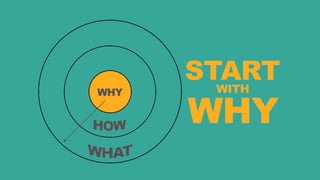
● Understand why we do what we do
● SMART Planning
● BREAK (15 mins)
● Annual planning & tools to take away
● LUNCH
● Smart Tactics
● Put in practice what you’ve learnt - Working Groups
INTRODUCTIONS
&
HOUSEKEEPING
What will I get out of today’s session?
● Time away from the office and any distractions
● Time to clearly focus on your marketing strategy
● Question whether you are focused on the right objectives
● The tools to articulate your goals clearly
● The importance of setting KPIs for every task you implement
● Leave with the beginning of a solid SMART plan
● Better understanding of how Pure360 can support you
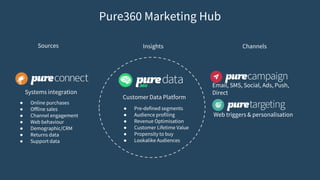
Email, SMS, Social, Ads, Push,
Direct
Web triggers & personalisation
Systems integration
Pure360 Marketing Hub
Customer Data Platform
ChannelsSources
● Pre-defined segments
● Audience profiling
● Revenue Optimisation
● Customer Lifetime Value
● Propensity to buy
● Lookalike Audiences
● Online purchases
● Offline sales
● Channel engagement
● Web behaviour
● Demographic/CRM
● Returns data
● Support data
Insights
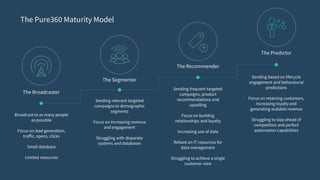
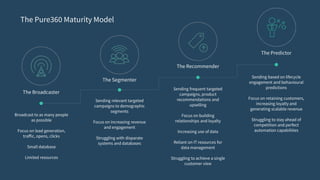
The Broadcaster
The Segmenter
The Recommender
The Predictor
Broadcast to as many people
as possible
Focus on lead generation,
traffic, opens, clicks
Small database
Limited resources
Sending relevant targeted
campaigns to demographic
segments
Focus on increasing revenue
and engagement
Struggling with disparate
systems and databases
Sending frequent targeted
campaigns, product
recommendations and
upselling
Focus on building
relationships and loyalty
Increasing use of data
Reliant on IT resources for
data management
Struggling to achieve a single
customer view
Sending based on lifecycle
engagement and behavioural
predictions
Focus on retaining customers,
increasing loyalty and
generating scalable revenue
Struggling to stay ahead of
competition and perfect
automation capabilities
The Pure360 Maturity Model
Document your objectives
1. What is the company objective / goal?
2. What is the department objective / goal?
3. What is expected of you?
(5 minutes)
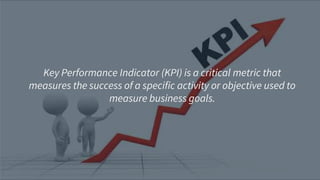
What are KPIs and why are they important?
Key Performance Indicator (KPI) is a critical metric that
measures the success of a specific activity or objective used to
measure business goals.
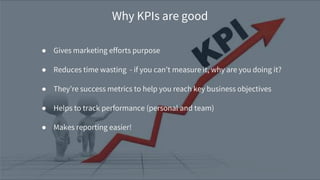
● Gives marketing efforts purpose
● Reduces time wasting - if you can’t measure it, why are you doing it?
● They’re success metrics to help you reach key business objectives
● Helps to track performance (personal and team)
● Makes reporting easier!
Why KPIs are good
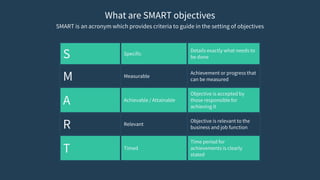
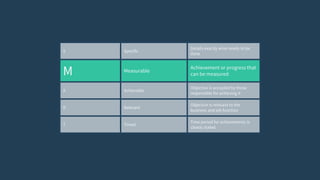
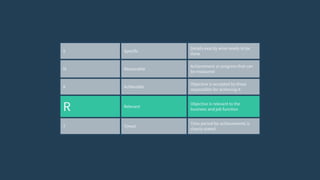
What are SMART objectives
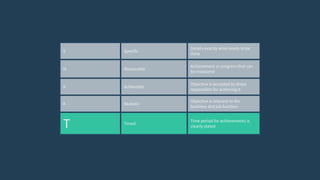
SMART is an acronym which provides criteria to guide in the setting of objectives
S Specific
Details exactly what needs to
be done
M Measurable
Achievement or progress that
can be measured
A Achievable / Attainable
Objective is accepted by
those responsible for
achieving it
R Relevant
Objective is relevant to the
business and job function
T Timed
Time period for
achievements is clearly
stated
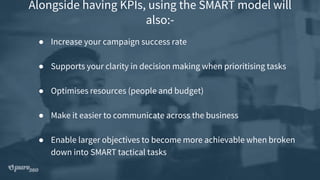
Alongside having KPIs, using the SMART model will
also:-
● Increase your campaign success rate
● Supports your clarity in decision making when prioritising tasks
● Optimises resources (people and budget)
● Make it easier to communicate across the business
● Enable larger objectives to become more achievable when broken
down into SMART tactical tasks
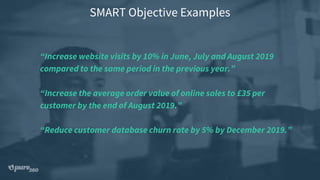
SMART Objective Examples
“Increase website visits by 10% in June, July and August 2019
compared to the same period in the previous year.”
“Increase the average order value of online sales to £35 per
customer by the end of August 2019.”
“Reduce customer database churn rate by 5% by December 2019.”
● Done: We know our business goals / objectives
● Next: We’ll clearly define our objectives that feed back up to our goals
Steps to setting SMART Objectives
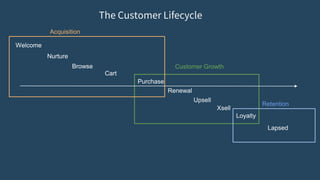
Acquisition
Customer Growth
Retention
The Customer Lifecycle
Customer Lifecycle Audit
Map current activities and the activities you need to
action to meet your objectives
(Acquisition / Growth / Retention)
(5 minutes)
Today’s Agenda
● Introductions & housekeeping
● A brief welcome from Pure360’s CEO - Mark Ash
● Understand why we do what we do
● SMART Planning (with a brief 5 minute break)
● Annual planning & tools to take away
● BREAK
● Smart Tactics
● Put in practice what you’ve learnt - Working
Groups
● LUNCH
S Specific
Details exactly what needs to
be done
M Measurable
Achievement or progress that can
be measured
A Achievable
Objective is accepted by those
responsible for achieving it
R Relevant
Objective is relevant to the
business and job function
T Timed
Time period for achievements is
clearly stated
S - Specific - Examples
Objective: “I need to grow the number of marketable
contacts in the customer database”
Objective: “We need to increase online sales conversions”
Objective: “ I want to reduce customer churn rates”
SMART GOAL / OBJECTIVE PLANNING
1. Pick one of your objectives (front page)
1. Write down that Goal in the Draft Goal Statement line
of the Smart Goal Planning template
1. Complete the “Specific” section of the template
(5 mins - confer with your neighbours!)
● Done: We know our objectives / goals
● Done: We’ve clearly defined one of our goals / objectives
● Next: We need to ensure it can be measured
Steps to setting SMART Objectives
S Specific
Details exactly what needs to be
done
M Measurable
Achievement or progress that
can be measured
A Achievable
Objective is accepted by those
responsible for achieving it
R Relevant
Objective is relevant to the
business and job function
T Timed
Time period for achievements is
clearly stated
M - Measurable - Achievement or progress that can be
measured
What are you currently measuring? For example:-
● Revenue by channel
● Return on Investment
● Sign up rates
● The value of an email address
● Customer Lifetime Value
● Open rates
● Click Rates
● Bounce/Blocked Rates
● Churn Rates
● Conversion Rates
● Average Order Values
● And so much more!
What % increase do you need to see across those metrics? Why?
Can your goal be measured? How?
Document how you intend to measure your
success of this goal and what metrics will you
want to monitor
(5 minutes)
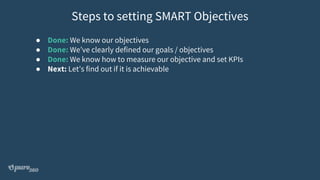
● Done: We know our objectives
● Done: We’ve clearly defined our goals / objectives
● Done: We know how to measure our objective and set KPIs
● Next: Let’s find out if it is achievable
Steps to setting SMART Objectives
S Specific
Details exactly what needs to be
done
M Measurable
Achievement or progress that can
be measured
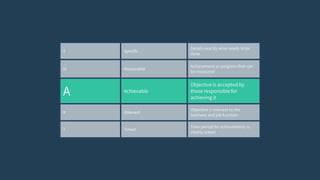
A Achievable
Objective is accepted by
those responsible for
achieving it
R Relevant
Objective is relevant to the
business and job function
T Timed
Time period for achievements is
clearly stated
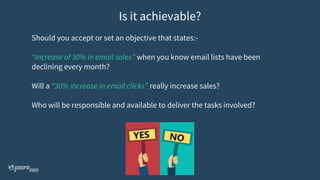
Should you accept or set an objective that states:-
“Increase of 30% in email sales” when you know email lists have been
declining every month?
Will a “30% increase in email clicks” really increase sales?
Who will be responsible and available to deliver the tasks involved?
Is it achievable?
Document the dependencies required for the
objective / goal to be achievable
(5 minutes)
● Done: We know our objectives
● Done: We’ve clearly defined our goals / objectives
● Done: We know how to measure our goal and set KPIs
● Done: We’ve outline how it can be achieved
● Next: We’re going to look at the objective’s relevancy to the business
Steps to setting SMART Objectives
S Specific
Details exactly what needs to be
done
M Measurable
Achievement or progress that can
be measured
A Achievable
Objective is accepted by those
responsible for achieving it
R Relevant
Objective is relevant to the
business and job function
T Timed
Time period for achievements is
clearly stated
Complete the relevancy of the goal to the
business and your role
(3 minutes)
● Done: We know our objectives
● Done: We’ve clearly defined our goals / objectives
● Done: We know how to measure our objectives and set KPIs
● Done: We’ve outline how it can be achieved
● Done: We’re confident the objective is relevant
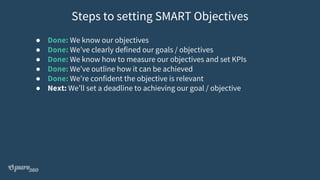
● Next: We’ll set a deadline to achieving our goal / objective
Steps to setting SMART Objectives
S Specific
Details exactly what needs to be
done
M Measurable
Achievement or progress that can
be measured
A Achievable
Objective is accepted by those
responsible for achieving it
R Realistic
Objective is relevant to the
business and job function
T Timed
Time period for achievements is
clearly stated
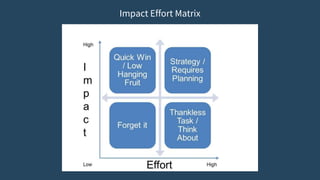
Impact Effort Matrix
Plot your most common regular tasks along with
new key goals
(2 minutes)
Complete the Time Based section of the goal
planning
(3 mins)
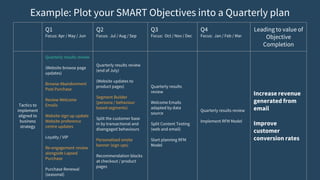
Example: Plot your SMART Objectives into a Quarterly plan
Q1
Focus: Apr / May / Jun
Q2
Focus: Jul / Aug / Sep
Q3
Focus: Oct / Nov / Dec
Q4
Focus: Jan / Feb / Mar
Leading to value of
Objective
Completion
Tactics to
implement
aligned to
business
strategy
Quarterly results review
(Website browse page
updates)
Browse Abandonment
Post Purchase
Review Welcome
Emails
Website sign up update
Website preference
centre updates
Loyalty / VIP
Re-engagement review
alongside Lapsed
Purchase
Purchase Renewal
(seasonal)
Quarterly results review
(end of July)
(Website updates to
product pages)
Segment Builder
(persona / behaviour
based segments)
Split the customer base
in by transactional and
disengaged behaviours
Personalised onsite
banner (sign ups)
Recommendation blocks
at checkout / product
pages
Quarterly results
review
Welcome Emails
adapted by data
source
Split Content Testing
(web and email)
Start planning RFM
Model
Quarterly results review
Implement RFM Model
Increase revenue
generated from
email
Improve
customer
conversion rates
● We know our objectives
● We’ve clearly defined our goals
● We know how to measure our goal and set KPIs
● We’ve outline how it can be achieved
● We’re confident the goal is relevant
● We’ve identified our priorities and set a deadline to
achieving our goal
What we have covered so far
Email, SMS, Social, Ads, Push,
Direct
Web triggers & personalisation
Systems integration
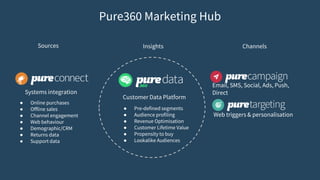
Pure360 Marketing Hub
Customer Data Platform
ChannelsSources
● Pre-defined segments
● Audience profiling
● Revenue Optimisation
● Customer Lifetime Value
● Propensity to buy
● Lookalike Audiences
● Online purchases
● Offline sales
● Channel engagement
● Web behaviour
● Demographic/CRM
● Returns data
● Support data
Insights
The Broadcaster
The Segmenter
The Recommender
The Predictor
Broadcast to as many people
as possible
Focus on lead generation,
traffic, opens, clicks
Small database
Limited resources
Sending relevant targeted
campaigns to demographic
segments
Focus on increasing revenue
and engagement
Struggling with disparate
systems and databases
Sending frequent targeted
campaigns, product
recommendations and
upselling
Focus on building
relationships and loyalty
Increasing use of data
Reliant on IT resources for
data management
Struggling to achieve a single
customer view
Sending based on lifecycle
engagement and behavioural
predictions
Focus on retaining customers,
increasing loyalty and
generating scalable revenue
Struggling to stay ahead of
competition and perfect
automation capabilities
The Pure360 Maturity Model
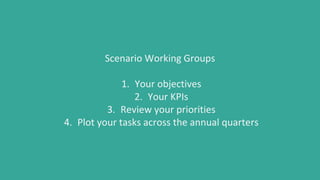
Scenario Working Groups
1. Your objectives
2. Your KPIs
3. Review your priorities
4. Plot your tasks across the annual quarters
SMART Tactics
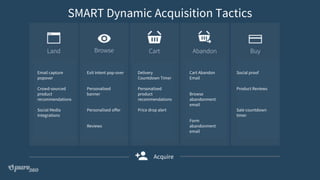
SMART Dynamic Acquisition Tactics
Email capture
popover
Crowd-sourced
product
recommendations
Social Media
Integrations
Exit intent pop-over
Personalised
banner
Personalised offer
Reviews
Delivery
Countdown Timer
Personalised
product
recommendations
Price drop alert
Cart Abandon
Email
Browse
abandonment
email
Form
abandonment
email
Social proof
Product Reviews
Sale countdown
timer
Acquire
Popovers
Increase your signup rate by over 100%!
Maximise your lead gen efforts by creating a one on one
conversation through email
Time these based on session duration to make sure the customer
experience is not interrupted
Land
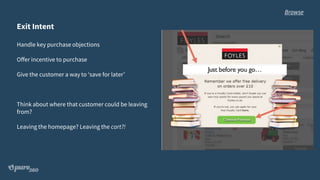
Exit Intent
Handle key purchase objections
Offer incentive to purchase
Give the customer a way to ‘save for later’
Think about where that customer could be leaving
from?
Leaving the homepage? Leaving the cart?!
Browse
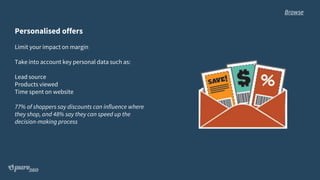
Personalised offers
Limit your impact on margin
Take into account key personal data such as:
Lead source
Products viewed
Time spent on website
77% of shoppers say discounts can influence where
they shop, and 48% say they can speed up the
decision-making process
Browse
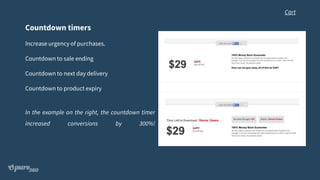
Countdown timers
Increase urgency of purchases.
Countdown to sale ending
Countdown to next day delivery
Countdown to product expiry
In the example on the right, the countdown timer
increased conversions by 300%!
Cart
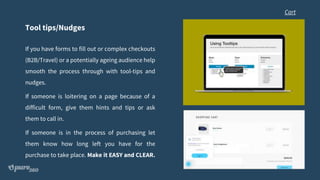
Tool tips/Nudges
If you have forms to fill out or complex checkouts
(B2B/Travel) or a potentially ageing audience help
smooth the process through with tool-tips and
nudges.
If someone is loitering on a page because of a
difficult form, give them hints and tips or ask
them to call in.
If someone is in the process of purchasing let
them know how long left you have for the
purchase to take place. Make it EASY and CLEAR.
Cart
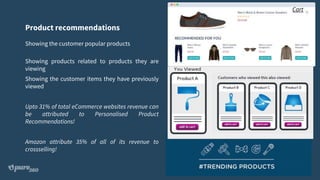
Product recommendations
Showing the customer popular products
Showing products related to products they are
viewing
Showing the customer items they have previously
viewed
Upto 31% of total eCommerce websites revenue can
be attributed to Personalised Product
Recommendations!
Amazon attribute 35% of all of its revenue to
crossselling!
Cart
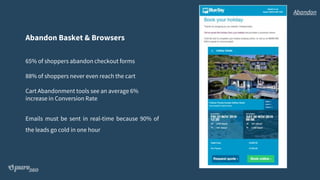
Abandon Basket & Browsers
65% of shoppers abandon checkout forms
88% of shoppers never even reach the cart
Cart Abandonment tools see an average 6%
increase in Conversion Rate
Emails must be sent in real-time because 90% of
the leads go cold in one hour
Abandon
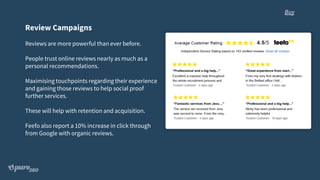
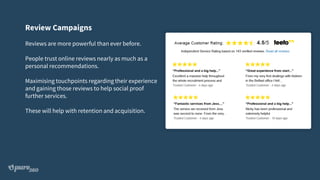
Review Campaigns
Reviews are more powerful than ever before.
People trust online reviews nearly as much as a
personal recommendations.
Maximising touchpoints regarding their experience
and gaining those reviews to help social proof
further services.
These will help with retention and acquisition.
Feefo also report a 10% increase in click through
from Google with organic reviews.
Buy
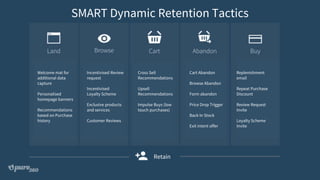
SMART Dynamic Retention Tactics
Welcome mat for
additional data
capture
Personalised
homepage banners
Recommendations
based on Purchase
history
Incentivised Review
request
Incentivised
Loyalty Scheme
Exclusive products
and services
Customer Reviews
Cross Sell
Recommendations
Upsell
Recommendations
Impulse Buys (low
touch purchases)
Cart Abandon
Browse Abandon
Form abandon
Price Drop Trigger
Back In Stock
Exit intent offer
Replenishment
email
Repeat Purchase
Discount
Review Request
Invite
Loyalty Scheme
Invite
Retain
Personalised Homepages/Banners
Land
Personalised Homepages/Banners
No seriously...
Land
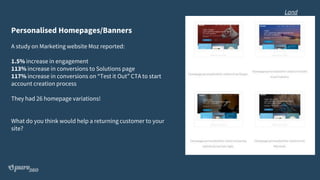
Personalised Homepages/Banners
A study on Marketing website Moz reported:
1.5% increase in engagement
113% increase in conversions to Solutions page
117% increase in conversions on “Test it Out” CTA to start
account creation process
They had 26 homepage variations!
What do you think would help a returning customer to your
site?
Land
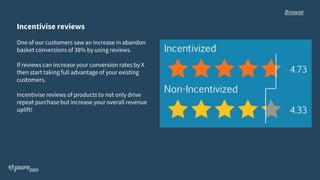
Incentivise reviews
One of our customers saw an increase in abandon
basket conversions of 38% by using reviews.
If reviews can increase your conversion rates by X
then start taking full advantage of your existing
customers.
Incentivise reviews of products to not only drive
repeat purchase but increase your overall revenue
uplift!
Browse
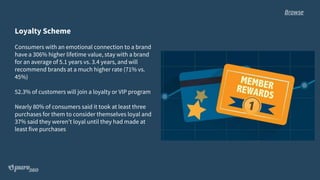
Loyalty Scheme
Consumers with an emotional connection to a brand
have a 306% higher lifetime value, stay with a brand
for an average of 5.1 years vs. 3.4 years, and will
recommend brands at a much higher rate (71% vs.
45%)
52.3% of customers will join a loyalty or VIP program
Nearly 80% of consumers said it took at least three
purchases for them to consider themselves loyal and
37% said they weren’t loyal until they had made at
least five purchases
Browse
Replenishment Campaigns
Live replenish on your website.
If your email list is 100k but you get 300k visitors a
month to your site, reach out to people not on your
email list by running live replenishment
campaigns.
Someone is back on the site with in 30 days of
buying an item that should last 30 days? Ask them
if they are running low!
Buy
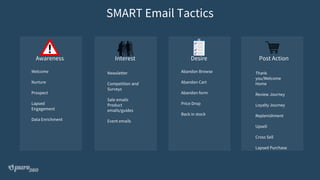
Awareness Interest Desire Post Action
Welcome
Nurture
Prospect
Lapsed
Engagement
Data Enrichment
Newsletter
Competition and
Surveys
Sale emails
Product
emails/guides
Event emails
Abandon Browse
Abandon Cart
Abandon form
Price Drop
Back in stock
Thank
you/Welcome
Home
Review Journey
Loyalty Journey
Replenishment
Upsell
Cross Sell
Lapsed Purchase
SMART Email Tactics
The best practice tactics we typically see
Awarenes
s
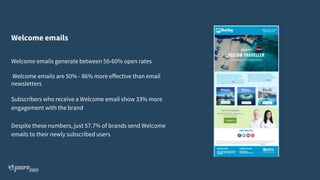
Welcome emails
Welcome emails generate between 50-60% open rates
Welcome emails are 50% - 86% more effective than email
newsletters
Subscribers who receive a Welcome email show 33% more
engagement with the brand
Despite these numbers, just 57.7% of brands send Welcome
emails to their newly subscribed users
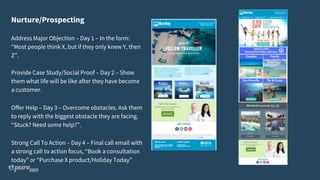
Nurture/Prospecting
Address Major Objection – Day 1 – In the form:
“Most people think X, but if they only knew Y, then
Z”.
Provide Case Study/Social Proof – Day 2 – Show
them what life will be like after they have become
a customer.
Offer Help – Day 3 – Overcome obstacles. Ask them
to reply with the biggest obstacle they are facing.
“Stuck? Need some help?”.
Strong Call To Action – Day 4 – Final call email with
a strong call to action focus, “Book a consultation
today” or “Purchase X product/Holiday Today”
Interest
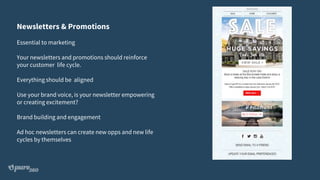
Newsletters & Promotions
Essential to marketing
Your newsletters and promotions should reinforce
your customer life cycle.
Everything should be aligned
Use your brand voice, is your newsletter empowering
or creating excitement?
Brand building and engagement
Ad hoc newsletters can create new opps and new life
cycles by themselves
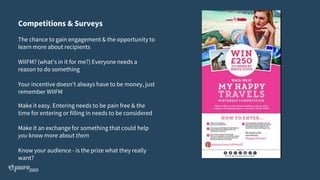
Competitions & Surveys
The chance to gain engagement & the opportunity to
learn more about recipients
WIIFM? (what's in it for me?) Everyone needs a
reason to do something
Your incentive doesn't always have to be money, just
remember WIIFM
Make it easy. Entering needs to be pain free & the
time for entering or filling in needs to be considered
Make it an exchange for something that could help
you know more about them
Know your audience - is the prize what they really
want?
Desire
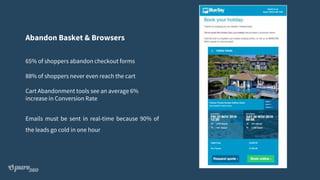
Abandon Basket & Browsers
65% of shoppers abandon checkout forms
88% of shoppers never even reach the cart
Cart Abandonment tools see an average 6%
increase in Conversion Rate
Emails must be sent in real-time because 90% of
the leads go cold in one hour
Post - Action
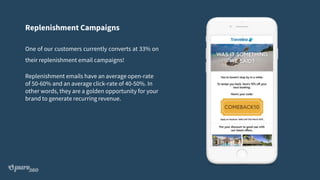
Replenishment Campaigns
One of our customers currently converts at 33% on
their replenishment email campaigns!
Replenishment emails have an average open-rate
of 50-60% and an average click-rate of 40-50%. In
other words, they are a golden opportunity for your
brand to generate recurring revenue.
Review Campaigns
Reviews are more powerful than ever before.
People trust online reviews nearly as much as a

personal recommendations.
Maximising touchpoints regarding their experience
and gaining those reviews to help social proof
further services.
These will help with retention and acquisition.
Don’t forget...
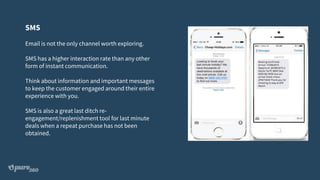
SMS
Email is not the only channel worth exploring.
SMS has a higher interaction rate than any other
form of instant communication.
Think about information and important messages
to keep the customer engaged around their entire
experience with you.
SMS is also a great last ditch re-
engagement/replenishment tool for last minute
deals when a repeat purchase has not been
obtained.
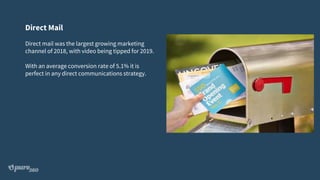
Direct Mail
Direct mail was the largest growing marketing
channel of 2018, with video being tipped for 2019.
With an average conversion rate of 5.1% it is
perfect in any direct communications strategy.
Maximising your touch points with monetary
segmentation…
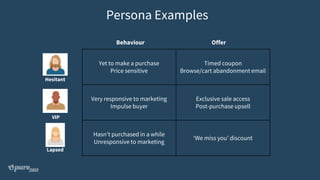
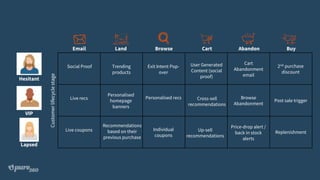
Hesitant
VIP
Lapsed
Yet to make a purchase
Price sensitive
Timed coupon
Browse/cart abandonment email
Very responsive to marketing
Impulse buyer
Exclusive sale access
Post-purchase upsell
Hasn’t purchased in a while
Unresponsive to marketing
‘We miss you’ discount
Behaviour Offer
Persona Examples
Land CartBrowse Abandon Buy
Trending
products
Personalised
homepage
banners
Recommendations
based on their
previous purchase
Exit Intent Pop-
over
User Generated
Content (social
proof)
Cart
Abandonment
email
2nd purchase
discount
Personalised recs
Individual
coupons
Post sale trigger
Browse
Abandonment
Cross-sell
recommendations
Up-sell
recommendations
Price-drop alert /
back in stock
alerts
Replenishment
Customerlifecyclestage
Email
Social Proof
Live recs
Live coupons
Hesitant
VIP
Lapsed
EXAMPLE of scenario
Scenario Working Groups
1. Your objectives
2. Your KPIs
3. Review your priorities
4. Plot your tasks across the annual quarters
Thank you!

PureAcademy Brighton - SMART Planning Workshop

  • 1.
    PureAcademy: S.M.A.R.T Planning &Tactics Workshop July 2019
  • 2.
    Today’s Agenda ● Introductions& housekeeping ● Pure360s Maturity Model ● Understand why we do what we do ● SMART Planning ● BREAK (15 mins) ● Annual planning & tools to take away ● LUNCH ● Smart Tactics ● Put in practice what you’ve learnt - Working Groups
  • 3.
  • 4.
    What will Iget out of today’s session? ● Time away from the office and any distractions ● Time to clearly focus on your marketing strategy ● Question whether you are focused on the right objectives ● The tools to articulate your goals clearly ● The importance of setting KPIs for every task you implement ● Leave with the beginning of a solid SMART plan ● Better understanding of how Pure360 can support you
  • 6.
    Email, SMS, Social,Ads, Push, Direct Web triggers & personalisation Systems integration Pure360 Marketing Hub Customer Data Platform ChannelsSources ● Pre-defined segments ● Audience profiling ● Revenue Optimisation ● Customer Lifetime Value ● Propensity to buy ● Lookalike Audiences ● Online purchases ● Offline sales ● Channel engagement ● Web behaviour ● Demographic/CRM ● Returns data ● Support data Insights
  • 7.
    The Broadcaster The Segmenter TheRecommender The Predictor Broadcast to as many people as possible Focus on lead generation, traffic, opens, clicks Small database Limited resources Sending relevant targeted campaigns to demographic segments Focus on increasing revenue and engagement Struggling with disparate systems and databases Sending frequent targeted campaigns, product recommendations and upselling Focus on building relationships and loyalty Increasing use of data Reliant on IT resources for data management Struggling to achieve a single customer view Sending based on lifecycle engagement and behavioural predictions Focus on retaining customers, increasing loyalty and generating scalable revenue Struggling to stay ahead of competition and perfect automation capabilities The Pure360 Maturity Model
  • 10.
    Document your objectives 1.What is the company objective / goal? 2. What is the department objective / goal? 3. What is expected of you? (5 minutes)
  • 11.
    What are KPIsand why are they important?
  • 12.
    Key Performance Indicator(KPI) is a critical metric that measures the success of a specific activity or objective used to measure business goals.
  • 13.
    ● Gives marketingefforts purpose ● Reduces time wasting - if you can’t measure it, why are you doing it? ● They’re success metrics to help you reach key business objectives ● Helps to track performance (personal and team) ● Makes reporting easier! Why KPIs are good
  • 15.
    What are SMARTobjectives SMART is an acronym which provides criteria to guide in the setting of objectives S Specific Details exactly what needs to be done M Measurable Achievement or progress that can be measured A Achievable / Attainable Objective is accepted by those responsible for achieving it R Relevant Objective is relevant to the business and job function T Timed Time period for achievements is clearly stated
  • 16.
    Alongside having KPIs,using the SMART model will also:- ● Increase your campaign success rate ● Supports your clarity in decision making when prioritising tasks ● Optimises resources (people and budget) ● Make it easier to communicate across the business ● Enable larger objectives to become more achievable when broken down into SMART tactical tasks
  • 17.
    SMART Objective Examples “Increasewebsite visits by 10% in June, July and August 2019 compared to the same period in the previous year.” “Increase the average order value of online sales to £35 per customer by the end of August 2019.” “Reduce customer database churn rate by 5% by December 2019.”
  • 18.
    ● Done: Weknow our business goals / objectives ● Next: We’ll clearly define our objectives that feed back up to our goals Steps to setting SMART Objectives
  • 20.
  • 21.
    Customer Lifecycle Audit Mapcurrent activities and the activities you need to action to meet your objectives (Acquisition / Growth / Retention) (5 minutes)
  • 22.
    Today’s Agenda ● Introductions& housekeeping ● A brief welcome from Pure360’s CEO - Mark Ash ● Understand why we do what we do ● SMART Planning (with a brief 5 minute break) ● Annual planning & tools to take away ● BREAK ● Smart Tactics ● Put in practice what you’ve learnt - Working Groups ● LUNCH
  • 23.
    S Specific Details exactlywhat needs to be done M Measurable Achievement or progress that can be measured A Achievable Objective is accepted by those responsible for achieving it R Relevant Objective is relevant to the business and job function T Timed Time period for achievements is clearly stated
  • 24.
    S - Specific- Examples Objective: “I need to grow the number of marketable contacts in the customer database” Objective: “We need to increase online sales conversions” Objective: “ I want to reduce customer churn rates”
  • 26.
    SMART GOAL /OBJECTIVE PLANNING 1. Pick one of your objectives (front page) 1. Write down that Goal in the Draft Goal Statement line of the Smart Goal Planning template 1. Complete the “Specific” section of the template (5 mins - confer with your neighbours!)
  • 27.
    ● Done: Weknow our objectives / goals ● Done: We’ve clearly defined one of our goals / objectives ● Next: We need to ensure it can be measured Steps to setting SMART Objectives
  • 28.
    S Specific Details exactlywhat needs to be done M Measurable Achievement or progress that can be measured A Achievable Objective is accepted by those responsible for achieving it R Relevant Objective is relevant to the business and job function T Timed Time period for achievements is clearly stated
  • 29.
    M - Measurable- Achievement or progress that can be measured What are you currently measuring? For example:- ● Revenue by channel ● Return on Investment ● Sign up rates ● The value of an email address ● Customer Lifetime Value ● Open rates ● Click Rates ● Bounce/Blocked Rates ● Churn Rates ● Conversion Rates ● Average Order Values ● And so much more! What % increase do you need to see across those metrics? Why?
  • 31.
    Can your goalbe measured? How? Document how you intend to measure your success of this goal and what metrics will you want to monitor (5 minutes)
  • 32.
    ● Done: Weknow our objectives ● Done: We’ve clearly defined our goals / objectives ● Done: We know how to measure our objective and set KPIs ● Next: Let’s find out if it is achievable Steps to setting SMART Objectives
  • 33.
    S Specific Details exactlywhat needs to be done M Measurable Achievement or progress that can be measured A Achievable Objective is accepted by those responsible for achieving it R Relevant Objective is relevant to the business and job function T Timed Time period for achievements is clearly stated
  • 34.
    Should you acceptor set an objective that states:- “Increase of 30% in email sales” when you know email lists have been declining every month? Will a “30% increase in email clicks” really increase sales? Who will be responsible and available to deliver the tasks involved? Is it achievable?
  • 35.
    Document the dependenciesrequired for the objective / goal to be achievable (5 minutes)
  • 37.
    ● Done: Weknow our objectives ● Done: We’ve clearly defined our goals / objectives ● Done: We know how to measure our goal and set KPIs ● Done: We’ve outline how it can be achieved ● Next: We’re going to look at the objective’s relevancy to the business Steps to setting SMART Objectives
  • 38.
    S Specific Details exactlywhat needs to be done M Measurable Achievement or progress that can be measured A Achievable Objective is accepted by those responsible for achieving it R Relevant Objective is relevant to the business and job function T Timed Time period for achievements is clearly stated
  • 40.
    Complete the relevancyof the goal to the business and your role (3 minutes)
  • 41.
    ● Done: Weknow our objectives ● Done: We’ve clearly defined our goals / objectives ● Done: We know how to measure our objectives and set KPIs ● Done: We’ve outline how it can be achieved ● Done: We’re confident the objective is relevant ● Next: We’ll set a deadline to achieving our goal / objective Steps to setting SMART Objectives
  • 42.
    S Specific Details exactlywhat needs to be done M Measurable Achievement or progress that can be measured A Achievable Objective is accepted by those responsible for achieving it R Realistic Objective is relevant to the business and job function T Timed Time period for achievements is clearly stated
  • 43.
  • 44.
    Impact Effort Matrix Plotyour most common regular tasks along with new key goals (2 minutes)
  • 45.
    Complete the TimeBased section of the goal planning (3 mins)
  • 46.
    Example: Plot yourSMART Objectives into a Quarterly plan Q1 Focus: Apr / May / Jun Q2 Focus: Jul / Aug / Sep Q3 Focus: Oct / Nov / Dec Q4 Focus: Jan / Feb / Mar Leading to value of Objective Completion Tactics to implement aligned to business strategy Quarterly results review (Website browse page updates) Browse Abandonment Post Purchase Review Welcome Emails Website sign up update Website preference centre updates Loyalty / VIP Re-engagement review alongside Lapsed Purchase Purchase Renewal (seasonal) Quarterly results review (end of July) (Website updates to product pages) Segment Builder (persona / behaviour based segments) Split the customer base in by transactional and disengaged behaviours Personalised onsite banner (sign ups) Recommendation blocks at checkout / product pages Quarterly results review Welcome Emails adapted by data source Split Content Testing (web and email) Start planning RFM Model Quarterly results review Implement RFM Model Increase revenue generated from email Improve customer conversion rates
  • 47.
    ● We knowour objectives ● We’ve clearly defined our goals ● We know how to measure our goal and set KPIs ● We’ve outline how it can be achieved ● We’re confident the goal is relevant ● We’ve identified our priorities and set a deadline to achieving our goal What we have covered so far
  • 49.
    Email, SMS, Social,Ads, Push, Direct Web triggers & personalisation Systems integration Pure360 Marketing Hub Customer Data Platform ChannelsSources ● Pre-defined segments ● Audience profiling ● Revenue Optimisation ● Customer Lifetime Value ● Propensity to buy ● Lookalike Audiences ● Online purchases ● Offline sales ● Channel engagement ● Web behaviour ● Demographic/CRM ● Returns data ● Support data Insights
  • 50.
    The Broadcaster The Segmenter TheRecommender The Predictor Broadcast to as many people as possible Focus on lead generation, traffic, opens, clicks Small database Limited resources Sending relevant targeted campaigns to demographic segments Focus on increasing revenue and engagement Struggling with disparate systems and databases Sending frequent targeted campaigns, product recommendations and upselling Focus on building relationships and loyalty Increasing use of data Reliant on IT resources for data management Struggling to achieve a single customer view Sending based on lifecycle engagement and behavioural predictions Focus on retaining customers, increasing loyalty and generating scalable revenue Struggling to stay ahead of competition and perfect automation capabilities The Pure360 Maturity Model
  • 51.
    Scenario Working Groups 1.Your objectives 2. Your KPIs 3. Review your priorities 4. Plot your tasks across the annual quarters
  • 52.
  • 53.
    SMART Dynamic AcquisitionTactics Email capture popover Crowd-sourced product recommendations Social Media Integrations Exit intent pop-over Personalised banner Personalised offer Reviews Delivery Countdown Timer Personalised product recommendations Price drop alert Cart Abandon Email Browse abandonment email Form abandonment email Social proof Product Reviews Sale countdown timer Acquire
  • 54.
    Popovers Increase your signuprate by over 100%! Maximise your lead gen efforts by creating a one on one conversation through email Time these based on session duration to make sure the customer experience is not interrupted Land
  • 55.
    Exit Intent Handle keypurchase objections Offer incentive to purchase Give the customer a way to ‘save for later’ Think about where that customer could be leaving from? Leaving the homepage? Leaving the cart?! Browse
  • 56.
    Personalised offers Limit yourimpact on margin Take into account key personal data such as: Lead source Products viewed Time spent on website 77% of shoppers say discounts can influence where they shop, and 48% say they can speed up the decision-making process Browse
  • 57.
    Countdown timers Increase urgencyof purchases. Countdown to sale ending Countdown to next day delivery Countdown to product expiry In the example on the right, the countdown timer increased conversions by 300%! Cart
  • 58.
    Tool tips/Nudges If youhave forms to fill out or complex checkouts (B2B/Travel) or a potentially ageing audience help smooth the process through with tool-tips and nudges. If someone is loitering on a page because of a difficult form, give them hints and tips or ask them to call in. If someone is in the process of purchasing let them know how long left you have for the purchase to take place. Make it EASY and CLEAR. Cart
  • 59.
    Product recommendations Showing thecustomer popular products Showing products related to products they are viewing Showing the customer items they have previously viewed Upto 31% of total eCommerce websites revenue can be attributed to Personalised Product Recommendations! Amazon attribute 35% of all of its revenue to crossselling! Cart
  • 60.
    Abandon Basket &Browsers 65% of shoppers abandon checkout forms 88% of shoppers never even reach the cart Cart Abandonment tools see an average 6% increase in Conversion Rate Emails must be sent in real-time because 90% of the leads go cold in one hour Abandon
  • 61.
    Review Campaigns Reviews aremore powerful than ever before. People trust online reviews nearly as much as a personal recommendations. Maximising touchpoints regarding their experience and gaining those reviews to help social proof further services. These will help with retention and acquisition. Feefo also report a 10% increase in click through from Google with organic reviews. Buy
  • 62.
    SMART Dynamic RetentionTactics Welcome mat for additional data capture Personalised homepage banners Recommendations based on Purchase history Incentivised Review request Incentivised Loyalty Scheme Exclusive products and services Customer Reviews Cross Sell Recommendations Upsell Recommendations Impulse Buys (low touch purchases) Cart Abandon Browse Abandon Form abandon Price Drop Trigger Back In Stock Exit intent offer Replenishment email Repeat Purchase Discount Review Request Invite Loyalty Scheme Invite Retain
  • 63.
  • 64.
  • 65.
    Personalised Homepages/Banners A studyon Marketing website Moz reported: 1.5% increase in engagement 113% increase in conversions to Solutions page 117% increase in conversions on “Test it Out” CTA to start account creation process They had 26 homepage variations! What do you think would help a returning customer to your site? Land
  • 66.
    Incentivise reviews One ofour customers saw an increase in abandon basket conversions of 38% by using reviews. If reviews can increase your conversion rates by X then start taking full advantage of your existing customers. Incentivise reviews of products to not only drive repeat purchase but increase your overall revenue uplift! Browse
  • 67.
    Loyalty Scheme Consumers withan emotional connection to a brand have a 306% higher lifetime value, stay with a brand for an average of 5.1 years vs. 3.4 years, and will recommend brands at a much higher rate (71% vs. 45%) 52.3% of customers will join a loyalty or VIP program Nearly 80% of consumers said it took at least three purchases for them to consider themselves loyal and 37% said they weren’t loyal until they had made at least five purchases Browse
  • 68.
    Replenishment Campaigns Live replenishon your website. If your email list is 100k but you get 300k visitors a month to your site, reach out to people not on your email list by running live replenishment campaigns. Someone is back on the site with in 30 days of buying an item that should last 30 days? Ask them if they are running low! Buy
  • 69.
    Awareness Interest DesirePost Action Welcome Nurture Prospect Lapsed Engagement Data Enrichment Newsletter Competition and Surveys Sale emails Product emails/guides Event emails Abandon Browse Abandon Cart Abandon form Price Drop Back in stock Thank you/Welcome Home Review Journey Loyalty Journey Replenishment Upsell Cross Sell Lapsed Purchase SMART Email Tactics
  • 70.
    The best practicetactics we typically see
  • 71.
  • 72.
    Welcome emails Welcome emailsgenerate between 50-60% open rates Welcome emails are 50% - 86% more effective than email newsletters Subscribers who receive a Welcome email show 33% more engagement with the brand Despite these numbers, just 57.7% of brands send Welcome emails to their newly subscribed users
  • 73.
    Nurture/Prospecting Address Major Objection– Day 1 – In the form: “Most people think X, but if they only knew Y, then Z”. Provide Case Study/Social Proof – Day 2 – Show them what life will be like after they have become a customer. Offer Help – Day 3 – Overcome obstacles. Ask them to reply with the biggest obstacle they are facing. “Stuck? Need some help?”. Strong Call To Action – Day 4 – Final call email with a strong call to action focus, “Book a consultation today” or “Purchase X product/Holiday Today”
  • 74.
  • 75.
    Newsletters & Promotions Essentialto marketing Your newsletters and promotions should reinforce your customer life cycle. Everything should be aligned Use your brand voice, is your newsletter empowering or creating excitement? Brand building and engagement Ad hoc newsletters can create new opps and new life cycles by themselves
  • 76.
    Competitions & Surveys Thechance to gain engagement & the opportunity to learn more about recipients WIIFM? (what's in it for me?) Everyone needs a reason to do something Your incentive doesn't always have to be money, just remember WIIFM Make it easy. Entering needs to be pain free & the time for entering or filling in needs to be considered Make it an exchange for something that could help you know more about them Know your audience - is the prize what they really want?
  • 77.
  • 78.
    Abandon Basket &Browsers 65% of shoppers abandon checkout forms 88% of shoppers never even reach the cart Cart Abandonment tools see an average 6% increase in Conversion Rate Emails must be sent in real-time because 90% of the leads go cold in one hour
  • 79.
  • 80.
    Replenishment Campaigns One ofour customers currently converts at 33% on their replenishment email campaigns! Replenishment emails have an average open-rate of 50-60% and an average click-rate of 40-50%. In other words, they are a golden opportunity for your brand to generate recurring revenue.
  • 81.
    Review Campaigns Reviews aremore powerful than ever before. People trust online reviews nearly as much as a personal recommendations. Maximising touchpoints regarding their experience and gaining those reviews to help social proof further services. These will help with retention and acquisition.
  • 82.
  • 83.
    SMS Email is notthe only channel worth exploring. SMS has a higher interaction rate than any other form of instant communication. Think about information and important messages to keep the customer engaged around their entire experience with you. SMS is also a great last ditch re- engagement/replenishment tool for last minute deals when a repeat purchase has not been obtained.
  • 84.
    Direct Mail Direct mailwas the largest growing marketing channel of 2018, with video being tipped for 2019. With an average conversion rate of 5.1% it is perfect in any direct communications strategy.
  • 85.
    Maximising your touchpoints with monetary segmentation…
  • 86.
    Hesitant VIP Lapsed Yet to makea purchase Price sensitive Timed coupon Browse/cart abandonment email Very responsive to marketing Impulse buyer Exclusive sale access Post-purchase upsell Hasn’t purchased in a while Unresponsive to marketing ‘We miss you’ discount Behaviour Offer Persona Examples
  • 87.
    Land CartBrowse AbandonBuy Trending products Personalised homepage banners Recommendations based on their previous purchase Exit Intent Pop- over User Generated Content (social proof) Cart Abandonment email 2nd purchase discount Personalised recs Individual coupons Post sale trigger Browse Abandonment Cross-sell recommendations Up-sell recommendations Price-drop alert / back in stock alerts Replenishment Customerlifecyclestage Email Social Proof Live recs Live coupons Hesitant VIP Lapsed
  • 88.
  • 89.
    Scenario Working Groups 1.Your objectives 2. Your KPIs 3. Review your priorities 4. Plot your tasks across the annual quarters
  • 90.

Editor's Notes

  • #6 https://www.commoncoresheets.com/FunStuff.php
  • #9 SMART planning is all about aligning your activities and efforts back to your business / team objectives. You need to understand what is expected of you? And why? What is the business trying to achieve? What will the impact be? Is it worth the time and effort?
  • #10 These taglines don’t tell you why you should use Nike or Apple products. They don’t include benefits or features. Instead, they act as brand triggers. Brand associations & values. They’re verbal logos of your brand They are the WHY of why you should engage with them. Example Apple, a great example of working from the WHY to the HOW to the WHAT Why- hey want to think differently thereby challenging the status quo. They answer the HOW question by informing their potential buyers that their eye-catching designs are easy to use. Finally, they arrive at the WHAT question: they make computers. Simon Sinek argues that customers do not buy products because of what companies do but because of why they do it.
  • #11 Worksheet Document your business and marketing objectives
  • #13  Show of hands - how many people have specific KPIs against each task / campaign you’ve planned?
  • #14 A single KPI is less important when it stands on its own. When reviewed as a collective - it provides you with far richer insight.
  • #15 You will need to be able to include a KPI alongside your SMART objectives. So let’s start breaking SMART down into detail.
  • #16 First of all - what is SMART Now most of you will already know what SMART objectives are. But are you actually working SMART on a daily basis?
  • #18 With each one these statements, there are several tasks that sit below these. And along with those tasks, sit other metrics that you have to consider and measure.
  • #20 As marketers, we’re responsible for all aspects of the customer journey. Although we are focused today on Email, please don’t feel restricted to plotting out just your email customer lifecycles. Consider other channels that drive your audience reach. Consider other channels in the wider objective planning, if that feeds in to your objectives.
  • #21 In terms of email, these are the key stages of the lifecycle to review. Ensure these are implemented as part of best practice, revenue generation and customer retention. Conversion (could be, download, demo request, form)
  • #22 Worksheets - there is a simple email lifecycle checklist to review Typically - we would actually spend a whole day on this. So although we’re only doing this task as a mini audit, We would encourage you to review this in detail.
  • #24 Considering the business objectives Let’s start with looking at the Specific part of the model The Objective needs to be clear, well defined, an unambiguous.
  • #25 Here are some examples of a specific statement that a marketer wants to achieve. They’re fairly clear. But we don’t yet know why they’re good.
  • #26 In a moment we are going to review our objective statements, we need to make sure we understand why we are setting those objectives. Ask yourself the question why? Why is this important? How does this align to my team or business objectives?
  • #29 Let’s find out if you can measure your objectives!!
  • #30 These are the most common metrics marketing teams measure. But this doesn’t answer the question on impact.
  • #31 Before we consider applying a KPI to our goal, we need to ensure that we are using the right KPI to measure its success. Your KPIs should match your why. Tactics for fill a KPI !!!! Pure360 why - empowering our customers to be the best they can be !!!! MY KPI - to speak to all customers a month
  • #32 You can start making notes and breaking down the main goal into smaller goals. You might want to start making a note of some of the KPIs you have in place or want to implement using the KPI section of the worksheet if that helps. giving you templates to take away with you to complete when you have more time
  • #35 We need to consider how other factors could influence the success of you being able to achieve your objective. Consider other challenges you might have. Ask yourself who will be responsible for the delivery of the objective and its tasks.
  • #36 On the achievable section of the objective planning, we now need to detail who will own the delivery. Who is going to own certain aspects / tasks How realistic will that be? Make a note of any challenges you think you might have too
  • #37 Has anyone so far identified any challenges they’d like to share? Reliance of other teams for example?
  • #39 Is your goal realistic? Is it relevant? Does this serve your job role? How relevant is this goal to the business?
  • #40 Is the time and effort realistic? Will it be worth it? Are you the right person to own this objective? Another question to ask yourself, is if the business are expecting revenue growth of 10% in 12 months, can you really achieve that when your list is deteriorating by 20%?
  • #41 Let’s complete the relevancy section of the goal planning
  • #43 Part of measuring the success of a goal is setting a deadline to measure it. We need a target and an end date to reach it. Time frames can also heavily influence whether the goal is achievable and realistic. Be honest with yourself!
  • #44 Before we set our time frames, we need to make sure we review all other tasks too. This is an easy way to see what you should do and when. And whether you should be doing it at all! Once you have your tasks and goals written out - spend time prioritising them. What are your quick wins? What are your biggest priorities feeding back to your goals? Don’t be afraid to drop something if it does not align to the goal!
  • #45 We’ve given you a template of the Impact Effort Matrix Feel free to start jotting down some other tasks But this one is to take away when you have some time to consider everything!
  • #47 Here is an example of quarterly mapping exercise
  • #49 Quick 5 minute break
  • #54 Up/Cross Selling Campaigns Can be responsible for 10% - 30% of ecommerce revenues Countdown Timers: 28% increase in clicks compared to ‘standard’ abandonment emails Identifying opportunities Your tactics
  • #55 https://www.smartinsights.com/email-marketing/email-list-management-ecrm/popovers-and-lightboxes/
  • #56 https://www.smartinsights.com/email-marketing/email-list-management-ecrm/popovers-and-lightboxes/
  • #57 https://blog.accessdevelopment.com/2018-customer-loyalty-statistics#lmktg
  • #58 https://blog.salecycle.com/strategies/countdown-timers-can-used-drive-ecommerce-sales/
  • #59 https://blog.salecycle.com/strategies/countdown-timers-can-used-drive-ecommerce-sales/
  • #60 https://www.barilliance.com/personalized-product-recommendations-stats/ Looking for inspiration, what are your most popular products? What are your trending products https://www.the-future-of-commerce.com/2013/10/14/ecommerce-cross-sell-up-sell/
  • #63 Up/Cross Selling Campaigns Can be responsible for 10% - 30% of ecommerce revenues Countdown Timers: 28% increase in clicks compared to ‘standard’ abandonment emails
  • #64 Next slide Add to this engagement, benefits of welcome series
  • #65 Next slide Add to this engagement, benefits of welcome series
  • #66 https://moz.com/blog/homepage-personalization
  • #68 https://blog.accessdevelopment.com/2018-customer-loyalty-statistics#loyalty
  • #69 https://blog.ometria.com/replenishment-email-examples
  • #70 Up/Cross Selling Campaigns Can be responsible for 10% - 30% of ecommerce revenues Countdown Timers: 28% increase in clicks compared to ‘standard’ abandonment emails
  • #73 Next slide Add to this engagement, benefits of welcome series
  • #74 Here's a great example of Non monetary incentives - building brand engagement, reinforcing their brand, who they are, their passion and pride They us social proof to eliminate any doubt for buying with reviews and feedback. They then drop back in our inbox just confirming what a great company they are..
  • #83 We can find out a lot about our customers by looking at their purchase habits and nothing else. How can we use this purchase information to make accurate segments?
  • #85 US Conversion rate: https://inkit.io/2018/05/31-essential-direct-mail-marketing-automation-statistics/
  • #86 We can find out a lot about our customers by looking at their purchase habits and nothing else. How can we use this purchase information to make accurate segments?
  • #88 Looking at personas with the full lifecycle in mind Jack clay 4/5