SHARON SHERANI DANIEL
BARCH IV YR VII SEM
FACULTY OF ARCHITECTURE
DR. MGR. EDUCATIONAL & RESEARCH
INSTITUTE, CHENNAI- 95
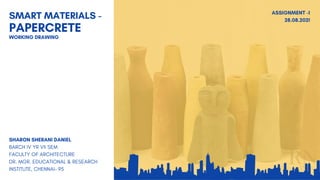
SMART MATERIALS -
PAPERCRETE
WORKING DRAWING
ASSIGNMENT -1
28.08.2021
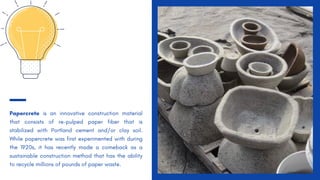
Papercrete is an innovative construction material
that consists of re-pulped paper fiber that is
stabilized with Portland cement and/or clay soil.
While papercrete was first experimented with during
the 1920s, it has recently made a comeback as a
sustainable construction method that has the ability
to recycle millions of pounds of paper waste.
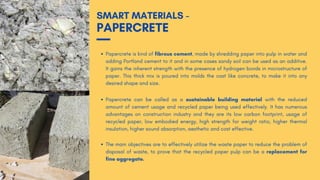
Papercrete is kind of fibrous cement, made by shredding paper into pulp in water and
adding Portland cement to it and in some cases sandy soil can be used as an additive.
It gains the inherent strength with the presence of hydrogen bonds in microstructure of
paper. This thick mix is poured into molds the cast like concrete, to make it into any
desired shape and size.
Papercrete can be called as a sustainable building material with the reduced
amount of cement usage and recycled paper being used effectively. It has numerous
advantages on construction industry and they are its low carbon footprint, usage of
recycled paper, low embodied energy, high strength for weight ratio, higher thermal
insulation, higher sound absorption, aesthetic and cost effective.
SMART MATERIALS -
PAPERCRETE
The main objectives are to effectively utilize the waste paper to reduce the problem of
disposal of waste, to prove that the recycled paper pulp can be a replacement for
fine aggregate.
Paper: usually waste paper such as used newsprint or cardboard.
Aggregate – coarse aggregate or fine aggregate such as sand may
be used depending in the desired strength of the Paper Crete.
Cement: it is used as a binder and used to provide strength and
rigidity to the Paper Crete.
Water
THE BASIC CONSTITUENTS
OF PAPERCRETE
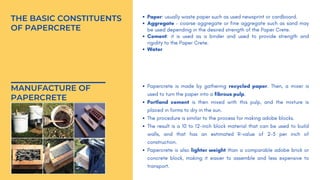
Papercrete is made by gathering recycled paper. Then, a mixer is
used to turn the paper into a fibrous pulp.
Portland cement is then mixed with this pulp, and the mixture is
placed in forms to dry in the sun.
The procedure is similar to the process for making adobe blocks.
The result is a 10 to 12-inch block material that can be used to build
walls, and that has an estimated R-value of 2-3 per inch of
construction.
Papercrete is also lighter weight than a comparable adobe brick or
concrete block, making it easier to assemble and less expensive to
transport.
MANUFACTURE OF
PAPERCRETE
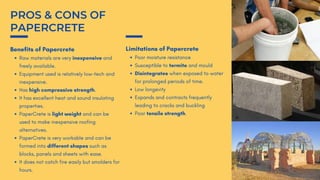
Raw materials are very inexpensive and
freely available.
Equipment used is relatively low-tech and
inexpensive.
Has high compressive strength.
It has excellent heat and sound insulating
properties.
PaperCrete is light weight and can be
used to make inexpensive roofing
alternatives.
PaperCrete is very workable and can be
formed into different shapes such as
blocks, panels and sheets with ease.
It does not catch fire easily but smolders for
hours.
Benefits of Papercrete
Poor moisture resistance
Susceptible to termite and mould
Disintegrates when exposed to water
for prolonged periods of time.
Low longevity
Expands and contracts frequently
leading to cracks and buckling
Poor tensile strength.
Limitations of Papercrete
PROS & CONS OF
PAPERCRETE
Tom and his wife Susan have been building with papercrete
for over twenty five years. Today numerous papercrete
buildings and sculptures dot the Alpine and neighboring
communities.
Its sculptability and organic nature make it an ideal artist's
medium.
It is strong, insulating and soundproof. It is earth friendly,
economical, energy efficient, and darn right beautiful!
CURRY STUDIO AND GALLERY
104 W MURPHY STREET ALPINE, TEXAS 7983
Artist Tom Curry's art studio and his home at texas is made
from recycled newspaper and magazine mixed with water,
sand & cement
NUBIAN VAULT AND SQUINCH
DOME
- BY TOM CURRY AT ALPINE, TEXAS
Papercrete uses waste but never becomes
waste. Papercrete construction is an innovative
home building material that can help reduce
waste and our reliance on cutting down trees.
- THANK YOU

SMART MATERIALS - PAPERCRETE

  • 1.
    SHARON SHERANI DANIEL BARCHIV YR VII SEM FACULTY OF ARCHITECTURE DR. MGR. EDUCATIONAL & RESEARCH INSTITUTE, CHENNAI- 95 SMART MATERIALS - PAPERCRETE WORKING DRAWING ASSIGNMENT -1 28.08.2021
  • 2.
    Papercrete is aninnovative construction material that consists of re-pulped paper fiber that is stabilized with Portland cement and/or clay soil. While papercrete was first experimented with during the 1920s, it has recently made a comeback as a sustainable construction method that has the ability to recycle millions of pounds of paper waste.
  • 3.
    Papercrete is kindof fibrous cement, made by shredding paper into pulp in water and adding Portland cement to it and in some cases sandy soil can be used as an additive. It gains the inherent strength with the presence of hydrogen bonds in microstructure of paper. This thick mix is poured into molds the cast like concrete, to make it into any desired shape and size. Papercrete can be called as a sustainable building material with the reduced amount of cement usage and recycled paper being used effectively. It has numerous advantages on construction industry and they are its low carbon footprint, usage of recycled paper, low embodied energy, high strength for weight ratio, higher thermal insulation, higher sound absorption, aesthetic and cost effective. SMART MATERIALS - PAPERCRETE The main objectives are to effectively utilize the waste paper to reduce the problem of disposal of waste, to prove that the recycled paper pulp can be a replacement for fine aggregate.
  • 4.
    Paper: usually wastepaper such as used newsprint or cardboard. Aggregate – coarse aggregate or fine aggregate such as sand may be used depending in the desired strength of the Paper Crete. Cement: it is used as a binder and used to provide strength and rigidity to the Paper Crete. Water THE BASIC CONSTITUENTS OF PAPERCRETE Papercrete is made by gathering recycled paper. Then, a mixer is used to turn the paper into a fibrous pulp. Portland cement is then mixed with this pulp, and the mixture is placed in forms to dry in the sun. The procedure is similar to the process for making adobe blocks. The result is a 10 to 12-inch block material that can be used to build walls, and that has an estimated R-value of 2-3 per inch of construction. Papercrete is also lighter weight than a comparable adobe brick or concrete block, making it easier to assemble and less expensive to transport. MANUFACTURE OF PAPERCRETE
  • 5.
    Raw materials arevery inexpensive and freely available. Equipment used is relatively low-tech and inexpensive. Has high compressive strength. It has excellent heat and sound insulating properties. PaperCrete is light weight and can be used to make inexpensive roofing alternatives. PaperCrete is very workable and can be formed into different shapes such as blocks, panels and sheets with ease. It does not catch fire easily but smolders for hours. Benefits of Papercrete Poor moisture resistance Susceptible to termite and mould Disintegrates when exposed to water for prolonged periods of time. Low longevity Expands and contracts frequently leading to cracks and buckling Poor tensile strength. Limitations of Papercrete PROS & CONS OF PAPERCRETE
  • 6.
    Tom and hiswife Susan have been building with papercrete for over twenty five years. Today numerous papercrete buildings and sculptures dot the Alpine and neighboring communities. Its sculptability and organic nature make it an ideal artist's medium. It is strong, insulating and soundproof. It is earth friendly, economical, energy efficient, and darn right beautiful! CURRY STUDIO AND GALLERY 104 W MURPHY STREET ALPINE, TEXAS 7983 Artist Tom Curry's art studio and his home at texas is made from recycled newspaper and magazine mixed with water, sand & cement
  • 7.
    NUBIAN VAULT ANDSQUINCH DOME - BY TOM CURRY AT ALPINE, TEXAS
  • 8.
    Papercrete uses wastebut never becomes waste. Papercrete construction is an innovative home building material that can help reduce waste and our reliance on cutting down trees. - THANK YOU