SUBMITTED TO: SUBMITTED BY:
Dr. M P S Chauhan Sachin Singh Rana
 INTRODUCTION
 HOW IT IS MADE?
 CONSTRUCTION
 TESTS ON PAPERCRETE
 PROPERTIES
 APPLICATIONS AND LIMITATION
 ADVANTAGES
 DISADVANTAGES
 ENVIRONMENTAL BONUS
 CONCLUSION
 REFERENCES
 Papercrete is a construction material which
consists of re-pulped paper fiber with portland
cement or clay and other soil.
 It is a type fibrous material made by shredding
paper (old newspaper ..) into pulp in water adding
Portland cement. The thick mix can then be
poured into moulds and cast like concrete,
creating block panels and innumerable other
shapes.
It was invented by Eric Patterson and Mike
McCain in year 1928.
 Soak the paper such as newspaper, shoe and juice
boxes, wrapping papers, napkins, etc overnight.
 Make the paper pulp.
 Weight cement and sand.
 Pour cement and sand.
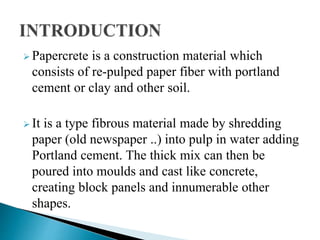
 Mix all the ingredients for approx. 10 mins.
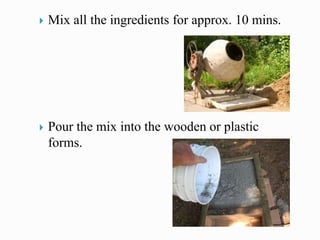
 Pour the mix into the wooden or plastic
forms.
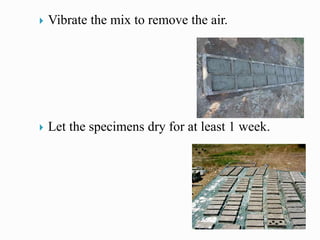
 Vibrate the mix to remove the air.
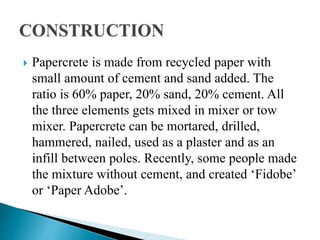
 Let the specimens dry for at least 1 week.
 Remove forms.
 Different shapes.
 Papercrete is made from recycled paper with
small amount of cement and sand added. The
ratio is 60% paper, 20% sand, 20% cement. All
the three elements gets mixed in mixer or tow
mixer. Papercrete can be mortared, drilled,
hammered, nailed, used as a plaster and as an
infill between poles. Recently, some people made
the mixture without cement, and created ‘Fidobe’
or ‘Paper Adobe’.
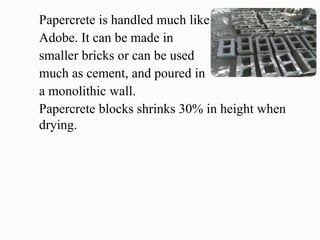
Papercrete is handled much like
Adobe. It can be made in
smaller bricks or can be used
much as cement, and poured in
a monolithic wall.
Papercrete blocks shrinks 30% in height when
drying.
• The Foundation
The function of the foundation is to support the load of the
walls and the roof of a structure and hold the structure
together.
There are number of ways to built footings and stem walls.
One of the most common ways is to pour a concrete footing
and the stem wall in a single monolithic units. This involves
excavating a footing, placing steel rebar horizontally and
vertically, and building forms to support the stem wall. This
cost quite a bit of money and causes significant amount of
concrete.
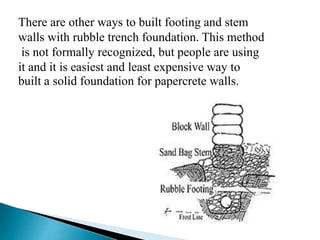
There are other ways to built footing and stem
walls with rubble trench foundation. This method
is not formally recognized, but people are using
it and it is easiest and least expensive way to
built a solid foundation for papercrete walls.
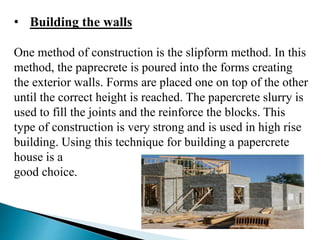
• Building the walls
One method of construction is the slipform method. In this
method, the paprecrete is poured into the forms creating
the exterior walls. Forms are placed one on top of the other
until the correct height is reached. The papercrete slurry is
used to fill the joints and the reinforce the blocks. This
type of construction is very strong and is used in high rise
building. Using this technique for building a papercrete
house is a
good choice.
• Installing the roof
Wooden plate can be attached to the
top of the wall and built a
conventional roof framework.
The rebar method of attaching the
Roof framework to the walls has
been used in structures.
After the roof framework has been installed, you have to
decide whether you want to built a conventional roof or a
papercrete roof. A conventional roof is quite expensive
than papercrete.
Tar is used as a seal for roofing and waterproofs the walls.
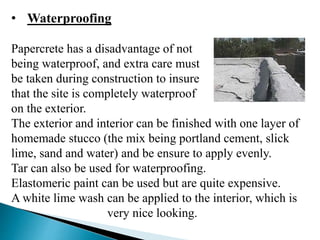
• Waterproofing
Papercrete has a disadvantage of not
being waterproof, and extra care must
be taken during construction to insure
that the site is completely waterproof
on the exterior.
The exterior and interior can be finished with one layer of
homemade stucco (the mix being portland cement, slick
lime, sand and water) and be ensure to apply evenly.
Tar can also be used for waterproofing.
Elastomeric paint can be used but are quite expensive.
A white lime wash can be applied to the interior, which is
very nice looking.
• Windows and doors
Windows and doors can simply be
screwed into the papercrete. The gap
can be trimmed conventionally and/or
filled with papercrete.
Windows should be at least double paned.
Insulated door or two-door
entryways should be built
to minimize heating and
cooling loss.
• Floor
Papercrete itself may not be
best solution for floors since
the point pressure of table
and chair will indent it unless
a great deal of cement is used.
Flagstone are also often used
for flooring.
Flooring can be made from
adobe or a mixture of adobe
and papercrete. An adobe earth floor inlaid with
flagstone
• Heating and cooling
This is where papercrete shines. With proper sealing and
well insulated doors and windows, much smaller heating
and cooling systems are possible.
You can also use solar power systems in papercrete home
if you want to stay further off the grid.
• Compressive Strength Test
The papercrete specimens was tested for their
capacity at compression stage. Sample are
tested after 14 days of drying.
The figure shows how
the papercrete
behaved
when compressed
under load.
The graph shows the average compression
strength of the given sample.
• Weight
All the given blocks were weighed and
their average weight was taken
depending on their ratio to be compared
with the ordinary ones since the main
objective is to determine if it is light
weight.
Average weight of the samples.
Ratios 1:1:0.5 1:1:1 1:1:1.5
Weight(kg) 7.2 6.6 6.1
• Density
Determined by dividing their mass by its
effective volume.
Higher the paper amount the lesser the
density.
Ratio Weight volume density(kg/m3
1:1:0.5 7.2 0.0093 774.193
1:1:1 6.6 0.0093 709.677
1:1:1.5 6.1 0.0093 655.913
Shf;khfdyf;jdlhkkhkh
• Fire Resistance Test
Less damage in papercrete as compared
to wood.
 Dried papercrete has very low strength.
 It has a rough surface which increases its surface
area and provides a very strong bond from one
block to the next.
 It is light-weight.
 It is dimensionally very stable.
 It provides good insulation.
 It is mold resistant material.
 Flame Retardant, i.e. does not catch fire but
smoulders for hours.
 Prevent insect infestation.
 In its natural state, it is a grey fibrous looking wall.
 It can be used as a sound-proofing material.
 R-value is about 2.0 – 3.0 per inch.
 Walls is about 10 – 12 inch thick (about 25 –
30cm).
 Good shear strength as a block.
 Young’s Modulus is 8GPa.
 Low tensile strength.
 Decrease Carbon dioxide content.
 Seven times light weight than concrete.
 Specific heat capacity is 1000J/KgK.
 Stiffness is many times less than that of
concrete.
 Compressive strength is 0.96 – 1.2MPa.
 Large use in house building.
 Different shapes to decorate houses, flower pots.
 Used as sound and heat insulator.
 Large number of shapes which generate
large area of constructions.
 As it is light-weight it can be used in various
applications.
 The application of papercrete has been
practiced mostly in US and England.
 Building made from this can only be of one
storey.
 Not suitable for rainy and marshy area.
 Papercrete is environment-friendly.
 Recycle paper waste.
 Reduces amount of concrete in building.
 Lighter building material that is safer and easier
on body to work with.
 Minimal equipment is needed to make bricks.
 Easy technique to learn.
 Only requires a 2inch concrete pad for a
foundation.
 Insulating material.
 Because of its greater R-value and insulating
qualities, papercrete
homes uses less energy.
 Suitable for hot/arid
climate.
 Low cost.
 As of 2007, papercrete lacks approval from the
International Code Council.
 Papercrete is not particularly ‘structural’, which
means it can’t be used over doors and windows
without some additional support – either wood or
traditional concrete.
 It absorbs water so it should be protected from
water in the rainy season.
 The cost of raw paper will increase as the
number of people using the papercrete will
increase and may also lead to deforestation.
 Incentivizes the recycling of waste paper,
especially in communities with no recycling
services. Saves landfill space.
 Saves wood and other construction resources
which would have been used to built out or finish
the interior and exterior of the structure.
 Provides low-cost sustainable housing. There is
no harmful by-products or excessive energy use
in the production of papercrete.
 Reduces carbon dioxide amount of the
house.
 Use of different material at the place of
cement such as gypsum and lime.
 Good choice to utilize waste paper.
 Good choice for one storey building.
 Inner walls of house can be made by papercrete
and good choice for decoration purpose.
 No government approval but can be used.
 Increase in demand may lead to deforestation.
 If you really want to live of the grid, then go for
papercrete.
 http://en.wikipedia.org/wiki/Papercrete
 www.slideshare.net
 www.livinginpaper.com
 www.greenhomebuilding.com
 www.motherearthnews.com
 www.doityourself.com/stry/papercrete
 www.papercrete.com
PAPERCRETE

PAPERCRETE

  • 1.
    SUBMITTED TO: SUBMITTEDBY: Dr. M P S Chauhan Sachin Singh Rana
  • 2.
     INTRODUCTION  HOWIT IS MADE?  CONSTRUCTION  TESTS ON PAPERCRETE  PROPERTIES  APPLICATIONS AND LIMITATION  ADVANTAGES  DISADVANTAGES  ENVIRONMENTAL BONUS  CONCLUSION  REFERENCES
  • 3.
     Papercrete isa construction material which consists of re-pulped paper fiber with portland cement or clay and other soil.  It is a type fibrous material made by shredding paper (old newspaper ..) into pulp in water adding Portland cement. The thick mix can then be poured into moulds and cast like concrete, creating block panels and innumerable other shapes.
  • 4.
    It was inventedby Eric Patterson and Mike McCain in year 1928.
  • 5.
     Soak thepaper such as newspaper, shoe and juice boxes, wrapping papers, napkins, etc overnight.  Make the paper pulp.
  • 6.
     Weight cementand sand.  Pour cement and sand.
  • 7.
     Mix allthe ingredients for approx. 10 mins.  Pour the mix into the wooden or plastic forms.
  • 8.
     Vibrate themix to remove the air.  Let the specimens dry for at least 1 week.
  • 9.
     Remove forms. Different shapes.
  • 10.
     Papercrete ismade from recycled paper with small amount of cement and sand added. The ratio is 60% paper, 20% sand, 20% cement. All the three elements gets mixed in mixer or tow mixer. Papercrete can be mortared, drilled, hammered, nailed, used as a plaster and as an infill between poles. Recently, some people made the mixture without cement, and created ‘Fidobe’ or ‘Paper Adobe’.
  • 11.
    Papercrete is handledmuch like Adobe. It can be made in smaller bricks or can be used much as cement, and poured in a monolithic wall. Papercrete blocks shrinks 30% in height when drying.
  • 12.
    • The Foundation Thefunction of the foundation is to support the load of the walls and the roof of a structure and hold the structure together. There are number of ways to built footings and stem walls. One of the most common ways is to pour a concrete footing and the stem wall in a single monolithic units. This involves excavating a footing, placing steel rebar horizontally and vertically, and building forms to support the stem wall. This cost quite a bit of money and causes significant amount of concrete.
  • 13.
    There are otherways to built footing and stem walls with rubble trench foundation. This method is not formally recognized, but people are using it and it is easiest and least expensive way to built a solid foundation for papercrete walls.
  • 14.
    • Building thewalls One method of construction is the slipform method. In this method, the paprecrete is poured into the forms creating the exterior walls. Forms are placed one on top of the other until the correct height is reached. The papercrete slurry is used to fill the joints and the reinforce the blocks. This type of construction is very strong and is used in high rise building. Using this technique for building a papercrete house is a good choice.
  • 15.
    • Installing theroof Wooden plate can be attached to the top of the wall and built a conventional roof framework. The rebar method of attaching the Roof framework to the walls has been used in structures. After the roof framework has been installed, you have to decide whether you want to built a conventional roof or a papercrete roof. A conventional roof is quite expensive than papercrete. Tar is used as a seal for roofing and waterproofs the walls.
  • 16.
    • Waterproofing Papercrete hasa disadvantage of not being waterproof, and extra care must be taken during construction to insure that the site is completely waterproof on the exterior. The exterior and interior can be finished with one layer of homemade stucco (the mix being portland cement, slick lime, sand and water) and be ensure to apply evenly. Tar can also be used for waterproofing. Elastomeric paint can be used but are quite expensive. A white lime wash can be applied to the interior, which is very nice looking.
  • 17.
    • Windows anddoors Windows and doors can simply be screwed into the papercrete. The gap can be trimmed conventionally and/or filled with papercrete. Windows should be at least double paned. Insulated door or two-door entryways should be built to minimize heating and cooling loss.
  • 18.
    • Floor Papercrete itselfmay not be best solution for floors since the point pressure of table and chair will indent it unless a great deal of cement is used. Flagstone are also often used for flooring. Flooring can be made from adobe or a mixture of adobe and papercrete. An adobe earth floor inlaid with flagstone
  • 19.
    • Heating andcooling This is where papercrete shines. With proper sealing and well insulated doors and windows, much smaller heating and cooling systems are possible. You can also use solar power systems in papercrete home if you want to stay further off the grid.
  • 20.
    • Compressive StrengthTest The papercrete specimens was tested for their capacity at compression stage. Sample are tested after 14 days of drying. The figure shows how the papercrete behaved when compressed under load.
  • 21.
    The graph showsthe average compression strength of the given sample.
  • 22.
    • Weight All thegiven blocks were weighed and their average weight was taken depending on their ratio to be compared with the ordinary ones since the main objective is to determine if it is light weight. Average weight of the samples. Ratios 1:1:0.5 1:1:1 1:1:1.5 Weight(kg) 7.2 6.6 6.1
  • 23.
    • Density Determined bydividing their mass by its effective volume. Higher the paper amount the lesser the density. Ratio Weight volume density(kg/m3 1:1:0.5 7.2 0.0093 774.193 1:1:1 6.6 0.0093 709.677 1:1:1.5 6.1 0.0093 655.913
  • 24.
    Shf;khfdyf;jdlhkkhkh • Fire ResistanceTest Less damage in papercrete as compared to wood.
  • 25.
     Dried papercretehas very low strength.  It has a rough surface which increases its surface area and provides a very strong bond from one block to the next.  It is light-weight.  It is dimensionally very stable.  It provides good insulation.  It is mold resistant material.
  • 26.
     Flame Retardant,i.e. does not catch fire but smoulders for hours.  Prevent insect infestation.  In its natural state, it is a grey fibrous looking wall.  It can be used as a sound-proofing material.
  • 27.
     R-value isabout 2.0 – 3.0 per inch.  Walls is about 10 – 12 inch thick (about 25 – 30cm).  Good shear strength as a block.  Young’s Modulus is 8GPa.  Low tensile strength.  Decrease Carbon dioxide content.  Seven times light weight than concrete.
  • 28.
     Specific heatcapacity is 1000J/KgK.  Stiffness is many times less than that of concrete.  Compressive strength is 0.96 – 1.2MPa.
  • 29.
     Large usein house building.  Different shapes to decorate houses, flower pots.
  • 30.
     Used assound and heat insulator.  Large number of shapes which generate large area of constructions.  As it is light-weight it can be used in various applications.  The application of papercrete has been practiced mostly in US and England.
  • 31.
     Building madefrom this can only be of one storey.  Not suitable for rainy and marshy area.
  • 32.
     Papercrete isenvironment-friendly.  Recycle paper waste.  Reduces amount of concrete in building.  Lighter building material that is safer and easier on body to work with.  Minimal equipment is needed to make bricks.  Easy technique to learn.
  • 33.
     Only requiresa 2inch concrete pad for a foundation.  Insulating material.  Because of its greater R-value and insulating qualities, papercrete homes uses less energy.  Suitable for hot/arid climate.  Low cost.
  • 34.
     As of2007, papercrete lacks approval from the International Code Council.  Papercrete is not particularly ‘structural’, which means it can’t be used over doors and windows without some additional support – either wood or traditional concrete.  It absorbs water so it should be protected from water in the rainy season.
  • 35.
     The costof raw paper will increase as the number of people using the papercrete will increase and may also lead to deforestation.
  • 36.
     Incentivizes therecycling of waste paper, especially in communities with no recycling services. Saves landfill space.  Saves wood and other construction resources which would have been used to built out or finish the interior and exterior of the structure.  Provides low-cost sustainable housing. There is no harmful by-products or excessive energy use in the production of papercrete.
  • 37.
     Reduces carbondioxide amount of the house.  Use of different material at the place of cement such as gypsum and lime.
  • 38.
     Good choiceto utilize waste paper.  Good choice for one storey building.  Inner walls of house can be made by papercrete and good choice for decoration purpose.  No government approval but can be used.  Increase in demand may lead to deforestation.  If you really want to live of the grid, then go for papercrete.
  • 39.
     http://en.wikipedia.org/wiki/Papercrete  www.slideshare.net www.livinginpaper.com  www.greenhomebuilding.com  www.motherearthnews.com  www.doityourself.com/stry/papercrete  www.papercrete.com