FOUNDRY SAND
BY DHANUSH GOWDA
UNDER THE GUIDANCE OF
Mr. VIKAS
WHAT IS FOUNDRY SAND
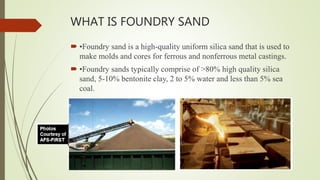
 •Foundry sand is a high-quality uniform silica sand that is used to
make molds and cores for ferrous and nonferrous metal castings.
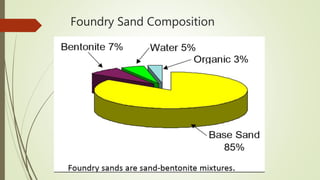
 •Foundry sands typically comprise of >80% high quality silica
sand, 5-10% bentonite clay, 2 to 5% water and less than 5% sea
coal.
Foundry Sand Composition
Foundry Sand Uses
Foundry sand is reused within the foundry several times until the
sand becomes unsuitable for mold construction.
Approximately 9 to 10 million tons of foundry sand is discarded
yearly.
An estimated 28% of discarded foundry sand is reused in primarily
construction-related applications.
Recycled foundry sand is generally considered a higher quality
material than virgin construction sands.
Reduce energy and financial expenses associated with obtaining
virgin construction sands.
Project managers can promote green construction and gain
sustainability points for their projects.
Use of Foundry Sand in Infrastructure Construction
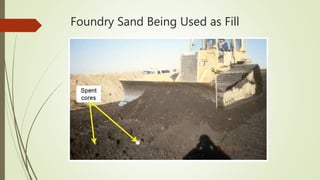
Foundry Sand Being Used as Fill
Design Considerations
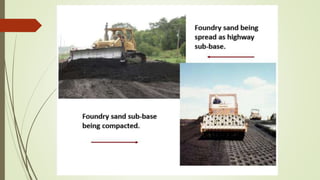
Highway Sub base
•California Bearing Ratio
•Resilient Modulus
•Uncompressive Strength
•Design charts and methodology for constructing working
platforms with FS found in Tanyuet al 2004 and 2005
•FS found to resist degradation due to winter conditions
better than typical reference materials
Design Considerations -Embankment
 Flowable slurry mixed & delivered like concrete.
 •Modest strength, but excavatable
 •Trench backfill, underground void backfill, pipeline grouting.
 •Use water-cement ratio of 9 to 12 to ensure strength in
correct range (0.3 – 1.0 MPa)
 Design Considerations
Foundry Sand safe to use in Infrastructure
Construction
•Discarded foundry sand can contain trace amounts of
leachable metals and organic constituents
•Ferrous and aluminum foundry sands have been
approved for use as a construction material -Brass and
Bronze foundry sands may contain high concentrations
of heavy metals
•Leaching studies of ferrous and aluminum foundry sands
generally show metals and organic constituents are
below designated environmental threshold levels
Advantages:
Simple production process
The production process of green sand moulding is a very
simple comparison, so easy to manipulate. The materials
are simple and easily accessible.
Lower production costs
Since the materials are simple and prices are relatively
low, the production of green sand casting is low.
Therefore, the green sand castings are less expensive
than sand casting casting resin and casting shell. As for
the current price of iron, you can visit to Dandong
Foundry.
Disadvantages:
More casting defects
Green sand mold is a kind of downy mildew, but not as hard as
the sand molds and casting resin shells. What more casting
defects such as sand waste, holes in the sand, the air holes and
withdrawals.
Quality of the rough surface
The surfaces of the casting process of green sand casting is very
rough and thick. If iron foundries using green fine sand, rough
surfaces, the better. However, there are some iron foundries that
use of very fine sand sheets in China.
CONCLUSION
The water absorption decreased up to 50% replacement of fine
aggregate by used foundry sand.
• Compressive strength increase when replacement of used foundry
sand percentage increases when compare to traditional concrete.
• From this test, replacement of fine aggregate with this used
foundry sand material provides maximum compressive strength at
50% replacement.
• Use of foundry sand in concrete can save the ferrous and non-
ferrous metal industries disposal, cost and produce a ‘greener’
concrete for construction.
• Environmental effects from wastes and disposal problems of waste
can be reduced through this research.
Reference
Abichou T. Benson, C. Edil T., 1998a.Database on beneficial reuse of
foundry by- products. Recycled materials in geotechnical
applications, Geotech. Spec. Publ.No.79, C. Vipulanandan and
D.Elton, eds., ASCE, Reston, Va., 210-223
Bemben,S.M.,Shulze,D.A.,1993.The influence of selected testing
procedures on soil/geomembrane shear strength
measurements.Proc.,Geosynthetics ’93,Industrial Fabrics Association
International,St.Paul,Minn.,619-631
USED FOUNDRY SAND: OPPORTUNITIES
FORDEVELOPMENT OF ECO-FRIENDLY LOW COST
CONCRETE Dushyant Rameshbhai Bhimani1, Prof. Jayeshkumar
Pitroda2, Prof. Jaydevbhai J. Bhavsar3

Foundry sand

  • 1.
    FOUNDRY SAND BY DHANUSHGOWDA UNDER THE GUIDANCE OF Mr. VIKAS
  • 2.
    WHAT IS FOUNDRYSAND  •Foundry sand is a high-quality uniform silica sand that is used to make molds and cores for ferrous and nonferrous metal castings.  •Foundry sands typically comprise of >80% high quality silica sand, 5-10% bentonite clay, 2 to 5% water and less than 5% sea coal.
  • 3.
  • 4.
    Foundry Sand Uses Foundrysand is reused within the foundry several times until the sand becomes unsuitable for mold construction. Approximately 9 to 10 million tons of foundry sand is discarded yearly. An estimated 28% of discarded foundry sand is reused in primarily construction-related applications.
  • 5.
    Recycled foundry sandis generally considered a higher quality material than virgin construction sands. Reduce energy and financial expenses associated with obtaining virgin construction sands. Project managers can promote green construction and gain sustainability points for their projects. Use of Foundry Sand in Infrastructure Construction
  • 6.
    Foundry Sand BeingUsed as Fill
  • 9.
    Design Considerations Highway Subbase •California Bearing Ratio •Resilient Modulus •Uncompressive Strength •Design charts and methodology for constructing working platforms with FS found in Tanyuet al 2004 and 2005 •FS found to resist degradation due to winter conditions better than typical reference materials
  • 10.
    Design Considerations -Embankment Flowable slurry mixed & delivered like concrete.  •Modest strength, but excavatable  •Trench backfill, underground void backfill, pipeline grouting.  •Use water-cement ratio of 9 to 12 to ensure strength in correct range (0.3 – 1.0 MPa)  Design Considerations
  • 11.
    Foundry Sand safeto use in Infrastructure Construction •Discarded foundry sand can contain trace amounts of leachable metals and organic constituents •Ferrous and aluminum foundry sands have been approved for use as a construction material -Brass and Bronze foundry sands may contain high concentrations of heavy metals •Leaching studies of ferrous and aluminum foundry sands generally show metals and organic constituents are below designated environmental threshold levels
  • 12.
    Advantages: Simple production process Theproduction process of green sand moulding is a very simple comparison, so easy to manipulate. The materials are simple and easily accessible. Lower production costs Since the materials are simple and prices are relatively low, the production of green sand casting is low. Therefore, the green sand castings are less expensive than sand casting casting resin and casting shell. As for the current price of iron, you can visit to Dandong Foundry.
  • 13.
    Disadvantages: More casting defects Greensand mold is a kind of downy mildew, but not as hard as the sand molds and casting resin shells. What more casting defects such as sand waste, holes in the sand, the air holes and withdrawals. Quality of the rough surface The surfaces of the casting process of green sand casting is very rough and thick. If iron foundries using green fine sand, rough surfaces, the better. However, there are some iron foundries that use of very fine sand sheets in China.
  • 14.
    CONCLUSION The water absorptiondecreased up to 50% replacement of fine aggregate by used foundry sand. • Compressive strength increase when replacement of used foundry sand percentage increases when compare to traditional concrete. • From this test, replacement of fine aggregate with this used foundry sand material provides maximum compressive strength at 50% replacement. • Use of foundry sand in concrete can save the ferrous and non- ferrous metal industries disposal, cost and produce a ‘greener’ concrete for construction. • Environmental effects from wastes and disposal problems of waste can be reduced through this research.
  • 15.
    Reference Abichou T. Benson,C. Edil T., 1998a.Database on beneficial reuse of foundry by- products. Recycled materials in geotechnical applications, Geotech. Spec. Publ.No.79, C. Vipulanandan and D.Elton, eds., ASCE, Reston, Va., 210-223 Bemben,S.M.,Shulze,D.A.,1993.The influence of selected testing procedures on soil/geomembrane shear strength measurements.Proc.,Geosynthetics ’93,Industrial Fabrics Association International,St.Paul,Minn.,619-631 USED FOUNDRY SAND: OPPORTUNITIES FORDEVELOPMENT OF ECO-FRIENDLY LOW COST CONCRETE Dushyant Rameshbhai Bhimani1, Prof. Jayeshkumar Pitroda2, Prof. Jaydevbhai J. Bhavsar3