Smart Lighting using IOT
By:
Srikant Chandan 12
Soham Channa 13
Abhinu Paika 58
Keul Patil 61
Smart Lighting
• Smart lighting is a technology mainly
designed to conserve energy
• It basically involves use of high efficiency
controls and machines based on conditions
like presence of people in an area at that
time,availability of daylight.
Disadvantages of the current smart lighting system
• Manual switching off/on of street lights
• More energy consumption
• High expense
• More manpower
Model of smart light using arduino and devices
The components used were
• LDR Input
• IR sensor
• LED
• ESP8266
LDR
A Light dependent resistor (LDR) alsotermed as a
photoresistor is adevice whose resistivity factor is
a function of the electromagnetic radiation.Hence,
they are light sensitive devices which are similar to
that of humaneyes. They are also named as
photoconductors, conductive cells or simply
photocells.
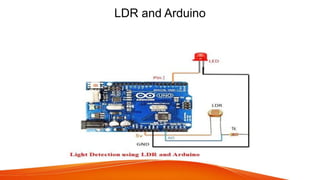
LDR and Arduino
IR Sensor
An infrared sensor is an electronic instrument that
is used to sense certaincharacteristics of its
surroundings by either emitting and/or
detectinginfrared radiation. It is also capable of
measuring heat of an object anddetecting motion.
LED
Alight-emitting diode (LED) is a junction diode,
which emits light when activated. When we apply
voltage across its leads, electrons are able
torecombine with holes within the LED, releasing
energy in the form of photonswhich gives the light.
ESP8266
ESP8266 is Wi-Fi enabled system on chip (SoC) module developedby Espressif
system. It is mostly used for development of IoT (Internet of Things) embedded
applications.
ESP8266 comes with capabilities of:
• 2.4 GHz Wi-Fi (802.11 b/g/n, supporting WPA/WPA2)
• General purpose input/output (16 GPIO)
• Inter-itegrated circuit (I²C) serial communication protocol
• Analog-to-digital conversion (10-bit ADC)
• Serial peripheral interface (SPI) serial communication protocol
• I²S (inter-IC sound) interfaces with DMA (direct memory access) (sharing pins with
GPIO)
• UART (on dedicated pins, plus a transmit-only UART can be enabled on GPIO2)
• Pulse-width modulation (PWM)
ESP8266-01 Module Pin Description
To communicate with the ESP8266 module we need a
ESP8266-01 module pin. Its details are given below:
• 3V3: - 3.3 V Power Pin.
• GND: - Ground Pin.
• RST: - Active Low Reset Pin.
• EN: - Active High Enable Pin.
• TX: - Serial Transmit Pin of UART.
• RX: - Serial Receive Pin of UART.
Smart Lighting Using IOT

Smart Lighting Using IOT

  • 1.
    Smart Lighting usingIOT By: Srikant Chandan 12 Soham Channa 13 Abhinu Paika 58 Keul Patil 61
  • 2.
    Smart Lighting • Smartlighting is a technology mainly designed to conserve energy • It basically involves use of high efficiency controls and machines based on conditions like presence of people in an area at that time,availability of daylight.
  • 3.
    Disadvantages of thecurrent smart lighting system • Manual switching off/on of street lights • More energy consumption • High expense • More manpower
  • 4.
    Model of smartlight using arduino and devices The components used were • LDR Input • IR sensor • LED • ESP8266
  • 5.
    LDR A Light dependentresistor (LDR) alsotermed as a photoresistor is adevice whose resistivity factor is a function of the electromagnetic radiation.Hence, they are light sensitive devices which are similar to that of humaneyes. They are also named as photoconductors, conductive cells or simply photocells.
  • 6.
  • 7.
    IR Sensor An infraredsensor is an electronic instrument that is used to sense certaincharacteristics of its surroundings by either emitting and/or detectinginfrared radiation. It is also capable of measuring heat of an object anddetecting motion.
  • 8.
    LED Alight-emitting diode (LED)is a junction diode, which emits light when activated. When we apply voltage across its leads, electrons are able torecombine with holes within the LED, releasing energy in the form of photonswhich gives the light.
  • 9.
    ESP8266 ESP8266 is Wi-Fienabled system on chip (SoC) module developedby Espressif system. It is mostly used for development of IoT (Internet of Things) embedded applications. ESP8266 comes with capabilities of: • 2.4 GHz Wi-Fi (802.11 b/g/n, supporting WPA/WPA2) • General purpose input/output (16 GPIO) • Inter-itegrated circuit (I²C) serial communication protocol • Analog-to-digital conversion (10-bit ADC) • Serial peripheral interface (SPI) serial communication protocol • I²S (inter-IC sound) interfaces with DMA (direct memory access) (sharing pins with GPIO) • UART (on dedicated pins, plus a transmit-only UART can be enabled on GPIO2) • Pulse-width modulation (PWM)
  • 10.
    ESP8266-01 Module PinDescription To communicate with the ESP8266 module we need a ESP8266-01 module pin. Its details are given below: • 3V3: - 3.3 V Power Pin. • GND: - Ground Pin. • RST: - Active Low Reset Pin. • EN: - Active High Enable Pin. • TX: - Serial Transmit Pin of UART. • RX: - Serial Receive Pin of UART.