Smart	
  Ci)es,	
  Smart	
  Ci)zens	
  	
  
and	
  Smart	
  Decisions	


December	
  11,	
  2015	
  
Martha	
  G	
  Russell	
  
mediaX	
  at	
  Stanford	
  University	
  
Overview	
  
•  A	
  perfect	
  Storm	
  for	
  Change	
  and	
  TransformaGon	
  	
  
–  Urban	
  Beyond	
  Measure	
  
–  Data	
  is	
  the	
  New	
  Gold	
  
–  Trends	
  ImpacGng	
  Smart	
  Environments	
  
•  Human	
  Dimension	
  of	
  “Smart	
  CiGes”	
  
–  Smart	
  People	
  Make	
  Smart	
  Decisions	
  
–  Partnership	
  of	
  People	
  and	
  Technology	
  
•  Shared	
  Vision	
  of	
  the	
  Commons	
  
–  Homo	
  narraGve	
  –	
  Why	
  Stories	
  MaTer	
  
–  RelaGonal	
  Capital	
  in	
  innovaGon	
  Ecosystems	
  
•  QuesGons	
  for	
  the	
  Future	
  
VISION	
  
3.51	
  nauGcal	
  miles	


The	
  half-­‐century	
  KondraGev	
  cycle	
  
Academic	
  producGon	
  	
  
11	
  years	
  -­‐	
  pharma	
  to	
  11	
  seconds	
  -­‐	
  social	
  media	
  
5-­‐20	
  years	
  for	
  future	
  of	
  Smart	
  CiGes	
  
OUR	
  SITUATION	
  IS	
  URGENT	
  
The	
  relaGonships	
  between	
  producGvity,	
  people	
  and	
  place	
  are	
  in	
  flux.	
  
Boundaries	
  are	
  blurred–	
  employee	
  /	
  employer,	
  work	
  /	
  leisure,	
  office	
  /	
  home,	
  personal	
  /	
  professional.	
  
CommuniGes	
  and	
  Commons	
  	
  have	
  personal	
  rather	
  than	
  geographical	
  definiGons	
  
Changing	
  responsibiliGes	
  call	
  for	
  complex	
  new	
  skills.	
  	
  
Learning	
  is	
  conGnuous.	
  
Work	
  and	
  workspaces	
  are	
  redefined.	
  
We	
  Have	
  
Survived	
  
Previous	
  
TransformaGons	


2	
  –	
  4	
  –	
  8	
  –	
  16	
  -­‐	
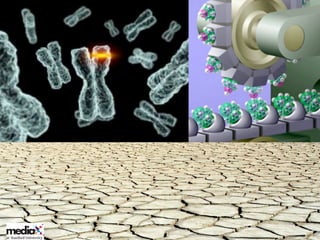
  ?	
  
Zero	
  
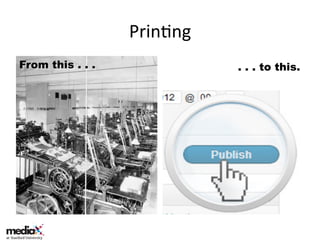
PrinGng	
  
. . . to this.From this . . .
11	
  
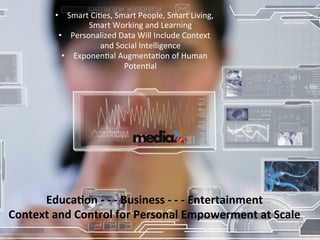
Educa)on	
  -­‐	
  -­‐	
  -­‐	
  Business	
  -­‐	
  -­‐	
  -­‐	
  Entertainment	
  
Context	
  and	
  Control	
  for	
  Personal	
  Empowerment	
  at	
  Scale	
  
•  Smart	
  CiGes,	
  Smart	
  People,	
  Smart	
  Living,	
  
Smart	
  Working	
  and	
  Learning	
  
•  Personalized	
  Data	
  Will	
  Include	
  Context	
  
and	
  Social	
  Intelligence	
  
•  ExponenGal	
  AugmentaGon	
  of	
  Human	
  
PotenGal	
  
Overview	
  
•  A	
  perfect	
  Storm	
  for	
  Change	
  and	
  TransformaGon	
  	
  
–  Urban	
  Beyond	
  Measure	
  
–  Data	
  is	
  the	
  New	
  Gold	
  
–  Trends	
  ImpacGng	
  Smart	
  Environments	
  
•  Human	
  Dimension	
  of	
  “Smart	
  CiGes”	
  
–  Smart	
  People	
  Make	
  Smart	
  Decisions	
  
–  Partnership	
  of	
  People	
  and	
  Technology	
  
•  Shared	
  Vision	
  of	
  the	
  Commons	
  
–  Homo	
  narraGve	
  –	
  why	
  stories	
  maTer	
  
–  RelaGonal	
  Capital	
  in	
  innovaGon	
  Ecosystems	
  
•  QuesGons	
  for	
  the	
  Future	
  
Data	
  is	
  the	
  New	
  GOLD!	
  
Abundant	
  Opportunity	
  
Abundance	
  Depends	
  on	
  Empowerment	
  
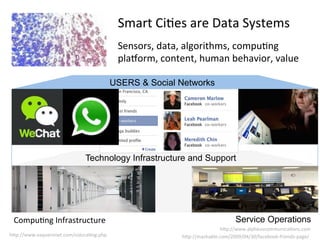
Smart	
  CiGes	
  are	
  Data	
  Systems	
  
	
  CompuGng	
  Infrastructure	
  
hTp://www.vaqueronet.com/colocaGng.php	
  
hTp://www.alpheuscommunicaGons.com	
  
Service Operations
hTp://mashable.com/2009/04/30/facebook-­‐friends-­‐page/	
  
USERS & Social Networks
Technology Infrastructure and Support
Sensors,	
  data,	
  algorithms,	
  compuGng	
  
plahorm,	
  content,	
  human	
  behavior,	
  value	
  	
  
√	
  
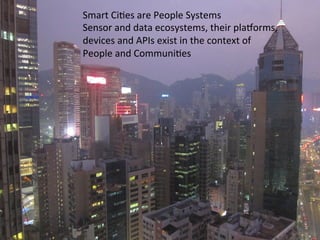
Smart	
  CiGes	
  are	
  People	
  Systems	
  
Sensor	
  and	
  data	
  ecosystems,	
  their	
  plahorms,	
  
devices	
  and	
  APIs	
  exist	
  in	
  the	
  context	
  of	
  	
  
People	
  and	
  CommuniGes	
  
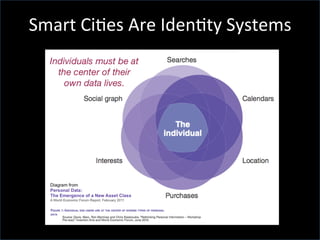
Smart	
  CiGes	
  Are	
  IdenGty	
  Systems	
  
Smart	
  (sensor-­‐based)	
  Services	
  and	
  
InteracGve	
  Experiences	
  Contain	
  
Embedded	
  Code	
  
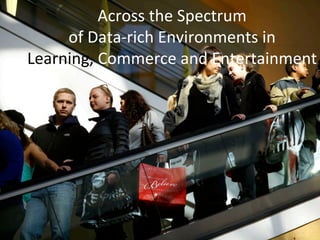
Across	
  the	
  Spectrum	
  	
  
of	
  Data-­‐rich	
  Environments	
  in	
  
Learning,	
  Commerce	
  and	
  Entertainment	
  
Apps	
  and	
  	
  Systems	
  Learn	
  About	
  Their	
  
Users	
  and	
  Promote	
  EmoGonal	
  Bonds	
  
IntenGon	
  Drives	
  the	
  Value	
  
Context	
  Drives	
  Meaning	
  of	
  Data	
  
People	
  organize	
  by	


Ideas	
  
InspiraGon	
  
Opportunity	
  
Meaning	
  
Velocity	
  
Trust	
  
Technology	
  
Access	
  
Dawn	
  of	
  New	
  User	
  Ecosystems	
  
Agents
Events
Impact
Coalitions
Shared	
  
Vision	
  
TransformaGon	
  
Iterative
Alignment
Interact &
Feedback
Co-Create
Value
Through
Context,
Culture,
Capital
Shared Vision Transforms
Russell, M.G., Still, K., Huhtamäki, J., and Rubens, N., “Relational Capital for Shared Vision in Innovation Ecosystems,” in Gebhardt,
C., and Meig, H.A. (Eds.), Special Issue: The Spatial Dimension of Innovation: Triple Helix and the City, Triple Helix Journal,
Forthcoming.
Partnership	
  of	
  People	
  and	
  Technology	
  
EvoluGon	
  toward	
  device-­‐level	
  control,	
  	
  
real-­‐Gme,	
  all-­‐the-­‐Gme	
  learning	
  
Observe
Situation
Assessment
Determine
Objectives
Generate
Alternate
Plans
Project
Probable
Outcomes
Select Best
Plan
Communicate
& Implement
Plan
Validate &
Improve
Model
adapted	
  from	
  Hayes-­‐Roth,	
  2006	
  
Smart	
  CiGes	
  Are	
  Decision	
  Systems	
  
And	
  need	
  conGnuously	
  improving	
  “Decision	
  Processes”	
  
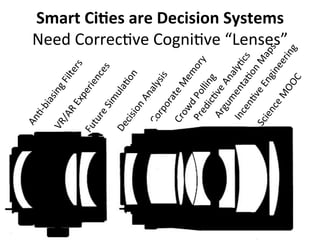
Smart	
  Ci)es	
  are	
  Decision	
  Systems	
  
Need	
  CorrecGve	
  CogniGve	
  “Lenses”	
  
Overview	
  
•  A	
  perfect	
  Storm	
  for	
  Change	
  and	
  TransformaGon	
  	
  
–  Urban	
  Beyond	
  Measure	
  
–  Data	
  is	
  the	
  New	
  Gold	
  
–  Trends	
  ImpacGng	
  Smart	
  Environments	
  
•  Human	
  Dimension	
  of	
  “Smart	
  CiGes”	
  
–  Smart	
  People	
  Make	
  Smart	
  Decisions	
  
–  Partnership	
  of	
  People	
  and	
  Technology	
  
•  Shared	
  Vision	
  of	
  the	
  Commons	
  
–  Homo	
  narraGve	
  –	
  why	
  stories	
  maTer	
  
–  RelaGonal	
  Capital	
  in	
  innovaGon	
  Ecosystems	
  
•  QuesGons	
  for	
  the	
  Future	
  
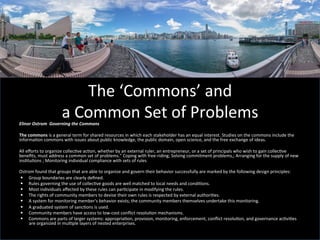
The	
  ‘Commons’	
  and	
  	
  
a	
  Common	
  Set	
  of	
  Problems	
  Elinor	
  Ostrom	
  	
  Governing	
  the	
  Commons	


The	
  commons	
  is	
  a	
  general	
  term	
  for	
  shared	
  resources	
  in	
  which	
  each	
  stakeholder	
  has	
  an	
  equal	
  interest.	
  Studies	
  on	
  the	
  commons	
  include	
  the	
  
informaGon	
  commons	
  with	
  issues	
  about	
  public	
  knowledge,	
  the	
  public	
  domain,	
  open	
  science,	
  and	
  the	
  free	
  exchange	
  of	
  ideas.	
  	
  
All	
  efforts	
  to	
  organize	
  collecGve	
  acGon,	
  whether	
  by	
  an	
  external	
  ruler,	
  an	
  entrepreneur,	
  or	
  a	
  set	
  of	
  principals	
  who	
  wish	
  to	
  gain	
  collecGve	
  
benefits,	
  must	
  address	
  a	
  common	
  set	
  of	
  problems.”	
  Coping	
  with	
  free-­‐riding;	
  Solving	
  commitment	
  problems,;	
  Arranging	
  for	
  the	
  supply	
  of	
  new	
  
insGtuGons	
  ;	
  Monitoring	
  individual	
  compliance	
  with	
  sets	
  of	
  rules	


Ostrom	
  found	
  that	
  groups	
  that	
  are	
  able	
  to	
  organize	
  and	
  govern	
  their	
  behavior	
  successfully	
  are	
  marked	
  by	
  the	
  following	
  design	
  principles:	
  
§  Group	
  boundaries	
  are	
  clearly	
  defined.	
  
§  Rules	
  governing	
  the	
  use	
  of	
  collecGve	
  goods	
  are	
  well	
  matched	
  to	
  local	
  needs	
  and	
  condiGons.	
  
§  Most	
  individuals	
  affected	
  by	
  these	
  rules	
  can	
  parGcipate	
  in	
  modifying	
  the	
  rules.	
  
§  The	
  rights	
  of	
  community	
  members	
  to	
  devise	
  their	
  own	
  rules	
  is	
  respected	
  by	
  external	
  authoriGes.	
  
§  A	
  system	
  for	
  monitoring	
  member's	
  behavior	
  exists;	
  the	
  community	
  members	
  themselves	
  undertake	
  this	
  monitoring.	
  
§  A	
  graduated	
  system	
  of	
  sancGons	
  is	
  used.	
  
§  Community	
  members	
  have	
  access	
  to	
  low-­‐cost	
  conflict	
  resoluGon	
  mechanisms.	
  
§  Commons	
  are	
  parts	
  of	
  larger	
  systems:	
  appropriaGon,	
  provision,	
  monitoring,	
  enforcement,	
  conflict	
  resoluGon,	
  and	
  governance	
  acGviGes	
  
are	
  organized	
  in	
  mulGple	
  layers	
  of	
  nested	
  enterprises.	
  
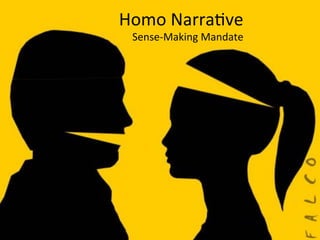
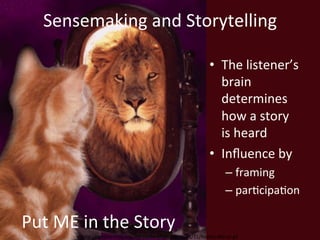
Homo	
  NarraGve	
  
Sense-­‐Making	
  Mandate	
  
•  The	
  listener’s	
  
brain	
  
determines	
  
how	
  a	
  story	
  
is	
  heard	
  
•  Influence	
  by	
  
– framing	
  
– parGcipaGon	
  
Put	
  ME	
  in	
  the	
  Story	
  	
  
hTp://uphillwriGng.org/wp-­‐content/uploads/2011/11/Reality-­‐Mirror.gif	
  
Sensemaking	
  and	
  Storytelling	
  
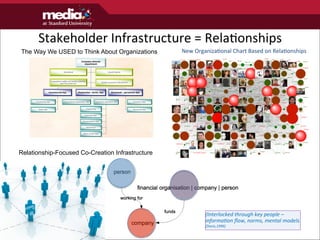
The Way We USED to Think About Organizations New	
  OrganizaGonal	
  Chart	
  Based	
  on	
  RelaGonships	
  
Relationship-Focused Co-Creation Infrastructure
Stakeholder	
  Infrastructure	
  =	
  RelaGonships	
  
(Interlocked	
  through	
  key	
  people	
  –	
  
informa7on	
  flow,	
  norms,	
  mental	
  models.
(Davis,1996)	
  
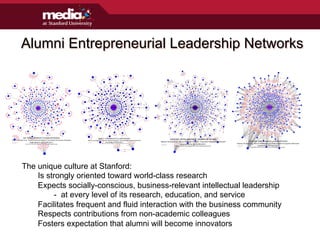
Alumni Entrepreneurial Leadership Networks
The unique culture at Stanford:
Is strongly oriented toward world-class research
Expects socially-conscious, business-relevant intellectual leadership
- at every level of its research, education, and service
Facilitates frequent and fluid interaction with the business community
Respects contributions from non-academic colleagues
Fosters expectation that alumni will become innovators
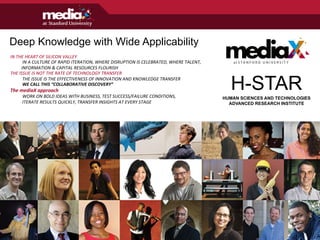
Deep Knowledge with Wide Applicability
IN	
  THE	
  HEART	
  OF	
  SILICON	
  VALLEY	
  
	
  IN	
  A	
  CULTURE	
  OF	
  RAPID	
  ITERATION,	
  WHERE	
  DISRUPTION	
  IS	
  CELEBRATED,	
  WHERE	
  TALENT,	


  INFORMATION	
  &	
  CAPITAL	
  RESOURCES	
  FLOURISH	
  
THE	
  ISSUE	
  IS	
  NOT	
  THE	
  RATE	
  OF	
  TECHNOLOGY	
  TRANSFER	
  
	
  THE	
  ISSUE	
  IS	
  THE	
  EFFECTIVENESS	
  OF	
  INNOVATION	
  AND	
  KNOWLEDGE	
  TRANSFER	


  WE	
  CALL	
  THIS	
  “COLLABORATIVE	
  DISCOVERY”	
  
The	
  mediaX	
  approach	
  
	
  WORK	
  ON	
  BOLD	
  IDEAS	
  WITH	
  BUSINESS,	
  TEST	
  SUCCESS/FAILURE	
  CONDITIONS,	


  ITERATE	
  RESULTS	
  QUICKLY,	
  TRANSFER	
  INSIGHTS	
  AT	
  EVERY	
  STAGE	
  
at S T A N F O R D U N I V E R S I T Y
H-STAR
HUMAN SCIENCES AND TECHNOLOGIES
ADVANCED RESEARCH INSTITUTE
mediaX at Stanford University
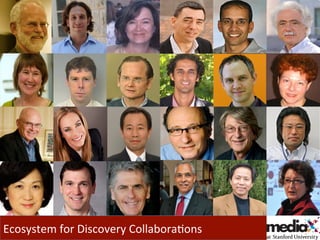
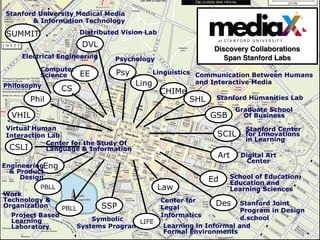
Ecosystem	
  for	
  Discovery	
  CollaboraGons	
  
CSLI
Eng
EE Psy
Ed
SSP
SCIL
SUMMIT
PBLL
GSB
Ling
CHIMe
Art
Discovery Collaborations
Span Stanford Labs
School of Education;
Education and
Learning Sciences
Digital Art
Center
Graduate School
Of Business
Communication Between Humans
and Interactive Media
Stanford Center
for Innovations
in Learning
Project Based
Learning
Laboratory
Symbolic
Systems Program
Engineering
& Product
Design
Center for the Study Of
Language & Information
Stanford University Medical Media
& Information Technology
Computer
Science
Psychology
Linguistics
Phil
Philosophy
Law
Center for
Legal
Informatics
LIFE
Learning in Informal and
Formal Environments
CS
Electrical Engineering
SHL Stanford Humanities Lab
VHIL
Virtual Human
Interaction Lab
PBLL
Work
Technology &
Organization
DVL
Distributed Vision Lab
Des Stanford Joint
Program in Design
d.school
at S T A N F O R D U N I V E R S I T Y
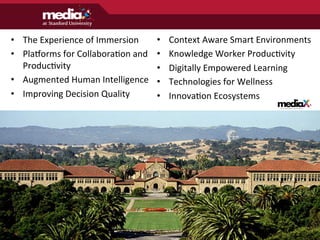
In	
  sum	
  
•  The	
  Experience	
  of	
  Immersion	
  
•  Plahorms	
  for	
  CollaboraGon	
  and	
  
ProducGvity	
  	
  
•  Augmented	
  Human	
  Intelligence	
  
•  Improving	
  Decision	
  Quality	
  
•  Context	
  Aware	
  Smart	
  Environments	
  
•  Knowledge	
  Worker	
  ProducGvity	
  
•  Digitally	
  Empowered	
  Learning	
  
•  Technologies	
  for	
  Wellness	
  
•  InnovaGon	
  Ecosystems	
  
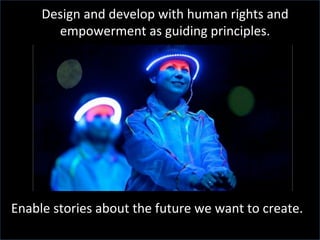
Design	
  and	
  develop	
  with	
  human	
  rights	
  and	
  
empowerment	
  as	
  guiding	
  principles.	
  
Enable	
  stories	
  about	
  the	
  future	
  we	
  want	
  to	
  create.	
  
Are	
  We	
  Moving	
  Forward	
  -­‐	
  -­‐	
  -­‐	
  	
  
•  Fast	
  enough?	
  
Summer	
  2015	
   CONFIDENTIAL	
  MATERIALS	
   38	
  
Simplify	
  my	
  life.	
  	
  
Heal	
  the	
  mistakes	
  of	
  previous	
  poor	
  decisions.	

  	
  
Crowd-­‐source	
  solu)ons	
  for	
  the	
  common	
  good.	


  Thank	
  You	
  
Martha	
  G	
  Russell	
  
Martha.russell@stanford.edu	
  
What Can We Do Together
That Neither of Us Could Do Alone?

Smart Cities, Smart Citizens and Smart Decisions

  • 1.
    Smart  Ci)es,  Smart  Ci)zens     and  Smart  Decisions     December  11,  2015   Martha  G  Russell   mediaX  at  Stanford  University  
  • 2.
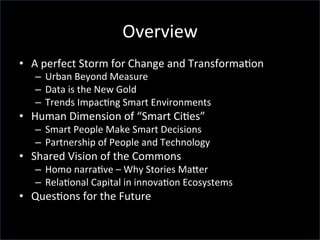
    Overview   •  A  perfect  Storm  for  Change  and  TransformaGon     –  Urban  Beyond  Measure   –  Data  is  the  New  Gold   –  Trends  ImpacGng  Smart  Environments   •  Human  Dimension  of  “Smart  CiGes”   –  Smart  People  Make  Smart  Decisions   –  Partnership  of  People  and  Technology   •  Shared  Vision  of  the  Commons   –  Homo  narraGve  –  Why  Stories  MaTer   –  RelaGonal  Capital  in  innovaGon  Ecosystems   •  QuesGons  for  the  Future  
  • 3.
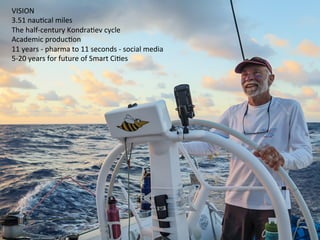
    VISION   3.51  nauGcal  miles       The  half-­‐century  KondraGev  cycle   Academic  producGon     11  years  -­‐  pharma  to  11  seconds  -­‐  social  media   5-­‐20  years  for  future  of  Smart  CiGes  
  • 4.
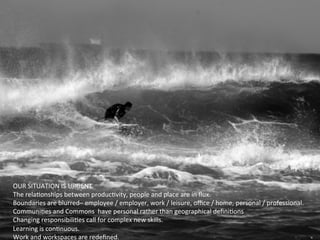
    OUR  SITUATION  IS  URGENT   The  relaGonships  between  producGvity,  people  and  place  are  in  flux.   Boundaries  are  blurred–  employee  /  employer,  work  /  leisure,  office  /  home,  personal  /  professional.   CommuniGes  and  Commons    have  personal  rather  than  geographical  definiGons   Changing  responsibiliGes  call  for  complex  new  skills.     Learning  is  conGnuous.   Work  and  workspaces  are  redefined.  
  • 6.
    We  Have   Survived   Previous   TransformaGons          
  • 7.
    2  –  4  –  8  –  16  -­‐  ?   Zero  
  • 8.
    PrinGng   . .. to this.From this . . .
  • 11.
    11   Educa)on  -­‐  -­‐  -­‐  Business  -­‐  -­‐  -­‐  Entertainment   Context  and  Control  for  Personal  Empowerment  at  Scale   •  Smart  CiGes,  Smart  People,  Smart  Living,   Smart  Working  and  Learning   •  Personalized  Data  Will  Include  Context   and  Social  Intelligence   •  ExponenGal  AugmentaGon  of  Human   PotenGal  
  • 12.
    Overview   •  A  perfect  Storm  for  Change  and  TransformaGon     –  Urban  Beyond  Measure   –  Data  is  the  New  Gold   –  Trends  ImpacGng  Smart  Environments   •  Human  Dimension  of  “Smart  CiGes”   –  Smart  People  Make  Smart  Decisions   –  Partnership  of  People  and  Technology   •  Shared  Vision  of  the  Commons   –  Homo  narraGve  –  why  stories  maTer   –  RelaGonal  Capital  in  innovaGon  Ecosystems   •  QuesGons  for  the  Future  
  • 13.
    Data  is  the  New  GOLD!   Abundant  Opportunity   Abundance  Depends  on  Empowerment  
  • 14.
    Smart  CiGes  are  Data  Systems    CompuGng  Infrastructure   hTp://www.vaqueronet.com/colocaGng.php   hTp://www.alpheuscommunicaGons.com   Service Operations hTp://mashable.com/2009/04/30/facebook-­‐friends-­‐page/   USERS & Social Networks Technology Infrastructure and Support Sensors,  data,  algorithms,  compuGng   plahorm,  content,  human  behavior,  value    
  • 15.
    √   Smart  CiGes  are  People  Systems   Sensor  and  data  ecosystems,  their  plahorms,   devices  and  APIs  exist  in  the  context  of     People  and  CommuniGes  
  • 16.
    Smart  CiGes  Are  IdenGty  Systems  
  • 17.
    Smart  (sensor-­‐based)  Services  and   InteracGve  Experiences  Contain   Embedded  Code  
  • 18.
    Across  the  Spectrum     of  Data-­‐rich  Environments  in   Learning,  Commerce  and  Entertainment  
  • 19.
    Apps  and    Systems  Learn  About  Their   Users  and  Promote  EmoGonal  Bonds  
  • 20.
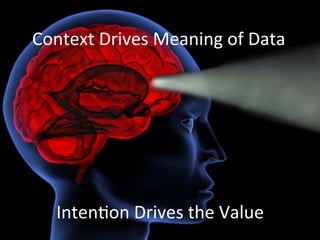
    IntenGon  Drives  the  Value   Context  Drives  Meaning  of  Data  
  • 21.
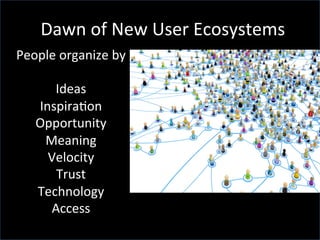
    People  organize  by     Ideas   InspiraGon   Opportunity   Meaning   Velocity   Trust   Technology   Access   Dawn  of  New  User  Ecosystems  
  • 22.
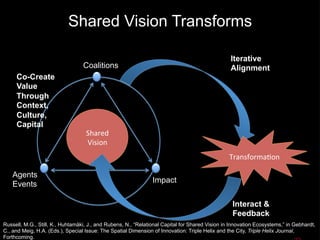
    Agents Events Impact Coalitions Shared   Vision   TransformaGon   Iterative Alignment Interact & Feedback Co-Create Value Through Context, Culture, Capital Shared Vision Transforms Russell, M.G., Still, K., Huhtamäki, J., and Rubens, N., “Relational Capital for Shared Vision in Innovation Ecosystems,” in Gebhardt, C., and Meig, H.A. (Eds.), Special Issue: The Spatial Dimension of Innovation: Triple Helix and the City, Triple Helix Journal, Forthcoming.
  • 23.
    Partnership  of  People  and  Technology   EvoluGon  toward  device-­‐level  control,     real-­‐Gme,  all-­‐the-­‐Gme  learning  
  • 24.
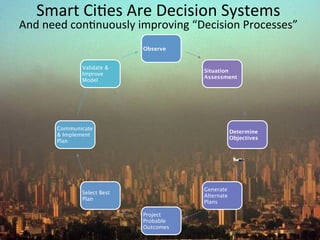
    Observe Situation Assessment Determine Objectives Generate Alternate Plans Project Probable Outcomes Select Best Plan Communicate & Implement Plan Validate& Improve Model adapted  from  Hayes-­‐Roth,  2006   Smart  CiGes  Are  Decision  Systems   And  need  conGnuously  improving  “Decision  Processes”  
  • 25.
    Smart  Ci)es  are  Decision  Systems   Need  CorrecGve  CogniGve  “Lenses”  
  • 26.
    Overview   •  A  perfect  Storm  for  Change  and  TransformaGon     –  Urban  Beyond  Measure   –  Data  is  the  New  Gold   –  Trends  ImpacGng  Smart  Environments   •  Human  Dimension  of  “Smart  CiGes”   –  Smart  People  Make  Smart  Decisions   –  Partnership  of  People  and  Technology   •  Shared  Vision  of  the  Commons   –  Homo  narraGve  –  why  stories  maTer   –  RelaGonal  Capital  in  innovaGon  Ecosystems   •  QuesGons  for  the  Future  
  • 27.
    The  ‘Commons’  and     a  Common  Set  of  Problems  Elinor  Ostrom    Governing  the  Commons     The  commons  is  a  general  term  for  shared  resources  in  which  each  stakeholder  has  an  equal  interest.  Studies  on  the  commons  include  the   informaGon  commons  with  issues  about  public  knowledge,  the  public  domain,  open  science,  and  the  free  exchange  of  ideas.     All  efforts  to  organize  collecGve  acGon,  whether  by  an  external  ruler,  an  entrepreneur,  or  a  set  of  principals  who  wish  to  gain  collecGve   benefits,  must  address  a  common  set  of  problems.”  Coping  with  free-­‐riding;  Solving  commitment  problems,;  Arranging  for  the  supply  of  new   insGtuGons  ;  Monitoring  individual  compliance  with  sets  of  rules     Ostrom  found  that  groups  that  are  able  to  organize  and  govern  their  behavior  successfully  are  marked  by  the  following  design  principles:   §  Group  boundaries  are  clearly  defined.   §  Rules  governing  the  use  of  collecGve  goods  are  well  matched  to  local  needs  and  condiGons.   §  Most  individuals  affected  by  these  rules  can  parGcipate  in  modifying  the  rules.   §  The  rights  of  community  members  to  devise  their  own  rules  is  respected  by  external  authoriGes.   §  A  system  for  monitoring  member's  behavior  exists;  the  community  members  themselves  undertake  this  monitoring.   §  A  graduated  system  of  sancGons  is  used.   §  Community  members  have  access  to  low-­‐cost  conflict  resoluGon  mechanisms.   §  Commons  are  parts  of  larger  systems:  appropriaGon,  provision,  monitoring,  enforcement,  conflict  resoluGon,  and  governance  acGviGes   are  organized  in  mulGple  layers  of  nested  enterprises.  
  • 28.
  • 29.
    •  The  listener’s   brain   determines   how  a  story   is  heard   •  Influence  by   – framing   – parGcipaGon   Put  ME  in  the  Story     hTp://uphillwriGng.org/wp-­‐content/uploads/2011/11/Reality-­‐Mirror.gif   Sensemaking  and  Storytelling  
  • 30.
    The Way WeUSED to Think About Organizations New  OrganizaGonal  Chart  Based  on  RelaGonships   Relationship-Focused Co-Creation Infrastructure Stakeholder  Infrastructure  =  RelaGonships   (Interlocked  through  key  people  –   informa7on  flow,  norms,  mental  models. (Davis,1996)  
  • 31.
    Alumni Entrepreneurial LeadershipNetworks The unique culture at Stanford: Is strongly oriented toward world-class research Expects socially-conscious, business-relevant intellectual leadership - at every level of its research, education, and service Facilitates frequent and fluid interaction with the business community Respects contributions from non-academic colleagues Fosters expectation that alumni will become innovators
  • 32.
    Deep Knowledge withWide Applicability IN  THE  HEART  OF  SILICON  VALLEY    IN  A  CULTURE  OF  RAPID  ITERATION,  WHERE  DISRUPTION  IS  CELEBRATED,  WHERE  TALENT,                        INFORMATION  &  CAPITAL  RESOURCES  FLOURISH   THE  ISSUE  IS  NOT  THE  RATE  OF  TECHNOLOGY  TRANSFER    THE  ISSUE  IS  THE  EFFECTIVENESS  OF  INNOVATION  AND  KNOWLEDGE  TRANSFER      WE  CALL  THIS  “COLLABORATIVE  DISCOVERY”   The  mediaX  approach    WORK  ON  BOLD  IDEAS  WITH  BUSINESS,  TEST  SUCCESS/FAILURE  CONDITIONS,      ITERATE  RESULTS  QUICKLY,  TRANSFER  INSIGHTS  AT  EVERY  STAGE   at S T A N F O R D U N I V E R S I T Y H-STAR HUMAN SCIENCES AND TECHNOLOGIES ADVANCED RESEARCH INSTITUTE mediaX at Stanford University
  • 33.
    Ecosystem  for  Discovery  CollaboraGons  
  • 34.
    CSLI Eng EE Psy Ed SSP SCIL SUMMIT PBLL GSB Ling CHIMe Art Discovery Collaborations SpanStanford Labs School of Education; Education and Learning Sciences Digital Art Center Graduate School Of Business Communication Between Humans and Interactive Media Stanford Center for Innovations in Learning Project Based Learning Laboratory Symbolic Systems Program Engineering & Product Design Center for the Study Of Language & Information Stanford University Medical Media & Information Technology Computer Science Psychology Linguistics Phil Philosophy Law Center for Legal Informatics LIFE Learning in Informal and Formal Environments CS Electrical Engineering SHL Stanford Humanities Lab VHIL Virtual Human Interaction Lab PBLL Work Technology & Organization DVL Distributed Vision Lab Des Stanford Joint Program in Design d.school at S T A N F O R D U N I V E R S I T Y
  • 35.
    at S TA N F O R D U N I V E R S I T Y In  sum   •  The  Experience  of  Immersion   •  Plahorms  for  CollaboraGon  and   ProducGvity     •  Augmented  Human  Intelligence   •  Improving  Decision  Quality   •  Context  Aware  Smart  Environments   •  Knowledge  Worker  ProducGvity   •  Digitally  Empowered  Learning   •  Technologies  for  Wellness   •  InnovaGon  Ecosystems  
  • 36.
    Design  and  develop  with  human  rights  and   empowerment  as  guiding  principles.   Enable  stories  about  the  future  we  want  to  create.  
  • 37.
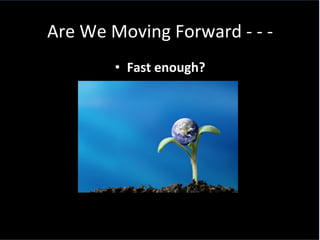
    Are  We  Moving  Forward  -­‐  -­‐  -­‐     •  Fast  enough?  
  • 38.
    Summer  2015  CONFIDENTIAL  MATERIALS   38   Simplify  my  life.     Heal  the  mistakes  of  previous  poor  decisions.     Crowd-­‐source  solu)ons  for  the  common  good.  
  • 39.
             Thank  You   Martha  G  Russell   Martha.russell@stanford.edu   What Can We Do Together That Neither of Us Could Do Alone?