THE FUTURE STARTED
YESTERDAY
The Top Ten Computer and IT Trends
Saturday, February 20, 2016
1:30pm – 2:45pm (2406)
The Future Started Yesterday:
The Top Ten Computer and IT Trends
1. Emergence of the Mobile Cloud
2. From Internet of Things to Web of Things
3. From Big Data to Extreme Data
4. The Revolution Will Be 3D
5. Supporting New Learning Styles
6. Next-generation mobile networks
7. Balancing Identity and Privacy
8. Smart and Connected Healthcare
9. e-Government
10. Scientific Cloud Computing
3
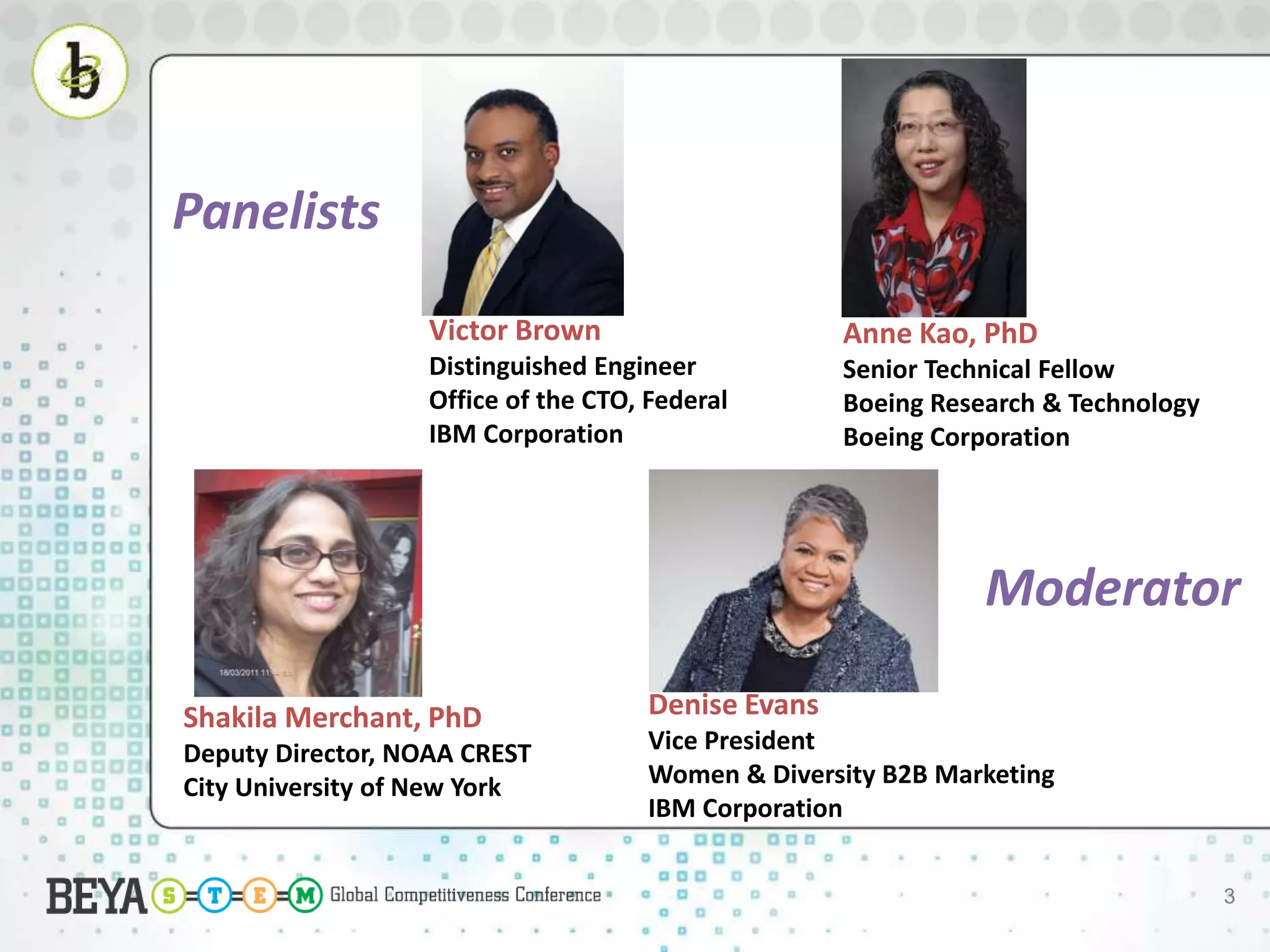
Denise Evans
Vice President
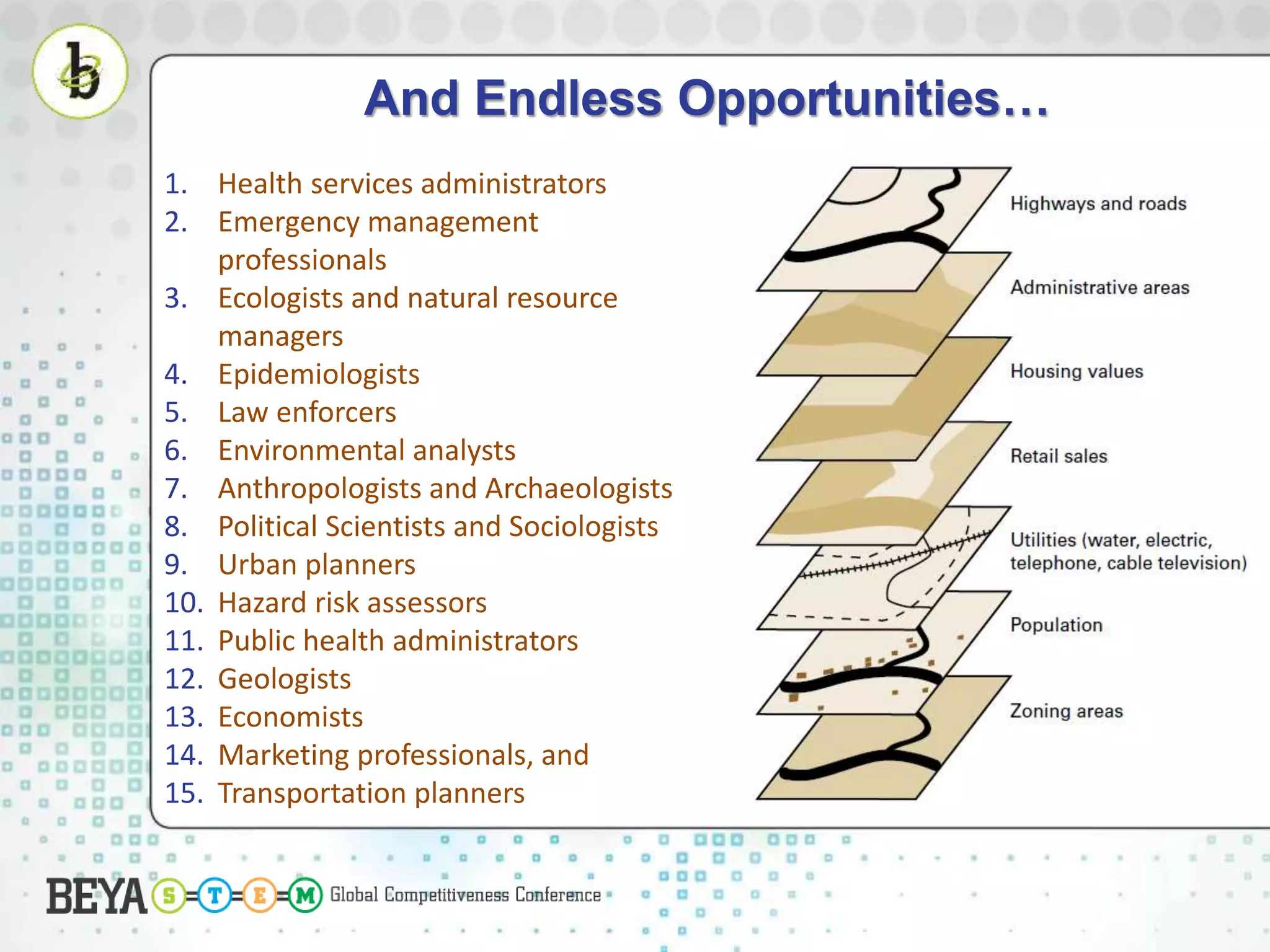
Women & Diversity B2B Marketing
IBM Corporation
Victor Brown
Distinguished Engineer
Office of the CTO, Federal
IBM Corporation
Shakila Merchant, PhD
Deputy Director, NOAA CREST
City University of New York
Anne Kao, PhD
Senior Technical Fellow
Boeing Research & Technology
Boeing Corporation
Panelists
Moderator
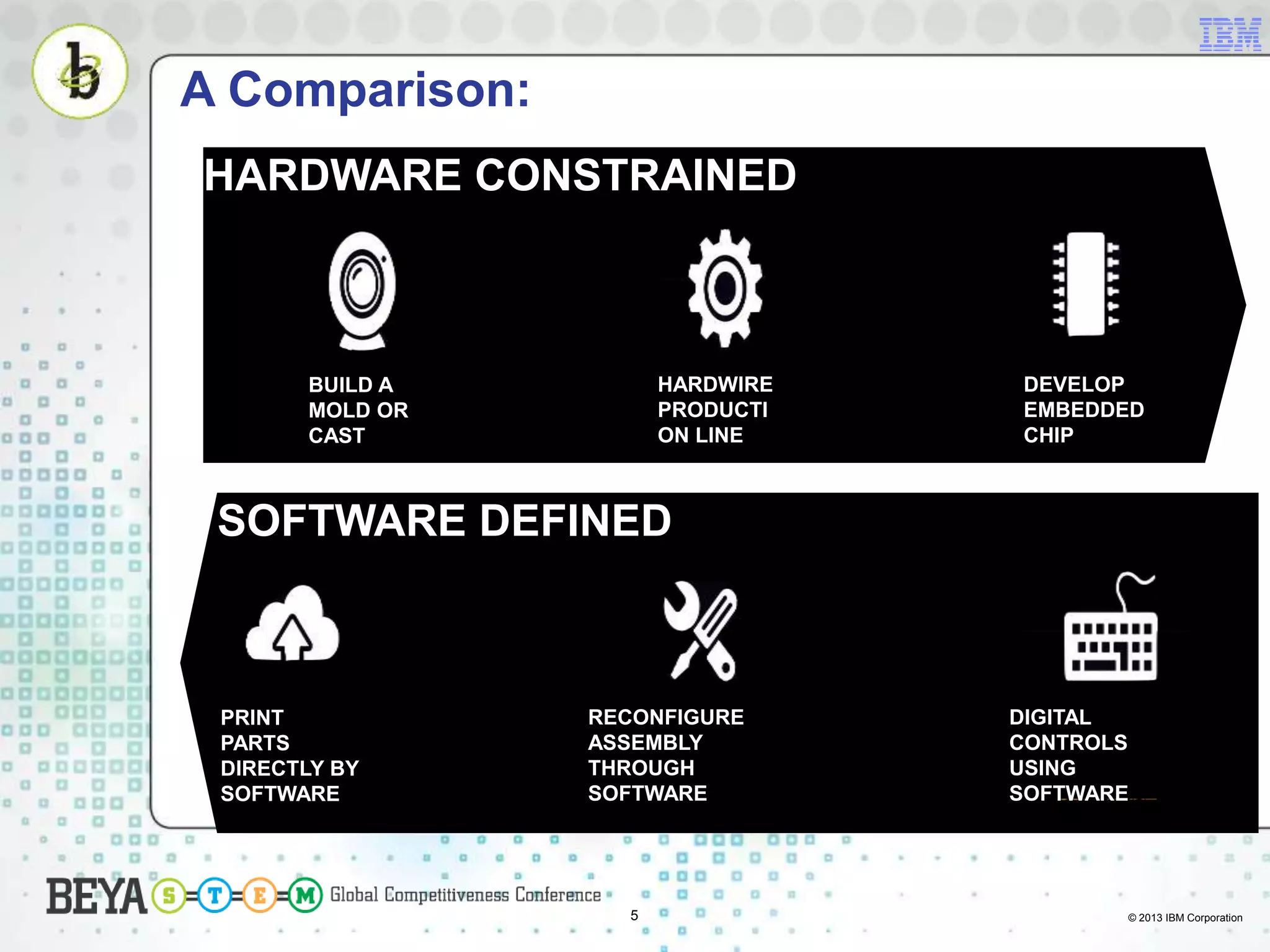
The Revolution will be 3D
• Emerging and converging technologies - 3D printing,
intelligent robotics and open source electronics are
transforming the supply chain
• 3D printing enables a Software Defined Supply Chain
(SDSC)
– SDSC is how to manufacture billions of smart devices easily and
effectively in small quantities and in a highly customized way.
– Prototyping and manufacturing of parts
– Software will control the way things are built as well as the
assembly lines
– Make changes on the fly and improve quality
– Improves competition as prototypes can be created at lower
costs
– Change the assembly line as needed
© 2013 IBM Corporation5
HARDWARE CONSTRAINED
BUILD A
MOLD OR
CAST
HARDWIRE
PRODUCTI
ON LINE
DEVELOP
EMBEDDED
CHIP
SOFTWARE DEFINED
PRINT
PARTS
DIRECTLY BY
SOFTWARE
RECONFIGURE
ASSEMBLY
THROUGH
SOFTWARE
DIGITAL
CONTROLS
USING
SOFTWARE
A Comparison:
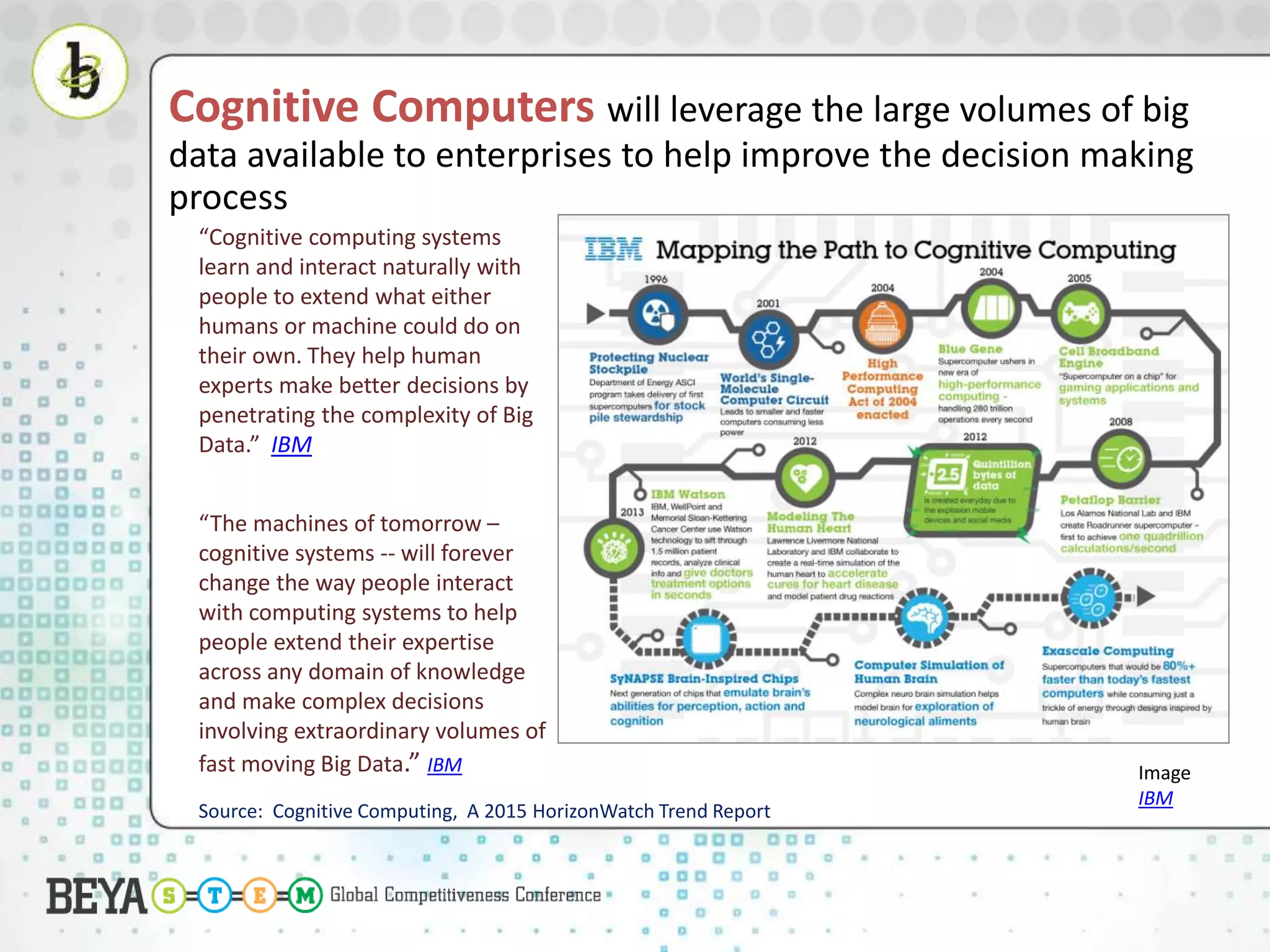
Cognitive Computers will leverage the large volumes of big
data available to enterprises to help improve the decision making
process
Source: Cognitive Computing, A 2015 HorizonWatch Trend Report
Image
IBM
“The machines of tomorrow –
cognitive systems -- will forever
change the way people interact
with computing systems to help
people extend their expertise
across any domain of knowledge
and make complex decisions
involving extraordinary volumes of
fast moving Big Data.” IBM
“Cognitive computing systems
learn and interact naturally with
people to extend what either
humans or machine could do on
their own. They help human
experts make better decisions by
penetrating the complexity of Big
Data.” IBM
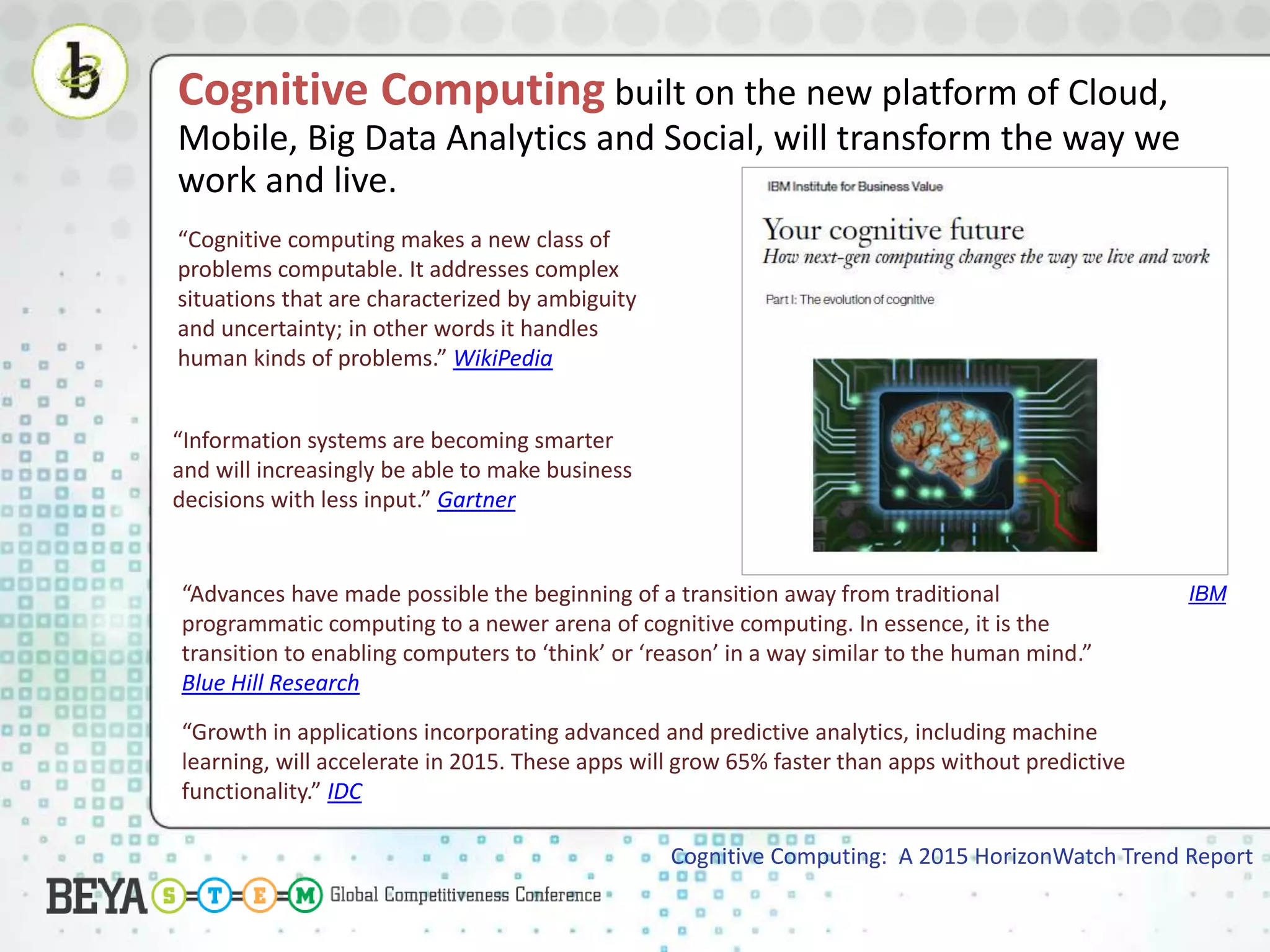
Cognitive Computing built on the new platform of Cloud,
Mobile, Big Data Analytics and Social, will transform the way we
work and live.
Cognitive Computing: A 2015 HorizonWatch Trend Report
“Cognitive computing makes a new class of
problems computable. It addresses complex
situations that are characterized by ambiguity
and uncertainty; in other words it handles
human kinds of problems.” WikiPedia
“Information systems are becoming smarter
and will increasingly be able to make business
decisions with less input.” Gartner
“Advances have made possible the beginning of a transition away from traditional
programmatic computing to a newer arena of cognitive computing. In essence, it is the
transition to enabling computers to ‘think’ or ‘reason’ in a way similar to the human mind.”
Blue Hill Research
“Growth in applications incorporating advanced and predictive analytics, including machine
learning, will accelerate in 2015. These apps will grow 65% faster than apps without predictive
functionality.” IDC
IBM
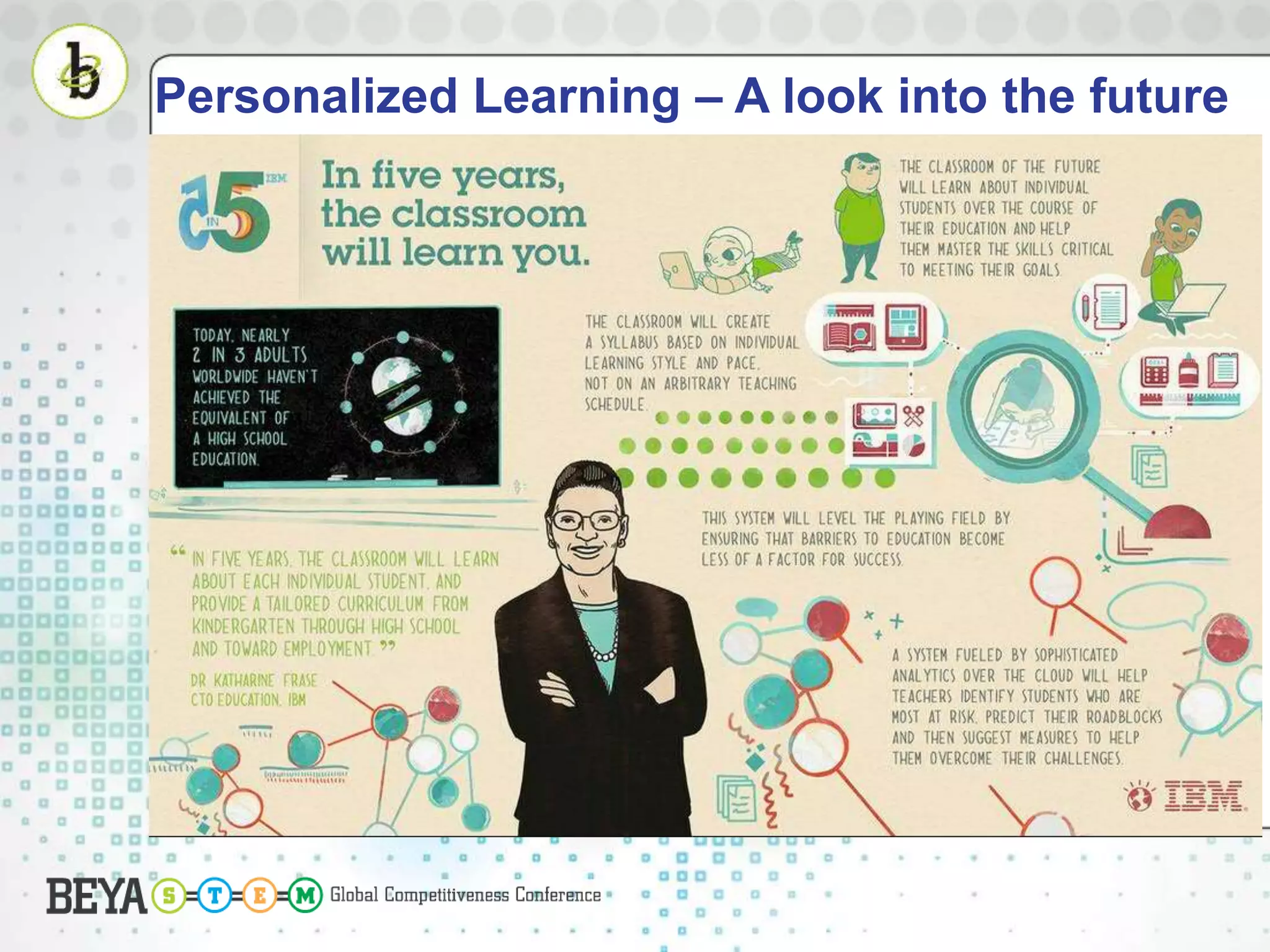
Personalized Learning – A look into the future
Next Generation Mobile Networks
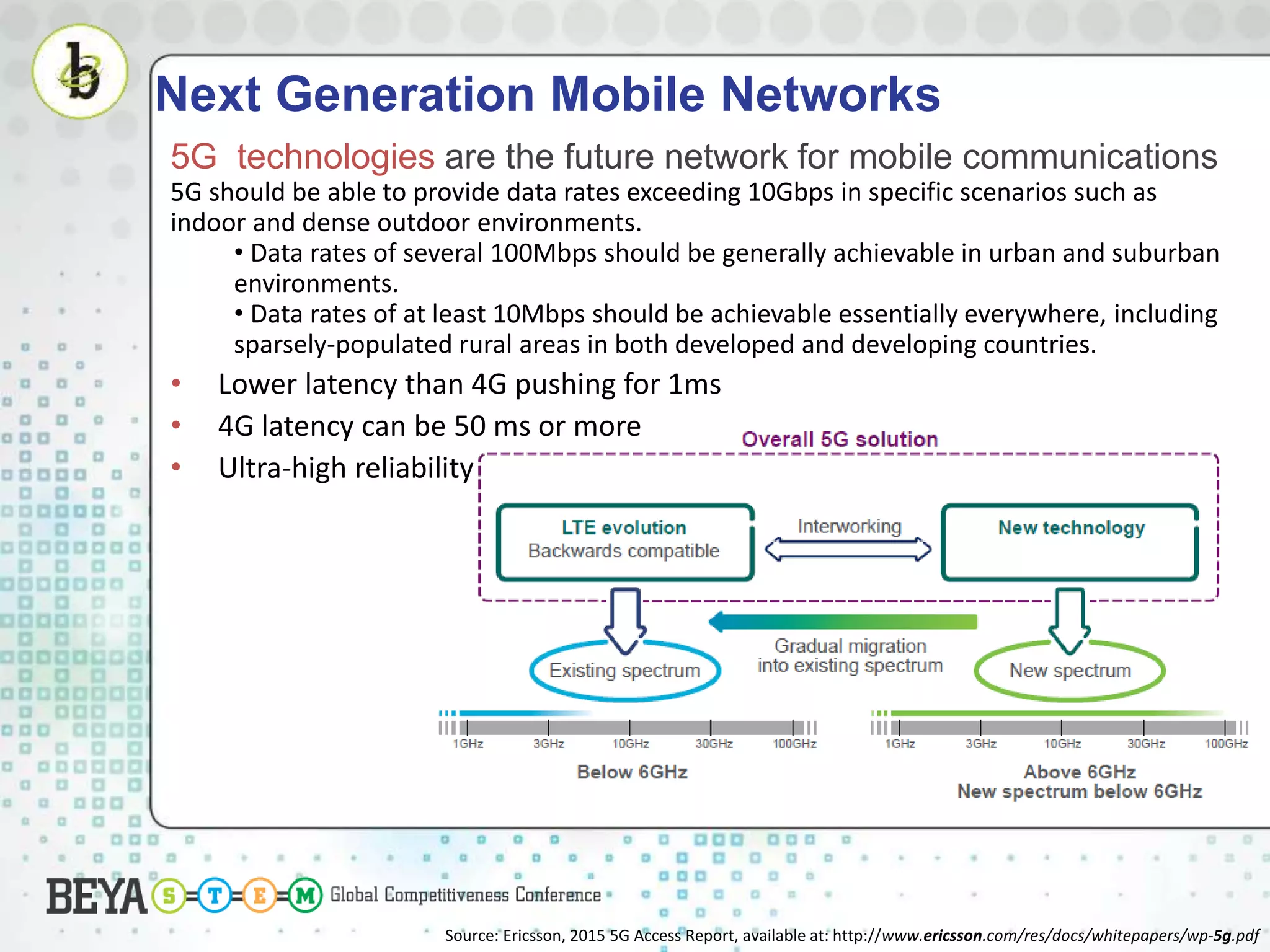
5G technologies are the future network for mobile communications
5G should be able to provide data rates exceeding 10Gbps in specific scenarios such as
indoor and dense outdoor environments.
• Data rates of several 100Mbps should be generally achievable in urban and suburban
environments.
• Data rates of at least 10Mbps should be achievable essentially everywhere, including
sparsely-populated rural areas in both developed and developing countries.
• Lower latency than 4G pushing for 1ms
• 4G latency can be 50 ms or more
• Ultra-high reliability
Source: Ericsson, 2015 5G Access Report, available at: http://www.ericsson.com/res/docs/whitepapers/wp-5g.pdf
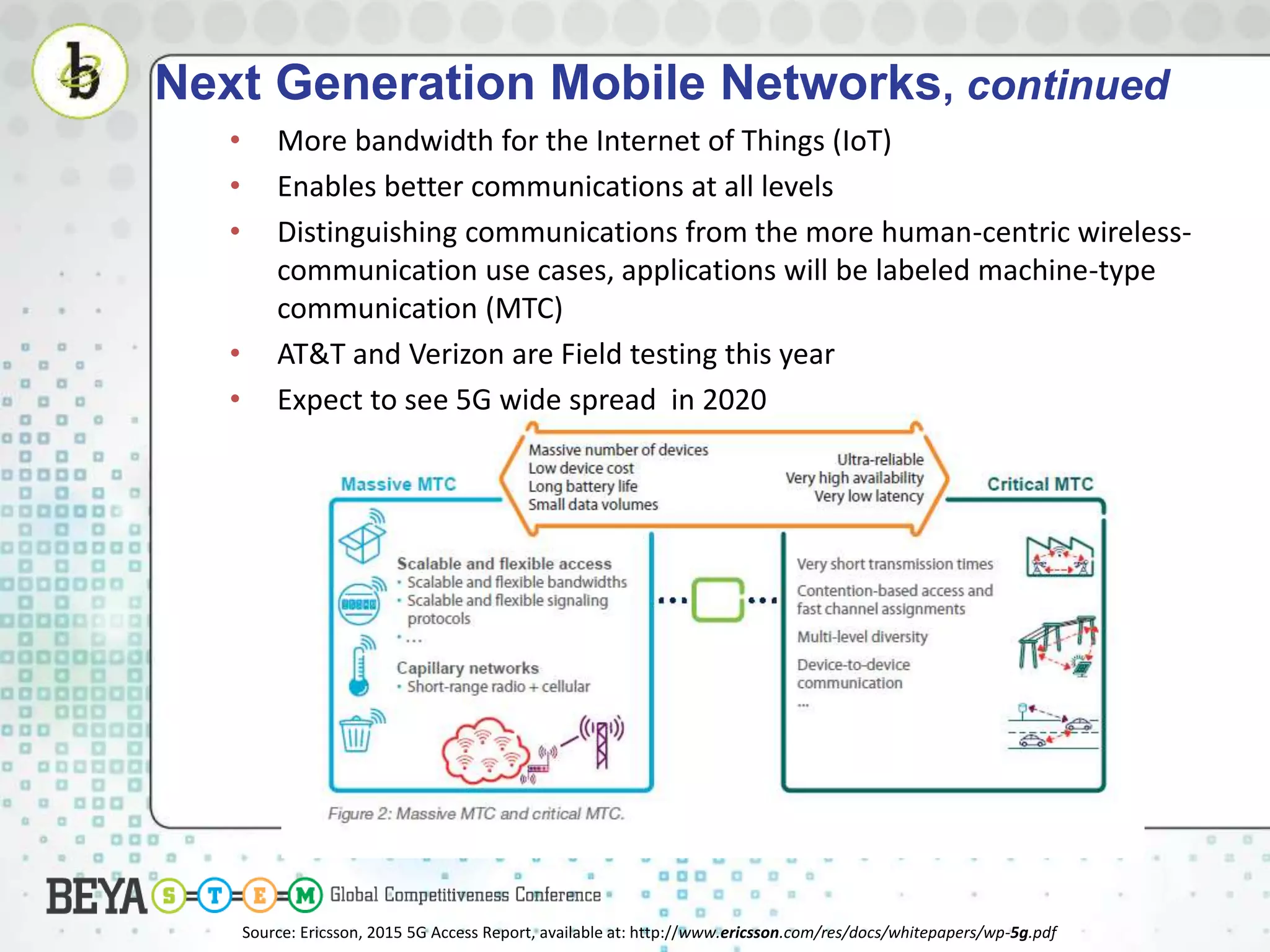
• More bandwidth for the Internet of Things (IoT)
• Enables better communications at all levels
• Distinguishing communications from the more human-centric wireless-
communication use cases, applications will be labeled machine-type
communication (MTC)
• AT&T and Verizon are Field testing this year
• Expect to see 5G wide spread in 2020
Next Generation Mobile Networks, continued
Source: Ericsson, 2015 5G Access Report, available at: http://www.ericsson.com/res/docs/whitepapers/wp-5g.pdf
Balancing Identity and Privacy
• Identity Theft is rising at all levels – Social media as well as financial theft
• Data Clearing houses are both good and bad
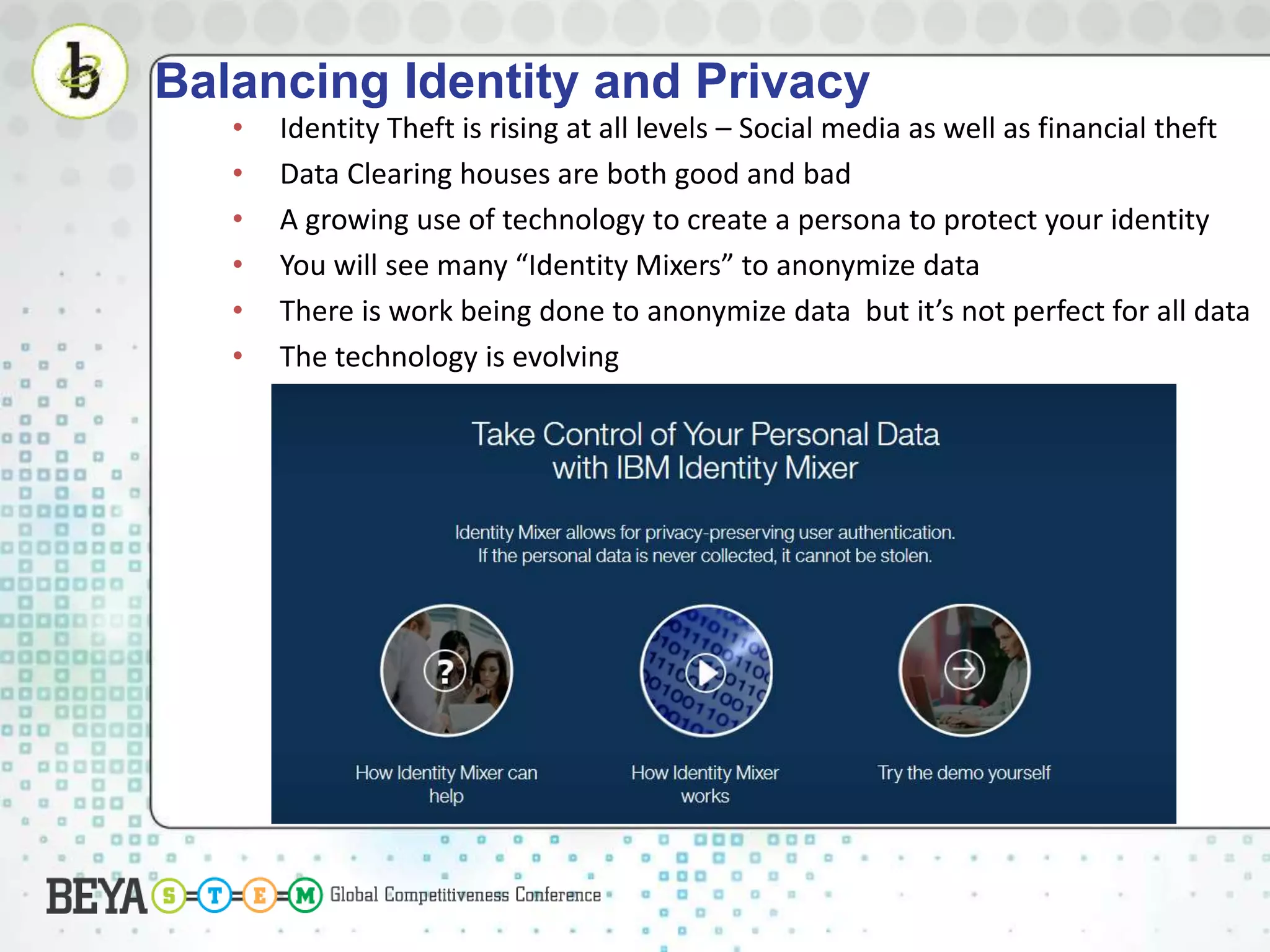
• A growing use of technology to create a persona to protect your identity
• You will see many “Identity Mixers” to anonymize data
• There is work being done to anonymize data but it’s not perfect for all data
• The technology is evolving
Smart and Connected Healthcare
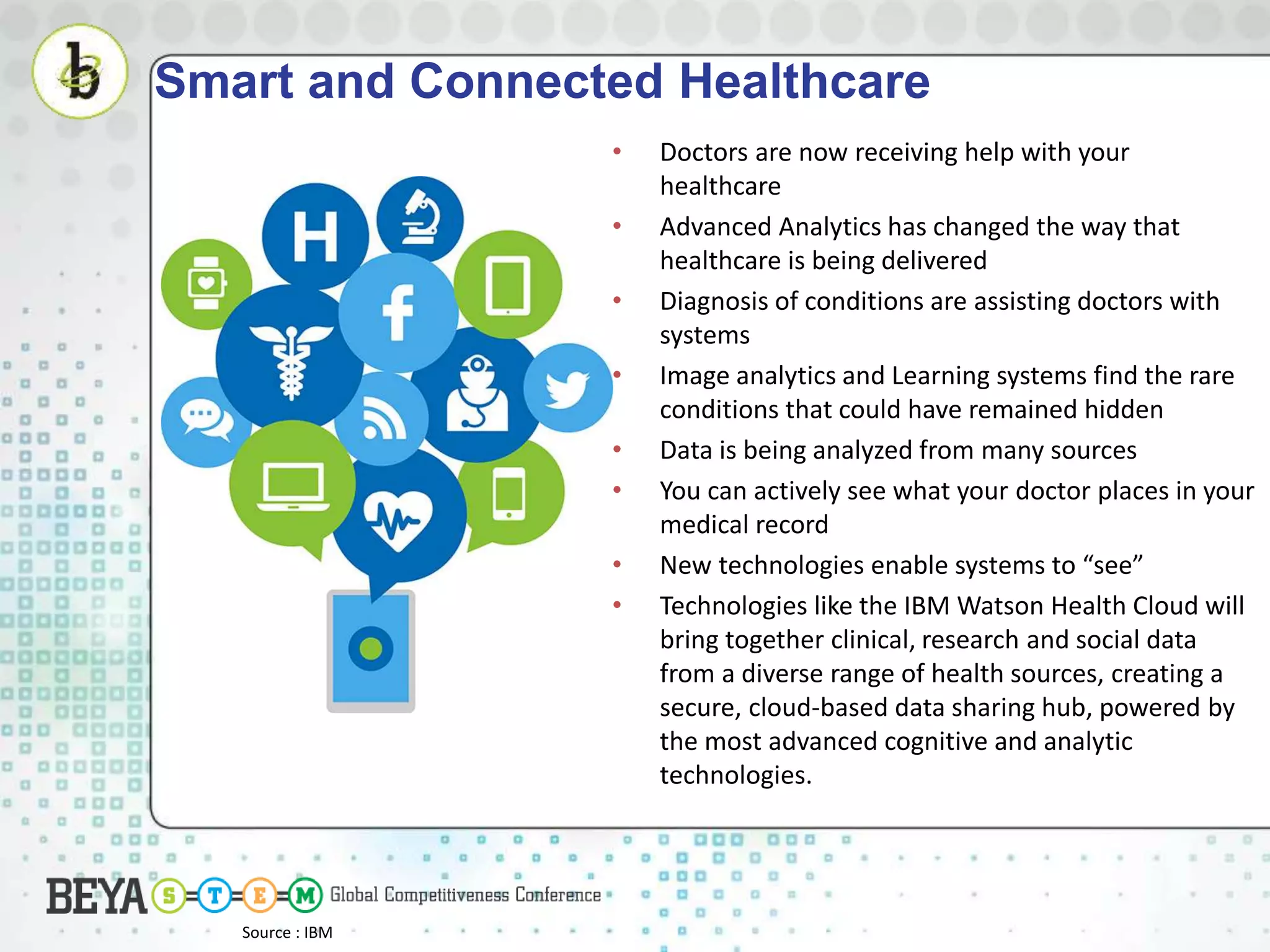
• Doctors are now receiving help with your
healthcare
• Advanced Analytics has changed the way that
healthcare is being delivered
• Diagnosis of conditions are assisting doctors with
systems
• Image analytics and Learning systems find the rare
conditions that could have remained hidden
• Data is being analyzed from many sources
• You can actively see what your doctor places in your
medical record
• New technologies enable systems to “see”
• Technologies like the IBM Watson Health Cloud will
bring together clinical, research and social data
from a diverse range of health sources, creating a
secure, cloud-based data sharing hub, powered by
the most advanced cognitive and analytic
technologies.
Source : IBM
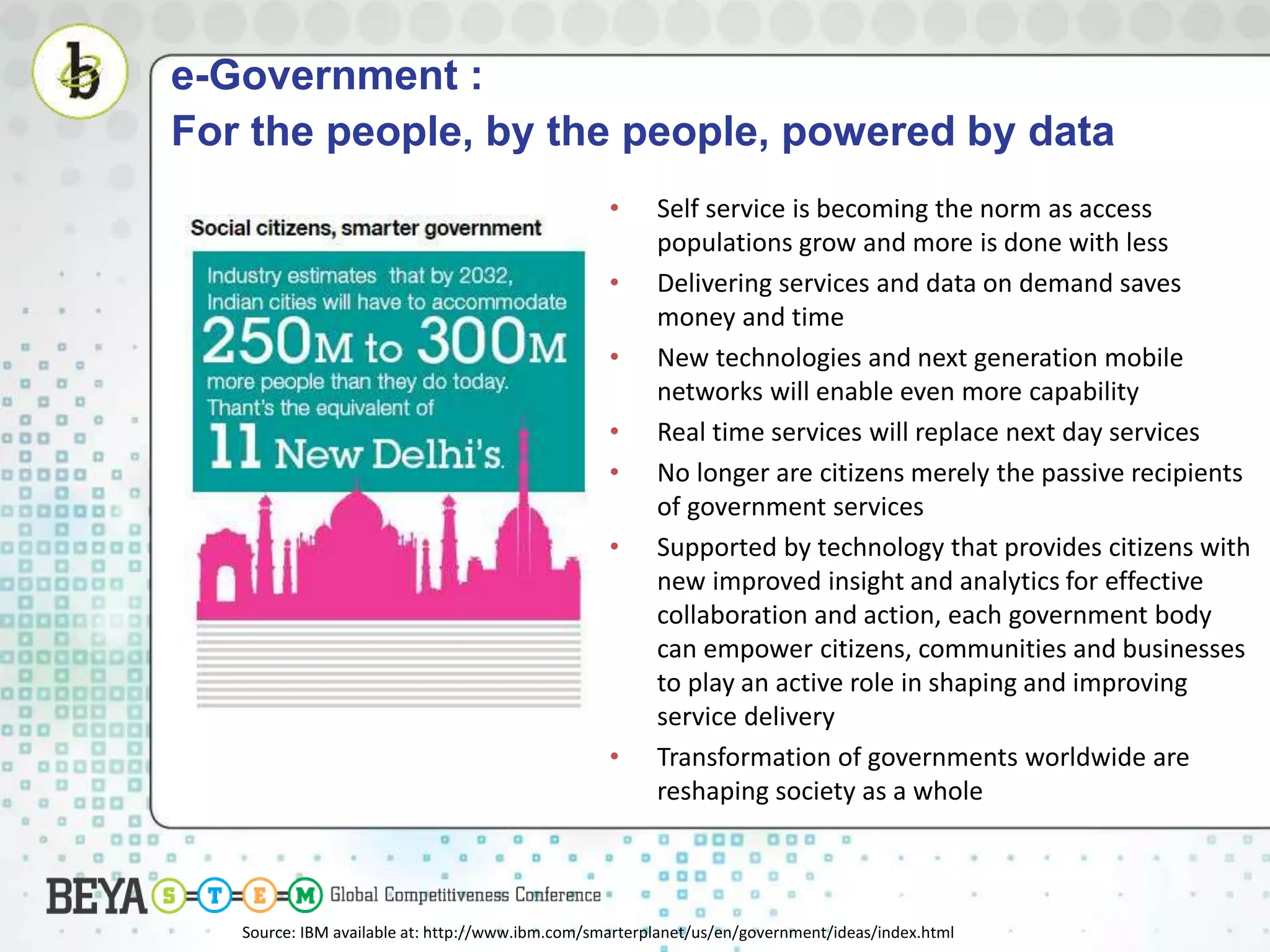
e-Government :
For the people, by the people, powered by data
• Self service is becoming the norm as access
populations grow and more is done with less
• Delivering services and data on demand saves
money and time
• New technologies and next generation mobile
networks will enable even more capability
• Real time services will replace next day services
• No longer are citizens merely the passive recipients
of government services
• Supported by technology that provides citizens with
new improved insight and analytics for effective
collaboration and action, each government body
can empower citizens, communities and businesses
to play an active role in shaping and improving
service delivery
• Transformation of governments worldwide are
reshaping society as a whole
Source: IBM available at: http://www.ibm.com/smarterplanet/us/en/government/ideas/index.html
What Makes Big Data Special?
• Volume
• Velocity
• Value
– Results have to be actionable
• Variety
• Variability
• Veracity
– Errors, missing values, inconsistent reporting
Challenges in Different Phases of Big Data
 Acquisition
 Storage
 Cleaning
 Transformation
 Integration / Aggregation
 Search
 Modeling
 Annotation
 Analysis
 Extraction
 Visualization
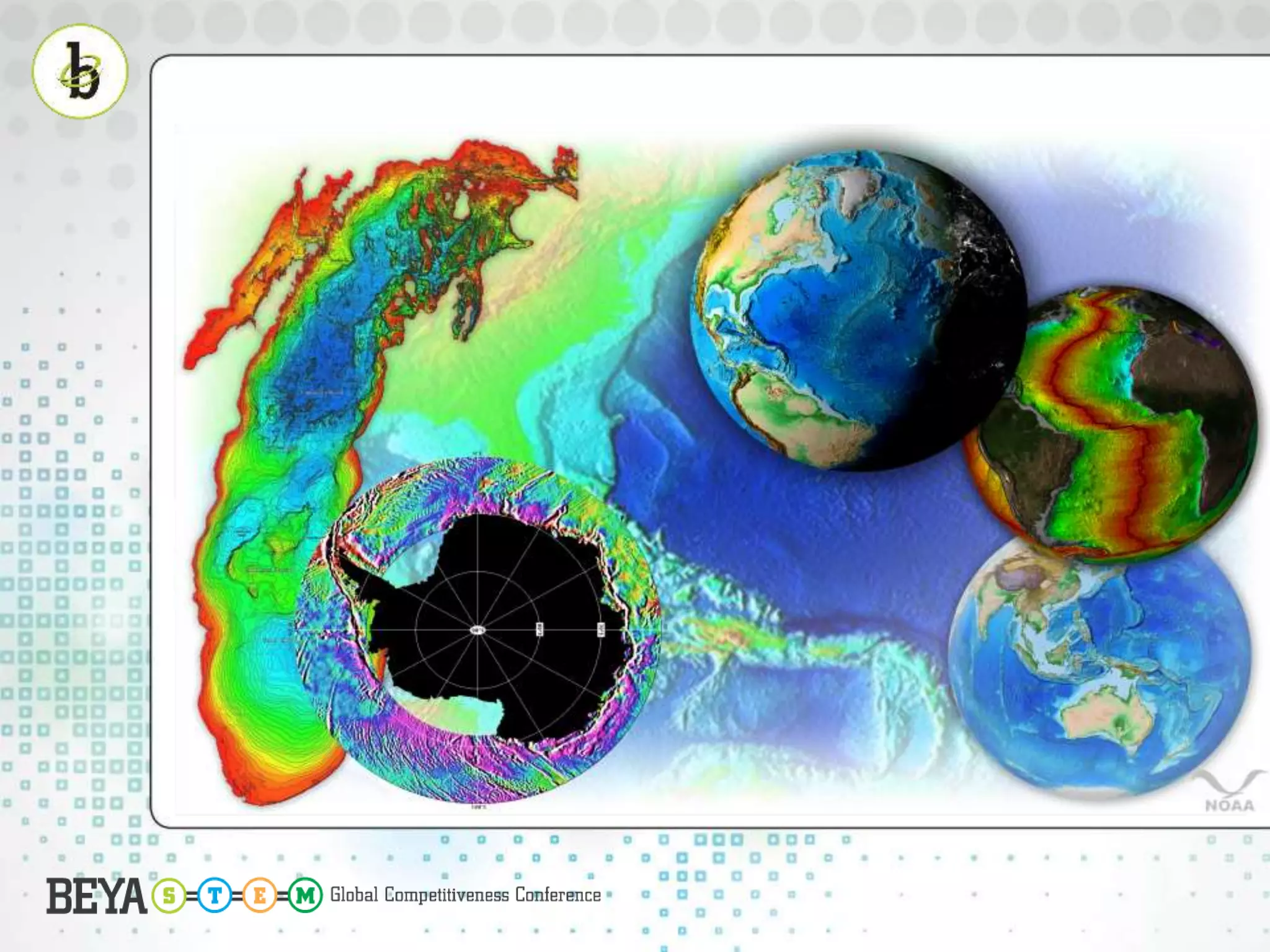
Global Challenges – Big Data NEEDS
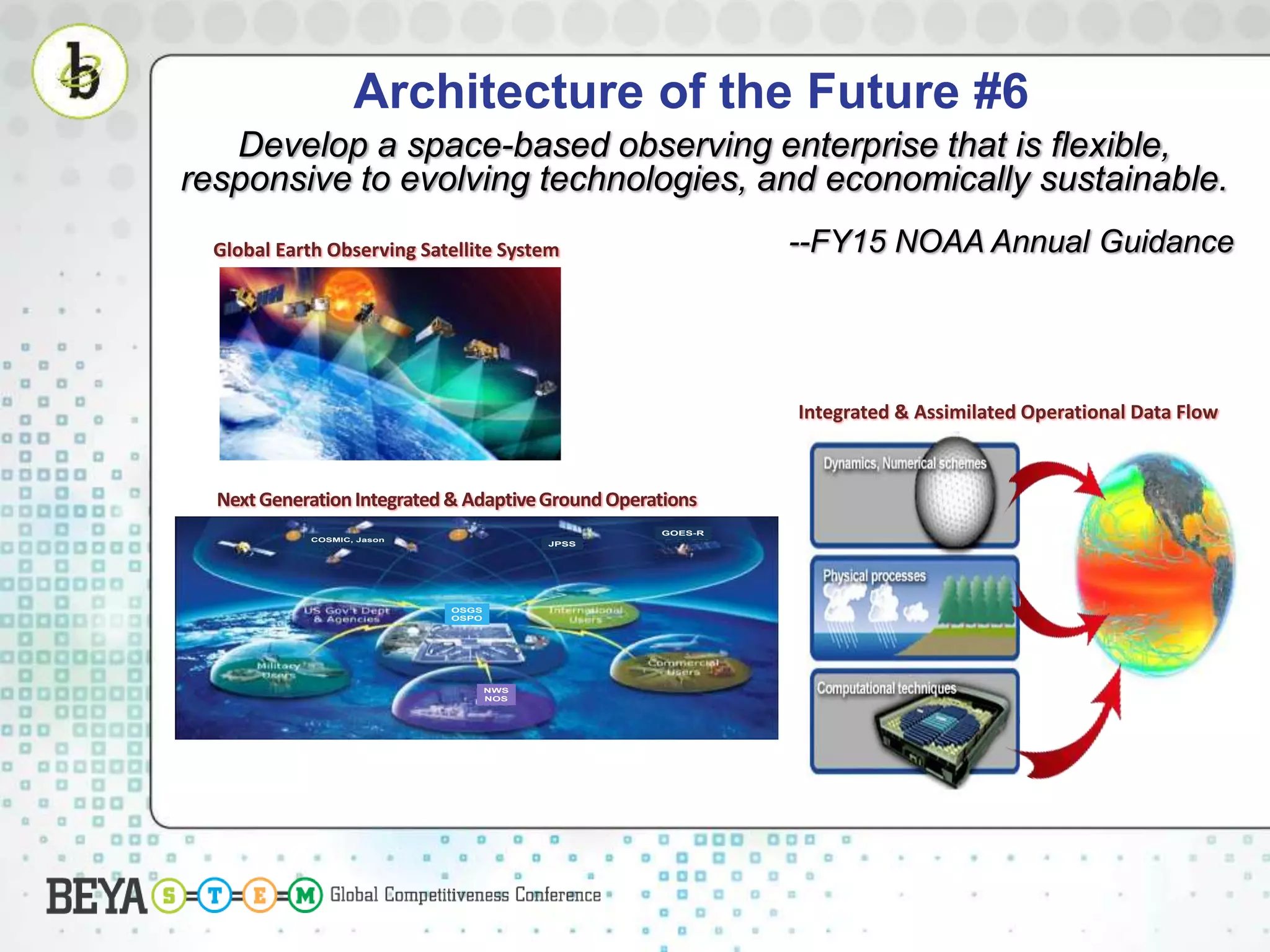
Architecture of the Future #6
Develop a space-based observing enterprise that is flexible,
responsive to evolving technologies, and economically sustainable.
--FY15 NOAA Annual Guidance
4"
Future Sources of Data
Global Earth Observing Satellite System
OSGS
OSPO
JPSS
GOES-R
COSMIC, Jason
NWS
NOS
NextGenerationIntegrated& AdaptiveGroundOperations
Integrated & Assimilated Operational Data Flow
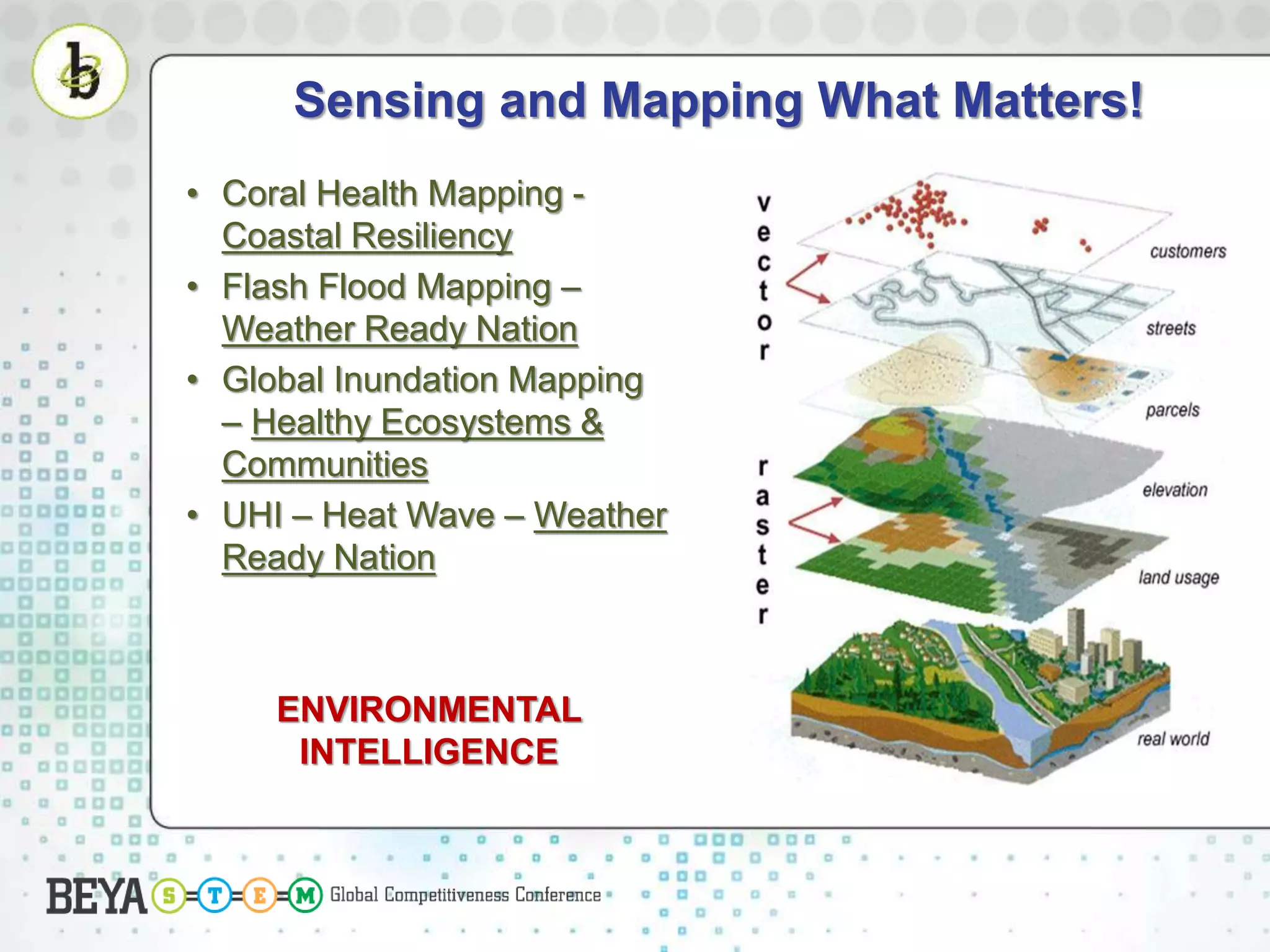
• Coral Health Mapping -
Coastal Resiliency
• Flash Flood Mapping –
Weather Ready Nation
• Global Inundation Mapping
– Healthy Ecosystems &
Communities
• UHI – Heat Wave – Weather
Ready Nation
ENVIRONMENTAL
INTELLIGENCE
Sensing and Mapping What Matters!
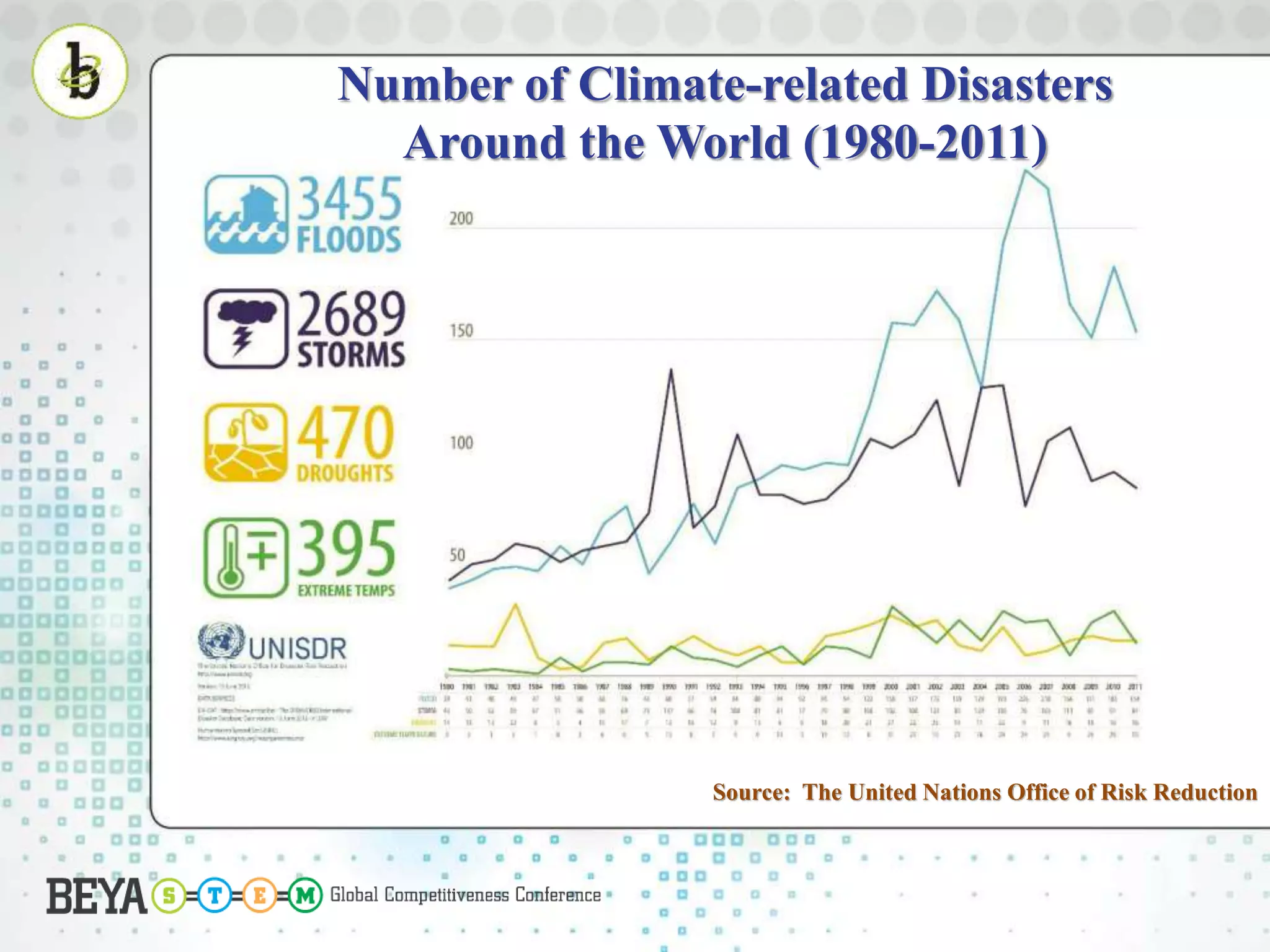
Source: The United Nations Office of Risk Reduction
Number of Climate-related Disasters
Around the World (1980-2011)
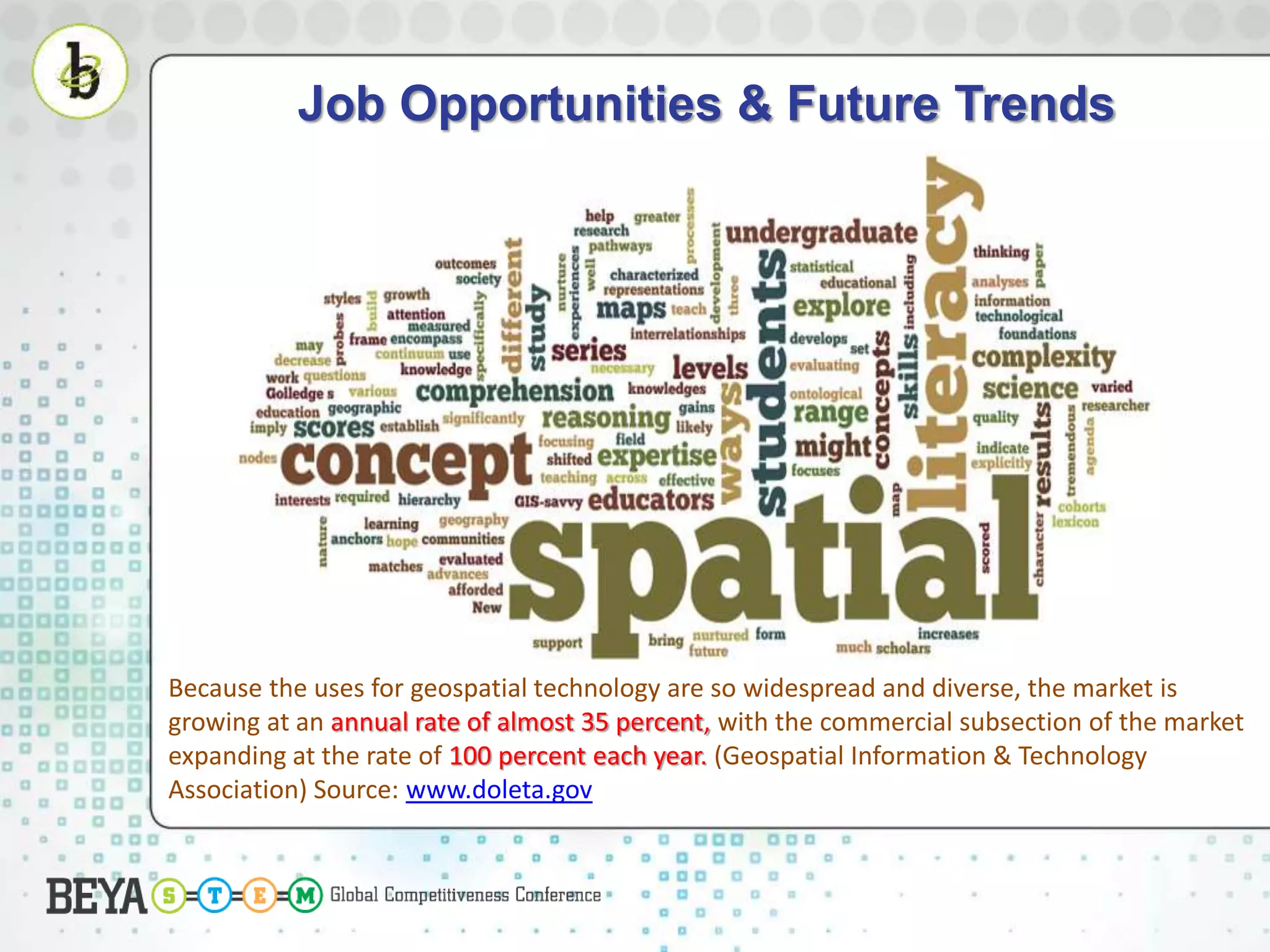
Job Opportunities & Future Trends
Because the uses for geospatial technology are so widespread and diverse, the market is
growing at an annual rate of almost 35 percent, with the commercial subsection of the market
expanding at the rate of 100 percent each year. (Geospatial Information & Technology
Association) Source: www.doleta.gov
1. Health services administrators
2. Emergency management
professionals
3. Ecologists and natural resource
managers
4. Epidemiologists
5. Law enforcers
6. Environmental analysts
7. Anthropologists and Archaeologists
8. Political Scientists and Sociologists
9. Urban planners
10. Hazard risk assessors
11. Public health administrators
12. Geologists
13. Economists
14. Marketing professionals, and
15. Transportation planners
And Endless Opportunities…
22
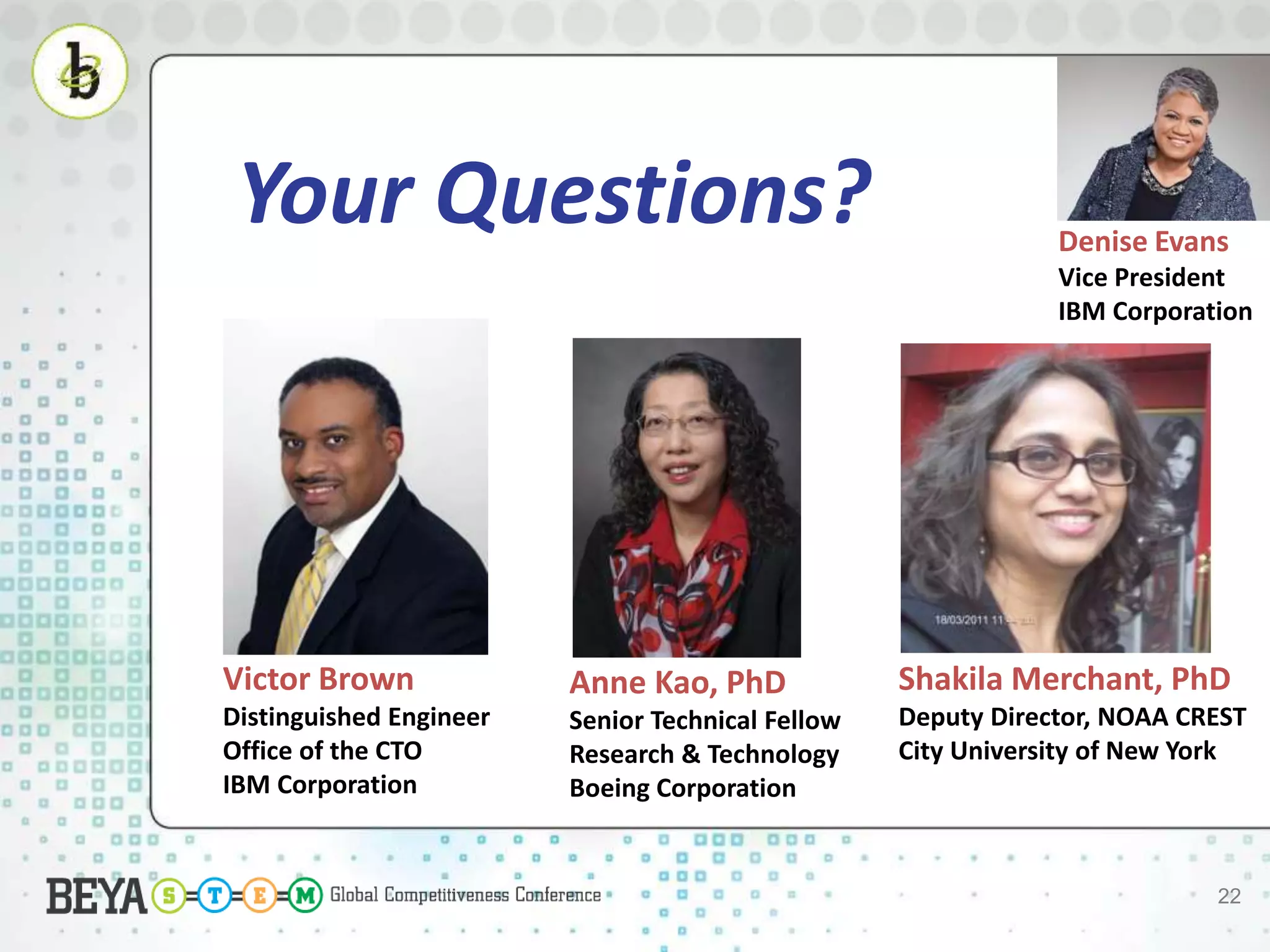
Denise Evans
Vice President
IBM Corporation
Victor Brown
Distinguished Engineer
Office of the CTO
IBM Corporation
Shakila Merchant, PhD
Deputy Director, NOAA CREST
City University of New York
Anne Kao, PhD
Senior Technical Fellow
Research & Technology
Boeing Corporation
Your Questions?

The Future Started Yesterday: The Top Ten Computer and IT Trends

  • 1.
    THE FUTURE STARTED YESTERDAY TheTop Ten Computer and IT Trends Saturday, February 20, 2016 1:30pm – 2:45pm (2406)
  • 2.
    The Future StartedYesterday: The Top Ten Computer and IT Trends 1. Emergence of the Mobile Cloud 2. From Internet of Things to Web of Things 3. From Big Data to Extreme Data 4. The Revolution Will Be 3D 5. Supporting New Learning Styles 6. Next-generation mobile networks 7. Balancing Identity and Privacy 8. Smart and Connected Healthcare 9. e-Government 10. Scientific Cloud Computing
  • 3.
    3 Denise Evans Vice President Women& Diversity B2B Marketing IBM Corporation Victor Brown Distinguished Engineer Office of the CTO, Federal IBM Corporation Shakila Merchant, PhD Deputy Director, NOAA CREST City University of New York Anne Kao, PhD Senior Technical Fellow Boeing Research & Technology Boeing Corporation Panelists Moderator
  • 4.
    The Revolution willbe 3D • Emerging and converging technologies - 3D printing, intelligent robotics and open source electronics are transforming the supply chain • 3D printing enables a Software Defined Supply Chain (SDSC) – SDSC is how to manufacture billions of smart devices easily and effectively in small quantities and in a highly customized way. – Prototyping and manufacturing of parts – Software will control the way things are built as well as the assembly lines – Make changes on the fly and improve quality – Improves competition as prototypes can be created at lower costs – Change the assembly line as needed
  • 5.
    © 2013 IBMCorporation5 HARDWARE CONSTRAINED BUILD A MOLD OR CAST HARDWIRE PRODUCTI ON LINE DEVELOP EMBEDDED CHIP SOFTWARE DEFINED PRINT PARTS DIRECTLY BY SOFTWARE RECONFIGURE ASSEMBLY THROUGH SOFTWARE DIGITAL CONTROLS USING SOFTWARE A Comparison:
  • 6.
    Cognitive Computers willleverage the large volumes of big data available to enterprises to help improve the decision making process Source: Cognitive Computing, A 2015 HorizonWatch Trend Report Image IBM “The machines of tomorrow – cognitive systems -- will forever change the way people interact with computing systems to help people extend their expertise across any domain of knowledge and make complex decisions involving extraordinary volumes of fast moving Big Data.” IBM “Cognitive computing systems learn and interact naturally with people to extend what either humans or machine could do on their own. They help human experts make better decisions by penetrating the complexity of Big Data.” IBM
  • 7.
    Cognitive Computing builton the new platform of Cloud, Mobile, Big Data Analytics and Social, will transform the way we work and live. Cognitive Computing: A 2015 HorizonWatch Trend Report “Cognitive computing makes a new class of problems computable. It addresses complex situations that are characterized by ambiguity and uncertainty; in other words it handles human kinds of problems.” WikiPedia “Information systems are becoming smarter and will increasingly be able to make business decisions with less input.” Gartner “Advances have made possible the beginning of a transition away from traditional programmatic computing to a newer arena of cognitive computing. In essence, it is the transition to enabling computers to ‘think’ or ‘reason’ in a way similar to the human mind.” Blue Hill Research “Growth in applications incorporating advanced and predictive analytics, including machine learning, will accelerate in 2015. These apps will grow 65% faster than apps without predictive functionality.” IDC IBM
  • 8.
    Personalized Learning –A look into the future
  • 9.
    Next Generation MobileNetworks 5G technologies are the future network for mobile communications 5G should be able to provide data rates exceeding 10Gbps in specific scenarios such as indoor and dense outdoor environments. • Data rates of several 100Mbps should be generally achievable in urban and suburban environments. • Data rates of at least 10Mbps should be achievable essentially everywhere, including sparsely-populated rural areas in both developed and developing countries. • Lower latency than 4G pushing for 1ms • 4G latency can be 50 ms or more • Ultra-high reliability Source: Ericsson, 2015 5G Access Report, available at: http://www.ericsson.com/res/docs/whitepapers/wp-5g.pdf
  • 10.
    • More bandwidthfor the Internet of Things (IoT) • Enables better communications at all levels • Distinguishing communications from the more human-centric wireless- communication use cases, applications will be labeled machine-type communication (MTC) • AT&T and Verizon are Field testing this year • Expect to see 5G wide spread in 2020 Next Generation Mobile Networks, continued Source: Ericsson, 2015 5G Access Report, available at: http://www.ericsson.com/res/docs/whitepapers/wp-5g.pdf
  • 11.
    Balancing Identity andPrivacy • Identity Theft is rising at all levels – Social media as well as financial theft • Data Clearing houses are both good and bad • A growing use of technology to create a persona to protect your identity • You will see many “Identity Mixers” to anonymize data • There is work being done to anonymize data but it’s not perfect for all data • The technology is evolving
  • 12.
    Smart and ConnectedHealthcare • Doctors are now receiving help with your healthcare • Advanced Analytics has changed the way that healthcare is being delivered • Diagnosis of conditions are assisting doctors with systems • Image analytics and Learning systems find the rare conditions that could have remained hidden • Data is being analyzed from many sources • You can actively see what your doctor places in your medical record • New technologies enable systems to “see” • Technologies like the IBM Watson Health Cloud will bring together clinical, research and social data from a diverse range of health sources, creating a secure, cloud-based data sharing hub, powered by the most advanced cognitive and analytic technologies. Source : IBM
  • 13.
    e-Government : For thepeople, by the people, powered by data • Self service is becoming the norm as access populations grow and more is done with less • Delivering services and data on demand saves money and time • New technologies and next generation mobile networks will enable even more capability • Real time services will replace next day services • No longer are citizens merely the passive recipients of government services • Supported by technology that provides citizens with new improved insight and analytics for effective collaboration and action, each government body can empower citizens, communities and businesses to play an active role in shaping and improving service delivery • Transformation of governments worldwide are reshaping society as a whole Source: IBM available at: http://www.ibm.com/smarterplanet/us/en/government/ideas/index.html
  • 14.
    What Makes BigData Special? • Volume • Velocity • Value – Results have to be actionable • Variety • Variability • Veracity – Errors, missing values, inconsistent reporting
  • 15.
    Challenges in DifferentPhases of Big Data  Acquisition  Storage  Cleaning  Transformation  Integration / Aggregation  Search  Modeling  Annotation  Analysis  Extraction  Visualization
  • 16.
    Global Challenges –Big Data NEEDS
  • 17.
    Architecture of theFuture #6 Develop a space-based observing enterprise that is flexible, responsive to evolving technologies, and economically sustainable. --FY15 NOAA Annual Guidance 4" Future Sources of Data Global Earth Observing Satellite System OSGS OSPO JPSS GOES-R COSMIC, Jason NWS NOS NextGenerationIntegrated& AdaptiveGroundOperations Integrated & Assimilated Operational Data Flow
  • 18.
    • Coral HealthMapping - Coastal Resiliency • Flash Flood Mapping – Weather Ready Nation • Global Inundation Mapping – Healthy Ecosystems & Communities • UHI – Heat Wave – Weather Ready Nation ENVIRONMENTAL INTELLIGENCE Sensing and Mapping What Matters!
  • 19.
    Source: The UnitedNations Office of Risk Reduction Number of Climate-related Disasters Around the World (1980-2011)
  • 20.
    Job Opportunities &Future Trends Because the uses for geospatial technology are so widespread and diverse, the market is growing at an annual rate of almost 35 percent, with the commercial subsection of the market expanding at the rate of 100 percent each year. (Geospatial Information & Technology Association) Source: www.doleta.gov
  • 21.
    1. Health servicesadministrators 2. Emergency management professionals 3. Ecologists and natural resource managers 4. Epidemiologists 5. Law enforcers 6. Environmental analysts 7. Anthropologists and Archaeologists 8. Political Scientists and Sociologists 9. Urban planners 10. Hazard risk assessors 11. Public health administrators 12. Geologists 13. Economists 14. Marketing professionals, and 15. Transportation planners And Endless Opportunities…
  • 22.
    22 Denise Evans Vice President IBMCorporation Victor Brown Distinguished Engineer Office of the CTO IBM Corporation Shakila Merchant, PhD Deputy Director, NOAA CREST City University of New York Anne Kao, PhD Senior Technical Fellow Research & Technology Boeing Corporation Your Questions?

Editor's Notes

  • #3 Learning Objective: Discuss the upcoming trends of information technology This seminar looks at the forefront of technology trends in the community for technology leaders. As a technology professional, staying on top of trends is crucial. Below is a list of technology topics that this seminar will cover. 1. Emergence of the Mobile Cloud Mobile distributed computing paradigm will lead to explosion of new services. 2. From Internet of Things to Web of Things Need connectivity, internet working to link physical and digital. 3. From Big Data to Extreme Data Simpler analytics tools needed to leverage the data deluge. 4. The Revolution Will Be 3D New tools; techniques bring 3D printing power to masses. 5. Supporting New Learning Styles Online courses demand seamless, ubiquitous approach. 6. Next-generation mobile networks Mobile infrastructure must catch up with user needs. 7. Balancing Identity and Privacy Growing risks and concerns about social networks. 8. Smart and Connected Healthcare Intelligent systems, assistive devices will improve health. 9. E-Government Interoperability a big challenge to delivering information. 10. Scientific Cloud Computing Key to solving grand challenges, pursuing breakthroughs. At the end of this seminar, participants will be able to: a. Explore the multiple uses of the internet. b. Identify ways that technology can make our society more productive. c. Examine what we give up when we advance technologically
  • #7 We are on a journey to a new era of computing capability that IBM calls Cognitive Computing. Cognitive Computing has the potential to revolutionize decision support applications resulting in a transformation of industry business and decision making processes.
  • #8 We are on a journey to a new era of computing capability that IBM calls Cognitive Computing. Cognitive Computing has the potential to revolutionize decision support applications resulting in a transformation of industry business and decision making processes.
  • #9 From the IBM GTO Personalized Education Introduction: An industry at the brink of transformation The education industry is at the brink of an IT-enabled transformation. This transformation is driven by a demand for quality education that outstrips supply especially in the growth markets, misalignment between education and employment needs, and impatience with inefficiencies of education systems. For example, the government of Brazil is already funding students to go abroad because of a shortage of education infrastructure and quality educators. If growth continues to follow the existing trajectory, India will need about 800 more traditional universities than current levels today of about 350 universities. Today, the most talked about application of technology to address these gaps is the advent of Massive Open Online Courses, or MOOC, which are growing rapidly. Several startups have emerged including Udacity, Khan Academy and Coursera, with millions of students enrolled across hundreds of countries. Large amounts of new data are being created, which thus far is untapped for its potential. What is Personalized Education Education today is mainly delivered on a one size fits all basis. This is a key cause of the poor quality and inefficiencies associated with the industry. Educational institutions can learn from healthcare by drawing the parallels of doctors to educators, patients to learners, medicine/treatment to courses/learning, and payers to education loan providers. From a technology point of view, the use of electronic health data to form patient records, derive evidence, and provide patient-centric personalized healthcare can be extended to education, with the formulation of digital student records helping to inform and provide personalized learning pathways based on the capabilities of the learner and the desired outcomes. Implications for the industry The education industry is ripe for innovation, as new business models are instantiated on the emerging new sources of data, in particular the longitudinal learning data (tracking student information over multiple years in multiple schools). Predictive and prescriptive analytics will be applied to improve outcomes and efficiency. Clustering learners into groups, assigning new learners to existing clusters, identifying when a learner is deviating from a particular path are some possible outcomes. Prescriptive analytics would identify personalized learning pathways, track progress, and provide feedback to ultimately improve timely graduations and employability. Combined with industry demand data, supply estimates could be provided and targeted courses created with intakes tweaked to meet estimated demand. What will it take to succeed? Ultimately there are many stakeholders who will be involved in improving education. This includes academic institutions, state education departments, students, learning management systems (LMS) and MOOC providers, government social service agencies and corporations. In order to achieve their often-shared goals, particularly to improve graduation and employment rates, they’ll need to come together to create an open platform for sharing this data and insights from the analytics.
  • #11  Smart and Connected Healthcare e-Government
  • #18 [slide text from the FY15 NOAA Annual Guidance] Current architecture studies look forward to 2050 for weather & environmental remote sensing needs space weather needs will be coordinated with SWORM process We will no longer be building “one-off” ground systems NESDIS will leverage common ground services & guide development of an Enterprise Ground Architecture The future enterprise will: Take advantage of technology advancements, both in performance and also in miniaturization and manufacturability. Take advantage of proven cost effective acquisition and operations approaches. Factor cost and, equally important, budget stability into the equation. Leverage science and technology investments of partner agencies for increased efficiency and to make use of the best available capabilities. Establish Enterprise Architecture and Enterprise Systems Engineering and Integration as core competencies of NESDIS. This is critical for NESDIS to be able to manage its space-based observation portfolio from an enterprise perspective. We will rely on NASA as our acquisition agent and as a technology developer, but we must manage the portfolio from the NOAA perspective based on a solid understanding of the needs of our users. We believe better performance and better value can be achieved, both technically and programmatically. Sensing with better resolution both spatially and temporally. Faster technology refresh, more programmatic agility.