Michael Hruska, CEO
Gerald L. Zahorchak, D.Ed,                     mike@problemsolutions.net
Superintendent                                             @mikehruska
www.allentownsd.org                             www.problemsolutions.net

                 Resources, connections, and the journey
Takeaways

•   Goals of a solution
•   Why it can work
•   How to start up
•   How to grow
•   How to scale
•   Approaches for design
Solution Goals and Background
•   18,000 students
•   1250 teachers
•   400 + administrators
•   Tools – Yammer and Facebook
    –   Admin (Y)
    –   School (Physical) driven groups (Y + FBp)
    –   Open groups (FB) [music/age]
    –   Encourage self organizing
• Approach - oriented to scale learning system to
  harness collective intelligence
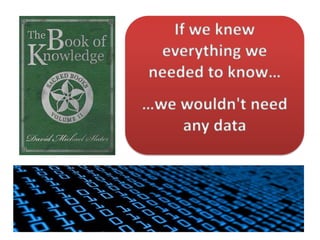
If we knew
 everything we
needed to know…
…we wouldn't need
    any data
Where are you…..we…..
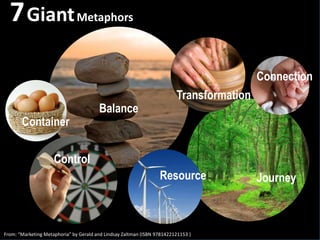
7 Giant Metaphors Metaphors
          7 Deep

                                                                                          Connection
                                                                         Transformation
                                        Balance
       Container


                     Control
                                                                  Resource                Journey


From: “Marketing Metaphoria” by Gerald and Lindsay Zaltman (ISBN 9781422121153 )
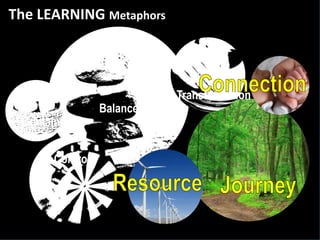
The LEARNING Metaphors
             7 Deep Metaphors


                           Transformation
                 Balance
 Container


       Control
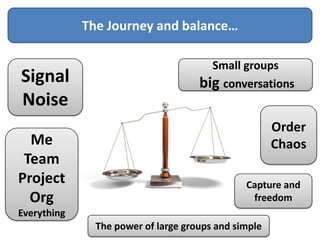
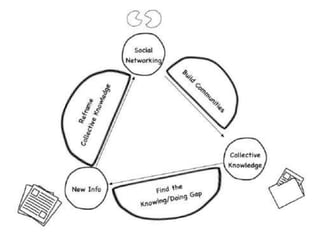
The Journey and balance…

                                       Small groups
Signal                               big conversations
Noise
                                                      Order
  Me                                                  Chaos
 Team
Project                                        Capture and
  Org                                           freedom
Everything
               The power of large groups and simple
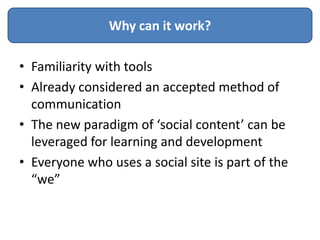
Why can it work?

• Familiarity with tools
• Already considered an accepted method of
  communication
• The new paradigm of ‘social content’ can be
  leveraged for learning and development
• Everyone who uses a social site is part of the
  “we”
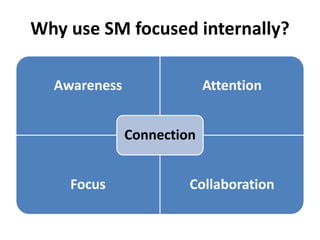
Why use SM focused internally?

  Awareness                Attention


              Connection


    Focus              Collaboration
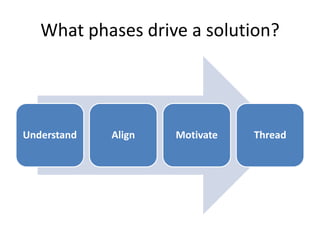
What phases drive a solution?


Understand   Align   Motivate   Thread
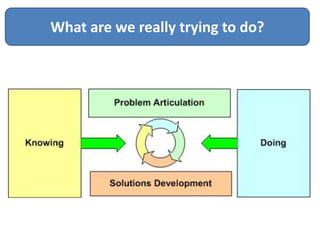
What are we really trying to do?
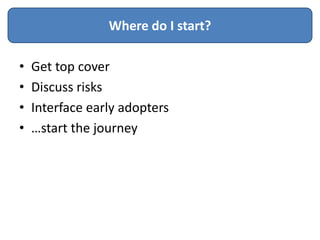
Where do I start?

•   Get top cover
•   Discuss risks
•   Interface early adopters
•   …start the journey
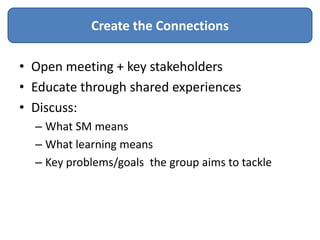
Create the Connections

• Open meeting + key stakeholders
• Educate through shared experiences
• Discuss:
  – What SM means
  – What learning means
  – Key problems/goals the group aims to tackle
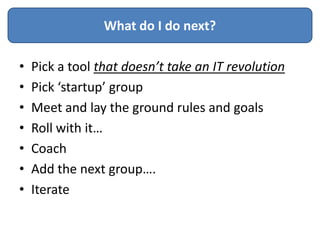
What do I do next?

•   Pick a tool that doesn’t take an IT revolution
•   Pick ‘startup’ group
•   Meet and lay the ground rules and goals
•   Roll with it…
•   Coach
•   Add the next group….
•   Iterate
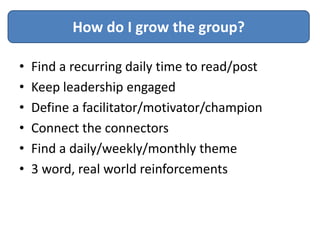
How do I grow the group?

•   Find a recurring daily time to read/post
•   Keep leadership engaged
•   Define a facilitator/motivator/champion
•   Connect the connectors
•   Find a daily/weekly/monthly theme
•   3 word, real world reinforcements
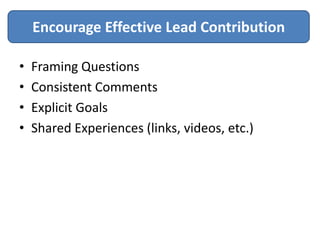
Encourage Effective Lead Contribution

•   Framing Questions
•   Consistent Comments
•   Explicit Goals
•   Shared Experiences (links, videos, etc.)
How do I grow it
beyond startup?
   …scale it?
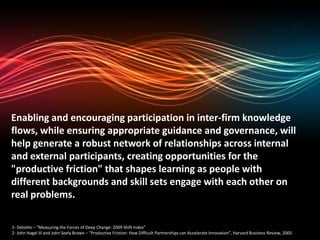
Enabling and encouraging participation in inter-firm knowledge
flows, while ensuring appropriate guidance and governance, will
help generate a robust network of relationships across internal
and external participants, creating opportunities for the
"productive friction" that shapes learning as people with
different backgrounds and skill sets engage with each other on
real problems.

1- Deloitte – “Measuring the Forces of Deep Change: 2009 Shift Index”
2- John Hagel III and John Seely Brown – “Productive Friction: How Difficult Partnerships can Accelerate Innovation”, Harvard Business Review, 2005
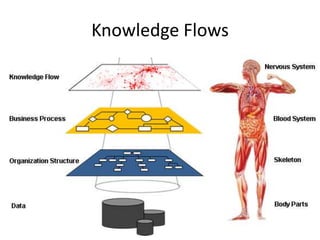
Knowledge Flows
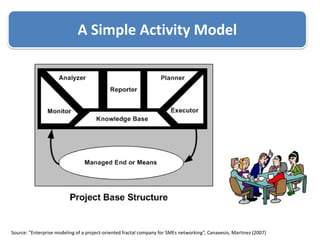
A Simple Activity Model


Source: “Enterprise modeling of a project-oriented fractal company for SMEs networking”, Canavesio, Martinez (2007)
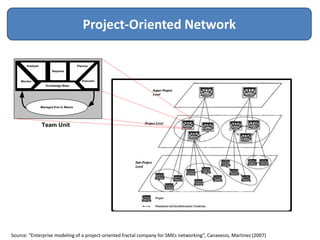
Project-Oriented Network

       Analyzer                          Planner
                         Reporter


    Monitor                                 Executor
                     Knowledge Base


                  Managed End or Means


                  Team Unit


Source: “Enterprise modeling of a project-oriented fractal company for SMEs networking”, Canavesio, Martinez (2007)
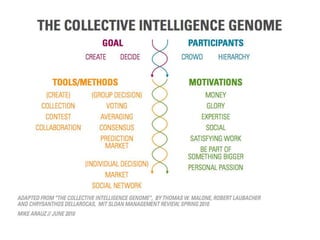
shared or group intelligence that emerges
                      from the collaboration and competition of
                      many individuals and appears in
                      consensus decision making


From www.wikipedia.com For more on CI: cci.mit.edu
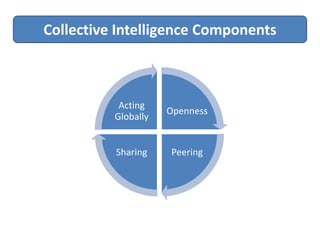
Collective Intelligence Components


           Acting
                     Openness
          Globally


          Sharing    Peering
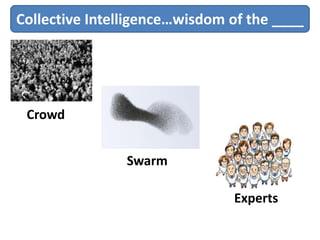
Collective Intelligence…wisdom of the ____


 Crowd


                Swarm

                               Experts
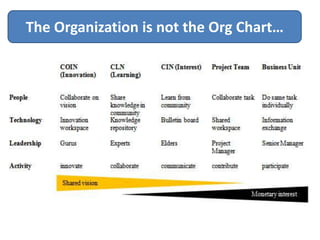
Collaborative Innovation Networks (COINs)
• Interaction of like-minded, self-motivated
  individuals who share the same vision
• Innovative ideas …..charismatic leaders, and a
  group of highly motivated collaborators
• A broad range of skills and expertise
• Not necessarily the corporate hierarchy
• Work outside of the formal organization
• Initially invisible
• Want to be part of the innovation that “will
  change the world.”
Collaborative Learning Networks (CLN)

• Community made of people inclined to share
  knowledge and practices
• Benefit reciprocally from personal mastery and
  the collective knowledge accumulation of a group
  of attitudinally similar people.
• Is aggregated to discuss the new idea
• Learn by exchanging information and experiences
  about the purpose or the application of the new
  idea
• Work in a collaborative way on development of
  new ideas
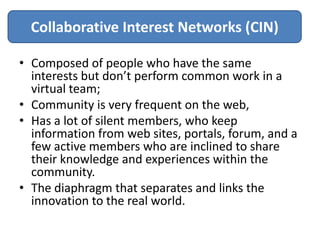
Collaborative Interest Networks (CIN)

• Composed of people who have the same
  interests but don’t perform common work in a
  virtual team;
• Community is very frequent on the web,
• Has a lot of silent members, who keep
  information from web sites, portals, forum, and a
  few active members who are inclined to share
  their knowledge and experiences within the
  community.
• The diaphragm that separates and links the
  innovation to the real world.
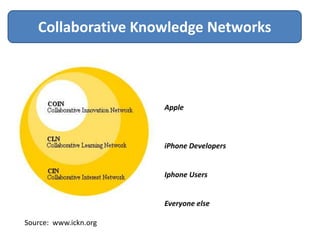
Collaborative Knowledge Networks


                       Apple


                       iPhone Developers


                       Iphone Users


                       Everyone else

Source: www.ickn.org
The Organization is not the Org Chart…
Considerations for Design

•   Structure
•   Themes and timing
•   Goals vs. Problems
•   Ends vs. Means
•   Compartments
•   Flow
Approaches for Design

•   Structure/Communities/Topics
•   By Functions
•   Crowd, swarm, or experts
•   By Tools
•   Hybrids
Analysis and planning change

•   Network flow
•   Measurement/Contribution/…
•   Themes / Problems…
•   Brokering
•   Semantic Spaces
•   Metaphors
Resources
• “The Design of Business” – ISBN 9781422177808
• MIT Center for Collective Intelligence
    – cci.mit.edu
• Innovative Collaborative Knowledge Networks
    – www.ickn.org
•   “Swarm Creativity” - ISBN 0195304128
•   “Coolhunting” - ISBN 0814473865
•   “Marketing Metaphoria” - ISBN 9781422121153
•   “Enterprise modeling of a project-oriented fractal
    company for SMEs networking”
    – Canavesio, Martinez (2007)           Michael Hruska, CEO
                                     mike@problemsolutions.net
                                                 @mikehruska
                                      www.problemsolutions.net

Social Media

  • 1.
    Michael Hruska, CEO GeraldL. Zahorchak, D.Ed, mike@problemsolutions.net Superintendent @mikehruska www.allentownsd.org www.problemsolutions.net Resources, connections, and the journey
  • 2.
    Takeaways • Goals of a solution • Why it can work • How to start up • How to grow • How to scale • Approaches for design
  • 3.
    Solution Goals andBackground • 18,000 students • 1250 teachers • 400 + administrators • Tools – Yammer and Facebook – Admin (Y) – School (Physical) driven groups (Y + FBp) – Open groups (FB) [music/age] – Encourage self organizing • Approach - oriented to scale learning system to harness collective intelligence
  • 4.
    If we knew everything we needed to know… …we wouldn't need any data
  • 5.
  • 6.
    7 Giant MetaphorsMetaphors 7 Deep Connection Transformation Balance Container Control Resource Journey From: “Marketing Metaphoria” by Gerald and Lindsay Zaltman (ISBN 9781422121153 )
  • 7.
    The LEARNING Metaphors 7 Deep Metaphors Transformation Balance Container Control
  • 8.
    The Journey andbalance… Small groups Signal big conversations Noise Order Me Chaos Team Project Capture and Org freedom Everything The power of large groups and simple
  • 9.
    Why can itwork? • Familiarity with tools • Already considered an accepted method of communication • The new paradigm of ‘social content’ can be leveraged for learning and development • Everyone who uses a social site is part of the “we”
  • 10.
    Why use SMfocused internally? Awareness Attention Connection Focus Collaboration
  • 11.
    What phases drivea solution? Understand Align Motivate Thread
  • 12.
    What are wereally trying to do?
  • 14.
    Where do Istart? • Get top cover • Discuss risks • Interface early adopters • …start the journey
  • 15.
    Create the Connections •Open meeting + key stakeholders • Educate through shared experiences • Discuss: – What SM means – What learning means – Key problems/goals the group aims to tackle
  • 16.
    What do Ido next? • Pick a tool that doesn’t take an IT revolution • Pick ‘startup’ group • Meet and lay the ground rules and goals • Roll with it… • Coach • Add the next group…. • Iterate
  • 17.
    How do Igrow the group? • Find a recurring daily time to read/post • Keep leadership engaged • Define a facilitator/motivator/champion • Connect the connectors • Find a daily/weekly/monthly theme • 3 word, real world reinforcements
  • 18.
    Encourage Effective LeadContribution • Framing Questions • Consistent Comments • Explicit Goals • Shared Experiences (links, videos, etc.)
  • 19.
    How do Igrow it beyond startup? …scale it?
  • 20.
    Enabling and encouragingparticipation in inter-firm knowledge flows, while ensuring appropriate guidance and governance, will help generate a robust network of relationships across internal and external participants, creating opportunities for the "productive friction" that shapes learning as people with different backgrounds and skill sets engage with each other on real problems. 1- Deloitte – “Measuring the Forces of Deep Change: 2009 Shift Index” 2- John Hagel III and John Seely Brown – “Productive Friction: How Difficult Partnerships can Accelerate Innovation”, Harvard Business Review, 2005
  • 21.
  • 22.
    A Simple ActivityModel Source: “Enterprise modeling of a project-oriented fractal company for SMEs networking”, Canavesio, Martinez (2007)
  • 23.
    Project-Oriented Network Analyzer Planner Reporter Monitor Executor Knowledge Base Managed End or Means Team Unit Source: “Enterprise modeling of a project-oriented fractal company for SMEs networking”, Canavesio, Martinez (2007)
  • 24.
    shared or groupintelligence that emerges from the collaboration and competition of many individuals and appears in consensus decision making From www.wikipedia.com For more on CI: cci.mit.edu
  • 25.
    Collective Intelligence Components Acting Openness Globally Sharing Peering
  • 26.
    Collective Intelligence…wisdom ofthe ____ Crowd Swarm Experts
  • 27.
    Collaborative Innovation Networks(COINs) • Interaction of like-minded, self-motivated individuals who share the same vision • Innovative ideas …..charismatic leaders, and a group of highly motivated collaborators • A broad range of skills and expertise • Not necessarily the corporate hierarchy • Work outside of the formal organization • Initially invisible • Want to be part of the innovation that “will change the world.”
  • 28.
    Collaborative Learning Networks(CLN) • Community made of people inclined to share knowledge and practices • Benefit reciprocally from personal mastery and the collective knowledge accumulation of a group of attitudinally similar people. • Is aggregated to discuss the new idea • Learn by exchanging information and experiences about the purpose or the application of the new idea • Work in a collaborative way on development of new ideas
  • 29.
    Collaborative Interest Networks(CIN) • Composed of people who have the same interests but don’t perform common work in a virtual team; • Community is very frequent on the web, • Has a lot of silent members, who keep information from web sites, portals, forum, and a few active members who are inclined to share their knowledge and experiences within the community. • The diaphragm that separates and links the innovation to the real world.
  • 30.
    Collaborative Knowledge Networks Apple iPhone Developers Iphone Users Everyone else Source: www.ickn.org
  • 31.
    The Organization isnot the Org Chart…
  • 33.
    Considerations for Design • Structure • Themes and timing • Goals vs. Problems • Ends vs. Means • Compartments • Flow
  • 34.
    Approaches for Design • Structure/Communities/Topics • By Functions • Crowd, swarm, or experts • By Tools • Hybrids
  • 35.
    Analysis and planningchange • Network flow • Measurement/Contribution/… • Themes / Problems… • Brokering • Semantic Spaces • Metaphors
  • 36.
    Resources • “The Designof Business” – ISBN 9781422177808 • MIT Center for Collective Intelligence – cci.mit.edu • Innovative Collaborative Knowledge Networks – www.ickn.org • “Swarm Creativity” - ISBN 0195304128 • “Coolhunting” - ISBN 0814473865 • “Marketing Metaphoria” - ISBN 9781422121153 • “Enterprise modeling of a project-oriented fractal company for SMEs networking” – Canavesio, Martinez (2007) Michael Hruska, CEO mike@problemsolutions.net @mikehruska www.problemsolutions.net

Editor's Notes

  • #2 Designing Learning NetworksThe Allentown School District organizes over 18,000 students, teachers, administrators and supporting staff.  To take their many challenges head-on, Allentown School District began employing social media as an internally focused sharing and learning solution for its administrators, faculty and staff. Initial goals are very straightforward: break down the cliques and silos, reduce misinformation and identify cross-functional areas of opportunity for collaboration to generate educational, operational and administrative improvements. The organization is tackling the inherent challenges that come with any new communication technology, including balancing the needs of sharing while considering the sensitivity of information and scale of participation.  Sharing across administrator, teacher and student boundaries is essential for holistic problem-solving, yet solving localized problems is sometimes easier solely contained within respective groups.  Similarly, large groups of diverse problem solvers can produce innovative solutions, yet openness and trust can often form faster and better in small groups. Additionally, the need to extract and share data between compartmented segments, to optimize the network and its problem solving capabilities, can be challenging.
  • #3 Design thinkingwhyPractical approaches to starting and growingTargets and frames for growing and scaling
  • #4 Design thinkingwhyPractical approaches to starting and growingTargets and frames for growing and scalingThe organization is tackling the inherent challenges that come with any new communication technology, including balancing the needs of sharing while considering the sensitivity of information and scale of participation.  Sharing across administrator, teacher and student boundaries is essential for holistic problem-solving, yet solving localized problems is sometimes easier solely contained within respective groups.  Similarly, large groups of diverse problem solvers can produce innovative solutions, yet openness and trust can often form faster and better in small groups. Additionally, the need to extract and share data between compartmented segments, to optimize the network and its problem solving capabilities, can be challenging.
  • #6 And most importantly, each of us can teach each other, we need to know who is like or unlike us ……>10k, >5k, >2k, >1k, >500, >200, >100, >50Existing SM solution?How many framed around learning?To find out how to make what we have betterTo know if we should start somethingTo find out what else is possible
  • #7 Design is everythingcite the book: Marketing Metaphoria. Maybe put a QR code in the lower right corner for people to purchase the book from Amazon.
  • #8 Connect resources: People to people and people to contentConnect the connectorsPush the journey
  • #21 Throughput, information flow and infrastructureDeloitte quote
  • #22 The flow of an organization is not the organization chart….How do I find the flow?How do we find the emerging flows?What are the most important flows?How do we encourage flows to continue?How do we create environments for flows to occur?
  • #24 How do you negotiate the balance between people organizing how they want to organize and following this model?
  • #31 EX Apple, Appstore, Iphone UsersA set of concentric communitiesWhere new knowledge is created and flows
  • #36 The Klout Score is the measurement of one’s overall online influence. The scores range from 1-100 with higher scores representing a wider and stronger sphere of influence. The Klout Score is a factor of over 35 variables broken into three categories; True Reach, Amplification Score and Network Score. True Reach is the size of one’s engaged audience and is based on the followers and friends who actively listen and react to one’s messages.