TheFutureofIoT
A presentation for Expert Talk on Internet Of Things
PAGE 1
Presenter: Prof. Arti U. Parab
Anna Leela & Shobha Jayaram College, Kurla
Presentation
Outline
Internet of Things: Introduction / Scope
Internet of Things: Future Applications and Challenges
Facing IoT Development
Internet of Things: Trends
Internet of Things: Future Job Roles
Internet of Things: Future Vision
PAGE 2
PAGE 3
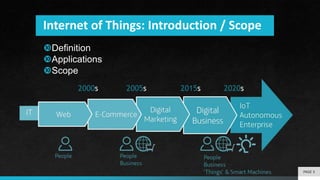
Definition
Applications
Scope
Internet of Things: Introduction / Scope
Defining IoT
 IoT basically about making things Smart.
 This enables the a new level of services and Capabilities.
 This can be achieved by a combination of following things:
 Adding Sensors and Actuators
 Adding Connectivity to the Cloud
 Implementing the things where its capabilities can be programmatically manipulated. Sensors &
Actuators Connectivity People & processes
 Essential Blocks of IoT
 Things
 Sensors
 Gateway
 Network & Cloud
 Monitoring & Operating platforms
PAGE 4
Industries Currently Being Served Best by IoT
Applications
 The most interesting areas according to a survey include home automation (19 percent), wearables
(13 percent), fitness (11 percent) and automotive (11 percent) applications.
 Success stories like FitBit and its recent IPO as well as the availability of devices like the Nest in big-
box stores are paving the way toward widespread consumer adoption of IoT devices.
 With the advent of the Apple Watch, wearable technologies have gained much customer-facing
attention.
 The military has also provided fertile ground for developing integrated wearables, like those in the
areas of infrared sensing and night vision. These applications can all be seen as the trailblazers in a
history that is still unfolding.
 Additionally, medical applications are rapidly maturing, merging wireless technologies and sensors
to monitor health. These innovations range from tiny devices to monitor heart rate all the way up to
caregiving robots already in use in Japan and Europe.
PAGE 5
What is the current scope of the Internet of Things in
India?
 IoT is next generation
internet, after
connecting people it is
moving to connect
every Thing to the
internet and the
resulting dynamics
would open up a new
set of opportunities
and possibilities.
 For a country where
internet penetration for
people hasn’t reached
its full potential this
question about scope
of IoT is a valid one.
PAGE 6
 1)Industries :Industries have to remain competitive and IoT helps them
monitor various production parameters , downtime and preventive maintenance
factors .This will decide who wins the next round .We have large industries from
steel to automotive and they surely will adopt IoT.
 2)Smart Cities : On this one some of our newer cities may directly skip the old
ways and get planned better with the help of IoT.
 3)India’s I.T service industry is huge and their clients abroad will demand IoT
based solutions and that indirectly translates to scope in India for IoT jobs
 4)A lot of inefficiencies in India can be better managed by IoT from school
bus tracking to public bus tracking and maybe even Cow tracking.
 5)Agriculture IoT : A lot of food is wasted between farm and customer .It begins
from lack of use of technology at farm level add to that further inefficiencies in
logistics due to improper supply demand information leading to constant need for
farm subsidy and support packages taking out money needed for infra . These
inefficiencies run into thousands of crores of rupees across India . Someone
studying Indian conditions and implementing a solution looks tough today but will
be a reality in few years .
Future Applications
and Challenges
 According to a survey Health care (14 percent), urban usage (13 percent) and automotive (12 percent)
applications ranked high in their potential for future IoT applications.
 Tracking health statistics will dramatically impact the medical community as well as the general public as a
whole.
 However, the bridge between gathering health data and sharing it safely and securely with the proper
health care providers remains a key challenge for this sector.
 Codifying standards that will allow these diverse devices to safely communicate with one another is a key
hurdle currently being addressed.
 The automotive industry is also facing scrutiny around the security of connected devices in cars. The
recent demo of the hacking of a connected Jeep Cherokee demonstrated the ability for a hacker to drive it
off the road, vividly illustrating the problems inherent in IoT security.
 Securing these devices is particularly daunting given the activity of hacker communities and the skills gap
between many smaller development shops and the larger security community.
 In order to move IoT adoption forward, these factors will need to be addressed.
PAGE 7
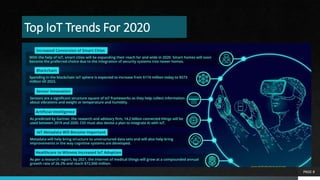
Top IoT Trends For 2020
PAGE 8
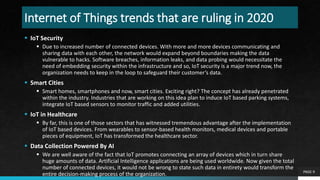
Internet of Things trends that are ruling in 2020
 IoT Security
 Due to increased number of connected devices. With more and more devices communicating and
sharing data with each other, the network would expand beyond boundaries making the data
vulnerable to hacks. Software breaches, information leaks, and data probing would necessitate the
need of embedding security within the infrastructure and so, IoT security is a major trend now, the
organization needs to keep in the loop to safeguard their customer’s data.
 Smart Cities
 Smart homes, smartphones and now, smart cities. Exciting right? The concept has already penetrated
within the industry. Industries that are working on this idea plan to induce IoT based parking systems,
integrate IoT based sensors to monitor traffic and added utilities.
 IoT in Healthcare
 By far, this is one of those sectors that has witnessed tremendous advantage after the implementation
of IoT based devices. From wearables to sensor-based health monitors, medical devices and portable
pieces of equipment, IoT has transformed the healthcare sector.
 Data Collection Powered By AI
 We are well aware of the fact that IoT promotes connecting an array of devices which in turn share
huge amounts of data. Artificial Intelligence applications are being used worldwide. Now given the total
number of connected devices, it would not be wrong to state such data in entirety would transform the
entire decision-making process of the organization. PAGE 9
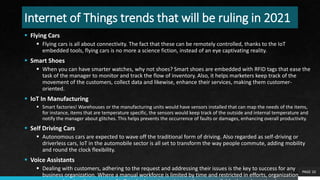
Internet of Things trends that will be ruling in 2021
 Flying Cars
 Flying cars is all about connectivity. The fact that these can be remotely controlled, thanks to the IoT
embedded tools, flying cars is no more a science fiction, instead of an eye captivating reality.
 Smart Shoes
 When you can have smarter watches, why not shoes? Smart shoes are embedded with RFID tags that ease the
task of the manager to monitor and track the flow of inventory. Also, it helps marketers keep track of the
movement of the customers, collect data and likewise, enhance their services, making them customer-
oriented.
 IoT In Manufacturing
 Smart factories! Warehouses or the manufacturing units would have sensors installed that can map the needs of the items,
for instance, items that are temperature specific, the sensors would keep track of the outside and internal temperature and
notify the manager about glitches. This helps prevents the occurrence of faults or damages, enhancing overall productivity.
 Self Driving Cars
 Autonomous cars are expected to wave off the traditional form of driving. Also regarded as self-driving or
driverless cars, IoT in the automobile sector is all set to transform the way people commute, adding mobility
and round the clock flexibility.
 Voice Assistants
 Dealing with customers, adhering to the request and addressing their issues is the key to success for any
business organization. Where a manual workforce is limited by time and restricted in efforts, organizations are
PAGE 10
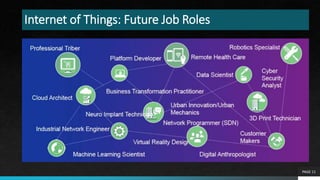
Internet of Things: Future Job Roles
PAGE 11
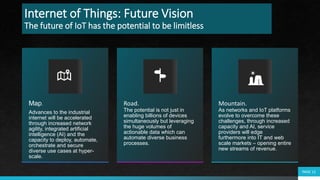
Internet of Things: Future Vision
The future of IoT has the potential to be limitless
Map.
Advances to the industrial
internet will be accelerated
through increased network
agility, integrated artificial
intelligence (AI) and the
capacity to deploy, automate,
orchestrate and secure
diverse use cases at hyper-
scale.
Road.
The potential is not just in
enabling billions of devices
simultaneously but leveraging
the huge volumes of
actionable data which can
automate diverse business
processes.
Mountain.
As networks and IoT platforms
evolve to overcome these
challenges, through increased
capacity and AI, service
providers will edge
furthermore into IT and web
scale markets – opening entire
new streams of revenue.
PAGE 12
The
Conclusion
The Final Word
No wonder, IoT is designated as the groundbreaking
technology. It is evidently reshaping the future, opening up
newer avenues for entrepreneurs and business professionals
to take advantage of. However, this is just the start and the
technology has a lot more to offer than you expect. So, let’s
not anticipate and let future unveil the real picture.
PAGE 13

The future of IOT

  • 1.
    TheFutureofIoT A presentation forExpert Talk on Internet Of Things PAGE 1 Presenter: Prof. Arti U. Parab Anna Leela & Shobha Jayaram College, Kurla
  • 2.
    Presentation Outline Internet of Things:Introduction / Scope Internet of Things: Future Applications and Challenges Facing IoT Development Internet of Things: Trends Internet of Things: Future Job Roles Internet of Things: Future Vision PAGE 2
  • 3.
  • 4.
    Defining IoT  IoTbasically about making things Smart.  This enables the a new level of services and Capabilities.  This can be achieved by a combination of following things:  Adding Sensors and Actuators  Adding Connectivity to the Cloud  Implementing the things where its capabilities can be programmatically manipulated. Sensors & Actuators Connectivity People & processes  Essential Blocks of IoT  Things  Sensors  Gateway  Network & Cloud  Monitoring & Operating platforms PAGE 4
  • 5.
    Industries Currently BeingServed Best by IoT Applications  The most interesting areas according to a survey include home automation (19 percent), wearables (13 percent), fitness (11 percent) and automotive (11 percent) applications.  Success stories like FitBit and its recent IPO as well as the availability of devices like the Nest in big- box stores are paving the way toward widespread consumer adoption of IoT devices.  With the advent of the Apple Watch, wearable technologies have gained much customer-facing attention.  The military has also provided fertile ground for developing integrated wearables, like those in the areas of infrared sensing and night vision. These applications can all be seen as the trailblazers in a history that is still unfolding.  Additionally, medical applications are rapidly maturing, merging wireless technologies and sensors to monitor health. These innovations range from tiny devices to monitor heart rate all the way up to caregiving robots already in use in Japan and Europe. PAGE 5
  • 6.
    What is thecurrent scope of the Internet of Things in India?  IoT is next generation internet, after connecting people it is moving to connect every Thing to the internet and the resulting dynamics would open up a new set of opportunities and possibilities.  For a country where internet penetration for people hasn’t reached its full potential this question about scope of IoT is a valid one. PAGE 6  1)Industries :Industries have to remain competitive and IoT helps them monitor various production parameters , downtime and preventive maintenance factors .This will decide who wins the next round .We have large industries from steel to automotive and they surely will adopt IoT.  2)Smart Cities : On this one some of our newer cities may directly skip the old ways and get planned better with the help of IoT.  3)India’s I.T service industry is huge and their clients abroad will demand IoT based solutions and that indirectly translates to scope in India for IoT jobs  4)A lot of inefficiencies in India can be better managed by IoT from school bus tracking to public bus tracking and maybe even Cow tracking.  5)Agriculture IoT : A lot of food is wasted between farm and customer .It begins from lack of use of technology at farm level add to that further inefficiencies in logistics due to improper supply demand information leading to constant need for farm subsidy and support packages taking out money needed for infra . These inefficiencies run into thousands of crores of rupees across India . Someone studying Indian conditions and implementing a solution looks tough today but will be a reality in few years .
  • 7.
    Future Applications and Challenges According to a survey Health care (14 percent), urban usage (13 percent) and automotive (12 percent) applications ranked high in their potential for future IoT applications.  Tracking health statistics will dramatically impact the medical community as well as the general public as a whole.  However, the bridge between gathering health data and sharing it safely and securely with the proper health care providers remains a key challenge for this sector.  Codifying standards that will allow these diverse devices to safely communicate with one another is a key hurdle currently being addressed.  The automotive industry is also facing scrutiny around the security of connected devices in cars. The recent demo of the hacking of a connected Jeep Cherokee demonstrated the ability for a hacker to drive it off the road, vividly illustrating the problems inherent in IoT security.  Securing these devices is particularly daunting given the activity of hacker communities and the skills gap between many smaller development shops and the larger security community.  In order to move IoT adoption forward, these factors will need to be addressed. PAGE 7
  • 8.
    Top IoT TrendsFor 2020 PAGE 8
  • 9.
    Internet of Thingstrends that are ruling in 2020  IoT Security  Due to increased number of connected devices. With more and more devices communicating and sharing data with each other, the network would expand beyond boundaries making the data vulnerable to hacks. Software breaches, information leaks, and data probing would necessitate the need of embedding security within the infrastructure and so, IoT security is a major trend now, the organization needs to keep in the loop to safeguard their customer’s data.  Smart Cities  Smart homes, smartphones and now, smart cities. Exciting right? The concept has already penetrated within the industry. Industries that are working on this idea plan to induce IoT based parking systems, integrate IoT based sensors to monitor traffic and added utilities.  IoT in Healthcare  By far, this is one of those sectors that has witnessed tremendous advantage after the implementation of IoT based devices. From wearables to sensor-based health monitors, medical devices and portable pieces of equipment, IoT has transformed the healthcare sector.  Data Collection Powered By AI  We are well aware of the fact that IoT promotes connecting an array of devices which in turn share huge amounts of data. Artificial Intelligence applications are being used worldwide. Now given the total number of connected devices, it would not be wrong to state such data in entirety would transform the entire decision-making process of the organization. PAGE 9
  • 10.
    Internet of Thingstrends that will be ruling in 2021  Flying Cars  Flying cars is all about connectivity. The fact that these can be remotely controlled, thanks to the IoT embedded tools, flying cars is no more a science fiction, instead of an eye captivating reality.  Smart Shoes  When you can have smarter watches, why not shoes? Smart shoes are embedded with RFID tags that ease the task of the manager to monitor and track the flow of inventory. Also, it helps marketers keep track of the movement of the customers, collect data and likewise, enhance their services, making them customer- oriented.  IoT In Manufacturing  Smart factories! Warehouses or the manufacturing units would have sensors installed that can map the needs of the items, for instance, items that are temperature specific, the sensors would keep track of the outside and internal temperature and notify the manager about glitches. This helps prevents the occurrence of faults or damages, enhancing overall productivity.  Self Driving Cars  Autonomous cars are expected to wave off the traditional form of driving. Also regarded as self-driving or driverless cars, IoT in the automobile sector is all set to transform the way people commute, adding mobility and round the clock flexibility.  Voice Assistants  Dealing with customers, adhering to the request and addressing their issues is the key to success for any business organization. Where a manual workforce is limited by time and restricted in efforts, organizations are PAGE 10
  • 11.
    Internet of Things:Future Job Roles PAGE 11
  • 12.
    Internet of Things:Future Vision The future of IoT has the potential to be limitless Map. Advances to the industrial internet will be accelerated through increased network agility, integrated artificial intelligence (AI) and the capacity to deploy, automate, orchestrate and secure diverse use cases at hyper- scale. Road. The potential is not just in enabling billions of devices simultaneously but leveraging the huge volumes of actionable data which can automate diverse business processes. Mountain. As networks and IoT platforms evolve to overcome these challenges, through increased capacity and AI, service providers will edge furthermore into IT and web scale markets – opening entire new streams of revenue. PAGE 12
  • 13.
    The Conclusion The Final Word Nowonder, IoT is designated as the groundbreaking technology. It is evidently reshaping the future, opening up newer avenues for entrepreneurs and business professionals to take advantage of. However, this is just the start and the technology has a lot more to offer than you expect. So, let’s not anticipate and let future unveil the real picture. PAGE 13