Smart Card
SeCurity
PRESENTED BY:
DHIRENDRA KUMAR
B.TECH(EC 3rd
year)
WHat iS a Smart Card?
 Standard credit card-sized with microchip embedded on it
 Two types
 Memory-only chips
 Microprocessor chips
 Can hold up to 32,000 bytes
eXamPLeS OF Smart CardS
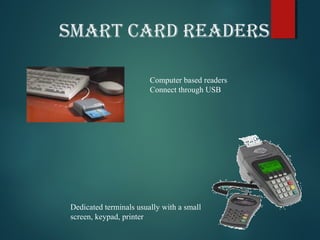
Smart Card readerS
Computer based readers
Connect through USB
Dedicated terminals usually with a small
screen, keypad, printer
TYPES OF SMART CARD
 CONTACT CARDS: A physical contact is required
between card and reader
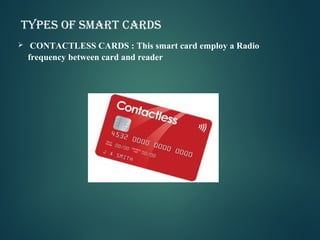
TYPES OF SMART CARDS
 CONTACTLESS CARDS : This smart card employ a Radio
frequency between card and reader
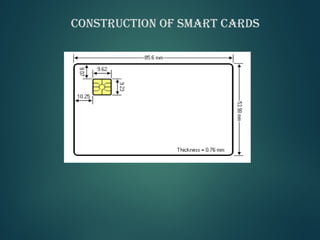
CONSTRUCTION OF SMART CARDS
VCC: Power supply input
RST : Reset signal supplied from the interface device
CLK : Clocking or timing signal
GND : Ground (reference voltage)
VPP : Programming voltage input
I/O : Input or Output for serial data to the integrated circuit inside the
card
RFU: Auxilliary contact, USB devices: D+
RFU : Auxilliary contact; USB devices: D-
 Payment system
 Smart networking
 National id / authentication
 University identification
 Financial applications
 Retail & loyalty
 Communication applications
APPLICATIONS OF SMART CARD
ADVANTAGE OF SMART CARDS
 Larger memory
 High levels of security
 Reliability
 Flexlibility
 Portability
DISADVANTAGE OF SMART CARD
 Can be lost / stolen
 Discomfort to retrieve information from a stolen card
 Not tamper proof
 Has to use same reader technology
ConClusions
 Smart card technology is emerging, applications are everywhere
 Smart cards enhance service and security
 Perfect security does not exist, even not for smart cards
 Risk analysis is essential
Thanks

Smart card security

  • 1.
  • 2.
    WHat iS aSmart Card?  Standard credit card-sized with microchip embedded on it  Two types  Memory-only chips  Microprocessor chips  Can hold up to 32,000 bytes
  • 3.
  • 4.
    Smart Card readerS Computerbased readers Connect through USB Dedicated terminals usually with a small screen, keypad, printer
  • 5.
    TYPES OF SMARTCARD  CONTACT CARDS: A physical contact is required between card and reader
  • 6.
    TYPES OF SMARTCARDS  CONTACTLESS CARDS : This smart card employ a Radio frequency between card and reader
  • 7.
  • 8.
  • 9.
    CONSTRUCTION OF SMARTCARDS VCC: Power supply input RST : Reset signal supplied from the interface device CLK : Clocking or timing signal GND : Ground (reference voltage) VPP : Programming voltage input I/O : Input or Output for serial data to the integrated circuit inside the card RFU: Auxilliary contact, USB devices: D+ RFU : Auxilliary contact; USB devices: D-
  • 10.
     Payment system Smart networking  National id / authentication  University identification  Financial applications  Retail & loyalty  Communication applications APPLICATIONS OF SMART CARD
  • 11.
    ADVANTAGE OF SMARTCARDS  Larger memory  High levels of security  Reliability  Flexlibility  Portability
  • 12.
    DISADVANTAGE OF SMARTCARD  Can be lost / stolen  Discomfort to retrieve information from a stolen card  Not tamper proof  Has to use same reader technology
  • 13.
    ConClusions  Smart cardtechnology is emerging, applications are everywhere  Smart cards enhance service and security  Perfect security does not exist, even not for smart cards  Risk analysis is essential
  • 14.