Rodents biology and
classification
Dr/ Walaa Samir Ahmed Nasser
Rodents research department
Research institute of medical
entomology
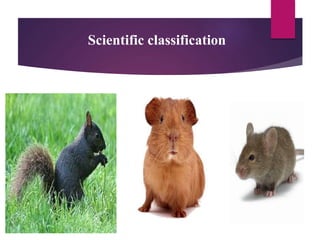
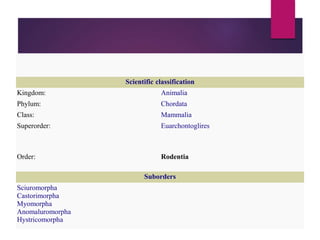
Scientific classification
Kingdom: Animalia
Phylum: Chordata
Class: Mammalia
Superorder: Euarchontoglires
Order: Rodentia
Suborders
Sciuromorpha
Castorimorpha
Myomorpha
Anomaluromorpha
Hystricomorpha
Introduction
 The mammals of Rodentia are called rodents’
 They are found in vast numbers on all continents other than Antarctica.
Common rodents are
Mice
rats
Squirrels
Porcupines
and guinea pigs, etc.
feeding behavior
 Rodents use their sharp incisors to cut wood, and bite predators.
 Most rodents eat seeds or plants, cutting wood, Nearly all rodents feed on plants,
seeds in particular, but a number of species eat insects .
Range of orders
 Rodents make up the largest order of mammals. With about 2,277 species of
rodents,
 over 40% of mammalian species belong to the order.
 Their success is probably due to their small size, short breeding cycle, and ability to
cut and eat a wide variety of foods.
 Rodents are found in vast numbers on all continents except Antarctica, most
islands, and in all habitats except oceans. They are the only placental order.
 All rodents have a single pair of upper and a single pair of lower incisors which
grows constantly , followed by a gap , and then one or more molars or premolars,
 Their anterior and lateral surfaces are covered with enamel, but the posterior
surface is exposed dentine. Rodents lack canines, and have a gap between their
incisors and premolars.
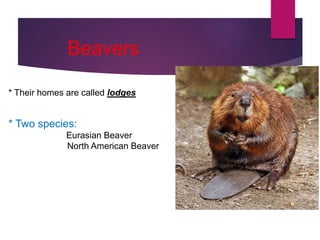
Beavers
* Their homes are called lodges
* Two species:
Eurasian Beaver
North American Beaver
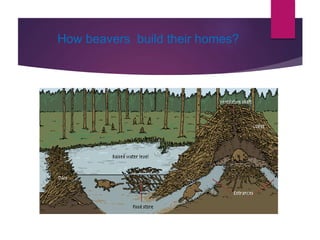
How beavers build their homes?
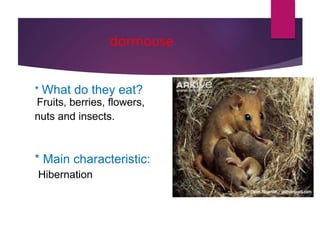
dormouse
* What do they eat?
Fruits, berries, flowers,
nuts and insects.
* Main characteristic:
Hibernation
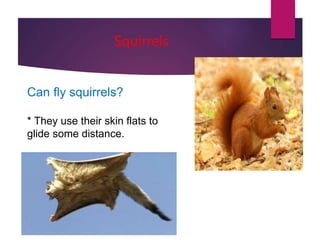
Squirrels
Can fly squirrels?
* They use their skin flats to
glide some distance.
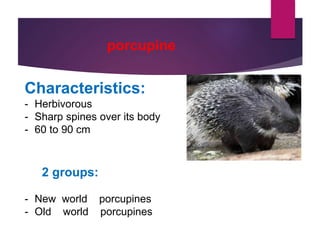
porcupine
Characteristics:
- Herbivorous
- Sharp spines over its body
- 60 to 90 cm
2 groups:
- New world porcupines
- Old world porcupines
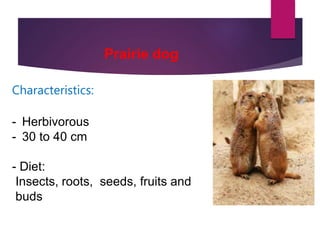
Prairie dog
Characteristics:
- Herbivorous
- 30 to 40 cm
- Diet:
Insects, roots, seeds, fruits and
buds
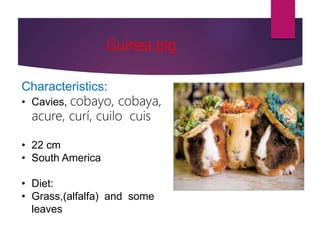
Guinea pig
Characteristics:
• Cavies, cobayo, cobaya,
acure, curí, cuilo cuis
• 22 cm
• South America
• Diet:
• Grass,(alfalfa) and some
leaves
Which is the smallest rodent?
African pygmy mouse (Mus minutoides)
10 Cm
7 g
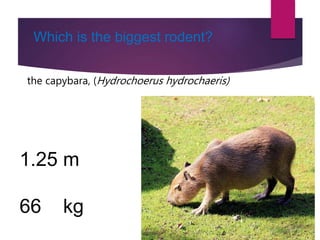
Which is the biggest rodent?
1.25 m
66 kg
the capybara, (Hydrochoerus hydrochaeris)
Commensal rodents
The three commensal rodents include:
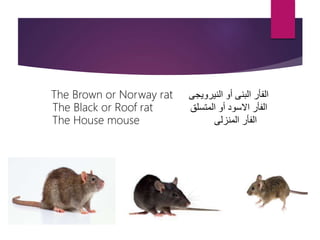
 the Brown or Norway rat ( Rattus norvegicus )
 the Black or Roof rat ( Rattus rattus )
 the House mouse ( Mus musculus )
‫التصنيف‬
The Brown or Norway rat ‫النيرويجى‬ ‫أو‬ ‫البنى‬ ‫الفأر‬
The Black or Roof rat ‫المتسلق‬ ‫أو‬ ‫االسود‬ ‫الفأر‬
The House mouse ‫المنزلى‬ ‫الفأر‬
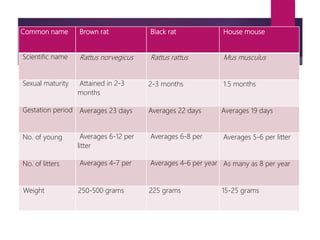
Common name Brown rat Black rat House mouse
Scientific name Rattus norvegicus Rattus rattus Mus musculus
Sexual maturity Attained in 2-3
months
2-3 months 1.5 months
Gestation period Averages 23 days Averages 22 days Averages 19 days
No. of young Averages 6-12 per
litter
Averages 6-8 per Averages 5-6 per litter
No. of litters Averages 4-7 per Averages 4-6 per year As many as 8 per year
Weight 250-500 grams 225 grams 15-25 grams
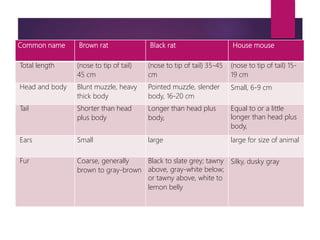
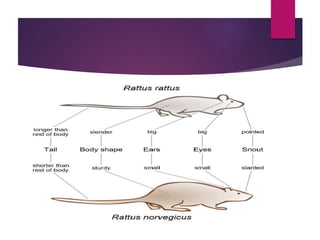
Common name Brown rat Black rat House mouse
Total length (nose to tip of tail)
45 cm
(nose to tip of tail) 35-45
cm
(nose to tip of tail) 15-
19 cm
Head and body Blunt muzzle, heavy
thick body
Pointed muzzle, slender
body, 16-20 cm
Small, 6-9 cm
Tail Shorter than head
plus body
Longer than head plus
body,
Equal to or a little
longer than head plus
body,
Ears Small large large for size of animal
Fur Coarse, generally
brown to gray-brown
Black to slate grey; tawny
above, gray-white below;
or tawny above, white to
lemon belly
Silky, dusky gray
 Brown rats are natural burrowers and will burrow near their food and water
supply in areas that provide harborage, such as vegetation and piles of clutter.
 Black rats are excellent climbers and will nest in higher places rather than
burrowing; hence requiring warmer climates than Brown rats.
 House mice are ubiquitous and exist in all climates and are routinely found
both indoors and out. Their constant gnawing, urinating, and defecating
causes extensive damage
 Rodents are nearly blind, using their sense of touch for
guidance. Their long hairs, or "guard" hairs, are used for
guidance as they move along walls and other objects.
 Rodents have sensory pads on their feet which are very
sensitive.
 Rodents are excellent swimmers. Brown rats can swim in a 30
mph current without drowning.
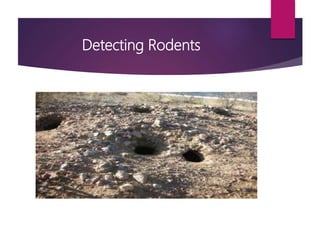
Detecting Rodents
Thank you

Rodents biology and classification

  • 1.
    Rodents biology and classification Dr/Walaa Samir Ahmed Nasser Rodents research department Research institute of medical entomology
  • 2.
  • 3.
    Scientific classification Kingdom: Animalia Phylum:Chordata Class: Mammalia Superorder: Euarchontoglires Order: Rodentia Suborders Sciuromorpha Castorimorpha Myomorpha Anomaluromorpha Hystricomorpha
  • 4.
    Introduction  The mammalsof Rodentia are called rodents’  They are found in vast numbers on all continents other than Antarctica. Common rodents are Mice rats Squirrels Porcupines and guinea pigs, etc.
  • 5.
    feeding behavior  Rodentsuse their sharp incisors to cut wood, and bite predators.  Most rodents eat seeds or plants, cutting wood, Nearly all rodents feed on plants, seeds in particular, but a number of species eat insects .
  • 6.
    Range of orders Rodents make up the largest order of mammals. With about 2,277 species of rodents,  over 40% of mammalian species belong to the order.  Their success is probably due to their small size, short breeding cycle, and ability to cut and eat a wide variety of foods.  Rodents are found in vast numbers on all continents except Antarctica, most islands, and in all habitats except oceans. They are the only placental order.
  • 7.
     All rodentshave a single pair of upper and a single pair of lower incisors which grows constantly , followed by a gap , and then one or more molars or premolars,  Their anterior and lateral surfaces are covered with enamel, but the posterior surface is exposed dentine. Rodents lack canines, and have a gap between their incisors and premolars.
  • 8.
    Beavers * Their homesare called lodges * Two species: Eurasian Beaver North American Beaver
  • 9.
    How beavers buildtheir homes?
  • 10.
    dormouse * What dothey eat? Fruits, berries, flowers, nuts and insects. * Main characteristic: Hibernation
  • 11.
    Squirrels Can fly squirrels? *They use their skin flats to glide some distance.
  • 12.
    porcupine Characteristics: - Herbivorous - Sharpspines over its body - 60 to 90 cm 2 groups: - New world porcupines - Old world porcupines
  • 13.
    Prairie dog Characteristics: - Herbivorous -30 to 40 cm - Diet: Insects, roots, seeds, fruits and buds
  • 14.
    Guinea pig Characteristics: • Cavies,cobayo, cobaya, acure, curí, cuilo cuis • 22 cm • South America • Diet: • Grass,(alfalfa) and some leaves
  • 15.
    Which is thesmallest rodent? African pygmy mouse (Mus minutoides) 10 Cm 7 g
  • 16.
    Which is thebiggest rodent? 1.25 m 66 kg the capybara, (Hydrochoerus hydrochaeris)
  • 17.
    Commensal rodents The threecommensal rodents include:  the Brown or Norway rat ( Rattus norvegicus )  the Black or Roof rat ( Rattus rattus )  the House mouse ( Mus musculus )
  • 18.
    ‫التصنيف‬ The Brown orNorway rat ‫النيرويجى‬ ‫أو‬ ‫البنى‬ ‫الفأر‬ The Black or Roof rat ‫المتسلق‬ ‫أو‬ ‫االسود‬ ‫الفأر‬ The House mouse ‫المنزلى‬ ‫الفأر‬
  • 19.
    Common name Brownrat Black rat House mouse Scientific name Rattus norvegicus Rattus rattus Mus musculus Sexual maturity Attained in 2-3 months 2-3 months 1.5 months Gestation period Averages 23 days Averages 22 days Averages 19 days No. of young Averages 6-12 per litter Averages 6-8 per Averages 5-6 per litter No. of litters Averages 4-7 per Averages 4-6 per year As many as 8 per year Weight 250-500 grams 225 grams 15-25 grams
  • 20.
    Common name Brownrat Black rat House mouse Total length (nose to tip of tail) 45 cm (nose to tip of tail) 35-45 cm (nose to tip of tail) 15- 19 cm Head and body Blunt muzzle, heavy thick body Pointed muzzle, slender body, 16-20 cm Small, 6-9 cm Tail Shorter than head plus body Longer than head plus body, Equal to or a little longer than head plus body, Ears Small large large for size of animal Fur Coarse, generally brown to gray-brown Black to slate grey; tawny above, gray-white below; or tawny above, white to lemon belly Silky, dusky gray
  • 22.
     Brown ratsare natural burrowers and will burrow near their food and water supply in areas that provide harborage, such as vegetation and piles of clutter.  Black rats are excellent climbers and will nest in higher places rather than burrowing; hence requiring warmer climates than Brown rats.  House mice are ubiquitous and exist in all climates and are routinely found both indoors and out. Their constant gnawing, urinating, and defecating causes extensive damage
  • 23.
     Rodents arenearly blind, using their sense of touch for guidance. Their long hairs, or "guard" hairs, are used for guidance as they move along walls and other objects.  Rodents have sensory pads on their feet which are very sensitive.  Rodents are excellent swimmers. Brown rats can swim in a 30 mph current without drowning.
  • 24.
  • 25.