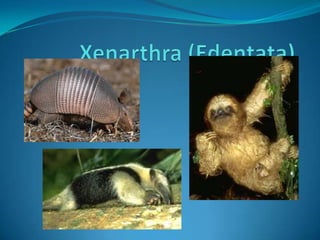
Edentata means
"toothless."
Xenarthra means
"strange joint."
General features
 placental mammals
• Lack incisor and canine teeth
• Lack teeth enamel
      Bone like structure called osteodentin
• two or three very long fingers in each hands
• excess joints between the ribs and lumbar region allowing
  their joints to move in a manor
• their teeth are held in by a single root each
Low body temperatures
Low metabolic rates
Polygynous
 Meaning males can mate with
  several females
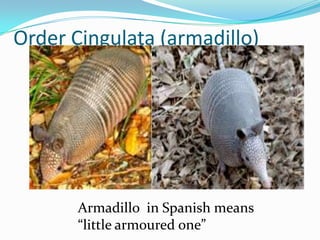
Order Cingulata (armadillo)


       Armadillo in Spanish means
       “little armoured one”
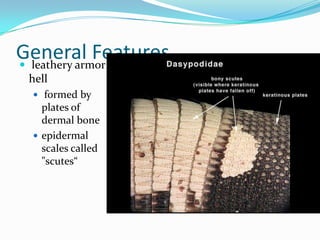
General Features
 leathery armor s
 hell
  formed by
   plates of
   dermal bone
  epidermal
   scales called
   "scutes“
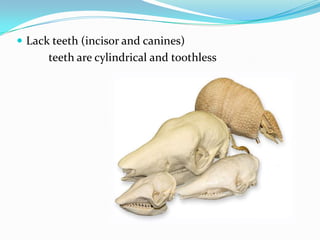
 Lack teeth (incisor and canines)
      teeth are cylindrical and toothless
 prolific diggers(pronounced claws to
  forage foods or dig dens
 birth of 1 to 12 young from a single
  ovum (monozygotic polyembryony).
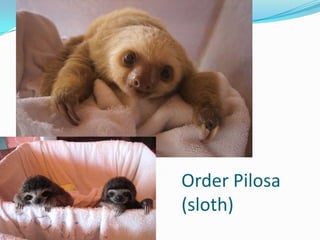
Order Pilosa
(sloth)
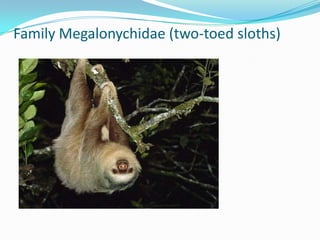
Family Megalonychidae (two-toed sloths)
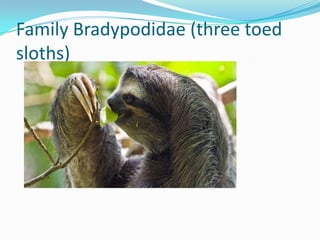
Family Bradypodidae (three toed
sloths)
General features
 Arboreal (have great difficulty moving on the ground)
 Often move upside-down on the underside of
  branches
 Long-limbed, with forelimbs longer than hind
 Toes are fused ( syndactyly )
 Cervical vertebrae are variable in number (6-9)
 Teeth
     *Lack incisors and canines
     *Cylindrical, homodont, rootless teeth
 Rudimentary tail
 Herbivorous: eat buds, flowers, fruit
 Very, very low metabolic rate and poor temperature
  regulation
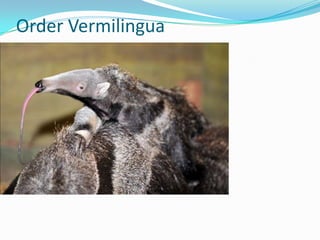
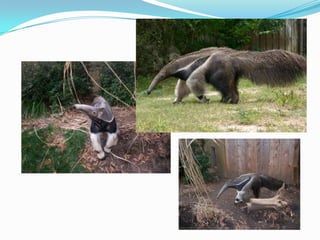
Order Vermilingua
General features


 feed on ants and termites (myrmecophagy)
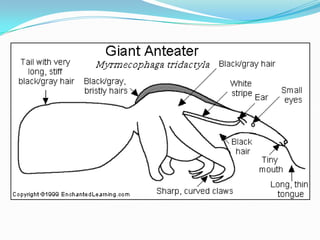
 long tapered skull
 terrible eyesight but a keen sense of smell.
 powerful clawed forelimbs with 3 toes
 no teeth(long snout and tiny mouth with long sticky
  tongue extending to posterior portion of sternum)
  flickers their tongue for 160 times/min
 large salivary glands
 Muscular stomach
 Gestation period: 6 months
 Order Xenartha
 Order Xenartha

Order Xenartha