
SME Financing – Issues and
Practices.
Presentation by
Mohammad Thoriq Bahri
Indonesia Delegation
SME Financing - Issues
Approx. 85% of SMEs in emerging markets suffer from
credit constraints
Approx. 70% of all emerging-market SMEs do not use
any formal credit
Informal sector meets their financial requirements,
WITH OTHER SOURCES AT HIGHER INTEREST RATES.
Nearly 23.7% of SMEs disappear in two years and nearly
52.7% of SMEs exit the market in four years due to
business failure, bankruptcy, or other reasons
SME Financing - Issues
Recent global economic downturn has further
aggravated the problems that already existed
Very few SMEs are able to finance their
expansion through their Cash Flow and have to
explore external sources of funding.
SME Financing - Issues
• Lack of successful track record of SMEs creates a
perception of greater credit risk among the banks
• SMEs lack the substantial asset base (collateral) to
provide as security against bank loans.
– Lack of equity support from public
• GOVERNMENT SUPPORT.
 Ministry of Small Scale Industries, Govt. of India has been
promoting use of IT in SME’s, to enhance SME
competitiveness, in view of globalization.
Government Support
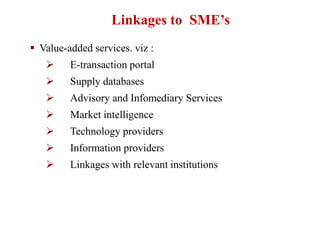
 Value-added services. viz :
 E-transaction portal
 Supply databases
 Advisory and Infomediary Services
 Market intelligence
 Technology providers
 Information providers
 Linkages with relevant institutions
Linkages to SME’s
 Non-availability of institutional finance on affordable and
easy terms is hindering SME’s access to new
technologies.
 Non availability of venture capital to the fullest extent.
Financial Access for SME’s
 IFCI
 IDBI
 SIDBI
 ICICI
 SFCs
 SIDO
 NSIC
Financial Access through insitutions for SME’s
 Some of its the popular schemes are
 Credit Linked Capital Subsidy Scheme for
Technology Up-gradation,
 Credit Guarantee Scheme,
 ISO 9000 / IS 14001 Certification
 Integrated Infrastructure Development Scheme
Financial Access for SME’s
 Recently Government of India has taken a number of
initiatives to help SSI viz.
 Credit Rating Scheme
 SME Fund
 Credit Cards
Financial Access for SME’s
• Credit Rating Scheme
• SMEs have been depending for a quite long
time on government support, such as
reservation of products, incentives,
concessions, subsidies, government policy,
for collection of dues, labour policies, etc.
I
Why this act?
 Credit Rating Scheme
 The scheme has been introduced to encourage the
SSI Units to get their credit rating done, by reputed
third party credit rating agencies.
 The credit rating will facilitate hassle free flow of
credit to SMEs, while enhancing comfort-level of
lending banks.
Financial Access for SME’s
• Banker to understand the financials and other
requisite details about the customer to make a
lending decision.
• The credit scoring models are single point indicator
for diverse risk factors as also tool for pricing.
Why Credit Scoring ?
Risk of Default in the SME sector is spread amongst a wider
base of borrowers and therefore the pricing would be linked
to the Credit Rating of the constituent considering also the
RBI directives from time to time.
• In view of the severe competition in the market, interest
rates offered at times may have to be lower than the rate
arrived at reckoning the borrower’s credit rating and to be
approved by boards
Pricing
• Applied to score the borrower as well as score the
effectiveness of services rendered by the organization (both
sides can be scored)
• Internal assessment as to whether the portfolio is
remunerative
• services, operational efficiency and better control
• Used for predicting /forecasting response, attrition,
retention, recovery
• profitability, collections and provisions
Why credit scoring?
• As per Basel II norms, the banks are
required to quantify the risk associated
with each borrower and arrive at the
risk weights by assigning rating.
Why credit Scoring?
• NSIC is the nodal agency for implementing the
scheme
• The validity of a rating shall be for a period of one
year from the date of issue of the rating letter..
• Rating fee as per credit rating orgn and turnover of
small enterprises.
Modalities of the SME Credit Rating Scheme
• In the event of the request for Rating being
treated as closed by the Rating Agency due
to non-receipt of the complete information,
50% of the fees received from the Small
Enterprises shall be refunded by the Rating
Agency.
Information by SMEs
 .
 SME Fund
 SIDBI : principal financial institution for promoting,
financing and development of industries in the small-
scale sector.
 To improve credit availability SME fund of $ 2
billion has been operational since 2004.
Financial Access for SME’s
 Credit Cards
 Laghu Udyami Credit Card (LUCC) Scheme (Small
Enterpreneur’s Credit Card) has been liberalised.
 Credit limit enhanced from $4000 to $20,000 for
borrowers with satisfactory track record.
Financial Access for SME’s
 Other Initiatives
 Allocation of more than $100 million towards
Technology Upgradation Fund for Textiles
 Setting up of Knowledge Commission Institutions of
Excellence at IISC, Bangalore
Financial Access for SME’s
 Other Initiatives
 Weighted deduction of 150% of expenditure on in-
house research and development facilities of companies,
engaged in biotechnology, pharma, electronics,
telecommunications, chemical, or other notified
products.
 Custom duty exempted on capital goods and raw
materials to a company for R&D project.
Financial Access for SME’s
• Public sector banks have been advised to
open at least one specialized branch in
each district.
Specialized SME branches
• Credit facilities extended to a single Small
Enterprises, Borrower (i.e. erstwhile SSI),
either by way of Term Loan or Working
Capital or both, without any collateral
security or third party guarantee, will be
covered, if eligible, under SIDBI’s Credit
Guarantee Fund Trust for Micro and Small
Enterprises (CGTMSE) Scheme .
•
Collateral Security and Margin Norms
• The buyer to make payment on or before the
date agreed on between him and the supplier
in writing
• The agreement between seller and buyer
shall not exceed more than 45 days.
• The buyer fails to make payment of the
amount to the supplier, he shall be liable to
pay with compound interest
Delayed Payment Act, 1998
• In case of dispute with regard to any
amount due, a reference shall be made
to the Micro and Small Enterprises
Facilitation Council, constituted by the
respective state government.
Delayed Payment
• Scoring by Banks for financing of
SMEs
• MANUFACTURING ENTERPRISES
• LOANS FOR FOOD AND AGRO
PROCESSING
• SERVICE ACTIVITIES PROVIDING OR
RENDERING OF SERVICES
• EXPORT CREDIT
• Loans to persons involved in assisting the
decentralized sector in the supply of inputs to
and marketing of outputs of artisans, village and
cottage industries.
• Loans to cooperatives of producers in the
decentralized sector viz. artisans village and
cottage industries.
• Loans sanctioned by banks to MFIs for on-lending
to MSE sector as per the conditions.
INDIRECT FINANCE
• For working capital limits up to Rs.5 Crores ,
Turnover Method would be applicable as
mandated under Nayak Committee
Recommendations for financing working
capital needs of the SMEs
• At 20% of the projected turnover based on
the assumption of a three month operating
cycle.
Working Capital Assessment
• For Small and medium enterprises, a
debt restructuring mechanism for units
in SME sector has been formulated by
Department of Banking Operations &
Development of Reserve Bank of India.
Debt Restructuring Mechanism for
MSMEs
• Banks have been advised that the decision
on viability of the unit should be taken at
the earliest but not later than 3 months of
becoming sick under any circumstances.
• The rehabilitation package should be fully
implemented within six months from the
date the unit is declared as 'potentially
viable' / 'viable'.
Decision on Viability
• 60 clusters have been identified by the
Ministry of Micro, Small and Medium
Enterprises, Government of India for
focused development of Small Enterprises
sector.
• All SLBC Convenor banks have been advised
to incorporate in their Annual Credit Plans,
the credit requirement inthe clusters
identified by the Ministry of Micro, Small
and Medium Enterprises, Government of
India.
Cluster Approach
Financing Issues in SMEs

Financing Issues in SMEs

  • 1.
    SME Financing –Issues and Practices. Presentation by Mohammad Thoriq Bahri Indonesia Delegation
  • 2.
    SME Financing -Issues Approx. 85% of SMEs in emerging markets suffer from credit constraints Approx. 70% of all emerging-market SMEs do not use any formal credit Informal sector meets their financial requirements, WITH OTHER SOURCES AT HIGHER INTEREST RATES. Nearly 23.7% of SMEs disappear in two years and nearly 52.7% of SMEs exit the market in four years due to business failure, bankruptcy, or other reasons
  • 3.
    SME Financing -Issues Recent global economic downturn has further aggravated the problems that already existed Very few SMEs are able to finance their expansion through their Cash Flow and have to explore external sources of funding.
  • 4.
    SME Financing -Issues • Lack of successful track record of SMEs creates a perception of greater credit risk among the banks • SMEs lack the substantial asset base (collateral) to provide as security against bank loans. – Lack of equity support from public
  • 5.
  • 6.
     Ministry ofSmall Scale Industries, Govt. of India has been promoting use of IT in SME’s, to enhance SME competitiveness, in view of globalization. Government Support
  • 7.
     Value-added services.viz :  E-transaction portal  Supply databases  Advisory and Infomediary Services  Market intelligence  Technology providers  Information providers  Linkages with relevant institutions Linkages to SME’s
  • 8.
     Non-availability ofinstitutional finance on affordable and easy terms is hindering SME’s access to new technologies.  Non availability of venture capital to the fullest extent. Financial Access for SME’s
  • 9.
     IFCI  IDBI SIDBI  ICICI  SFCs  SIDO  NSIC Financial Access through insitutions for SME’s
  • 10.
     Some ofits the popular schemes are  Credit Linked Capital Subsidy Scheme for Technology Up-gradation,  Credit Guarantee Scheme,  ISO 9000 / IS 14001 Certification  Integrated Infrastructure Development Scheme Financial Access for SME’s
  • 11.
     Recently Governmentof India has taken a number of initiatives to help SSI viz.  Credit Rating Scheme  SME Fund  Credit Cards Financial Access for SME’s
  • 12.
  • 13.
    • SMEs havebeen depending for a quite long time on government support, such as reservation of products, incentives, concessions, subsidies, government policy, for collection of dues, labour policies, etc. I Why this act?
  • 14.
     Credit RatingScheme  The scheme has been introduced to encourage the SSI Units to get their credit rating done, by reputed third party credit rating agencies.  The credit rating will facilitate hassle free flow of credit to SMEs, while enhancing comfort-level of lending banks. Financial Access for SME’s
  • 15.
    • Banker tounderstand the financials and other requisite details about the customer to make a lending decision. • The credit scoring models are single point indicator for diverse risk factors as also tool for pricing. Why Credit Scoring ?
  • 16.
    Risk of Defaultin the SME sector is spread amongst a wider base of borrowers and therefore the pricing would be linked to the Credit Rating of the constituent considering also the RBI directives from time to time. • In view of the severe competition in the market, interest rates offered at times may have to be lower than the rate arrived at reckoning the borrower’s credit rating and to be approved by boards Pricing
  • 17.
    • Applied toscore the borrower as well as score the effectiveness of services rendered by the organization (both sides can be scored) • Internal assessment as to whether the portfolio is remunerative • services, operational efficiency and better control • Used for predicting /forecasting response, attrition, retention, recovery • profitability, collections and provisions Why credit scoring?
  • 18.
    • As perBasel II norms, the banks are required to quantify the risk associated with each borrower and arrive at the risk weights by assigning rating. Why credit Scoring?
  • 19.
    • NSIC isthe nodal agency for implementing the scheme • The validity of a rating shall be for a period of one year from the date of issue of the rating letter.. • Rating fee as per credit rating orgn and turnover of small enterprises. Modalities of the SME Credit Rating Scheme
  • 20.
    • In theevent of the request for Rating being treated as closed by the Rating Agency due to non-receipt of the complete information, 50% of the fees received from the Small Enterprises shall be refunded by the Rating Agency. Information by SMEs
  • 21.
     .  SMEFund  SIDBI : principal financial institution for promoting, financing and development of industries in the small- scale sector.  To improve credit availability SME fund of $ 2 billion has been operational since 2004. Financial Access for SME’s
  • 22.
     Credit Cards Laghu Udyami Credit Card (LUCC) Scheme (Small Enterpreneur’s Credit Card) has been liberalised.  Credit limit enhanced from $4000 to $20,000 for borrowers with satisfactory track record. Financial Access for SME’s
  • 23.
     Other Initiatives Allocation of more than $100 million towards Technology Upgradation Fund for Textiles  Setting up of Knowledge Commission Institutions of Excellence at IISC, Bangalore Financial Access for SME’s
  • 24.
     Other Initiatives Weighted deduction of 150% of expenditure on in- house research and development facilities of companies, engaged in biotechnology, pharma, electronics, telecommunications, chemical, or other notified products.  Custom duty exempted on capital goods and raw materials to a company for R&D project. Financial Access for SME’s
  • 25.
    • Public sectorbanks have been advised to open at least one specialized branch in each district. Specialized SME branches
  • 26.
    • Credit facilitiesextended to a single Small Enterprises, Borrower (i.e. erstwhile SSI), either by way of Term Loan or Working Capital or both, without any collateral security or third party guarantee, will be covered, if eligible, under SIDBI’s Credit Guarantee Fund Trust for Micro and Small Enterprises (CGTMSE) Scheme . • Collateral Security and Margin Norms
  • 27.
    • The buyerto make payment on or before the date agreed on between him and the supplier in writing • The agreement between seller and buyer shall not exceed more than 45 days. • The buyer fails to make payment of the amount to the supplier, he shall be liable to pay with compound interest Delayed Payment Act, 1998
  • 28.
    • In caseof dispute with regard to any amount due, a reference shall be made to the Micro and Small Enterprises Facilitation Council, constituted by the respective state government. Delayed Payment
  • 29.
    • Scoring byBanks for financing of SMEs
  • 30.
    • MANUFACTURING ENTERPRISES •LOANS FOR FOOD AND AGRO PROCESSING • SERVICE ACTIVITIES PROVIDING OR RENDERING OF SERVICES • EXPORT CREDIT
  • 31.
    • Loans topersons involved in assisting the decentralized sector in the supply of inputs to and marketing of outputs of artisans, village and cottage industries. • Loans to cooperatives of producers in the decentralized sector viz. artisans village and cottage industries. • Loans sanctioned by banks to MFIs for on-lending to MSE sector as per the conditions. INDIRECT FINANCE
  • 32.
    • For workingcapital limits up to Rs.5 Crores , Turnover Method would be applicable as mandated under Nayak Committee Recommendations for financing working capital needs of the SMEs • At 20% of the projected turnover based on the assumption of a three month operating cycle. Working Capital Assessment
  • 33.
    • For Smalland medium enterprises, a debt restructuring mechanism for units in SME sector has been formulated by Department of Banking Operations & Development of Reserve Bank of India. Debt Restructuring Mechanism for MSMEs
  • 34.
    • Banks havebeen advised that the decision on viability of the unit should be taken at the earliest but not later than 3 months of becoming sick under any circumstances. • The rehabilitation package should be fully implemented within six months from the date the unit is declared as 'potentially viable' / 'viable'. Decision on Viability
  • 35.
    • 60 clustershave been identified by the Ministry of Micro, Small and Medium Enterprises, Government of India for focused development of Small Enterprises sector. • All SLBC Convenor banks have been advised to incorporate in their Annual Credit Plans, the credit requirement inthe clusters identified by the Ministry of Micro, Small and Medium Enterprises, Government of India. Cluster Approach