SMEDA PAKISTAN (SMALL AND MEDIUM ENTERPRISE DEVELOPMENT AUTHORITY) PRESENTED BY   ABDULLAH & SIAL MUHAMMAD PAKISTAN
Definition of  SMEDA What is meant by smeda? According to the criterion worked out by SMEDA, all those business enterprises having 10 to 40 employees and having productive assets (excluding land and building) worth Rs 2 to Rs 20 million are small business establishments. Those having more than 40 employees upto 99 with productive assets worth over Rs 40 million have been classified as medium size business establishments.
Brief history of SMEDA Government of Nawaz Sharif established Small and Medium Enterprises Development Authority in late 1998 with great fanfare and pledged to provide Rs. 250 billion for Small and Medium Enterprises (SMEs) in three years. But there had practically been no investment in the small and cottage industries since the establishment of SMEDA.
It is established to take on the challenge of developing Small & Medium Enterprises (SMEs) in Pakistan. SMEDA is relatively a new organization with a futuristic structure and focus on providing business development services to small and medium enterprises. SMEDA is not only an SME policy-advisory body for the government of Pakistan but also acts as a one-stop-shop for its SME clients
Evolutionary Phases of SMEDA Phase - 1 Dec ‘98-Dec ‘00   Textile Vision 2005 Fisheries  Transport Dairy Light Engineering Information Technology Leather SES Monitoring HEXPO 2000 & beyond Leather Outlook 2010 Cool Chain  Flatted Factories Fisheries Implementation Marble & Granite  Gems & Jewelry Phase - 2 Jan ‘00-Dec ‘00 Boat Modification Auto Vendors Carpet Weaving Power Loom Cluster Ceramic Cluster Marble & Granite Dates & Apples Wooden Furniture Leather Garments   Trade Secrets Phase -  3 Jan ‘01- May ‘03 Help Desk Launched OTC Products Business Plan Develop- Training & Development Website Launched Publications Sector Strategies and Implementation Business Dev. Services Cluster Development Sector Strategy Updates Strategic Focus - WTO   Phase -  4 Oct ’03 - onwards SME Policy  SME Info. Services SME Networking Group   Policy and Conducive Environment Textiles  Marble and Granite  Ginning Cutlery  Furniture  Light Engineering  Bangles Cluster Dairy Help Desk & RBCs Tech. Up gradation Training & Development Marketing Services Financial Services Entrepreneurship   ILO Study  World Bank  ADB PPTA
Phase I (Dec 98 - Oct 99):  SMEDA in the initial stage started working on a few priority sectors. The objective was to develop comprehensive strategies followed by implementation with the collaboration of the relevant Government departments. Case in point is the marine fisheries sector where a detailed strategy was developed and implemented through various regulatory authorities. However, the Business Development Services (BDS) during that phase were only limited to the monitoring of the Prime Minister’s Self-Employment Scheme. Phase II (Jan 00 - Dec 00):  During this period SMEDA worked on different sectoral studies including the Textile Vision 2005, Hexpo 2000 & beyond, etc. These assignments of long term strategy development were successfully completed and later on submitted to the Ministry of Commerce for implementation and follow-up.
Even during this phase limited resources were allocated towards the development of BDS. Phase III (Jan 01 - Nov 01):  SMEDA was restructured from being a sector driven organisation to a functional support body. Emphasis shifted from macro level strategy formulation towards provision of business development services to SMEs and physical intervention in SME clusters. During this period lending programmes tailored to meet the credit requirements of specific clusters were also formulated. A wide array of Over the Counter (OTC) products were produced to facilitate SMEs through Help-Desks. SMEDA also launched its B2B portal to provide market connect to the SME sector.
SMEDA VISION  Growth of globally competitive SME sector through a favorable and facilitating environment and support services as an engine of growth and sustainability to national economy.
MISSION OF SMEDA To function as the promoter & facilitator of SME sector in Pakistan by creating a conducive and facilitating environment as well as providing and facilitating service delivery to SMEs for enhancing their capacities and competitiveness.
OBJECTIVES OF SMEDA Formulate Policy  to encourage the growth of SMEs in the country and to advise the Government on fiscal and monetary issues related to SMEs. Facilitation of Business Development Services to SMEs. Facilitate the development and strengthening of SME representative bodies associations/chambers. Set up and manage a service provider’s database including machinery and supplier for SMEs.
SMEDA objective continued.. Conducting sector studies and  analysis for sector development strategies. Facilitation of SMEs in securing financing. Strengthening of SMEs by conducting and facilitating seminars, workshops and training programs. Donor assistances for SME development of SMEs through programs and projects. Assist SMEs in getting international certifications (such as UL, CE, DIN, JIS, ASME, KS, etc.) for their products and processes. Identification of service opportunities on the basis of supply/demand gap.
BACKGROUND Army Rule in Pakistan A market economy and encouraged trade liberalization Investment both local and foreign  hindered by political instability distrust between public and private sector and  a non conducive (favorable) legal and economic policy environment Over 95% of businesses fall in SME category which have not  developed due  obsolete  labour laws and skills, wrong taxation system, idle trade capacity,  lack of finance and credit availability and  market access. The Small and Medium Enterprises Development Authority (SMEDA) was established in 1998 under the Ministry of Industries and Production in order to foster the development of SMEs in the economy.
Emergence of  SMEDA Small and Medium Enterprises Development Authority (SMEDA) Premier institution of the Government of Pakistan under the Federal Ministry of Industries and Production, SMEDA was established in  October 1998  to take on the challenge of developing (SMEs) in Pakistan. With a futuristic approach and professional management structure, it has focus on providing an enabling environment and business development services to small and medium enterprises. SMEDA is not only an SME policy-advisory body for the Government of Pakistan but also facilitates other stakeholders in addressing their SME development agendas.
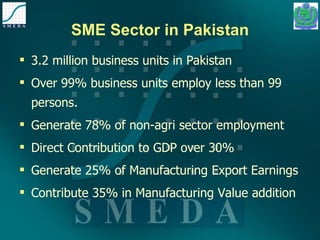
SME Sector in Pakistan 3.2 million business units in Pakistan Over 99% business units employ less than 99 persons. Generate 78% of non-agri sector employment Direct Contribution to GDP over 30% Generate 25% of Manufacturing Export Earnings Contribute 35% in Manufacturing Value addition
Functions of SMEDA  SMEDA has a country wide out reach with four main regional offices each headed by a Provincial Chief for each of the four provinces of  Pakistan  i.e.  Punjab ,  Sindh ,  Balochistan  and  North West Frontier Province  these are further extended to 23 major cities of the country with a one-man office housed in prominent Chambers of Commerce & Industry which are called Regional Business Coordinators. The Outreach Division also includes Industry Support Cell and Training Services Department which is responsible for providing training services to SMEs. Business & Sector Development Service
Functions of SMEDA continued…  SMEDA Facilitate  SMEs in securing financing. SMEDAS also strengthening  SMEs by conducting and facilitating seminars, workshops and training programs. SMEDA get Donor assistances for SME development through national and international organizaionanl societies  SMEs through programs and projects. Assist SMEs in getting international certifications (such as UL, CE, DIN, JIS, ASME, KS, etc.) for their products and processes.
Organization structure of SMEDA
CHALLENGES TO SEMDA AND  LESSONS LEARNED Public and private sector roles need to be defined very clearly to reduce power struggle. The roles should contain a balance of power and performance as otherwise dialogue turns into a monologue. Constitution of such structures should try to make them safe from political changes in leadership. A balanced system of incentives both for public and private stakeholders encouraging cooperation  needs to be designed to create motivation for results.
SMEDA Achievements  SMEDA  has so far successfully formulated strategies for sectors including,  dairy & livestock, marble and granite, gems and jewellery, marine fisheries, leather and footwear, textiles, surgical instruments, and transport
SMEDA Achievements  Along with the sectoral focus a broad spectrum of business development services are also offered to the SMEs by SMEDA. These services include identification of viable business opportunities for potential investors. In order to facilitate these investors, SMEDA provides business guidance through its help desk services as well as development of project specific documents. These documents consist of information required to make well-researched investment decisions. Pre-feasibility studies and business plan development are some of the services provided to enhance the capacity of individual SMEs to exploit viable business opportunities in a better way.
SMEDA Achievements  According to  Economic Census of Pakistan , 2005 by Federal Bureau of Statistics, there are 70,658 women owned businesses operating across Pakistan. This represents 3% of total enterprises in Pakistan. It is estimated that most of the women owned businesses fall within the category of SMEs. The level of women participating in enterprise development currently is around 16%, reason being availability of their limited resources topped by lack of confidence to invest in infrastructural facilities. In order to bridge this gap,  Government of Pakistan  has given SMEDA the task of setting of first  Women Business Incubation Center (WBIC)  which was
SMEDA Achievements  SME Clusters in Pakistan have huge potential and critical to SME growth. SMEDA has always been fully cognizant of the significance of Cluster Development and has taken several initiatives in this regard. These initiatives include Technological Up-gradation, establishment of Common Facility Centers(CFCs) , access to Formal Finance for SME clusters, Marketing support, Improving HR skills and Awareness on International Certification & Regulations
Issues in SME Financing
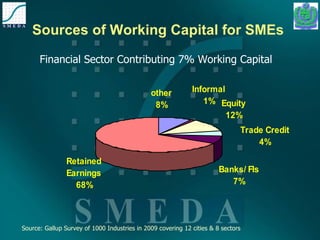
Sources of Working Capital for SMEs  Financial Sector Contributing 7% Working Capital Source: Gallup Survey of 1000 Industries in 2009 covering 12 cities & 8 sectors
Sources of Investment for SMEs Financial Sector Contributing 8% Investment Source: Gallup Survey of 1000 Industries in 2009 covering 12 cities & 8 sectors
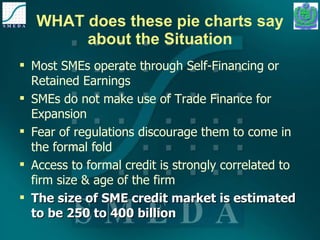
WHAT does these pie charts say about the Situation Most SMEs operate through Self-Financing or Retained Earnings SMEs do not make use of Trade Finance for Expansion Fear of regulations discourage them to come in the formal fold Access to formal credit is strongly correlated to firm size & age of the firm The size of SME credit market is estimated to be 250 to 400 billion
Legal Structure of Business Units in Pakistan  Source: ILO SMEDA Study 2009
International Linkages & Collaboration SMEDA also aggressively works to develop international linkages with other countries & international donor agencies. SMEDA strives to develop SME Development ties on bilateral and multilateral basis with countries around the globe. SMEDA has working relations with over 50 countries which includes share of information and experiences, business match making for investment and joint venture opportunities, support & encouragement of trade fairs Out of these over 50 countries, SMEDA has signed Memorandum of Understanding with 9 countries with its counterpart agencies, these include  China ,  Poland ,  Turkey ,  Morocco ,  Tunisia ,  Algeria ,  Mauritius ,  Kuwait , and  Uzbekistan
SMEDA oversees efforts SMEDA has also developed strong working ties with a number of international donor agencies who are involved in the economic development of  Pakistan . This collaboration generally includes financial and technical assistance to the SME sector of  Pakistan . These agencies include  JICA ,  UNIDO ,  UNDP ,  World Bank ,  Asian Development Bank ,  USAID ,  SES ,  GTZ  etc. SMEDA in collaboration with JICA (Japan International Cooperation Agency) has initiated an Industry Support Program in Pakistan.
strategies of smeda The Small and Medium Enterprises Authority (SMEDA) is planning to take two major initiatives which will have far reaching effect on the industrial development in the country specially the small and medium scale industry. The SMEDA has asked the government to carry out a the information that how  much  small and medium size business working in  pakiatan through the Federal Bureau of Statistics.  It also  launch a regulatory mapping exercise in coordination with two experts from the International Labour Organization (ILO) to review the entire set of laws, rules and regulations at the federal, provincial and local levels that govern business operations.
SMEDA today Shahid Rashid, Chief Executive Officer of the Small and Medium Enterprises Development Authority (Smeda) is going to launch the first SME Subcontracting Exchange (SMEX) of the country today (Wednesday), January 27, 2010 at 3:00pm at Gujranwala Business Centre (GBC). The launching ceremony, besides the CEO, will also be addressed by Khalid Mehmood Chadha, President, Gujranwala Chamber of Commerce and Industry.
The present government's emphasis on development of small and medium scale enterprises in the private sector is being duly appreciated by the donor countries. Japan, European Union, Italian government and Asian Development Bank have shown keen interest in the various projects identified by Small and Medium Enterprises Development Authority (SMEDA) of Pakistan
Our Findings . Recently, in Pakistan hundreds of businesses have been closed due to shortage of Electricity, water, Sui gas (natural gas), or due to law and order situation (like assassination of Ex-Prime Minister of Pakistan Benazir Bhutto in Rawalpindi).  every day million of assets are being transferred to Gulf countries by existing business community, in such a scenario no SME can prevail and grow with reasonable level of certainty.
recommendation Moreover, economically, this policy is viable but not focused for some excellence sectors in future, like a widely acclaimed adopted one village, one product model for microfinance and SMEs, this policy shall be focused on some specific businesses and product lines, instead of forming a mass of unplanned and less cost-effective SMEs, in today world of globalization and specialization
Priority Sectors Gems & Jewelry Marble & Granite Dairy Sports Goods Furniture Fisheries Light Engineering
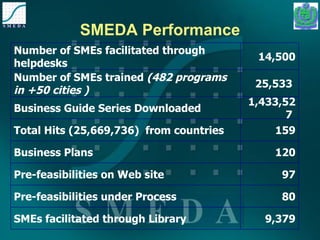
SMEDA Performance 80 Pre-feasibilities under Process 9,379 SMEs facilitated through Library 97 Pre-feasibilities on Web site  120 Business Plans 159 Total Hits (25,669,736)  from countries 1,433,527  Business Guide Series Downloaded  25,533  Number of SMEs trained  (482 programs in +50 cities )   14,500 Number of SMEs facilitated through helpdesks
SME Development – Policy Statement “ The Government of Pakistan is committed to develop the SME sector for achieving higher economic growth leading to creation of jobs and  poverty alleviation.  SME development will be achieved by providing conducive business environment, greater access to formal financing and through provision of support in technical up gradation, human resource development, marketing and innovation. The Government will facilitate establishment of new businesses by developing policies that help in unleashing the entrepreneurial potential of the people of Pakistan”
Thank You
Any queries regarding SMEDA … ?????

Smeda

  • 1.
  • 2.
    SMEDA PAKISTAN (SMALLAND MEDIUM ENTERPRISE DEVELOPMENT AUTHORITY) PRESENTED BY ABDULLAH & SIAL MUHAMMAD PAKISTAN
  • 3.
    Definition of SMEDA What is meant by smeda? According to the criterion worked out by SMEDA, all those business enterprises having 10 to 40 employees and having productive assets (excluding land and building) worth Rs 2 to Rs 20 million are small business establishments. Those having more than 40 employees upto 99 with productive assets worth over Rs 40 million have been classified as medium size business establishments.
  • 4.
    Brief history ofSMEDA Government of Nawaz Sharif established Small and Medium Enterprises Development Authority in late 1998 with great fanfare and pledged to provide Rs. 250 billion for Small and Medium Enterprises (SMEs) in three years. But there had practically been no investment in the small and cottage industries since the establishment of SMEDA.
  • 5.
    It is establishedto take on the challenge of developing Small & Medium Enterprises (SMEs) in Pakistan. SMEDA is relatively a new organization with a futuristic structure and focus on providing business development services to small and medium enterprises. SMEDA is not only an SME policy-advisory body for the government of Pakistan but also acts as a one-stop-shop for its SME clients
  • 6.
    Evolutionary Phases ofSMEDA Phase - 1 Dec ‘98-Dec ‘00 Textile Vision 2005 Fisheries Transport Dairy Light Engineering Information Technology Leather SES Monitoring HEXPO 2000 & beyond Leather Outlook 2010 Cool Chain Flatted Factories Fisheries Implementation Marble & Granite Gems & Jewelry Phase - 2 Jan ‘00-Dec ‘00 Boat Modification Auto Vendors Carpet Weaving Power Loom Cluster Ceramic Cluster Marble & Granite Dates & Apples Wooden Furniture Leather Garments Trade Secrets Phase - 3 Jan ‘01- May ‘03 Help Desk Launched OTC Products Business Plan Develop- Training & Development Website Launched Publications Sector Strategies and Implementation Business Dev. Services Cluster Development Sector Strategy Updates Strategic Focus - WTO Phase - 4 Oct ’03 - onwards SME Policy SME Info. Services SME Networking Group Policy and Conducive Environment Textiles Marble and Granite Ginning Cutlery Furniture Light Engineering Bangles Cluster Dairy Help Desk & RBCs Tech. Up gradation Training & Development Marketing Services Financial Services Entrepreneurship ILO Study World Bank ADB PPTA
  • 7.
    Phase I (Dec98 - Oct 99): SMEDA in the initial stage started working on a few priority sectors. The objective was to develop comprehensive strategies followed by implementation with the collaboration of the relevant Government departments. Case in point is the marine fisheries sector where a detailed strategy was developed and implemented through various regulatory authorities. However, the Business Development Services (BDS) during that phase were only limited to the monitoring of the Prime Minister’s Self-Employment Scheme. Phase II (Jan 00 - Dec 00): During this period SMEDA worked on different sectoral studies including the Textile Vision 2005, Hexpo 2000 & beyond, etc. These assignments of long term strategy development were successfully completed and later on submitted to the Ministry of Commerce for implementation and follow-up.
  • 8.
    Even during thisphase limited resources were allocated towards the development of BDS. Phase III (Jan 01 - Nov 01): SMEDA was restructured from being a sector driven organisation to a functional support body. Emphasis shifted from macro level strategy formulation towards provision of business development services to SMEs and physical intervention in SME clusters. During this period lending programmes tailored to meet the credit requirements of specific clusters were also formulated. A wide array of Over the Counter (OTC) products were produced to facilitate SMEs through Help-Desks. SMEDA also launched its B2B portal to provide market connect to the SME sector.
  • 9.
    SMEDA VISION Growth of globally competitive SME sector through a favorable and facilitating environment and support services as an engine of growth and sustainability to national economy.
  • 10.
    MISSION OF SMEDATo function as the promoter & facilitator of SME sector in Pakistan by creating a conducive and facilitating environment as well as providing and facilitating service delivery to SMEs for enhancing their capacities and competitiveness.
  • 11.
    OBJECTIVES OF SMEDAFormulate Policy  to encourage the growth of SMEs in the country and to advise the Government on fiscal and monetary issues related to SMEs. Facilitation of Business Development Services to SMEs. Facilitate the development and strengthening of SME representative bodies associations/chambers. Set up and manage a service provider’s database including machinery and supplier for SMEs.
  • 12.
    SMEDA objective continued..Conducting sector studies and analysis for sector development strategies. Facilitation of SMEs in securing financing. Strengthening of SMEs by conducting and facilitating seminars, workshops and training programs. Donor assistances for SME development of SMEs through programs and projects. Assist SMEs in getting international certifications (such as UL, CE, DIN, JIS, ASME, KS, etc.) for their products and processes. Identification of service opportunities on the basis of supply/demand gap.
  • 13.
    BACKGROUND Army Rulein Pakistan A market economy and encouraged trade liberalization Investment both local and foreign hindered by political instability distrust between public and private sector and a non conducive (favorable) legal and economic policy environment Over 95% of businesses fall in SME category which have not developed due obsolete labour laws and skills, wrong taxation system, idle trade capacity, lack of finance and credit availability and market access. The Small and Medium Enterprises Development Authority (SMEDA) was established in 1998 under the Ministry of Industries and Production in order to foster the development of SMEs in the economy.
  • 14.
    Emergence of SMEDA Small and Medium Enterprises Development Authority (SMEDA) Premier institution of the Government of Pakistan under the Federal Ministry of Industries and Production, SMEDA was established in October 1998 to take on the challenge of developing (SMEs) in Pakistan. With a futuristic approach and professional management structure, it has focus on providing an enabling environment and business development services to small and medium enterprises. SMEDA is not only an SME policy-advisory body for the Government of Pakistan but also facilitates other stakeholders in addressing their SME development agendas.
  • 15.
    SME Sector inPakistan 3.2 million business units in Pakistan Over 99% business units employ less than 99 persons. Generate 78% of non-agri sector employment Direct Contribution to GDP over 30% Generate 25% of Manufacturing Export Earnings Contribute 35% in Manufacturing Value addition
  • 16.
    Functions of SMEDA SMEDA has a country wide out reach with four main regional offices each headed by a Provincial Chief for each of the four provinces of Pakistan i.e. Punjab , Sindh , Balochistan and North West Frontier Province these are further extended to 23 major cities of the country with a one-man office housed in prominent Chambers of Commerce & Industry which are called Regional Business Coordinators. The Outreach Division also includes Industry Support Cell and Training Services Department which is responsible for providing training services to SMEs. Business & Sector Development Service
  • 17.
    Functions of SMEDAcontinued… SMEDA Facilitate SMEs in securing financing. SMEDAS also strengthening  SMEs by conducting and facilitating seminars, workshops and training programs. SMEDA get Donor assistances for SME development through national and international organizaionanl societies SMEs through programs and projects. Assist SMEs in getting international certifications (such as UL, CE, DIN, JIS, ASME, KS, etc.) for their products and processes.
  • 18.
  • 19.
    CHALLENGES TO SEMDAAND LESSONS LEARNED Public and private sector roles need to be defined very clearly to reduce power struggle. The roles should contain a balance of power and performance as otherwise dialogue turns into a monologue. Constitution of such structures should try to make them safe from political changes in leadership. A balanced system of incentives both for public and private stakeholders encouraging cooperation needs to be designed to create motivation for results.
  • 20.
    SMEDA Achievements SMEDA has so far successfully formulated strategies for sectors including, dairy & livestock, marble and granite, gems and jewellery, marine fisheries, leather and footwear, textiles, surgical instruments, and transport
  • 21.
    SMEDA Achievements Along with the sectoral focus a broad spectrum of business development services are also offered to the SMEs by SMEDA. These services include identification of viable business opportunities for potential investors. In order to facilitate these investors, SMEDA provides business guidance through its help desk services as well as development of project specific documents. These documents consist of information required to make well-researched investment decisions. Pre-feasibility studies and business plan development are some of the services provided to enhance the capacity of individual SMEs to exploit viable business opportunities in a better way.
  • 22.
    SMEDA Achievements Along with the sectoral focus a broad spectrum of business development services are also offered to the SMEs by SMEDA. These services include identification of viable business opportunities for potential investors. In order to facilitate these investors, SMEDA provides business guidance through its help desk services as well as development of project specific documents. These documents consist of information required to make well-researched investment decisions. Pre-feasibility studies and business plan development are some of the services provided to enhance the capacity of individual SMEs to exploit viable business opportunities in a better way.
  • 23.
    SMEDA Achievements According to Economic Census of Pakistan , 2005 by Federal Bureau of Statistics, there are 70,658 women owned businesses operating across Pakistan. This represents 3% of total enterprises in Pakistan. It is estimated that most of the women owned businesses fall within the category of SMEs. The level of women participating in enterprise development currently is around 16%, reason being availability of their limited resources topped by lack of confidence to invest in infrastructural facilities. In order to bridge this gap, Government of Pakistan has given SMEDA the task of setting of first Women Business Incubation Center (WBIC) which was
  • 24.
    SMEDA Achievements SME Clusters in Pakistan have huge potential and critical to SME growth. SMEDA has always been fully cognizant of the significance of Cluster Development and has taken several initiatives in this regard. These initiatives include Technological Up-gradation, establishment of Common Facility Centers(CFCs) , access to Formal Finance for SME clusters, Marketing support, Improving HR skills and Awareness on International Certification & Regulations
  • 25.
    Issues in SMEFinancing
  • 26.
    Sources of WorkingCapital for SMEs Financial Sector Contributing 7% Working Capital Source: Gallup Survey of 1000 Industries in 2009 covering 12 cities & 8 sectors
  • 27.
    Sources of Investmentfor SMEs Financial Sector Contributing 8% Investment Source: Gallup Survey of 1000 Industries in 2009 covering 12 cities & 8 sectors
  • 28.
    WHAT does thesepie charts say about the Situation Most SMEs operate through Self-Financing or Retained Earnings SMEs do not make use of Trade Finance for Expansion Fear of regulations discourage them to come in the formal fold Access to formal credit is strongly correlated to firm size & age of the firm The size of SME credit market is estimated to be 250 to 400 billion
  • 29.
    Legal Structure ofBusiness Units in Pakistan Source: ILO SMEDA Study 2009
  • 30.
    International Linkages &Collaboration SMEDA also aggressively works to develop international linkages with other countries & international donor agencies. SMEDA strives to develop SME Development ties on bilateral and multilateral basis with countries around the globe. SMEDA has working relations with over 50 countries which includes share of information and experiences, business match making for investment and joint venture opportunities, support & encouragement of trade fairs Out of these over 50 countries, SMEDA has signed Memorandum of Understanding with 9 countries with its counterpart agencies, these include China , Poland , Turkey , Morocco , Tunisia , Algeria , Mauritius , Kuwait , and Uzbekistan
  • 31.
    SMEDA oversees effortsSMEDA has also developed strong working ties with a number of international donor agencies who are involved in the economic development of Pakistan . This collaboration generally includes financial and technical assistance to the SME sector of Pakistan . These agencies include JICA , UNIDO , UNDP , World Bank , Asian Development Bank , USAID , SES , GTZ etc. SMEDA in collaboration with JICA (Japan International Cooperation Agency) has initiated an Industry Support Program in Pakistan.
  • 32.
    strategies of smedaThe Small and Medium Enterprises Authority (SMEDA) is planning to take two major initiatives which will have far reaching effect on the industrial development in the country specially the small and medium scale industry. The SMEDA has asked the government to carry out a the information that how much small and medium size business working in pakiatan through the Federal Bureau of Statistics. It also launch a regulatory mapping exercise in coordination with two experts from the International Labour Organization (ILO) to review the entire set of laws, rules and regulations at the federal, provincial and local levels that govern business operations.
  • 33.
    SMEDA today ShahidRashid, Chief Executive Officer of the Small and Medium Enterprises Development Authority (Smeda) is going to launch the first SME Subcontracting Exchange (SMEX) of the country today (Wednesday), January 27, 2010 at 3:00pm at Gujranwala Business Centre (GBC). The launching ceremony, besides the CEO, will also be addressed by Khalid Mehmood Chadha, President, Gujranwala Chamber of Commerce and Industry.
  • 34.
    The present government'semphasis on development of small and medium scale enterprises in the private sector is being duly appreciated by the donor countries. Japan, European Union, Italian government and Asian Development Bank have shown keen interest in the various projects identified by Small and Medium Enterprises Development Authority (SMEDA) of Pakistan
  • 35.
    Our Findings .Recently, in Pakistan hundreds of businesses have been closed due to shortage of Electricity, water, Sui gas (natural gas), or due to law and order situation (like assassination of Ex-Prime Minister of Pakistan Benazir Bhutto in Rawalpindi). every day million of assets are being transferred to Gulf countries by existing business community, in such a scenario no SME can prevail and grow with reasonable level of certainty.
  • 36.
    recommendation Moreover, economically,this policy is viable but not focused for some excellence sectors in future, like a widely acclaimed adopted one village, one product model for microfinance and SMEs, this policy shall be focused on some specific businesses and product lines, instead of forming a mass of unplanned and less cost-effective SMEs, in today world of globalization and specialization
  • 37.
    Priority Sectors Gems& Jewelry Marble & Granite Dairy Sports Goods Furniture Fisheries Light Engineering
  • 38.
    SMEDA Performance 80Pre-feasibilities under Process 9,379 SMEs facilitated through Library 97 Pre-feasibilities on Web site 120 Business Plans 159 Total Hits (25,669,736) from countries 1,433,527 Business Guide Series Downloaded 25,533 Number of SMEs trained (482 programs in +50 cities ) 14,500 Number of SMEs facilitated through helpdesks
  • 39.
    SME Development –Policy Statement “ The Government of Pakistan is committed to develop the SME sector for achieving higher economic growth leading to creation of jobs and poverty alleviation. SME development will be achieved by providing conducive business environment, greater access to formal financing and through provision of support in technical up gradation, human resource development, marketing and innovation. The Government will facilitate establishment of new businesses by developing policies that help in unleashing the entrepreneurial potential of the people of Pakistan”
  • 40.
  • 41.
    Any queries regardingSMEDA … ?????

Editor's Notes

  • #7 Phase I (Dec 98 - Oct 99): SMEDA in the initial stage started working on a few priority sectors. The objective was to develop comprehensive strategies followed by implementation with the collaboration of the relevant Government departments. Case in point is the marine fisheries sector where a detailed strategy was developed and implemented through various regulatory authorities. However, the Business Development Services (BDS) during that phase were only limited to the monitoring of the Prime Minister’s Self-Employment Scheme. Phase II (Jan 00 - Dec 00): During this period SMEDA worked on different sectoral studies including the Textile Vision 2005, Hexpo 2000 & beyond, etc. These assignments of long term strategy development were successfully completed and later on submitted to the Ministry of Commerce for implementation and follow-up. Even during this phase limited resources were allocated towards the development of BDS. Phase III (Jan 01 - Nov 01): SMEDA was restructured from being a sector driven organisation to a functional support body. Emphasis shifted from macro level strategy formulation towards provision of business development services to SMEs and physical intervention in SME clusters. During this period lending programmes tailored to meet the credit requirements of specific clusters were also formulated. A wide array of Over the Counter (OTC) products were produced to facilitate SMEs through Help-Desks. SMEDA also launched its B2B portal to provide market connect to the SME sector.
  • #16 It is fair to say that our e conomy is an economy of SME. Enterprises employing up to 99 persons constitute about 90 %[1] of all private enterprises in the industrial sector and SME employ some 78 % of non-agriculture labour force. [2] They contribute over 30 % to GDP, PKR 140 billion to exports, and 25 % of manufacturing export earnings besides sharing 35 % in manufacturing value added.[3] [1] Pakistan Country Assistance Strategy, World Bank Report, Annex II, Page 3 [2] Census of Establishments-1998 [3] Economic Survey of Pakistan 2002-03
  • #26 Coverage by support programs limited due to large size of the SME sector. Absence of a specialized, uniform legal framework for the development of SME hampers SME operations. Relationship between Government and SME seems to be fundamentally weak. In many cases this extends also to other large organizations and their interaction with smaller clients as SME.