Financing SMEs
Hammad J. Vohra
Small & Medium Enterprises
 SMEs are an essential part of any Country’s
economy and accordingly of vital importance for the
Banking industry.
 Since SME businesses are in vast numbers, they
provide an opportunity to diversify risk, whilst at
the same time earn higher profit.
 Yet these SMEs attract risk, owing to their business
acumen.
SMEs from SBP Point of View
 The State Bank of Pakistan also focuses and has
been focusing a lot on these SMEs. It has been
encouraging Banks to tap and support these
businesses in order to bring them into the Banking
channel and help flourish the businesses and the
economy itself.
 Accordingly to State Bank, SMEs are divided and
treated separately into:
 Small Enterprise
 Medium Enterprise
SMEs from SBP Point of View
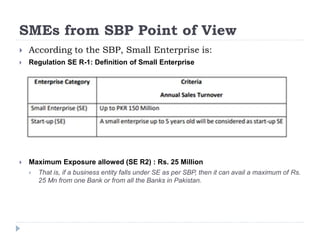
 According to the SBP, Small Enterprise is:
 Regulation SE R-1: Definition of Small Enterprise
 Maximum Exposure allowed (SE R2) : Rs. 25 Million
 That is, if a business entity falls under SE as per SBP, then it can avail a maximum of Rs.
25 Mn from one Bank or from all the Banks in Pakistan.
SMEs from SBP Point of View
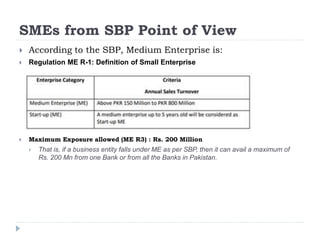
 According to the SBP, Medium Enterprise is:
 Regulation ME R-1: Definition of Small Enterprise
 Maximum Exposure allowed (ME R3) : Rs. 200 Million
 That is, if a business entity falls under ME as per SBP, then it can avail a maximum of
Rs. 200 Mn from one Bank or from all the Banks in Pakistan.
What are SMEs
 Now we know what are SMEs as per SBP, but
irrespective of this criteria, consider that all
Proprietorship and Partnership concerns are SMEs.
 Because, even logically, when such businesses
(Proprietorship or Partnership) want to grow large, they
lack capital and for that purpose they intend to convert
themselves into Incorporated businesses.
 One might ask that Private Limited companies are
however usually family owned then how come this
concept applies. Well, Banks rather prefer to finance
Private limited companies then Proprietorship or
Partnerships.
What are SMEs
 Now that it is clear where to place SMEs, it is
important to understand that how to analyze them
from a Credit Perspective.
 The general credit practices remains the same be it
Corporate, Commercial or SME. Financial Analysis,
Industry or Business Analysis, Sponsor etc. Even
the 5Cs of Credit will remain the same.
 The question is, then what is the difference?
What are SMEs
 The difference is understanding the risk attached.
 Firstly, SMEs are un-organized. Usually, they donot belong to a
particular industry, hence industry analysis is difficult. Also, they
usually lack formal IT systems, Corporate Governance and other Policies.
 They are not required by law to even produce and publish financial
statements. Since there is no such requirement, they are not required to
get their accounts audited. Hence, the financail statements provided by
these SMEs are of less reliance compared to Incorporations.
 They are not required to submit or announce any disclosures like
expansion plans or change in partnership.
 There are no regulations pertaining to them
 Hypothecation charges are not registered with SECP since such business
are not Governed under Companies Law. Hence there is no concept of
Ranking or Pari Passu. In such case, the charge is only Hypothecation
charge declaring right of a Bank on the Business’s asset.
 Succession planning is always a issue particularly with respect to
Proprietors.
What are SMEs
 So how to counter these problems? Its not like we stop
financing them right.
 When the business provides financial statements, ask
the owner to either provide:
 Invoices
 Bank Statements (preferred method)
 The turnover in Bank Statements for the year should be
close to sales revenue reported in the financial
statements.
 At times, the business only report half of the sales and
only that half is routed through Banks. The other half is
dealt with in Cash. In such case, the owner will confirm
this and might provide some invoices.
What are SMEs
 Understanding the client’s actual requirement.
 Whenever a SME customer requires funded working
capital lines (RF/CF/FIM/FATR/Murabaha/Istisna etc)
 As an analyst, you should calculate its requirement.
 For example, ABC company requested for Rs. 75 Mn of
FATR for 60 days.
 You obtained its financial statements (and checked it
with bank statements to match the turnover). Some
highlights are as follows:
What are SMEs
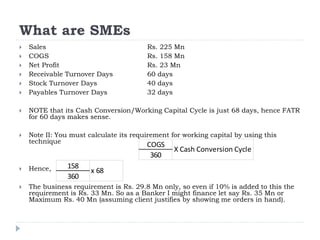
 Sales Rs. 225 Mn
 COGS Rs. 158 Mn
 Net Profit Rs. 23 Mn
 Receivable Turnover Days 60 days
 Stock Turnover Days 40 days
 Payables Turnover Days 32 days
 NOTE that its Cash Conversion/Working Capital Cycle is just 68 days, hence FATR
for 60 days makes sense.
 Note II: You must calculate its requirement for working capital by using this
technique
 Hence,
 The business requirement is Rs. 29.8 Mn only, so even if 10% is added to this the
requirement is Rs. 33 Mn. So as a Banker I might finance let say Rs. 35 Mn or
Maximum Rs. 40 Mn (assuming client justifies by showing me orders in hand).
COGS
360
X Cash Conversion Cycle
158
360
x 68
What are SMEs
 Try to obtain better security.
 If hypothecation is being suggested, try to get
Mortgage over the shop/office/factory or even
his/her personal residence. If that is not possible,
try to obtain mortgage of his/her relative.
 If pledge is the security, try to keep high margin
30% or 40% (however this may be reduce if the
relationship is known to be strong for few years
now).
What are SMEs
 It is a must for Proprietors & Partnership to provide
Personal Guarantee. So as a Banker one must obtain
PGs for each partner.
 Also, you must know that it is important to know the
Owner (The CHARACTER within 5 Cs). The information
is least likely to be available over Internet or Magazines
or Annual Reports. So you must conduct a market
check. Ask other Bankers if they know about them, how
is there repayment behavior, reputation. If that is not
available or possible, try to obtain information from the
market or your client’s suppliers.
 At times, your potential client’s supplier is your Bank’s
existing customer, which helps in getting better
information.
What are SMEs
 Also, obtain information with respective to duration
the owners have been in this line of business.
 At times it has been noticed that the Partners or
Proprietor has stepped into this business for only
couple of years and before them it was their Parents
who used to run the business.
 In such cases, if the parents are available , request
to obtain their Personal Guarantee too.
What are SMEs
 SMEs are risky, infact they have higher risk but
ofcourse they yield higher returns for the Bank.
 In order to mitigate the risk as a Banker you can:
 Counter check the financial figures
 Ensure the funding/financing requirement is legitimate.
 Obtain stronger/better security
 Obtain higher spread/mark-up
 Conduct market checks
 And ofcourse close monitoring for the initial years
(alteast one year to ensure the relationship is on track
and repayments/mark-up payments are timely).
Session 14.pptx

Session 14.pptx

  • 1.
  • 2.
    Small & MediumEnterprises  SMEs are an essential part of any Country’s economy and accordingly of vital importance for the Banking industry.  Since SME businesses are in vast numbers, they provide an opportunity to diversify risk, whilst at the same time earn higher profit.  Yet these SMEs attract risk, owing to their business acumen.
  • 3.
    SMEs from SBPPoint of View  The State Bank of Pakistan also focuses and has been focusing a lot on these SMEs. It has been encouraging Banks to tap and support these businesses in order to bring them into the Banking channel and help flourish the businesses and the economy itself.  Accordingly to State Bank, SMEs are divided and treated separately into:  Small Enterprise  Medium Enterprise
  • 4.
    SMEs from SBPPoint of View  According to the SBP, Small Enterprise is:  Regulation SE R-1: Definition of Small Enterprise  Maximum Exposure allowed (SE R2) : Rs. 25 Million  That is, if a business entity falls under SE as per SBP, then it can avail a maximum of Rs. 25 Mn from one Bank or from all the Banks in Pakistan.
  • 5.
    SMEs from SBPPoint of View  According to the SBP, Medium Enterprise is:  Regulation ME R-1: Definition of Small Enterprise  Maximum Exposure allowed (ME R3) : Rs. 200 Million  That is, if a business entity falls under ME as per SBP, then it can avail a maximum of Rs. 200 Mn from one Bank or from all the Banks in Pakistan.
  • 6.
    What are SMEs Now we know what are SMEs as per SBP, but irrespective of this criteria, consider that all Proprietorship and Partnership concerns are SMEs.  Because, even logically, when such businesses (Proprietorship or Partnership) want to grow large, they lack capital and for that purpose they intend to convert themselves into Incorporated businesses.  One might ask that Private Limited companies are however usually family owned then how come this concept applies. Well, Banks rather prefer to finance Private limited companies then Proprietorship or Partnerships.
  • 7.
    What are SMEs Now that it is clear where to place SMEs, it is important to understand that how to analyze them from a Credit Perspective.  The general credit practices remains the same be it Corporate, Commercial or SME. Financial Analysis, Industry or Business Analysis, Sponsor etc. Even the 5Cs of Credit will remain the same.  The question is, then what is the difference?
  • 8.
    What are SMEs The difference is understanding the risk attached.  Firstly, SMEs are un-organized. Usually, they donot belong to a particular industry, hence industry analysis is difficult. Also, they usually lack formal IT systems, Corporate Governance and other Policies.  They are not required by law to even produce and publish financial statements. Since there is no such requirement, they are not required to get their accounts audited. Hence, the financail statements provided by these SMEs are of less reliance compared to Incorporations.  They are not required to submit or announce any disclosures like expansion plans or change in partnership.  There are no regulations pertaining to them  Hypothecation charges are not registered with SECP since such business are not Governed under Companies Law. Hence there is no concept of Ranking or Pari Passu. In such case, the charge is only Hypothecation charge declaring right of a Bank on the Business’s asset.  Succession planning is always a issue particularly with respect to Proprietors.
  • 9.
    What are SMEs So how to counter these problems? Its not like we stop financing them right.  When the business provides financial statements, ask the owner to either provide:  Invoices  Bank Statements (preferred method)  The turnover in Bank Statements for the year should be close to sales revenue reported in the financial statements.  At times, the business only report half of the sales and only that half is routed through Banks. The other half is dealt with in Cash. In such case, the owner will confirm this and might provide some invoices.
  • 10.
    What are SMEs Understanding the client’s actual requirement.  Whenever a SME customer requires funded working capital lines (RF/CF/FIM/FATR/Murabaha/Istisna etc)  As an analyst, you should calculate its requirement.  For example, ABC company requested for Rs. 75 Mn of FATR for 60 days.  You obtained its financial statements (and checked it with bank statements to match the turnover). Some highlights are as follows:
  • 11.
    What are SMEs Sales Rs. 225 Mn  COGS Rs. 158 Mn  Net Profit Rs. 23 Mn  Receivable Turnover Days 60 days  Stock Turnover Days 40 days  Payables Turnover Days 32 days  NOTE that its Cash Conversion/Working Capital Cycle is just 68 days, hence FATR for 60 days makes sense.  Note II: You must calculate its requirement for working capital by using this technique  Hence,  The business requirement is Rs. 29.8 Mn only, so even if 10% is added to this the requirement is Rs. 33 Mn. So as a Banker I might finance let say Rs. 35 Mn or Maximum Rs. 40 Mn (assuming client justifies by showing me orders in hand). COGS 360 X Cash Conversion Cycle 158 360 x 68
  • 12.
    What are SMEs Try to obtain better security.  If hypothecation is being suggested, try to get Mortgage over the shop/office/factory or even his/her personal residence. If that is not possible, try to obtain mortgage of his/her relative.  If pledge is the security, try to keep high margin 30% or 40% (however this may be reduce if the relationship is known to be strong for few years now).
  • 13.
    What are SMEs It is a must for Proprietors & Partnership to provide Personal Guarantee. So as a Banker one must obtain PGs for each partner.  Also, you must know that it is important to know the Owner (The CHARACTER within 5 Cs). The information is least likely to be available over Internet or Magazines or Annual Reports. So you must conduct a market check. Ask other Bankers if they know about them, how is there repayment behavior, reputation. If that is not available or possible, try to obtain information from the market or your client’s suppliers.  At times, your potential client’s supplier is your Bank’s existing customer, which helps in getting better information.
  • 14.
    What are SMEs Also, obtain information with respective to duration the owners have been in this line of business.  At times it has been noticed that the Partners or Proprietor has stepped into this business for only couple of years and before them it was their Parents who used to run the business.  In such cases, if the parents are available , request to obtain their Personal Guarantee too.
  • 15.
    What are SMEs SMEs are risky, infact they have higher risk but ofcourse they yield higher returns for the Bank.  In order to mitigate the risk as a Banker you can:  Counter check the financial figures  Ensure the funding/financing requirement is legitimate.  Obtain stronger/better security  Obtain higher spread/mark-up  Conduct market checks  And ofcourse close monitoring for the initial years (alteast one year to ensure the relationship is on track and repayments/mark-up payments are timely).