SMALL GROUP
COMMUNICATION
SMALL GROUP COMMUNICATION
-- is a subset of interpersonal
communication which refers to
communication or interaction
involving three or more people.
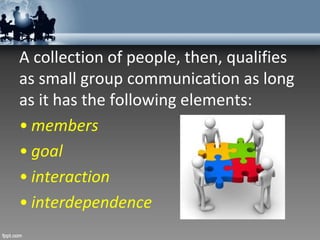
A collection of people, then, qualifies
as small group communication as long
as it has the following elements:
• members
• goal
• interaction
• interdependence
• Group meeting attendance is an
example of the interdependent
nature of group interaction.
• Members who attend meetings but
don’t participate can also derail
group progress
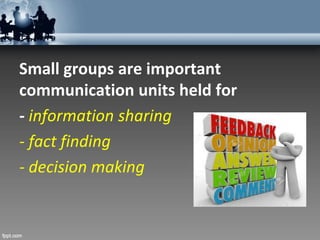
Small groups are important
communication units held for
- information sharing
- fact finding
- decision making
HOW BIG IS A SMALL
GROUP?
According to Socha (1997),
a small group consists
of 3-15 members.
TYPES OF SMALL
DISCUSSION GROUPS
PANEL DISCUSSION
- a public exchange of ideas involving a
group of people gathered to discuss a
topic in front of an audience.
Topics are typically discussed at scientific,
business or academic conferences and
conventions, and on television shows.
SYMPOSIUM
- a series of individual presentations which
address different aspects of a single topic,
usually followed by a short question and
answer period.
ROUNDTABLE DISCUSSION
- a group communication that allows
extensive discussion and feedback for the
presenter (host) in a more informal way
than a panel presentation.
The goal is to get everyone involved and
participating in the discussion.
BRAINSTORMING
- is a type of communication that is
designed to help a group generate ideas.
External and internal participants who
think differently may be invited because
research shows that bringing together
individuals with diverse backgrounds can
enhance the flow of ideas
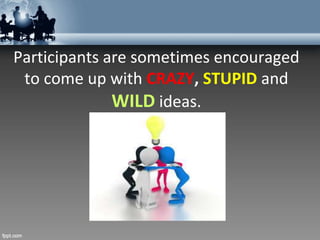
Participants are sometimes encouraged
to come up with CRAZY, STUPID and
WILD ideas.
DEBATE
MEETING
- is a gathering of two or more people that
has been convened for the purpose of
achieving a common goal through verbal
interaction.
It provides opportunities for sharing
information, making suggestions and
proposals, taking discussions and obtaining
instant feedback.
CRITERIA FOR AN EFFECTIVE
MEETING
CRITERIA FOR AN EFFECTIVE MEETING
1. Purpose is clear to all attendees.
2. All who are needed are attending
and only those who are needed are
attending.
3. Participants are prepared.
4. Time is effectively used.
CRITERIA FOR AN EFFECTIVE MEETING
5. Participants are committed.
6. The main goal is achieving the goals,
not meeting for sake of meeting.
7. The outcome should justify the
investment.
8. Actions, responsibilities and
mechanism for review are clear.
TYPES OF SPEECH
STYLES
1. Intimate
It is a style among intimate members of
a family or friends that do not need a
complete language with clear
articulation.
Another characteristic of this style is
grammar unnecessarily used here,
because it can bring disorder to this
intimate style.
2. Casual
A casual form of information sharing
typically used in personal
conversations with friends or family
members
3. Consultative
It is used in regular conversation at
school, companies, trade, speech
conversation, etc. One of the its
characteristics is its tendency of
average speed, which is higher than
formal style. The sentence tend to be
shorter and less well planned (tend to
spontaneous).
4. Formal
A type of verbal presentation intended
to share information and which
conforms to establish professional
rules, standards and processes and
avoids using slang terminology.
5. Frozen
It is the most formal communicative
style that is usually used in respectful
situation or formal ceremony.

Small Group Communication.ppt

  • 1.
  • 2.
    SMALL GROUP COMMUNICATION --is a subset of interpersonal communication which refers to communication or interaction involving three or more people.
  • 3.
    A collection ofpeople, then, qualifies as small group communication as long as it has the following elements: • members • goal • interaction • interdependence
  • 4.
    • Group meetingattendance is an example of the interdependent nature of group interaction. • Members who attend meetings but don’t participate can also derail group progress
  • 5.
    Small groups areimportant communication units held for - information sharing - fact finding - decision making
  • 6.
    HOW BIG ISA SMALL GROUP?
  • 7.
    According to Socha(1997), a small group consists of 3-15 members.
  • 8.
  • 9.
    PANEL DISCUSSION - apublic exchange of ideas involving a group of people gathered to discuss a topic in front of an audience. Topics are typically discussed at scientific, business or academic conferences and conventions, and on television shows.
  • 10.
    SYMPOSIUM - a seriesof individual presentations which address different aspects of a single topic, usually followed by a short question and answer period.
  • 11.
    ROUNDTABLE DISCUSSION - agroup communication that allows extensive discussion and feedback for the presenter (host) in a more informal way than a panel presentation. The goal is to get everyone involved and participating in the discussion.
  • 12.
    BRAINSTORMING - is atype of communication that is designed to help a group generate ideas. External and internal participants who think differently may be invited because research shows that bringing together individuals with diverse backgrounds can enhance the flow of ideas
  • 13.
    Participants are sometimesencouraged to come up with CRAZY, STUPID and WILD ideas.
  • 14.
  • 15.
    MEETING - is agathering of two or more people that has been convened for the purpose of achieving a common goal through verbal interaction. It provides opportunities for sharing information, making suggestions and proposals, taking discussions and obtaining instant feedback.
  • 16.
    CRITERIA FOR ANEFFECTIVE MEETING
  • 17.
    CRITERIA FOR ANEFFECTIVE MEETING 1. Purpose is clear to all attendees. 2. All who are needed are attending and only those who are needed are attending. 3. Participants are prepared. 4. Time is effectively used.
  • 18.
    CRITERIA FOR ANEFFECTIVE MEETING 5. Participants are committed. 6. The main goal is achieving the goals, not meeting for sake of meeting. 7. The outcome should justify the investment. 8. Actions, responsibilities and mechanism for review are clear.
  • 19.
  • 20.
    1. Intimate It isa style among intimate members of a family or friends that do not need a complete language with clear articulation. Another characteristic of this style is grammar unnecessarily used here, because it can bring disorder to this intimate style.
  • 21.
    2. Casual A casualform of information sharing typically used in personal conversations with friends or family members
  • 22.
    3. Consultative It isused in regular conversation at school, companies, trade, speech conversation, etc. One of the its characteristics is its tendency of average speed, which is higher than formal style. The sentence tend to be shorter and less well planned (tend to spontaneous).
  • 23.
    4. Formal A typeof verbal presentation intended to share information and which conforms to establish professional rules, standards and processes and avoids using slang terminology.
  • 24.
    5. Frozen It isthe most formal communicative style that is usually used in respectful situation or formal ceremony.