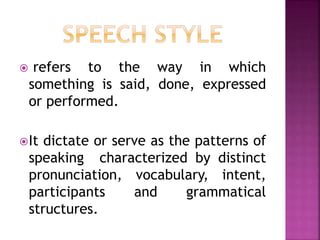
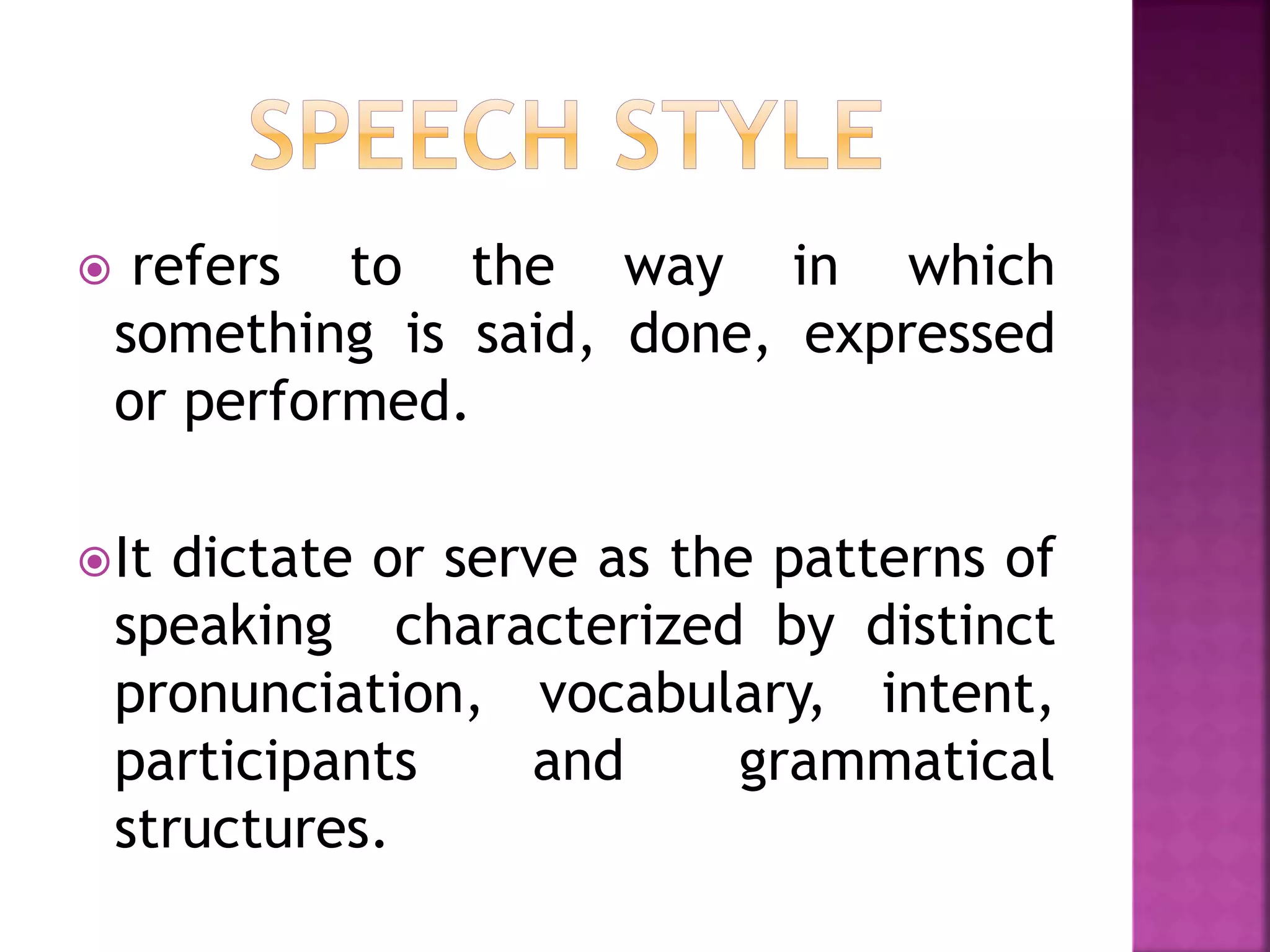
 refers to the way in which
something is said, done, expressed
or performed.
It dictate or serve as the patterns of
speaking characterized by distinct
pronunciation, vocabulary, intent,
participants and grammatical
structures.
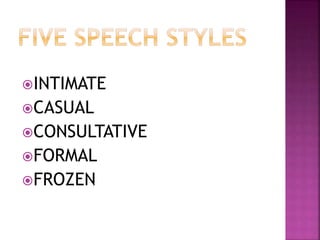
INTIMATE
CASUAL
CONSULTATIVE
FORMAL
FROZEN
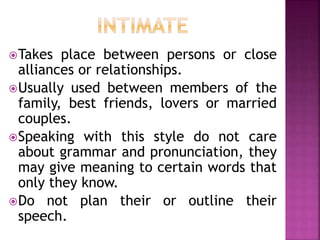
Takes place between persons or close
alliances or relationships.
Usually used between members of the
family, best friends, lovers or married
couples.
Speaking with this style do not care
about grammar and pronunciation, they
may give meaning to certain words that
only they know.
Do not plan their or outline their
speech.
This style is more informal compared
to the other speech styles.
 it is characterized by use of ellipsis or
omission of words, slang, contractions
and colloquial/idiom expressions
 street language, gay language, or
vulgar words are used.
 used among friends, classmates, co-
workers, peers and neighbors.
This style is the standard one.
Professional or mutually acceptable
language is a must in this style.
Person using this style pronounces
words well, chooses words carefully,
and speaks in complete sentences.
Doctor and patient consultation
Teachers and students
interaction
Employers and employees
Used in formal settings no matter
how the participants are related in
each other.
Unlike the consultative style, this is
one way.
This requires the speaker to plan the
speech or utterance in advance.
Sermons by priests and ministers
A President delivering his State of
the Nation Address
Formal speeches
Pronouncement by judges
Also called as FIXED SPEECH
Reserve for traditions in which the
language does not change.
It mostly occurs in ceremonies.
Most formal communicative style for
respectful situation
Preamble to the Constitution
Lord’s Prayer
Pledge of Allegiance to country
or flag
The way we communicate depends
on the people who we talk to, the
location of communication, and the
type of occasion.
There are different speech styles or
levels of language we can use
depending on the occasion and the
interlocutors and these include
FROZEN, FORMAL, CASUAL,
CONSULTATIVE, and INTIMATE.
Why are speech styles
important in delivering and
conveying messages?
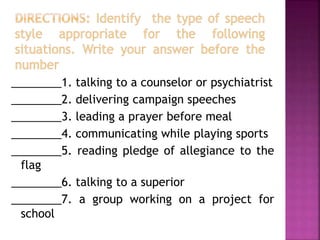
________1. talking to a counselor or psychiatrist
________2. delivering campaign speeches
________3. leading a prayer before meal
________4. communicating while playing sports
________5. reading pledge of allegiance to the
flag
________6. talking to a superior
________7. a group working on a project for
school
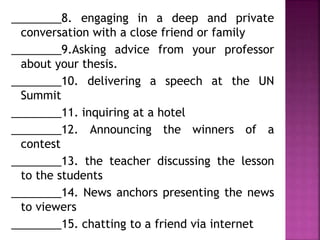
________8. engaging in a deep and private
conversation with a close friend or family
________9.Asking advice from your professor
about your thesis.
________10. delivering a speech at the UN
Summit
________11. inquiring at a hotel
________12. Announcing the winners of a
contest
________13. the teacher discussing the lesson
to the students
________14. News anchors presenting the news
to viewers
________15. chatting to a friend via internet
Speech styles ppt.

Speech styles ppt.

  • 1.
     refers tothe way in which something is said, done, expressed or performed. It dictate or serve as the patterns of speaking characterized by distinct pronunciation, vocabulary, intent, participants and grammatical structures.
  • 2.
  • 3.
    Takes place betweenpersons or close alliances or relationships. Usually used between members of the family, best friends, lovers or married couples. Speaking with this style do not care about grammar and pronunciation, they may give meaning to certain words that only they know. Do not plan their or outline their speech.
  • 4.
    This style ismore informal compared to the other speech styles.  it is characterized by use of ellipsis or omission of words, slang, contractions and colloquial/idiom expressions  street language, gay language, or vulgar words are used.  used among friends, classmates, co- workers, peers and neighbors.
  • 5.
    This style isthe standard one. Professional or mutually acceptable language is a must in this style. Person using this style pronounces words well, chooses words carefully, and speaks in complete sentences.
  • 6.
    Doctor and patientconsultation Teachers and students interaction Employers and employees
  • 7.
    Used in formalsettings no matter how the participants are related in each other. Unlike the consultative style, this is one way. This requires the speaker to plan the speech or utterance in advance.
  • 8.
    Sermons by priestsand ministers A President delivering his State of the Nation Address Formal speeches Pronouncement by judges
  • 9.
    Also called asFIXED SPEECH Reserve for traditions in which the language does not change. It mostly occurs in ceremonies. Most formal communicative style for respectful situation
  • 10.
    Preamble to theConstitution Lord’s Prayer Pledge of Allegiance to country or flag
  • 11.
    The way wecommunicate depends on the people who we talk to, the location of communication, and the type of occasion. There are different speech styles or levels of language we can use depending on the occasion and the interlocutors and these include FROZEN, FORMAL, CASUAL, CONSULTATIVE, and INTIMATE.
  • 12.
    Why are speechstyles important in delivering and conveying messages?
  • 13.
    ________1. talking toa counselor or psychiatrist ________2. delivering campaign speeches ________3. leading a prayer before meal ________4. communicating while playing sports ________5. reading pledge of allegiance to the flag ________6. talking to a superior ________7. a group working on a project for school
  • 14.
    ________8. engaging ina deep and private conversation with a close friend or family ________9.Asking advice from your professor about your thesis. ________10. delivering a speech at the UN Summit ________11. inquiring at a hotel ________12. Announcing the winners of a contest ________13. the teacher discussing the lesson to the students ________14. News anchors presenting the news to viewers ________15. chatting to a friend via internet