• the exchange of thoughts,
ideas, concepts, and views
between or among two or
more people
• the circumstance or
environment in which
communication takes
place.
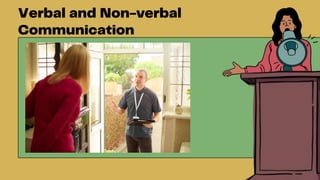
Effective communication calls for the
blending of these two types. One cannot
be separated from the other.
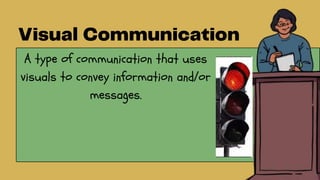
A type of communication that uses
visuals to convey information and/or
messages.
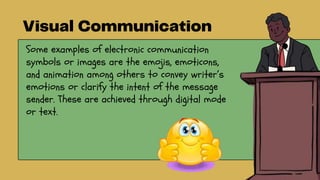
Some examples of electronic communication
symbols or images are the emojis, emoticons,
and animation among others to convey writer’s
emotions or clarify the intent of the message
sender. These are achieved through digital mode
or text.
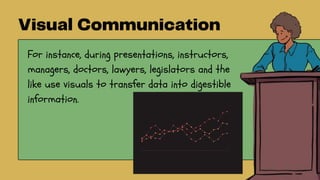
For instance, during presentations, instructors,
managers, doctors, lawyers, legislators and the
like use visuals to transfer data into digestible
information.
Have greater success in catching the
attention of the audience, making the
latter easily recall the information.
More advantageous since it makes use of
technology that provides applications, videos,
and images that rely less on the printed
word making presentations more interesting.
•
• The Latin prefix intra – means within or
inside.
• It means talking to oneself.
• Some label it as self or inner talk, inner
monologue, or inner dialogue.
• Psychologists call it with other names
such as self-verbalization or self-
statement.
For instance, if you find yourself talking to yourself, there
is really no need for you to answer back.
You talk to yourself because you think that there is the
need to:
• boost your confidence when you are nervous to
speak in front of an audience;
• apprise yourself that you performed a good job;
• console yourself that you did a task poorly.
Engaging in inner speech such as fantasizing
or daydreaming is not bad as long as you are
able to distinguish it from reality.
Self-talk can be advantageous as it can
enable you to practice what you ought to
say in times when you lack the motivation
and confidence to speak.
• The Latin prefix inter – means
between, among, and together.
• An interactive exchange takes place
as interpersonal communication
takes place.
• As it occurs, a transaction does not
necessarily take place since it can only be a
simple interaction such as greetings,
getting to know a person, or ordinary
conversations that happen between or
among the interactants.
• This may occur in dyads or small groups,
also known as group communication
• A communication situation is interpersonal
if it is meant to establish or deepen one’s
relationship with others.
• If the objective is to achieve something at
the end of the conversation, it becomes
transactional.
Interpersonal talks are meant for
maintaining social relationships,
transactional talks aim to accomplish or
resolve something at the end of the
conversation.
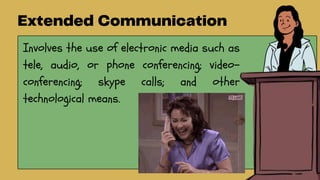
Involves the use of electronic media such as
tele, audio, or phone conferencing; video-
conferencing; skype calls; and other
technological means.
Participants may not be physically present but
are still able to track down the lectures and
participate actively because of the mass
articulation and dissemination of information ,
allowing speakers to reach a wider group of
listeners.
Since extended communication is public in
nature, speakers are expected to be
prepared when they speak, making their
language more formal.
With the use of electronic media, messages
are transmitted quickly.
For instance, with the use of the internet, recorded
videos may be transmitted in seconds/minutes and may
be viewed by a greater number of people.
With extended communication, your own thinking,
behavior, and attitude may be influenced by other
people and you may be persuaded to take the views
you hear.
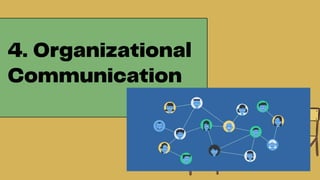
The focus is on the role that
communication plays in organizational
contexts.
Organizations comprise individuals who
work for the company.
For an organization to be successful, a system of
communication should be put in place.
A set of rules or standards for communication protocol
should be made clear so that interaction patterns are
established.
On the part of the individual, you should be equipped with the
needed oral and written communication skills that the
organization expects you to possess.
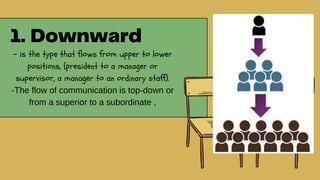
- is the type that flows from upper to lower
positions, (president to a manager or
supervisor, a manager to an ordinary staff).
-The flow of communication is top-down or
from a superior to a subordinate ,
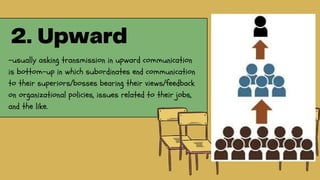
-usually asking transmission in upward communication
is bottom-up in which subordinates end communication
to their superiors/bosses bearing their views/feedback
on organizational policies, issues related to their jobs,
and the like.
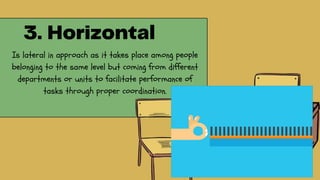
Is lateral in approach as it takes place among people
belonging to the same level but coming from different
departments or units to facilitate performance of
tasks through proper coordination.
diagonal in nature as employees from different
units or departments working at various
levels communicate with each other.
• Comes from unofficial channels of
message flow.
• Also known as “grapevine”
messages coming from the
different levels of the organization
are transmitted.
This occurs due to the dissatisfaction
of some employees accompanied by
uncertainty, such as superiors playing
favorites and unfavorable or
unacceptable company rules and
regulations.
•
• Based on its history and development, an
organization develops its own core
values, vision and mission statements,
goals, and objectives.
• Organizational culture is of utmost
significance since it will dictate the kind of
behavior that employees should possess
as well as the extent of commitment
expected from them by the organization.
Peter Drucker’s famous quote,
“Company cultures are like country
cultures. Never try to change one. Try
instead, to work, with that what you’ve
got,”
• Communication between or among people
having different linguistic, religious ethnic,
social, and professional backgrounds.
• Even gender difference affects communication.
• Individuals having different orientations
communicate and interpret messages
differently.
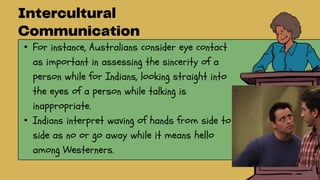
• For instance, Australians consider eye contact
as important in assessing the sincerity of a
person while for Indians, looking straight into
the eyes of a person while talking is
inappropriate.
• Indians interpret waving of hands from side to
side as no or go away while it means hello
among Westerners.
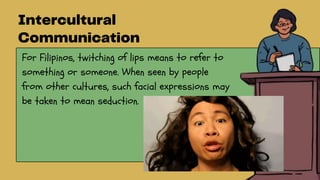
For Filipinos, twitching of lips means to refer to
something or someone. When seen by people
from other cultures, such facial expressions may
be taken to mean seduction.
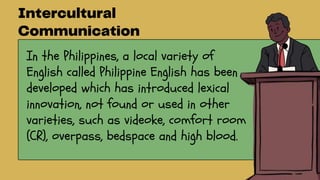
In the Philippines, a local variety of
English called Philippine English has been
developed which has introduced lexical
innovation, not found or used in other
varieties, such as videoke, comfort room
(CR), overpass, bedspace and high blood.
• The types of communication in relation
to purpose and style are formal and
informal.
• The focus here is on the communication
setting and the mode of delivery.
• Employs formal language delivered orally or in
written form.
• Lectures, public talks/speeches, research and
project proposals, reports and business
letters, among others are all considered
formal situations and writings.
• Note that while lectures and speeches are
delivered orally, the texts have been
thought out carefully and written well
before they are delivered.
• To inform, to entertain and to persuade are
the main objectives of this type of
communication.
• Certainly does not employ formal language.
• It involves personal and ordinary
conversations with friends, family members,
or acquaintances about anything under the
sun.
• The mode may be oral as in face-to-
face, ordinary or everyday talks and
phone calls, or written as in the case of
e-mail messages, personal notes,
letters or text messages.
• The purpose is simply to socialize
and enhance relationships.
3-Types-of-Communication-Purposive-Communication.pptx

3-Types-of-Communication-Purposive-Communication.pptx

  • 2.
    • the exchangeof thoughts, ideas, concepts, and views between or among two or more people
  • 3.
    • the circumstanceor environment in which communication takes place.
  • 8.
    Effective communication callsfor the blending of these two types. One cannot be separated from the other.
  • 11.
    A type ofcommunication that uses visuals to convey information and/or messages.
  • 12.
    Some examples ofelectronic communication symbols or images are the emojis, emoticons, and animation among others to convey writer’s emotions or clarify the intent of the message sender. These are achieved through digital mode or text.
  • 13.
    For instance, duringpresentations, instructors, managers, doctors, lawyers, legislators and the like use visuals to transfer data into digestible information.
  • 14.
    Have greater successin catching the attention of the audience, making the latter easily recall the information.
  • 15.
    More advantageous sinceit makes use of technology that provides applications, videos, and images that rely less on the printed word making presentations more interesting.
  • 17.
  • 18.
    • The Latinprefix intra – means within or inside. • It means talking to oneself. • Some label it as self or inner talk, inner monologue, or inner dialogue. • Psychologists call it with other names such as self-verbalization or self- statement.
  • 20.
    For instance, ifyou find yourself talking to yourself, there is really no need for you to answer back. You talk to yourself because you think that there is the need to: • boost your confidence when you are nervous to speak in front of an audience; • apprise yourself that you performed a good job; • console yourself that you did a task poorly.
  • 21.
    Engaging in innerspeech such as fantasizing or daydreaming is not bad as long as you are able to distinguish it from reality. Self-talk can be advantageous as it can enable you to practice what you ought to say in times when you lack the motivation and confidence to speak.
  • 24.
    • The Latinprefix inter – means between, among, and together. • An interactive exchange takes place as interpersonal communication takes place.
  • 25.
    • As itoccurs, a transaction does not necessarily take place since it can only be a simple interaction such as greetings, getting to know a person, or ordinary conversations that happen between or among the interactants. • This may occur in dyads or small groups, also known as group communication
  • 26.
    • A communicationsituation is interpersonal if it is meant to establish or deepen one’s relationship with others. • If the objective is to achieve something at the end of the conversation, it becomes transactional.
  • 27.
    Interpersonal talks aremeant for maintaining social relationships, transactional talks aim to accomplish or resolve something at the end of the conversation.
  • 29.
    Involves the useof electronic media such as tele, audio, or phone conferencing; video- conferencing; skype calls; and other technological means.
  • 30.
    Participants may notbe physically present but are still able to track down the lectures and participate actively because of the mass articulation and dissemination of information , allowing speakers to reach a wider group of listeners.
  • 31.
    Since extended communicationis public in nature, speakers are expected to be prepared when they speak, making their language more formal. With the use of electronic media, messages are transmitted quickly.
  • 32.
    For instance, withthe use of the internet, recorded videos may be transmitted in seconds/minutes and may be viewed by a greater number of people. With extended communication, your own thinking, behavior, and attitude may be influenced by other people and you may be persuaded to take the views you hear.
  • 34.
    The focus ison the role that communication plays in organizational contexts. Organizations comprise individuals who work for the company.
  • 35.
    For an organizationto be successful, a system of communication should be put in place. A set of rules or standards for communication protocol should be made clear so that interaction patterns are established. On the part of the individual, you should be equipped with the needed oral and written communication skills that the organization expects you to possess.
  • 39.
    - is thetype that flows from upper to lower positions, (president to a manager or supervisor, a manager to an ordinary staff). -The flow of communication is top-down or from a superior to a subordinate ,
  • 40.
    -usually asking transmissionin upward communication is bottom-up in which subordinates end communication to their superiors/bosses bearing their views/feedback on organizational policies, issues related to their jobs, and the like.
  • 41.
    Is lateral inapproach as it takes place among people belonging to the same level but coming from different departments or units to facilitate performance of tasks through proper coordination.
  • 42.
    diagonal in natureas employees from different units or departments working at various levels communicate with each other.
  • 43.
    • Comes fromunofficial channels of message flow. • Also known as “grapevine” messages coming from the different levels of the organization are transmitted.
  • 44.
    This occurs dueto the dissatisfaction of some employees accompanied by uncertainty, such as superiors playing favorites and unfavorable or unacceptable company rules and regulations.
  • 45.
    • • Based onits history and development, an organization develops its own core values, vision and mission statements, goals, and objectives.
  • 46.
    • Organizational cultureis of utmost significance since it will dictate the kind of behavior that employees should possess as well as the extent of commitment expected from them by the organization.
  • 47.
    Peter Drucker’s famousquote, “Company cultures are like country cultures. Never try to change one. Try instead, to work, with that what you’ve got,”
  • 49.
    • Communication betweenor among people having different linguistic, religious ethnic, social, and professional backgrounds. • Even gender difference affects communication. • Individuals having different orientations communicate and interpret messages differently.
  • 50.
    • For instance,Australians consider eye contact as important in assessing the sincerity of a person while for Indians, looking straight into the eyes of a person while talking is inappropriate. • Indians interpret waving of hands from side to side as no or go away while it means hello among Westerners.
  • 51.
    For Filipinos, twitchingof lips means to refer to something or someone. When seen by people from other cultures, such facial expressions may be taken to mean seduction.
  • 52.
    In the Philippines,a local variety of English called Philippine English has been developed which has introduced lexical innovation, not found or used in other varieties, such as videoke, comfort room (CR), overpass, bedspace and high blood.
  • 54.
    • The typesof communication in relation to purpose and style are formal and informal. • The focus here is on the communication setting and the mode of delivery.
  • 56.
    • Employs formallanguage delivered orally or in written form. • Lectures, public talks/speeches, research and project proposals, reports and business letters, among others are all considered formal situations and writings.
  • 57.
    • Note thatwhile lectures and speeches are delivered orally, the texts have been thought out carefully and written well before they are delivered. • To inform, to entertain and to persuade are the main objectives of this type of communication.
  • 58.
    • Certainly doesnot employ formal language. • It involves personal and ordinary conversations with friends, family members, or acquaintances about anything under the sun.
  • 59.
    • The modemay be oral as in face-to- face, ordinary or everyday talks and phone calls, or written as in the case of e-mail messages, personal notes, letters or text messages. • The purpose is simply to socialize and enhance relationships.