By Steven Beebe and John Masterson
Copyright © 2015, 2012, 2009, Pearson Education, Inc. All Rights Reserved
This multimedia product and its contents are protected under copyright law. The following are prohibited by law:
•Any public performance or display, including transmission of any image over a network;
•Preparation of any derivative work, including the extraction, in whole or in part, of any images;
•Any rental, lease, or lending of the program.
Chapter 1
Copyright © 2015, 2012, 2009, Pearson Education, Inc. All Rights Reserved
Communication in Small Groups:
Principles and Practices 11/e
Communication is about:
Making sense – interpreting what we see, hear,
touch, smell, and taste.
 We look for patterns/structure
Sharing sense – verbal and non-verbal
Creating meaning – created meaning based on
our exper., backgrounds and culture.
Verbal and nonverbal messages
 Symbols – is something that represents a thought,
concept, object, or experience (gestures, clothing, tone,
etc…).
Copyright © 2015, 2012, 2009, Pearson Education, Inc. All Rights Reserved
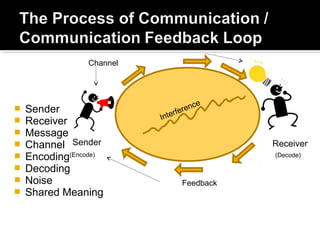
 Sender
 Receiver
 Message
 Channel
 Encoding
 Decoding
 Noise
 Shared Meaning
4
Receiver
Channel
Interference
(Decode)
Sender
Feedback
(Encode)
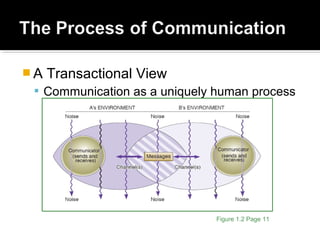
 Is transactional
 We send and receive messages
simultaneously
 As you talk to someone:
▪ You respond to verbal and nonverbal messages
Copyright © 2015, 2012, 2009, Pearson Education, Inc. All Rights Reserved
 A Transactional View
 Communication as a uniquely human process
Figure 1.2 Page 11
 Source
 Receiver
 Channel
 Mediated settings
 Phone
 Fiber-optic cable
 Wireless signal
 The Internet
Copyright © 2015, 2012, 2009, Pearson Education, Inc. All Rights Reserved
 Is essential for effective group outcomes
 Does the communication affect group
accomplishments?
Copyright © 2015, 2012, 2009, Pearson Education, Inc. All Rights Reserved
A small group of people meeting
with a common purpose, feeling a
sense of belonging and exerting
influence on one another.
Copyright © 2015, 2012, 2009, Pearson Education, Inc. All Rights Reserved
Minimum of three people
Two people is a dyad – Interpersonal
Communication
Maximum 12 people, anymore would take
away from the group
Copyright © 2015, 2012, 2009, Pearson Education, Inc. All Rights Reserved
 Meets with a purpose –
goals/objectives/outcomes
 Feels a sense of belonging – identity
 Exerts influence – “influencing others
defines leadership” (p.5)
Copyright © 2015, 2012, 2009, Pearson Education, Inc. All Rights Reserved
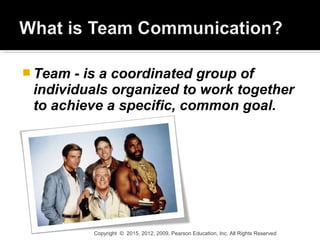
 Team - is a coordinated group of
individuals organized to work together
to achieve a specific, common goal.
Copyright © 2015, 2012, 2009, Pearson Education, Inc. All Rights Reserved
 Develop clear, well-defined goals
 What needs to be accomplished?
 Establish clearly defined roles
 Team leader, problem solver, etc….
 Create clearly defined rules
 Possible hierarchy, mediator, referee
 Coordinate a collaborative work ethic
 How everything fits together
Copyright © 2015, 2012, 2009, Pearson Education, Inc. All Rights Reserved
1. Clear, elevating goal – should be enticing
2. Results driven structure – clearly defined roles
3. Competent team members – training/skills
4. Unified commitment
5. Collaborative climate
6. Standards of excellence
7. External support and recognition
8. Principled leadership – among all members
Copyright © 2015, 2012, 2009, Pearson Education, Inc. All Rights Reserved
 Don’t trust other team members
 Fear conflict
 Don’t commit to the team
 Avoid accountability
 Don’t focus on achieving results
Copyright © 2015, 2012, 2009, Pearson Education, Inc. All Rights Reserved
 Experience
 Problem-solving ability
 Openness
 Supportiveness
Copyright © 2015, 2012, 2009, Pearson Education, Inc. All Rights Reserved
 Action oriented
 Positive personal style
 Positive overall team perceptions
 Self-Fulfilling Prophecy
 Team learning and adapting
Copyright © 2015, 2012, 2009, Pearson Education, Inc. All Rights Reserved
 Offer more resources – “two brains are
better than one”
 exper., cultures, etc…
 Stimulate creativity
 Support learning and comprehension
 Foster commitment and satisfaction with
decisions
 Enhance feedback and self-understanding
Copyright © 2015, 2012, 2009, Pearson Education, Inc. All Rights Reserved
 Pressure to conform
 Groupthink – when groups agree primarily in order to
avoid conflict.
 Dominant group members
 Reliance on others
 Social Loafing – members hold back on their
contributions (loaf), assuming others will do the work.
 Involves more time
Copyright © 2015, 2012, 2009, Pearson Education, Inc. All Rights Reserved
 When there are time constraints
 When an expert already has the answer
 When information is readily available
 When conflict and contention become
unmanageable
Copyright © 2015, 2012, 2009, Pearson Education, Inc. All Rights Reserved
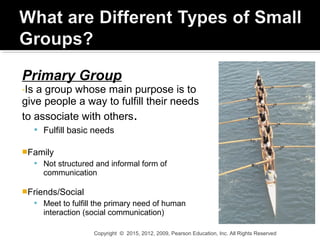
Primary Group
-Is a group whose main purpose is to
give people a way to fulfill their needs
to associate with others.
 Fulfill basic needs
Family
 Not structured and informal form of
communication
Friends/Social
 Meet to fulfill the primary need of human
interaction (social communication)
Copyright © 2015, 2012, 2009, Pearson Education, Inc. All Rights Reserved
Secondary Group
- Accomplish task or achieve goal
Usually work or school
Mainly join a group to get something
done/accomplished
Copyright © 2015, 2012, 2009, Pearson Education, Inc. All Rights Reserved
 Problem-Solving Groups – exist to overcome
some unsatisfactory situation or obstacles to
achieving a goal.
 Decision-Making groups – make choices
among alternatives
 Study Groups
 Therapy Groups
 Committees- people are appointed/elected for
a specific task
 Standing Committee
 Ad hoc Committee
 Focus groups
Virtual Small Group Communication – three or more
people who collaborate from different physical locations,
perform interdependent tasks, shared responsibility for the
outcome of the work, and rely on some form of technology
to communicate.
Channels
Telephone conferences
Text
Video conferences
Electronic meeting systems
 Web pages
 Webinars
Copyright © 2015, 2012, 2009, Pearson Education, Inc. All Rights Reserved
 Time
 Asynchronous – time delay, not seen/hear at the
same time
 Synchronous – instant and simultaneous
 Social Presence – is the feeling we have when we
act and think as if we’re involved in an unmediated,
fact to face conversation.
 Varying degrees of anonymity
 Potential for deception
 Non-verbal messages
 Written messages
 Distance
Copyright © 2015, 2012, 2009, Pearson Education, Inc. All Rights Reserved
 Cues-Filtered-Out Theory – suggests
that emotional expression is severely
restricted when we communicate using
only text messages
Copyright © 2015, 2012, 2009, Pearson Education, Inc. All Rights Reserved
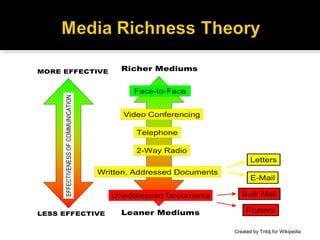
 Media Richness Theory – suggests that
richness of a communication channel is based
on 4 criteria:
 The amount of feedback that the communicators can
receive
 The number of cures that the channel can convey and
that can be interpreted by a receiver
 The variety of language that communicators use
 The potential for expression emotions and feeling.
Copyright © 2015, 2012, 2009, Pearson Education, Inc. All Rights Reserved
Created by Tntdj for Wikipedia
 Social Information-Processing Theory
– suggests that we can communicate
relational and emotional messages via the
Internet, but it just may take longer to
express messages that are typically
communicated using facial expression
and tone of voice.
Copyright © 2015, 2012, 2009, Pearson Education, Inc. All Rights Reserved
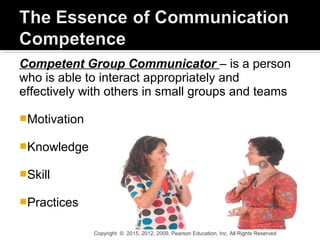
Competent Group Communicator – is a person
who is able to interact appropriately and
effectively with others in small groups and teams
Motivation
Knowledge
Skill
Practices
Copyright © 2015, 2012, 2009, Pearson Education, Inc. All Rights Reserved
 Problem-oriented
 Define problem
 Analyze problem
 Solution-oriented
 Identify criteria
 Generate solutions
 Evaluate solutions
Copyright © 2015, 2012, 2009, Pearson Education, Inc. All Rights Reserved
 Discussion- management
 Maintain task focus
 Manage interaction
 Relational
 Manage conflict
 Maintain climate
Copyright © 2015, 2012, 2009, Pearson Education, Inc. All Rights Reserved

Ch 1 group communication beebe

  • 1.
    By Steven Beebeand John Masterson Copyright © 2015, 2012, 2009, Pearson Education, Inc. All Rights Reserved This multimedia product and its contents are protected under copyright law. The following are prohibited by law: •Any public performance or display, including transmission of any image over a network; •Preparation of any derivative work, including the extraction, in whole or in part, of any images; •Any rental, lease, or lending of the program.
  • 2.
    Chapter 1 Copyright ©2015, 2012, 2009, Pearson Education, Inc. All Rights Reserved Communication in Small Groups: Principles and Practices 11/e
  • 3.
    Communication is about: Makingsense – interpreting what we see, hear, touch, smell, and taste.  We look for patterns/structure Sharing sense – verbal and non-verbal Creating meaning – created meaning based on our exper., backgrounds and culture. Verbal and nonverbal messages  Symbols – is something that represents a thought, concept, object, or experience (gestures, clothing, tone, etc…). Copyright © 2015, 2012, 2009, Pearson Education, Inc. All Rights Reserved
  • 4.
     Sender  Receiver Message  Channel  Encoding  Decoding  Noise  Shared Meaning 4 Receiver Channel Interference (Decode) Sender Feedback (Encode)
  • 5.
     Is transactional We send and receive messages simultaneously  As you talk to someone: ▪ You respond to verbal and nonverbal messages Copyright © 2015, 2012, 2009, Pearson Education, Inc. All Rights Reserved
  • 6.
     A TransactionalView  Communication as a uniquely human process Figure 1.2 Page 11
  • 7.
     Source  Receiver Channel  Mediated settings  Phone  Fiber-optic cable  Wireless signal  The Internet Copyright © 2015, 2012, 2009, Pearson Education, Inc. All Rights Reserved
  • 8.
     Is essentialfor effective group outcomes  Does the communication affect group accomplishments? Copyright © 2015, 2012, 2009, Pearson Education, Inc. All Rights Reserved
  • 9.
    A small groupof people meeting with a common purpose, feeling a sense of belonging and exerting influence on one another. Copyright © 2015, 2012, 2009, Pearson Education, Inc. All Rights Reserved
  • 10.
    Minimum of threepeople Two people is a dyad – Interpersonal Communication Maximum 12 people, anymore would take away from the group Copyright © 2015, 2012, 2009, Pearson Education, Inc. All Rights Reserved
  • 11.
     Meets witha purpose – goals/objectives/outcomes  Feels a sense of belonging – identity  Exerts influence – “influencing others defines leadership” (p.5) Copyright © 2015, 2012, 2009, Pearson Education, Inc. All Rights Reserved
  • 12.
     Team -is a coordinated group of individuals organized to work together to achieve a specific, common goal. Copyright © 2015, 2012, 2009, Pearson Education, Inc. All Rights Reserved
  • 13.
     Develop clear,well-defined goals  What needs to be accomplished?  Establish clearly defined roles  Team leader, problem solver, etc….  Create clearly defined rules  Possible hierarchy, mediator, referee  Coordinate a collaborative work ethic  How everything fits together Copyright © 2015, 2012, 2009, Pearson Education, Inc. All Rights Reserved
  • 14.
    1. Clear, elevatinggoal – should be enticing 2. Results driven structure – clearly defined roles 3. Competent team members – training/skills 4. Unified commitment 5. Collaborative climate 6. Standards of excellence 7. External support and recognition 8. Principled leadership – among all members Copyright © 2015, 2012, 2009, Pearson Education, Inc. All Rights Reserved
  • 15.
     Don’t trustother team members  Fear conflict  Don’t commit to the team  Avoid accountability  Don’t focus on achieving results Copyright © 2015, 2012, 2009, Pearson Education, Inc. All Rights Reserved
  • 16.
     Experience  Problem-solvingability  Openness  Supportiveness Copyright © 2015, 2012, 2009, Pearson Education, Inc. All Rights Reserved
  • 17.
     Action oriented Positive personal style  Positive overall team perceptions  Self-Fulfilling Prophecy  Team learning and adapting Copyright © 2015, 2012, 2009, Pearson Education, Inc. All Rights Reserved
  • 18.
     Offer moreresources – “two brains are better than one”  exper., cultures, etc…  Stimulate creativity  Support learning and comprehension  Foster commitment and satisfaction with decisions  Enhance feedback and self-understanding Copyright © 2015, 2012, 2009, Pearson Education, Inc. All Rights Reserved
  • 19.
     Pressure toconform  Groupthink – when groups agree primarily in order to avoid conflict.  Dominant group members  Reliance on others  Social Loafing – members hold back on their contributions (loaf), assuming others will do the work.  Involves more time Copyright © 2015, 2012, 2009, Pearson Education, Inc. All Rights Reserved
  • 20.
     When thereare time constraints  When an expert already has the answer  When information is readily available  When conflict and contention become unmanageable Copyright © 2015, 2012, 2009, Pearson Education, Inc. All Rights Reserved
  • 21.
    Copyright © 2015,2012, 2009, Pearson Education, Inc. All Rights Reserved
  • 22.
    Primary Group -Is agroup whose main purpose is to give people a way to fulfill their needs to associate with others.  Fulfill basic needs Family  Not structured and informal form of communication Friends/Social  Meet to fulfill the primary need of human interaction (social communication) Copyright © 2015, 2012, 2009, Pearson Education, Inc. All Rights Reserved
  • 23.
    Secondary Group - Accomplishtask or achieve goal Usually work or school Mainly join a group to get something done/accomplished Copyright © 2015, 2012, 2009, Pearson Education, Inc. All Rights Reserved
  • 24.
     Problem-Solving Groups– exist to overcome some unsatisfactory situation or obstacles to achieving a goal.  Decision-Making groups – make choices among alternatives  Study Groups  Therapy Groups  Committees- people are appointed/elected for a specific task  Standing Committee  Ad hoc Committee  Focus groups
  • 25.
    Virtual Small GroupCommunication – three or more people who collaborate from different physical locations, perform interdependent tasks, shared responsibility for the outcome of the work, and rely on some form of technology to communicate. Channels Telephone conferences Text Video conferences Electronic meeting systems  Web pages  Webinars Copyright © 2015, 2012, 2009, Pearson Education, Inc. All Rights Reserved
  • 26.
     Time  Asynchronous– time delay, not seen/hear at the same time  Synchronous – instant and simultaneous  Social Presence – is the feeling we have when we act and think as if we’re involved in an unmediated, fact to face conversation.  Varying degrees of anonymity  Potential for deception  Non-verbal messages  Written messages  Distance Copyright © 2015, 2012, 2009, Pearson Education, Inc. All Rights Reserved
  • 27.
     Cues-Filtered-Out Theory– suggests that emotional expression is severely restricted when we communicate using only text messages Copyright © 2015, 2012, 2009, Pearson Education, Inc. All Rights Reserved
  • 28.
     Media RichnessTheory – suggests that richness of a communication channel is based on 4 criteria:  The amount of feedback that the communicators can receive  The number of cures that the channel can convey and that can be interpreted by a receiver  The variety of language that communicators use  The potential for expression emotions and feeling. Copyright © 2015, 2012, 2009, Pearson Education, Inc. All Rights Reserved
  • 29.
    Created by Tntdjfor Wikipedia
  • 30.
     Social Information-ProcessingTheory – suggests that we can communicate relational and emotional messages via the Internet, but it just may take longer to express messages that are typically communicated using facial expression and tone of voice. Copyright © 2015, 2012, 2009, Pearson Education, Inc. All Rights Reserved
  • 31.
    Competent Group Communicator– is a person who is able to interact appropriately and effectively with others in small groups and teams Motivation Knowledge Skill Practices Copyright © 2015, 2012, 2009, Pearson Education, Inc. All Rights Reserved
  • 32.
     Problem-oriented  Defineproblem  Analyze problem  Solution-oriented  Identify criteria  Generate solutions  Evaluate solutions Copyright © 2015, 2012, 2009, Pearson Education, Inc. All Rights Reserved
  • 33.
     Discussion- management Maintain task focus  Manage interaction  Relational  Manage conflict  Maintain climate Copyright © 2015, 2012, 2009, Pearson Education, Inc. All Rights Reserved