GROUP COMMUNICATION AND
GROUP DISCUSSIONS
ASSIGNMENT OF
BUSINESS
COMMUNICATION
INTRODUCTION: GROUP COMMUNICATION
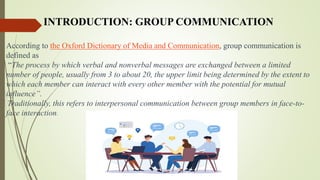
According to the Oxford Dictionary of Media and Communication, group communication is
defined as
“The process by which verbal and nonverbal messages are exchanged between a limited
number of people, usually from 3 to about 20, the upper limit being determined by the extent to
which each member can interact with every other member with the potential for mutual
influence”.
Traditionally, this refers to interpersonal communication between group members in face-to-
face interaction.
Components of Group Communication
 Interdependence: Group members depend on each other to achieve their shared goals. This means that they must
communicate effectively with each other in order to share information, coordinate their efforts, and make decisions.
 Context-specific: Group communication is influenced by the context in which it is taking place. This context can include the
physical environment, the group's culture, and the social relationships between group members. It is important to be aware of
the context of group communication in order to communicate effectively.
 Dynamic: Group communication is a dynamic process that is constantly evolving. This is because group members are
individuals with different personalities, experiences, and perspectives. As group members interact with each other, they learn
from each other and grow as a group.
 Shared goals: Group members must have a shared understanding of their goals in order to communicate effectively. This
means that they must be able to articulate their goals clearly and concisely, and they must be willing to work together to
achieve them.
 Shared norms: Group members develop shared norms, or rules of behavior, over time. These norms govern how group
members interact with each other and how they communicate. Shared norms can help to create a sense of trust and cohesion
within the group, which can facilitate effective communication.
 Feedback: Group members provide feedback to each other on their communication. This feedback can be positive or
negative, but it is essential for helping group members to improve their communication skills and to develop more effective
communication patterns.
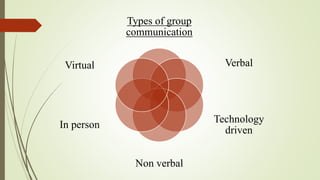
Types of group
communication
Verbal
Technology
driven
Non verbal
In person
Virtual
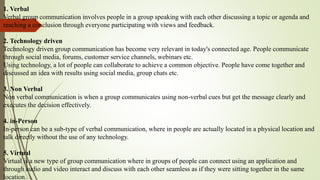
1. Verbal
Verbal group communication involves people in a group speaking with each other discussing a topic or agenda and
reaching a conclusion through everyone participating with views and feedback.
2. Technology driven
Technology driven group communication has become very relevant in today's connected age. People communicate
through social media, forums, customer service channels, webinars etc.
Using technology, a lot of people can collaborate to achieve a common objective. People have come together and
discussed an idea with results using social media, group chats etc.
3. Non Verbal
Non verbal communication is when a group communicates using non-verbal cues but get the message clearly and
executes the decision effectively.
4. in-Person
In-person can be a sub-type of verbal communication, where in people are actually located in a physical location and
talk directly without the use of any technology.
5. Virtual
Virtual is a new type of group communication where in groups of people can connect using an application and
through audio and video interact and discuss with each other seamless as if they were sitting together in the same
location.
Group discussions
Group discussion is when a group of people comes together to discuss a certain topic. Many
Recruiters use group discussion (GD) to test a candidate’s communication skills, leadership
skills, test topic knowledge, etc
The general discussion (GD) is a session in which the candidate’s abilities are evaluated,
including leadership, communication, social and behavioral skills, courtesy, teamwork,
listening skills, general awareness, self-assurance, and problem-solving abilities.
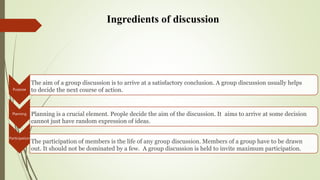
Purpose
Planning
Participation
Ingredients of discussion
The aim of a group discussion is to arrive at a satisfactory conclusion. A group discussion usually helps
to decide the next course of action.
Planning is a crucial element. People decide the aim of the discussion. It aims to arrive at some decision
cannot just have random expression of ideas.
The participation of members is the life of any group discussion. Members of a group have to be drawn
out. It should not be dominated by a few. A group discussion is held to invite maximum participation.
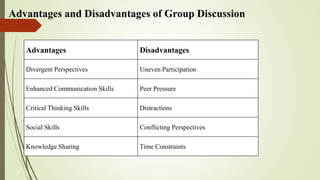
Advantages and Disadvantages of Group Discussion
Advantages Disadvantages
Divergent Perspectives Uneven Participation
Enhanced Communication Skills Peer Pressure
Critical Thinking Skills Distractions
Social Skills Conflicting Perspectives
Knowledge Sharing Time Constraints
REFERENCES
 pumble.com
 Study .com
 Great learning
 Getup learn.com
 MBAskool.com
 Aspiringyouths.com
 Yourarticlelibrary.com

group communication and group discussion

  • 1.
    GROUP COMMUNICATION AND GROUPDISCUSSIONS ASSIGNMENT OF BUSINESS COMMUNICATION
  • 2.
    INTRODUCTION: GROUP COMMUNICATION Accordingto the Oxford Dictionary of Media and Communication, group communication is defined as “The process by which verbal and nonverbal messages are exchanged between a limited number of people, usually from 3 to about 20, the upper limit being determined by the extent to which each member can interact with every other member with the potential for mutual influence”. Traditionally, this refers to interpersonal communication between group members in face-to- face interaction.
  • 3.
    Components of GroupCommunication  Interdependence: Group members depend on each other to achieve their shared goals. This means that they must communicate effectively with each other in order to share information, coordinate their efforts, and make decisions.
  • 4.
     Context-specific: Groupcommunication is influenced by the context in which it is taking place. This context can include the physical environment, the group's culture, and the social relationships between group members. It is important to be aware of the context of group communication in order to communicate effectively.  Dynamic: Group communication is a dynamic process that is constantly evolving. This is because group members are individuals with different personalities, experiences, and perspectives. As group members interact with each other, they learn from each other and grow as a group.  Shared goals: Group members must have a shared understanding of their goals in order to communicate effectively. This means that they must be able to articulate their goals clearly and concisely, and they must be willing to work together to achieve them.  Shared norms: Group members develop shared norms, or rules of behavior, over time. These norms govern how group members interact with each other and how they communicate. Shared norms can help to create a sense of trust and cohesion within the group, which can facilitate effective communication.  Feedback: Group members provide feedback to each other on their communication. This feedback can be positive or negative, but it is essential for helping group members to improve their communication skills and to develop more effective communication patterns.
  • 5.
  • 6.
    1. Verbal Verbal groupcommunication involves people in a group speaking with each other discussing a topic or agenda and reaching a conclusion through everyone participating with views and feedback. 2. Technology driven Technology driven group communication has become very relevant in today's connected age. People communicate through social media, forums, customer service channels, webinars etc. Using technology, a lot of people can collaborate to achieve a common objective. People have come together and discussed an idea with results using social media, group chats etc. 3. Non Verbal Non verbal communication is when a group communicates using non-verbal cues but get the message clearly and executes the decision effectively. 4. in-Person In-person can be a sub-type of verbal communication, where in people are actually located in a physical location and talk directly without the use of any technology. 5. Virtual Virtual is a new type of group communication where in groups of people can connect using an application and through audio and video interact and discuss with each other seamless as if they were sitting together in the same location.
  • 7.
    Group discussions Group discussionis when a group of people comes together to discuss a certain topic. Many Recruiters use group discussion (GD) to test a candidate’s communication skills, leadership skills, test topic knowledge, etc The general discussion (GD) is a session in which the candidate’s abilities are evaluated, including leadership, communication, social and behavioral skills, courtesy, teamwork, listening skills, general awareness, self-assurance, and problem-solving abilities.
  • 8.
    Purpose Planning Participation Ingredients of discussion Theaim of a group discussion is to arrive at a satisfactory conclusion. A group discussion usually helps to decide the next course of action. Planning is a crucial element. People decide the aim of the discussion. It aims to arrive at some decision cannot just have random expression of ideas. The participation of members is the life of any group discussion. Members of a group have to be drawn out. It should not be dominated by a few. A group discussion is held to invite maximum participation.
  • 9.
    Advantages and Disadvantagesof Group Discussion Advantages Disadvantages Divergent Perspectives Uneven Participation Enhanced Communication Skills Peer Pressure Critical Thinking Skills Distractions Social Skills Conflicting Perspectives Knowledge Sharing Time Constraints
  • 10.
    REFERENCES  pumble.com  Study.com  Great learning  Getup learn.com  MBAskool.com  Aspiringyouths.com  Yourarticlelibrary.com