Dr. Ajay Sasidharan
Dr. Dipanjan Majumder
Tata Memorial Hospital
Incidence of SCLC
 Incidence of Lung cancer – 1.8 million (12.9% cases of total)
 Small cell lung cancer (a type of neuroendocrine
tumor) : 15-20 % (approx 3.6 lakhs )
 In Tata Memorial Hospital : 75 cases (2008)
 Occurs in older patients: median age of 64
 97% are smokers; 90% associated with heavy tobacco use.
IARC GLOBOCAN 2012
Jemal A, Siegel R, Xu J, Ward E. Cancer Statistics, 2010. CA Cancer J Clin. 2010;60(5) :277-300
Travis WD. Pathology and Diagnosis of Neuroendocrine Tumors: Lung Neuroendocrine.
Thorac Surg Clin. 2014 Aug;24(3):257-266.
TMH Registry
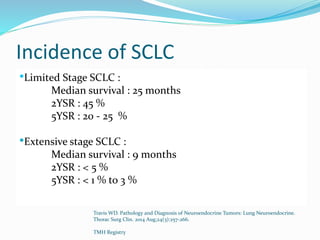
•Limited Stage SCLC :
Median survival : 25 months
2YSR : 45 %
5YSR : 20 - 25 %
•Extensive stage SCLC :
Median survival : 9 months
2YSR : < 5 %
5YSR : < 1 % to 3 %
Presentation of SCLC
 90%–95% occur
centrally
 Arising in a lobar or
main bronchus
 Symptoms:
 Dyspnea
 Persistent cough
 Hemoptysis
 Postobstructive
pneumonia
Chong S, Lee KS, et al. Neuro endocrine tumors of the lung: clinical, pathologic and imaging
findings.Radiographics. 2006Jan-Feb26(1):41-57.
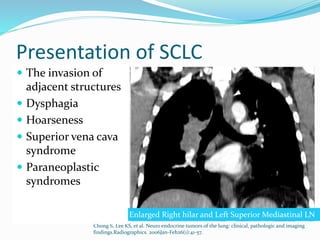
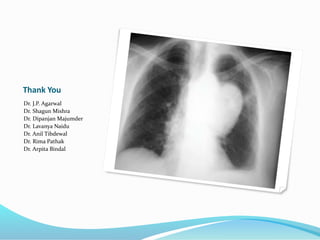
Bilateral enlargement at pulmonary hilumEnlarged Right hilar and Left Superior Mediastinal LN
 The invasion of
adjacent structures
 Dysphagia
 Hoarseness
 Superior vena cava
syndrome
 Paraneoplastic
syndromes
Staging of SCLC
 Limited stage (30%) -
Historically defined as disease confined in ipsilateral
hemithorax that can be safely encompassed in tolerable
radiation field. Includes contralateral hilar, mediastinal
and supraclavicular nodes also
 Extensive stage (70%) –
Disease beyond above definition which may include
malignant “pleural” or pericardial effusions or
contralateral lung or extrathoracic metastasisArgiris A, Murren JR. Staging and clinical prognostic factors for small-cell lung cancer.
Cancer J. 2001 Sep-Oct;7(5):437-47
Micke P, Faldum A
Staging small cell lung cancer: Veterans Administration Lung Study Group versus International
Association for the Study of Lung Cancer--what limits limited disease?
Lung Cancer. 2002 Sep;37(3):271-6.
Prognostic factors
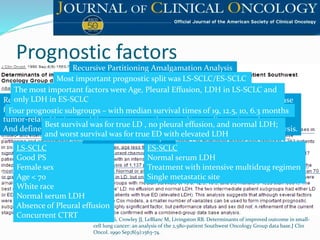
Albain KS, Crowley JJ, LeBlanc M, Livingston RB. Determinants of improved outcome in small-
cell lung cancer: an analysis of the 2,580-patient Southwest Oncology Group data base.J Clin
Oncol. 1990 Sep;8(9):1563-74.
LS-SCLC
Good PS
Female sex
Age < 70
White race
Normal serum LDH
Absence of Pleural effusion
Concurrent CTRT
ES-SCLC
Normal serum LDH
Treatment with intensive multidrug regimen
Single metastatic site
Retrospective analysis of 2580 patients from SWOG small –cell lung cancer data base
from 1976-1988 to determine prognostic value of favourable demographic and
tumor-related factors and therapy programs by using Cox multivariate analysis
And define patient subgroups with significantly different survivals using RPA analysis.
Cox multivariate analysis
Recursive Partitioning Amalgamation Analysis
Most important prognostic split was LS-SCLC/ES-SCLC
Four prognostic subgroups – with median survival times of 19, 12.5, 10, 6.3 months
The most important factors were Age, Pleural Effusion, LDH in LS-SCLC and
only LDH in ES-SCLC
Best survival was for true LD , no pleural effusion, and normal LDH;
and worst survival was for true ED with elevated LDH
Work Up Chest X-ray
 Complete Blood Count, Renal Function tests, Liver Function tests,
Serum Electrolytes
 Pulmonary Function tests
 CECT scan of thorax
 Biopsy – Bronchoscopic or CT guided
 PET-CT scan
 MRI Brain
Vansteenkiste JF. Imaging in lung cancer: positron emission tomography scan. Eur Respir J
Suppl. 2002 Feb;35:49s-60s
Bradley JD, Dehdashti F. et al. Positron emission tomography in limited-stage small-cell lung
cancer: A prospective study. J Clin Oncol Biol Phys. 2004;22(16):3248-3254.
Van Loon J, De Ruysscher D, Wanders R, et al. Selective nodal irradiation on basis of (18) FDG-
PET scans in limited-disease small-cell lung cancer. Int J Radiat Oncol Biol Phys.
2010;77(2):329-336.
Hirsch FR, Paulson OB, Hansen HH, Vraa-Jensen J. Intracranial metastases in small cell
carcinoma of the lung: correlation of clinical and autopsy findings. Cancer 1982;50:2433-7.
Role of PET-CT SCAN in SCLC
Van Loon J, De Ruysscher D, Wanders R, et al. Selective nodal irradiation on basis of (18) FDG-
PET scans in limited-disease small-cell lung cancer. Int J Radiat Oncol Biol Phys.
2010;77(2):329-336.
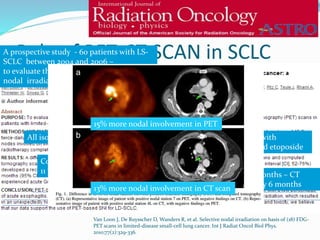
A prospective study - 60 patients with LS-
SCLC between 2004 and 2006 –
to evaluate the results of PET CT based
nodal irradiation on isolated nodal failure
Pretreatment PET scan – primary tumor
and mediastinal lymph nodes
EBRT : 45 Gy in 1.5Gy BD with
concurrent carboplatin and etoposide
Post CTRT 3 months – CT
scan, then every 6 months
Median follow up: 18.5 +/- 10.3 months.
2 (3%) – isolated regional failure
Median actuarial overall survival – 19 months
Median actuarial progression free survival – 14 months
Acute Grade 3 esophagitis – 12%
Compared to their own prospective study of CT based –
11 % isolated regional failure
All isolated nodal failures were in ipsilateral supraclavicular fossa
15% more nodal involvement in PET
13% more nodal involvement in CT scan
Role of MRI Brain in SCLC
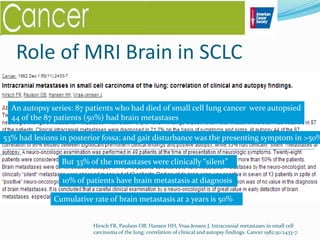
Hirsch FR, Paulson OB, Hansen HH, Vraa-Jensen J. Intracranial metastases in small cell
carcinoma of the lung: correlation of clinical and autopsy findings. Cancer 1982;50:2433-7.
But 33% of the metastases were clinically “silent”
53% had lesions in posterior fossa; and gait disturbance was the presenting symptom in >50%
An autopsy series: 87 patients who had died of small cell lung cancer were autopsied
44 of the 87 patients (50%) had brain metastases
10% of patients have brain metastasis at diagnosis
Cumulative rate of brain metastasis at 2 years is 50%
Treatment of Small Cell Lung
Cancer
 Role of Sugery in SCLC
 Role of Radiotherapy and Chemotherapy
 Timing of Radiotherapy in relation to Chemotherapy
 Maximum Tolerated Dose
 Role of Hyperfractionation
 Prohylactic Cranial Irradiation
Surgery for SCLC
 Till 1960’s surgery alone was the standard of care for all
lung cancer.
 But survival rates achieved were <1% at 5 years
Fox W, Scadding JG. Medical Research Council comparative trial of surgery and radiotherapy for
primary treatment of small-celled or oat celled carcinoma of bronchus. Ten year follow up.
Lancet. 1973;2(7820):63-65
Thomas Lad, Steven Piantadosi. A prospective randomized trial to determine the benefit of
surgical resection of residual diseasefollowing response of Small cell lung cancer to combination
chemotherapy. Chest. 1994 Dec;106(6 Suppl):320S-323S
Surgery
Radiotherapy?
Surgery vs Radiotherapy
Fox W, Scadding JG. Medical Research Council comparative trial of surgery and radiotherapy
for primary treatment of small-celled or oat celled carcinoma of bronchus. Ten year follow up.
Lancet. 1973;2(7820):63-65
Fox et al comparative trial conducted in 1973
144 patients – 71 alocated to surgery and 73 to radical radiotherapy
5 year survival : 1% in surgery arm and 4% in radiotherapy arm
10 year survival : 0 in surgery arm and 4% in radiotherapy arm
Mean Survival : 199 days in surgery series
300 days in radiotherapy series
(p = 0.04)
Role of Chemotherapy alone in LS-
SCLC
 Throughout 1960s and 70’s different combinations of chemotherapy
had been tried as the sole treatment modality for SCLC
 Two or three drug combinations.
 Alternating cyclic chemotherapy using non cross resistant drugs.
 The use of platinum based regimens.
Cohen MH, Ihde DC, et al. Cyclic alternating combination chemotherapy for small cell
bronchogenic carcinoma. Cancer Treat Rep. 1979;63(2): 163-170
Gaspar LE, Gay EG, Crawford J, Putnam JB, et al. Limited-stage small-cell lung cancer(stages I-
III): observations from the National Cancer Data Base. Clin Lung Cancer. 2005;6(6):355-360
Chemotherapy?
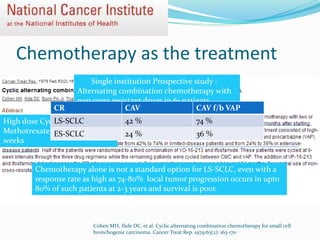
Chemotherapy as the treatment
Cohen MH, Ihde DC, et al. Cyclic alternating combination chemotherapy for small cell
bronchogenic carcinoma. Cancer Treat Rep. 1979;63(2): 163-170
High dose Cyclophosphamide,
Methotrexate, CCNU for 6
weeks
Vincristine, Adriamycin,
Procarbazine for 6 weeks
Single institution Prospective study :
Alternating combination chemotherapy with
non cross resistant drugs in 61 patients
Chemotherapy alone is not a standard option for LS-SCLC, even with a
response rate as high as 74-80% local tumor progression occurs in upto
80% of such patients at 2-3 years and survival is poor.
CR CAV CAV f/b VAP
LS-SCLC 42 % 74 %
ES-SCLC 24 % 36 %
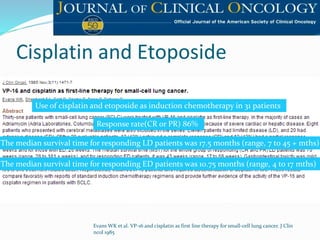
Cisplatin and Etoposide
Evans WK et al. VP-16 and cisplatin as first line therapy for small-cell lung cancer. J Clin
ncol 1985
Response rate(CR or PR) 86%
Use of cisplatin and etoposide as induction chemotherapy in 31 patients
The median survival time for responding LD patients was 17.5 months (range, 7 to 45 + mths)
The median survival time for responding ED patients was 10.75 months (range, 4 to 17 mths)
Cisplatin and Etoposide
Sundstrom S, Bremnes RM, et al. Cisplatin and etoposide regimen is superior to
cyclophosphamide, epirubicin, and vincristine regimen in small-cell lung cancer: results from
a randomized phase III trial with 5 years follow up
Phase III randomized controlled trial to establish with 5 years follo wp
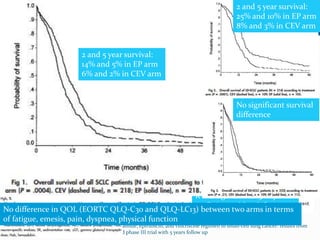
Total 436 patients randomized to chemotherapy with EP(n=218) or CEV(n=218)
The primary endpoint was overall survivalEP group received 5 # of cisplatin + etoposide
Cisplatin 75 mg/m2 and Etoposide 100 mg/m2 on Day 1
Etoposide 200 mg/m 2 on Day 2 to 4
CEV group received epirubicin 50mg/m2 ,
cyclophosphamide 1000 mg/m2 and vincristine 1mg/m2
RT was given with 3rd cycle
42 Gy/15 # with 2.8 Gy once
daily
2 and 5 year survival:
14% and 5% in EP arm
6% and 2% in CEV arm
2 and 5 year survival:
25% and 10% in EP arm
8% and 3% in CEV arm
No significant survival
difference
No difference in QOL (EORTC QLQ-C30 and QLQ-LC13) between two arms in terms
of fatigue, emesis, pain, dyspnea, physical function
Chemotherapy + Radiotherapy ?
• Two meta-analysis showed significant survival
advantage with addition of radiotherapy to
chemotherapy.
Pignon JP, Arriagada R, et al. A meta-analysis of thoracic radiotherapy for small-cell lung
cancer. N Engl J Med 1992 Dec 3;327(23): 1618-24
Warde P, Payne D. Does thoracic irradiation improve survival and local control in limited-
stage small –cell carcinoma of the lung? A meta-analysis
Meta-analysis of CT + RT
Pignon JP, Arriagada R, et al. A meta-analysis of thoracic radiotherapy for small-cell lung
cancer. N Engl J Med 1992 Dec 3;327(23): 1618-24
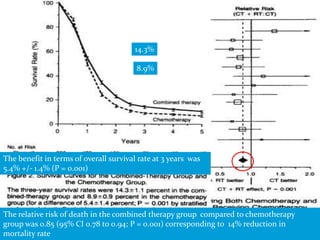
13 randomized trials comparing CTRT and CT conducted before December 1988
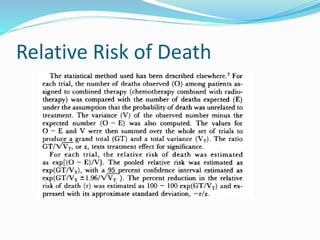
The relative risk of death in the combined therapy group compared to chemotherapy
group was 0.85 (95% CI 0.78 to 0.94; P = 0.001) corresponding to 14% reduction in
mortality rate
The benefit in terms of overall survival rate at 3 years was
5.4% +/- 1.4% (P = 0.001)
14.3%
8.9%
Meta-analysis of CT + RT
Warde P, Payne D. Does thoracic irradiation improve survival and local control in limited-
stage small –cell carcinoma of the lung? A meta-analysis
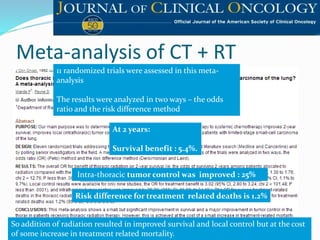
11 randomized trials were assessed in this meta-
analysis
The results were analyzed in two ways – the odds
ratio and the risk difference method
At 2 years:
Survival benefit : 5.4%.
Intra-thoracic tumor control was improved : 25%
Risk difference for treatment related deaths is 1.2%
So addition of radiation resulted in improved survival and local control but at the cost
of some increase in treatment related mortality.
Radiochemotherapy
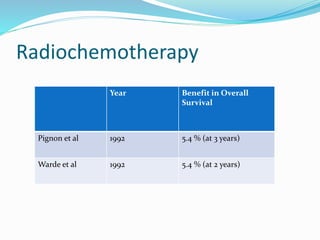
Year Benefit in Overall
Survival
Pignon et al 1992 5.4 % (at 3 years)
Warde et al 1992 5.4 % (at 2 years)
CTRT as the primary treatment
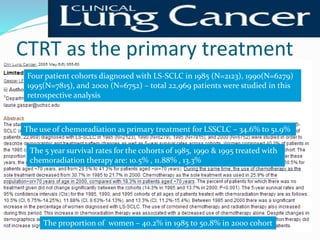
Four patient cohorts diagnosed with LS-SCLC in 1985 (N=2123), 1990(N=6279)
1995(N=7815), and 2000 (N=6752) – total 22,969 patients were studied in this
retrospective analysis
The proportion of women – 40.2% in 1985 to 50.8% in 2000 cohort
The use of chemoradiation as primary treatment for LSSCLC – 34.6% to 51.9%
The 5 year survival rates for the cohorts of 1985, 1990 & 1995 treated with
chemoradiation therapy are: 10.5% , 11.88% , 13.3%
Timing of Radiotherapy
 Sequential vs concurrent
 With early (1st cycle / 2nd cycle) vs late (3rd or 4th cycle) Concurrent RT
De Ruysscher, D., Pijls-Johannesma, M., Bentzen, and others, (2006). Time between the first
day of chemotherapy and the last day of chest radiation is the most important predictor of
survival in limited-disease small-cell lung cancer. Journal of Clinical Oncology, 24(7), pp.1057--
1063.
Fried, D., Morris, D., Poole, C., (2004). Systematic review evaluating the timing of thoracic
radiation therapy in combined modality therapy for limited-stage small-cell lung
cancer. Journal of clinical oncology, 22(23), pp.4837--4845.
Pijls-Johannesma, M., De Ruysscher, D., Lambin, P., Houben, R., Rutten, I. and Vansteenkiste,
J. (2004). Early versus late chest radiotherapy in patients with limited stage small cell lung
cancer. Cochrane Database of Systematic Reviews, (4).
Sequential or Concurrent RT
Takada M, Fukuoka M, et al. Phase III study of concurrent versus sequential radiotherapy in
combination with cisplatin and etoposide for limited-stage small-cell lung cancer: results of the
Japan Clinical Oncology Group Study 9104. J Clin Oncol 2002 Jul 15,20(14):3054-60
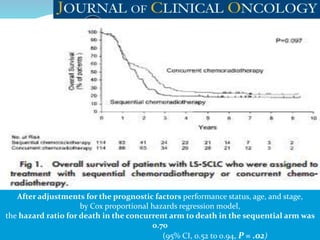
Phase III randomized controlled trial from Japan with 231 patients of LS-SCLC
Thoracic RT consisted of 45 Gy in 3 weeks (1.5Gy BD)
Randomly assigned to sequential (3 weekly) or concurrent (4 weekly) chemotherapy
4 cycles of cisplatin and etoposide
Log rank test (p=0.097) Concurrent Sequential
Median Survival time 27.2 months 19.7 months
5 year survival 23.7 % 18.3%
After adjustments for the prognostic factors performance status, age, and stage,
by Cox proportional hazards regression model,
the hazard ratio for death in the concurrent arm to death in the sequential arm was
0.70
(95% CI, 0.52 to 0.94, P = .02)
Early versus late concurrent RT
Fried, D., Morris, D., Poole, C., (2004). Systematic review evaluating the timing of thoracic
radiation therapy in combined modality therapy for limited-stage small-cell lung
cancer. Journal of clinical oncology, 22(23), pp.4837--4845.
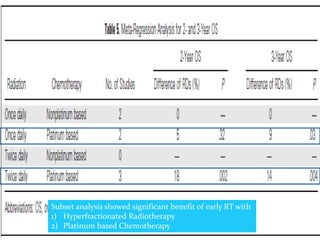
Meta-analysis of seven trials published after 1985 comparing Early RT vs Late RT.
The results were analyzed by risk ratio of survival.CVV
Early RT was defined as beginning before 9 weeks of initiation of CT or
before 3rd cycle of CT
Late RT was defined as beginning 9 weeks or more after initiation of CT or
after beginning 3rd cycle of CT
Overall survival Risk Ratios for all studies were 1.17 at 2 years and
1.13 at 3 years indicating a significantly increased survival for ERT versus LRT.
Subset analysis showed significant benefit of early RT with
1) Hyperfractionated Radiotherapy
2) Platinum based Chemotherapy
Timing between start of chemotherapy
and end of Radiation (SER)
De Ruysscher, D., Pijls-Johannesma, M., Bentzen, and others, (2006). Time between the first day of
chemotherapy and the last day of chest radiation is the most important predictor of survival in
limited-disease small-cell lung cancer. Journal of Clinical Oncology, 24(7), pp.1057--1063.
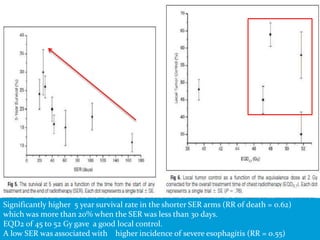
Four phase III trials
Role of SER – time from the start of any treatment until the end of radiotherapy
- local tumor control
- survival
- esophagitis.
Significantly higher 5 year survival rate in the shorter SER arms (RR of death = 0.62)
which was more than 20% when the SER was less than 30 days.
EQD2 of 45 to 52 Gy gave a good local control.
A low SER was associated with higher incidence of severe esophagitis (RR = 0.55)
Treatment for LS-SCLC
 Concurrent Radiochemotherapy
 4 cycles of cisplatin + etoposide given at 4 weekly
intervals.
 Ideally radiotherapy started with 1st cycle.
 Starting with 2nd cycle is pragmatic.
American College of Radiology; ACR Appropriateness Criteria - Radiation therapy for small
cell lung cancer.
The NCCN clinical Practice Guidelines in Oncologgy Small Cell Lung Cancer V.1.201
De Ruysscher, D., Pijls-Johannesma, M., Bentzen, and others, (2006). Time between the first
day of chemotherapy and the last day of chest radiation is the most important predictor of
survival in limited-disease small-cell lung cancer. Journal of Clinical Oncology, 24(7),
pp.1057--1063.
Fried, D., Morris, D., Poole, C., (2004). Systematic review evaluating the timing of thoracic
radiation therapy in combined modality therapy for limited-stage small-cell lung
cancer. Journal of clinical oncology, 22(23), pp.4837--4845.
Pijls-Johannesma, M., De Ruysscher, D., Lambin, P., Houben, R., Rutten, I. and
Vansteenkiste, J. (2004). Early versus late chest radiotherapy in patients with limited stage
small cell lung cancer. Cochrane Database of Systematic Reviews, (4).
Dose and fractionation of
Radiotherapy
 “Usually presents as small primary with large nodal burden”.
 45 -50.4 Gy in conventional fractionation (QD)
 50% locoregional failure with above dose in QD fractionation.
Langer C, Swann S, Werner-Wasik M,et al. Phase I studyof Irinotecan (Ir) and cisplatin (DDP)
in combination with thoracic radiotherapy (RT), either twice daily (45 Gy) or once daily (70 Gy),
in patients with limited (Ltd) small cell lung carcinoma (SCLC): Early analysis of RTOG 0241.
ASCO meeting abstracts. 2006;21(24): 4553-4559
Movsas B. Moughan J, Komaki R, et al. Radiotherapy patterns of care study in lung carcinoma. J
Clin Oncol. 2003; 21(24):4553-4559
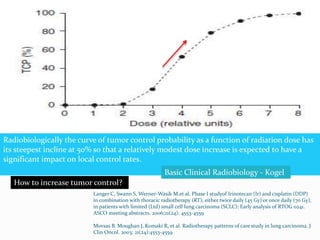
Radiobiologically the curve of tumor control probability as a function of radiation dose has
its steepest incline at 50% so that a relatively modest dose increase is expected to have a
significant impact on local control rates.
Basic Clinical Radiobiology - Kogel
How to increase tumor control?
Hyperfractionation – Intergroup 0096
 Reduced overall treatment time - Prevents accelerated repopulation.
 45 Gy in 1.5 Gy twice daily fractions (BID) - recommended regimen
Turrisi AT, Kim K, Blum R, et al. Twice-daily compared with once-daily thoracic radiotherapy in
limited small-cell lung cancer treated concurrently with cisplatin and etoposide. N Engl J Med.
1999;340(4):265-271
Choi, N., Herndon, J., Rosenman, J., Carey, R., Chung, C., Bernard, S., Leone, L., Seagren, S. and
Green, M. (1998). Phase I study to determine the maximum-tolerated dose of radiation in
standard daily and hyperfractionated-accelerated twice-daily radiation schedules with
concurrent chemotherapy for limited-stage small-cell lung cancer. Journal of clinical oncology,
16(11), pp.3528--3536.
Hyperfractionation
Turrisi AT, Kim K, Blum R, et al. Twice-daily compared with once-daily thoracic radiotherapy in
limited small-cell lung cancer treated concurrently with cisplatin and etoposide. N Engl J Med.
1999;340(4):265-271
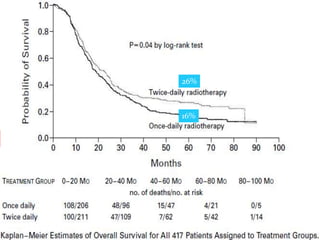
Randomized controlled trial
n=417 patients with LS-SCLC
Primary endpoint was overall survival
4# of 3 weekly cisplatin plus etoposide
Randomly assigned these patients to receive a total of 45 Gy of concurrent thoracic
radiotherapy
-Twice daily over 3 weeks
-Once daily over 5 weeks
26%
16%
Increasing Total Dose
 Arriagada et al (1991) – No difference in Local
control or Survival between 45 Gy – 65 Gy
 Various single institution studies and Phase 1 and
Phase 2 studies done in 2000’s have shown the
feasibility of increasing the total dose to more than
50 Gy with conventional fractionation and the
improvement in local control and survival.
Miller KL,Marks LB, Sibley GS, et al. Routine use of approximately 60 Gy once-daily thoracic
irradiation for patients with limited-stag small-cell lung cancer. Int J Radiat Oncol Biol Phys.
2003;56(2):355-359
Roof KS, Fidias P, et al. Radiation dose escalation in limited-stage small-cell lung cancer. Int J
Radiat Oncol Biol Phys. 2004;59(2): 460-468
Arriagada R, Bergman B, Dunant A, et al. Cisplatin-based adjuvant chemotherapy in patients with
completely resected non-small-cell lung cancer. N Engl J Med 2004;350:351-360.
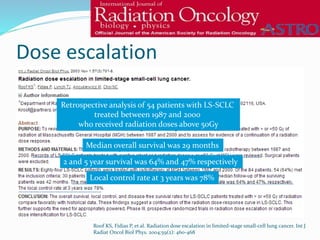
Dose escalation
Roof KS, Fidias P, et al. Radiation dose escalation in limited-stage small-cell lung cancer. Int J
Radiat Oncol Biol Phys. 2004;59(2): 460-468
Retrospective analysis of 54 patients with LS-SCLC
treated between 1987 and 2000
who received radiation doses above 50Gy
Median overall survival was 29 months
2 and 5 year survival was 64% and 47% respectively
Local control rate at 3 years was 78%
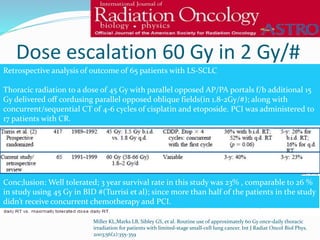
Dose escalation 60 Gy in 2 Gy/#
Miller KL,Marks LB, Sibley GS, et al. Routine use of approximately 60 Gy once-daily thoracic
irradiation for patients with limited-stage small-cell lung cancer. Int J Radiat Oncol Biol Phys.
2003;56(2):355-359
Retrospective analysis of outcome of 65 patients with LS-SCLC
Thoracic radiation to a dose of 45 Gy with parallel opposed AP/PA portals f/b additional 15
Gy delivered off cordusing parallel opposed oblique fields(in 1.8-2Gy/#); along with
concurrent/sequential CT of 4-6 cycles of cisplatin and etoposide. PCI was administered to
17 patients with CR.
The 3-year actuarial rate of
local failure – 40%
progression-free survival – 25%
overall survival – 23%
One case of grade 3 acute esophagitis
Late complications : 4 pulmonary, 3 esophageal, 2 infectious, 1 leukemia and 1 retinal
toxicity with PCI.
Conc;lusion: Well tolerated; 3 year survival rate in this study was 23% , comparable to 26 %
in study using 45 Gy in BID #(Turrisi et al); since more than half of the patients in the study
didn’t receive concurrent chemotherapy and PCI.
Maximum tolerated dose
Choi, N., Herndon, J., Rosenman, J., Carey, R., Chung, C., Bernard, S., Leone, L., Seagren, S. and Green, M. (1998).
Phase I study to determine the maximum-tolerated dose of radiation in standard daily and hyperfractionated-
accelerated twice-daily radiation schedules with concurrent chemotherapy for limited-stage small-cell lung
cancer. Journal of clinical oncology, 16(11), pp.3528--3536.
Phase 1 study
To determine Maximum Tolerated Dose
in standard daily and HA twice daily RT schedules
Study design: Sequential dose
escalation of 7% to 11% to
subsequent cohort, with RT dose to
initial volume kept at 40 to 40.5 Gy
Chemotherapy included 3 cycles of
cisplatin, cyclophosphamide,
etoposide
f/b 2 cycles of cisplatin-etoposide
RT was started along with
4th cycle of chemotherapy
The MTD was defined as the radiation dose level at one cohort below that which
resulted in more than 33% of patients experiencing > or = grade 4 esophagitis or
> or = grade 4 pulmonary toxicity
- 45 Gy in 30 fractions over 3 weeks,
- 70 Gy in 35 fractions over 7 weeks
(Phase II)
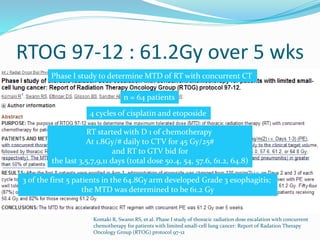
RTOG 97-12 : 61.2Gy over 5 wks
Komaki R, Swann RS, et al. Phase I study of thoracic radiation dose escalation with concurrent
chemotherapy for patients with limited small-cell lung cancer: Report of Radation Therapy
Oncology Group (RTOG) protocol 97-12
Phase I study to determine MTD of RT with concurrent CT
n = 64 patients
4 cycles of cisplatin and etoposide
RT started with D 1 of chemotherapy
At 1.8Gy/# daily to CTV for 45 Gy/25#
and RT to GTV bid for
the last 3,5,7,9,11 days (total dose 50.4, 54, 57.6, 61.2, 64.8)
3 of the first 5 patients in the 64.8Gy arm developed Grade 3 esophagitis;
the MTD was determined to be 61.2 Gy
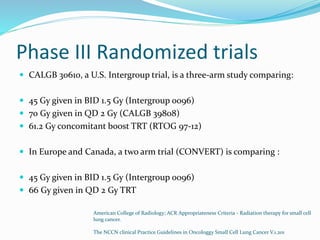
Phase III Randomized trials
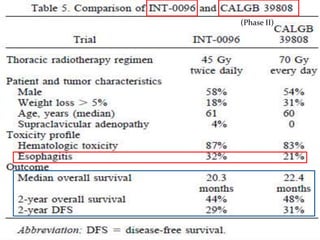
 CALGB 30610, a U.S. Intergroup trial, is a three-arm study comparing:
 45 Gy given in BID 1.5 Gy (Intergroup 0096)
 70 Gy given in QD 2 Gy (CALGB 39808)
 61.2 Gy concomitant boost TRT (RTOG 97-12)
 In Europe and Canada, a two arm trial (CONVERT) is comparing :
 45 Gy given in BID 1.5 Gy (Intergroup 0096)
 66 Gy given in QD 2 Gy TRT
American College of Radiology; ACR Appropriateness Criteria - Radiation therapy for small cell
lung cancer.
The NCCN clinical Practice Guidelines in Oncologgy Small Cell Lung Cancer V.1.201
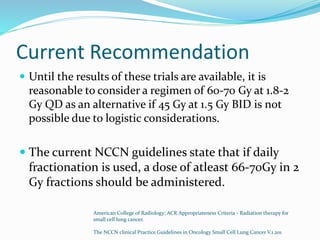
Current Recommendation
 Until the results of these trials are available, it is
reasonable to consider a regimen of 60-70 Gy at 1.8-2
Gy QD as an alternative if 45 Gy at 1.5 Gy BID is not
possible due to logistic considerations.
 The current NCCN guidelines state that if daily
fractionation is used, a dose of atleast 66-70Gy in 2
Gy fractions should be administered.
American College of Radiology; ACR Appropriateness Criteria - Radiation therapy for
small cell lung cancer.
The NCCN clinical Practice Guidelines in Oncology Small Cell Lung Cancer V.1.201
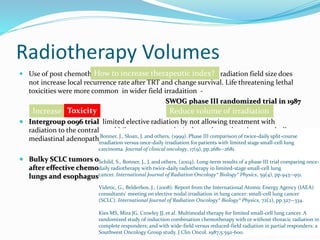
Radiotherapy Volumes
 Use of post chemotherapy volumes, with an associated smaller radiation field size does
not increase local recurrence rate after TRT and change survival. Life threatening lethal
toxicities were more common in wider field irradaition -
SWOG phase III randomized trial in 1987
 Intergroup 0096 trial limited elective radiation by not allowing treatment with
radiation to the contralateral hilum or to supraclavicular nodes, unless there was bulky
mediastinal adenopathy.
 Bulky SCLC tumors often require large radiation field size that can be reduced
after effective chemotherapy shrinks the tumor, potentially reducing toxicity to
lungs and esophagus.
Bonner, J., Sloan, J. and others, (1999). Phase III comparison of twice-daily split-course
irradiation versus once-daily irradiation for patients with limited stage small-cell lung
carcinoma. Journal of clinical oncology, 17(9), pp.2681--2681.
Schild, S., Bonner, J., J. and others, (2004). Long-term results of a phase III trial comparing once-
daily radiotherapy with twice-daily radiotherapy in limited-stage small-cell lung
cancer. International Journal of Radiation Oncology* Biology* Physics, 59(4), pp.943--951.
Videtic, G., Belderbos, J., (2008). Report from the International Atomic Energy Agency (IAEA)
consultants' meeting on elective nodal irradiation in lung cancer: small-cell lung cancer
(SCLC). International Journal of Radiation Oncology* Biology* Physics, 72(2), pp.327--334.
Kies MS, Mira JG, Crowley JJ, et al. Multimodal therapy for limited small-cell lung cancer. A
randomized study of induction combination chemotherapy with or without thoracic radiation in
complete responders; and with wide-field versus reduced-field radiation in partial responders: a
Southwest Oncology Group study. J Clin Oncol. 1987;5:592-600.
How to increase therapeutic index?
Increase total doseToxicity Reduce volume of irradiation
Post-chemotherapy volume
Hu X, Bao Y, et al. Omitting elective nodal irradiation and irradiating postinduction versus
preinduction chemotherapy tumor extent for limited-stage small cell lung cancer: interim
analysis of a prospective randomized noninferiority trial. Cancer. 2012 Jan 1;118(1):278-87
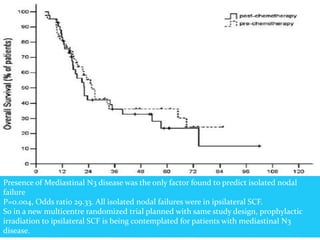
Prospective Randomized non inferiority trial to compare PFS and OS between LS-SCLC
patients who received thoracic radiotherapy to different target volumes.
CT – 6 cycles of etoposide and cisplatin
After 2 cycles patients(n= 42 and 43) were randomized to receive RT to pre chemotherapy or
post chemotherapy volume
RT started with cycle 3 of CT
Local recurrence rates : POST CHEMO – 31.6% ; PRE CHEMO – 28.6% (P = 0.81)
3 year overall survival rates : POST CHEMO – 36.2% ; PRE CHEMO – 36.4% (P = 0.54)
Presence of Mediastinal N3 disease was the only factor found to predict isolated nodal
failure
P=0.004, Odds ratio 29.33. All isolated nodal failures were in ipsilateral SCF.
So in a new multicentre randomized trial planned with same study design, prophylactic
irradiation to ipsilateral SCF is being contemplated for patients with mediastinal N3
disease.
Role of Surgery in residual or very
early LS-SCLC
 Not suitable as an upfront treatment modality
 Residual disease ??
 Very Early disease ??
Shepherd FA, Ewans WK, et al. Adjuvant chemotherapy following surgical resection in small-
cell carcinoma of the lung. J Clin Oncol 1988 May;6(5):832-8
Shields, T., Higgins Jr, G., Matthews, M. and Keehn, R. (1982). Surgical resection in the
management of small cell carcinoma of the lung. The Journal of thoracic and cardiovascular
surgery, 84(4), pp.481--488.
Mentzer, S., Reilly, J. and Sugarbaker, D. (1993). Surgical resection in the management of small-
cell carcinoma of the lung. CHEST Journal, 103(4_Supplement), pp.349--351.
OHTA, M., HARA, N., ICHINOSE, Y., MOTOHIRO, A., TAKEO, S. and MIYAKE, J. (1986). The
role of surgical resection in the management of small cell carcinoma of the lung. Japanese
journal of clinical oncology, 16(3), pp.289--296.
Surgery for Residual Disease?
Thomas Lad, Steven Piantadosi. A prospective randomized trial to determine the benefit of
surgical resection of residual disease following response of Small cell lung cancer to combination
chemotherapy. Chest. 1994 Dec;106(6 Suppl):320S-323S
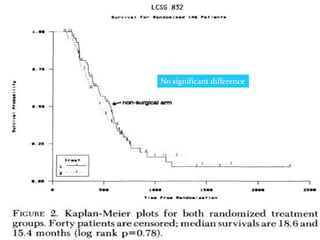
LCSG 832, ECOG 5585, and EORTC 08845.
Large prospective trial ; accrual – 1983 to 1989
To evaluate surgical treatment in patients responding to chemoradiotherapy
328
217
No significant difference
Surgery in very early LSCLC
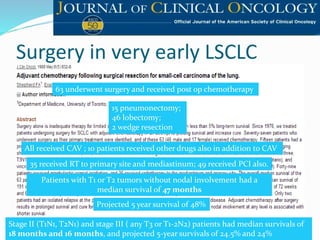
Shepherd FA, Ewans WK, et al. Adjuvant chemotherapy following surgical resection in small-
cell carcinoma of the lung. J Clin Oncol 1988 May;6(5):832-8
63 underwent surgery and received post op chemotherapy
15 pneumonectomy;
46 lobectomy;
2 wedge resection
All received CAV ; 10 patients received other drugs also in addition to CAV
35 received RT to primary site and mediastinum; 49 received PCI also.
Patients with T1 or T2 tumors without nodal involvement had a
median survival of 47 months
Projected 5 year survival of 48%
Stage II (T1N1, T2N1) and stage III ( any T3 or T1-2N2) patients had median survivals of
18 months and 16 months, and projected 5-year survivals of 24.5% and 24%
Role of Prophylactic Cranial
Irradiation
 About 50 % of isolated metastsis in SCLC is found in brain.
 The rate of brain metastasis is significantly reduced by PCI, also
increasing the overall survival rate.
Hirsch FR, Paulson OB, Hansen HH, Vraa-Jensen J. Intracranial metastases in small cell
carcinoma of the lung: correlation of clinical and autopsy findings. Cancer 1982;50:2433-7
Arriagada R, Le Chevalier T., et al. Prophylactic cranial irradiation for patients with small-cell
lung cancer in complete remission. J Natl Cancer Inst. 1995;87(3):183-190.
Gregor A, Cull A, et al. Prophylactic cranial irradiation is indicated following complete response
to induction therapy in small cell lung cancer: results of a multi centre randomised trial.
UKCCCR and EORT. Eur J Cancer. 1997;33(11):1752-1758
Auperin A, Arriagada R, Pignon JP, et al. Prophylacitc cranial irradiation for patients with small-
cell lung cancer in complete remission. Prophylactic Cranial Irradiation Overview Collaborative
Group. N Engl J Med. 1999;341(7):476-484
Le Pechoux C, Dunant A, Senan S, et al. Standard-dose versus higher-dose prophylactic cranial
irradaiation(PCI) in patients with limited-stage small-cell lung cancer in complete remission
after chemotherapy and thoracic radiotherapy (PCI 99-01, EORTC 22003-08004, RTOG 0212, and
IFCT 99-01): a randomised clinical trial. Lancet Oncol. 2009;10(5):467-474.
Prophylactic Cranial Irradiation ??
Arriagada R, Le Chevalier T., et al. Prophylactic cranial irradiation for patients with small-cell
lung cancer in complete remission. J Natl Cancer Inst. 1995;87(3):183-190.
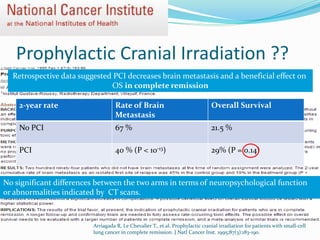
Retrospective data suggested PCI decreases brain metastasis and a beneficial effect on
OS in complete remission
Prospective randomized trial of 300 patients
Treatment group – received PCI 24 Gy/8#/12 days
Control group – no PCI
No significant differences between the two arms in terms of neuropsychological function
or abnormalities indicated by CT scans.
2-year rate Rate of Brain
Metastasis
Overall Survival
No PCI 67 % 21.5 %
PCI 40 % (P < 10-13) 29% (P = 0.14)
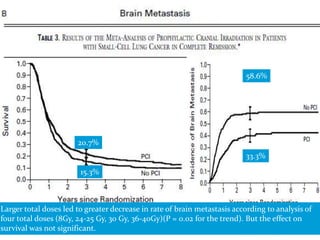
Meta analysis to determine whether PCI prolongs survival
Prophylactic Cranial Irradiation
Auperin A, Arriagada R, Pignon JP, et al. Prophylacitc cranial irradiation for patients with
small-cell lung cancer in complete remission. Prophylactic Cranial Irradiation Overview
Collaborative Group. N Engl J Med. 1999;341(7):476-484
Larger total doses led to greater decrease in rate of brain metastasis according to analysis of
four total doses (8Gy, 24-25 Gy, 30 Gy, 36-40Gy)(P = 0.02 for the trend). But the effect on
survival was not significant.
20.7%
15.3%
58.6%
33.3%
Prophylactic Cranial Irradiation –
Dose rates
Le Pechoux C, Dunant A, Senan S, et al. Standard-dose versus higher-dose prophylactic
cranial irradaiation(PCI) in patients with limited-stage small-cell lung cancer in complete
remission after chemotherapy and thoracic radiotherapy (PCI 99-01, EORTC 22003-08004,
RTOG 0212, and IFCT 99-01): a randomised clinical trial. Lancet Oncol. 2009;10(5):467-474.
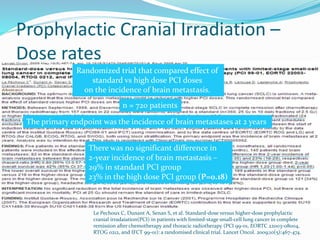
Randomized trial that compared effect of
standard vs high dose PCI doses
on the incidence of brain metastasis.
The primary endpoint was the incidence of brain metastases at 2 years
n = 720 patients
There was no significant difference in
2-year incidence of brain metastasis –
29% in standard PCI group
23% in the high dose PCI group (P=0.18)
Treatment of ES-SCLC
 The ratio of LS-SCLC to ES-SCLC was formerly 1:1 and is now 1:3
 Improvements in Staging
 Improvement in Imaging techniques
 Pleural effusion, cytology positive or not is considered now to be extensive
stage.
 Cisplatin + Etoposide chemotherapy remains the mainstay of treatment.
Spira A, Ettinger DS. Extensive-stage small-cell lung cancer. Semin Surg Oncol. 2003; 21(2):164-175
Treatment of ES-SCLC
 Response rates of 70 – 85 %
 Complete response rates of 20 – 30 %
 Standard of care in U.S has been to use the EP combination for 4 cycles since
the 1980s.
 Carboplatin may be substituted for cisplatin without an apparent loss of effect
and is preferred in older patients or those with renal insufficiency.
 But virtually every patient relapses , with median disease free survival of 4-5
months.
 Trials have shown no increase in survival with further maintenance therapy.
Evans WK, Shepherd FA, et al. VP-16 and cisplatin as first-line therapy for small-cell lung
cancer. N Engl J Med. 2002;346(2):85-91
Okamoto H, Watanabe K. Kunikane H, et al. Randomized Phase III trial of carboplatin plus
etoposide vs split doses of cisplatin plus etoposide in elderly or poor risk patients with extensive
disease small-cell lung cancer: JCOG9702. J Clin Oncol(Meeting Abstracts). 2005;23(16_suppl)
Chemotherapy
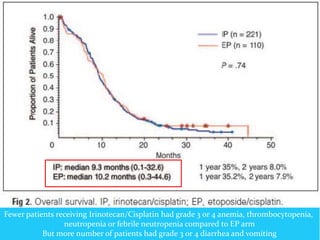
Chemotherapy in ES-SCLC
Hanna N, Bunn PA Jr, et al. Randomized Phase III trial comparing irinotecan/cisplatin with
etoposide/cisplatin in patients with previously untreated extensive-stage disease small-cell lung
cancer. J Clin Oncol 2006 May 1;24(13):2038-43
Fewer patients receiving Irinotecan/Cisplatin had grade 3 or 4 anemia, thrombocytopenia,
neutropenia or febrile neutropenia compared to EP arm
But more number of patients had grade 3 or 4 diarrhea and vomiting
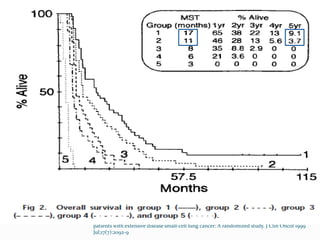
Radiotherapy in subset of ES-SCLC
Jeremic B, Shibamoto Y, et al. Role of radiation therapy in the combined –modality treatment of
patients with extensive disease small-cell lung cancer: A randomized study. J Clin Oncol 1999
Jul;17(7):2092-9
PCI in ES-SCLC
 Although routine use of TRT to treat ES-SCLC should not yet be integrated
into standard care of patients.
 There is more convincing evidence for offering PCI to patients with ES-SCLC
who responded to chemotherapy.
 Landmark trial in 2007 by EORTC
Slotman B, Faivre-Finn C, Kramer G, et al. Prophylactic cranial irradiation in extensive
small-cell lung cancer. N Engl J Med. 2007;357(7)
Slotman BJ, Mauer ME, Bottomley A, et al. Prophylactic cranial irradiation in extensive
disease small-cell lung cancer: short-term health-related quality of life and patient reported
symptoms: results of an international Phase III randomized trial by the EORTC Radiation
Oncology and Lung Cancer Groups
PCI in ES-SCLC
Slotman B, Faivre-Finn C, Kramer G, et al. Prophylactic cranial irradiation in extensive
small-cell lung cancer. N Engl J Med. 2007;357(7)
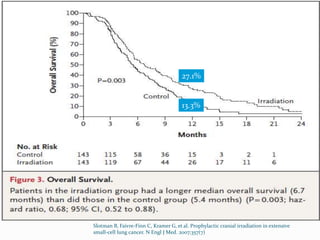
Randomized trial by Slotman et al in VU University Medical centre, Amsterdam
Patients with ES-SCLC responding to chemotherapywere randomly assigned to
undergo PCI or not
Primary end point was the time to symptomatic brain metastasis14.6%
40.4%27.1%
13.3%
Prophylactic Cranial Irradiation
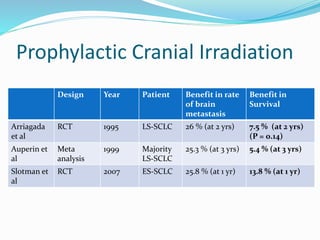
Design Year Patient Benefit in rate
of brain
metastasis
Benefit in
Survival
Arriagada
et al
RCT 1995 LS-SCLC 26 % (at 2 yrs) 7.5 % (at 2 yrs)
(P = 0.14)
Auperin et
al
Meta
analysis
1999 Majority
LS-SCLC
25.3 % (at 3 yrs) 5.4 % (at 3 yrs)
Slotman et
al
RCT 2007 ES-SCLC 25.8 % (at 1 yr) 13.8 % (at 1 yr)
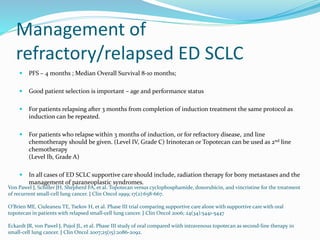
Management of
refractory/relapsed ED SCLC
 PFS – 4 months ; Median Overall Survival 8-10 months;
 Good patient selection is important – age and performance status
 For patients relapsing after 3 months from completion of induction treatment the same protocol as
induction can be repeated.
 For patients who relapse within 3 months of induction, or for refractory disease, 2nd line
chemotherapy should be given. (Level IV, Grade C) Irinotecan or Topotecan can be used as 2nd line
chemotherapy
(Level Ib, Grade A)
 In all cases of ED SCLC supportive care should include, radiation therapy for bony metastases and the
management of paraneoplastic syndromes.
Von Pawel J, Schiller JH, Shepherd FA, et al. Topotecan versus cyclophosphamide, doxorubicin, and vincristine for the treatment
of recurrent small-cell lung cancer. J Clin Oncol 1999; 17(2):658-667.
O’Brien ME, Ciuleaneu TE, Tsekov H, et al. Phase III trial comparing supportive care alone with supportive care with oral
topotecan in patients with relapsed small-cell lung cancer. J Clin Oncol 2006; 24(34):5441-5447
Eckardt JR, von Pawel J, Pujol JL, et al. Phase III study of oral compared wiith intravenous topotecan as second-line therapy in
small-cell lung cancer. J Clin Oncol 2007;25(15):2086-2092.
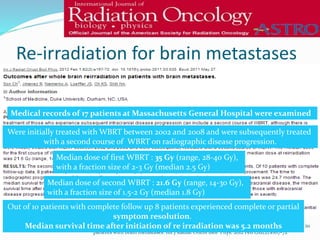
Re-irradiation for brain metastases
Son CH, Jimenez R, Niemierko A, Loeffler JS, et al. Outcomes after whole brain reirradiation in
patients with brain metastases. Int J Radiat Oncol Biol Phys. 2012 Feb 1;82(2):e167-72
Medical records of 17 patients at Massachusetts General Hospital were examined
Were initially treated with WBRT between 2002 and 2008 and were subsequently treated
with a second course of WBRT on radiographic disease progression.
Median dose of first WBRT : 35 Gy (range, 28-40 Gy),
with a fraction size of 2-3 Gy (median 2.5 Gy)
Median dose of second WBRT : 21.6 Gy (range, 14-30 Gy),
with a fraction size of 1.5-2 Gy (median 1.8 Gy)
Out of 10 patients with complete follow up 8 patients experienced complete or partial
symptom resolution.
Median survival time after initiation of re irradiation was 5.2 months
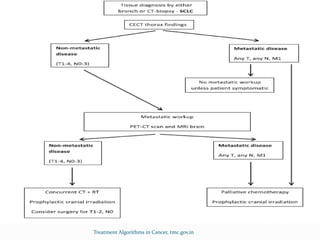
Treatment Algorithms in Cancer, tmc.gov.in
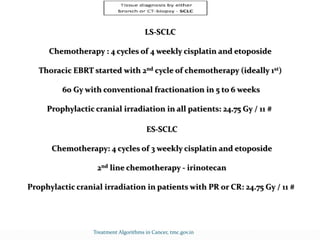
LS-SCLC
Chemotherapy : 4 cycles of 4 weekly cisplatin and etoposide
Thoracic EBRT started with 2nd cycle of chemotherapy (ideally 1st)
60 Gy with conventional fractionation in 5 to 6 weeks
Prophylactic cranial irradiation in all patients: 24.75 Gy / 11 #
ES-SCLC
Chemotherapy: 4 cycles of 3 weekly cisplatin and etoposide
2nd line chemotherapy - irinotecan
Prophylactic cranial irradiation in patients with PR or CR: 24.75 Gy / 11 #
Thank You
Dr. J.P. Agarwal
Dr. Shagun Mishra
Dr. Dipanjan Majumder
Dr. Lavanya Naidu
Dr. Anil Tibdewal
Dr. Rima Pathak
Dr. Arpita Bindal
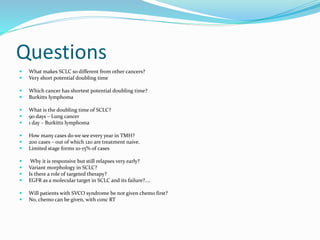
Questions
 What makes SCLC so different from other cancers?
 Very short potential doubling time
 Which cancer has shortest potential doubling time?
 Burkitts lymphoma
 What is the doubling time of SCLC?
 90 days – Lung cancer
 1 day – Burkitts lymphoma
 How many cases do we see every year in TMH?
 200 cases – out of which 120 are treatment naive.
 Limited stage forms 10-15% of cases
 Why it is responsive but still relapses very early?
 Variant morphology in SCLC?
 Is there a role of targeted therapy?
 EGFR as a molecular target in SCLC and its failure?....
 Will patients with SVCO syndrome be not given chemo first?
 No, chemo can be given, with conc RT
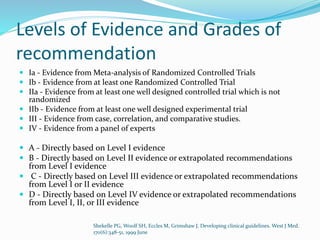
Levels of Evidence and Grades of
recommendation
 Ia - Evidence from Meta-analysis of Randomized Controlled Trials
 Ib - Evidence from at least one Randomized Controlled Trial
 IIa - Evidence from at least one well designed controlled trial which is not
randomized
 IIb - Evidence from at least one well designed experimental trial
 III - Evidence from case, correlation, and comparative studies.
 IV - Evidence from a panel of experts
 A - Directly based on Level I evidence
 B - Directly based on Level II evidence or extrapolated recommendations
from Level I evidence
 C - Directly based on Level III evidence or extrapolated recommendations
from Level I or II evidence
 D - Directly based on Level IV evidence or extrapolated recommendations
from Level I, II, or III evidence
Shekelle PG, Woolf SH, Eccles M, Grimshaw J. Developing clinical guidelines. West J Med.
170(6):348-51, 1999 June
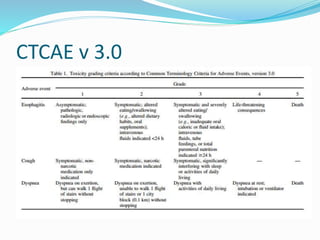
CTCAE v 3.0
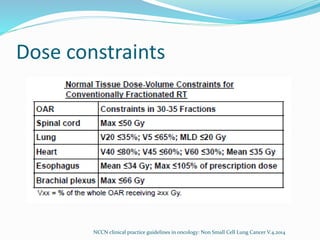
Dose constraints
NCCN clinical practice guidelines in oncology: Non Small Cell Lung Cancer V.4.2014
Relative Risk of Death

Small Cell Lung Cancer

  • 1.
    Dr. Ajay Sasidharan Dr.Dipanjan Majumder Tata Memorial Hospital
  • 2.
    Incidence of SCLC Incidence of Lung cancer – 1.8 million (12.9% cases of total)  Small cell lung cancer (a type of neuroendocrine tumor) : 15-20 % (approx 3.6 lakhs )  In Tata Memorial Hospital : 75 cases (2008)  Occurs in older patients: median age of 64  97% are smokers; 90% associated with heavy tobacco use. IARC GLOBOCAN 2012 Jemal A, Siegel R, Xu J, Ward E. Cancer Statistics, 2010. CA Cancer J Clin. 2010;60(5) :277-300 Travis WD. Pathology and Diagnosis of Neuroendocrine Tumors: Lung Neuroendocrine. Thorac Surg Clin. 2014 Aug;24(3):257-266. TMH Registry •Limited Stage SCLC : Median survival : 25 months 2YSR : 45 % 5YSR : 20 - 25 % •Extensive stage SCLC : Median survival : 9 months 2YSR : < 5 % 5YSR : < 1 % to 3 %
  • 3.
    Presentation of SCLC 90%–95% occur centrally  Arising in a lobar or main bronchus  Symptoms:  Dyspnea  Persistent cough  Hemoptysis  Postobstructive pneumonia Chong S, Lee KS, et al. Neuro endocrine tumors of the lung: clinical, pathologic and imaging findings.Radiographics. 2006Jan-Feb26(1):41-57. Bilateral enlargement at pulmonary hilumEnlarged Right hilar and Left Superior Mediastinal LN  The invasion of adjacent structures  Dysphagia  Hoarseness  Superior vena cava syndrome  Paraneoplastic syndromes
  • 4.
    Staging of SCLC Limited stage (30%) - Historically defined as disease confined in ipsilateral hemithorax that can be safely encompassed in tolerable radiation field. Includes contralateral hilar, mediastinal and supraclavicular nodes also  Extensive stage (70%) – Disease beyond above definition which may include malignant “pleural” or pericardial effusions or contralateral lung or extrathoracic metastasisArgiris A, Murren JR. Staging and clinical prognostic factors for small-cell lung cancer. Cancer J. 2001 Sep-Oct;7(5):437-47 Micke P, Faldum A Staging small cell lung cancer: Veterans Administration Lung Study Group versus International Association for the Study of Lung Cancer--what limits limited disease? Lung Cancer. 2002 Sep;37(3):271-6.
  • 5.
    Prognostic factors Albain KS,Crowley JJ, LeBlanc M, Livingston RB. Determinants of improved outcome in small- cell lung cancer: an analysis of the 2,580-patient Southwest Oncology Group data base.J Clin Oncol. 1990 Sep;8(9):1563-74. LS-SCLC Good PS Female sex Age < 70 White race Normal serum LDH Absence of Pleural effusion Concurrent CTRT ES-SCLC Normal serum LDH Treatment with intensive multidrug regimen Single metastatic site Retrospective analysis of 2580 patients from SWOG small –cell lung cancer data base from 1976-1988 to determine prognostic value of favourable demographic and tumor-related factors and therapy programs by using Cox multivariate analysis And define patient subgroups with significantly different survivals using RPA analysis. Cox multivariate analysis Recursive Partitioning Amalgamation Analysis Most important prognostic split was LS-SCLC/ES-SCLC Four prognostic subgroups – with median survival times of 19, 12.5, 10, 6.3 months The most important factors were Age, Pleural Effusion, LDH in LS-SCLC and only LDH in ES-SCLC Best survival was for true LD , no pleural effusion, and normal LDH; and worst survival was for true ED with elevated LDH
  • 6.
    Work Up ChestX-ray  Complete Blood Count, Renal Function tests, Liver Function tests, Serum Electrolytes  Pulmonary Function tests  CECT scan of thorax  Biopsy – Bronchoscopic or CT guided  PET-CT scan  MRI Brain Vansteenkiste JF. Imaging in lung cancer: positron emission tomography scan. Eur Respir J Suppl. 2002 Feb;35:49s-60s Bradley JD, Dehdashti F. et al. Positron emission tomography in limited-stage small-cell lung cancer: A prospective study. J Clin Oncol Biol Phys. 2004;22(16):3248-3254. Van Loon J, De Ruysscher D, Wanders R, et al. Selective nodal irradiation on basis of (18) FDG- PET scans in limited-disease small-cell lung cancer. Int J Radiat Oncol Biol Phys. 2010;77(2):329-336. Hirsch FR, Paulson OB, Hansen HH, Vraa-Jensen J. Intracranial metastases in small cell carcinoma of the lung: correlation of clinical and autopsy findings. Cancer 1982;50:2433-7.
  • 7.
    Role of PET-CTSCAN in SCLC Van Loon J, De Ruysscher D, Wanders R, et al. Selective nodal irradiation on basis of (18) FDG- PET scans in limited-disease small-cell lung cancer. Int J Radiat Oncol Biol Phys. 2010;77(2):329-336. A prospective study - 60 patients with LS- SCLC between 2004 and 2006 – to evaluate the results of PET CT based nodal irradiation on isolated nodal failure Pretreatment PET scan – primary tumor and mediastinal lymph nodes EBRT : 45 Gy in 1.5Gy BD with concurrent carboplatin and etoposide Post CTRT 3 months – CT scan, then every 6 months Median follow up: 18.5 +/- 10.3 months. 2 (3%) – isolated regional failure Median actuarial overall survival – 19 months Median actuarial progression free survival – 14 months Acute Grade 3 esophagitis – 12% Compared to their own prospective study of CT based – 11 % isolated regional failure All isolated nodal failures were in ipsilateral supraclavicular fossa 15% more nodal involvement in PET 13% more nodal involvement in CT scan
  • 8.
    Role of MRIBrain in SCLC Hirsch FR, Paulson OB, Hansen HH, Vraa-Jensen J. Intracranial metastases in small cell carcinoma of the lung: correlation of clinical and autopsy findings. Cancer 1982;50:2433-7. But 33% of the metastases were clinically “silent” 53% had lesions in posterior fossa; and gait disturbance was the presenting symptom in >50% An autopsy series: 87 patients who had died of small cell lung cancer were autopsied 44 of the 87 patients (50%) had brain metastases 10% of patients have brain metastasis at diagnosis Cumulative rate of brain metastasis at 2 years is 50%
  • 9.
    Treatment of SmallCell Lung Cancer  Role of Sugery in SCLC  Role of Radiotherapy and Chemotherapy  Timing of Radiotherapy in relation to Chemotherapy  Maximum Tolerated Dose  Role of Hyperfractionation  Prohylactic Cranial Irradiation
  • 10.
    Surgery for SCLC Till 1960’s surgery alone was the standard of care for all lung cancer.  But survival rates achieved were <1% at 5 years Fox W, Scadding JG. Medical Research Council comparative trial of surgery and radiotherapy for primary treatment of small-celled or oat celled carcinoma of bronchus. Ten year follow up. Lancet. 1973;2(7820):63-65 Thomas Lad, Steven Piantadosi. A prospective randomized trial to determine the benefit of surgical resection of residual diseasefollowing response of Small cell lung cancer to combination chemotherapy. Chest. 1994 Dec;106(6 Suppl):320S-323S Surgery Radiotherapy?
  • 11.
    Surgery vs Radiotherapy FoxW, Scadding JG. Medical Research Council comparative trial of surgery and radiotherapy for primary treatment of small-celled or oat celled carcinoma of bronchus. Ten year follow up. Lancet. 1973;2(7820):63-65 Fox et al comparative trial conducted in 1973 144 patients – 71 alocated to surgery and 73 to radical radiotherapy 5 year survival : 1% in surgery arm and 4% in radiotherapy arm 10 year survival : 0 in surgery arm and 4% in radiotherapy arm Mean Survival : 199 days in surgery series 300 days in radiotherapy series (p = 0.04)
  • 12.
    Role of Chemotherapyalone in LS- SCLC  Throughout 1960s and 70’s different combinations of chemotherapy had been tried as the sole treatment modality for SCLC  Two or three drug combinations.  Alternating cyclic chemotherapy using non cross resistant drugs.  The use of platinum based regimens. Cohen MH, Ihde DC, et al. Cyclic alternating combination chemotherapy for small cell bronchogenic carcinoma. Cancer Treat Rep. 1979;63(2): 163-170 Gaspar LE, Gay EG, Crawford J, Putnam JB, et al. Limited-stage small-cell lung cancer(stages I- III): observations from the National Cancer Data Base. Clin Lung Cancer. 2005;6(6):355-360 Chemotherapy?
  • 13.
    Chemotherapy as thetreatment Cohen MH, Ihde DC, et al. Cyclic alternating combination chemotherapy for small cell bronchogenic carcinoma. Cancer Treat Rep. 1979;63(2): 163-170 High dose Cyclophosphamide, Methotrexate, CCNU for 6 weeks Vincristine, Adriamycin, Procarbazine for 6 weeks Single institution Prospective study : Alternating combination chemotherapy with non cross resistant drugs in 61 patients Chemotherapy alone is not a standard option for LS-SCLC, even with a response rate as high as 74-80% local tumor progression occurs in upto 80% of such patients at 2-3 years and survival is poor. CR CAV CAV f/b VAP LS-SCLC 42 % 74 % ES-SCLC 24 % 36 %
  • 14.
    Cisplatin and Etoposide EvansWK et al. VP-16 and cisplatin as first line therapy for small-cell lung cancer. J Clin ncol 1985 Response rate(CR or PR) 86% Use of cisplatin and etoposide as induction chemotherapy in 31 patients The median survival time for responding LD patients was 17.5 months (range, 7 to 45 + mths) The median survival time for responding ED patients was 10.75 months (range, 4 to 17 mths)
  • 15.
    Cisplatin and Etoposide SundstromS, Bremnes RM, et al. Cisplatin and etoposide regimen is superior to cyclophosphamide, epirubicin, and vincristine regimen in small-cell lung cancer: results from a randomized phase III trial with 5 years follow up Phase III randomized controlled trial to establish with 5 years follo wp Total 436 patients randomized to chemotherapy with EP(n=218) or CEV(n=218) The primary endpoint was overall survivalEP group received 5 # of cisplatin + etoposide Cisplatin 75 mg/m2 and Etoposide 100 mg/m2 on Day 1 Etoposide 200 mg/m 2 on Day 2 to 4 CEV group received epirubicin 50mg/m2 , cyclophosphamide 1000 mg/m2 and vincristine 1mg/m2 RT was given with 3rd cycle 42 Gy/15 # with 2.8 Gy once daily 2 and 5 year survival: 14% and 5% in EP arm 6% and 2% in CEV arm 2 and 5 year survival: 25% and 10% in EP arm 8% and 3% in CEV arm No significant survival difference No difference in QOL (EORTC QLQ-C30 and QLQ-LC13) between two arms in terms of fatigue, emesis, pain, dyspnea, physical function
  • 16.
    Chemotherapy + Radiotherapy? • Two meta-analysis showed significant survival advantage with addition of radiotherapy to chemotherapy. Pignon JP, Arriagada R, et al. A meta-analysis of thoracic radiotherapy for small-cell lung cancer. N Engl J Med 1992 Dec 3;327(23): 1618-24 Warde P, Payne D. Does thoracic irradiation improve survival and local control in limited- stage small –cell carcinoma of the lung? A meta-analysis
  • 17.
    Meta-analysis of CT+ RT Pignon JP, Arriagada R, et al. A meta-analysis of thoracic radiotherapy for small-cell lung cancer. N Engl J Med 1992 Dec 3;327(23): 1618-24 13 randomized trials comparing CTRT and CT conducted before December 1988 The relative risk of death in the combined therapy group compared to chemotherapy group was 0.85 (95% CI 0.78 to 0.94; P = 0.001) corresponding to 14% reduction in mortality rate The benefit in terms of overall survival rate at 3 years was 5.4% +/- 1.4% (P = 0.001) 14.3% 8.9%
  • 18.
    Meta-analysis of CT+ RT Warde P, Payne D. Does thoracic irradiation improve survival and local control in limited- stage small –cell carcinoma of the lung? A meta-analysis 11 randomized trials were assessed in this meta- analysis The results were analyzed in two ways – the odds ratio and the risk difference method At 2 years: Survival benefit : 5.4%. Intra-thoracic tumor control was improved : 25% Risk difference for treatment related deaths is 1.2% So addition of radiation resulted in improved survival and local control but at the cost of some increase in treatment related mortality.
  • 19.
    Radiochemotherapy Year Benefit inOverall Survival Pignon et al 1992 5.4 % (at 3 years) Warde et al 1992 5.4 % (at 2 years)
  • 20.
    CTRT as theprimary treatment Four patient cohorts diagnosed with LS-SCLC in 1985 (N=2123), 1990(N=6279) 1995(N=7815), and 2000 (N=6752) – total 22,969 patients were studied in this retrospective analysis The proportion of women – 40.2% in 1985 to 50.8% in 2000 cohort The use of chemoradiation as primary treatment for LSSCLC – 34.6% to 51.9% The 5 year survival rates for the cohorts of 1985, 1990 & 1995 treated with chemoradiation therapy are: 10.5% , 11.88% , 13.3%
  • 21.
    Timing of Radiotherapy Sequential vs concurrent  With early (1st cycle / 2nd cycle) vs late (3rd or 4th cycle) Concurrent RT De Ruysscher, D., Pijls-Johannesma, M., Bentzen, and others, (2006). Time between the first day of chemotherapy and the last day of chest radiation is the most important predictor of survival in limited-disease small-cell lung cancer. Journal of Clinical Oncology, 24(7), pp.1057-- 1063. Fried, D., Morris, D., Poole, C., (2004). Systematic review evaluating the timing of thoracic radiation therapy in combined modality therapy for limited-stage small-cell lung cancer. Journal of clinical oncology, 22(23), pp.4837--4845. Pijls-Johannesma, M., De Ruysscher, D., Lambin, P., Houben, R., Rutten, I. and Vansteenkiste, J. (2004). Early versus late chest radiotherapy in patients with limited stage small cell lung cancer. Cochrane Database of Systematic Reviews, (4).
  • 22.
    Sequential or ConcurrentRT Takada M, Fukuoka M, et al. Phase III study of concurrent versus sequential radiotherapy in combination with cisplatin and etoposide for limited-stage small-cell lung cancer: results of the Japan Clinical Oncology Group Study 9104. J Clin Oncol 2002 Jul 15,20(14):3054-60 Phase III randomized controlled trial from Japan with 231 patients of LS-SCLC Thoracic RT consisted of 45 Gy in 3 weeks (1.5Gy BD) Randomly assigned to sequential (3 weekly) or concurrent (4 weekly) chemotherapy 4 cycles of cisplatin and etoposide Log rank test (p=0.097) Concurrent Sequential Median Survival time 27.2 months 19.7 months 5 year survival 23.7 % 18.3% After adjustments for the prognostic factors performance status, age, and stage, by Cox proportional hazards regression model, the hazard ratio for death in the concurrent arm to death in the sequential arm was 0.70 (95% CI, 0.52 to 0.94, P = .02)
  • 23.
    Early versus lateconcurrent RT Fried, D., Morris, D., Poole, C., (2004). Systematic review evaluating the timing of thoracic radiation therapy in combined modality therapy for limited-stage small-cell lung cancer. Journal of clinical oncology, 22(23), pp.4837--4845. Meta-analysis of seven trials published after 1985 comparing Early RT vs Late RT. The results were analyzed by risk ratio of survival.CVV Early RT was defined as beginning before 9 weeks of initiation of CT or before 3rd cycle of CT Late RT was defined as beginning 9 weeks or more after initiation of CT or after beginning 3rd cycle of CT Overall survival Risk Ratios for all studies were 1.17 at 2 years and 1.13 at 3 years indicating a significantly increased survival for ERT versus LRT. Subset analysis showed significant benefit of early RT with 1) Hyperfractionated Radiotherapy 2) Platinum based Chemotherapy
  • 24.
    Timing between startof chemotherapy and end of Radiation (SER) De Ruysscher, D., Pijls-Johannesma, M., Bentzen, and others, (2006). Time between the first day of chemotherapy and the last day of chest radiation is the most important predictor of survival in limited-disease small-cell lung cancer. Journal of Clinical Oncology, 24(7), pp.1057--1063. Four phase III trials Role of SER – time from the start of any treatment until the end of radiotherapy - local tumor control - survival - esophagitis. Significantly higher 5 year survival rate in the shorter SER arms (RR of death = 0.62) which was more than 20% when the SER was less than 30 days. EQD2 of 45 to 52 Gy gave a good local control. A low SER was associated with higher incidence of severe esophagitis (RR = 0.55)
  • 25.
    Treatment for LS-SCLC Concurrent Radiochemotherapy  4 cycles of cisplatin + etoposide given at 4 weekly intervals.  Ideally radiotherapy started with 1st cycle.  Starting with 2nd cycle is pragmatic. American College of Radiology; ACR Appropriateness Criteria - Radiation therapy for small cell lung cancer. The NCCN clinical Practice Guidelines in Oncologgy Small Cell Lung Cancer V.1.201 De Ruysscher, D., Pijls-Johannesma, M., Bentzen, and others, (2006). Time between the first day of chemotherapy and the last day of chest radiation is the most important predictor of survival in limited-disease small-cell lung cancer. Journal of Clinical Oncology, 24(7), pp.1057--1063. Fried, D., Morris, D., Poole, C., (2004). Systematic review evaluating the timing of thoracic radiation therapy in combined modality therapy for limited-stage small-cell lung cancer. Journal of clinical oncology, 22(23), pp.4837--4845. Pijls-Johannesma, M., De Ruysscher, D., Lambin, P., Houben, R., Rutten, I. and Vansteenkiste, J. (2004). Early versus late chest radiotherapy in patients with limited stage small cell lung cancer. Cochrane Database of Systematic Reviews, (4).
  • 26.
    Dose and fractionationof Radiotherapy  “Usually presents as small primary with large nodal burden”.  45 -50.4 Gy in conventional fractionation (QD)  50% locoregional failure with above dose in QD fractionation. Langer C, Swann S, Werner-Wasik M,et al. Phase I studyof Irinotecan (Ir) and cisplatin (DDP) in combination with thoracic radiotherapy (RT), either twice daily (45 Gy) or once daily (70 Gy), in patients with limited (Ltd) small cell lung carcinoma (SCLC): Early analysis of RTOG 0241. ASCO meeting abstracts. 2006;21(24): 4553-4559 Movsas B. Moughan J, Komaki R, et al. Radiotherapy patterns of care study in lung carcinoma. J Clin Oncol. 2003; 21(24):4553-4559 Radiobiologically the curve of tumor control probability as a function of radiation dose has its steepest incline at 50% so that a relatively modest dose increase is expected to have a significant impact on local control rates. Basic Clinical Radiobiology - Kogel How to increase tumor control?
  • 27.
    Hyperfractionation – Intergroup0096  Reduced overall treatment time - Prevents accelerated repopulation.  45 Gy in 1.5 Gy twice daily fractions (BID) - recommended regimen Turrisi AT, Kim K, Blum R, et al. Twice-daily compared with once-daily thoracic radiotherapy in limited small-cell lung cancer treated concurrently with cisplatin and etoposide. N Engl J Med. 1999;340(4):265-271 Choi, N., Herndon, J., Rosenman, J., Carey, R., Chung, C., Bernard, S., Leone, L., Seagren, S. and Green, M. (1998). Phase I study to determine the maximum-tolerated dose of radiation in standard daily and hyperfractionated-accelerated twice-daily radiation schedules with concurrent chemotherapy for limited-stage small-cell lung cancer. Journal of clinical oncology, 16(11), pp.3528--3536.
  • 28.
    Hyperfractionation Turrisi AT, KimK, Blum R, et al. Twice-daily compared with once-daily thoracic radiotherapy in limited small-cell lung cancer treated concurrently with cisplatin and etoposide. N Engl J Med. 1999;340(4):265-271 Randomized controlled trial n=417 patients with LS-SCLC Primary endpoint was overall survival 4# of 3 weekly cisplatin plus etoposide Randomly assigned these patients to receive a total of 45 Gy of concurrent thoracic radiotherapy -Twice daily over 3 weeks -Once daily over 5 weeks 26% 16%
  • 29.
    Increasing Total Dose Arriagada et al (1991) – No difference in Local control or Survival between 45 Gy – 65 Gy  Various single institution studies and Phase 1 and Phase 2 studies done in 2000’s have shown the feasibility of increasing the total dose to more than 50 Gy with conventional fractionation and the improvement in local control and survival. Miller KL,Marks LB, Sibley GS, et al. Routine use of approximately 60 Gy once-daily thoracic irradiation for patients with limited-stag small-cell lung cancer. Int J Radiat Oncol Biol Phys. 2003;56(2):355-359 Roof KS, Fidias P, et al. Radiation dose escalation in limited-stage small-cell lung cancer. Int J Radiat Oncol Biol Phys. 2004;59(2): 460-468 Arriagada R, Bergman B, Dunant A, et al. Cisplatin-based adjuvant chemotherapy in patients with completely resected non-small-cell lung cancer. N Engl J Med 2004;350:351-360.
  • 30.
    Dose escalation Roof KS,Fidias P, et al. Radiation dose escalation in limited-stage small-cell lung cancer. Int J Radiat Oncol Biol Phys. 2004;59(2): 460-468 Retrospective analysis of 54 patients with LS-SCLC treated between 1987 and 2000 who received radiation doses above 50Gy Median overall survival was 29 months 2 and 5 year survival was 64% and 47% respectively Local control rate at 3 years was 78%
  • 31.
    Dose escalation 60Gy in 2 Gy/# Miller KL,Marks LB, Sibley GS, et al. Routine use of approximately 60 Gy once-daily thoracic irradiation for patients with limited-stage small-cell lung cancer. Int J Radiat Oncol Biol Phys. 2003;56(2):355-359 Retrospective analysis of outcome of 65 patients with LS-SCLC Thoracic radiation to a dose of 45 Gy with parallel opposed AP/PA portals f/b additional 15 Gy delivered off cordusing parallel opposed oblique fields(in 1.8-2Gy/#); along with concurrent/sequential CT of 4-6 cycles of cisplatin and etoposide. PCI was administered to 17 patients with CR. The 3-year actuarial rate of local failure – 40% progression-free survival – 25% overall survival – 23% One case of grade 3 acute esophagitis Late complications : 4 pulmonary, 3 esophageal, 2 infectious, 1 leukemia and 1 retinal toxicity with PCI. Conc;lusion: Well tolerated; 3 year survival rate in this study was 23% , comparable to 26 % in study using 45 Gy in BID #(Turrisi et al); since more than half of the patients in the study didn’t receive concurrent chemotherapy and PCI.
  • 32.
    Maximum tolerated dose Choi,N., Herndon, J., Rosenman, J., Carey, R., Chung, C., Bernard, S., Leone, L., Seagren, S. and Green, M. (1998). Phase I study to determine the maximum-tolerated dose of radiation in standard daily and hyperfractionated- accelerated twice-daily radiation schedules with concurrent chemotherapy for limited-stage small-cell lung cancer. Journal of clinical oncology, 16(11), pp.3528--3536. Phase 1 study To determine Maximum Tolerated Dose in standard daily and HA twice daily RT schedules Study design: Sequential dose escalation of 7% to 11% to subsequent cohort, with RT dose to initial volume kept at 40 to 40.5 Gy Chemotherapy included 3 cycles of cisplatin, cyclophosphamide, etoposide f/b 2 cycles of cisplatin-etoposide RT was started along with 4th cycle of chemotherapy The MTD was defined as the radiation dose level at one cohort below that which resulted in more than 33% of patients experiencing > or = grade 4 esophagitis or > or = grade 4 pulmonary toxicity - 45 Gy in 30 fractions over 3 weeks, - 70 Gy in 35 fractions over 7 weeks (Phase II)
  • 33.
    RTOG 97-12 :61.2Gy over 5 wks Komaki R, Swann RS, et al. Phase I study of thoracic radiation dose escalation with concurrent chemotherapy for patients with limited small-cell lung cancer: Report of Radation Therapy Oncology Group (RTOG) protocol 97-12 Phase I study to determine MTD of RT with concurrent CT n = 64 patients 4 cycles of cisplatin and etoposide RT started with D 1 of chemotherapy At 1.8Gy/# daily to CTV for 45 Gy/25# and RT to GTV bid for the last 3,5,7,9,11 days (total dose 50.4, 54, 57.6, 61.2, 64.8) 3 of the first 5 patients in the 64.8Gy arm developed Grade 3 esophagitis; the MTD was determined to be 61.2 Gy
  • 34.
    Phase III Randomizedtrials  CALGB 30610, a U.S. Intergroup trial, is a three-arm study comparing:  45 Gy given in BID 1.5 Gy (Intergroup 0096)  70 Gy given in QD 2 Gy (CALGB 39808)  61.2 Gy concomitant boost TRT (RTOG 97-12)  In Europe and Canada, a two arm trial (CONVERT) is comparing :  45 Gy given in BID 1.5 Gy (Intergroup 0096)  66 Gy given in QD 2 Gy TRT American College of Radiology; ACR Appropriateness Criteria - Radiation therapy for small cell lung cancer. The NCCN clinical Practice Guidelines in Oncologgy Small Cell Lung Cancer V.1.201
  • 35.
    Current Recommendation  Untilthe results of these trials are available, it is reasonable to consider a regimen of 60-70 Gy at 1.8-2 Gy QD as an alternative if 45 Gy at 1.5 Gy BID is not possible due to logistic considerations.  The current NCCN guidelines state that if daily fractionation is used, a dose of atleast 66-70Gy in 2 Gy fractions should be administered. American College of Radiology; ACR Appropriateness Criteria - Radiation therapy for small cell lung cancer. The NCCN clinical Practice Guidelines in Oncology Small Cell Lung Cancer V.1.201
  • 36.
    Radiotherapy Volumes  Useof post chemotherapy volumes, with an associated smaller radiation field size does not increase local recurrence rate after TRT and change survival. Life threatening lethal toxicities were more common in wider field irradaition - SWOG phase III randomized trial in 1987  Intergroup 0096 trial limited elective radiation by not allowing treatment with radiation to the contralateral hilum or to supraclavicular nodes, unless there was bulky mediastinal adenopathy.  Bulky SCLC tumors often require large radiation field size that can be reduced after effective chemotherapy shrinks the tumor, potentially reducing toxicity to lungs and esophagus. Bonner, J., Sloan, J. and others, (1999). Phase III comparison of twice-daily split-course irradiation versus once-daily irradiation for patients with limited stage small-cell lung carcinoma. Journal of clinical oncology, 17(9), pp.2681--2681. Schild, S., Bonner, J., J. and others, (2004). Long-term results of a phase III trial comparing once- daily radiotherapy with twice-daily radiotherapy in limited-stage small-cell lung cancer. International Journal of Radiation Oncology* Biology* Physics, 59(4), pp.943--951. Videtic, G., Belderbos, J., (2008). Report from the International Atomic Energy Agency (IAEA) consultants' meeting on elective nodal irradiation in lung cancer: small-cell lung cancer (SCLC). International Journal of Radiation Oncology* Biology* Physics, 72(2), pp.327--334. Kies MS, Mira JG, Crowley JJ, et al. Multimodal therapy for limited small-cell lung cancer. A randomized study of induction combination chemotherapy with or without thoracic radiation in complete responders; and with wide-field versus reduced-field radiation in partial responders: a Southwest Oncology Group study. J Clin Oncol. 1987;5:592-600. How to increase therapeutic index? Increase total doseToxicity Reduce volume of irradiation
  • 37.
    Post-chemotherapy volume Hu X,Bao Y, et al. Omitting elective nodal irradiation and irradiating postinduction versus preinduction chemotherapy tumor extent for limited-stage small cell lung cancer: interim analysis of a prospective randomized noninferiority trial. Cancer. 2012 Jan 1;118(1):278-87 Prospective Randomized non inferiority trial to compare PFS and OS between LS-SCLC patients who received thoracic radiotherapy to different target volumes. CT – 6 cycles of etoposide and cisplatin After 2 cycles patients(n= 42 and 43) were randomized to receive RT to pre chemotherapy or post chemotherapy volume RT started with cycle 3 of CT Local recurrence rates : POST CHEMO – 31.6% ; PRE CHEMO – 28.6% (P = 0.81) 3 year overall survival rates : POST CHEMO – 36.2% ; PRE CHEMO – 36.4% (P = 0.54) Presence of Mediastinal N3 disease was the only factor found to predict isolated nodal failure P=0.004, Odds ratio 29.33. All isolated nodal failures were in ipsilateral SCF. So in a new multicentre randomized trial planned with same study design, prophylactic irradiation to ipsilateral SCF is being contemplated for patients with mediastinal N3 disease.
  • 38.
    Role of Surgeryin residual or very early LS-SCLC  Not suitable as an upfront treatment modality  Residual disease ??  Very Early disease ?? Shepherd FA, Ewans WK, et al. Adjuvant chemotherapy following surgical resection in small- cell carcinoma of the lung. J Clin Oncol 1988 May;6(5):832-8 Shields, T., Higgins Jr, G., Matthews, M. and Keehn, R. (1982). Surgical resection in the management of small cell carcinoma of the lung. The Journal of thoracic and cardiovascular surgery, 84(4), pp.481--488. Mentzer, S., Reilly, J. and Sugarbaker, D. (1993). Surgical resection in the management of small- cell carcinoma of the lung. CHEST Journal, 103(4_Supplement), pp.349--351. OHTA, M., HARA, N., ICHINOSE, Y., MOTOHIRO, A., TAKEO, S. and MIYAKE, J. (1986). The role of surgical resection in the management of small cell carcinoma of the lung. Japanese journal of clinical oncology, 16(3), pp.289--296.
  • 39.
    Surgery for ResidualDisease? Thomas Lad, Steven Piantadosi. A prospective randomized trial to determine the benefit of surgical resection of residual disease following response of Small cell lung cancer to combination chemotherapy. Chest. 1994 Dec;106(6 Suppl):320S-323S LCSG 832, ECOG 5585, and EORTC 08845. Large prospective trial ; accrual – 1983 to 1989 To evaluate surgical treatment in patients responding to chemoradiotherapy 328 217 No significant difference
  • 40.
    Surgery in veryearly LSCLC Shepherd FA, Ewans WK, et al. Adjuvant chemotherapy following surgical resection in small- cell carcinoma of the lung. J Clin Oncol 1988 May;6(5):832-8 63 underwent surgery and received post op chemotherapy 15 pneumonectomy; 46 lobectomy; 2 wedge resection All received CAV ; 10 patients received other drugs also in addition to CAV 35 received RT to primary site and mediastinum; 49 received PCI also. Patients with T1 or T2 tumors without nodal involvement had a median survival of 47 months Projected 5 year survival of 48% Stage II (T1N1, T2N1) and stage III ( any T3 or T1-2N2) patients had median survivals of 18 months and 16 months, and projected 5-year survivals of 24.5% and 24%
  • 41.
    Role of ProphylacticCranial Irradiation  About 50 % of isolated metastsis in SCLC is found in brain.  The rate of brain metastasis is significantly reduced by PCI, also increasing the overall survival rate. Hirsch FR, Paulson OB, Hansen HH, Vraa-Jensen J. Intracranial metastases in small cell carcinoma of the lung: correlation of clinical and autopsy findings. Cancer 1982;50:2433-7 Arriagada R, Le Chevalier T., et al. Prophylactic cranial irradiation for patients with small-cell lung cancer in complete remission. J Natl Cancer Inst. 1995;87(3):183-190. Gregor A, Cull A, et al. Prophylactic cranial irradiation is indicated following complete response to induction therapy in small cell lung cancer: results of a multi centre randomised trial. UKCCCR and EORT. Eur J Cancer. 1997;33(11):1752-1758 Auperin A, Arriagada R, Pignon JP, et al. Prophylacitc cranial irradiation for patients with small- cell lung cancer in complete remission. Prophylactic Cranial Irradiation Overview Collaborative Group. N Engl J Med. 1999;341(7):476-484 Le Pechoux C, Dunant A, Senan S, et al. Standard-dose versus higher-dose prophylactic cranial irradaiation(PCI) in patients with limited-stage small-cell lung cancer in complete remission after chemotherapy and thoracic radiotherapy (PCI 99-01, EORTC 22003-08004, RTOG 0212, and IFCT 99-01): a randomised clinical trial. Lancet Oncol. 2009;10(5):467-474.
  • 42.
    Prophylactic Cranial Irradiation?? Arriagada R, Le Chevalier T., et al. Prophylactic cranial irradiation for patients with small-cell lung cancer in complete remission. J Natl Cancer Inst. 1995;87(3):183-190. Retrospective data suggested PCI decreases brain metastasis and a beneficial effect on OS in complete remission Prospective randomized trial of 300 patients Treatment group – received PCI 24 Gy/8#/12 days Control group – no PCI No significant differences between the two arms in terms of neuropsychological function or abnormalities indicated by CT scans. 2-year rate Rate of Brain Metastasis Overall Survival No PCI 67 % 21.5 % PCI 40 % (P < 10-13) 29% (P = 0.14)
  • 43.
    Meta analysis todetermine whether PCI prolongs survival Prophylactic Cranial Irradiation Auperin A, Arriagada R, Pignon JP, et al. Prophylacitc cranial irradiation for patients with small-cell lung cancer in complete remission. Prophylactic Cranial Irradiation Overview Collaborative Group. N Engl J Med. 1999;341(7):476-484 Larger total doses led to greater decrease in rate of brain metastasis according to analysis of four total doses (8Gy, 24-25 Gy, 30 Gy, 36-40Gy)(P = 0.02 for the trend). But the effect on survival was not significant. 20.7% 15.3% 58.6% 33.3%
  • 44.
    Prophylactic Cranial Irradiation– Dose rates Le Pechoux C, Dunant A, Senan S, et al. Standard-dose versus higher-dose prophylactic cranial irradaiation(PCI) in patients with limited-stage small-cell lung cancer in complete remission after chemotherapy and thoracic radiotherapy (PCI 99-01, EORTC 22003-08004, RTOG 0212, and IFCT 99-01): a randomised clinical trial. Lancet Oncol. 2009;10(5):467-474. Randomized trial that compared effect of standard vs high dose PCI doses on the incidence of brain metastasis. The primary endpoint was the incidence of brain metastases at 2 years n = 720 patients There was no significant difference in 2-year incidence of brain metastasis – 29% in standard PCI group 23% in the high dose PCI group (P=0.18)
  • 45.
    Treatment of ES-SCLC The ratio of LS-SCLC to ES-SCLC was formerly 1:1 and is now 1:3  Improvements in Staging  Improvement in Imaging techniques  Pleural effusion, cytology positive or not is considered now to be extensive stage.  Cisplatin + Etoposide chemotherapy remains the mainstay of treatment. Spira A, Ettinger DS. Extensive-stage small-cell lung cancer. Semin Surg Oncol. 2003; 21(2):164-175
  • 46.
    Treatment of ES-SCLC Response rates of 70 – 85 %  Complete response rates of 20 – 30 %  Standard of care in U.S has been to use the EP combination for 4 cycles since the 1980s.  Carboplatin may be substituted for cisplatin without an apparent loss of effect and is preferred in older patients or those with renal insufficiency.  But virtually every patient relapses , with median disease free survival of 4-5 months.  Trials have shown no increase in survival with further maintenance therapy. Evans WK, Shepherd FA, et al. VP-16 and cisplatin as first-line therapy for small-cell lung cancer. N Engl J Med. 2002;346(2):85-91 Okamoto H, Watanabe K. Kunikane H, et al. Randomized Phase III trial of carboplatin plus etoposide vs split doses of cisplatin plus etoposide in elderly or poor risk patients with extensive disease small-cell lung cancer: JCOG9702. J Clin Oncol(Meeting Abstracts). 2005;23(16_suppl) Chemotherapy
  • 47.
    Chemotherapy in ES-SCLC HannaN, Bunn PA Jr, et al. Randomized Phase III trial comparing irinotecan/cisplatin with etoposide/cisplatin in patients with previously untreated extensive-stage disease small-cell lung cancer. J Clin Oncol 2006 May 1;24(13):2038-43 Fewer patients receiving Irinotecan/Cisplatin had grade 3 or 4 anemia, thrombocytopenia, neutropenia or febrile neutropenia compared to EP arm But more number of patients had grade 3 or 4 diarrhea and vomiting
  • 48.
    Radiotherapy in subsetof ES-SCLC Jeremic B, Shibamoto Y, et al. Role of radiation therapy in the combined –modality treatment of patients with extensive disease small-cell lung cancer: A randomized study. J Clin Oncol 1999 Jul;17(7):2092-9
  • 49.
    PCI in ES-SCLC Although routine use of TRT to treat ES-SCLC should not yet be integrated into standard care of patients.  There is more convincing evidence for offering PCI to patients with ES-SCLC who responded to chemotherapy.  Landmark trial in 2007 by EORTC Slotman B, Faivre-Finn C, Kramer G, et al. Prophylactic cranial irradiation in extensive small-cell lung cancer. N Engl J Med. 2007;357(7) Slotman BJ, Mauer ME, Bottomley A, et al. Prophylactic cranial irradiation in extensive disease small-cell lung cancer: short-term health-related quality of life and patient reported symptoms: results of an international Phase III randomized trial by the EORTC Radiation Oncology and Lung Cancer Groups
  • 50.
    PCI in ES-SCLC SlotmanB, Faivre-Finn C, Kramer G, et al. Prophylactic cranial irradiation in extensive small-cell lung cancer. N Engl J Med. 2007;357(7) Randomized trial by Slotman et al in VU University Medical centre, Amsterdam Patients with ES-SCLC responding to chemotherapywere randomly assigned to undergo PCI or not Primary end point was the time to symptomatic brain metastasis14.6% 40.4%27.1% 13.3%
  • 51.
    Prophylactic Cranial Irradiation DesignYear Patient Benefit in rate of brain metastasis Benefit in Survival Arriagada et al RCT 1995 LS-SCLC 26 % (at 2 yrs) 7.5 % (at 2 yrs) (P = 0.14) Auperin et al Meta analysis 1999 Majority LS-SCLC 25.3 % (at 3 yrs) 5.4 % (at 3 yrs) Slotman et al RCT 2007 ES-SCLC 25.8 % (at 1 yr) 13.8 % (at 1 yr)
  • 52.
    Management of refractory/relapsed EDSCLC  PFS – 4 months ; Median Overall Survival 8-10 months;  Good patient selection is important – age and performance status  For patients relapsing after 3 months from completion of induction treatment the same protocol as induction can be repeated.  For patients who relapse within 3 months of induction, or for refractory disease, 2nd line chemotherapy should be given. (Level IV, Grade C) Irinotecan or Topotecan can be used as 2nd line chemotherapy (Level Ib, Grade A)  In all cases of ED SCLC supportive care should include, radiation therapy for bony metastases and the management of paraneoplastic syndromes. Von Pawel J, Schiller JH, Shepherd FA, et al. Topotecan versus cyclophosphamide, doxorubicin, and vincristine for the treatment of recurrent small-cell lung cancer. J Clin Oncol 1999; 17(2):658-667. O’Brien ME, Ciuleaneu TE, Tsekov H, et al. Phase III trial comparing supportive care alone with supportive care with oral topotecan in patients with relapsed small-cell lung cancer. J Clin Oncol 2006; 24(34):5441-5447 Eckardt JR, von Pawel J, Pujol JL, et al. Phase III study of oral compared wiith intravenous topotecan as second-line therapy in small-cell lung cancer. J Clin Oncol 2007;25(15):2086-2092.
  • 53.
    Re-irradiation for brainmetastases Son CH, Jimenez R, Niemierko A, Loeffler JS, et al. Outcomes after whole brain reirradiation in patients with brain metastases. Int J Radiat Oncol Biol Phys. 2012 Feb 1;82(2):e167-72 Medical records of 17 patients at Massachusetts General Hospital were examined Were initially treated with WBRT between 2002 and 2008 and were subsequently treated with a second course of WBRT on radiographic disease progression. Median dose of first WBRT : 35 Gy (range, 28-40 Gy), with a fraction size of 2-3 Gy (median 2.5 Gy) Median dose of second WBRT : 21.6 Gy (range, 14-30 Gy), with a fraction size of 1.5-2 Gy (median 1.8 Gy) Out of 10 patients with complete follow up 8 patients experienced complete or partial symptom resolution. Median survival time after initiation of re irradiation was 5.2 months
  • 54.
    Treatment Algorithms inCancer, tmc.gov.in
  • 55.
    Treatment Algorithms inCancer, tmc.gov.in LS-SCLC Chemotherapy : 4 cycles of 4 weekly cisplatin and etoposide Thoracic EBRT started with 2nd cycle of chemotherapy (ideally 1st) 60 Gy with conventional fractionation in 5 to 6 weeks Prophylactic cranial irradiation in all patients: 24.75 Gy / 11 # ES-SCLC Chemotherapy: 4 cycles of 3 weekly cisplatin and etoposide 2nd line chemotherapy - irinotecan Prophylactic cranial irradiation in patients with PR or CR: 24.75 Gy / 11 #
  • 56.
    Thank You Dr. J.P.Agarwal Dr. Shagun Mishra Dr. Dipanjan Majumder Dr. Lavanya Naidu Dr. Anil Tibdewal Dr. Rima Pathak Dr. Arpita Bindal
  • 57.
    Questions  What makesSCLC so different from other cancers?  Very short potential doubling time  Which cancer has shortest potential doubling time?  Burkitts lymphoma  What is the doubling time of SCLC?  90 days – Lung cancer  1 day – Burkitts lymphoma  How many cases do we see every year in TMH?  200 cases – out of which 120 are treatment naive.  Limited stage forms 10-15% of cases  Why it is responsive but still relapses very early?  Variant morphology in SCLC?  Is there a role of targeted therapy?  EGFR as a molecular target in SCLC and its failure?....  Will patients with SVCO syndrome be not given chemo first?  No, chemo can be given, with conc RT
  • 58.
    Levels of Evidenceand Grades of recommendation  Ia - Evidence from Meta-analysis of Randomized Controlled Trials  Ib - Evidence from at least one Randomized Controlled Trial  IIa - Evidence from at least one well designed controlled trial which is not randomized  IIb - Evidence from at least one well designed experimental trial  III - Evidence from case, correlation, and comparative studies.  IV - Evidence from a panel of experts  A - Directly based on Level I evidence  B - Directly based on Level II evidence or extrapolated recommendations from Level I evidence  C - Directly based on Level III evidence or extrapolated recommendations from Level I or II evidence  D - Directly based on Level IV evidence or extrapolated recommendations from Level I, II, or III evidence Shekelle PG, Woolf SH, Eccles M, Grimshaw J. Developing clinical guidelines. West J Med. 170(6):348-51, 1999 June
  • 59.
  • 60.
    Dose constraints NCCN clinicalpractice guidelines in oncology: Non Small Cell Lung Cancer V.4.2014
  • 61.

Editor's Notes

  • #3 WHO defn of heavy smoking : daily consumption more than 20 cig /day Most common cancer in men Incidence – 1.2 million (16.7% cases of total) Lung cancer is more frequent in men than in women. Most common cancer mortality Mortality – 1.59 million (19.4% cases of total) One in Five cancer deaths Cancer fatality ratio 0.87
  • #4 Presentation of SVC? What are the common Paraneoplastic syndromes? Characteristic features are edema(swelling due to excess fluid) of the face and arms and development of swollen collateral veins on the front of the chest wall. Shortness of breath and coughing are quite common symptoms; difficulty swallowing is reported in 11% of cases, headache in 6% and stridor (a high-pitched wheeze) in 4%. The condition is rarely life-threatening, though edema of theepiglottis can make breathing difficult, and edema of the brain can cause reduced alertness, and in less than 5% of cases of SVCO, severe neurological symptoms or airway compromise are reported. Rx – Diuretics, steroids Paraneoplastic syndromes – Lambert Eaton myasthenic syndrome (an auto immune syndrome which results in muscle weakness, due to autoantibodies formed against pre synaptic voltage gated calcium channels); Cushing syndrome, SIADH, Limbic encephalitis Squamous cell – Hypercalcemia
  • #5 Sites of metastasis? Nearly half of all NSCLC in developed countries (and one fourth of cases in India) are diagnosed in localized or locally advanced stage when they are treated by resection or combined modality treatment with or without surgery. Limited stage disease (LD) is defined as disease restricted to one hemithorax, with or without involvement of ipsilateral regional nodes including hilar, mediastinal and supraclavicular. It also includes involvement of contralateral mediastinal and supraclavicular nodes and an ipsilateral pleural effusion. TNM staging why it was not used previously ???? Survival was very poor, and it was observed that presence of distant metastasis to be most significant factor for prediction of response to treatment.
  • #6  1990; 2580 patients; Cox multivariate analysis; RPA analysis: CTRT is a strong independent predictor of survival
  • #7 FEV1 > 1 L is good. Trial showing incidence of brain mets at diagnosis in SCLC? Incidence of brain mets in NSCLC? Natural history……………???????????? Clinical examination, CBC,CXR, LH……
  • #8 D. De Ruysscher, R.H. Bremer, F. Koppe,et al. Omission of elective node irradiation on basis of CT-scans in patients with limited disease small cell lung cancer: A phase II trial Radiother Oncol, 80 (2006), pp. 307–312  An isolated nodal recurrence was defined as recurrence in the regional nodes outside the CTV, in the absence of in-field failure or distant metastases. Grade 3 Lung toxicity – 5%, Esophageal toxicity 12% compared to elective nodal irradiation or CT baased irradiation – 30%
  • #9 Trial showing efficacy of MRI in SCLC?
  • #11 The available data indicate that surgery can be useful in T1, T2 tumours without nodal involvement. For small lesions, surgery can also be considered as first line treatment followed by chemotherapy. (Level IV, Grade C)
  • #12 RT was accepted as a part of combined modality approach as a result of 2 meta-analyses which clearly showed an improvement in local control with subsequent improvement in overall survival (Level Ia, Grade A). Thoracic RT should be administered early, i.e during the 1st or 2nd cycle of chemotherapy at curative doses to achieve increase in the overall survival. (Level Ib, Grade A) MRC had formed a working group for
  • #14 Smaller studies…………
  • #16 Toxicity of the two regimens are not comparable as Cisplatin – nephrotoxicity, neurotoxicity, myelosuppression Etoposide: Hair loss, hypotension , pain at iv site, constipation or diarrhea, metallic food taste, bone marrow suppression Cyclophosphamide: Bladder toxicity Epirubicin : Less cardiotoxicity than doxorubicin(trade name: adriamycin) Vincristine : neurotoxicity
  • #18 Which year to which year trials? What modality of radiotherapy and chemotherapy were used in these trials? Relative risk = probability of event when exposed / probability of event when not exposed.
  • #19 odds ratio is very similar to the risk ratio, particularly if a disease is rare. For the odds ratio to be a good approximation, the cases and controls must be representative of the general population with respect to exposure. However, because the incidence of disease is unknown, the absolute risk can not be calculated. An odds ratio should be accompanied by the confidence interval observed around the point estimate". A relative risk is much easier to interpret and makes much more sense to the layman - e.g. a relative risk of 7.0 means that the affected group has seven times the risk of a non-affected group. Most people can grasp this concept fairly easily. An odds ratio (the ratio of the relative odds of the disease occurring in Group A compared to it occurring in Group B) is more complex conceptually, but has some statistical advantages over the relative risk - essentially it's more versatile. The general rule though is that if the prevalence of the disease is <10% or so, the relative risk and the odds ratio will be approximately the same. The rarer the disease, the closer the approximation. If it is statistically sound to do so, it's generally safer, easier and less open to misinterpretation if you use the relative risk, especially if dealing with a less prevalent disease outcome. 
  • #23 Check p value significance???? No of patients Randomized or not Balanced or not Primary end point Statistical
  • #24 Why?
  • #25 Till now the salient points: SCLC is aggressive, Most are extensive, PET CT SCAN and MRI Brain, Surgery as an upfront modality?? –ve, Radiotherapy alone was better, Chemotherapy
  • #27 With 45 Gy BID # survival 25%, but still 30% local failure. Improving locoregional control – Increase total dose; but more toxicity. So reduce volume. eg: selective nodal irradiation.
  • #28 Hyperfractiontion >45 Gy?? Small cell alpha by beta???
  • #29 Survival of 25 % Local failure of 30%
  • #31 5 yr survival rate of 47% ???????????????????????????
  • #37 Bulky mediastinal adenopathy? NACT????
  • #40 Trial showing chemotherapy advantage over surgery? . A prospective randomized trial to determine the benefit of surgical resection of residual disease following response of Small cell lung cancer to combination chemotherapy . A prospective randomized trial to determine the benefit of surgical resection of residual disease following response of Small cell lung cancer to combination chemotherapy
  • #42 NSCLC percentage of brain mets?
  • #44 increase of 8.8% in the disease free survival. (Level Ia, Grade A)
  • #45 Limited stage partial
  • #53 How do you manage Cushing syndrome? SIADH?
  • #55 Extensive stage ?? Surgery – lobectomy Chemotherapy – cyclophosphamide, doxorubicin, vincristine, cisplatin, etoposide.
  • #56 Extensive stage ?? Surgery – lobectomy Chemotherapy – cyclophosphamide, doxorubicin, vincristine, cisplatin, etoposide.
  • #61 What to tell? Quantec………..