LUNG CANCER-ANATOMY TO
PATHOLOGICAL CLASSIFICATION
BY
DR.AYUSH GARG
PG JR-I
RADIOTHERAPY
INTRODUCTION
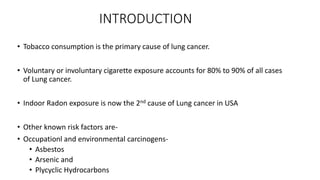
• Tobacco consumption is the primary cause of lung cancer.
• Voluntary or involuntary cigarette exposure accounts for 80% to 90% of all cases
of Lung cancer.
• Indoor Radon exposure is now the 2nd cause of Lung cancer in USA
• Other known risk factors are-
• Occupationl and environmental carcinogens-
• Asbestos
• Arsenic and
• Plycyclic Hydrocarbons
EPIDEMIOLOGY
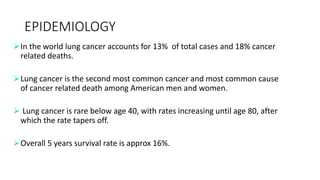
In the world lung cancer accounts for 13% of total cases and 18% cancer
related deaths.
Lung cancer is the second most common cancer and most common cause
of cancer related death among American men and women.
 Lung cancer is rare below age 40, with rates increasing until age 80, after
which the rate tapers off.
Overall 5 years survival rate is approx 16%.
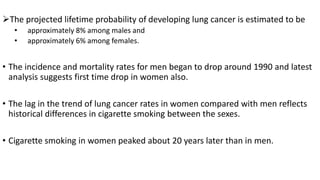
The projected lifetime probability of developing lung cancer is estimated to be
• approximately 8% among males and
• approximately 6% among females.
• The incidence and mortality rates for men began to drop around 1990 and latest
analysis suggests first time drop in women also.
• The lag in the trend of lung cancer rates in women compared with men reflects
historical differences in cigarette smoking between the sexes.
• Cigarette smoking in women peaked about 20 years later than in men.
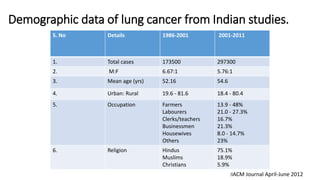
Demographic data of lung cancer from Indian studies.
S. No Details 1986-2001 2001-2011
1. Total cases 173500 297300
2. M:F 6.67:1 5.76:1
3. Mean age (yrs) 52.16 54.6
4. Urban: Rural 19.6 - 81.6 18.4 - 80.4
5. Occupation Farmers
Labourers
Clerks/teachers
Businessmen
Housewives
Others
13.9 - 48%
21.0 - 27.3%
16.7%
21.3%
8.0 - 14.7%
23%
6. Religion Hindus
Muslims
Christians
75.1%
18.9%
5.9%
:IACM Journal April-June 2012
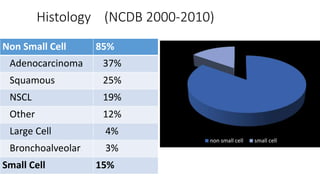
Histology (NCDB 2000-2010)
Non Small Cell 85%
Adenocarcinoma 37%
Squamous 25%
NSCL 19%
Other 12%
Large Cell 4%
Bronchoalveolar 3%
Small Cell 15%
non small cell small cell
RISK FACTORS
Majority (80–90%) by cigarette smoking.
-Cigarette smokers have a 10 fold or greater increase in risk.
-One genetic mutation is induced for every 15 cigarettes smoked.
- Cigarette smoking increases the risk of all the major lung cancer cell types.
- Environmental tobacco smoke (ETS) or second hand smoke is also an
established cause of lung cancer.
• In Indian patients with lung cancer, history of active tobacco smoking was found
in 87% of males and 85% of females.
• History of passive tobacco exposure is found in 3% in India. So 90% of all cases in
India resulted from tobacco exposure.
Prior lung diseases such as
-chronic bronchitis,
-emphysema, and
- tuberculosis
 Air pollution:
• 5 year survival for lung cancer has gone from 12 to 17% in 2008.
• Most people are diagnosed in advance stages: Local (15%), Regional
(22%), Distant (56%)
• Cure rate stage is poor: Local (52%), Regional (25%), Distant (4%)
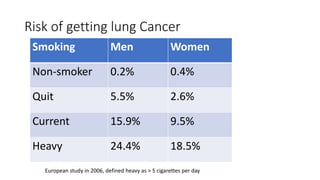
Risk of getting lung Cancer
Smoking Men Women
Non-smoker 0.2% 0.4%
Quit 5.5% 2.6%
Current 15.9% 9.5%
Heavy 24.4% 18.5%
European study in 2006, defined heavy as > 5 cigarettes per day
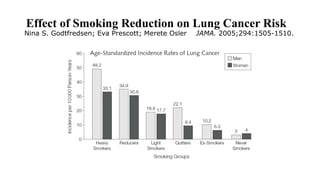
Effect of Smoking Reduction on Lung Cancer Risk
Nina S. Godtfredsen; Eva Prescott; Merete Osler JAMA. 2005;294:1505-1510.
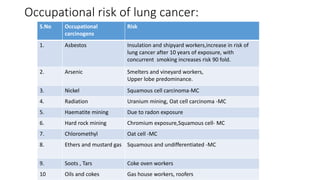
Occupational risk of lung cancer:
S.No Occupational
carcinogens
Risk
1. Asbestos Insulation and shipyard workers,increase in risk of
lung cancer after 10 years of exposure, with
concurrent smoking increases risk 90 fold.
2. Arsenic Smelters and vineyard workers,
Upper lobe predominance.
3. Nickel Squamous cell carcinoma-MC
4. Radiation Uranium mining, Oat cell carcinoma -MC
5. Haematite mining Due to radon exposure
6. Hard rock mining Chromium exposure,Squamous cell- MC
7. Chloromethyl Oat cell -MC
8. Ethers and mustard gas Squamous and undifferentiated -MC
9. Soots , Tars Coke oven workers
10 Oils and cokes Gas house workers, roofers
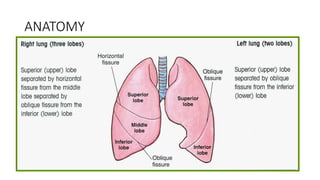
ANATOMY
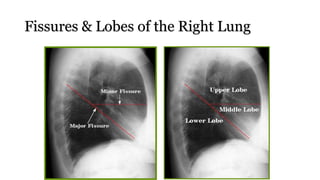
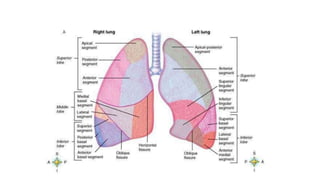
Fissures & Lobes of the Right Lung
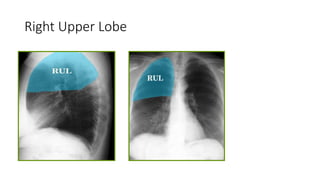
Right Upper Lobe
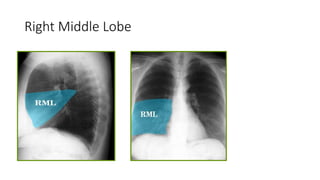
Right Middle Lobe
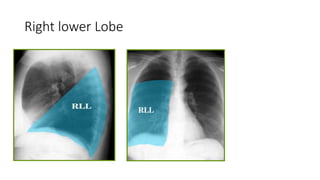
Right lower Lobe
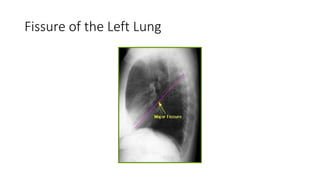
Fissure of the Left Lung
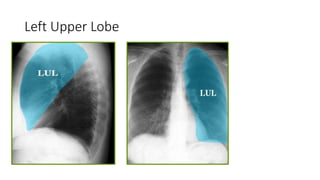
Left Upper Lobe
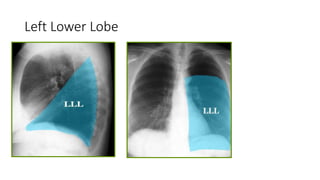
Left Lower Lobe
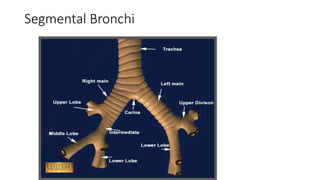
Segmental Bronchi
Parts of Lung
• Conical in shape
•
• Each lung has an apex,base,3 borders and 2 surfaces.
• Surfaces-
• Costal surface- broad and pressed against the rib cage.
• Mediastinal surface- smaller, concave and faces medially.
• Apex[apex pulmonis]-rounded & extends to the root of the neck[2.5-4cm above
the level of sternal end of first rib]
• The base[basis pulmonis]- is broad, concave & rest on the convex surface of
diaphragm.
• Borders-
1. Inferior border- separates the base from the costal surface .
2. Posterior border- is broad & rounded& is received into the deep concavity on
either side of the vertebral column.
3. Anterior border- thin& sharp, and overlaps the front of pericardium.
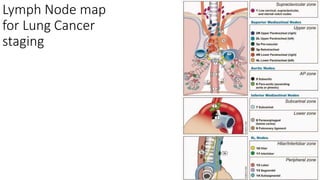
Lymph Node map
for Lung Cancer
staging
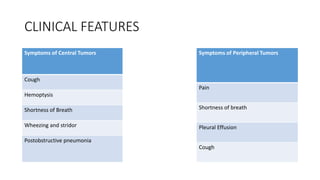
CLINICAL FEATURES
Symptoms of Central Tumors
Cough
Hemoptysis
Shortness of Breath
Wheezing and stridor
Postobstructive pneumonia
Symptoms of Peripheral Tumors
Pain
Shortness of breath
Pleural Effusion
Cough
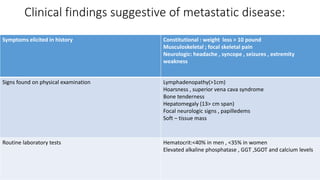
Clinical findings suggestive of metastatic disease:
Symptoms elicited in history Constitutional : weight loss > 10 pound
Musculoskeletal ; focal skeletal pain
Neurologic: headache , syncope , seizures , extremity
weakness
Signs found on physical examination Lymphadenopathy(>1cm)
Hoarsness , superior vena cava syndrome
Bone tenderness
Hepatomegaly (13> cm span)
Focal neurologic signs , papilledems
Soft – tissue mass
Routine laboratory tests Hematocrit:<40% in men , <35% in women
Elevated alkaline phosphatase , GGT ,SGOT and calcium levels
Syndromes/Symptoms secondary to regional
metastases:
 Esophageal compression  dysphagia
 Laryngeal nerve paralysis  hoarseness
 Symptomatic nerve paralysis  Horner’s syndrome (enophthalmos, ptosis, miosis, and
anhidrosis)
 Cervical/thoracic nerve invasion  Pancoast syndrome.
 Lymphatic obstruction  pleural effusion
 Vascular obstruction  SVC syndrome
 Pericardial/cardiac extension  effusion, tamponade
SUPERIOR VENA CAVA SYNDROME
• Results from obstruction of blood flow to the heart from the head and
neck regions and upper extremities.
• It occurs as a consequence of compression of the superior vena cava,
either from direct invasion by the primary tumor into the mediastinum
or from lymphatic spread with enlarged right paratracheal lymph
nodes.
• It is commonly caused by SCLC but can result from any centrally located
tumor or mediastinal spread.
Features-
1. Feeling of fullness in the head
2. Dyspnea
3. Cough
4. Dilated neck veins
5. Prominent venous pattern on the face and the chest
6. Upper extremitt and facial edema
7. Pappiledema
8. Facial cyanosis
9. Plethora
10. Conjunctival edema(possibly)
PARANEOPLASTIC SYNDROMES
 SIADH – Small cell –
 It results into Hyponatremia
 Symptoms include-Headache,Muscle cramps,Anorexia & Decreased urine output
 Resolves within 1–4weeks of initiating chemotherapy.
 Demeclocycline is the agent of choice
 Cushing Syndrome-ACTH-producing tumors – Small cell-
 Symptoms-Muscle weakness,weight loss,hypertension,hirsutism & osteoporosis.
 Hypokalemic alkalosis and hyperglycemia are present.
 It has worse prognosis
 Hypercalcemia-Squamous cell –
 It is associated with secretion of
 parathyroid hormone-related protein(PTHrp),
 calcitriol or
 other cytokines including osteoclast activating factors
 Clinical symptoms include
 Anorexia,
 Nausea,
 Vomiting,
 Abdominal Pain,
 Lethargy,
 Constipation,
 Polyuria,
 Polydipsia And
 Thirst.
 Late symptoms-Renal failure,confusion and coma.
 Lambert-Eaton Myasthenic Syndrome(LEMS)
 It is characterized by muscle weakness of the limbs.
 Proximal muscles are affected associated with difficulty in climbing chairs and
rising from a sitting position.
 Chemotherapy is the initial treatment of choice.
Skeletal–
 Clubbing - 30% (usually NSCLCs)
 Hypertrophic primary osteoarthropathy - 1–10% (usually adenocarcinomas).
 Periostitis
Cutaneous manifestations – 1%
- Dermatomyositis and
- Acanthosis nigricans
Neurologic–
 Myopathic syndromes - 1%
 Myasthenic Eaton-Lambert syndrome and retinal blindness (SCLC).
 Peripheral neuropathies,
 Subacute cerebellar degeneration,
 Cortical degeneration, and
 Polymyositis

Hematologic manifestations – 1-8%
-Migratory venous thrombophlebiti (Trousseau's syndrome),
-Nonbacterial Thrombotic (marantic) endocarditis with
arterial emboli,
-Disseminated intravascular coagulation
-Thrombotic disease complicating cancer is usually a poor
prognostic sign.
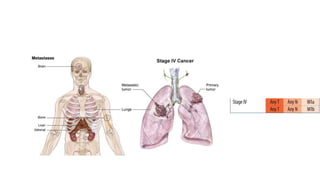
LUNG CANCER METASTASIS
• Adrenals - ~50% of cancers
• Liver – 30-50%
• Brain – 20%
• Bone – 20%
DIAGNOSTIC WORK UP
• Complete history
• Complete physical examination
Chest-may show signs of-
I. Partial or complete obstruction of airways
II. Pneumonia
III. Pleural Effusion
Neck Examination-Signs of Supraclavicular lymphadenopathy
Abdominal examination-signs of hepatomegaly
Neurological examination-signs of Brain metastais
Haemogram
• CBC-anemia due to metastatic disease
• LFT-May indicate Liver mets
• Increased ALP-May indicate Liver or Bone mets
• Increased Calcium ion-May indicate Bone mets or Paraneoplastic
syndrome
RADIOLOGIC EXAMINATIONS
• Chest Xray-initial imaging modality.
• Current Xray should be compared with previous ones to determine if a lesion is-
• New
• Enlarging or
• Stable
• CT Scan-
• CECT Chest + Upper Abdomen should be done so that Liver and Adrenals can be
visualized
• In a patient with known lung cancer a lymph node is considered suspicious if it
measures >1cm in diameter on its short axis.
• It can establish T stage by-
I. Determining tumor size
II. Presence of separate tumor nodules
III. Presence of atelectasis
IV. Post obstructive pneumonia
V. Invasion of adjacent structures
VI. Proximal extent of the tumor
• PET or PET-CT SCAN
• It has become standard in the staging work up of lung cancer patients.
• The biggest advantage is the identification of suspicious lymph nodes or distant
metastasis.
• Kaeff et al prospectively evaluated the utility of PET-
• They found that PET correctly upstaged 26% patients
• and downstaged 10-16 patients.
• Additionally PET can detect malignant disease in lymph nodes of normal size.
• PET-CT is superior to CT or PET alone and can detect malignancies in tumors as
small as 0.5cm.
• Novel tracers-
• FDG
• FMISO(18F-fluoromisonidazole)-For tumor Hypoxia
• FLT(18F-fluorothymidine)-For tumor proliferation
• 11C-methionine and 11C-tyrosine-For amino acid metabolism.
• Sputum Cytology-Sensitivity is 65%.
• Percutaneous Fine Needle Aspiration(FNA)-
• CT guided FNA done in lesions which cannot be reached by Bronchoscopy.
Overall diagnostic yield is 80%.
• Bronchoscopy-
• FOB is done and cytologic brushings,biopsies can be taken.
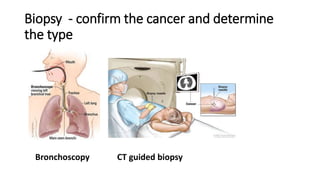
Biopsy - confirm the cancer and determine
the type
Bronchoscopy CT guided biopsy
• Endoscopic FNA-
• Endobronchial USG guided transbronchial needle aspiration(EBUS-TBNA) can be
done for ultrasound suspicious lymph nodes-
Paratracheal-Level 2 & 4
Subcarinal-Level 7
Hilar lymph node stations-level 10
• Thoracocentesis-
• If on multiple taps of pleural fluid is consistently bloody or exudative ,it should be
considered malignant.
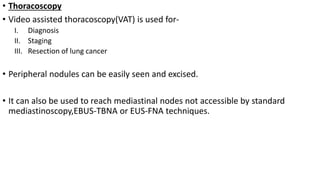
• Thoracoscopy
• Video assisted thoracoscopy(VAT) is used for-
I. Diagnosis
II. Staging
III. Resection of lung cancer
• Peripheral nodules can be easily seen and excised.
• It can also be used to reach mediastinal nodes not accessible by standard
mediastinoscopy,EBUS-TBNA or EUS-FNA techniques.
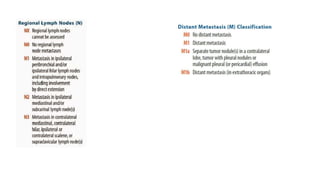
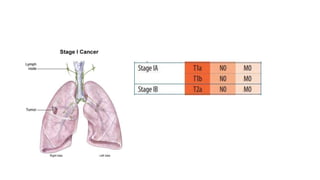
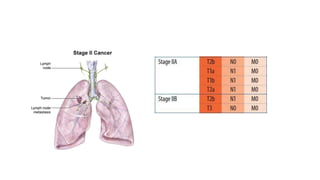
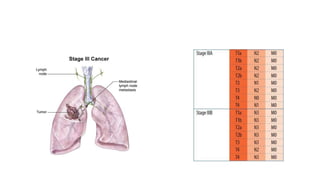
AJCC STAGING
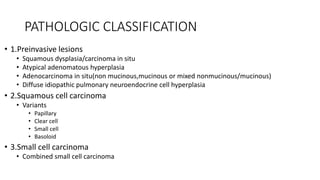
PATHOLOGIC CLASSIFICATION
• 1.Preinvasive lesions
• Squamous dysplasia/carcinoma in situ
• Atypical adenomatous hyperplasia
• Adenocarcinoma in situ(non mucinous,mucinous or mixed nonmucinous/mucinous)
• Diffuse idiopathic pulmonary neuroendocrine cell hyperplasia
• 2.Squamous cell carcinoma
• Variants
• Papillary
• Clear cell
• Small cell
• Basoloid
• 3.Small cell carcinoma
• Combined small cell carcinoma
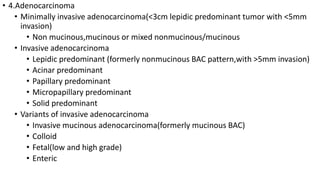
• 4.Adenocarcinoma
• Minimally invasive adenocarcinoma(<3cm lepidic predominant tumor with <5mm
invasion)
• Non mucinous,mucinous or mixed nonmucinous/mucinous
• Invasive adenocarcinoma
• Lepidic predominant (formerly nonmucinous BAC pattern,with >5mm invasion)
• Acinar predominant
• Papillary predominant
• Micropapillary predominant
• Solid predominant
• Variants of invasive adenocarcinoma
• Invasive mucinous adenocarcinoma(formerly mucinous BAC)
• Colloid
• Fetal(low and high grade)
• Enteric
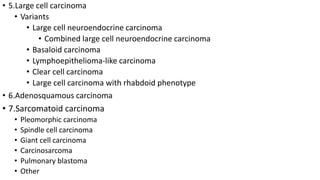
• 5.Large cell carcinoma
• Variants
• Large cell neuroendocrine carcinoma
• Combined large cell neuroendocrine carcinoma
• Basaloid carcinoma
• Lymphoepithelioma-like carcinoma
• Clear cell carcinoma
• Large cell carcinoma with rhabdoid phenotype
• 6.Adenosquamous carcinoma
• 7.Sarcomatoid carcinoma
• Pleomorphic carcinoma
• Spindle cell carcinoma
• Giant cell carcinoma
• Carcinosarcoma
• Pulmonary blastoma
• Other
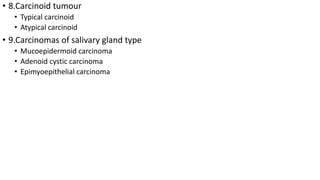
• 8.Carcinoid tumour
• Typical carcinoid
• Atypical carcinoid
• 9.Carcinomas of salivary gland type
• Mucoepidermoid carcinoma
• Adenoid cystic carcinoma
• Epimyoepithelial carcinoma
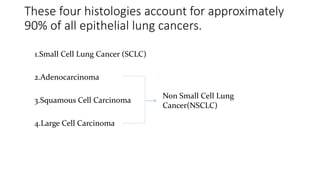
These four histologies account for approximately
90% of all epithelial lung cancers.
1.Small Cell Lung Cancer (SCLC)
2.Adenocarcinoma
3.Squamous Cell Carcinoma
4.Large Cell Carcinoma
Non Small Cell Lung
Cancer(NSCLC)
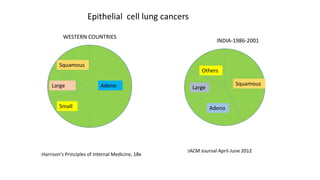
Adeno
Squamous
Large
Small
Epithelial cell lung cancers
:Harrison's Principles of Internal Medicine, 18e
Squamous
Adeno
Large
Others
WESTERN COUNTRIES
INDIA-1986-2001
:IACM Journal April-June 2012
LUNG CANCER IN INDIA
Non-small-cell lung cancer constitutes 75 - 80% of lung cancers.
More than 70 % of them are in Stages III and IV, thus
curative surgery can not be done in these cases.
Small-cell lung carcinoma constitute 20% of all lung cancers .
Extensive stage in 70% of patients at the time of diagnosis.
While in many Western countries adenocarcinoma has become the commonest lung
cancer.
In India it is still squamous cell carcinoma in both males and females
THANK YOU

Lung cancer anatomy to pathological classification

  • 1.
    LUNG CANCER-ANATOMY TO PATHOLOGICALCLASSIFICATION BY DR.AYUSH GARG PG JR-I RADIOTHERAPY
  • 2.
    INTRODUCTION • Tobacco consumptionis the primary cause of lung cancer. • Voluntary or involuntary cigarette exposure accounts for 80% to 90% of all cases of Lung cancer. • Indoor Radon exposure is now the 2nd cause of Lung cancer in USA • Other known risk factors are- • Occupationl and environmental carcinogens- • Asbestos • Arsenic and • Plycyclic Hydrocarbons
  • 3.
    EPIDEMIOLOGY In the worldlung cancer accounts for 13% of total cases and 18% cancer related deaths. Lung cancer is the second most common cancer and most common cause of cancer related death among American men and women.  Lung cancer is rare below age 40, with rates increasing until age 80, after which the rate tapers off. Overall 5 years survival rate is approx 16%.
  • 4.
    The projected lifetimeprobability of developing lung cancer is estimated to be • approximately 8% among males and • approximately 6% among females. • The incidence and mortality rates for men began to drop around 1990 and latest analysis suggests first time drop in women also. • The lag in the trend of lung cancer rates in women compared with men reflects historical differences in cigarette smoking between the sexes. • Cigarette smoking in women peaked about 20 years later than in men.
  • 5.
    Demographic data oflung cancer from Indian studies. S. No Details 1986-2001 2001-2011 1. Total cases 173500 297300 2. M:F 6.67:1 5.76:1 3. Mean age (yrs) 52.16 54.6 4. Urban: Rural 19.6 - 81.6 18.4 - 80.4 5. Occupation Farmers Labourers Clerks/teachers Businessmen Housewives Others 13.9 - 48% 21.0 - 27.3% 16.7% 21.3% 8.0 - 14.7% 23% 6. Religion Hindus Muslims Christians 75.1% 18.9% 5.9% :IACM Journal April-June 2012
  • 6.
    Histology (NCDB 2000-2010) NonSmall Cell 85% Adenocarcinoma 37% Squamous 25% NSCL 19% Other 12% Large Cell 4% Bronchoalveolar 3% Small Cell 15% non small cell small cell
  • 7.
    RISK FACTORS Majority (80–90%)by cigarette smoking. -Cigarette smokers have a 10 fold or greater increase in risk. -One genetic mutation is induced for every 15 cigarettes smoked. - Cigarette smoking increases the risk of all the major lung cancer cell types. - Environmental tobacco smoke (ETS) or second hand smoke is also an established cause of lung cancer.
  • 8.
    • In Indianpatients with lung cancer, history of active tobacco smoking was found in 87% of males and 85% of females. • History of passive tobacco exposure is found in 3% in India. So 90% of all cases in India resulted from tobacco exposure. Prior lung diseases such as -chronic bronchitis, -emphysema, and - tuberculosis  Air pollution:
  • 9.
    • 5 yearsurvival for lung cancer has gone from 12 to 17% in 2008. • Most people are diagnosed in advance stages: Local (15%), Regional (22%), Distant (56%) • Cure rate stage is poor: Local (52%), Regional (25%), Distant (4%)
  • 10.
    Risk of gettinglung Cancer Smoking Men Women Non-smoker 0.2% 0.4% Quit 5.5% 2.6% Current 15.9% 9.5% Heavy 24.4% 18.5% European study in 2006, defined heavy as > 5 cigarettes per day
  • 11.
    Effect of SmokingReduction on Lung Cancer Risk Nina S. Godtfredsen; Eva Prescott; Merete Osler JAMA. 2005;294:1505-1510.
  • 12.
    Occupational risk oflung cancer: S.No Occupational carcinogens Risk 1. Asbestos Insulation and shipyard workers,increase in risk of lung cancer after 10 years of exposure, with concurrent smoking increases risk 90 fold. 2. Arsenic Smelters and vineyard workers, Upper lobe predominance. 3. Nickel Squamous cell carcinoma-MC 4. Radiation Uranium mining, Oat cell carcinoma -MC 5. Haematite mining Due to radon exposure 6. Hard rock mining Chromium exposure,Squamous cell- MC 7. Chloromethyl Oat cell -MC 8. Ethers and mustard gas Squamous and undifferentiated -MC 9. Soots , Tars Coke oven workers 10 Oils and cokes Gas house workers, roofers
  • 13.
  • 14.
    Fissures & Lobesof the Right Lung
  • 15.
  • 16.
  • 17.
  • 18.
    Fissure of theLeft Lung
  • 19.
  • 20.
  • 21.
  • 23.
    Parts of Lung •Conical in shape • • Each lung has an apex,base,3 borders and 2 surfaces. • Surfaces- • Costal surface- broad and pressed against the rib cage. • Mediastinal surface- smaller, concave and faces medially. • Apex[apex pulmonis]-rounded & extends to the root of the neck[2.5-4cm above the level of sternal end of first rib]
  • 24.
    • The base[basispulmonis]- is broad, concave & rest on the convex surface of diaphragm. • Borders- 1. Inferior border- separates the base from the costal surface . 2. Posterior border- is broad & rounded& is received into the deep concavity on either side of the vertebral column. 3. Anterior border- thin& sharp, and overlaps the front of pericardium.
  • 25.
    Lymph Node map forLung Cancer staging
  • 26.
    CLINICAL FEATURES Symptoms ofCentral Tumors Cough Hemoptysis Shortness of Breath Wheezing and stridor Postobstructive pneumonia Symptoms of Peripheral Tumors Pain Shortness of breath Pleural Effusion Cough
  • 27.
    Clinical findings suggestiveof metastatic disease: Symptoms elicited in history Constitutional : weight loss > 10 pound Musculoskeletal ; focal skeletal pain Neurologic: headache , syncope , seizures , extremity weakness Signs found on physical examination Lymphadenopathy(>1cm) Hoarsness , superior vena cava syndrome Bone tenderness Hepatomegaly (13> cm span) Focal neurologic signs , papilledems Soft – tissue mass Routine laboratory tests Hematocrit:<40% in men , <35% in women Elevated alkaline phosphatase , GGT ,SGOT and calcium levels
  • 28.
    Syndromes/Symptoms secondary toregional metastases:  Esophageal compression  dysphagia  Laryngeal nerve paralysis  hoarseness  Symptomatic nerve paralysis  Horner’s syndrome (enophthalmos, ptosis, miosis, and anhidrosis)  Cervical/thoracic nerve invasion  Pancoast syndrome.  Lymphatic obstruction  pleural effusion  Vascular obstruction  SVC syndrome  Pericardial/cardiac extension  effusion, tamponade
  • 29.
    SUPERIOR VENA CAVASYNDROME • Results from obstruction of blood flow to the heart from the head and neck regions and upper extremities. • It occurs as a consequence of compression of the superior vena cava, either from direct invasion by the primary tumor into the mediastinum or from lymphatic spread with enlarged right paratracheal lymph nodes. • It is commonly caused by SCLC but can result from any centrally located tumor or mediastinal spread.
  • 30.
    Features- 1. Feeling offullness in the head 2. Dyspnea 3. Cough 4. Dilated neck veins 5. Prominent venous pattern on the face and the chest 6. Upper extremitt and facial edema 7. Pappiledema 8. Facial cyanosis 9. Plethora 10. Conjunctival edema(possibly)
  • 31.
    PARANEOPLASTIC SYNDROMES  SIADH– Small cell –  It results into Hyponatremia  Symptoms include-Headache,Muscle cramps,Anorexia & Decreased urine output  Resolves within 1–4weeks of initiating chemotherapy.  Demeclocycline is the agent of choice  Cushing Syndrome-ACTH-producing tumors – Small cell-  Symptoms-Muscle weakness,weight loss,hypertension,hirsutism & osteoporosis.  Hypokalemic alkalosis and hyperglycemia are present.  It has worse prognosis
  • 32.
     Hypercalcemia-Squamous cell–  It is associated with secretion of  parathyroid hormone-related protein(PTHrp),  calcitriol or  other cytokines including osteoclast activating factors  Clinical symptoms include  Anorexia,  Nausea,  Vomiting,  Abdominal Pain,  Lethargy,  Constipation,  Polyuria,  Polydipsia And  Thirst.  Late symptoms-Renal failure,confusion and coma.
  • 33.
     Lambert-Eaton MyasthenicSyndrome(LEMS)  It is characterized by muscle weakness of the limbs.  Proximal muscles are affected associated with difficulty in climbing chairs and rising from a sitting position.  Chemotherapy is the initial treatment of choice. Skeletal–  Clubbing - 30% (usually NSCLCs)  Hypertrophic primary osteoarthropathy - 1–10% (usually adenocarcinomas).  Periostitis Cutaneous manifestations – 1% - Dermatomyositis and - Acanthosis nigricans
  • 34.
    Neurologic–  Myopathic syndromes- 1%  Myasthenic Eaton-Lambert syndrome and retinal blindness (SCLC).  Peripheral neuropathies,  Subacute cerebellar degeneration,  Cortical degeneration, and  Polymyositis  Hematologic manifestations – 1-8% -Migratory venous thrombophlebiti (Trousseau's syndrome), -Nonbacterial Thrombotic (marantic) endocarditis with arterial emboli, -Disseminated intravascular coagulation -Thrombotic disease complicating cancer is usually a poor prognostic sign.
  • 35.
    LUNG CANCER METASTASIS •Adrenals - ~50% of cancers • Liver – 30-50% • Brain – 20% • Bone – 20%
  • 36.
    DIAGNOSTIC WORK UP •Complete history • Complete physical examination Chest-may show signs of- I. Partial or complete obstruction of airways II. Pneumonia III. Pleural Effusion Neck Examination-Signs of Supraclavicular lymphadenopathy Abdominal examination-signs of hepatomegaly Neurological examination-signs of Brain metastais
  • 37.
    Haemogram • CBC-anemia dueto metastatic disease • LFT-May indicate Liver mets • Increased ALP-May indicate Liver or Bone mets • Increased Calcium ion-May indicate Bone mets or Paraneoplastic syndrome
  • 38.
    RADIOLOGIC EXAMINATIONS • ChestXray-initial imaging modality. • Current Xray should be compared with previous ones to determine if a lesion is- • New • Enlarging or • Stable • CT Scan- • CECT Chest + Upper Abdomen should be done so that Liver and Adrenals can be visualized • In a patient with known lung cancer a lymph node is considered suspicious if it measures >1cm in diameter on its short axis.
  • 39.
    • It canestablish T stage by- I. Determining tumor size II. Presence of separate tumor nodules III. Presence of atelectasis IV. Post obstructive pneumonia V. Invasion of adjacent structures VI. Proximal extent of the tumor • PET or PET-CT SCAN • It has become standard in the staging work up of lung cancer patients. • The biggest advantage is the identification of suspicious lymph nodes or distant metastasis.
  • 40.
    • Kaeff etal prospectively evaluated the utility of PET- • They found that PET correctly upstaged 26% patients • and downstaged 10-16 patients. • Additionally PET can detect malignant disease in lymph nodes of normal size. • PET-CT is superior to CT or PET alone and can detect malignancies in tumors as small as 0.5cm. • Novel tracers- • FDG • FMISO(18F-fluoromisonidazole)-For tumor Hypoxia • FLT(18F-fluorothymidine)-For tumor proliferation • 11C-methionine and 11C-tyrosine-For amino acid metabolism.
  • 41.
    • Sputum Cytology-Sensitivityis 65%. • Percutaneous Fine Needle Aspiration(FNA)- • CT guided FNA done in lesions which cannot be reached by Bronchoscopy. Overall diagnostic yield is 80%. • Bronchoscopy- • FOB is done and cytologic brushings,biopsies can be taken.
  • 42.
    Biopsy - confirmthe cancer and determine the type Bronchoscopy CT guided biopsy
  • 43.
    • Endoscopic FNA- •Endobronchial USG guided transbronchial needle aspiration(EBUS-TBNA) can be done for ultrasound suspicious lymph nodes- Paratracheal-Level 2 & 4 Subcarinal-Level 7 Hilar lymph node stations-level 10 • Thoracocentesis- • If on multiple taps of pleural fluid is consistently bloody or exudative ,it should be considered malignant.
  • 44.
    • Thoracoscopy • Videoassisted thoracoscopy(VAT) is used for- I. Diagnosis II. Staging III. Resection of lung cancer • Peripheral nodules can be easily seen and excised. • It can also be used to reach mediastinal nodes not accessible by standard mediastinoscopy,EBUS-TBNA or EUS-FNA techniques.
  • 45.
  • 52.
    PATHOLOGIC CLASSIFICATION • 1.Preinvasivelesions • Squamous dysplasia/carcinoma in situ • Atypical adenomatous hyperplasia • Adenocarcinoma in situ(non mucinous,mucinous or mixed nonmucinous/mucinous) • Diffuse idiopathic pulmonary neuroendocrine cell hyperplasia • 2.Squamous cell carcinoma • Variants • Papillary • Clear cell • Small cell • Basoloid • 3.Small cell carcinoma • Combined small cell carcinoma
  • 53.
    • 4.Adenocarcinoma • Minimallyinvasive adenocarcinoma(<3cm lepidic predominant tumor with <5mm invasion) • Non mucinous,mucinous or mixed nonmucinous/mucinous • Invasive adenocarcinoma • Lepidic predominant (formerly nonmucinous BAC pattern,with >5mm invasion) • Acinar predominant • Papillary predominant • Micropapillary predominant • Solid predominant • Variants of invasive adenocarcinoma • Invasive mucinous adenocarcinoma(formerly mucinous BAC) • Colloid • Fetal(low and high grade) • Enteric
  • 54.
    • 5.Large cellcarcinoma • Variants • Large cell neuroendocrine carcinoma • Combined large cell neuroendocrine carcinoma • Basaloid carcinoma • Lymphoepithelioma-like carcinoma • Clear cell carcinoma • Large cell carcinoma with rhabdoid phenotype • 6.Adenosquamous carcinoma • 7.Sarcomatoid carcinoma • Pleomorphic carcinoma • Spindle cell carcinoma • Giant cell carcinoma • Carcinosarcoma • Pulmonary blastoma • Other
  • 55.
    • 8.Carcinoid tumour •Typical carcinoid • Atypical carcinoid • 9.Carcinomas of salivary gland type • Mucoepidermoid carcinoma • Adenoid cystic carcinoma • Epimyoepithelial carcinoma
  • 56.
    These four histologiesaccount for approximately 90% of all epithelial lung cancers. 1.Small Cell Lung Cancer (SCLC) 2.Adenocarcinoma 3.Squamous Cell Carcinoma 4.Large Cell Carcinoma Non Small Cell Lung Cancer(NSCLC)
  • 57.
    Adeno Squamous Large Small Epithelial cell lungcancers :Harrison's Principles of Internal Medicine, 18e Squamous Adeno Large Others WESTERN COUNTRIES INDIA-1986-2001 :IACM Journal April-June 2012
  • 58.
    LUNG CANCER ININDIA Non-small-cell lung cancer constitutes 75 - 80% of lung cancers. More than 70 % of them are in Stages III and IV, thus curative surgery can not be done in these cases. Small-cell lung carcinoma constitute 20% of all lung cancers . Extensive stage in 70% of patients at the time of diagnosis. While in many Western countries adenocarcinoma has become the commonest lung cancer. In India it is still squamous cell carcinoma in both males and females
  • 59.