Communication for Relationship Building Chapter 5
Introduction  The Salesperson must be able to communicate with the buyer.  This is very important in a business deal leading to business success. Elements of Process of Communication consist of : Oral Communication Non Verbal or Behavioral Communication
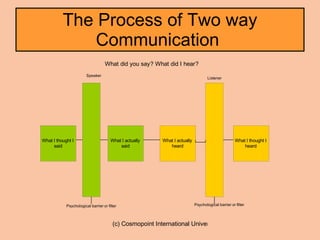
The Process of Two way Communication
Process of Communication in sales What is Communication in Sales? Communication is the act of transmitting verbal and non-verbal information and creating understanding between seller and buyer. Communication is an exchange process of sending and receiving messages with some type of positive response expected between seller and buyer.
Types of Communication Channels Sales presentation takes many forms: Ideas and attitudes – communicated by other media other than language – audio visual, sign language, signals etc. Social Conversation – Verbal Communication.
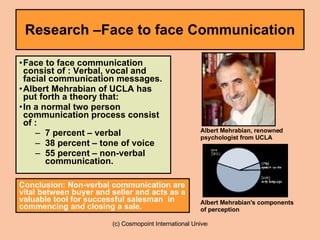
Research –Face to face Communication Face to face communication consist of : Verbal, vocal and facial communication messages. Albert Mehrabian of UCLA has put forth a theory that: In a normal two person communication process consist of :   7   percent – verbal 38 percent – tone of voice 55 percent – non-verbal communication. Albert Mehrabian, renowned psychologist from UCLA Albert Mehrabian's components of perception Conclusion: Non-verbal communication are vital between buyer and seller and acts as a valuable tool for successful salesman  in commencing   and closing a sale.
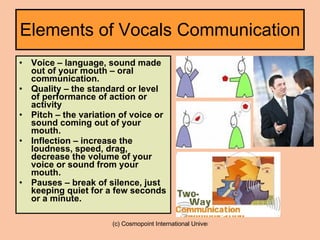
Elements of  Vocals  Communication Voice – language, sound made out of your mouth – oral communication. Quality – the standard or level of performance of action or activity Pitch – the variation of voice or sound coming out of your mouth. Inflection – increase the loudness, speed, drag, decrease the volume of your voice or sound from your mouth. Pauses – break of silence, just keeping quiet for a few seconds or a minute.
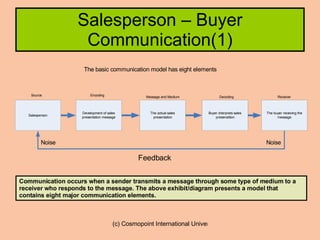
Salesperson – Buyer Communication(1) Communication occurs when a sender transmits a message through some type of medium to a receiver who responds to the message. The above exhibit/diagram presents a model that contains eight major communication elements.
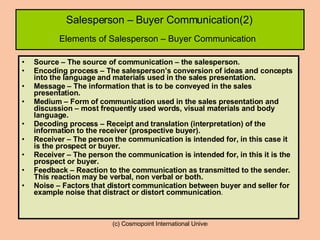
Salesperson – Buyer Communication(2)   Elements of Salesperson – Buyer Communication   Source – The source of communication – the salesperson. Encoding process – The salesperson’s conversion of ideas and concepts into the language and materials used in the sales presentation. Message – The information that is to be conveyed in the sales presentation. Medium – Form of communication used in the sales presentation and discussion – most frequently used words, visual materials and body language. Decoding process – Receipt and translation (interpretation) of the information to the receiver (prospective buyer). Receiver – The person the communication is intended for, in this case it is the prospect or buyer. Receiver – The person the communication is intended for, in this it is the prospect or buyer. Feedback – Reaction to the communication as transmitted to the sender. This reaction may be verbal, non verbal or both. Noise – Factors that distort communication between buyer and seller for example noise that distract or distort communication .
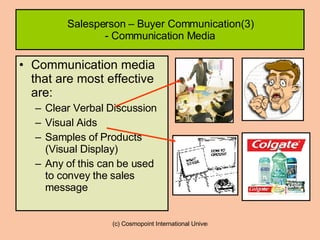
Salesperson – Buyer Communication(3) - Communication Media Communication media that are most effective are: Clear Verbal Discussion Visual Aids  Samples of Products (Visual Display)  Any of this can be used to convey the sales message
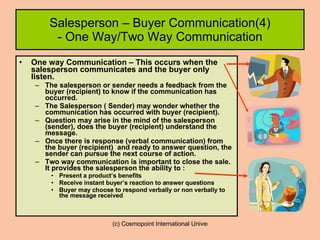
Salesperson – Buyer Communication(4) - One Way/Two Way Communication One way Communication – This occurs when the salesperson communicates and the buyer only listen. The salesperson or sender needs a feedback from the buyer (recipient) to know if the communication has occurred.  The Salesperson ( Sender) may wonder whether the communication has occurred with buyer (recipient). Question may arise in the mind of the salesperson (sender), does the buyer (recipient) understand the message. Once there is response (verbal communication) from the buyer (recipient)  and ready to answer question, the sender can pursue the next course of action. Two way communication is important to close the sale. It provides the salesperson the ability to : Present a product’s benefits Receive instant buyer’s reaction to answer questions Buyer may choose to respond verbally or non verbally to the message received
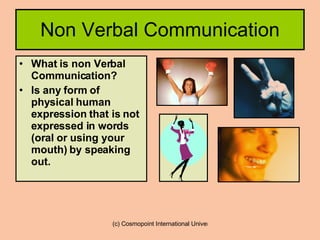
Non Verbal Communication What is non Verbal Communication? Is any form of physical human expression that is not expressed in words (oral or using your mouth) by speaking out.
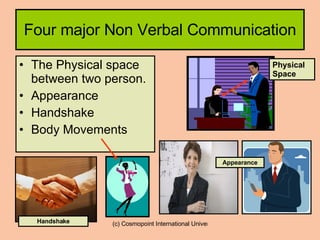
Four major Non Verbal Communication The Physical space between two person. Appearance Handshake Body Movements Physical Space Appearance Handshake
Concept of Space Territorial Space – Refers to the area around a person who feels that is very personal.  Any unknown person will not be allowed to enter this private space. Salesperson must beware not to infringe this territorial space without permission. (verbal or non-verbal)
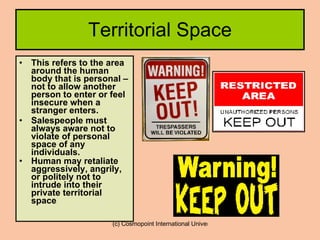
Territorial Space This refers to the area around the human body that is personal – not to allow another person to enter or feel insecure when a stranger enters. Salespeople must always aware not to violate of personal space of any individuals. Human may retaliate  aggressively, angrily, or politely not to intrude into their private territorial space .
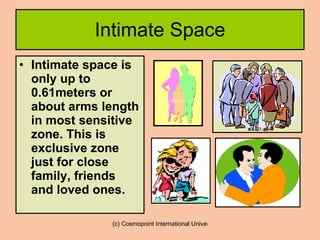
Intimate Space Intimate space is only up to 0.61meters or about arms length in most sensitive zone. This is exclusive zone just for close family, friends and loved ones.
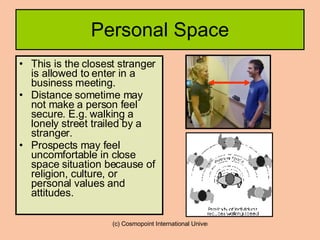
Personal Space This is the closest stranger is allowed to enter in a business meeting. Distance sometime may not make a person feel secure. E.g. walking a lonely street trailed by a stranger.  Prospects may feel uncomfortable in close space situation because of religion, culture, or personal values and attitudes.
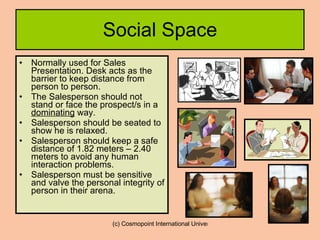
Social Space Normally used for Sales Presentation. Desk acts as the barrier to keep distance from person to person. The Salesperson should not stand or face the prospect/s in a  dominating  way.  Salesperson should be seated to show he is relaxed. Salesperson should keep a safe distance of 1.82 meters – 2.40 meters to avoid any human interaction problems. Salesperson must be sensitive and valve the personal integrity of person in their arena.
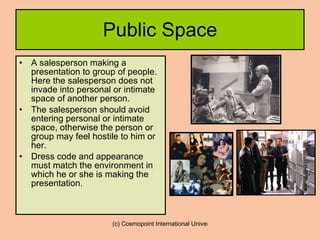
Public Space A salesperson making a presentation to group of people. Here the salesperson does not invade into personal or intimate space of another person. The salesperson should avoid entering personal or intimate space, otherwise the person or group may feel hostile to him or her. Dress code and appearance must match the environment in which he or she is making the presentation.
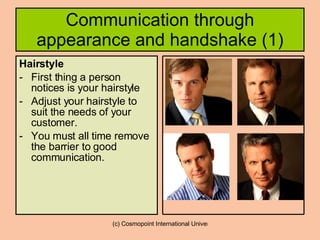
Communication through appearance and handshake (1) Hairstyle   First thing a person notices is your hairstyle Adjust your hairstyle to suit the needs of your customer. You must all time remove the barrier to good communication.
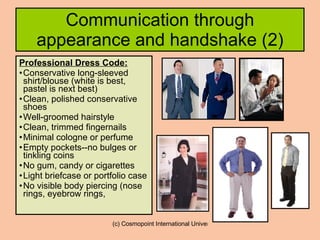
Communication through appearance and handshake (2) Professional Dress Code: Conservative long-sleeved shirt/blouse (white is best, pastel is next best)  Clean, polished conservative shoes  Well-groomed hairstyle  Clean, trimmed fingernails  Minimal cologne or perfume  Empty pockets--no bulges or tinkling coins  No gum, candy or cigarettes  Light briefcase or portfolio case  No visible body piercing (nose rings, eyebrow rings,
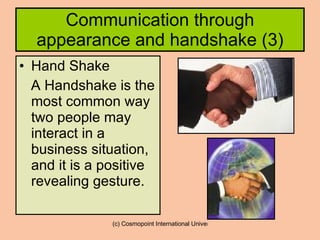
Communication through appearance and handshake (3) Hand Shake A Handshake is the most common way two people may interact in a business situation, and it is a positive revealing gesture.
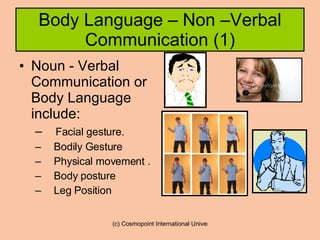
Body Language – Non –Verbal Communication (1) Noun - Verbal Communication or Body Language include: Facial gesture. Bodily Gesture Physical movement . Body posture Leg Position
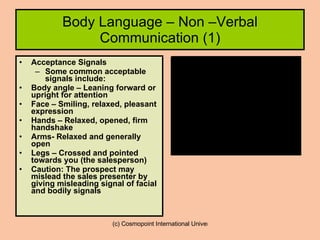
Body Language – Non –Verbal Communication (1) Acceptance Signals Some common acceptable signals include: Body angle – Leaning forward or upright for attention Face – Smiling, relaxed, pleasant expression Hands – Relaxed, opened, firm handshake Arms- Relaxed and generally open Legs – Crossed and pointed towards you (the salesperson) Caution: The prospect may mislead the sales presenter by giving misleading signal of facial and bodily signals
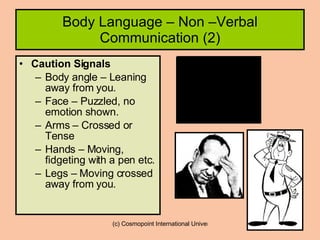
Body Language – Non –Verbal Communication (2) Caution Signals Body angle – Leaning away from you. Face – Puzzled, no emotion shown. Arms – Crossed or Tense Hands – Moving, fidgeting with a pen etc. Legs – Moving crossed away from you.
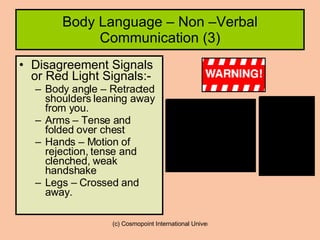
Body Language – Non –Verbal Communication (3) Disagreement Signals or Red Light Signals:- Body angle – Retracted shoulders leaning away from you. Arms – Tense and folded over chest Hands – Motion of rejection, tense and clenched, weak handshake Legs – Crossed and away.
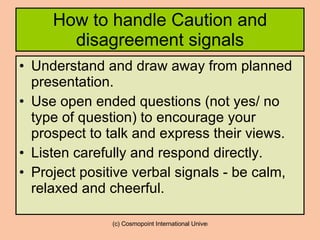
How to handle Caution and disagreement signals Understand and draw away from planned presentation. Use open ended questions (not yes/ no type of question) to encourage your prospect to talk and express their views. Listen carefully and respond directly. Project positive verbal signals - be calm, relaxed and cheerful.
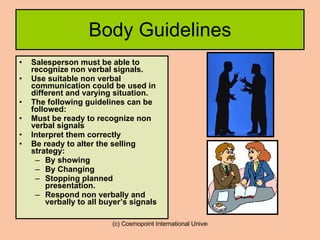
Body Guidelines Salesperson must be able to recognize non verbal signals.  Use suitable non verbal communication could be used in different and varying situation. The following guidelines can be followed: Must be ready to recognize non verbal signals Interpret them correctly Be ready to alter the selling strategy: By showing  By Changing  Stopping planned presentation. Respond non verbally and verbally to all buyer’s signals
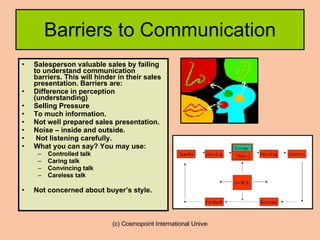
Barriers to Communication Salesperson valuable sales by failing to understand communication barriers. This will hinder in their sales presentation. Barriers are: Difference in perception (understanding) Selling Pressure To much information. Not well prepared sales presentation. Noise – inside and outside. Not listening carefully. What you can say? You may use: Controlled talk Caring talk Convincing talk Careless talk Not concerned about buyer’s style.
Persuasive Communication The process through which people try to influence the beliefs or action of others. Salesperson want to be good communicators to : Persuade people to make a purchase of their products. Influence by both reason and emotion. Factors that play part in the buyer’s decision making process
Persuasive Presentation Strategy Follow the following preparation in a persuasive presentation: Place special emphasis on the relationship Sell benefits and obtain customer reactions Minimize the negative impact of change Impress and appeal to buyer emotion at the beginning and the end. Place and target emotional links Use Metaphors, stories and testimonials

Sm 5

  • 1.
  • 2.
    Introduction TheSalesperson must be able to communicate with the buyer. This is very important in a business deal leading to business success. Elements of Process of Communication consist of : Oral Communication Non Verbal or Behavioral Communication
  • 3.
    The Process ofTwo way Communication
  • 4.
    Process of Communicationin sales What is Communication in Sales? Communication is the act of transmitting verbal and non-verbal information and creating understanding between seller and buyer. Communication is an exchange process of sending and receiving messages with some type of positive response expected between seller and buyer.
  • 5.
    Types of CommunicationChannels Sales presentation takes many forms: Ideas and attitudes – communicated by other media other than language – audio visual, sign language, signals etc. Social Conversation – Verbal Communication.
  • 6.
    Research –Face toface Communication Face to face communication consist of : Verbal, vocal and facial communication messages. Albert Mehrabian of UCLA has put forth a theory that: In a normal two person communication process consist of : 7 percent – verbal 38 percent – tone of voice 55 percent – non-verbal communication. Albert Mehrabian, renowned psychologist from UCLA Albert Mehrabian's components of perception Conclusion: Non-verbal communication are vital between buyer and seller and acts as a valuable tool for successful salesman in commencing and closing a sale.
  • 7.
    Elements of Vocals Communication Voice – language, sound made out of your mouth – oral communication. Quality – the standard or level of performance of action or activity Pitch – the variation of voice or sound coming out of your mouth. Inflection – increase the loudness, speed, drag, decrease the volume of your voice or sound from your mouth. Pauses – break of silence, just keeping quiet for a few seconds or a minute.
  • 8.
    Salesperson – BuyerCommunication(1) Communication occurs when a sender transmits a message through some type of medium to a receiver who responds to the message. The above exhibit/diagram presents a model that contains eight major communication elements.
  • 9.
    Salesperson – BuyerCommunication(2) Elements of Salesperson – Buyer Communication Source – The source of communication – the salesperson. Encoding process – The salesperson’s conversion of ideas and concepts into the language and materials used in the sales presentation. Message – The information that is to be conveyed in the sales presentation. Medium – Form of communication used in the sales presentation and discussion – most frequently used words, visual materials and body language. Decoding process – Receipt and translation (interpretation) of the information to the receiver (prospective buyer). Receiver – The person the communication is intended for, in this case it is the prospect or buyer. Receiver – The person the communication is intended for, in this it is the prospect or buyer. Feedback – Reaction to the communication as transmitted to the sender. This reaction may be verbal, non verbal or both. Noise – Factors that distort communication between buyer and seller for example noise that distract or distort communication .
  • 10.
    Salesperson – BuyerCommunication(3) - Communication Media Communication media that are most effective are: Clear Verbal Discussion Visual Aids Samples of Products (Visual Display) Any of this can be used to convey the sales message
  • 11.
    Salesperson – BuyerCommunication(4) - One Way/Two Way Communication One way Communication – This occurs when the salesperson communicates and the buyer only listen. The salesperson or sender needs a feedback from the buyer (recipient) to know if the communication has occurred. The Salesperson ( Sender) may wonder whether the communication has occurred with buyer (recipient). Question may arise in the mind of the salesperson (sender), does the buyer (recipient) understand the message. Once there is response (verbal communication) from the buyer (recipient) and ready to answer question, the sender can pursue the next course of action. Two way communication is important to close the sale. It provides the salesperson the ability to : Present a product’s benefits Receive instant buyer’s reaction to answer questions Buyer may choose to respond verbally or non verbally to the message received
  • 12.
    Non Verbal CommunicationWhat is non Verbal Communication? Is any form of physical human expression that is not expressed in words (oral or using your mouth) by speaking out.
  • 13.
    Four major NonVerbal Communication The Physical space between two person. Appearance Handshake Body Movements Physical Space Appearance Handshake
  • 14.
    Concept of SpaceTerritorial Space – Refers to the area around a person who feels that is very personal. Any unknown person will not be allowed to enter this private space. Salesperson must beware not to infringe this territorial space without permission. (verbal or non-verbal)
  • 15.
    Territorial Space Thisrefers to the area around the human body that is personal – not to allow another person to enter or feel insecure when a stranger enters. Salespeople must always aware not to violate of personal space of any individuals. Human may retaliate aggressively, angrily, or politely not to intrude into their private territorial space .
  • 16.
    Intimate Space Intimatespace is only up to 0.61meters or about arms length in most sensitive zone. This is exclusive zone just for close family, friends and loved ones.
  • 17.
    Personal Space Thisis the closest stranger is allowed to enter in a business meeting. Distance sometime may not make a person feel secure. E.g. walking a lonely street trailed by a stranger. Prospects may feel uncomfortable in close space situation because of religion, culture, or personal values and attitudes.
  • 18.
    Social Space Normallyused for Sales Presentation. Desk acts as the barrier to keep distance from person to person. The Salesperson should not stand or face the prospect/s in a dominating way. Salesperson should be seated to show he is relaxed. Salesperson should keep a safe distance of 1.82 meters – 2.40 meters to avoid any human interaction problems. Salesperson must be sensitive and valve the personal integrity of person in their arena.
  • 19.
    Public Space Asalesperson making a presentation to group of people. Here the salesperson does not invade into personal or intimate space of another person. The salesperson should avoid entering personal or intimate space, otherwise the person or group may feel hostile to him or her. Dress code and appearance must match the environment in which he or she is making the presentation.
  • 20.
    Communication through appearanceand handshake (1) Hairstyle First thing a person notices is your hairstyle Adjust your hairstyle to suit the needs of your customer. You must all time remove the barrier to good communication.
  • 21.
    Communication through appearanceand handshake (2) Professional Dress Code: Conservative long-sleeved shirt/blouse (white is best, pastel is next best) Clean, polished conservative shoes Well-groomed hairstyle Clean, trimmed fingernails Minimal cologne or perfume Empty pockets--no bulges or tinkling coins No gum, candy or cigarettes Light briefcase or portfolio case No visible body piercing (nose rings, eyebrow rings,
  • 22.
    Communication through appearanceand handshake (3) Hand Shake A Handshake is the most common way two people may interact in a business situation, and it is a positive revealing gesture.
  • 23.
    Body Language –Non –Verbal Communication (1) Noun - Verbal Communication or Body Language include: Facial gesture. Bodily Gesture Physical movement . Body posture Leg Position
  • 24.
    Body Language –Non –Verbal Communication (1) Acceptance Signals Some common acceptable signals include: Body angle – Leaning forward or upright for attention Face – Smiling, relaxed, pleasant expression Hands – Relaxed, opened, firm handshake Arms- Relaxed and generally open Legs – Crossed and pointed towards you (the salesperson) Caution: The prospect may mislead the sales presenter by giving misleading signal of facial and bodily signals
  • 25.
    Body Language –Non –Verbal Communication (2) Caution Signals Body angle – Leaning away from you. Face – Puzzled, no emotion shown. Arms – Crossed or Tense Hands – Moving, fidgeting with a pen etc. Legs – Moving crossed away from you.
  • 26.
    Body Language –Non –Verbal Communication (3) Disagreement Signals or Red Light Signals:- Body angle – Retracted shoulders leaning away from you. Arms – Tense and folded over chest Hands – Motion of rejection, tense and clenched, weak handshake Legs – Crossed and away.
  • 27.
    How to handleCaution and disagreement signals Understand and draw away from planned presentation. Use open ended questions (not yes/ no type of question) to encourage your prospect to talk and express their views. Listen carefully and respond directly. Project positive verbal signals - be calm, relaxed and cheerful.
  • 28.
    Body Guidelines Salespersonmust be able to recognize non verbal signals. Use suitable non verbal communication could be used in different and varying situation. The following guidelines can be followed: Must be ready to recognize non verbal signals Interpret them correctly Be ready to alter the selling strategy: By showing By Changing Stopping planned presentation. Respond non verbally and verbally to all buyer’s signals
  • 29.
    Barriers to CommunicationSalesperson valuable sales by failing to understand communication barriers. This will hinder in their sales presentation. Barriers are: Difference in perception (understanding) Selling Pressure To much information. Not well prepared sales presentation. Noise – inside and outside. Not listening carefully. What you can say? You may use: Controlled talk Caring talk Convincing talk Careless talk Not concerned about buyer’s style.
  • 30.
    Persuasive Communication Theprocess through which people try to influence the beliefs or action of others. Salesperson want to be good communicators to : Persuade people to make a purchase of their products. Influence by both reason and emotion. Factors that play part in the buyer’s decision making process
  • 31.
    Persuasive Presentation StrategyFollow the following preparation in a persuasive presentation: Place special emphasis on the relationship Sell benefits and obtain customer reactions Minimize the negative impact of change Impress and appeal to buyer emotion at the beginning and the end. Place and target emotional links Use Metaphors, stories and testimonials