PROFESSIONAL
SALESMANSHIP
MIDTERM
The exchange of information between a
salesperson and a customer.
- Communication
What makes a communication effective?
•Ang bango mo.
•Ang bango mo!
•Ang bango mo?
•Ang bango mo!!!!!
Verbal Communication Techniques:
1. Tone of voice
Different tones convey different intentions, and a
salesperson's skill in adjusting their tone to fit the context
can significantly impact the outcome of the interaction.
Types of tone:
Friendly and Warm Tone - helps establish a positive and
inviting atmosphere, encouraging open communication.
Sample Line: “It’s great to meet you! How may I help you
today?”
Verbal Communication Techniques:
•Types of tone:
Confident and Assured Tone- to establish credibility
and show that you are knowledgeable about the
product or service. Use it when explaining product
features, benefits, and addressing questions or
concerns.
Sample Line: “This product has a proven track record
and is one of the best choices for durability and
efficiency.”
Verbal Communication Techniques:
•Types of tone:
Empathetic and Understanding Tone - to show
empathy and understanding, especially when a
customer expresses concerns, objections, or
frustrations. Use when addressing a customer’s
worries, such as price or product limitations.
Sample Line: “I understand how important it is for you
to stay within your budget. Let’s look at some options
that might work for you.”
Verbal Communication Techniques:
•Types of tone:
Excited and Enthusiastic - To create excitement
and make the product or service sound appealing.
Use when introducing new features or benefits
that would resonate with the customer’s interests.
Sample Line: “You’re going to love this feature! It
makes everything so much easier and more
enjoyable.”
Verbal Communication Techniques:
•Types of tone:
Calm and Reassuring Tone - To provide comfort
and ease any anxieties or stress the customer
may feel. Use when explaining complex features
or discussing sensitive topics like cost.
Sample Line: “Take your time to think it over. I’m
here to answer any questions, whenever you’re
ready.”
Tips for Using Tone Effectively:
• Adapt to the Customer’s Emotional State: Match the customer’s
mood to show empathy and make adjustments if their emotions shift.
• Pace and Volume Matter: A slow, steady tone conveys calmness,
while a lively, energetic tone shows enthusiasm. Be mindful not to
speak too quickly, which can cause confusion, or too loudly, which
may seem pushy.
• Avoid Monotony: Vary your tone to maintain the customer’s interest,
particularly during long discussions or presentations.
• Practice Self-Awareness: Record practice sales pitches to evaluate
how your tone comes across and adjust as necessary for clarity and
sincerity.
Verbal Communication Techniques:
2. Clarity and Conciseness:
Salespeople need to articulate their message clearly
and avoid jargon. Using simple language ensures the
customer easily understands the message.
Example: "This product can help reduce your electricity
bill by 30% over a year," rather than, "This product
utilizes state-of-the-art technology to enhance energy
efficiency."
Verbal Communication Techniques:
3. Active Listening:
Verbal communication is not only about speaking but
also about listening. Active listening allows salespeople
to understand customer needs and respond
accordingly.
Example: Reflecting the customer’s concerns with
phrases like, "It sounds like you're worried about the
durability of the product. Let me explain how it’s made
to last."
Verbal Communication Techniques:
Role of Active Listening in Understanding Customer Needs:
• Building Trust: when customers feel heard and understood
• Identifying Needs: helps salespeople identify not just the
surface-level needs also the underlying concerns.
• Personalizing the Approach:, salespeople can tailor their
offer to match the customer’s specific situation, preferences,
and pain points
• Improving Customer Experience: ensures the customer feels
valued, respected, and that their needs are prioritized.
Verbal Communication Techniques:
Key Steps of Active Listening
1. Pay Attention
• Give the customer your full attention. Use positive body
language to show that you are engaged.
2. Verbal Acknowledgment:
• Phrases like “I see,” “That makes sense,” or “I
understand” signal to the customer that you are
following along with what they are saying.
Verbal Communication Techniques:
Key Steps of Active Listening
3. Provide Feedback
• Paraphrasing and Summarizing: After the customer has
shared information, paraphrase or summarize what they
said to ensure understanding.
• Reflective Statements: Reflect the emotional tone of the
conversation. If a customer expresses frustration,
acknowledging it with a statement like “It seems like
you’ve been frustrated with the product” shows
empathy.
Verbal Communication Techniques:
Key Steps of Active Listening
3. Provide Feedback
• Paraphrasing and Summarizing: After the customer has
shared information, paraphrase or summarize what they
said to ensure understanding.
• Reflective Statements: Reflect the emotional tone of the
conversation. If a customer expresses frustration,
acknowledging it with a statement like “It seems like
you’ve been frustrated with the product” shows
empathy.
Verbal Communication Techniques:
Key Steps of Active Listening
4. Defer Judgment
• Avoiding Interruptions: Don’t jump to conclusions or
interrupt while the customer is speaking. Refrain from
immediately offering a solution or advice until you fully
understand the problem.
• Open Mind: Active listening requires withholding judgment,
even if you feel you know what the customer needs. Stay
open to hearing their full perspective before making any
assumptions or offering solutions.
Verbal Communication Techniques:
Key Steps of Active Listening
4. Defer Judgment
• Avoiding Interruptions: Don’t jump to conclusions or
interrupt while the customer is speaking. Refrain from
immediately offering a solution or advice until you fully
understand the problem.
• Open Mind: Active listening requires withholding judgment,
even if you feel you know what the customer needs. Stay
open to hearing their full perspective before making any
assumptions or offering solutions.
Verbal Communication Techniques:
4. Asking Open-Ended Questions:
Ask open-ended questions to gather information and
engage customers.
Example: “What are some challenges you're currently
facing with your current product?” vs. closed questions
like “Are you satisfied with your current product?”
Non-verbal Communication and Body Language
Non-verbal communication plays a significant role in
sales, as it can reinforce or undermine the spoken
message and impact the customer's perception of
the salesperson's trustworthiness and
professionalism.
1. Body language – a powerful non-verbal
communication tool that often reveals more about a
person’s emotions and attitudes than words alone.
Non-verbal Communication and Body Language
Body language and its meaning:
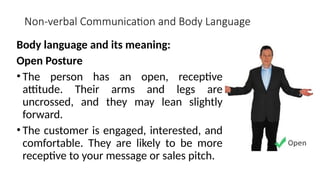
Open Posture
• The person has an open, receptive
attitude. Their arms and legs are
uncrossed, and they may lean slightly
forward.
• The customer is engaged, interested, and
comfortable. They are likely to be more
receptive to your message or sales pitch.
Non-verbal Communication and Body Language
Body language and its meaning:
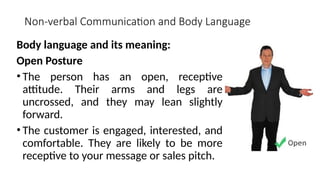
Open Posture
• The person has an open, receptive
attitude. Their arms and legs are
uncrossed, and they may lean slightly
forward.
• The customer is engaged, interested, and
comfortable. They are likely to be more
receptive to your message or sales pitch.
Non-verbal Communication and Body Language
Body language and its meaning:
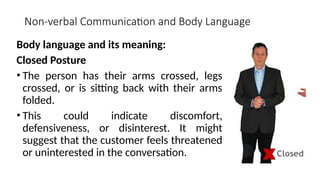
Closed Posture
• The person has their arms crossed, legs
crossed, or is sitting back with their arms
folded.
• This could indicate discomfort,
defensiveness, or disinterest. It might
suggest that the customer feels threatened
or uninterested in the conversation.
Non-verbal Communication and Body Language
Body language and its meaning:
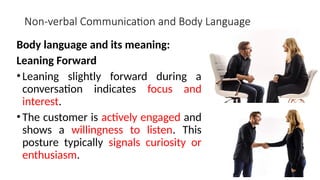
Leaning Forward
•Leaning slightly forward during a
conversation indicates focus and
interest.
•The customer is actively engaged and
shows a willingness to listen. This
posture typically signals curiosity or
enthusiasm.
Non-verbal Communication and Body Language
Body language and its meaning:
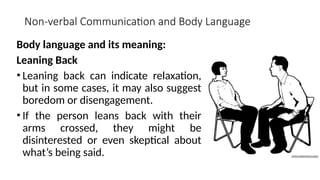
Leaning Back
• Leaning back can indicate relaxation,
but in some cases, it may also suggest
boredom or disengagement.
• If the person leans back with their
arms crossed, they might be
disinterested or even skeptical about
what’s being said.
Non-verbal Communication and Body Language
Body language and its meaning:
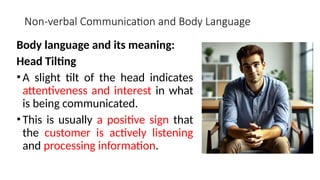
Head Tilting
•A slight tilt of the head indicates
attentiveness and interest in what
is being communicated.
•This is usually a positive sign that
the customer is actively listening
and processing information.
Non-verbal Communication and Body Language
Body language and its meaning:
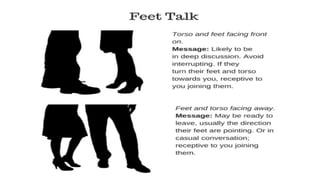
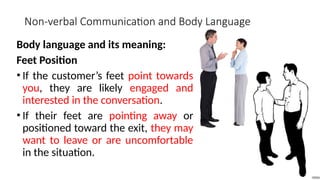
Feet Position
• If the customer’s feet point towards
you, they are likely engaged and
interested in the conversation.
• If their feet are pointing away or
positioned toward the exit, they may
want to leave or are uncomfortable
in the situation.
Non-verbal Communication and Body Language
Body language and its meaning:
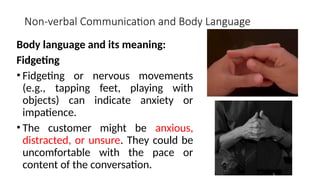
Fidgeting
• Fidgeting or nervous movements
(e.g., tapping feet, playing with
objects) can indicate anxiety or
impatience.
• The customer might be anxious,
distracted, or unsure. They could be
uncomfortable with the pace or
content of the conversation.
Non-verbal Communication and Body Language
Body language and its meaning:
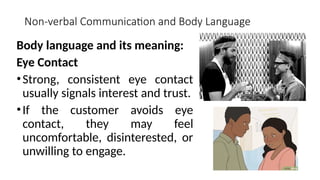
Eye Contact
•Strong, consistent eye contact
usually signals interest and trust.
•If the customer avoids eye
contact, they may feel
uncomfortable, disinterested, or
unwilling to engage.
Non-verbal Communication and Body Language
Body language and its
meaning:
Mirroring
• When a customer subtly
mirrors your posture or
gestures, it’s a sign of rapport
and alignment.
• This suggests that the
customer is comfortable and
is likely to respond positively
to your suggestions.
Non-verbal Communication and Body Language
2. Facial Expressions
•A genuine smile is inviting and warm, helping to
put customers at ease. It conveys friendliness,
approachability, and confidence.
•Mirroring the customer’s facial expressions (e.g.,
nodding or showing understanding when they
express a concern) demonstrates empathy.
Non-verbal Communication and Body Language
3. Positioning and Space
•Respecting Personal Space: Standing an
appropriate distance from the customer helps
them feel comfortable. Aim for about an arm’s
length in typical sales settings.
•Aligning Body Angle: Standing or sitting at a slight
angle (not directly facing) can make conversations
feel more relaxed and collaborative, rather than
confrontational.
Language and Gestures Across Regions
Urban vs. Rural Differences
1. Language
• Urban Areas (Metro Manila, Cebu, Davao, etc.): In larger
cities, Tagalog (or Filipino) is commonly spoken, and
English is widely understood, especially among the
younger, more educated population. Urban areas tend to
have more formal, direct communication styles.
Example: "Kumusta po, how can I help you today?" or "I
understand what you need; let’s look at the options
available."
Language and Gestures Across Regions
Urban vs. Rural Differences
1. Language
• Rural Areas (Provincial Areas, Small Towns): In rural areas,
people are more likely to speak their local dialects (e.g.,
Ilocano, Cebuano, Hiligaynon, Bicolano) in addition to
Filipino. English proficiency may vary depending on the
region, with older generations less comfortable using it.
Example: A simple greeting in the local dialect like
"Maayong adlaw" (Good day in Cebuano) can help break the
ice and create a more personal connection.
Language and Gestures Across Regions
Urban vs. Rural Differences
2. Gestures
• Urban Areas: In cities, gestures are generally more relaxed,
though still professional. For example, handshakes are
common in business settings
• Rural Areas: In more traditional rural areas, a handshake
might be replaced with a gesture like a bow or a head nod,
and younger people might use more respectful forms of
address, like "po" and "opo" when speaking to elders.
Language and Gestures Across Regions
Urban vs. Rural Differences
2. Gestures
• Urban Areas: In cities, gestures are generally more relaxed,
though still professional. For example, handshakes are
common in business settings
• Rural Areas: In more traditional rural areas, a handshake
might be replaced with a gesture like a bow or a head nod,
and younger people might use more respectful forms of
address, like "po" and "opo" when speaking to elders.
The ‘art of salesmanship’ depends upon
personality and skills of salesman. A well-
groomed person equipped with ‘knowledge’: the
knowledge of product/ service, knowledge about
the company, knowledge about the competitors,
knowledge of customers, sales related marketing
policies and knowledge of selling techniques is
the pre-requisite of salesmanship.
Sales-person without product knowledge is
just like body without soul. Of course,
salesmen should ‘dress to impress’; as a good
personality is the starting point of any sale;
but perfect knowledge of the industry/ firm;
product/services and the customer segment
to be targeted helps the salesman in dealing
with the customer in a satisfactory manner.
Benefits of knowledge to Salesman
• Increases the self-confidence of the salespersons: Due to knowledge
of salesman gains confidence and expertise in handling prospects.
• Satisfaction to customers: Salespersons can guide the prospects about
how to use and what precautions should be taken while using that
product.
• Increase in sales through better services to the prospects: A satisfied
customer makes repeat orders and also recommends it to others.
• Better position over competitors: With adequate knowledge of rival
companies and their products, he can put across superiority of his own
product.
The salesperson should know everything about
the company he or she is connected. The most
common thing that a prospect is interested is
about the company’s reputation where he will
make an investment or purchase a product.
KNOWING YOUR COMPANY AND YOUR COMPETITOR
What company information does a salesman should
know?
1. History of the company;
2. Company’s business area;
3. Management and financial aspect;
4. Competitive position;
5. Production process;
6. Research and development;
7. Service and distribution policies.
1. History of the company
The salesperson should have the knowledge of the
conception and earlier years of his company.
Why?
It enables you to converse intelligently with old
buyers who have dealings with your company
before. The salesperson’s familiarity of the history
of the company will build a positive image in the
mind of the prospect.
2. Company’s business area.
The prospect is always inclined to know where he
or she can transact business or make a follow-up.
The salesperson should provide the client with the
list of their branches, address, contact number,
and the specific person to talk to.
3. Management and Financial aspect
This aspect is very important. The existence and
stability of the company lies on the people who
managed the company wisely. The financial aspect
determines the financial stability and liquidity of
the business. The salesman should have a deep
knowledge and understanding on this matter to
persuade the client to entrust the business with
them.
4. Competitive position
Despite the challenging market competition, the
salesman must be able to address the competitive
position of his company. He might stress out the
good reputation, their rank in the industry and
how do they get there. Competitive salespeople
and different investment the company has into can
be also cited.
5. Production process
In case of price objection occur, the salesman may
justify it through the production method employed
by the company. The raw materials, the people
involved, and the scrutiny of the process will make
justice to a high price objection.
6. Research and development
The transition of product from old into its new
form is very important to customer. How it was
conceptualized, what triggers it are the questions
that needs to be answered properly by the
salesman. Latest development in other product line
should be known by the salesman. Keeping the
client informed and updated build confidence and
a chance to keep business with your company.
7. Service and distribution policies.
The salesman must be able to convey the service
facilities they offer such as installation, delivery and
many others.
Distribution policies should be disclosed. The
delivery time, delivery charges, discounts and
promotion must be discussed. Avoid overpromise
but under deliver product.
What is the importance of knowing your
competitor?
1. You can learn from their mistakes
When you find mistakes or things that didn’t
seem to work very well for your competition, take
note of it. Work to avoid making the same
mistakes you see your competitors making.
What is the importance of knowing your competitor?
2. You can model what works for them
As you research your competitor also look for what’s
working really well for them. It’s very important that
you model what is working for your competitor and do
not copy your competition directly. You want to look
for strategies they are putting in place and overall
marketing efforts they are making to give you ideas on
how you can make your company better.
What is the importance of knowing your competitor?
3. They reveal opportunities in the marketplace
Looking at each of your competitors, you should be
able to determine what segment of the marketplace
they are targeting and what type of customers or
clients they are looking to attract. Through reasonable
deduction, you can find new opportunities and tap
those gapped market for your product or service.
BENCHMARKING WITH THE COMPETITOR
•Identify their competitive advantage
Are they faster, more affordable, better than you are?
•How are they marketing?
Where is their focus? Who is their typical client? How
do they follow up with potential customers to convert
them into actual ones? In short, what are they doing?
•What about their sources and product expenses?
Are they getting resources at less cost?
BENCHMARKING WITH THE COMPETITOR
• What about their people?
Are their employees superior to yours? Why? Is it training? The
hiring process? How they are supervised? Motivated?
Compensated?
• How is their image compared with yours?
This refers to the company image that comes up when someone
thinks of your company and theirs.
• What about customer retention?
Do they seem to have customers for life? What is it about the way
they do business that stimulates this kind of loyalty.
PRODUCT KNOWLEDGE
What are the product information that the salesman must
know?
1. Production methods – how the product is being processed.
2. Service facilities - different service facilities that the client
may reach
3. Distribution and Delivery - Distribution policies and pricing
policies, how the product should be delivered
4. Product lines and differentiation - complementary or
related products
5. Technical details - materials the product is made of
SOURCES OF PRODUCT KNOWLEDGE
•Personal Experience
•Senior and Fellow Salesmen
•Sales Manuals
•Sales Bulletins
•Salesman’s Portfolio
•Plant Visits
•Meetings and Conferences
KNOWING THE PROSPECT
Why prospects buy?
1. Basic needs - to fulfil the basic needs.
2. Convenience - if there is an urgent need, the
prospect will take the easiest or fastest path to
get it.
3. Replacement - customers buy because they need
to replace old things they have.
4. Scarcity - a perceived need that something may
run out or have limited availability in the future.
Why prospects buy?
5. Prestige or aspirational purchase - purchased
for an esteem related reason or for personal
development.
6. Emotional emptiness - buy to try to replace
things you cannot have and never will.
7. Lower prices - identified earlier as a want is
now at a lower price than before.
Why prospects buy?
8. Great value - when the perceived value considerably exceeds
the price of a product or service. This is something you don’t
particularly need; you just feel it’s too good of a deal to ignore.
9. Name recognition - purchasing a product category you’ re
unfamiliar with, branding plays a big role. Maybe you had to
buy diapers for a family member and you reach for Pampers
because of your knowledge with the brand, even though you
don’t have children yourself.
Why prospects buy?
10. Fad or innovation - everybody wants the latest and
greatest. This could also be when someone imitates their
favorite celebrity.
11. Compulsory purchase - some external force, like school
books, uniforms.
12. Ego - sometimes you make a purchase to attract someone
or to have something bigger and better than others.
Why prospects buy?
13. Niche identity - something that helps bond you to a
cultural, religious, or community affiliation.
14. Peer pressure - something is purchased because your
friends want you to.
15. The “Girl Scout Cookie effect” - people feel better
about themselves by feeling as though they9re giving
to others
Why prospects buy?
16. Reciprocity or guilt - happens when somebody,
usually an acquaintance, or someone rarely gift-
worthy buys you a gift.
17. Empathy - sometimes people buy from other people
because they listened and cared about them.
18. Addiction – buying things you’re attached to.
Why prospects buy?
19. Fear – buy to protect yourself (Guns, oversized
vehicle).
20. Indulgence – “Deserve ko to”. So long as you
can afford it, sometimes there’s no better
justification for that hour-long massage, that
half of mango flavor ice cream.
TYPES OF PROSPECTS
• The Bargain-hunter
Doesn’t matter if calm and quiet, or confident and loud;
this customers always want to bargain. If you’re dealing
with them, know that a common objection is to bargain
your price based on a cheaper competitors offer.
How to deal with a bargain hunter:
• point out the good quality and performance of the
product
TYPES OF PROSPECTS
• The Intelligent type
The intelligent types are confident. They will walk directly
towards you, giving you a firm handshake. Often their decision
to purchase is based on how the product reflects their social
status.
• How to deal with a bargain hunter:
provide them with precise information. Acknowledging their
competence will comfort them. If their idea is false try not to
lecture them as this will make them uncomfortable and
perhaps even angry.
TYPES OF PROSPECTS
• The Annoyed type
Every once in a while you have to deal with customers who complain about
almost everything. Whether it’s the high price, the bad quality or the
unfriendly seller there’s nothing really you can do to please the customer.
They’re just always irritated.
How to deal with the annoyed ones:
• impress them with expertise. Ease the customer’s mind with theright
balance between problem solution, approval, politeness and courteous
treatment. When getting the feeling of being listened and responded to,
you’re eventually able to convince them.
TYPES OF PROSPECTS
• The Annoyed type
Every once in a while you have to deal with customers who complain
about almost everything. Whether it’s the high price, the bad quality
there’s nothing really you can them. They’re just always irritated.
How to deal with the annoyed ones:
• impress them with expertise. Ease the customer’s mind with the
right balance between problem solution, approval, politeness and
courteous treatment. When getting the feeling of being listened
and responded to, you’re eventually able to convince them.
TYPES OF PROSPECTS
• The Suspicious type
Suspicious customers will not hide their mistrust of products and
advertising. They’re one thing above all: critical. They will gladly let
you explain everything and surprise you with a strong opinion and
knowledge.
How to deal with the annoyed ones:
• Don’t interrupt them; make them feel that they are taken seriously.
You need to seek confidence and show them that they are in best
hands. Assure to provide reliable information and convince them
with great expertise.
TYPES OF PROSPECTS
• The Argumentative type
This type of customer can be very pushy and confrontational.
How to deal with the annoyed ones:
• Firstly try to find out if they really intend to buy. Perhaps they
already ordered the product somewhere else and just want a free
consultation. If you don’t think so, stay friendly and patient as
always. Even if these customers are not buying right away, your
patience will be remembered.
TYPES OF PROSPECTS
• The Open-minded type
These customers are reserved and act shy. They will say “yes” quickly.
At the same time they’re overwhelmed and feel that they’ve been
taken by surprise. The sales conversation is a stressful moment for
them. Sensitivity is required here.
How to deal with the annoyed ones:
• Make sure you ask open questions to find out about the customer’s
needs and preferences. Give him the time for consideration and
leave him in the meantime. Let him approach you for his final
purchase decision..
TYPES OF PROSPECTS
• The Slow-thinking type
Customers who aren’t really sure about what they want. They’ll give
you short, indecisive answers, saying things like “maybe” or the
dreaded “I don’t know”. They are considering whether to buy or not
to buy.
How to deal with the annoyed ones:
• To convince them, they’re going to need a little, or a lot
handholding. Educate this type of customer on why your product is
the best one for them. Support their final decision a few more
times by approving the purchase.
Quiz
• Part 1: Multiple Choice
• Why is company knowledge important to the salesperson?
• What do you think are the advantages and disadvantages of benchmarking
with your competitor?
• Explain: “Salesperson are made not born”.
• Describe and provide example of products or services under the following
forces that influence why prospects buy:
Lower pricesFad/innovation Fear
Ego Prestige Scarcity
Convenience Peer pressure Empathy
Indulgence
Who would you sell to?
STAGES OF SALES PROCESS
SALESPROCESS
•The sales process is a structured series of
steps that a salesperson takes to turn potential
customers into actual customers.
•A sales process is mainly about creating relationships
with potential customers. It’s about asking questions,
educating and providing value for them.
•The most effective sales processes have between five
and seven steps.
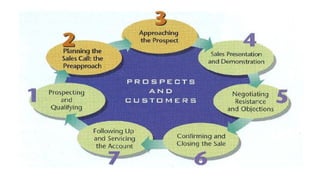
Stages of Sales Process
PROSPECTING
•Identifying potential customers (prospects)
•Prospecting is the process of searching for
potential clients, or buyers in order to develop
new business. The end goal is to move prospects
through the sales process until they eventually
convert into revenue-generating customers.
•Finding potential customers.
Prospecting ensures that the bottom level of
your sales channel is always full. Prospecting
involves continuously contacting new leads
for sales and converting them into customers.
The longer you keep prospecting, the longer
will be the sales channel and hence the better
will be the sales income.
Hence you will notice businesses which have been
existing since a decade don’t do prospecting any
more or don’t invest much in new customers. This
is because they invested quite well in their idle
days and that effort pays off in the long run. Once a
steady stream of customers starts flowing in, you
only need to take care of the referrals and then the
cycle continues.
Stages of Sales Process
PROSPECTING
•few ways to generate prospects:
•Networking (in-person) – talking to them
•Cold Outreach – calling or sending email
•Social Selling – using social media
•Advertising –TV ads or print ads
•Events & Trade Shows
Stages of Sales Process
PROSPECTING
•PROSPECTING METHODS
• Endless Chain Method - salesman gathers the names
and addresses of friends and relatives and interviews
the persons who are likely to be prospects.
• Center of Influence Method - . A salesman develops
a selected group of persons who serve as his center
of influence in his own territory or the community.
Stages of Sales Process
PROSPECTING
•PROSPECTING METHODS
•Personal Observation Method - this method is
popularly known as “eyes and ears” inductive
method where salesman observes keenly,
meaningfully and meticulously.
•Spotters Methods – use of junior salesman spotting
for prospects
Stages of Sales Process
PROSPECTING
•PROSPECTING METHODS
• Cold Canvas Method - salesman takes a calculated
chance by collecting the names and addresses in a
particular area and meets them.
• Direct Mail and Telephone Method - the salesman
contacts the past and present users of the products
by mail. The sent message covers the arrival of new
products.
Stages of Sales Process
PROSPECTING
•PROSPECTING METHODS
• Exhibits and Demonstration - As the visitors walk to
examine the products, the experienced salesman
takes a few minutes to gets their names and
addresses so as to contact them later on either at
their homes or offices for demonstration.
• Referrals - a network of prospective client whom he
can make appointments.
Stages of Sales Process
QUALIFYING PROSPECTS
•Qualifying is the process of assessing prospective
customers to determine their probability in buying the
products.
•This is usually to decide whether it is worth putting
any effort into the sale. It also may determine
whether to visit the customer, conduct business over
the phone or otherwise apportion effort proportional
to the value that may be gained from the customer.
Stages of Sales Process
QUALIFYING PROSPECTS
Characteristics of a Qualified Prospect
•Have the NEED
•Have the ability to PAY
•Have the AUTHORITY to buy
•Have the TIME to buy
Stages of Sales Process
QUALIFYING PROSPECTS
Characteristics of a Qualified Prospect
• They have a Need - a highly qualified prospect needs your product
now or relatively soon.
• They have ability to Pay - a qualified prospect has the money to
buy your product or service.
• They have the Authority - a person may have need of product and
ability to pay; but if he does not possess the authority to
purchase, he is not worthy a prospect.
• They have the Time - it means whether a person can be contacted
easily or not.
Stages of Sales Process
•Pre-approach is the second step in sales process.
•Prospecting is completed when the salesman feels
that he knows enough about the prospect and that
there is a chance of selling to him.
•In the pre-approach stage, the salesman collects
information about the prospect, his likes and dislikes,
habits, types of economic status. This helps him a lot
to plan his selling proposition intelligently.
Stages of Sales Process
•Approach
•This is an important stage where the salesperson
must be very careful because this can make or break
the sale. The methods used by the salesperson should
depend on the prospects type and the nature of
product. 3 important things in this stage:
• Attention
• Interest
• Transition
Stages of Sales Process
PRELIMINARIES DURING APPROACH
•Greet the Prospect.
•Introduce yourself.
•Offer a warm handshake.
•Discuss few related matters that will interest the
prospect.
•Introduce the product shortly.
Stages of Sales Process
METHODS FOR APPROACHING PROSPECTS:
• Introductory Approach
• This is the most commonly used technique. Unfortunately, it
is also the weakest. This is only applicable if the prospect is
already expecting the salesperson, and there is already a
recognize problem from which the salesperson may be of
help.
• Example:
“Hello, Mr. Moreno, I am Jocel Pajantoy representing Ryco
Maketing Company.”
Stages of Sales Process
METHODS FOR APPROACHING PROSPECTS:
Introductory Approach
• In this approach, the prospect might reply, “okay, so what do
you want?”
• This response sometimes makes the salesperson awkward. In
some situations, it is best to leave introductions after a
successful approach is made. Better yet, the salesperson
after introductory approach must use other approach to
immediately erase the tension.
Stages of Sales Process
METHODS FOR APPROACHING PROSPECTS:
Consumer-Benefit Approach.
Consist of opening the interview with a statement or question
which directs the benefit that you want to offer with the
prospect. It is designed to awaken the prospects curiosity.
Example:
Car sales executive might asked, “Isn’t it nice to reward
yourself a brand new car after all your hard work?”
Stages of Sales Process
METHODS FOR APPROACHING PROSPECTS:
Compliment Method
This is a simple appreciation of things related to prospect
before the interview started. Building rapport is important.
Prospect hardly trust the salesperson, not until the sales
person can break the ice between them.
Example:
“Mr. Luna, I can see that you have a great family here. Your
son is as handsome as you. I wonder how your younger years
go through.”
Stages of Sales Process
METHODS FOR APPROACHING PROSPECTS:
Question Method
The use of question to open an interview is an art itself. It can
be used in combination with other approaches.
Example:
“Sir, how do you find yourself doing after retirement?”
Stages of Sales Process
METHODS FOR APPROACHING PROSPECTS:
Shock Method
This is another method of approach where the salesman prefers
to shock the prospect by demonstrating the element of fear. It
may be fear of old age, death, sickness, fire, theft and the like
that have profound and great concern in one’s life.
Example:
“Sir if things happen against your calculation, what do you think
will happen to your family? Will you not be haunted by your
conscience knowing that you could have done this before?”
TYPES OF SALES APPROACHES
There's no one best way to sell. Your personality
and background will determine which type of sales
technique is most effective for you. Even if you
have a methodology that works well, it's a good
idea to try a different approach now and then.
Trying new methods keeps you out of a rut, and
you may be surprised by how well a new strategy
works for you. In fact, many sales people do best
by using a combination of approaches.
TYPES OF SALES APPROACHES
The Instant Buddy
• Salespeople who use this approach are warm and friendly,
asking questions and showing interest in their prospects.
They try to connect on an emotional level with a prospective
customer.
• This approach can be very effective, but only in the right
hands. Don't try to make friends with a prospect unless you
really mean it - people can tell if you're faking it, and they'll
be very unhappy with you. You'll also need to do some follow-
through to demonstrate that you really do like the prospect.
TYPES OF SALES APPROACHES
The Guru
•They position themselves as problem-solvers, able to
answer any question and tackle any issue that the
prospect lays before them.
•The guru approach requires plenty of work learning
the relevant information and keeping up with changes
in your industry. Once customers realize what a great
resource you are, they're quite likely to send friends
and co-workers with questions straight to you.
TYPES OF SALES APPROACHES
The Consultant
• This approach combines the 'guru' and 'buddy'
approaches. She knows all about her company's products
and by asking a prospect a few questions, she can match
him up with the best product for his needs.
• As an approach that combines the best qualities of the of
the first two methods, it's extremely effective. You must be
both knowledgeable and able to make an emotional
connection with your prospects. If you can manage both of
these feats, your sales will take off like a rocket.
TYPES OF SALES APPROACHES
The Networker
• Setting up and maintaining a web of friends, co-workers,
salespeople from other companies, customers and former
customers, and anyone else he meets.
• A strong enough network will create an on-going flow of warm
leads that can provide most or even all of the salesperson's
needs.
• With this approach, you'll spend a great deal of time cultivating
people. It's a highly effective technique for salespeople who enjoy
attending various events, parties, and so on and meeting new
people.
TYPES OF SALES APPROACHES
The Networker
• Setting up and maintaining a web of friends, co-workers,
salespeople from other companies, customers and former
customers, and anyone else he meets.
• A strong enough network will create an on-going flow of warm
leads that can provide most or even all of the salesperson's
needs.
• With this approach, you'll spend a great deal of time cultivating
people. It's a highly effective technique for salespeople who enjoy
attending various events, parties, and so on and meeting new
people.
TYPES OF SALES APPROACHES
The Hard Seller
Best described as “scare the prospect into buying”, the
hard sell approach is what gives salespeople their bad
reputation. Hard selling involves getting someone to buy
a product even though he doesn't want or need it.
Methods range from bullying “Buy this now or you'll feel
stupid tomorrow” to manipulation “If you don't buy from
me I'll lose my job” to outright deception “This product
has a much better safety record than the competition”.
Quiz: Types of Sales Approaches
1. This salesperson establishes an approachable demeanor to build
trust and rapport, focusing on creating a personal connection.
2. Known for their expertise, this salesperson provides in-depth
knowledge about products or services.
3. This salesperson takes a solution-oriented approach, carefully
assessing the customer's needs and tailoring recommendations to
solve their problems effectively.
4. Building and maintaining relationships is their forte, and they
thrive on leveraging connections.
5. Often assertive and persistent, this salesperson employs high-
pressure tactics to close deals.
Quiz: Types of Sales Approaches
6. By acting as an advisor, this salesperson ensures their recommendations align
with the customer's goals, earning trust through personalized advice and
genuine care.
7. They exude confidence and are always prepared with detailed insights,
impressing potential clients with their authority and mastery of the product.
8. This approach relies heavily on social and professional networks, with the
salesperson prioritizing long-term relationship building over short-term gains.
9. Often prioritizing the relationship above the sale, this salesperson uses humor,
compliments, or shared interests to create an enjoyable buying experience.
10. Their aggressive style can sometimes alienate potential buyers, but they focus
on quick, transactional success, often ignoring long-term relationship-building.
Quiz: Methods of Approaching to Prospects
11.The salesperson starts by highlighting the advantages or specific
benefits the product or service can provide to the prospect.
12.A direct and straightforward approach where the salesperson
introduces themselves and their purpose without diving into details
immediately.
13.The salesperson captures the prospect’s attention by making a
surprising or dramatic statement to spark interest in the conversation.
14.This approach begins by asking an open-ended or thought-provoking
question to engage the prospect and understand their needs.
15.The salesperson uses a positive remark about the prospect or their
achievements to create a friendly and engaging start to the
conversation.
Exercise:
Provide your own example of Sales approach script in the
following Approach method:
1. Introductory approach
2. Consumer-benefit approach
3. Compliment method
4. Question method
5. Shock method

PROFESSIONAL SALESMANSHIP MIDTERM .pptx

  • 1.
  • 2.
    The exchange ofinformation between a salesperson and a customer. - Communication
  • 3.
    What makes acommunication effective?
  • 5.
    •Ang bango mo. •Angbango mo! •Ang bango mo? •Ang bango mo!!!!!
  • 6.
    Verbal Communication Techniques: 1.Tone of voice Different tones convey different intentions, and a salesperson's skill in adjusting their tone to fit the context can significantly impact the outcome of the interaction. Types of tone: Friendly and Warm Tone - helps establish a positive and inviting atmosphere, encouraging open communication. Sample Line: “It’s great to meet you! How may I help you today?”
  • 7.
    Verbal Communication Techniques: •Typesof tone: Confident and Assured Tone- to establish credibility and show that you are knowledgeable about the product or service. Use it when explaining product features, benefits, and addressing questions or concerns. Sample Line: “This product has a proven track record and is one of the best choices for durability and efficiency.”
  • 8.
    Verbal Communication Techniques: •Typesof tone: Empathetic and Understanding Tone - to show empathy and understanding, especially when a customer expresses concerns, objections, or frustrations. Use when addressing a customer’s worries, such as price or product limitations. Sample Line: “I understand how important it is for you to stay within your budget. Let’s look at some options that might work for you.”
  • 9.
    Verbal Communication Techniques: •Typesof tone: Excited and Enthusiastic - To create excitement and make the product or service sound appealing. Use when introducing new features or benefits that would resonate with the customer’s interests. Sample Line: “You’re going to love this feature! It makes everything so much easier and more enjoyable.”
  • 10.
    Verbal Communication Techniques: •Typesof tone: Calm and Reassuring Tone - To provide comfort and ease any anxieties or stress the customer may feel. Use when explaining complex features or discussing sensitive topics like cost. Sample Line: “Take your time to think it over. I’m here to answer any questions, whenever you’re ready.”
  • 12.
    Tips for UsingTone Effectively: • Adapt to the Customer’s Emotional State: Match the customer’s mood to show empathy and make adjustments if their emotions shift. • Pace and Volume Matter: A slow, steady tone conveys calmness, while a lively, energetic tone shows enthusiasm. Be mindful not to speak too quickly, which can cause confusion, or too loudly, which may seem pushy. • Avoid Monotony: Vary your tone to maintain the customer’s interest, particularly during long discussions or presentations. • Practice Self-Awareness: Record practice sales pitches to evaluate how your tone comes across and adjust as necessary for clarity and sincerity.
  • 13.
    Verbal Communication Techniques: 2.Clarity and Conciseness: Salespeople need to articulate their message clearly and avoid jargon. Using simple language ensures the customer easily understands the message. Example: "This product can help reduce your electricity bill by 30% over a year," rather than, "This product utilizes state-of-the-art technology to enhance energy efficiency."
  • 14.
    Verbal Communication Techniques: 3.Active Listening: Verbal communication is not only about speaking but also about listening. Active listening allows salespeople to understand customer needs and respond accordingly. Example: Reflecting the customer’s concerns with phrases like, "It sounds like you're worried about the durability of the product. Let me explain how it’s made to last."
  • 15.
    Verbal Communication Techniques: Roleof Active Listening in Understanding Customer Needs: • Building Trust: when customers feel heard and understood • Identifying Needs: helps salespeople identify not just the surface-level needs also the underlying concerns. • Personalizing the Approach:, salespeople can tailor their offer to match the customer’s specific situation, preferences, and pain points • Improving Customer Experience: ensures the customer feels valued, respected, and that their needs are prioritized.
  • 16.
    Verbal Communication Techniques: KeySteps of Active Listening 1. Pay Attention • Give the customer your full attention. Use positive body language to show that you are engaged. 2. Verbal Acknowledgment: • Phrases like “I see,” “That makes sense,” or “I understand” signal to the customer that you are following along with what they are saying.
  • 17.
    Verbal Communication Techniques: KeySteps of Active Listening 3. Provide Feedback • Paraphrasing and Summarizing: After the customer has shared information, paraphrase or summarize what they said to ensure understanding. • Reflective Statements: Reflect the emotional tone of the conversation. If a customer expresses frustration, acknowledging it with a statement like “It seems like you’ve been frustrated with the product” shows empathy.
  • 18.
    Verbal Communication Techniques: KeySteps of Active Listening 3. Provide Feedback • Paraphrasing and Summarizing: After the customer has shared information, paraphrase or summarize what they said to ensure understanding. • Reflective Statements: Reflect the emotional tone of the conversation. If a customer expresses frustration, acknowledging it with a statement like “It seems like you’ve been frustrated with the product” shows empathy.
  • 19.
    Verbal Communication Techniques: KeySteps of Active Listening 4. Defer Judgment • Avoiding Interruptions: Don’t jump to conclusions or interrupt while the customer is speaking. Refrain from immediately offering a solution or advice until you fully understand the problem. • Open Mind: Active listening requires withholding judgment, even if you feel you know what the customer needs. Stay open to hearing their full perspective before making any assumptions or offering solutions.
  • 20.
    Verbal Communication Techniques: KeySteps of Active Listening 4. Defer Judgment • Avoiding Interruptions: Don’t jump to conclusions or interrupt while the customer is speaking. Refrain from immediately offering a solution or advice until you fully understand the problem. • Open Mind: Active listening requires withholding judgment, even if you feel you know what the customer needs. Stay open to hearing their full perspective before making any assumptions or offering solutions.
  • 21.
    Verbal Communication Techniques: 4.Asking Open-Ended Questions: Ask open-ended questions to gather information and engage customers. Example: “What are some challenges you're currently facing with your current product?” vs. closed questions like “Are you satisfied with your current product?”
  • 22.
    Non-verbal Communication andBody Language Non-verbal communication plays a significant role in sales, as it can reinforce or undermine the spoken message and impact the customer's perception of the salesperson's trustworthiness and professionalism. 1. Body language – a powerful non-verbal communication tool that often reveals more about a person’s emotions and attitudes than words alone.
  • 23.
    Non-verbal Communication andBody Language Body language and its meaning: Open Posture • The person has an open, receptive attitude. Their arms and legs are uncrossed, and they may lean slightly forward. • The customer is engaged, interested, and comfortable. They are likely to be more receptive to your message or sales pitch.
  • 24.
    Non-verbal Communication andBody Language Body language and its meaning: Open Posture • The person has an open, receptive attitude. Their arms and legs are uncrossed, and they may lean slightly forward. • The customer is engaged, interested, and comfortable. They are likely to be more receptive to your message or sales pitch.
  • 25.
    Non-verbal Communication andBody Language Body language and its meaning: Closed Posture • The person has their arms crossed, legs crossed, or is sitting back with their arms folded. • This could indicate discomfort, defensiveness, or disinterest. It might suggest that the customer feels threatened or uninterested in the conversation.
  • 27.
    Non-verbal Communication andBody Language Body language and its meaning: Leaning Forward •Leaning slightly forward during a conversation indicates focus and interest. •The customer is actively engaged and shows a willingness to listen. This posture typically signals curiosity or enthusiasm.
  • 28.
    Non-verbal Communication andBody Language Body language and its meaning: Leaning Back • Leaning back can indicate relaxation, but in some cases, it may also suggest boredom or disengagement. • If the person leans back with their arms crossed, they might be disinterested or even skeptical about what’s being said.
  • 29.
    Non-verbal Communication andBody Language Body language and its meaning: Head Tilting •A slight tilt of the head indicates attentiveness and interest in what is being communicated. •This is usually a positive sign that the customer is actively listening and processing information.
  • 30.
    Non-verbal Communication andBody Language Body language and its meaning: Feet Position • If the customer’s feet point towards you, they are likely engaged and interested in the conversation. • If their feet are pointing away or positioned toward the exit, they may want to leave or are uncomfortable in the situation.
  • 32.
    Non-verbal Communication andBody Language Body language and its meaning: Fidgeting • Fidgeting or nervous movements (e.g., tapping feet, playing with objects) can indicate anxiety or impatience. • The customer might be anxious, distracted, or unsure. They could be uncomfortable with the pace or content of the conversation.
  • 33.
    Non-verbal Communication andBody Language Body language and its meaning: Eye Contact •Strong, consistent eye contact usually signals interest and trust. •If the customer avoids eye contact, they may feel uncomfortable, disinterested, or unwilling to engage.
  • 34.
    Non-verbal Communication andBody Language Body language and its meaning: Mirroring • When a customer subtly mirrors your posture or gestures, it’s a sign of rapport and alignment. • This suggests that the customer is comfortable and is likely to respond positively to your suggestions.

  • 36.
    Non-verbal Communication andBody Language 2. Facial Expressions •A genuine smile is inviting and warm, helping to put customers at ease. It conveys friendliness, approachability, and confidence. •Mirroring the customer’s facial expressions (e.g., nodding or showing understanding when they express a concern) demonstrates empathy.
  • 38.
    Non-verbal Communication andBody Language 3. Positioning and Space •Respecting Personal Space: Standing an appropriate distance from the customer helps them feel comfortable. Aim for about an arm’s length in typical sales settings. •Aligning Body Angle: Standing or sitting at a slight angle (not directly facing) can make conversations feel more relaxed and collaborative, rather than confrontational.
  • 41.
    Language and GesturesAcross Regions Urban vs. Rural Differences 1. Language • Urban Areas (Metro Manila, Cebu, Davao, etc.): In larger cities, Tagalog (or Filipino) is commonly spoken, and English is widely understood, especially among the younger, more educated population. Urban areas tend to have more formal, direct communication styles. Example: "Kumusta po, how can I help you today?" or "I understand what you need; let’s look at the options available."
  • 42.
    Language and GesturesAcross Regions Urban vs. Rural Differences 1. Language • Rural Areas (Provincial Areas, Small Towns): In rural areas, people are more likely to speak their local dialects (e.g., Ilocano, Cebuano, Hiligaynon, Bicolano) in addition to Filipino. English proficiency may vary depending on the region, with older generations less comfortable using it. Example: A simple greeting in the local dialect like "Maayong adlaw" (Good day in Cebuano) can help break the ice and create a more personal connection.
  • 43.
    Language and GesturesAcross Regions Urban vs. Rural Differences 2. Gestures • Urban Areas: In cities, gestures are generally more relaxed, though still professional. For example, handshakes are common in business settings • Rural Areas: In more traditional rural areas, a handshake might be replaced with a gesture like a bow or a head nod, and younger people might use more respectful forms of address, like "po" and "opo" when speaking to elders.
  • 44.
    Language and GesturesAcross Regions Urban vs. Rural Differences 2. Gestures • Urban Areas: In cities, gestures are generally more relaxed, though still professional. For example, handshakes are common in business settings • Rural Areas: In more traditional rural areas, a handshake might be replaced with a gesture like a bow or a head nod, and younger people might use more respectful forms of address, like "po" and "opo" when speaking to elders.
  • 48.
    The ‘art ofsalesmanship’ depends upon personality and skills of salesman. A well- groomed person equipped with ‘knowledge’: the knowledge of product/ service, knowledge about the company, knowledge about the competitors, knowledge of customers, sales related marketing policies and knowledge of selling techniques is the pre-requisite of salesmanship.
  • 49.
    Sales-person without productknowledge is just like body without soul. Of course, salesmen should ‘dress to impress’; as a good personality is the starting point of any sale; but perfect knowledge of the industry/ firm; product/services and the customer segment to be targeted helps the salesman in dealing with the customer in a satisfactory manner.
  • 50.
    Benefits of knowledgeto Salesman • Increases the self-confidence of the salespersons: Due to knowledge of salesman gains confidence and expertise in handling prospects. • Satisfaction to customers: Salespersons can guide the prospects about how to use and what precautions should be taken while using that product. • Increase in sales through better services to the prospects: A satisfied customer makes repeat orders and also recommends it to others. • Better position over competitors: With adequate knowledge of rival companies and their products, he can put across superiority of his own product.
  • 51.
    The salesperson shouldknow everything about the company he or she is connected. The most common thing that a prospect is interested is about the company’s reputation where he will make an investment or purchase a product.
  • 52.
    KNOWING YOUR COMPANYAND YOUR COMPETITOR
  • 53.
    What company informationdoes a salesman should know? 1. History of the company; 2. Company’s business area; 3. Management and financial aspect; 4. Competitive position; 5. Production process; 6. Research and development; 7. Service and distribution policies.
  • 54.
    1. History ofthe company The salesperson should have the knowledge of the conception and earlier years of his company. Why? It enables you to converse intelligently with old buyers who have dealings with your company before. The salesperson’s familiarity of the history of the company will build a positive image in the mind of the prospect.
  • 57.
    2. Company’s businessarea. The prospect is always inclined to know where he or she can transact business or make a follow-up. The salesperson should provide the client with the list of their branches, address, contact number, and the specific person to talk to.
  • 60.
    3. Management andFinancial aspect This aspect is very important. The existence and stability of the company lies on the people who managed the company wisely. The financial aspect determines the financial stability and liquidity of the business. The salesman should have a deep knowledge and understanding on this matter to persuade the client to entrust the business with them.
  • 61.
    4. Competitive position Despitethe challenging market competition, the salesman must be able to address the competitive position of his company. He might stress out the good reputation, their rank in the industry and how do they get there. Competitive salespeople and different investment the company has into can be also cited.
  • 62.
    5. Production process Incase of price objection occur, the salesman may justify it through the production method employed by the company. The raw materials, the people involved, and the scrutiny of the process will make justice to a high price objection.
  • 63.
    6. Research anddevelopment The transition of product from old into its new form is very important to customer. How it was conceptualized, what triggers it are the questions that needs to be answered properly by the salesman. Latest development in other product line should be known by the salesman. Keeping the client informed and updated build confidence and a chance to keep business with your company.
  • 64.
    7. Service anddistribution policies. The salesman must be able to convey the service facilities they offer such as installation, delivery and many others. Distribution policies should be disclosed. The delivery time, delivery charges, discounts and promotion must be discussed. Avoid overpromise but under deliver product.
  • 65.
    What is theimportance of knowing your competitor? 1. You can learn from their mistakes When you find mistakes or things that didn’t seem to work very well for your competition, take note of it. Work to avoid making the same mistakes you see your competitors making.
  • 67.
    What is theimportance of knowing your competitor? 2. You can model what works for them As you research your competitor also look for what’s working really well for them. It’s very important that you model what is working for your competitor and do not copy your competition directly. You want to look for strategies they are putting in place and overall marketing efforts they are making to give you ideas on how you can make your company better.
  • 68.
    What is theimportance of knowing your competitor? 3. They reveal opportunities in the marketplace Looking at each of your competitors, you should be able to determine what segment of the marketplace they are targeting and what type of customers or clients they are looking to attract. Through reasonable deduction, you can find new opportunities and tap those gapped market for your product or service.
  • 69.
    BENCHMARKING WITH THECOMPETITOR •Identify their competitive advantage Are they faster, more affordable, better than you are? •How are they marketing? Where is their focus? Who is their typical client? How do they follow up with potential customers to convert them into actual ones? In short, what are they doing? •What about their sources and product expenses? Are they getting resources at less cost?
  • 70.
    BENCHMARKING WITH THECOMPETITOR • What about their people? Are their employees superior to yours? Why? Is it training? The hiring process? How they are supervised? Motivated? Compensated? • How is their image compared with yours? This refers to the company image that comes up when someone thinks of your company and theirs. • What about customer retention? Do they seem to have customers for life? What is it about the way they do business that stimulates this kind of loyalty.
  • 71.
  • 72.
    What are theproduct information that the salesman must know? 1. Production methods – how the product is being processed. 2. Service facilities - different service facilities that the client may reach 3. Distribution and Delivery - Distribution policies and pricing policies, how the product should be delivered 4. Product lines and differentiation - complementary or related products 5. Technical details - materials the product is made of
  • 73.
    SOURCES OF PRODUCTKNOWLEDGE •Personal Experience •Senior and Fellow Salesmen •Sales Manuals •Sales Bulletins •Salesman’s Portfolio •Plant Visits •Meetings and Conferences
  • 74.
  • 75.
    Why prospects buy? 1.Basic needs - to fulfil the basic needs. 2. Convenience - if there is an urgent need, the prospect will take the easiest or fastest path to get it. 3. Replacement - customers buy because they need to replace old things they have. 4. Scarcity - a perceived need that something may run out or have limited availability in the future.
  • 76.
    Why prospects buy? 5.Prestige or aspirational purchase - purchased for an esteem related reason or for personal development. 6. Emotional emptiness - buy to try to replace things you cannot have and never will. 7. Lower prices - identified earlier as a want is now at a lower price than before.
  • 77.
    Why prospects buy? 8.Great value - when the perceived value considerably exceeds the price of a product or service. This is something you don’t particularly need; you just feel it’s too good of a deal to ignore. 9. Name recognition - purchasing a product category you’ re unfamiliar with, branding plays a big role. Maybe you had to buy diapers for a family member and you reach for Pampers because of your knowledge with the brand, even though you don’t have children yourself.
  • 78.
    Why prospects buy? 10.Fad or innovation - everybody wants the latest and greatest. This could also be when someone imitates their favorite celebrity. 11. Compulsory purchase - some external force, like school books, uniforms. 12. Ego - sometimes you make a purchase to attract someone or to have something bigger and better than others.
  • 79.
    Why prospects buy? 13.Niche identity - something that helps bond you to a cultural, religious, or community affiliation. 14. Peer pressure - something is purchased because your friends want you to. 15. The “Girl Scout Cookie effect” - people feel better about themselves by feeling as though they9re giving to others
  • 80.
    Why prospects buy? 16.Reciprocity or guilt - happens when somebody, usually an acquaintance, or someone rarely gift- worthy buys you a gift. 17. Empathy - sometimes people buy from other people because they listened and cared about them. 18. Addiction – buying things you’re attached to.
  • 81.
    Why prospects buy? 19.Fear – buy to protect yourself (Guns, oversized vehicle). 20. Indulgence – “Deserve ko to”. So long as you can afford it, sometimes there’s no better justification for that hour-long massage, that half of mango flavor ice cream.
  • 82.
    TYPES OF PROSPECTS •The Bargain-hunter Doesn’t matter if calm and quiet, or confident and loud; this customers always want to bargain. If you’re dealing with them, know that a common objection is to bargain your price based on a cheaper competitors offer. How to deal with a bargain hunter: • point out the good quality and performance of the product
  • 83.
    TYPES OF PROSPECTS •The Intelligent type The intelligent types are confident. They will walk directly towards you, giving you a firm handshake. Often their decision to purchase is based on how the product reflects their social status. • How to deal with a bargain hunter: provide them with precise information. Acknowledging their competence will comfort them. If their idea is false try not to lecture them as this will make them uncomfortable and perhaps even angry.

  • 84.
    TYPES OF PROSPECTS •The Annoyed type Every once in a while you have to deal with customers who complain about almost everything. Whether it’s the high price, the bad quality or the unfriendly seller there’s nothing really you can do to please the customer. They’re just always irritated. How to deal with the annoyed ones: • impress them with expertise. Ease the customer’s mind with theright balance between problem solution, approval, politeness and courteous treatment. When getting the feeling of being listened and responded to, you’re eventually able to convince them.

  • 85.
    TYPES OF PROSPECTS •The Annoyed type Every once in a while you have to deal with customers who complain about almost everything. Whether it’s the high price, the bad quality there’s nothing really you can them. They’re just always irritated. How to deal with the annoyed ones: • impress them with expertise. Ease the customer’s mind with the right balance between problem solution, approval, politeness and courteous treatment. When getting the feeling of being listened and responded to, you’re eventually able to convince them.
  • 86.
    TYPES OF PROSPECTS •The Suspicious type Suspicious customers will not hide their mistrust of products and advertising. They’re one thing above all: critical. They will gladly let you explain everything and surprise you with a strong opinion and knowledge. How to deal with the annoyed ones: • Don’t interrupt them; make them feel that they are taken seriously. You need to seek confidence and show them that they are in best hands. Assure to provide reliable information and convince them with great expertise.
  • 87.
    TYPES OF PROSPECTS •The Argumentative type This type of customer can be very pushy and confrontational. How to deal with the annoyed ones: • Firstly try to find out if they really intend to buy. Perhaps they already ordered the product somewhere else and just want a free consultation. If you don’t think so, stay friendly and patient as always. Even if these customers are not buying right away, your patience will be remembered.
  • 88.
    TYPES OF PROSPECTS •The Open-minded type These customers are reserved and act shy. They will say “yes” quickly. At the same time they’re overwhelmed and feel that they’ve been taken by surprise. The sales conversation is a stressful moment for them. Sensitivity is required here. How to deal with the annoyed ones: • Make sure you ask open questions to find out about the customer’s needs and preferences. Give him the time for consideration and leave him in the meantime. Let him approach you for his final purchase decision..
  • 89.
    TYPES OF PROSPECTS •The Slow-thinking type Customers who aren’t really sure about what they want. They’ll give you short, indecisive answers, saying things like “maybe” or the dreaded “I don’t know”. They are considering whether to buy or not to buy. How to deal with the annoyed ones: • To convince them, they’re going to need a little, or a lot handholding. Educate this type of customer on why your product is the best one for them. Support their final decision a few more times by approving the purchase.
  • 90.
    Quiz • Part 1:Multiple Choice • Why is company knowledge important to the salesperson? • What do you think are the advantages and disadvantages of benchmarking with your competitor? • Explain: “Salesperson are made not born”. • Describe and provide example of products or services under the following forces that influence why prospects buy: Lower pricesFad/innovation Fear Ego Prestige Scarcity Convenience Peer pressure Empathy Indulgence
  • 91.
    Who would yousell to?
  • 92.
  • 93.
    SALESPROCESS •The sales processis a structured series of steps that a salesperson takes to turn potential customers into actual customers. •A sales process is mainly about creating relationships with potential customers. It’s about asking questions, educating and providing value for them. •The most effective sales processes have between five and seven steps.
  • 95.
    Stages of SalesProcess PROSPECTING •Identifying potential customers (prospects) •Prospecting is the process of searching for potential clients, or buyers in order to develop new business. The end goal is to move prospects through the sales process until they eventually convert into revenue-generating customers. •Finding potential customers.
  • 96.
    Prospecting ensures thatthe bottom level of your sales channel is always full. Prospecting involves continuously contacting new leads for sales and converting them into customers. The longer you keep prospecting, the longer will be the sales channel and hence the better will be the sales income.
  • 97.
    Hence you willnotice businesses which have been existing since a decade don’t do prospecting any more or don’t invest much in new customers. This is because they invested quite well in their idle days and that effort pays off in the long run. Once a steady stream of customers starts flowing in, you only need to take care of the referrals and then the cycle continues.
  • 98.
    Stages of SalesProcess PROSPECTING •few ways to generate prospects: •Networking (in-person) – talking to them •Cold Outreach – calling or sending email •Social Selling – using social media •Advertising –TV ads or print ads •Events & Trade Shows
  • 99.
    Stages of SalesProcess PROSPECTING •PROSPECTING METHODS • Endless Chain Method - salesman gathers the names and addresses of friends and relatives and interviews the persons who are likely to be prospects. • Center of Influence Method - . A salesman develops a selected group of persons who serve as his center of influence in his own territory or the community.
  • 100.
    Stages of SalesProcess PROSPECTING •PROSPECTING METHODS •Personal Observation Method - this method is popularly known as “eyes and ears” inductive method where salesman observes keenly, meaningfully and meticulously. •Spotters Methods – use of junior salesman spotting for prospects
  • 101.
    Stages of SalesProcess PROSPECTING •PROSPECTING METHODS • Cold Canvas Method - salesman takes a calculated chance by collecting the names and addresses in a particular area and meets them. • Direct Mail and Telephone Method - the salesman contacts the past and present users of the products by mail. The sent message covers the arrival of new products.
  • 102.
    Stages of SalesProcess PROSPECTING •PROSPECTING METHODS • Exhibits and Demonstration - As the visitors walk to examine the products, the experienced salesman takes a few minutes to gets their names and addresses so as to contact them later on either at their homes or offices for demonstration. • Referrals - a network of prospective client whom he can make appointments.
  • 103.
    Stages of SalesProcess QUALIFYING PROSPECTS •Qualifying is the process of assessing prospective customers to determine their probability in buying the products. •This is usually to decide whether it is worth putting any effort into the sale. It also may determine whether to visit the customer, conduct business over the phone or otherwise apportion effort proportional to the value that may be gained from the customer.
  • 104.
    Stages of SalesProcess QUALIFYING PROSPECTS Characteristics of a Qualified Prospect •Have the NEED •Have the ability to PAY •Have the AUTHORITY to buy •Have the TIME to buy
  • 105.
    Stages of SalesProcess QUALIFYING PROSPECTS Characteristics of a Qualified Prospect • They have a Need - a highly qualified prospect needs your product now or relatively soon. • They have ability to Pay - a qualified prospect has the money to buy your product or service. • They have the Authority - a person may have need of product and ability to pay; but if he does not possess the authority to purchase, he is not worthy a prospect. • They have the Time - it means whether a person can be contacted easily or not.
  • 106.
    Stages of SalesProcess •Pre-approach is the second step in sales process. •Prospecting is completed when the salesman feels that he knows enough about the prospect and that there is a chance of selling to him. •In the pre-approach stage, the salesman collects information about the prospect, his likes and dislikes, habits, types of economic status. This helps him a lot to plan his selling proposition intelligently.
  • 107.
    Stages of SalesProcess •Approach •This is an important stage where the salesperson must be very careful because this can make or break the sale. The methods used by the salesperson should depend on the prospects type and the nature of product. 3 important things in this stage: • Attention • Interest • Transition
  • 108.
    Stages of SalesProcess PRELIMINARIES DURING APPROACH •Greet the Prospect. •Introduce yourself. •Offer a warm handshake. •Discuss few related matters that will interest the prospect. •Introduce the product shortly.
  • 109.
    Stages of SalesProcess METHODS FOR APPROACHING PROSPECTS: • Introductory Approach • This is the most commonly used technique. Unfortunately, it is also the weakest. This is only applicable if the prospect is already expecting the salesperson, and there is already a recognize problem from which the salesperson may be of help. • Example: “Hello, Mr. Moreno, I am Jocel Pajantoy representing Ryco Maketing Company.”
  • 110.
    Stages of SalesProcess METHODS FOR APPROACHING PROSPECTS: Introductory Approach • In this approach, the prospect might reply, “okay, so what do you want?” • This response sometimes makes the salesperson awkward. In some situations, it is best to leave introductions after a successful approach is made. Better yet, the salesperson after introductory approach must use other approach to immediately erase the tension.
  • 111.
    Stages of SalesProcess METHODS FOR APPROACHING PROSPECTS: Consumer-Benefit Approach. Consist of opening the interview with a statement or question which directs the benefit that you want to offer with the prospect. It is designed to awaken the prospects curiosity. Example: Car sales executive might asked, “Isn’t it nice to reward yourself a brand new car after all your hard work?”
  • 112.
    Stages of SalesProcess METHODS FOR APPROACHING PROSPECTS: Compliment Method This is a simple appreciation of things related to prospect before the interview started. Building rapport is important. Prospect hardly trust the salesperson, not until the sales person can break the ice between them. Example: “Mr. Luna, I can see that you have a great family here. Your son is as handsome as you. I wonder how your younger years go through.”
  • 113.
    Stages of SalesProcess METHODS FOR APPROACHING PROSPECTS: Question Method The use of question to open an interview is an art itself. It can be used in combination with other approaches. Example: “Sir, how do you find yourself doing after retirement?”
  • 114.
    Stages of SalesProcess METHODS FOR APPROACHING PROSPECTS: Shock Method This is another method of approach where the salesman prefers to shock the prospect by demonstrating the element of fear. It may be fear of old age, death, sickness, fire, theft and the like that have profound and great concern in one’s life. Example: “Sir if things happen against your calculation, what do you think will happen to your family? Will you not be haunted by your conscience knowing that you could have done this before?”
  • 115.
    TYPES OF SALESAPPROACHES There's no one best way to sell. Your personality and background will determine which type of sales technique is most effective for you. Even if you have a methodology that works well, it's a good idea to try a different approach now and then. Trying new methods keeps you out of a rut, and you may be surprised by how well a new strategy works for you. In fact, many sales people do best by using a combination of approaches.
  • 116.
    TYPES OF SALESAPPROACHES The Instant Buddy • Salespeople who use this approach are warm and friendly, asking questions and showing interest in their prospects. They try to connect on an emotional level with a prospective customer. • This approach can be very effective, but only in the right hands. Don't try to make friends with a prospect unless you really mean it - people can tell if you're faking it, and they'll be very unhappy with you. You'll also need to do some follow- through to demonstrate that you really do like the prospect.
  • 117.
    TYPES OF SALESAPPROACHES The Guru •They position themselves as problem-solvers, able to answer any question and tackle any issue that the prospect lays before them. •The guru approach requires plenty of work learning the relevant information and keeping up with changes in your industry. Once customers realize what a great resource you are, they're quite likely to send friends and co-workers with questions straight to you.
  • 118.
    TYPES OF SALESAPPROACHES The Consultant • This approach combines the 'guru' and 'buddy' approaches. She knows all about her company's products and by asking a prospect a few questions, she can match him up with the best product for his needs. • As an approach that combines the best qualities of the of the first two methods, it's extremely effective. You must be both knowledgeable and able to make an emotional connection with your prospects. If you can manage both of these feats, your sales will take off like a rocket.
  • 119.
    TYPES OF SALESAPPROACHES The Networker • Setting up and maintaining a web of friends, co-workers, salespeople from other companies, customers and former customers, and anyone else he meets. • A strong enough network will create an on-going flow of warm leads that can provide most or even all of the salesperson's needs. • With this approach, you'll spend a great deal of time cultivating people. It's a highly effective technique for salespeople who enjoy attending various events, parties, and so on and meeting new people.
  • 120.
    TYPES OF SALESAPPROACHES The Networker • Setting up and maintaining a web of friends, co-workers, salespeople from other companies, customers and former customers, and anyone else he meets. • A strong enough network will create an on-going flow of warm leads that can provide most or even all of the salesperson's needs. • With this approach, you'll spend a great deal of time cultivating people. It's a highly effective technique for salespeople who enjoy attending various events, parties, and so on and meeting new people.
  • 121.
    TYPES OF SALESAPPROACHES The Hard Seller Best described as “scare the prospect into buying”, the hard sell approach is what gives salespeople their bad reputation. Hard selling involves getting someone to buy a product even though he doesn't want or need it. Methods range from bullying “Buy this now or you'll feel stupid tomorrow” to manipulation “If you don't buy from me I'll lose my job” to outright deception “This product has a much better safety record than the competition”.
  • 122.
    Quiz: Types ofSales Approaches 1. This salesperson establishes an approachable demeanor to build trust and rapport, focusing on creating a personal connection. 2. Known for their expertise, this salesperson provides in-depth knowledge about products or services. 3. This salesperson takes a solution-oriented approach, carefully assessing the customer's needs and tailoring recommendations to solve their problems effectively. 4. Building and maintaining relationships is their forte, and they thrive on leveraging connections. 5. Often assertive and persistent, this salesperson employs high- pressure tactics to close deals.
  • 123.
    Quiz: Types ofSales Approaches 6. By acting as an advisor, this salesperson ensures their recommendations align with the customer's goals, earning trust through personalized advice and genuine care. 7. They exude confidence and are always prepared with detailed insights, impressing potential clients with their authority and mastery of the product. 8. This approach relies heavily on social and professional networks, with the salesperson prioritizing long-term relationship building over short-term gains. 9. Often prioritizing the relationship above the sale, this salesperson uses humor, compliments, or shared interests to create an enjoyable buying experience. 10. Their aggressive style can sometimes alienate potential buyers, but they focus on quick, transactional success, often ignoring long-term relationship-building.
  • 124.
    Quiz: Methods ofApproaching to Prospects 11.The salesperson starts by highlighting the advantages or specific benefits the product or service can provide to the prospect. 12.A direct and straightforward approach where the salesperson introduces themselves and their purpose without diving into details immediately. 13.The salesperson captures the prospect’s attention by making a surprising or dramatic statement to spark interest in the conversation. 14.This approach begins by asking an open-ended or thought-provoking question to engage the prospect and understand their needs. 15.The salesperson uses a positive remark about the prospect or their achievements to create a friendly and engaging start to the conversation.
  • 125.
    Exercise: Provide your ownexample of Sales approach script in the following Approach method: 1. Introductory approach 2. Consumer-benefit approach 3. Compliment method 4. Question method 5. Shock method

Editor's Notes

  • #6 it shapes how customers perceive the message and can evoke emotions
  • #7 This reassures the customer that you know your material
  • #8 This reassures the customer that you know your material
  • #9 This reassures the customer that you know your material
  • #10 This reassures the customer that you know your material
  • #13 Speak the words completely
  • #14 Speak the words completely
  • #15 By listening carefully
  • #16 This means eliminating distractions (e.g., putting away your phone) and focusing entirely on what the customer is saying. maintain eye contact, nod occasionally, and face the speaker to demonstrate attentiveness.
  • #17 This also gives the customer a chance to clarify any misunderstandings.
  • #18 This also gives the customer a chance to clarify any misunderstandings.
  • #19 This also gives the customer a chance to clarify any misunderstandings.
  • #20 This also gives the customer a chance to clarify any misunderstandings.
  • #21 Speak the words completely
  • #22 Speak the words completely
  • #23 Speak the words completely
  • #24 Speak the words completely
  • #36 Speak the words completely
  • #38 Speak the words completely
  • #41 using a mixture of Filipino and English (often referred to as "Taglish") is common and can make communication feel more relatable.
  • #54 It is important to note who your founders are, and how your company able to surpass obstacles in terms of investments and the likes.
  • #64 Enlighten the customer about your service facilities in case of delivery problem.
  • #75 things like food and shelter.
  • #76 things like food and shelter.
  • #77 things like food and shelter.
  • #78 things like food and shelter.
  • #79 things like food and shelter.
  • #80 things like food and shelter.
  • #81 things like food and shelter.
  • #84 It can get quite exhausting dealing with a know-it-all. But, power comes from inner peace.
  • #85 It can get quite exhausting dealing with a know-it-all. But, power comes from inner peace.
  • #86 It can get quite exhausting dealing with a know-it-all. But, power comes from inner peace.
  • #87 It can get quite exhausting dealing with a know-it-all. But, power comes from inner peace.
  • #88 It can get quite exhausting dealing with a know-it-all. But, power comes from inner peace.
  • #89 It can get quite exhausting dealing with a know-it-all. But, power comes from inner peace.
  • #91 How do you find a prospect?
  • #97 This does not mean that if your business is good, you stop prospecting.
  • #106 After the salesman determines the names and addresses of the prospects, the pre-approach stage begins.
  • #107 After the salesman determines the names and addresses of the prospects, the pre-approach stage begins.
  • #108 After the salesman determines the names and addresses of the prospects, the pre-approach stage begins.
  • #109 After the salesman determines the names and addresses of the prospects, the pre-approach stage begins.
  • #110 After the salesman determines the names and addresses of the prospects, the pre-approach stage begins.
  • #111 After the salesman determines the names and addresses of the prospects, the pre-approach stage begins.
  • #112 After the salesman determines the names and addresses of the prospects, the pre-approach stage begins.
  • #113 After the salesman determines the names and addresses of the prospects, the pre-approach stage begins.
  • #114 After the salesman determines the names and addresses of the prospects, the pre-approach stage begins.
  • #116 People will be more willing to buy from someone they like.
  • #117 Salespeople who prefer a more logical and less emotional approach often set themselves the task of becoming experts in anything and everything related to their industry.