Chapter 6 Sales Knowledge
Sources of Sales Knowledge Formal Sales Training – An employer or company provides the opportunity for a salesperson to receive: Job related culture – induce or reform a trainee to be part of the organizational culture of the company. Required job skills Suitable knowledge Right work attitude Prepared for any change All this factors lead to improved performance in the selling environment.
On Job Sales Experience Selling skill that is developed only through work experience.  Sales knowledge is obtained from: Education Reading Formal Training Verbal promotion But is nothing compared to on the job sales experience the salesperson has.
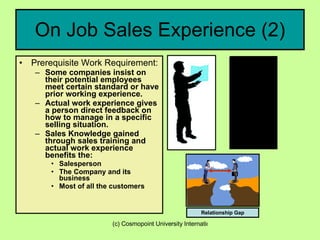
On Job Sales Experience (2) Prerequisite Work Requirement: Some companies insist on their potential employees meet certain standard or have prior working experience. Actual work experience gives a person direct feedback on how to manage in a specific selling situation. Sales Knowledge gained through sales training and actual work experience benefits the: Salesperson  The Company and its business Most of all the customers Relationship Gap
Knowledge builds Relationship Salesperson must be knowledgeable to be effective in their job.  Selling Knowledge (SK) helps to: Increase the salesperson’s confidence Helps to forge trust between buyer and salesperson Helps to build long term relationship.
Why do salespeople have to acquire Sales Knowledge? (SK) Knowledge increases confidence among salespeople. Salesperson confidence increases from the buyer if the salesperson knows both about the business and the product as well.  The salesperson must gain the confidence of the prospect – the sales presentation be comes more acceptable and believable by the prospect. Relationship increases sales – Relationship starts to develop, knowledge in turn brings in increases sales, revenue and good relationship with the seller or salesperson.
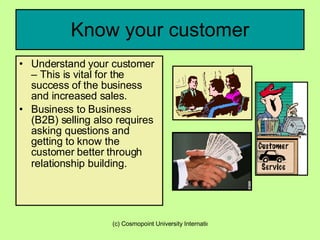
Know your customer Understand your customer – This is vital for the success of the business and increased sales. Business to Business (B2B) selling also requires asking questions and getting to know the customer better through relationship   building.
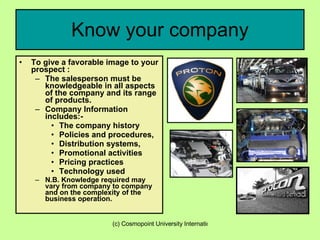
Know your company To give a favorable image to your prospect : The salesperson must be knowledgeable in all aspects of the company and its range of products. Company Information includes:- The company history Policies and procedures, Distribution systems,  Promotional activities Pricing practices Technology used N.B. Knowledge required may vary from company to company and on the complexity of the business operation.
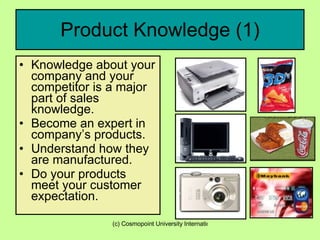
Product Knowledge (1) Knowledge about your company and your competitor is a major part of sales knowledge. Become an expert in company’s products. Understand how they are manufactured. Do your products meet your customer expectation.
Product Knowledge (2) Product Knowledge includes: Information on the product performance capability. Physical size and characteristics Product operation – ease of operation. FAB – Features, Advantages and Benefits Product Marketability.
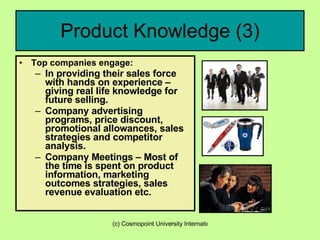
Product Knowledge (3) Top companies engage: In providing their sales force with hands on experience – giving real life knowledge for future selling. Company advertising programs, price discount, promotional allowances, sales strategies and competitor analysis. Company Meetings – Most of the time is spent on product information, marketing outcomes strategies, sales revenue evaluation etc.
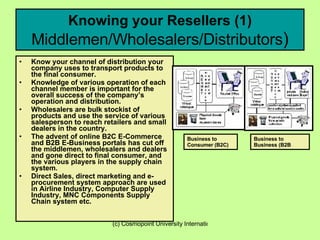
Knowing your Resellers (1)  Middlemen/Wholesalers/Distributors ) Know your channel of distribution your company uses to transport products to the final consumer. Knowledge of various operation of each channel member is important for the overall success of the company’s operation and distribution. Wholesalers are bulk stockist of products and use the service of various salesperson to reach retailers and small dealers in the country. The advent of online B2C E-Commerce and B2B E-Business portals has cut off the middlemen, wholesalers and dealers and gone direct to final consumer, and the various players in the supply chain system.  Direct Sales, direct marketing and e-procurement system approach are used in Airline Industry, Computer Supply Industry, MNC Components Supply Chain system etc. Business to Consumer (B2C) Business to Business (B2B
Knowing your Resellers (2)  Middlemen/Wholesalers/Distributors ) Important information required by the producer : Likes & dislikes of each channel suppliers’ customers Product line and various assortment available. Time, appointment via online system to see salesperson Distribution, promotion and pricing policies. Past Record of the various channel members showing purchasing track movement.
Advertising Aids - Salesperson Personal selling, advertising, publicity and sales promotion are the ways of business’s promotional efforts. Senior marketing manager may resort to a selective approach or combination of any promotional efforts to launch their product or marketing strategy. The successful salesperson must know the company’s advertising and sales promotion activities.  By providing enriched information your sales presentation will be more effective in gaining or closing the sales with the prospect or customer.
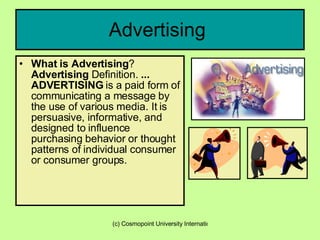
Advertising  What is Advertising ?  Advertising  Definition.  ...   ADVERTISING  is a paid form of communicating a message by the use of various media. It is persuasive, informative, and designed to influence purchasing behavior or thought patterns of individual consumer or consumer groups.
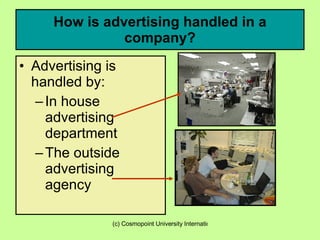
How is advertising handled in a company? Advertising is handled by: In house advertising department  The outside advertising agency
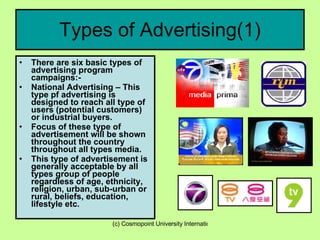
Types of Advertising(1) There are six basic types of advertising program campaigns:- National Advertising – This type pf advertising is designed to reach all type of users (potential customers) or industrial buyers. Focus of these type of advertisement will be shown throughout the country throughout all types media. This type of advertisement is generally acceptable by all types group of people regardless of age, ethnicity, religion, urban, sub-urban or rural, beliefs, education, lifestyle etc.
Types of Advertising(2) Retail Advertising  This is localized advertising which is confined to a particular area or location – state, region, city, town etc. Many retail outlets or local business use this form of retail advertising in print form, outside advertising or via local radio or TV to convey their advertising. Restricted and more focus to give a more effective edge to advertising – targeting certain segments or group of people, age, sex, lifestyle, income, beliefs etc.
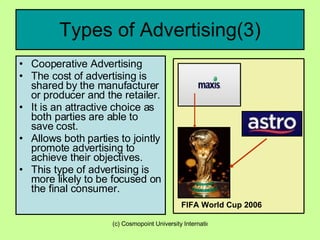
Types of Advertising(3) Cooperative Advertising The cost of advertising is shared by the manufacturer or producer and the retailer. It is an attractive choice as both parties are able to save cost. Allows both parties to jointly promote advertising to achieve their objectives. This type of advertising is more likely to be focused on the final consumer. Fif FIFA World Cup 2006
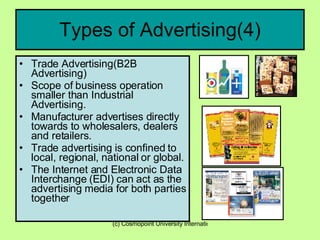
Types of Advertising(4) Trade Advertising(B2B Advertising)  Scope of business operation smaller than Industrial Advertising. Manufacturer advertises directly towards to wholesalers, dealers and retailers. Trade advertising is confined to local, regional, national or global. The Internet and Electronic Data Interchange (EDI) can act as the advertising media for both parties together
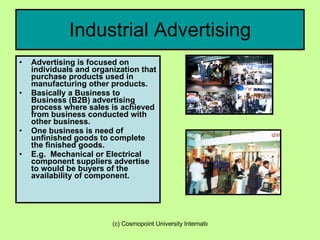
Industrial Advertising Advertising is focused on individuals and organization that purchase products used in manufacturing other products. Basically a Business to Business (B2B) advertising process where sales is achieved from business conducted with other business. One business is need of unfinished goods to complete the finished goods. E.g.  Mechanical or Electrical component suppliers advertise to would be buyers of the availability of component.
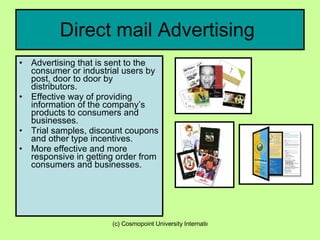
Direct mail Advertising  Advertising that is sent to the consumer or industrial users by post, door to door by distributors. Effective way of providing information of the company’s products to consumers and businesses. Trial samples, discount coupons and other type incentives. More effective and more responsive in getting order from consumers and businesses.
Why do business engage in advertising? Business engage in advertising to : Increase overall sales and the sales of specific product. Provide salesperson with additional selling information for sales presentation. Develop leads for salesperson through mail ins, advert response etc. Increase cooperation from channel members (supply chain business players) through co-op advertising and promotional campaigns Educate the prospect or customer about the company’s products. Be informative to the prospect about product and availability. Clear any doubts that may be in the mind of the prospect/buyer or customer or showing any reluctance. Create sales or sells (by itself) before a salesperson’s calls the prospect or customer .
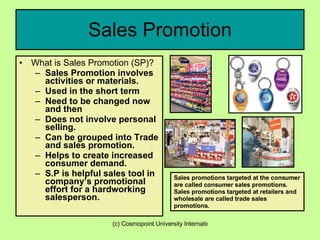
Sales Promotion What is Sales Promotion (SP)? Sales Promotion involves activities or materials. Used in the short term Need to be changed now and then Does not involve personal selling. Can be grouped into Trade and sales promotion. Helps to create increased consumer demand. S.P is helpful sales tool in company’s promotional effort for a hardworking salesperson. Sales promotions targeted at the consumer are called consumer sales promotions. Sales promotions targeted at retailers and wholesale are called trade sales promotions.
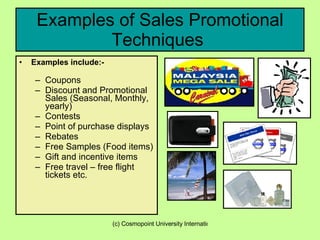
Examples of Sales Promotional Techniques  Examples include:- Coupons Discount and Promotional Sales (Seasonal, Monthly, yearly) Contests Point of purchase displays Rebates  Free Samples (Food items) Gift and incentive items Free travel – free flight tickets etc.
Consumer Sales Promotion Techniques   Price deal : A temporary reduction in the price, such as happy hour  Loyalty rewards program : Consumers collect points, miles, or credits for purchases and redeem them for rewards. The two most famous examples are Pepsi Stuff and A Advantage (product).  Cents-off deal : Offers a brand at a lower price. Price reduction may be a percentage marked on the package.  Price-pack deal : The packaging offers a consumer a certain percentage more of the product for the same price (for example, 25 percent extra).  Coupons:  coupons have become a standard mechanism for sales promotions.  Loss leader:  the price of a popular product is temporarily reduced in order to stimulate other profitable sales  Free-standing insert (FSI):  A coupon booklet is inserted into the local newspaper for delivery.  On-shelf couponing : Coupons are present at the shelf where the product is available.  Checkout dispensers:  On checkout the customer is given a coupon based on products purchased.  On-line couponing:  Coupons are available on line. Consumers print them out and take them to the store.  Rebates:  Consumers are offered money back if the receipt and barcode are mailed to the producer.  Contests/sweepstakes/games:  The consumer is automatically entered into the event by purchasing the product.  Point-of-sale displays:  Aisle interrupter: A sign the juts into the aisle from the shelf.  Dangler: A sign that sways when a consumer walks by it.  Dump bin: A bin full of products dumped inside.  Glorifier: A small stage that elevates a product above other products.  Wobbler: A sign that jiggles.  Lipstick Board: A board on which messages are written in crayon.  Necker: A coupon placed on the 'neck' of a bottle.  YES unit: "your extra salesperson" is a pull-out fact sheet.
Trade Sales Promotion Techniques Trade allowances:  short term incentive offered to induce a retailer to stock up on a product.  Dealer loader:  An incentive given to induce a retailer to purchase and display a product.  Trade contest:  A contest to reward retailers that sell the most product.  Point-of-purchase displays : Extra sales tools given to retailers to boost sales.  Training programs:  dealer employees are trained in selling the product.  Push money:  also known as "spiffs". An extra commission paid to retail employees to push products.
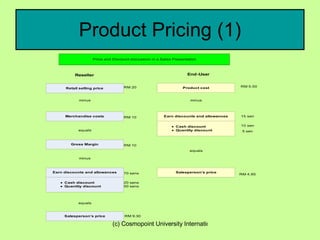
Product Pricing (1)
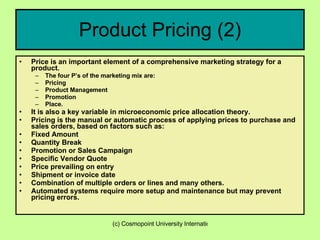
Product Pricing (2) Price is an important element of a comprehensive marketing strategy for a product.  The four P’s of the marketing mix are: Pricing Product Management Promotion Place. It is also a key variable in microeconomic price allocation theory. Pricing is the manual or automatic process of applying prices to purchase and sales orders, based on factors such as:  Fixed Amount Quantity Break Promotion or Sales Campaign Specific Vendor Quote Price prevailing on entry Shipment or invoice date Combination of multiple orders or lines and many others.  Automated systems require more setup and maintenance but may prevent pricing errors.
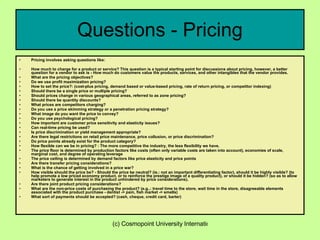
Questions - Pricing Pricing involves asking questions like: How much to charge for a product or service? This question is a typical starting point for discussions about pricing, however, a better question for a vendor to ask is - How much do customers value the products, services, and other intangibles that the vendor provides.  What are the pricing objectives?  Do we use profit maximization pricing?  How to set the price?: (cost-plus pricing, demand based or value-based pricing, rate of return pricing, or competitor indexing)  Should there be a single price or multiple pricing?  Should prices change in various geographical areas, referred to as zone pricing?  Should there be quantity discounts?  What prices are competitors charging?  Do you use a price skimming strategy or a penetration pricing strategy?  What image do you want the price to convey?  Do you use psychological pricing?  How important are customer price sensitivity and elasticity issues?  Can real-time pricing be used?  Is price discrimination or yield management appropriate?  Are there legal restrictions on retail price maintenance, price collusion, or price discrimination?  Do price points already exist for the product category?  How flexible can we be in pricing? : The more competitive the industry, the less flexibility we have.  The price floor is determined by production factors like costs (often only variable costs are taken into account), economies of scale, marginal cost, and degree of operating leverage  The price ceiling is determined by demand factors like price elasticity and price points  Are there transfer pricing considerations?  What is the chance of getting involved in a price war?  How visible should the price be? - Should the price be neutral? (ie.: not an important differentiating factor), should it be highly visible? (to help promote a low priced economy product, or to reinforce the prestige image of a quality product), or should it be hidden? (so as to allow marketers to generate interest in the product unhindered by price considerations).  Are there joint product pricing considerations?  What are the non-price costs of purchasing the product? (e.g..: travel time to the store, wait time in the store, disagreeable elements associated with the product purchase - dentist -> pain, fish market -> smells)  What sort of payments should be accepted? (cash, cheque, credit card, barter)
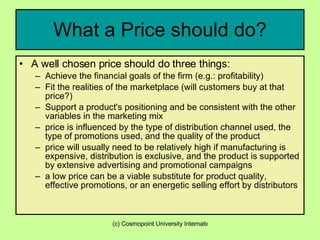
What a Price should do? A well chosen price should do three things: Achieve the financial goals of the firm (e.g.: profitability)  Fit the realities of the marketplace (will customers buy at that price?)  Support a product's positioning and be consistent with the other variables in the marketing mix  price is influenced by the type of distribution channel used, the type of promotions used, and the quality of the product  price will usually need to be relatively high if manufacturing is expensive, distribution is exclusive, and the product is supported by extensive advertising and promotional campaigns  a low price can be a viable substitute for product quality, effective promotions, or an energetic selling effort by distributors
Definition – Efficient & Effective Price Efficient Price – A price that is very close to the maximum that customers are prepared to pay.  Effective Price – The price the company receives after accounting for discounts, promotion and other incentives.
Types of Effective Pricing Techniques (1)  Price Lining – Use of a fixed or limited number of prices for all your product offerings.  E.g. Product sold for RM 2.00 only or RM2.00 to RM 5.00 per piece. Also known as Two Ringgit Shop or Five Ringgit Shop. Price are all fixed – No price change – one ceiling price, for example price range does not exceed RM5.00.
Types of Effective Pricing Techniques (2) Promotional Pricing – Pricing refers to an instances where pricing is the key element of the marketing mix – 4Ps ( price, place, promotion and product). The Price/Quality Relationship – This refers to the belief (perception) by most consumers that a high price is sign of good quality.
Types of Effective Pricing Techniques (3) Premium Pricing (Prestige Pricing) – The strategy of pricing at or near, the high end of possible price range.  Consumer will pay a premium price because: The high price is an indication of good quality The price paid is worth the money paid. The product performance surpasses the customer’s expectation. The customer is very satisfied with the product.
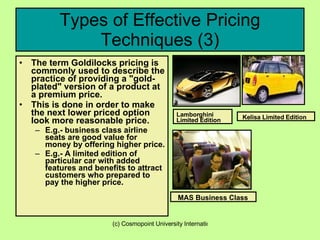
Types of Effective Pricing Techniques (3) The term Goldilocks pricing is commonly used to describe the practice of providing a "gold-plated" version of a product at a premium price. This is done in order to make the next lower priced option look more reasonable price.  E.g.- business class airline seats are good value for money by offering higher price.  E.g.- A limited edition of particular car with added features and benefits to attract customers who prepared to pay the higher price. Lamborghini Limited Edition MAS Business Class  Kelisa Limited Edition
Types of Effective Pricing Techniques (3) What is Demand based Pricing? Demand-based pricing is any pricing method that uses consumer demand - based on perceived (apparent) value - as the central element. These include : price skimming, price discrimination and yield management, price points, psychological pricing, bundle pricing, penetration pricing, price lining, value-based pricing, and premium pricing.
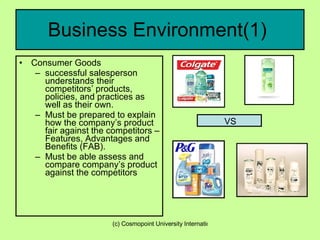
Business Environment(1)  Consumer Goods  successful salesperson understands their competitors’ products, policies, and practices as well as their own.   Must be prepared to explain how the company’s product fair against the competitors – Features, Advantages and Benefits (FAB). Must be able assess and compare company’s product against the competitors  VS
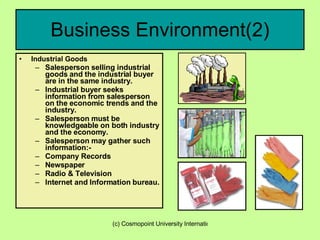
Business Environment(2) Industrial Goods Salesperson selling industrial goods and the industrial buyer are in the same industry. Industrial buyer seeks information from salesperson on the economic trends and the industry. Salesperson must be knowledgeable on both industry and the economy. Salesperson may gather such information:- Company Records Newspaper Radio & Television Internet and Information bureau.
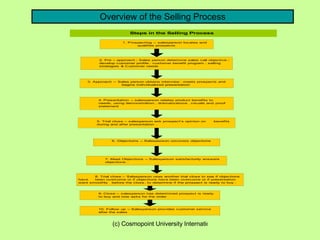
Overview of the Selling Process

Sm 6

  • 1.
    Chapter 6 SalesKnowledge
  • 2.
    Sources of SalesKnowledge Formal Sales Training – An employer or company provides the opportunity for a salesperson to receive: Job related culture – induce or reform a trainee to be part of the organizational culture of the company. Required job skills Suitable knowledge Right work attitude Prepared for any change All this factors lead to improved performance in the selling environment.
  • 3.
    On Job SalesExperience Selling skill that is developed only through work experience. Sales knowledge is obtained from: Education Reading Formal Training Verbal promotion But is nothing compared to on the job sales experience the salesperson has.
  • 4.
    On Job SalesExperience (2) Prerequisite Work Requirement: Some companies insist on their potential employees meet certain standard or have prior working experience. Actual work experience gives a person direct feedback on how to manage in a specific selling situation. Sales Knowledge gained through sales training and actual work experience benefits the: Salesperson The Company and its business Most of all the customers Relationship Gap
  • 5.
    Knowledge builds RelationshipSalesperson must be knowledgeable to be effective in their job. Selling Knowledge (SK) helps to: Increase the salesperson’s confidence Helps to forge trust between buyer and salesperson Helps to build long term relationship.
  • 6.
    Why do salespeoplehave to acquire Sales Knowledge? (SK) Knowledge increases confidence among salespeople. Salesperson confidence increases from the buyer if the salesperson knows both about the business and the product as well. The salesperson must gain the confidence of the prospect – the sales presentation be comes more acceptable and believable by the prospect. Relationship increases sales – Relationship starts to develop, knowledge in turn brings in increases sales, revenue and good relationship with the seller or salesperson.
  • 7.
    Know your customerUnderstand your customer – This is vital for the success of the business and increased sales. Business to Business (B2B) selling also requires asking questions and getting to know the customer better through relationship building.
  • 8.
    Know your companyTo give a favorable image to your prospect : The salesperson must be knowledgeable in all aspects of the company and its range of products. Company Information includes:- The company history Policies and procedures, Distribution systems, Promotional activities Pricing practices Technology used N.B. Knowledge required may vary from company to company and on the complexity of the business operation.
  • 9.
    Product Knowledge (1)Knowledge about your company and your competitor is a major part of sales knowledge. Become an expert in company’s products. Understand how they are manufactured. Do your products meet your customer expectation.
  • 10.
    Product Knowledge (2)Product Knowledge includes: Information on the product performance capability. Physical size and characteristics Product operation – ease of operation. FAB – Features, Advantages and Benefits Product Marketability.
  • 11.
    Product Knowledge (3)Top companies engage: In providing their sales force with hands on experience – giving real life knowledge for future selling. Company advertising programs, price discount, promotional allowances, sales strategies and competitor analysis. Company Meetings – Most of the time is spent on product information, marketing outcomes strategies, sales revenue evaluation etc.
  • 12.
    Knowing your Resellers(1) Middlemen/Wholesalers/Distributors ) Know your channel of distribution your company uses to transport products to the final consumer. Knowledge of various operation of each channel member is important for the overall success of the company’s operation and distribution. Wholesalers are bulk stockist of products and use the service of various salesperson to reach retailers and small dealers in the country. The advent of online B2C E-Commerce and B2B E-Business portals has cut off the middlemen, wholesalers and dealers and gone direct to final consumer, and the various players in the supply chain system. Direct Sales, direct marketing and e-procurement system approach are used in Airline Industry, Computer Supply Industry, MNC Components Supply Chain system etc. Business to Consumer (B2C) Business to Business (B2B
  • 13.
    Knowing your Resellers(2) Middlemen/Wholesalers/Distributors ) Important information required by the producer : Likes & dislikes of each channel suppliers’ customers Product line and various assortment available. Time, appointment via online system to see salesperson Distribution, promotion and pricing policies. Past Record of the various channel members showing purchasing track movement.
  • 14.
    Advertising Aids -Salesperson Personal selling, advertising, publicity and sales promotion are the ways of business’s promotional efforts. Senior marketing manager may resort to a selective approach or combination of any promotional efforts to launch their product or marketing strategy. The successful salesperson must know the company’s advertising and sales promotion activities. By providing enriched information your sales presentation will be more effective in gaining or closing the sales with the prospect or customer.
  • 15.
    Advertising Whatis Advertising ? Advertising Definition. ... ADVERTISING is a paid form of communicating a message by the use of various media. It is persuasive, informative, and designed to influence purchasing behavior or thought patterns of individual consumer or consumer groups.
  • 16.
    How is advertisinghandled in a company? Advertising is handled by: In house advertising department The outside advertising agency
  • 17.
    Types of Advertising(1)There are six basic types of advertising program campaigns:- National Advertising – This type pf advertising is designed to reach all type of users (potential customers) or industrial buyers. Focus of these type of advertisement will be shown throughout the country throughout all types media. This type of advertisement is generally acceptable by all types group of people regardless of age, ethnicity, religion, urban, sub-urban or rural, beliefs, education, lifestyle etc.
  • 18.
    Types of Advertising(2)Retail Advertising This is localized advertising which is confined to a particular area or location – state, region, city, town etc. Many retail outlets or local business use this form of retail advertising in print form, outside advertising or via local radio or TV to convey their advertising. Restricted and more focus to give a more effective edge to advertising – targeting certain segments or group of people, age, sex, lifestyle, income, beliefs etc.
  • 19.
    Types of Advertising(3)Cooperative Advertising The cost of advertising is shared by the manufacturer or producer and the retailer. It is an attractive choice as both parties are able to save cost. Allows both parties to jointly promote advertising to achieve their objectives. This type of advertising is more likely to be focused on the final consumer. Fif FIFA World Cup 2006
  • 20.
    Types of Advertising(4)Trade Advertising(B2B Advertising) Scope of business operation smaller than Industrial Advertising. Manufacturer advertises directly towards to wholesalers, dealers and retailers. Trade advertising is confined to local, regional, national or global. The Internet and Electronic Data Interchange (EDI) can act as the advertising media for both parties together
  • 21.
    Industrial Advertising Advertisingis focused on individuals and organization that purchase products used in manufacturing other products. Basically a Business to Business (B2B) advertising process where sales is achieved from business conducted with other business. One business is need of unfinished goods to complete the finished goods. E.g. Mechanical or Electrical component suppliers advertise to would be buyers of the availability of component.
  • 22.
    Direct mail Advertising Advertising that is sent to the consumer or industrial users by post, door to door by distributors. Effective way of providing information of the company’s products to consumers and businesses. Trial samples, discount coupons and other type incentives. More effective and more responsive in getting order from consumers and businesses.
  • 23.
    Why do businessengage in advertising? Business engage in advertising to : Increase overall sales and the sales of specific product. Provide salesperson with additional selling information for sales presentation. Develop leads for salesperson through mail ins, advert response etc. Increase cooperation from channel members (supply chain business players) through co-op advertising and promotional campaigns Educate the prospect or customer about the company’s products. Be informative to the prospect about product and availability. Clear any doubts that may be in the mind of the prospect/buyer or customer or showing any reluctance. Create sales or sells (by itself) before a salesperson’s calls the prospect or customer .
  • 24.
    Sales Promotion Whatis Sales Promotion (SP)? Sales Promotion involves activities or materials. Used in the short term Need to be changed now and then Does not involve personal selling. Can be grouped into Trade and sales promotion. Helps to create increased consumer demand. S.P is helpful sales tool in company’s promotional effort for a hardworking salesperson. Sales promotions targeted at the consumer are called consumer sales promotions. Sales promotions targeted at retailers and wholesale are called trade sales promotions.
  • 25.
    Examples of SalesPromotional Techniques Examples include:- Coupons Discount and Promotional Sales (Seasonal, Monthly, yearly) Contests Point of purchase displays Rebates Free Samples (Food items) Gift and incentive items Free travel – free flight tickets etc.
  • 26.
    Consumer Sales PromotionTechniques Price deal : A temporary reduction in the price, such as happy hour Loyalty rewards program : Consumers collect points, miles, or credits for purchases and redeem them for rewards. The two most famous examples are Pepsi Stuff and A Advantage (product). Cents-off deal : Offers a brand at a lower price. Price reduction may be a percentage marked on the package. Price-pack deal : The packaging offers a consumer a certain percentage more of the product for the same price (for example, 25 percent extra). Coupons: coupons have become a standard mechanism for sales promotions. Loss leader: the price of a popular product is temporarily reduced in order to stimulate other profitable sales Free-standing insert (FSI): A coupon booklet is inserted into the local newspaper for delivery. On-shelf couponing : Coupons are present at the shelf where the product is available. Checkout dispensers: On checkout the customer is given a coupon based on products purchased. On-line couponing: Coupons are available on line. Consumers print them out and take them to the store. Rebates: Consumers are offered money back if the receipt and barcode are mailed to the producer. Contests/sweepstakes/games: The consumer is automatically entered into the event by purchasing the product. Point-of-sale displays: Aisle interrupter: A sign the juts into the aisle from the shelf. Dangler: A sign that sways when a consumer walks by it. Dump bin: A bin full of products dumped inside. Glorifier: A small stage that elevates a product above other products. Wobbler: A sign that jiggles. Lipstick Board: A board on which messages are written in crayon. Necker: A coupon placed on the 'neck' of a bottle. YES unit: "your extra salesperson" is a pull-out fact sheet.
  • 27.
    Trade Sales PromotionTechniques Trade allowances: short term incentive offered to induce a retailer to stock up on a product. Dealer loader: An incentive given to induce a retailer to purchase and display a product. Trade contest: A contest to reward retailers that sell the most product. Point-of-purchase displays : Extra sales tools given to retailers to boost sales. Training programs: dealer employees are trained in selling the product. Push money: also known as "spiffs". An extra commission paid to retail employees to push products.
  • 28.
  • 29.
    Product Pricing (2)Price is an important element of a comprehensive marketing strategy for a product. The four P’s of the marketing mix are: Pricing Product Management Promotion Place. It is also a key variable in microeconomic price allocation theory. Pricing is the manual or automatic process of applying prices to purchase and sales orders, based on factors such as: Fixed Amount Quantity Break Promotion or Sales Campaign Specific Vendor Quote Price prevailing on entry Shipment or invoice date Combination of multiple orders or lines and many others. Automated systems require more setup and maintenance but may prevent pricing errors.
  • 30.
    Questions - PricingPricing involves asking questions like: How much to charge for a product or service? This question is a typical starting point for discussions about pricing, however, a better question for a vendor to ask is - How much do customers value the products, services, and other intangibles that the vendor provides. What are the pricing objectives? Do we use profit maximization pricing? How to set the price?: (cost-plus pricing, demand based or value-based pricing, rate of return pricing, or competitor indexing) Should there be a single price or multiple pricing? Should prices change in various geographical areas, referred to as zone pricing? Should there be quantity discounts? What prices are competitors charging? Do you use a price skimming strategy or a penetration pricing strategy? What image do you want the price to convey? Do you use psychological pricing? How important are customer price sensitivity and elasticity issues? Can real-time pricing be used? Is price discrimination or yield management appropriate? Are there legal restrictions on retail price maintenance, price collusion, or price discrimination? Do price points already exist for the product category? How flexible can we be in pricing? : The more competitive the industry, the less flexibility we have. The price floor is determined by production factors like costs (often only variable costs are taken into account), economies of scale, marginal cost, and degree of operating leverage The price ceiling is determined by demand factors like price elasticity and price points Are there transfer pricing considerations? What is the chance of getting involved in a price war? How visible should the price be? - Should the price be neutral? (ie.: not an important differentiating factor), should it be highly visible? (to help promote a low priced economy product, or to reinforce the prestige image of a quality product), or should it be hidden? (so as to allow marketers to generate interest in the product unhindered by price considerations). Are there joint product pricing considerations? What are the non-price costs of purchasing the product? (e.g..: travel time to the store, wait time in the store, disagreeable elements associated with the product purchase - dentist -> pain, fish market -> smells) What sort of payments should be accepted? (cash, cheque, credit card, barter)
  • 31.
    What a Priceshould do? A well chosen price should do three things: Achieve the financial goals of the firm (e.g.: profitability) Fit the realities of the marketplace (will customers buy at that price?) Support a product's positioning and be consistent with the other variables in the marketing mix price is influenced by the type of distribution channel used, the type of promotions used, and the quality of the product price will usually need to be relatively high if manufacturing is expensive, distribution is exclusive, and the product is supported by extensive advertising and promotional campaigns a low price can be a viable substitute for product quality, effective promotions, or an energetic selling effort by distributors
  • 32.
    Definition – Efficient& Effective Price Efficient Price – A price that is very close to the maximum that customers are prepared to pay. Effective Price – The price the company receives after accounting for discounts, promotion and other incentives.
  • 33.
    Types of EffectivePricing Techniques (1) Price Lining – Use of a fixed or limited number of prices for all your product offerings. E.g. Product sold for RM 2.00 only or RM2.00 to RM 5.00 per piece. Also known as Two Ringgit Shop or Five Ringgit Shop. Price are all fixed – No price change – one ceiling price, for example price range does not exceed RM5.00.
  • 34.
    Types of EffectivePricing Techniques (2) Promotional Pricing – Pricing refers to an instances where pricing is the key element of the marketing mix – 4Ps ( price, place, promotion and product). The Price/Quality Relationship – This refers to the belief (perception) by most consumers that a high price is sign of good quality.
  • 35.
    Types of EffectivePricing Techniques (3) Premium Pricing (Prestige Pricing) – The strategy of pricing at or near, the high end of possible price range. Consumer will pay a premium price because: The high price is an indication of good quality The price paid is worth the money paid. The product performance surpasses the customer’s expectation. The customer is very satisfied with the product.
  • 36.
    Types of EffectivePricing Techniques (3) The term Goldilocks pricing is commonly used to describe the practice of providing a "gold-plated" version of a product at a premium price. This is done in order to make the next lower priced option look more reasonable price. E.g.- business class airline seats are good value for money by offering higher price. E.g.- A limited edition of particular car with added features and benefits to attract customers who prepared to pay the higher price. Lamborghini Limited Edition MAS Business Class Kelisa Limited Edition
  • 37.
    Types of EffectivePricing Techniques (3) What is Demand based Pricing? Demand-based pricing is any pricing method that uses consumer demand - based on perceived (apparent) value - as the central element. These include : price skimming, price discrimination and yield management, price points, psychological pricing, bundle pricing, penetration pricing, price lining, value-based pricing, and premium pricing.
  • 38.
    Business Environment(1) Consumer Goods successful salesperson understands their competitors’ products, policies, and practices as well as their own. Must be prepared to explain how the company’s product fair against the competitors – Features, Advantages and Benefits (FAB). Must be able assess and compare company’s product against the competitors VS
  • 39.
    Business Environment(2) IndustrialGoods Salesperson selling industrial goods and the industrial buyer are in the same industry. Industrial buyer seeks information from salesperson on the economic trends and the industry. Salesperson must be knowledgeable on both industry and the economy. Salesperson may gather such information:- Company Records Newspaper Radio & Television Internet and Information bureau.
  • 40.
    Overview of theSelling Process