USING COMMUNICATION PRINCIPLES TO BUILD RELATIONSHIPS What are the basic elements in the communication process? Why are listening and questioning skills important? How can salespeople develop listening skills to collect information about customers? How do people communicate without using words? What are some things to remember when communicating via technology like phones and e-mail? How does a salesperson adjust for cultural differences? 5- McGraw-Hill/Irwin chapter 5 SOME QUESTIONS ANSWERED IN THIS CHAPTER ARE:
“ Good communication is the cornerstone to my sales success.” ~Mike Donley ArthroCare Sports Medicine 5- McGraw-Hill/Irwin
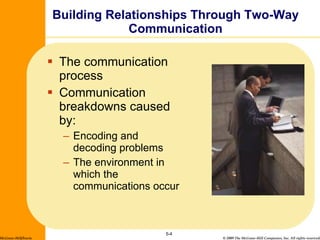
Building Relationships Through Two-Way Communication The communication process Communication breakdowns caused by: Encoding and decoding problems The environment in which the communications occur 5- McGraw-Hill/Irwin
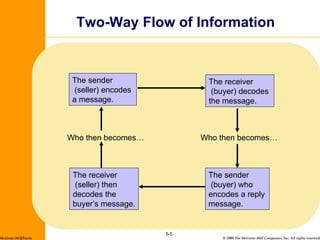
Two-Way Flow of Information 5- McGraw-Hill/Irwin The sender (seller) encodes  a message. The receiver (buyer) decodes  the message. The sender (buyer) who encodes a reply message. The receiver (seller) then  decodes the  buyer’s message. Who then becomes… Who then becomes…
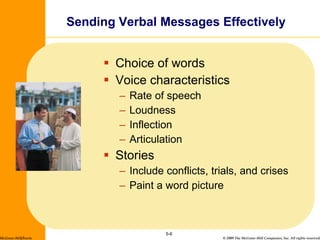
Sending Verbal Messages Effectively Choice of words Voice characteristics Rate of speech Loudness Inflection Articulation Stories Include conflicts, trials, and crises Paint a word picture 5- McGraw-Hill/Irwin
Active Listening 5- McGraw-Hill/Irwin 80-20 listening rule Salespeople should listen 80 percent of the time and talk no more than 20 percent of the time. Speaking-listening differential People can speak at a rate of only 120-160 words per minute, but they can listen to more than 800 words per minute.
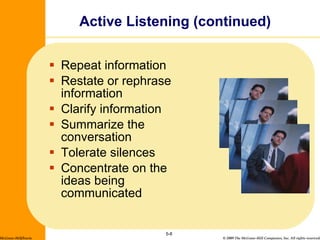
Active Listening (continued) Repeat information Restate or rephrase information Clarify information Summarize the conversation Tolerate silences Concentrate on the ideas being communicated 5- McGraw-Hill/Irwin
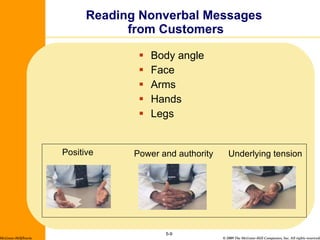
Reading Nonverbal Messages  from Customers Body angle Face Arms Hands Legs 5- McGraw-Hill/Irwin Positive Power and authority Underlying tension
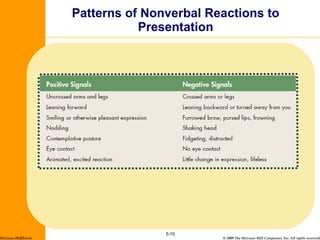
Patterns of Nonverbal Reactions to Presentation 5- McGraw-Hill/Irwin
Consider the pattern of signals via a number of channels Signals customers are hiding their true feelings: Contradictions and verbal mistakes Differences in two parts of a conversation Contradictions between verbal and nonverbal messages Certain nonverbal signals such as hesitation in the voice, small shrugs, and so on Body Language Patterns 5- McGraw-Hill/Irwin
“Perhaps there is some reason you cannot share the information with me.” “Are you worried about how I might react to what you are telling me?” “I have a sense that there is really more to the story than you are telling me. Let’s put the cards on the table so we can put this issue to rest.” Encouraging Forthright Discussion 5- McGraw-Hill/Irwin
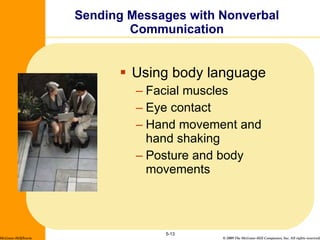
Sending Messages with Nonverbal Communication Using body language Facial muscles Eye contact Hand movement and hand shaking Posture and body movements 5- McGraw-Hill/Irwin
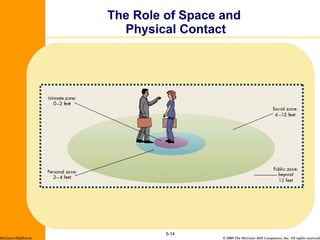
The Role of Space and  Physical Contact 5- McGraw-Hill/Irwin
Consider the geography The temperature The local cultural norms Consider your customers Their appearance Their expectations of your appearance Consider your corporate culture Norms for your industry Appearance 5- McGraw-Hill/Irwin
Consider your aspirations Top levels of your organization Dress above your position Consider your own personal style Wait until you have the halo effect Be reasonable Appearance (continued) 5- McGraw-Hill/Irwin
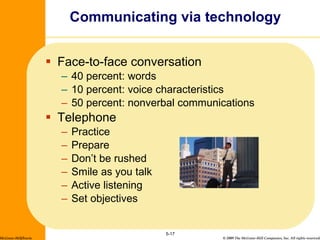
Communicating via technology Face-to-face conversation 40 percent: words 10 percent: voice characteristics 50 percent: nonverbal communications Telephone Practice Prepare Don’t be rushed Smile as you talk Active listening Set objectives 5- McGraw-Hill/Irwin
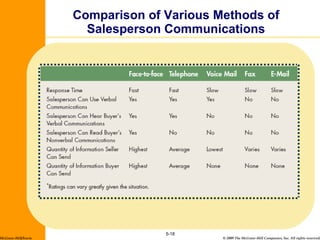
Comparison of Various Methods of Salesperson Communications 5- McGraw-Hill/Irwin
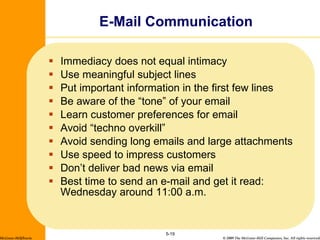
Immediacy does not equal intimacy Use meaningful subject lines Put important information in the first few lines Be aware of the “tone” of your email Learn customer preferences for email Avoid “techno overkill” Avoid sending long emails and large attachments Use speed to impress customers Don’t deliver bad news via email Best time to send an e-mail and get it read: Wednesday around 11:00 a.m. E-Mail Communication 5- McGraw-Hill/Irwin
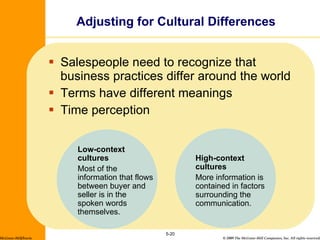
Salespeople need to recognize that business practices differ around the world Terms have different meanings Time perception Adjusting for Cultural Differences 5- McGraw-Hill/Irwin Low-context cultures Most of the information that flows between buyer and seller is in the spoken words themselves. High-context cultures More information is contained in factors surrounding the communication.
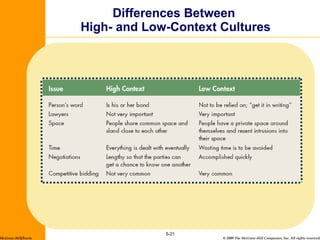
Differences Between  High- and Low-Context Cultures 5- McGraw-Hill/Irwin
Use common English words, e.g.  stop  instead of  cease Use words that do not have multiple meanings Avoid American slang expressions Use strict rules of grammar Use action-specific verbs Never use vulgar expressions, tell off-color jokes, or make religious references Using English in International Selling 5- McGraw-Hill/Irwin
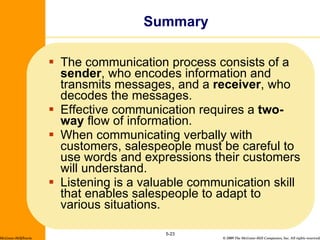
The communication process consists of a  sender , who encodes information and transmits messages, and a  receiver , who decodes the messages. Effective communication requires a  two-way  flow of information. When communicating verbally with customers, salespeople must be careful to use words and expressions their customers will understand. Listening is a valuable communication skill that enables salespeople to adapt to various situations. Summary 5- McGraw-Hill/Irwin
About  50 percent  of communication is nonverbal. Salespeople can use nonverbal communication to convey information to customers. Two-way communication increases when salespeople adjust their communication styles to the styles of their customers. Summary (continued) 5- McGraw-Hill/Irwin

Pp Ch005

  • 1.
  • 2.
    USING COMMUNICATION PRINCIPLESTO BUILD RELATIONSHIPS What are the basic elements in the communication process? Why are listening and questioning skills important? How can salespeople develop listening skills to collect information about customers? How do people communicate without using words? What are some things to remember when communicating via technology like phones and e-mail? How does a salesperson adjust for cultural differences? 5- McGraw-Hill/Irwin chapter 5 SOME QUESTIONS ANSWERED IN THIS CHAPTER ARE:
  • 3.
    “ Good communicationis the cornerstone to my sales success.” ~Mike Donley ArthroCare Sports Medicine 5- McGraw-Hill/Irwin
  • 4.
    Building Relationships ThroughTwo-Way Communication The communication process Communication breakdowns caused by: Encoding and decoding problems The environment in which the communications occur 5- McGraw-Hill/Irwin
  • 5.
    Two-Way Flow ofInformation 5- McGraw-Hill/Irwin The sender (seller) encodes a message. The receiver (buyer) decodes the message. The sender (buyer) who encodes a reply message. The receiver (seller) then decodes the buyer’s message. Who then becomes… Who then becomes…
  • 6.
    Sending Verbal MessagesEffectively Choice of words Voice characteristics Rate of speech Loudness Inflection Articulation Stories Include conflicts, trials, and crises Paint a word picture 5- McGraw-Hill/Irwin
  • 7.
    Active Listening 5-McGraw-Hill/Irwin 80-20 listening rule Salespeople should listen 80 percent of the time and talk no more than 20 percent of the time. Speaking-listening differential People can speak at a rate of only 120-160 words per minute, but they can listen to more than 800 words per minute.
  • 8.
    Active Listening (continued)Repeat information Restate or rephrase information Clarify information Summarize the conversation Tolerate silences Concentrate on the ideas being communicated 5- McGraw-Hill/Irwin
  • 9.
    Reading Nonverbal Messages from Customers Body angle Face Arms Hands Legs 5- McGraw-Hill/Irwin Positive Power and authority Underlying tension
  • 10.
    Patterns of NonverbalReactions to Presentation 5- McGraw-Hill/Irwin
  • 11.
    Consider the patternof signals via a number of channels Signals customers are hiding their true feelings: Contradictions and verbal mistakes Differences in two parts of a conversation Contradictions between verbal and nonverbal messages Certain nonverbal signals such as hesitation in the voice, small shrugs, and so on Body Language Patterns 5- McGraw-Hill/Irwin
  • 12.
    “Perhaps there issome reason you cannot share the information with me.” “Are you worried about how I might react to what you are telling me?” “I have a sense that there is really more to the story than you are telling me. Let’s put the cards on the table so we can put this issue to rest.” Encouraging Forthright Discussion 5- McGraw-Hill/Irwin
  • 13.
    Sending Messages withNonverbal Communication Using body language Facial muscles Eye contact Hand movement and hand shaking Posture and body movements 5- McGraw-Hill/Irwin
  • 14.
    The Role ofSpace and Physical Contact 5- McGraw-Hill/Irwin
  • 15.
    Consider the geographyThe temperature The local cultural norms Consider your customers Their appearance Their expectations of your appearance Consider your corporate culture Norms for your industry Appearance 5- McGraw-Hill/Irwin
  • 16.
    Consider your aspirationsTop levels of your organization Dress above your position Consider your own personal style Wait until you have the halo effect Be reasonable Appearance (continued) 5- McGraw-Hill/Irwin
  • 17.
    Communicating via technologyFace-to-face conversation 40 percent: words 10 percent: voice characteristics 50 percent: nonverbal communications Telephone Practice Prepare Don’t be rushed Smile as you talk Active listening Set objectives 5- McGraw-Hill/Irwin
  • 18.
    Comparison of VariousMethods of Salesperson Communications 5- McGraw-Hill/Irwin
  • 19.
    Immediacy does notequal intimacy Use meaningful subject lines Put important information in the first few lines Be aware of the “tone” of your email Learn customer preferences for email Avoid “techno overkill” Avoid sending long emails and large attachments Use speed to impress customers Don’t deliver bad news via email Best time to send an e-mail and get it read: Wednesday around 11:00 a.m. E-Mail Communication 5- McGraw-Hill/Irwin
  • 20.
    Salespeople need torecognize that business practices differ around the world Terms have different meanings Time perception Adjusting for Cultural Differences 5- McGraw-Hill/Irwin Low-context cultures Most of the information that flows between buyer and seller is in the spoken words themselves. High-context cultures More information is contained in factors surrounding the communication.
  • 21.
    Differences Between High- and Low-Context Cultures 5- McGraw-Hill/Irwin
  • 22.
    Use common Englishwords, e.g. stop instead of cease Use words that do not have multiple meanings Avoid American slang expressions Use strict rules of grammar Use action-specific verbs Never use vulgar expressions, tell off-color jokes, or make religious references Using English in International Selling 5- McGraw-Hill/Irwin
  • 23.
    The communication processconsists of a sender , who encodes information and transmits messages, and a receiver , who decodes the messages. Effective communication requires a two-way flow of information. When communicating verbally with customers, salespeople must be careful to use words and expressions their customers will understand. Listening is a valuable communication skill that enables salespeople to adapt to various situations. Summary 5- McGraw-Hill/Irwin
  • 24.
    About 50percent of communication is nonverbal. Salespeople can use nonverbal communication to convey information to customers. Two-way communication increases when salespeople adjust their communication styles to the styles of their customers. Summary (continued) 5- McGraw-Hill/Irwin