Overview Of The  Sales Call
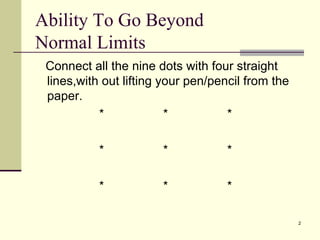
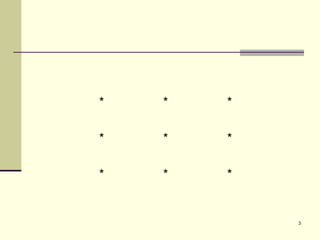
Ability To Go Beyond Normal Limits  Connect all the nine dots with four straight lines,with out lifting your pen/pencil from the paper. * * * * * * * * *
* * * * * * * * *
Ability To Go Beyond Normal Limits Lesson When one goes  Beyond The Limits The  Impossible  becomes  Possible
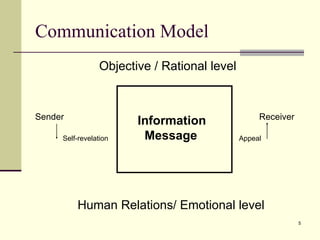
Communication Model Objective / Rational level Sender Receiver Self-revelation   Appeal   Human Relations/ Emotional level Information  Message
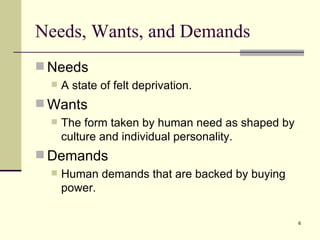
Needs, Wants, and Demands Needs A state of felt deprivation. Wants The form taken by human need as shaped by culture and individual personality. Demands Human demands that are backed by buying power.
Always Remember You do not purchase the product But You purchase what it provides to you.
Buying Motives An  inner force  that directs a customer to buy a  particular  product in order to  satisfy a need . When the  benefit(s)  of a product  match  with the customer’s  motive(s) , he buys the product. Motive may be rational or emotional. No body does anything with out a motive. There are six buying motives.
Buying Motives 6.  Gaining Social Approval, Prestige 5.  Boosting Self- Satisfaction, Pride Recognition 4.  Fear of Pain,  Worries, Problems 3.  Having Pleasure, Enjoyment, Comfort, Convenience Experience 2.  Fear of Loss 1.  Making A Gain Possession
A customer can have a cluster of motives.  But one motive will be  decisive. To find buying motives. Avoid over hasty conclusions. Ask questions. After identifying buying motives. Tell the benefit of your product, which should appeal to all identifying buying motives. Let customer buy for HIS REASONS not yours. Buying Motives
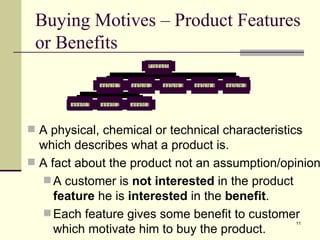
Buying Motives – Product Features or Benefits A physical, chemical or technical characteristics which describes what a product is. A fact about the product not an assumption/opinion. A customer is  not interested  in the product  feature  he is  interested  in the  benefit . Each feature gives some benefit to customer which motivate him to buy the product.
Buying Motives – Product Features or Benefits The key to successful selling is  converting features into benefits. First state a “Product Feature” and then use the phrase “which means that it will give such and such benefit to you”. Salesmen often fails because they present features only. It is the benefit of product which satisfy the customer needs.
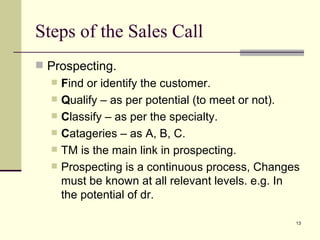
Steps of the Sales Call Prospecting. F ind or identify the customer. Q ualify – as per potential (to meet or not). C lassify – as per the specialty. C atageries – as A, B, C. TM is the main link in prospecting. Prospecting is a continuous process, Changes must be known at all relevant levels. e.g. In the potential of dr.
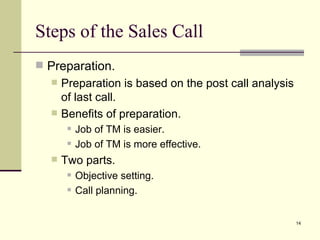
Preparation. Preparation is based on the post call analysis of last call. Benefits of preparation. Job of TM is easier. Job of TM is more effective. Two parts. Objective setting. Call planning. Steps of the Sales Call
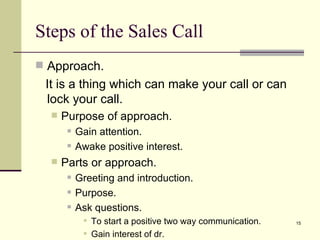
Approach. It is a thing which can make your call or can lock your call. Purpose of approach. Gain attention. Awake positive interest. Parts or approach. Greeting and introduction. Purpose. Ask questions. To start a positive two way communication. Gain interest of dr. Steps of the Sales Call
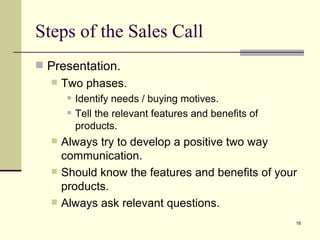
Presentation. Two phases. Identify needs / buying motives. Tell the relevant features and benefits of products. Always try to develop a positive two way communication. Should know the features and benefits of your products. Always ask relevant questions. Steps of the Sales Call
Response handeling. Listen and understand the responses / reactions. Listen to the buying signals. Closing. Closing means ask for order and commitment. Ask for order and shut up. If there is a positive response, pick up the positive, use it and go towards closing. Steps of the Sales Call
Post Call. Objective of post call. Personal evaluation of sale call. Prospecting. Cycle of selling. Post call should be immediately after the call. Steps of the Sales Call
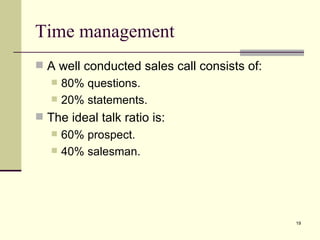
Time management A well conducted sales call consists of: 80% questions. 20% statements. The ideal talk ratio is: 60% prospect. 40% salesman.
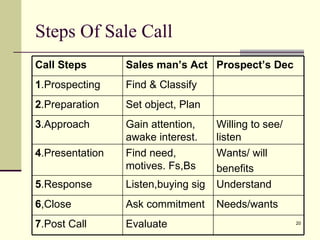
Steps Of Sale Call Evaluate 7 .Post Call Needs/wants Ask commitment 6 ,Close Understand Listen,buying sig 5 .Response Wants/ will benefits Find need, motives. Fs,Bs 4 .Presentation Willing to see/ listen Gain attention, awake interest. 3 .Approach Set object, Plan 2 .Preparation Find & Classify 1 .Prospecting Prospect’s Dec Sales man’s Act Call Steps
 
Thanks [email_address]

Sales Call

  • 1.
    Overview Of The Sales Call
  • 2.
    Ability To GoBeyond Normal Limits Connect all the nine dots with four straight lines,with out lifting your pen/pencil from the paper. * * * * * * * * *
  • 3.
    * * ** * * * * *
  • 4.
    Ability To GoBeyond Normal Limits Lesson When one goes Beyond The Limits The Impossible becomes Possible
  • 5.
    Communication Model Objective/ Rational level Sender Receiver Self-revelation Appeal Human Relations/ Emotional level Information Message
  • 6.
    Needs, Wants, andDemands Needs A state of felt deprivation. Wants The form taken by human need as shaped by culture and individual personality. Demands Human demands that are backed by buying power.
  • 7.
    Always Remember Youdo not purchase the product But You purchase what it provides to you.
  • 8.
    Buying Motives An inner force that directs a customer to buy a particular product in order to satisfy a need . When the benefit(s) of a product match with the customer’s motive(s) , he buys the product. Motive may be rational or emotional. No body does anything with out a motive. There are six buying motives.
  • 9.
    Buying Motives 6. Gaining Social Approval, Prestige 5. Boosting Self- Satisfaction, Pride Recognition 4. Fear of Pain, Worries, Problems 3. Having Pleasure, Enjoyment, Comfort, Convenience Experience 2. Fear of Loss 1. Making A Gain Possession
  • 10.
    A customer canhave a cluster of motives. But one motive will be decisive. To find buying motives. Avoid over hasty conclusions. Ask questions. After identifying buying motives. Tell the benefit of your product, which should appeal to all identifying buying motives. Let customer buy for HIS REASONS not yours. Buying Motives
  • 11.
    Buying Motives –Product Features or Benefits A physical, chemical or technical characteristics which describes what a product is. A fact about the product not an assumption/opinion. A customer is not interested in the product feature he is interested in the benefit . Each feature gives some benefit to customer which motivate him to buy the product.
  • 12.
    Buying Motives –Product Features or Benefits The key to successful selling is converting features into benefits. First state a “Product Feature” and then use the phrase “which means that it will give such and such benefit to you”. Salesmen often fails because they present features only. It is the benefit of product which satisfy the customer needs.
  • 13.
    Steps of theSales Call Prospecting. F ind or identify the customer. Q ualify – as per potential (to meet or not). C lassify – as per the specialty. C atageries – as A, B, C. TM is the main link in prospecting. Prospecting is a continuous process, Changes must be known at all relevant levels. e.g. In the potential of dr.
  • 14.
    Preparation. Preparation isbased on the post call analysis of last call. Benefits of preparation. Job of TM is easier. Job of TM is more effective. Two parts. Objective setting. Call planning. Steps of the Sales Call
  • 15.
    Approach. It isa thing which can make your call or can lock your call. Purpose of approach. Gain attention. Awake positive interest. Parts or approach. Greeting and introduction. Purpose. Ask questions. To start a positive two way communication. Gain interest of dr. Steps of the Sales Call
  • 16.
    Presentation. Two phases.Identify needs / buying motives. Tell the relevant features and benefits of products. Always try to develop a positive two way communication. Should know the features and benefits of your products. Always ask relevant questions. Steps of the Sales Call
  • 17.
    Response handeling. Listenand understand the responses / reactions. Listen to the buying signals. Closing. Closing means ask for order and commitment. Ask for order and shut up. If there is a positive response, pick up the positive, use it and go towards closing. Steps of the Sales Call
  • 18.
    Post Call. Objectiveof post call. Personal evaluation of sale call. Prospecting. Cycle of selling. Post call should be immediately after the call. Steps of the Sales Call
  • 19.
    Time management Awell conducted sales call consists of: 80% questions. 20% statements. The ideal talk ratio is: 60% prospect. 40% salesman.
  • 20.
    Steps Of SaleCall Evaluate 7 .Post Call Needs/wants Ask commitment 6 ,Close Understand Listen,buying sig 5 .Response Wants/ will benefits Find need, motives. Fs,Bs 4 .Presentation Willing to see/ listen Gain attention, awake interest. 3 .Approach Set object, Plan 2 .Preparation Find & Classify 1 .Prospecting Prospect’s Dec Sales man’s Act Call Steps
  • 21.
  • 22.