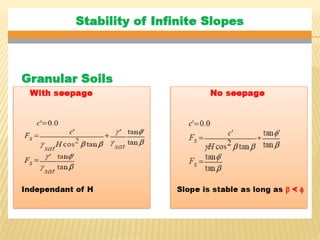
ANALYSIS OF SLOPES, EARTH RETAINING
STRUCTURES AND UNDERGROUND STRUCTURES
CENG 6208
ARGAW.A (PHD)
36
37
38
39
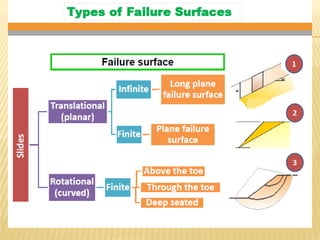
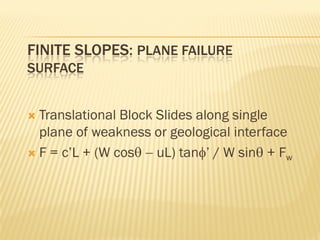
FINITE SLOPES: PLANE FAILURE
SURFACE
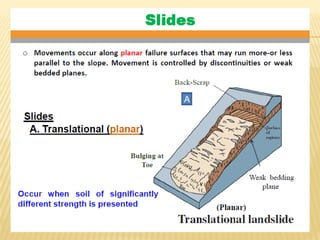
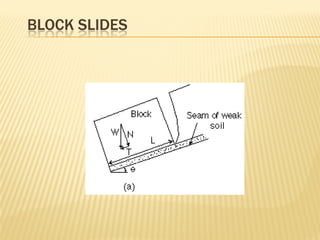
 Translational Block Slides along single
plane of weakness or geological interface
 F = c’L + (W cosθ − uL) tanφ’ / W sinθ + Fw
BLOCK SLIDES
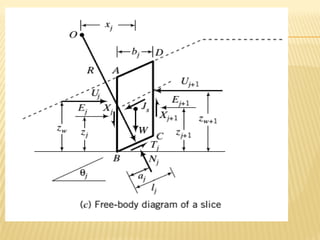
Limit Equilibrium: 1) Assume some circular (or other shape) failu
2) Calculate driving forces (moment about O)
3) Calculate resisting forces (moment about O
BASIC ANALYSIS APPROACH FOR
ROTATIONAL FAILURE SURFACE
Issues:
• Where is the center of mass?
• How does resistance vary along surface?
• How does normal stress vary along surface?
• Water table and seepage forces?
• Soil layering?
• More complex geometry?
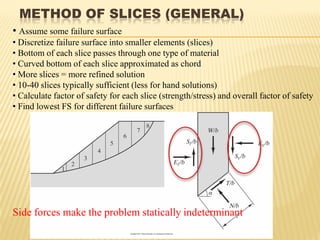
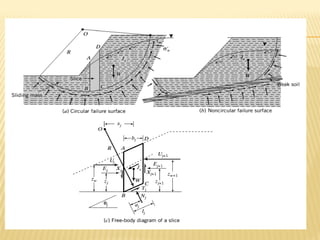
METHOD OF SLICES (GENERAL)
• Assume some failure surface
• Discretize failure surface into smaller elements (slices)
• Bottom of each slice passes through one type of material
• Curved bottom of each slice approximated as chord
• More slices = more refined solution
• 10-40 slices typically sufficient (less for hand solutions)
• Calculate factor of safety for each slice (strength/stress) and overall factor of safety
• Find lowest FS for different failure surfaces
Side forces make the problem statically indeterminant
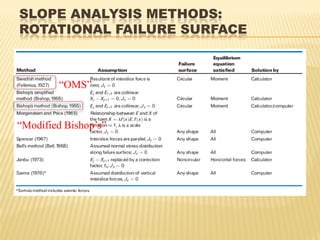
SLOPE ANALYSIS METHODS:
ROTATIONAL FAILURE SURFACE
“OMS”
“Modified Bishop’s”
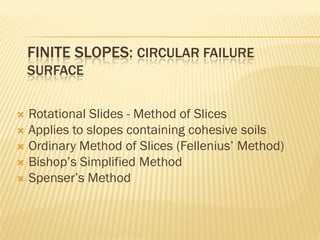
FINITE SLOPES: CIRCULAR FAILURE
SURFACE
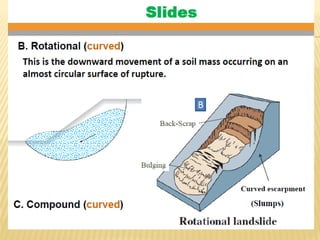
 Rotational Slides - Method of Slices
 Applies to slopes containing cohesive soils
 Ordinary Method of Slices (Fellenius’ Method)
 Bishop’s Simplified Method
 Spenser’s Method
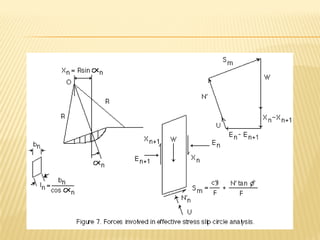
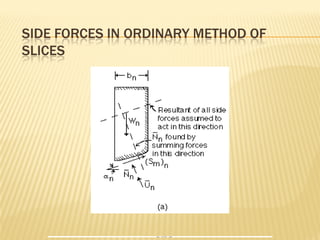
ORDINARY METHOD OF SLICES
 Assumes that resultant of side forces on each
slice are collinear and act parallel to failure
surface and therefore cancel each other
 F = Σ[cn ln + (Wn cosαn - un ln) tanφn] / ΣWn sinαn
 Undrained analysis: F = Σ[cn ln] / ΣWn sinαn
SIDE FORCES IN ORDINARY METHOD OF
SLICES
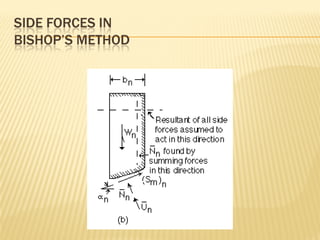
BISHOP’S SIMPLIFIED METHOD
 Assumes that resultant of side forces on each slice
act in horizontal direction and therefore vertical
side force components cancel each other
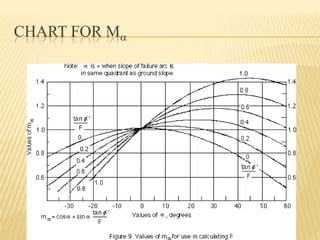
 F = Σ[cn bn + (Wn - un bn) tanφn](1/mα) / ΣWn sinαn
 mα = cosαn + (sinαn tanαn)/F
 Undrained analysis: F = Σ[cn ln] / ΣWn sinαn
CHART FOR Mα
SIDE FORCES IN
BISHOP’S METHOD
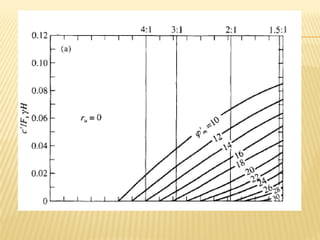
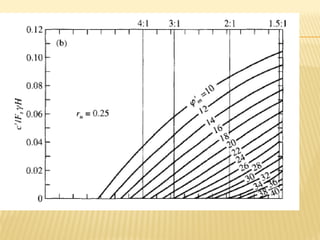
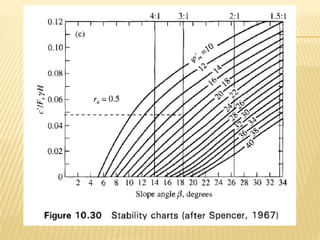
SPENCER’S METHOD
 Assumes that the point of application of
resultant of side forces on each slice is at mid-
height of each slice but no assumption is made
regarding inclination of resultants; inclination is
determined as part of the solution
 This method is more exact than Bishop’s
FINITE SLOPES: NONCIRCULAR FAILURE
SURFACE
 Wedge Method
 Janbu’s Simplified Method
 Morgenstern-Bishop Method
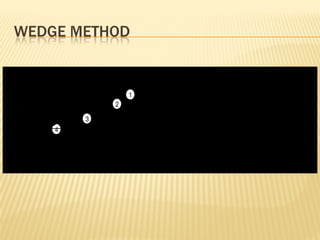
WEDGE METHOD
 Failure surface consists of two or more planes
and applicable to slope containing several
planes of interfaces and weak layers
 Force equilibrium is satisfied
 Assumes that resultant of side forces on each
slice either acts horizontally or at varying
angles from horizontal (typically up to 15o)
WEDGE METHOD
Layer B
Layer A
4
3
2
1
φm
θ
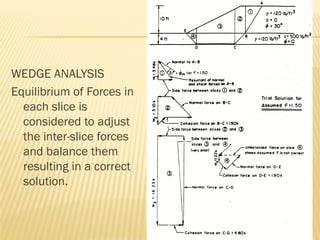
WEDGE ANALYSIS
Equilibrium of Forces in
each slice is
considered to adjust
the inter-slice forces
and balance them
resulting in a correct
solution.
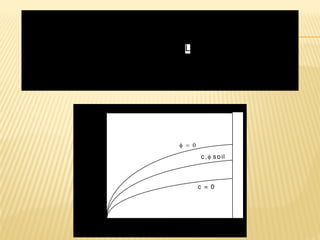
JANBU’S SIMPLIFIED METHOD
 A method of slices applicable to circular and
noncircular failure surfaces
 F = fo Σ{[cn bn + (Wn - un bn) tanφn](1/ cosαnmα)}

/ ΣWn tanαn
 fo is a correction factor that varies with depth to
length ratio of sliding mass and type of soil
(φ = 0, c, φ or c = 0)
Fa cto r, f
o
R a tio, d /L
φ = 0
c, φ so il
c = 0
L
d
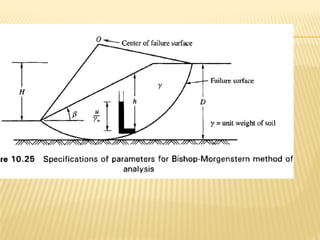
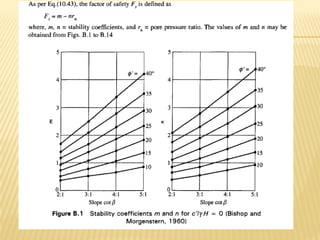
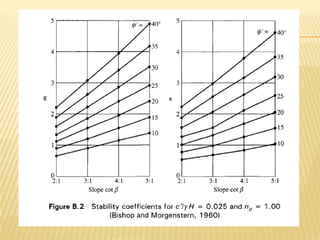
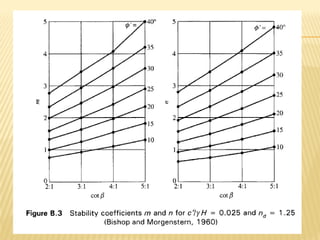
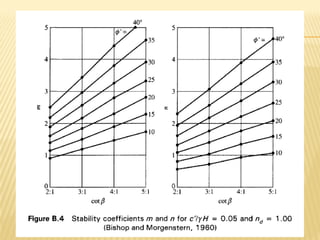
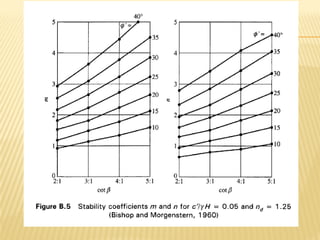
MORGENSTERN-BISHOP METHOD
 No assumption is made regarding inclination or
point of application of resultants and these are
determined as part of the solution
 Requires computers for solving the basic
equation
 Exact but not practical
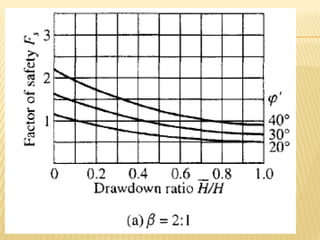
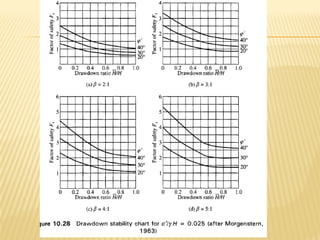
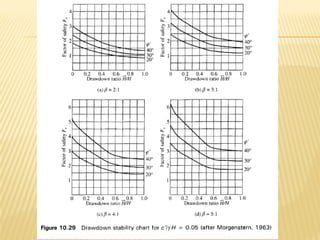
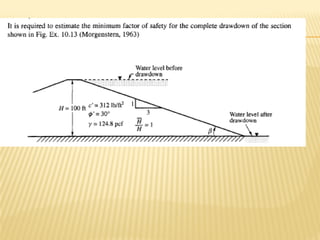
MORGENSTERN RAPID DRAWN CONDITION
GEOSYENTHITICS
slope stability geotechnical engineering.pdf

slope stability geotechnical engineering.pdf

  • 1.
    ANALYSIS OF SLOPES,EARTH RETAINING STRUCTURES AND UNDERGROUND STRUCTURES CENG 6208 ARGAW.A (PHD)
  • 36.
  • 37.
  • 38.
  • 39.
  • 52.
    FINITE SLOPES: PLANEFAILURE SURFACE  Translational Block Slides along single plane of weakness or geological interface  F = c’L + (W cosθ − uL) tanφ’ / W sinθ + Fw
  • 53.
  • 54.
    Limit Equilibrium: 1)Assume some circular (or other shape) failu 2) Calculate driving forces (moment about O) 3) Calculate resisting forces (moment about O BASIC ANALYSIS APPROACH FOR ROTATIONAL FAILURE SURFACE Issues: • Where is the center of mass? • How does resistance vary along surface? • How does normal stress vary along surface? • Water table and seepage forces? • Soil layering? • More complex geometry?
  • 55.
    METHOD OF SLICES(GENERAL) • Assume some failure surface • Discretize failure surface into smaller elements (slices) • Bottom of each slice passes through one type of material • Curved bottom of each slice approximated as chord • More slices = more refined solution • 10-40 slices typically sufficient (less for hand solutions) • Calculate factor of safety for each slice (strength/stress) and overall factor of safety • Find lowest FS for different failure surfaces Side forces make the problem statically indeterminant
  • 56.
    SLOPE ANALYSIS METHODS: ROTATIONALFAILURE SURFACE “OMS” “Modified Bishop’s”
  • 57.
    FINITE SLOPES: CIRCULARFAILURE SURFACE  Rotational Slides - Method of Slices  Applies to slopes containing cohesive soils  Ordinary Method of Slices (Fellenius’ Method)  Bishop’s Simplified Method  Spenser’s Method
  • 61.
    ORDINARY METHOD OFSLICES  Assumes that resultant of side forces on each slice are collinear and act parallel to failure surface and therefore cancel each other  F = Σ[cn ln + (Wn cosαn - un ln) tanφn] / ΣWn sinαn  Undrained analysis: F = Σ[cn ln] / ΣWn sinαn
  • 62.
    SIDE FORCES INORDINARY METHOD OF SLICES
  • 63.
    BISHOP’S SIMPLIFIED METHOD Assumes that resultant of side forces on each slice act in horizontal direction and therefore vertical side force components cancel each other  F = Σ[cn bn + (Wn - un bn) tanφn](1/mα) / ΣWn sinαn  mα = cosαn + (sinαn tanαn)/F  Undrained analysis: F = Σ[cn ln] / ΣWn sinαn
  • 64.
  • 65.
  • 66.
    SPENCER’S METHOD  Assumesthat the point of application of resultant of side forces on each slice is at mid- height of each slice but no assumption is made regarding inclination of resultants; inclination is determined as part of the solution  This method is more exact than Bishop’s
  • 70.
    FINITE SLOPES: NONCIRCULARFAILURE SURFACE  Wedge Method  Janbu’s Simplified Method  Morgenstern-Bishop Method
  • 71.
    WEDGE METHOD  Failuresurface consists of two or more planes and applicable to slope containing several planes of interfaces and weak layers  Force equilibrium is satisfied  Assumes that resultant of side forces on each slice either acts horizontally or at varying angles from horizontal (typically up to 15o)
  • 72.
  • 73.
    WEDGE ANALYSIS Equilibrium ofForces in each slice is considered to adjust the inter-slice forces and balance them resulting in a correct solution.
  • 74.
    JANBU’S SIMPLIFIED METHOD A method of slices applicable to circular and noncircular failure surfaces  F = fo Σ{[cn bn + (Wn - un bn) tanφn](1/ cosαnmα)} / ΣWn tanαn  fo is a correction factor that varies with depth to length ratio of sliding mass and type of soil (φ = 0, c, φ or c = 0)
  • 75.
    Fa cto r,f o R a tio, d /L φ = 0 c, φ so il c = 0 L d
  • 76.
    MORGENSTERN-BISHOP METHOD  Noassumption is made regarding inclination or point of application of resultants and these are determined as part of the solution  Requires computers for solving the basic equation  Exact but not practical
  • 83.
  • 88.