Variable Structure Control
• Variable structure control (VSC) is a form
of discontinuous nonlinear control.
• The method alters the dynamics of
a nonlinear system by application of a high-
frequency switching control.
• The state-feedback control law
is not a continuous function of time.
Variable Structure Control –
Constituent Systems
Mode 1
Mode 2
1x a x 
2
2 10
x a x
a a
 
 
Piecing together
Properties of VSC
►Both constituent systems were oscillatory
and were not asymptotically stable.
►‘Combined’ system is asymptotically stable.
►Property not present in any of the constituent
system is obtained by VSC
Another Example – Unstable
Constituent Systems
0x x x   0x x x   
Analysis
►Both systems are unstable
►Only stable mode is one mode of system
►IF the following VSC is employed
2
0,
2 4
x x x
 
        
0
, * , *
0
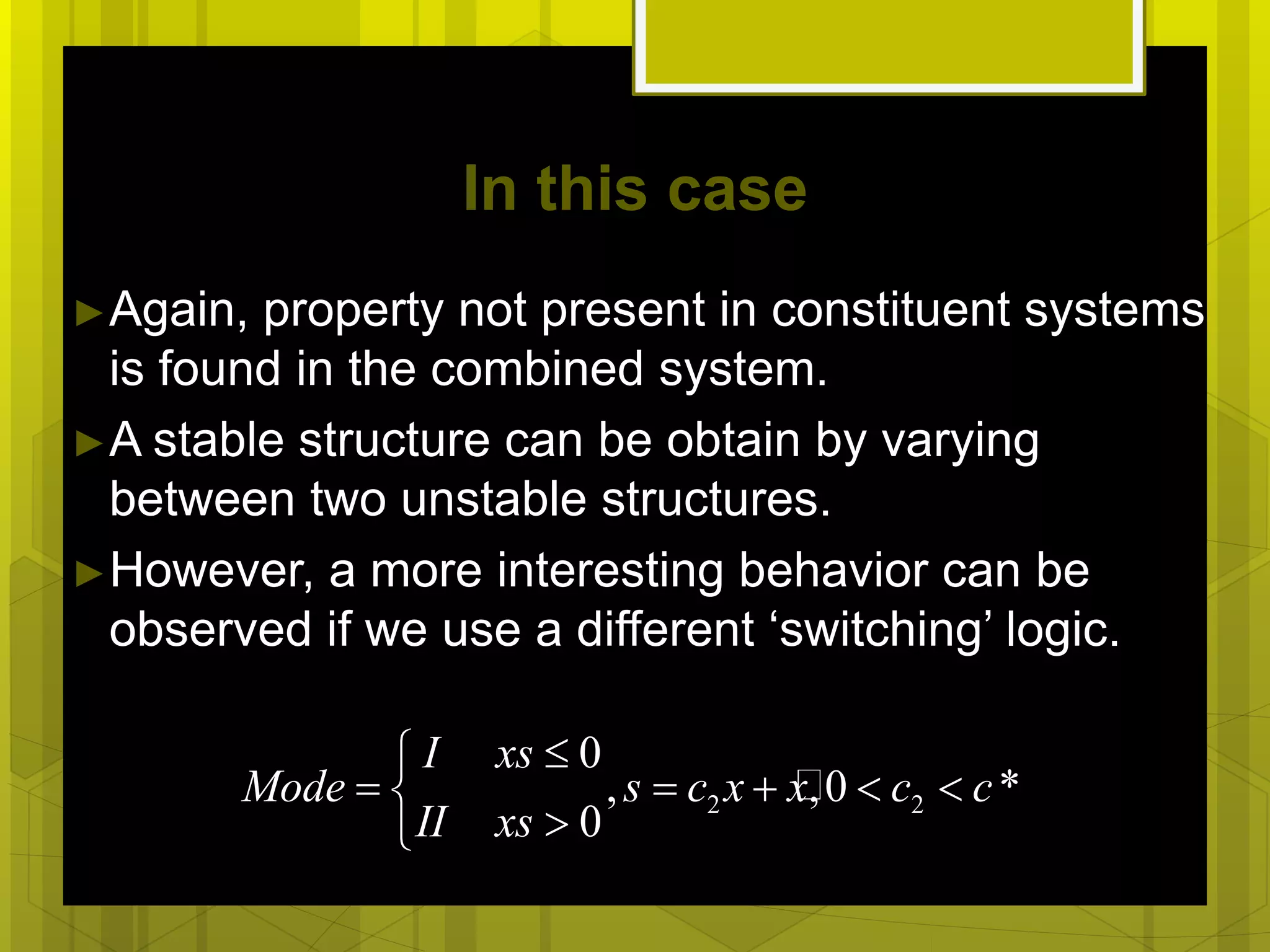
I xs
Mode s c x x c
II xs


    

Combined
In this case
►Again, property not present in constituent systems
is found in the combined system.
►A stable structure can be obtain by varying
between two unstable structures.
►However, a more interesting behavior can be
observed if we use a different ‘switching’ logic.
2 2
0
, ,0 *
0
I xs
Mode s c x x c c
II xs

    

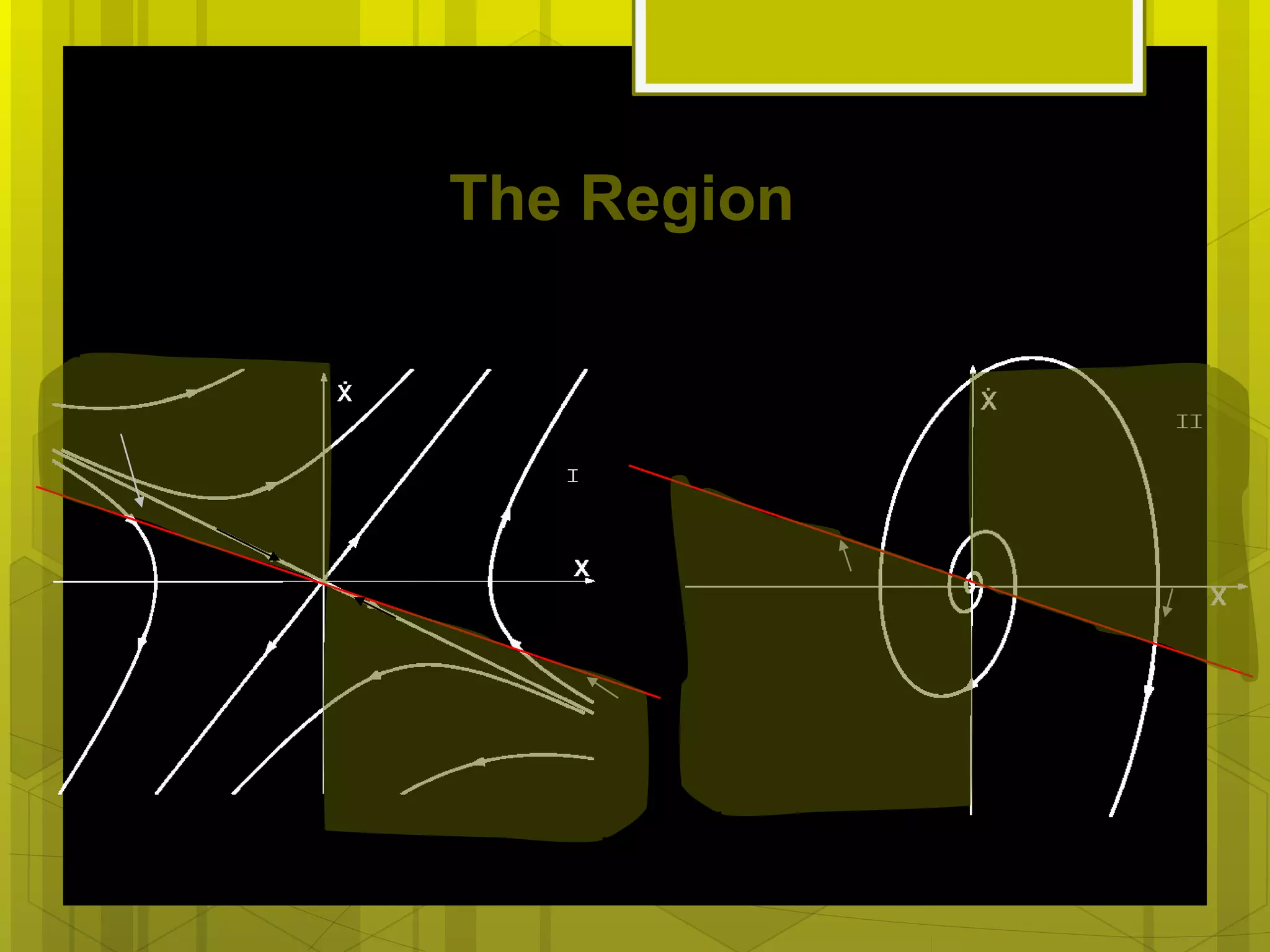
The Region
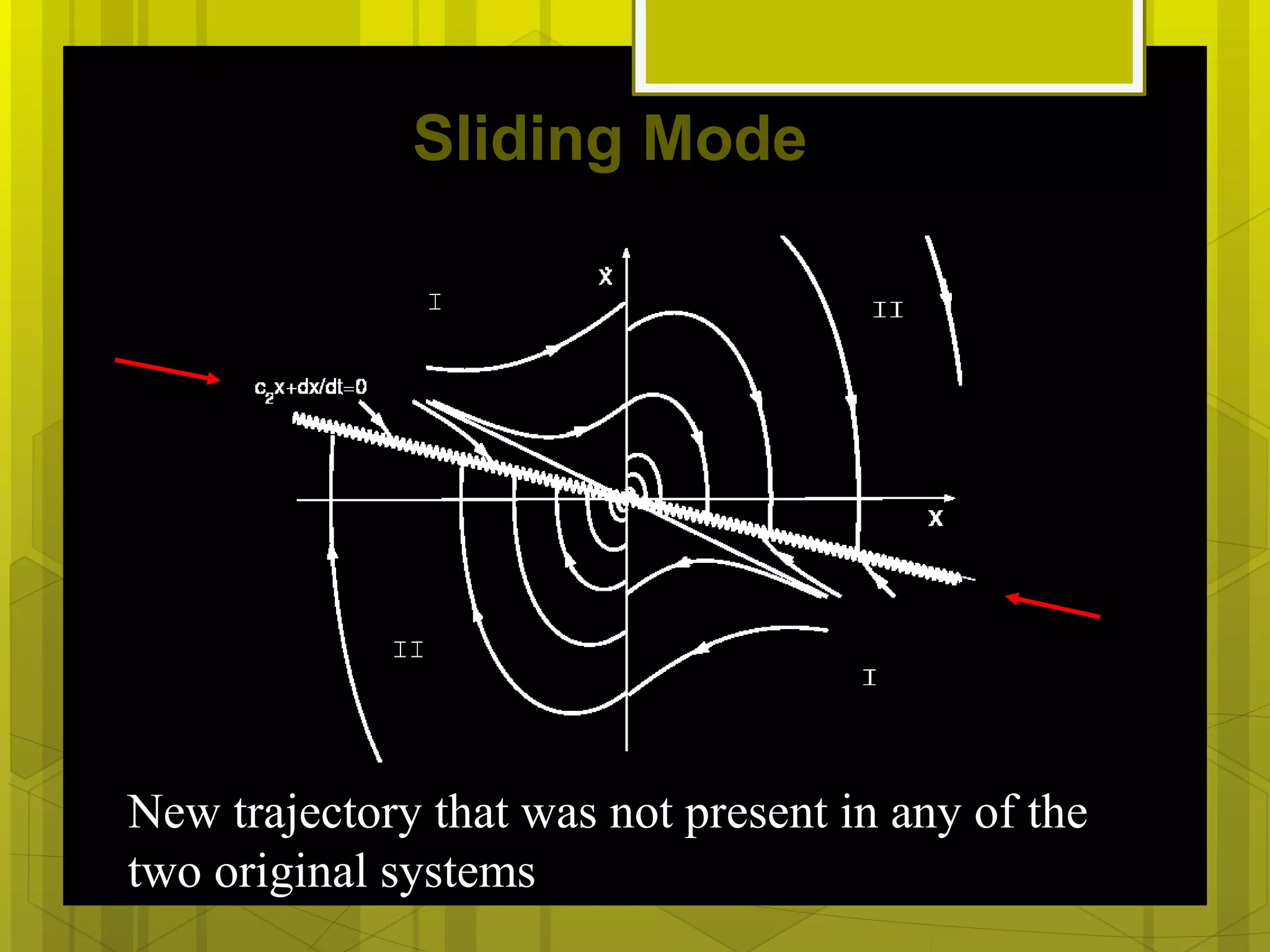
Sliding Mode
New trajectory that was not present in any of the
two original systems
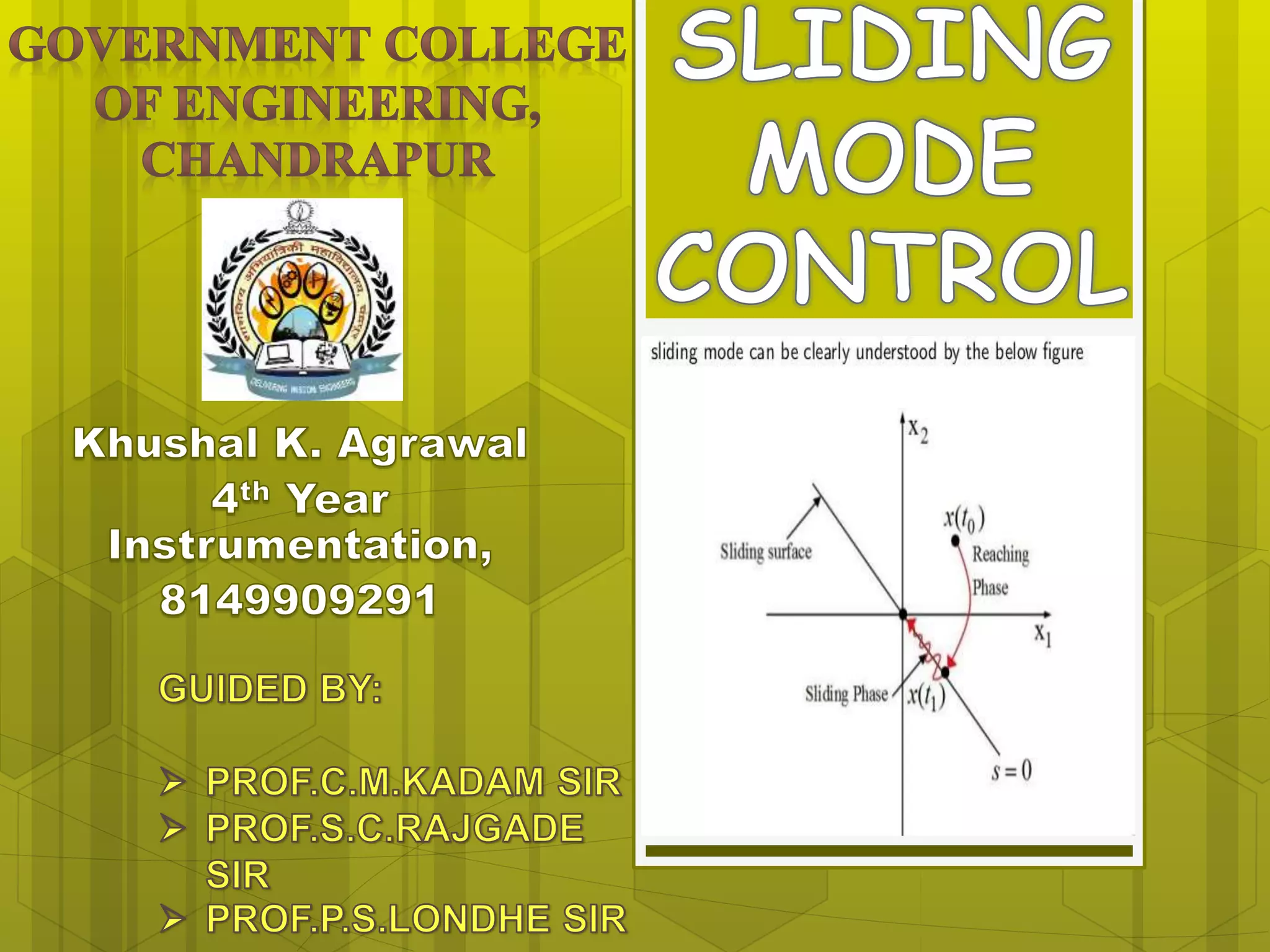
Sliding mode?
►Defined : Motion of the system trajectory along a
‘chosen’ line/plane/surface of the state space.
►Sliding Mode Control : Control designed with the
aim to achieve sliding mode.
 Is usually of VSC type
Eg : Previous problem can be perceived as
0
sgn( )
x x u
u xs x


  
 
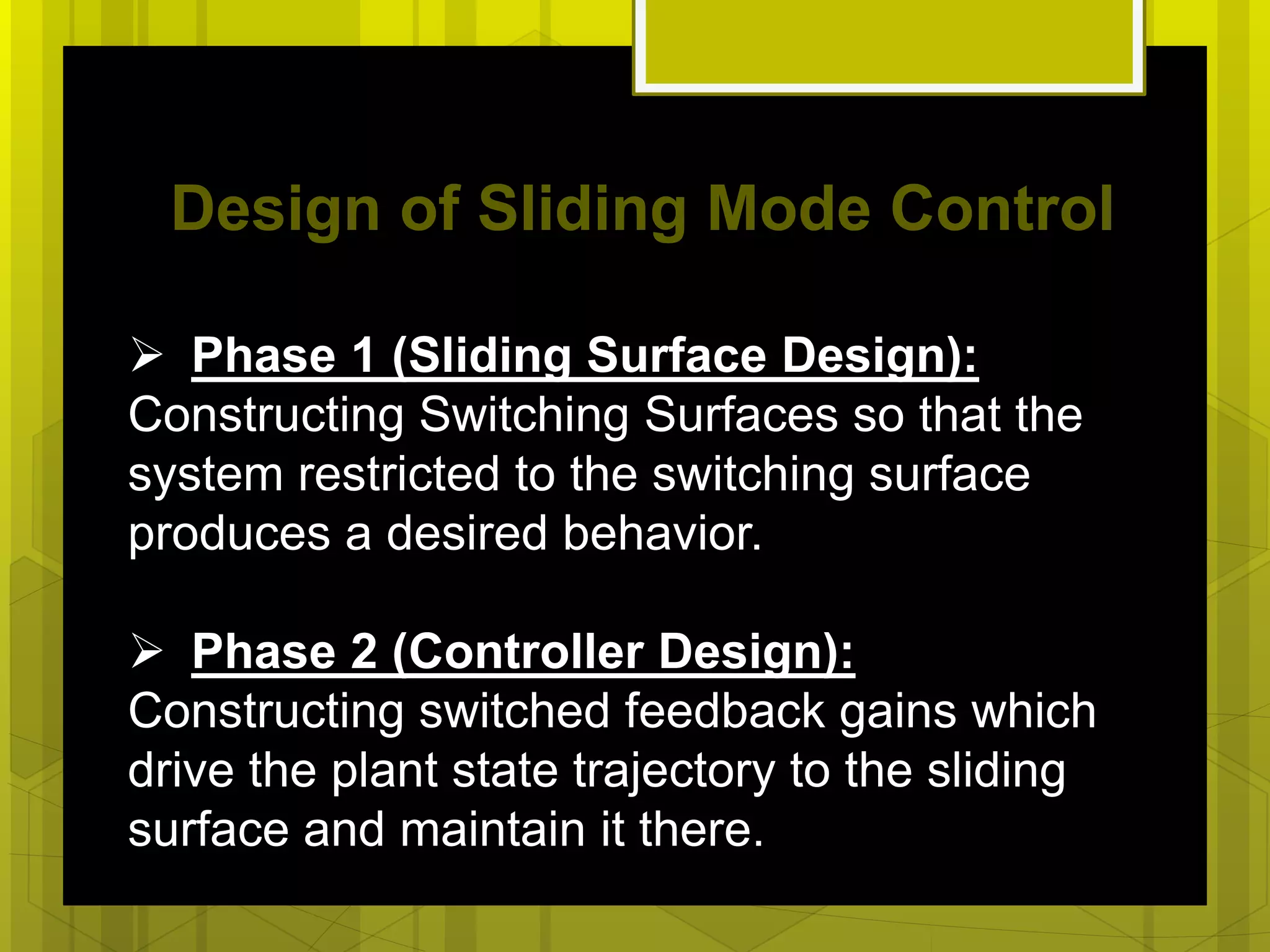
Design of Sliding Mode Control
 Phase 1 (Sliding Surface Design):
Constructing Switching Surfaces so that the
system restricted to the switching surface
produces a desired behavior.
 Phase 2 (Controller Design):
Constructing switched feedback gains which
drive the plant state trajectory to the sliding
surface and maintain it there.
Advantage of SMC
Robustness
Nonlinear Structures
Uses information about input as well as output
feedback in control determination.
It is an open-closed-loop type control.
Improve performance based on computed torque
Insensitive to the uncertainties variation
Required Property
►For sliding mode to be of any use, it should have
the following properties
System stability confined to sliding surface
(unstable sliding mode is NOT sliding mode at
all)
Sliding mode should not take ‘forever’ to start
Disadvantages:
Very large control effort
The Chattering Problem
►When, s is very close to zero, the control signal
switches between two structures.
►Theoretically, the switching causes zero
magnitude oscillations with infinite frequency in x.
►Practically, actuators cannot switch at infinite
frequency. So we have high frequency oscillations
of non-zero magnitude.
►This undesirable phenomenon is called chattering.
Response
Ideal Sliding Mode
Practical – With
Chattering
Why is chattering undesirable?
►The ‘high frequency’ of chattering actuates un-
modeled high frequency dynamics of the system.
Controller performance deteriorates.
►More seriously, high frequency oscillations can
cause mechanical wear in the system.
Chattering Avoidance/Reduction
►The chattering problem is because signum
function is used in control.
Control changes very abruptly near s=0.
Actuator tries to cope up leading to ‘maximum-
possible-frequency’ oscillations.
►Solution :
Replace signum term in control by ‘smoother’
choices’
Disadvantage of ‘smoothing’
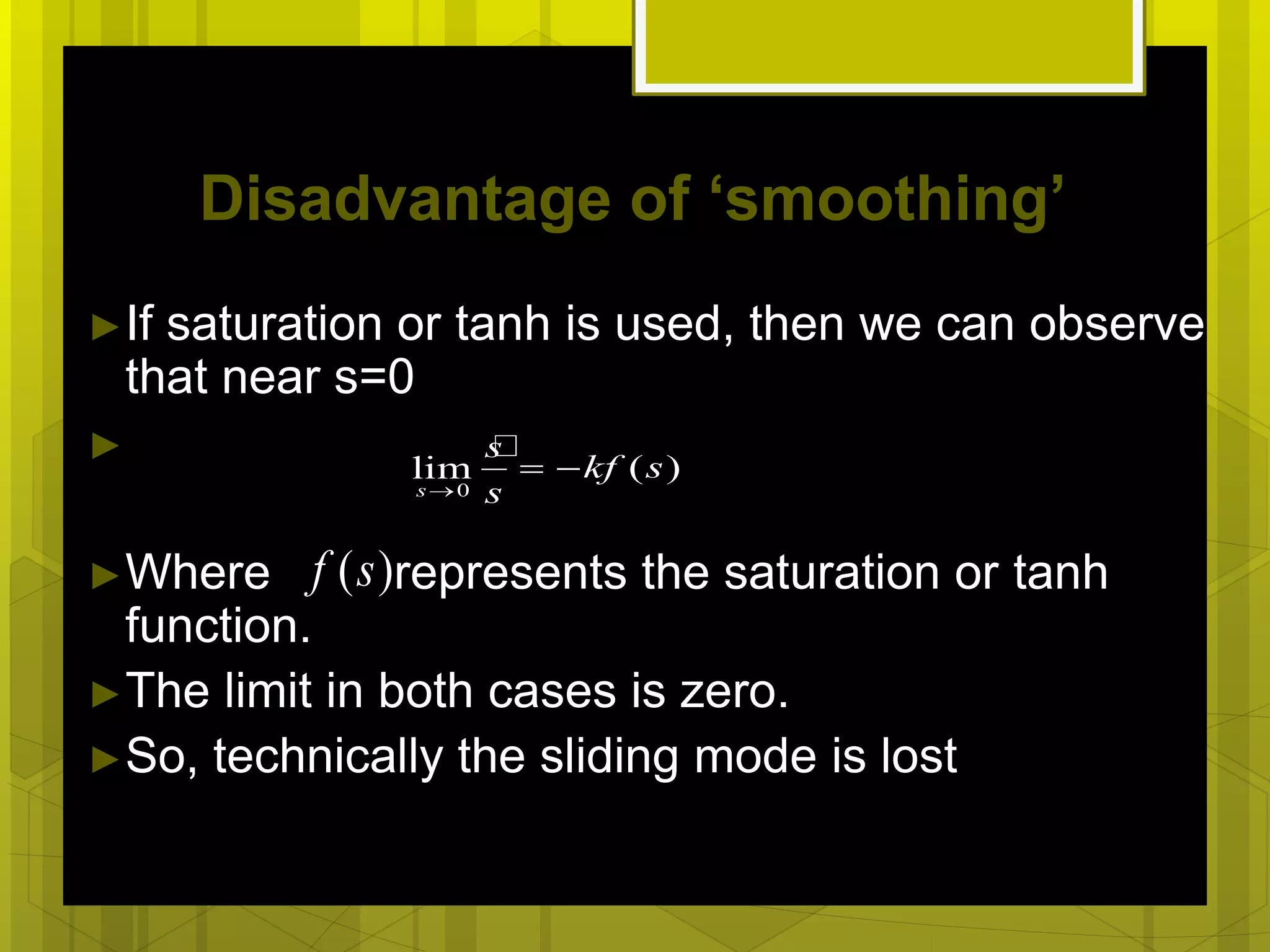
►If saturation or tanh is used, then we can observe
that near s=0
►
►Where represents the saturation or tanh
function.
►The limit in both cases is zero.
►So, technically the sliding mode is lost
0
( )lim
s
s
kf s
s
 
( )f s
QUESTIONS
Sliding mode control

Sliding mode control

  • 2.
    Variable Structure Control •Variable structure control (VSC) is a form of discontinuous nonlinear control. • The method alters the dynamics of a nonlinear system by application of a high- frequency switching control. • The state-feedback control law is not a continuous function of time.
  • 3.
    Variable Structure Control– Constituent Systems Mode 1 Mode 2 1x a x  2 2 10 x a x a a    
  • 4.
  • 5.
    Properties of VSC ►Bothconstituent systems were oscillatory and were not asymptotically stable. ►‘Combined’ system is asymptotically stable. ►Property not present in any of the constituent system is obtained by VSC
  • 6.
    Another Example –Unstable Constituent Systems 0x x x   0x x x   
  • 7.
    Analysis ►Both systems areunstable ►Only stable mode is one mode of system ►IF the following VSC is employed 2 0, 2 4 x x x            0 , * , * 0 I xs Mode s c x x c II xs        
  • 8.
  • 9.
    In this case ►Again,property not present in constituent systems is found in the combined system. ►A stable structure can be obtain by varying between two unstable structures. ►However, a more interesting behavior can be observed if we use a different ‘switching’ logic. 2 2 0 , ,0 * 0 I xs Mode s c x x c c II xs       
  • 10.
  • 11.
    Sliding Mode New trajectorythat was not present in any of the two original systems
  • 12.
    Sliding mode? ►Defined :Motion of the system trajectory along a ‘chosen’ line/plane/surface of the state space. ►Sliding Mode Control : Control designed with the aim to achieve sliding mode.  Is usually of VSC type Eg : Previous problem can be perceived as 0 sgn( ) x x u u xs x       
  • 13.
    Design of SlidingMode Control  Phase 1 (Sliding Surface Design): Constructing Switching Surfaces so that the system restricted to the switching surface produces a desired behavior.  Phase 2 (Controller Design): Constructing switched feedback gains which drive the plant state trajectory to the sliding surface and maintain it there.
  • 14.
    Advantage of SMC Robustness NonlinearStructures Uses information about input as well as output feedback in control determination. It is an open-closed-loop type control. Improve performance based on computed torque Insensitive to the uncertainties variation
  • 15.
    Required Property ►For slidingmode to be of any use, it should have the following properties System stability confined to sliding surface (unstable sliding mode is NOT sliding mode at all) Sliding mode should not take ‘forever’ to start Disadvantages: Very large control effort
  • 16.
    The Chattering Problem ►When,s is very close to zero, the control signal switches between two structures. ►Theoretically, the switching causes zero magnitude oscillations with infinite frequency in x. ►Practically, actuators cannot switch at infinite frequency. So we have high frequency oscillations of non-zero magnitude. ►This undesirable phenomenon is called chattering.
  • 17.
  • 18.
    Why is chatteringundesirable? ►The ‘high frequency’ of chattering actuates un- modeled high frequency dynamics of the system. Controller performance deteriorates. ►More seriously, high frequency oscillations can cause mechanical wear in the system.
  • 19.
    Chattering Avoidance/Reduction ►The chatteringproblem is because signum function is used in control. Control changes very abruptly near s=0. Actuator tries to cope up leading to ‘maximum- possible-frequency’ oscillations. ►Solution : Replace signum term in control by ‘smoother’ choices’
  • 20.
    Disadvantage of ‘smoothing’ ►Ifsaturation or tanh is used, then we can observe that near s=0 ► ►Where represents the saturation or tanh function. ►The limit in both cases is zero. ►So, technically the sliding mode is lost 0 ( )lim s s kf s s   ( )f s
  • 21.