Publishing Simon French [email_address]
Why publish? There are a host of reasons
The good … To share ideas To share results and data To join debate To shape and advance Science Practice To change the World
The bad … To get a job So you publish before the ideas or results are fully ready To get a PhD Puts peer review into the role of examiner To set up a grant application Because you want to go to  that  conference Because you have been told to
The ugly … To keep a job Publication targets To meet research assessment requirements [Depends on country]
Types of Publication Academic or Professional  Peer-reviewed or not Journal or conference Paper or electronic Invited or submitted Book or paper Thesis e -Science
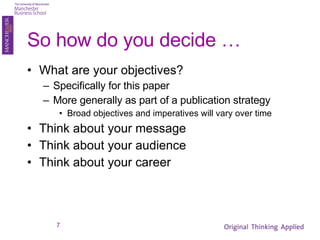
So how do you decide … What are your objectives? Specifically for this paper More generally as part of a publication strategy Broad objectives and imperatives will vary over time Think about your message Think about your audience Think about your career
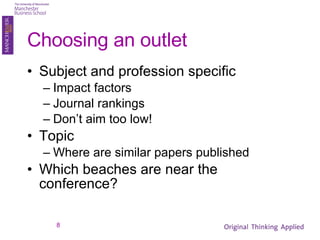
Choosing an outlet Subject and profession specific Impact factors Journal rankings Don’t aim too low! Topic Where are similar papers published Which beaches are near the conference?
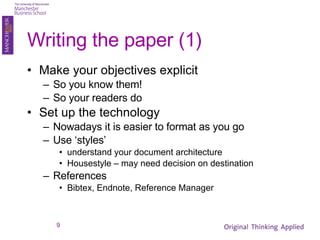
Writing the paper (1) Make your objectives explicit So you know them! So your readers do Set up the technology Nowadays it is easier to format as you go Use ‘styles’ understand your document architecture Housestyle – may need decision on destination References Bibtex, Endnote, Reference Manager
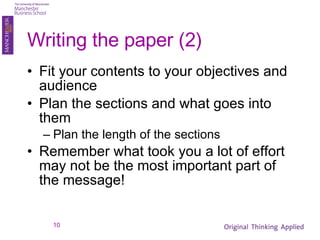
Writing the paper (2) Fit your contents to your objectives and audience Plan the sections and what goes into them Plan the length of the sections Remember what took you a lot of effort may not be the most important part of the message!
Writing the paper (3) Find your style You should be comfortable with it So should your audience But you will need to tailor it to the style of the journal/conference/whatever As you write, seek critical comment from colleagues/supervisors
Publication strategy You need one!!! For the project For you Balance is everything
Refereeing – the other side Peer Review The basis of good science Open    double blind Skim the paper and decide roughly what you think If you recommend accept Provide reasons to accept Provide detailed constructive criticism If you recommend rejection Provide key reasons to reject But consider how much effort to put into very detailed criticism If you are not sure Say so!!! Explain your reasons Be detailed in your comments In all cases, remember it might be your paper!!! And keep to deadlines

Slides_on_Publishing_Simon_French

  • 1.
    Publishing Simon French[email_address]
  • 2.
    Why publish? Thereare a host of reasons
  • 3.
    The good …To share ideas To share results and data To join debate To shape and advance Science Practice To change the World
  • 4.
    The bad …To get a job So you publish before the ideas or results are fully ready To get a PhD Puts peer review into the role of examiner To set up a grant application Because you want to go to that conference Because you have been told to
  • 5.
    The ugly …To keep a job Publication targets To meet research assessment requirements [Depends on country]
  • 6.
    Types of PublicationAcademic or Professional Peer-reviewed or not Journal or conference Paper or electronic Invited or submitted Book or paper Thesis e -Science
  • 7.
    So how doyou decide … What are your objectives? Specifically for this paper More generally as part of a publication strategy Broad objectives and imperatives will vary over time Think about your message Think about your audience Think about your career
  • 8.
    Choosing an outletSubject and profession specific Impact factors Journal rankings Don’t aim too low! Topic Where are similar papers published Which beaches are near the conference?
  • 9.
    Writing the paper(1) Make your objectives explicit So you know them! So your readers do Set up the technology Nowadays it is easier to format as you go Use ‘styles’ understand your document architecture Housestyle – may need decision on destination References Bibtex, Endnote, Reference Manager
  • 10.
    Writing the paper(2) Fit your contents to your objectives and audience Plan the sections and what goes into them Plan the length of the sections Remember what took you a lot of effort may not be the most important part of the message!
  • 11.
    Writing the paper(3) Find your style You should be comfortable with it So should your audience But you will need to tailor it to the style of the journal/conference/whatever As you write, seek critical comment from colleagues/supervisors
  • 12.
    Publication strategy Youneed one!!! For the project For you Balance is everything
  • 13.
    Refereeing – theother side Peer Review The basis of good science Open  double blind Skim the paper and decide roughly what you think If you recommend accept Provide reasons to accept Provide detailed constructive criticism If you recommend rejection Provide key reasons to reject But consider how much effort to put into very detailed criticism If you are not sure Say so!!! Explain your reasons Be detailed in your comments In all cases, remember it might be your paper!!! And keep to deadlines