Tools for writing Review Article
Monday, October 4, 2021 1
Instructor Name: Dr. Princy Randhawa
Department of Mechatronics Engg.
Manipal University Jaipur
Monday, October 4, 2021 2
Before you start writing
Read the journal aim and scope an make sure it matches with
your research field
Check journal metrics to understand the impact of journal
 Cite-score Metrics
 SJR- Scientific Journal Ranking
 SNIP- Source Normalised impact per paper
 JIF- Journal Impact Factor
Monday, October 4, 2021 3
Types of Articles
Original Research/Research Article
Letters/short Reports
Review Articles/ Survey
Methodologies/Methods
Tutorials
Book Chapters
Case Studies
Monday, October 4, 2021 4
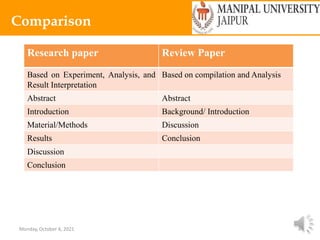
Comparison
Research paper Review Paper
Based on Experiment, Analysis, and
Result Interpretation
Based on compilation and Analysis
Abstract Abstract
Introduction Background/ Introduction
Material/Methods Discussion
Results Conclusion
Discussion
Conclusion
Monday, October 4, 2021 5
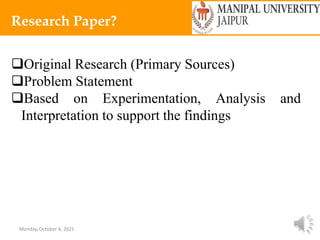
Research Paper?
Original Research (Primary Sources)
Problem Statement
Based on Experimentation, Analysis and
Interpretation to support the findings
Monday, October 4, 2021 6
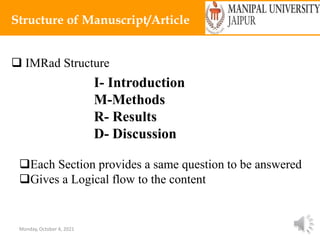
Structure of Manuscript/Article
 IMRad Structure
I- Introduction
M-Methods
R- Results
D- Discussion
Each Section provides a same question to be answered
Gives a Logical flow to the content
Monday, October 4, 2021 7
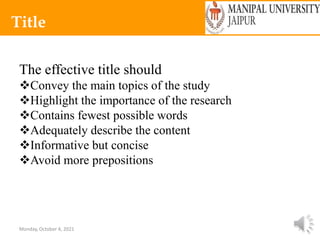
Title
The effective title should
Convey the main topics of the study
Highlight the importance of the research
Contains fewest possible words
Adequately describe the content
Informative but concise
Avoid more prepositions
Monday, October 4, 2021 8
Abstract
Gateway to the manuscript
Summarise the problem, method, results and conclusion
in a Single paragraph
Make it interesting and understandable
Keep it brief as possible
A clear abstract will keep peer reviewers and readers to
assess the content of the manuscript
150-200 Words
It should mention
Purpose/Design/Methodology/approach/Findings and its
meaning
Monday, October 4, 2021 9
Keywords
Tools to help indexers to search engines to search relevant topics
Tips for choosing appropriate keywords
 Include your techniques and or specific methodology (to get more citations)
 Focus on the main topic of your research
 Avoid keywords that are normally one word
 Avoid overlapping keywords in title and keyword list
 Follow journal guidelines when selecting keywords
Monday, October 4, 2021 10
Introduction
 Do not write Literature Review in the introduction
 Tell the readers the purpose of your study
 At the end of your introduction include a clear and exact stamen
of your motivation
 Also, explain in a sentence or two about how you conducted the
study
Monday, October 4, 2021 11
Methods/study Design/ Experimental
Setup/Materials and Methods
 Materials
 Procedures
 Methods used to measure the results
 Methods used for data analysis
 Equipment's used in the experiments
Tips for writing effective Method Section
 Use subheadings to separate different methodologies
 Avoid present tense, use past perfect tense
 Avoid active voice, use passive voice
 Describe new methods in enough detail
 Describe established methods briefly
 Identify the equipment's and material used
Monday, October 4, 2021 12
Results
Use subheadings to separate the results of different
experiments
Results should be present in logical order
Use the past tense to describe the results
Refer to figures and Tables in the present tense
Include the results of statistical analysis in the text
Highlight the main findings
Monday, October 4, 2021 13
Discussion
Discuss the results in order of most to least important
Compare the results with those of other studies
 Discuss what your results may mean for researchers
Discuss how could your findings be applied
Monday, October 4, 2021 14
Conclusion
State your conclusion in clear and simple way
 Provide justification for the work
Explain how your work advances the present state of
knowledge
Include limitations to your study
Suggest future experiments (increase citations)
Do not re-write the abstract
Do not introduce new arguments, evidence, new ideas
or information unrelated to topic
Do not apologise for doing a poor job of presenting
the material
Monday, October 4, 2021 15
Display Items (Figures/Tables)
A picture is a worth a thousands of words
 Display items should stand alone from the text and communicate
clearly your most significant results.
 Display items are important for attracting readers to your work
 High Quality Display items give your work a professional
appearance.
Monday, October 4, 2021 16
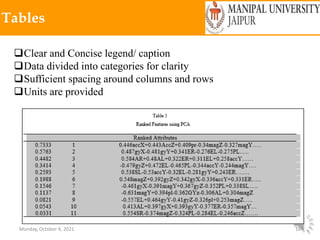
Tables
Clear and Concise legend/ caption
Data divided into categories for clarity
Sufficient spacing around columns and rows
Units are provided
Monday, October 4, 2021 17
Figures
Include Scale bars
Schematic Figures
Data plots
Maps
Units are provided
Monday, October 4, 2021 18
References
Reference Management and Formatting Software Applications
 Zotero
 End Note
 Mendeley
 Refworks
 Redcube
 Qicca
 Paperpile
 JabRef
 Doccear
 Margin Note
Monday, October 4, 2021 19
Research Paper Writing Tool
 MS Word
 Latex
 Dropbox Paper
 Openoffice
 Scrivener
 Google docs
 Libreoffice
Monday, October 4, 2021 20
Review Paper?
Not an Original Research (Secondary Literature)
It gives you a critical analysis of existing published literature in
a field, through summary, analysis, and comparison, often
identifying specific gaps or problems and providing
recommendations for future research.
Narrative- Explanation of exiting knowledge about topic (3000-
5000 words)
Thoughtful-Aim at answering specific questions which require
thought process
Monday, October 4, 2021 21
Benefits of Writing a Review
 More citations and increases scientific score
 Attracts more readers
 Readers need not to research more articles
Monday, October 4, 2021 22
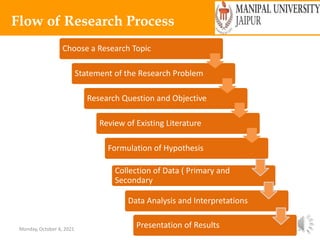
Flow of Research Process
Choose a Research Topic
Statement of the Research Problem
Research Question and Objective
Review of Existing Literature
Formulation of Hypothesis
Collection of Data ( Primary and
Secondary
Data Analysis and Interpretations
Presentation of Results
Monday, October 4, 2021 23
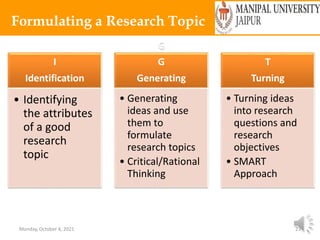
Formulating a Research Topic
I
Identification
• Identifying
the attributes
of a good
research
topic
G
G
Generating
• Generating
ideas and use
them to
formulate
research topics
• Critical/Rational
Thinking
T
Turning
• Turning ideas
into research
questions and
research
objectives
• SMART
Approach
Monday, October 4, 2021 24
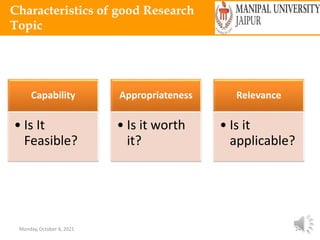
Characteristics of good Research
Topic
Capability
• Is It
Feasible?
Appropriateness
• Is it worth
it?
Relevance
• Is it
applicable?
Monday, October 4, 2021 25
Refining the Research Idea
Use Delphi Technique
Pilot Testing
Continually testing out your ideas
Integrating Ideas
Refining Topics
Monday, October 4, 2021 26
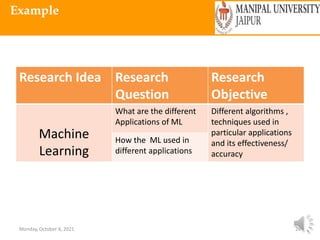
Example
Research Idea Research
Question
Research
Objective
Machine
Learning
What are the different
Applications of ML
Different algorithms ,
techniques used in
particular applications
and its effectiveness/
accuracy
How the ML used in
different applications
Monday, October 4, 2021 27
Types of Review
Critical Review
Literature (Narrative) Review
Systematic Literature Review (SLR)
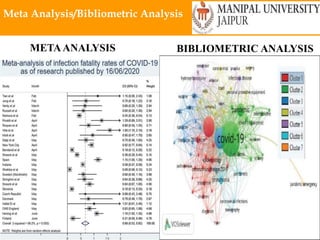
Review Based on Meta-analysis
Bibliometric Review
State of the art Review
Scoping Review
Review of Reviews Umbrella Reviews
Monday, October 4, 2021 28
Meta Analysis/Bibliometric Analysis
METAANALYSIS BIBLIOMETRIC ANALYSIS
Monday, October 4, 2021 29
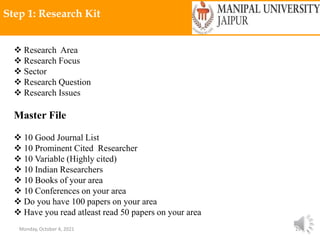
Step 1: Research Kit
 Research Area
 Research Focus
 Sector
 Research Question
 Research Issues
Master File
 10 Good Journal List
 10 Prominent Cited Researcher
 10 Variable (Highly cited)
 10 Indian Researchers
 10 Books of your area
 10 Conferences on your area
 Do you have 100 papers on your area
 Have you read atleast read 50 papers on your area
Monday, October 4, 2021 30
Step 2: Search the Literature/ Academic
databases and Search Engines
 IEEE Xplorer
 SCOPUS
 Springer
 Google scholor
 Mendeley
 PubMed
 Research Gate
 Science Direct
 Web of science
Monday, October 4, 2021 31
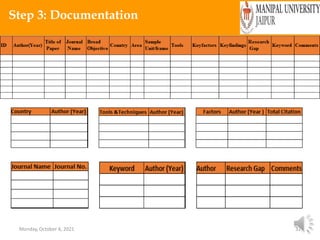
Step 3: Documentation
 List of Papers
 List of Citations
 List of Books
 List of Journals
 List of Keywords
 List of Indian Authors and Foreign Authors
 List of Conferences
 List of Institution for similar work
 List of project and Funding agency
Monday, October 4, 2021 32
Step 3: Documentation
Monday, October 4, 2021 33
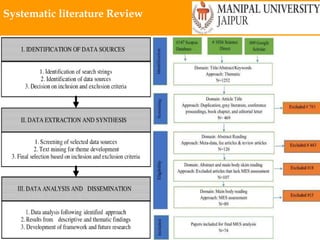
Systematic literature Review
Monday, October 4, 2021 34
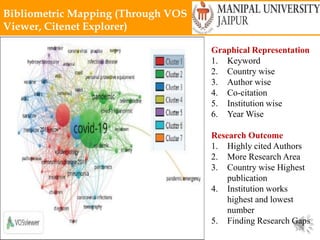
Bibliometric Mapping (Through VOS
Viewer, Citenet Explorer)
Graphical Representation
1. Keyword
2. Country wise
3. Author wise
4. Co-citation
5. Institution wise
6. Year Wise
Research Outcome
1. Highly cited Authors
2. More Research Area
3. Country wise Highest
publication
4. Institution works
highest and lowest
number
5. Finding Research Gaps
Monday, October 4, 2021 35
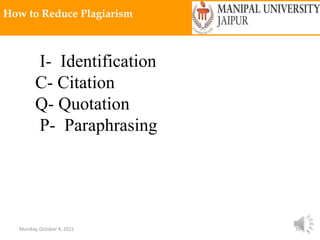
How to Reduce Plagiarism
I- Identification
C- Citation
Q- Quotation
P- Paraphrasing

Tools for writing Review Article

  • 1.
    Tools for writingReview Article Monday, October 4, 2021 1 Instructor Name: Dr. Princy Randhawa Department of Mechatronics Engg. Manipal University Jaipur
  • 2.
    Monday, October 4,2021 2 Before you start writing Read the journal aim and scope an make sure it matches with your research field Check journal metrics to understand the impact of journal  Cite-score Metrics  SJR- Scientific Journal Ranking  SNIP- Source Normalised impact per paper  JIF- Journal Impact Factor
  • 3.
    Monday, October 4,2021 3 Types of Articles Original Research/Research Article Letters/short Reports Review Articles/ Survey Methodologies/Methods Tutorials Book Chapters Case Studies
  • 4.
    Monday, October 4,2021 4 Comparison Research paper Review Paper Based on Experiment, Analysis, and Result Interpretation Based on compilation and Analysis Abstract Abstract Introduction Background/ Introduction Material/Methods Discussion Results Conclusion Discussion Conclusion
  • 5.
    Monday, October 4,2021 5 Research Paper? Original Research (Primary Sources) Problem Statement Based on Experimentation, Analysis and Interpretation to support the findings
  • 6.
    Monday, October 4,2021 6 Structure of Manuscript/Article  IMRad Structure I- Introduction M-Methods R- Results D- Discussion Each Section provides a same question to be answered Gives a Logical flow to the content
  • 7.
    Monday, October 4,2021 7 Title The effective title should Convey the main topics of the study Highlight the importance of the research Contains fewest possible words Adequately describe the content Informative but concise Avoid more prepositions
  • 8.
    Monday, October 4,2021 8 Abstract Gateway to the manuscript Summarise the problem, method, results and conclusion in a Single paragraph Make it interesting and understandable Keep it brief as possible A clear abstract will keep peer reviewers and readers to assess the content of the manuscript 150-200 Words It should mention Purpose/Design/Methodology/approach/Findings and its meaning
  • 9.
    Monday, October 4,2021 9 Keywords Tools to help indexers to search engines to search relevant topics Tips for choosing appropriate keywords  Include your techniques and or specific methodology (to get more citations)  Focus on the main topic of your research  Avoid keywords that are normally one word  Avoid overlapping keywords in title and keyword list  Follow journal guidelines when selecting keywords
  • 10.
    Monday, October 4,2021 10 Introduction  Do not write Literature Review in the introduction  Tell the readers the purpose of your study  At the end of your introduction include a clear and exact stamen of your motivation  Also, explain in a sentence or two about how you conducted the study
  • 11.
    Monday, October 4,2021 11 Methods/study Design/ Experimental Setup/Materials and Methods  Materials  Procedures  Methods used to measure the results  Methods used for data analysis  Equipment's used in the experiments Tips for writing effective Method Section  Use subheadings to separate different methodologies  Avoid present tense, use past perfect tense  Avoid active voice, use passive voice  Describe new methods in enough detail  Describe established methods briefly  Identify the equipment's and material used
  • 12.
    Monday, October 4,2021 12 Results Use subheadings to separate the results of different experiments Results should be present in logical order Use the past tense to describe the results Refer to figures and Tables in the present tense Include the results of statistical analysis in the text Highlight the main findings
  • 13.
    Monday, October 4,2021 13 Discussion Discuss the results in order of most to least important Compare the results with those of other studies  Discuss what your results may mean for researchers Discuss how could your findings be applied
  • 14.
    Monday, October 4,2021 14 Conclusion State your conclusion in clear and simple way  Provide justification for the work Explain how your work advances the present state of knowledge Include limitations to your study Suggest future experiments (increase citations) Do not re-write the abstract Do not introduce new arguments, evidence, new ideas or information unrelated to topic Do not apologise for doing a poor job of presenting the material
  • 15.
    Monday, October 4,2021 15 Display Items (Figures/Tables) A picture is a worth a thousands of words  Display items should stand alone from the text and communicate clearly your most significant results.  Display items are important for attracting readers to your work  High Quality Display items give your work a professional appearance.
  • 16.
    Monday, October 4,2021 16 Tables Clear and Concise legend/ caption Data divided into categories for clarity Sufficient spacing around columns and rows Units are provided
  • 17.
    Monday, October 4,2021 17 Figures Include Scale bars Schematic Figures Data plots Maps Units are provided
  • 18.
    Monday, October 4,2021 18 References Reference Management and Formatting Software Applications  Zotero  End Note  Mendeley  Refworks  Redcube  Qicca  Paperpile  JabRef  Doccear  Margin Note
  • 19.
    Monday, October 4,2021 19 Research Paper Writing Tool  MS Word  Latex  Dropbox Paper  Openoffice  Scrivener  Google docs  Libreoffice
  • 20.
    Monday, October 4,2021 20 Review Paper? Not an Original Research (Secondary Literature) It gives you a critical analysis of existing published literature in a field, through summary, analysis, and comparison, often identifying specific gaps or problems and providing recommendations for future research. Narrative- Explanation of exiting knowledge about topic (3000- 5000 words) Thoughtful-Aim at answering specific questions which require thought process
  • 21.
    Monday, October 4,2021 21 Benefits of Writing a Review  More citations and increases scientific score  Attracts more readers  Readers need not to research more articles
  • 22.
    Monday, October 4,2021 22 Flow of Research Process Choose a Research Topic Statement of the Research Problem Research Question and Objective Review of Existing Literature Formulation of Hypothesis Collection of Data ( Primary and Secondary Data Analysis and Interpretations Presentation of Results
  • 23.
    Monday, October 4,2021 23 Formulating a Research Topic I Identification • Identifying the attributes of a good research topic G G Generating • Generating ideas and use them to formulate research topics • Critical/Rational Thinking T Turning • Turning ideas into research questions and research objectives • SMART Approach
  • 24.
    Monday, October 4,2021 24 Characteristics of good Research Topic Capability • Is It Feasible? Appropriateness • Is it worth it? Relevance • Is it applicable?
  • 25.
    Monday, October 4,2021 25 Refining the Research Idea Use Delphi Technique Pilot Testing Continually testing out your ideas Integrating Ideas Refining Topics
  • 26.
    Monday, October 4,2021 26 Example Research Idea Research Question Research Objective Machine Learning What are the different Applications of ML Different algorithms , techniques used in particular applications and its effectiveness/ accuracy How the ML used in different applications
  • 27.
    Monday, October 4,2021 27 Types of Review Critical Review Literature (Narrative) Review Systematic Literature Review (SLR) Review Based on Meta-analysis Bibliometric Review State of the art Review Scoping Review Review of Reviews Umbrella Reviews
  • 28.
    Monday, October 4,2021 28 Meta Analysis/Bibliometric Analysis METAANALYSIS BIBLIOMETRIC ANALYSIS
  • 29.
    Monday, October 4,2021 29 Step 1: Research Kit  Research Area  Research Focus  Sector  Research Question  Research Issues Master File  10 Good Journal List  10 Prominent Cited Researcher  10 Variable (Highly cited)  10 Indian Researchers  10 Books of your area  10 Conferences on your area  Do you have 100 papers on your area  Have you read atleast read 50 papers on your area
  • 30.
    Monday, October 4,2021 30 Step 2: Search the Literature/ Academic databases and Search Engines  IEEE Xplorer  SCOPUS  Springer  Google scholor  Mendeley  PubMed  Research Gate  Science Direct  Web of science
  • 31.
    Monday, October 4,2021 31 Step 3: Documentation  List of Papers  List of Citations  List of Books  List of Journals  List of Keywords  List of Indian Authors and Foreign Authors  List of Conferences  List of Institution for similar work  List of project and Funding agency
  • 32.
    Monday, October 4,2021 32 Step 3: Documentation
  • 33.
    Monday, October 4,2021 33 Systematic literature Review
  • 34.
    Monday, October 4,2021 34 Bibliometric Mapping (Through VOS Viewer, Citenet Explorer) Graphical Representation 1. Keyword 2. Country wise 3. Author wise 4. Co-citation 5. Institution wise 6. Year Wise Research Outcome 1. Highly cited Authors 2. More Research Area 3. Country wise Highest publication 4. Institution works highest and lowest number 5. Finding Research Gaps
  • 35.
    Monday, October 4,2021 35 How to Reduce Plagiarism I- Identification C- Citation Q- Quotation P- Paraphrasing

Editor's Notes

  • #7 I- what did others do, what did you do M- how did u do R- what did u find D- what does it all mean
  • #20 Scriverner- writing novel, thesis
  • #23 .
  • #29 Upper limit and lower limit control and analysis done by Jamovi software . Objective: check the coorelation , mean value, sample data and calculate those values. Here calculated the diamond value and when it sende cut that line it means that is hihgly cited/contributed paper
  • #34 PRISMA stands for Preferred Reporting Items for Systematic Reviews and Meta-Analyses. The aim of the PRISMA Statement is to help authors improve the reporting of systematic reviews and meta-analyses.
  • #35 Network diagram Dry area, existed area, Citation analysis